



You’ve heard the horror stories about data breaches, leaked customer information, and unsecured payment systems. When you’re planning to launch a white-label UrbanClap-style app, these fears aren’t imaginary—they’re the biggest risks that can make or break your business overnight.
In 2025, safety is no longer a “technical feature.” It is a business survival requirement. Your app will handle highly sensitive data: customer home addresses, service provider IDs, real-time location tracking, chat records, and online payments. One weak security layer can lead to legal action, massive financial loss, and permanent brand damage.
This guide gives you an honest, no-hype assessment of white-label UrbanClap app security—what the real risks are, what standards you must demand, and how to ensure your platform is built on a truly secure foundation. You’ll also see how Miracuves approaches white-label app safety as a security-first solution provider, not just a software vendor.
By the end of this guide, you’ll clearly understand
- What makes a white-label UrbanClap app safe or unsafe
- Which security and compliance standards truly matter in 2025
- How to confidently choose a secure white-label app provider without risking your business
Understanding White-Label UrbanClap App Security Landscape
What “white-label security” actually means
White-label security refers to the protection mechanisms built directly into a ready-made app framework that is customized and branded for your business. Instead of developing security from scratch, your platform relies on the provider’s core architecture for data protection, infrastructure safety, API security, and regulatory compliance. The strength of your app’s security is only as strong as the white-label provider’s engineering and policies.
Current threat landscape for UrbanClap-type platforms
Service marketplace apps face a unique mix of risks:
- Account takeover through weak authentication
- Fake service partner registrations
- Payment fraud and chargebacks
- Location data misuse
- API attacks on booking and pricing systems
In 2024–2025, cybercriminals have increasingly targeted marketplace apps because they combine identity data, financial transactions, and real-world addresses in one system.
Security standards in 2025
By 2025, secure UrbanClap-style apps are expected to follow zero-trust architecture, encrypted APIs, role-based access control, and continuous vulnerability scanning. Manual security is no longer enough. Automated monitoring and real-time threat detection are becoming the industry baseline.
Real-world statistics on app security incidents
Recent industry reports show that over 60% of mobile application breaches now originate from insecure APIs, while nearly 40% of marketplace and booking apps report at least one attempted payment fraud incident per quarter. Data exposure through misconfigured cloud servers remains one of the top causes of large-scale leaks in service platforms.
Key Security Risks & How to Identify Them
High-risk areas in a white-label UrbanClap app
Service marketplace apps handle some of the most sensitive real-world data. The risk is not theoretical—these platforms connect strangers for in-person services and process live payments. Security failures directly impact physical safety, finances, and legal exposure.
1. Data Protection & Privacy Risks
User personal information
Names, phone numbers, home addresses, and service history are prime targets for data theft. A single leak can expose thousands of households.
Payment data security
If card or wallet data is stored improperly, attackers can perform fraudulent transactions or resell financial information.
Location tracking concerns
Real-time location data for both customers and service professionals can be misused for stalking, theft planning, or personal harm if not encrypted and access-restricted.
GDPR/CCPA compliance exposure
Non-compliance can result in heavy penalties, forced shutdowns, and lawsuits. Many low-quality providers ignore consent logs, data deletion rights, and proper disclosure policies.
2. Technical Vulnerabilities
Code quality issues
Poorly written or copied code often contains known vulnerabilities, hard-coded credentials, and insecure functions.
Server security gaps
Open ports, weak firewall rules, and outdated operating systems allow attackers to penetrate cloud infrastructure easily.
API vulnerabilities
Marketplace apps heavily rely on APIs for bookings, pricing, chat, and tracking. Insecure APIs are the most exploited attack surface today.
Third-party integrations
Payment gateways, SMS services, maps, and analytics tools can become entry points if not securely configured and monitored.
3. Business Risks
Legal liability
If customer data is compromised, your business—not the vendor—faces lawsuits and regulatory action.
Reputation damage
Trust is the foundation of any service marketplace. One public breach can permanently destroy user confidence.
Financial losses
Losses arise from fraud, refunds, downtime, and regulatory penalties.
Regulatory penalties
Fines under GDPR can go up to 4% of global revenue. CCPA and local data laws also carry severe penalties.
Risk Assessment Checklist
Use this checklist to evaluate the safety of any white-label UrbanClap app before launch:
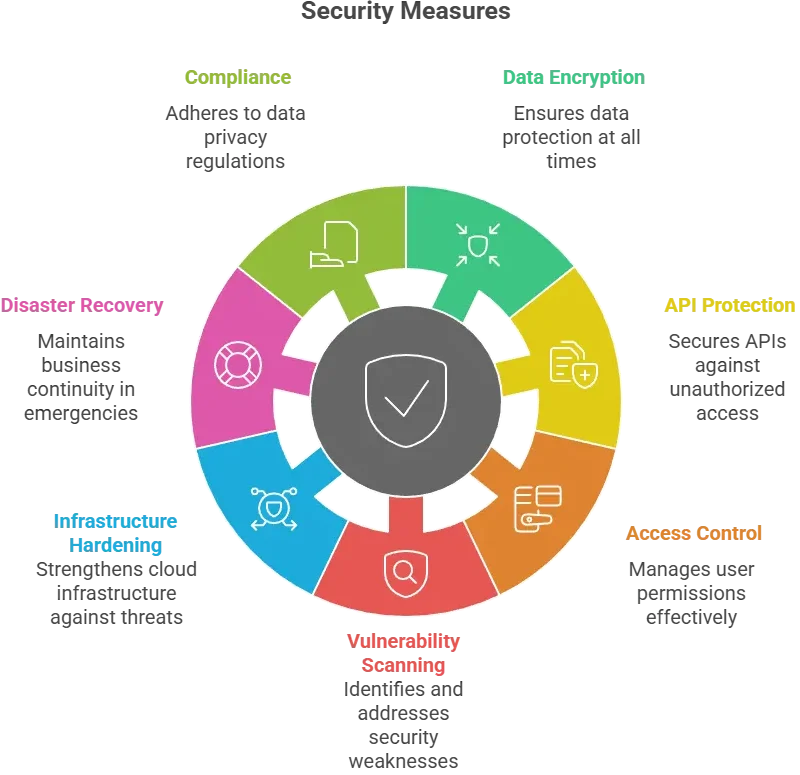
If even one of these checks fails, your platform carries high operational risk.
Read more : – UrbanClap Feature List for Startups Building Service Apps
Security Standards Your White-Label UrbanClap App Must Meet
Essential certifications you must demand from your provider
In 2025, regulatory authorities and enterprise clients no longer accept “assured security” as a claim. They require formal, auditable certifications. A secure white-label UrbanClap app should be built and maintained under the following frameworks:
ISO 27001 compliance
This international standard confirms that the provider follows a structured information security management system covering risk assessment, access control, incident management, and continuous improvement.
SOC 2 Type II
SOC 2 verifies how a provider manages customer data across security, availability, processing integrity, confidentiality, and privacy over a sustained monitoring period—not just a one-time audit.
GDPR compliance
Mandatory for any app serving users in the European Union. Covers consent management, data minimization, right to deletion, breach reporting, and cross-border data transfer controls.
HIPAA (if applicable)
If your UrbanClap-style platform includes healthcare, wellness, or medical services, HIPAA compliance becomes legally critical.
PCI DSS for payments
Any app accepting card payments must follow Payment Card Industry Data Security Standards for secure storage, processing, and transmission of financial data.
Core technical security requirements in 2025
End-to-end encryption
All data—from login credentials to in-app chat and payments—must be encrypted both in transit (TLS 1.3+) and at rest (AES-256 standard).
Secure authentication (2FA / OAuth)
Multi-factor authentication for admins and partners is no longer optional. OAuth-based secure login prevents credential reuse attacks.
Regular security audits
Independent third-party audits must be conducted at least annually to detect architecture-level issues.
Penetration testing
Ethical hackers simulate real-world attacks to identify vulnerabilities before criminals exploit them.
SSL certificates and HTTPS enforcement
Every endpoint must enforce HTTPS with strong cipher suites and HSTS policies.
Secure API design
APIs must use token-based authentication, request validation, rate limiting, and detailed logging to prevent abuse and data scraping.
Security standards comparison table
| Security Standard | Mandatory in 2025 | Applies To | Risk If Missing |
|---|---|---|---|
| ISO 27001 | Yes | Core platform infrastructure | Data breaches, audit failure |
| SOC 2 Type II | Strongly recommended | SaaS operations & data handling | Enterprise client rejection |
| GDPR | Legally required (EU users) | User data privacy | Heavy fines, legal shutdown |
| HIPAA | Conditional | Health & wellness services | Criminal penalties |
| PCI DSS | Mandatory for payments | Payment processing | Card fraud, financial liability |
| SSL/TLS | Mandatory | All app traffic | Man-in-the-middle attacks |
Without these standards, a white-label UrbanClap app cannot be considered enterprise-safe or regulator-ready.
Red Flags – How to Spot Unsafe White-Label Providers
Not every white-label provider follows enterprise security practices. Many focus only on quick deployment and low pricing, leaving critical security gaps that later become your legal and financial burden. Knowing these warning signs early can save your entire business.
Major Warning Signs You Should Never Ignore
No security documentation
If a provider cannot clearly explain how data is encrypted, where it is stored, and how access is controlled, it is a serious risk indicator. A secure provider always maintains written security and compliance documentation.
Unrealistically cheap pricing without explanation
Extremely low prices often mean corners are being cut in infrastructure, audits, and security maintenance. Real security requires continuous investment.
No compliance certifications
If the provider cannot demonstrate ISO 27001, GDPR alignment, or PCI DSS readiness, your app is exposed to regulatory penalties from day one.
Outdated technology stack
Using old frameworks, unsupported libraries, or deprecated APIs increases the likelihood of known exploits being used against your platform.
Poor code quality
Messy, unstructured, or copied code leads to injection attacks, authentication bypasses, and data leaks.
No security updates policy
If there is no defined process for vulnerability patching and updates, your app will become unsafe within months of launch.
Lack of data backup systems
Without real-time or scheduled backups, ransomware or server failure can permanently wipe out your entire business.
No insurance coverage
Professional providers carry cyber liability insurance. If your provider does not, all financial liability may fall on you.
Evaluation Checklist: How to Vet a White-Label Provider
Questions to ask providers
- How is user and payment data encrypted?
- Do you follow ISO 27001 or SOC 2 standards?
- How often do you conduct security audits and penetration tests?
- What is your incident response process in case of a breach?
- Who is legally responsible if data is compromised?
Documents to request
- Security architecture overview
- Data protection and privacy policies
- Compliance certification reports
- Penetration testing summaries
- Disaster recovery and business continuity plans
Testing procedures
- Perform API vulnerability testing before launch
- Validate authentication and authorization flows
- Test payment security under real transaction conditions
- Simulate server and traffic load attacks
Due diligence steps
- Verify the provider’s past security track record
- Check if they have handled any public breach before
- Review client testimonials focused on reliability and uptime
- Involve a third-party security consultant if needed
If a provider resists transparency at any of these steps, it is a strong sign that your platform will not meet enterprise security expectations.
Best Practices for Secure White-Label UrbanClap App Implementation
Security is not a one-time setup. It is a continuous process that starts before launch and continues throughout the life of your platform. A white-label UrbanClap app that is only “secure at launch” but not actively maintained becomes a high-risk system within months.
Pre-Launch Security Best Practices
Security audit process
Before going live, a full internal and third-party security audit should be conducted. This includes code review, server configuration checks, and vulnerability scanning to eliminate known threats.
Code review requirements
Every critical module—authentication, payments, booking, chat, and admin access—must undergo manual and automated code reviews to detect logical flaws and insecure practices.
Infrastructure hardening
Servers must be protected with firewalls, intrusion detection systems, DDoS protection, and strict access control policies. Database access should never be publicly exposed.
Compliance verification
Before launch, GDPR, PCI DSS, and regional data protection requirements must be verified with documented proof—not verbal assurance.
Staff training programs
Human error is one of the largest security risks. Admin staff, support teams, and operations managers must be trained in secure data handling and phishing awareness.
Post-Launch Monitoring and Protection
Continuous security monitoring
Real-time monitoring of server traffic, login attempts, and API usage helps detect suspicious behavior before it becomes a full breach.
Regular updates and patches
Security vulnerabilities evolve constantly. Your app must receive routine OS updates, framework patches, and dependency upgrades without delay.
Incident response planning
A defined incident response plan ensures that security events are contained quickly, users are informed responsibly, and regulatory obligations are met within legal timelines.
User data management
Access to sensitive user information should be strictly role-based. Audit logs must track every access and modification of critical data.
Backup and recovery systems
Automated daily backups with encrypted storage and tested recovery procedures protect your business from ransomware, data corruption, and accidental loss.
Security Implementation Timeline
| Phase | Security Focus | Outcome |
|---|---|---|
| Pre-development | Architecture risk analysis | Security-by-design foundation |
| Development | Secure coding & API protection | Reduced vulnerability exposure |
| Pre-launch | Audit & penetration testing | Verified launch readiness |
| Post-launch (0–3 months) | Continuous monitoring & patching | Early threat detection |
| Long-term | Periodic audits & compliance review | Sustainable enterprise security |
Following this structured approach significantly lowers the probability of breach, operational downtime, and regulatory penalties.
Legal & Compliance Considerations
Security is not only a technical responsibility—it is also a legal obligation. A white-label UrbanClap app operates in a highly regulated environment because it handles personal identity data, home addresses, live location tracking, and online payments. Failing to meet legal standards can lead to permanent shutdowns, lawsuits, and severe financial penalties.
Regulatory Requirements You Must Follow
Data protection laws by region
Different countries impose different legal standards for user data protection. In 2025, the most important regulations affecting UrbanClap-style platforms include:
- GDPR (European Union): Governs how personal data is collected, stored, processed, and deleted. Requires explicit user consent and breach notification within 72 hours.
- CCPA/CPRA (United States – California): Gives users the right to access, delete, and opt out of data sharing.
- DPDP Act (India): Mandates lawful processing, purpose limitation, data minimization, and strong safeguards for personal data.
- Local Data Residency Laws: Some regions require user data to be stored within national borders.
Industry-specific regulations
If your platform offers services related to healthcare, wellness, financial consulting, or home security, additional compliance layers may apply, including sector-specific licensing and audit requirements.
User consent management
Your app must clearly capture, store, and audit user consent for data usage, marketing communication, and location access. Consent logs must be tamper-proof.
Privacy policy requirements
A legally valid privacy policy must clearly define what data is collected, how it is used, who it is shared with, how long it is stored, and how users can request deletion.
Terms of service essentials
Your terms must define platform liability, user responsibilities, dispute resolution processes, and jurisdiction for legal conflicts.
Liability Protection for Business Owners
Insurance requirements
Cyber liability insurance is increasingly mandatory for platforms handling payments and physical service bookings. This protects your business against:
- Data breaches
- Ransomware attacks
- Regulatory fines
- Legal defense costs
- Business interruption losses
Legal disclaimers
Clear disclaimers must outline platform limitations, third-party service responsibility, and force majeure events to manage legal exposure.
User agreements
Digital agreements must be enforceable and clearly define the relationship between customers, service providers, and the platform.
Incident reporting protocols
In the event of a breach, laws require strict timelines for notifying regulators and affected users. Failure to follow these timelines multiplies penalties.
Regulatory compliance monitoring
Laws change frequently. Continuous legal and compliance monitoring ensures your app remains lawful across all operational regions.
Compliance Checklist by Region
| Region | Key Regulation | Mandatory Actions |
|---|---|---|
| European Union | GDPR | Consent logs, breach reporting, right to erasure |
| United States (California) | CCPA/CPRA | Data access rights, opt-out mechanisms |
| India | DPDP Act | Lawful processing, storage safeguards |
| Middle East | Local Data Laws | Data residency, government approvals |
| Global Payments | PCI DSS | Secure card processing & audits |
Meeting these legal standards is not optional. It is the foundation of long-term operational stability for any white-label UrbanClap app.
Read more : – How to Hire the Best UrbanClap Clone Developer
Why Miracuves White-Label UrbanClap App is Your Safest Choice
When it comes to launching a service marketplace app, security cannot be an afterthought. It must be engineered into the platform from the first line of code. This is where Miracuves differentiates itself as a true security-first white-label solution provider, not just a software delivery partner.
Miracuves Security Advantages
Enterprise-grade security architecture
Miracuves builds white-label UrbanClap apps using hardened cloud infrastructure, secure network segmentation, and role-based access control across all admin, partner, and user modules.
Regular security audits and certifications
Our platforms follow internationally accepted security frameworks with periodic internal and third-party audits to ensure continuous compliance with evolving risk standards.
GDPR and CCPA compliant by default
Data protection is baked into the system architecture. Consent management, right-to-delete, and data minimization are not add-ons—they are part of the core design.
24/7 security monitoring
Miracuves platforms are continuously monitored for unusual activity, API abuse, traffic anomalies, and intrusion attempts to ensure rapid threat detection and response.
Encrypted data transmission
All user data, chats, booking details, and transactions are protected using industry-standard encryption in transit and at rest.
Secure payment processing
Miracuves integrates only PCI-compliant payment gateways and follows strict tokenization and transaction security practices to eliminate financial data exposure.
Regular security updates
Your UrbanClap app receives consistent framework updates, vulnerability patches, and dependency upgrades to stay protected against new attack methods.
Insurance coverage included
Miracuves works with clients to ensure appropriate cyber liability coverage and risk mitigation support—an often-ignored but critical layer of business protection.
Conclusion
Don’t compromise on security. Miracuves white-label UrbanClap app solutions come with enterprise-grade security built-in. With 600+ successful deployments and a zero-major-breach track record, we help businesses launch secure, compliant, and trusted service platforms with confidence. Get a free security assessment and see why serious founders choose Miracuves for long-term platform safety.
A white-label UrbanClap app can be safe, scalable, and legally compliant—but only when security is treated as a core business strategy, not a technical checklist. The difference between a risky platform and a trusted marketplace lies in the quality of architecture, continuous monitoring, and compliance discipline. With a security-first approach like Miracuves, you are not just launching an app—you are protecting your brand, your users, and your long-term revenue foundation.
FAQs
1. How secure is a white-label UrbanClap app compared to custom development?
A properly audited white-label app is often more secure than custom builds because it is already tested across multiple real-world deployments.
2. What happens if there’s a security breach?
A secure provider follows an incident response plan with rapid containment, legal notification, user communication, and system recovery.
3. Who is responsible for security updates?
The white-label provider handles core security updates, while the business owner manages access control and operational security.
4. How is user data protected in white-label apps?
Through encryption at rest and in transit, strict access control, secure APIs, and continuous monitoring.
5. What compliance certifications should I look for?
ISO 27001, SOC 2 Type II, GDPR, PCI DSS, and region-specific data protection laws.
6. Can white-label apps meet enterprise security standards?
Yes, when built on audited infrastructure with proper compliance and monitoring.
7. How often should security audits be conducted?
At least once a year, with continuous vulnerability scanning throughout the year.
8. What’s included in the Miracuves security package?
Encrypted infrastructure, PCI-compliant payments, GDPR/CCPA compliance, continuous monitoring, regular audits, and update management.
9. How to handle security in different countries?
By following regional data protection laws, enabling data residency where required, and maintaining updated legal documentation.
10. What insurance is needed for app security?
Cyber liability insurance covering data breaches, regulatory fines, legal costs, and business interruption.
Related Articles: