

Airbnb Clone App: White-Label Multi-Service Rental Marketplace
A launch-ready rental and booking marketplace that runs seven bookable service types on one engine: stays, spaces, cars, tours, boats, events and flights. Guests search and book, hosts list and get paid, and you take a commission you control.
Four surfaces, one Laravel API. A guest web app, a host console, an operator admin of more than twenty modules, and Android and iOS builds that consume the same contracts, so nothing drifts between them. You receive the source code and host it wherever you choose.
Go Live in 6 Days with Seven Service TypesOne Booking EngineSix GatewaysHost PayoutsMulti-LanguageWhite-Label
⚡ Platform at a Glance
6
Revenue Streams
booking commission, host plans, service and listing fees
7
Rental Verticals
stays, cars, boats, gear and more on one codebase
0
Revenue Share
you own the source outright, with no per-seat fee
100%
On Platform
payouts, refunds and wallet float never leave the system
One Marketplace, Seven Things to Rent
Stays are only the first vertical. The same listing, calendar, pricing and payout engine runs cars, boats, equipment and experiences, so a new category is a switch rather than a second build.
The Back Office Operators Actually Need
Calendars, pricing rules, payouts, cancellations, disputes and payout holds run from one console, so managing a thousand listings is a workflow instead of a spreadsheet.
🚀 Ready to launch your own Airbnb-style rental marketplace?









Live in Action
Airbnb Clone Demo: Guest App, Host Console, Admin and Android Build
Four live surfaces and three credential sets. Open the guest experience, sign in as a host to manage listings and payouts, then sign in as the operator to see the console that runs the marketplace. The Android build is the same platform on a phone.
GUEST WEB APP
Airbnb Clone: Search, Book and Pay
The guest experience: search across every service type you enable, filter by location, dates, guests and price, open a listing with gallery and map, check live availability, apply a coupon and pay through the gateway you configure.
-
Open the web app in your browser
-
Login with the guest credentials below
-
Explore: Search, Listing, Availability, Checkout
-
Try: user@demo.com | User_321
HOST CONSOLE
Listings, Calendar, Earnings and Payouts
The host side of the marketplace: create and manage listings, set seasonal and date-based pricing, control the availability calendar, answer enquiries, read booking analytics, request a payout and add team members with their own roles.
-
Open the same web app and sign in as a host
-
Login with the vendor credentials below
-
Explore: Listings, Calendar, Enquiries, Payouts
-
Try: vendor@demo.com | Vendor_321
OPERATOR ADMIN
The Console That Runs the Marketplace
Over twenty admin modules: users and roles, host approval and identity verification, listing moderation across every service type, bookings, payments and refunds, payout processing, commission, coupons, locations, languages, templates, media and system logs.
-
Open the admin console in your browser
-
Login with the admin credentials below
-
Explore: Users, Bookings, Payouts, Settings
-
Try: admin@demo.com | Admin_$321
ANDROID APP
The Same Platform on a Phone
The mobile build carries the guest and host experience through the same REST API the web app uses: search and book, manage bookings, message a host, submit a review, run the host dashboard, upload verification documents and request payouts.
-
Download the Android build
-
Sign in with the guest or host credentials
-
Explore: Search, Book, Messages, Host Tools
-
Same credentials as the web demo
Video Walkthrough
Airbnb Clone Video Demo: Booking Flow, Host Tools and Admin Walkthrough
A recorded walkthrough of the platform from three sides. The guest half covers search across the service types you enable, opening a listing with its gallery and map, checking live availability for a date range, applying a coupon, and completing checkout through a configured gateway. The host half shows a listing being created, seasonal pricing set against the calendar, an enquiry answered, and a payout requested against an available balance. The operator half opens the console: a host approved after document review, a listing moved through moderation, a booking status changed by hand, and a payout marked complete. If you would rather see one specific flow than the whole thing, the demo credentials above open the same build, and we will walk any part of it with you on a call.
App Flows
Airbnb Clone App Screens: Guest, Host and Operator Surfaces
The interface across the surfaces that decide whether a marketplace actually gets used. Discovery and search, with the filters that apply to each service type. The listing page with gallery, amenities, reviews and map. The availability and checkout flow, where a date range becomes a priced booking. The host dashboard with its calendar, earnings and payout request. The operator console where hosts are approved and listings moderated. The tabs below group these by role, because a guest screen and a host screen answer different questions, and the same platform has to stay legible to both without either feeling like an afterthought bolted on later.

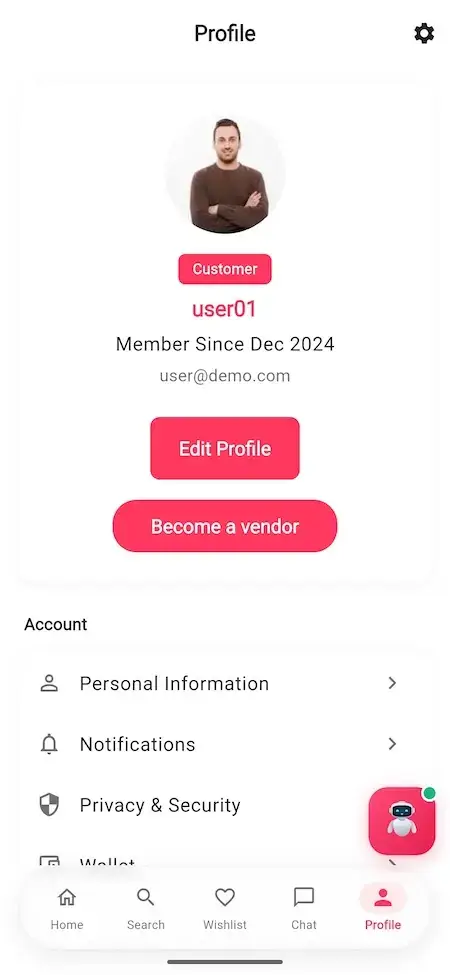
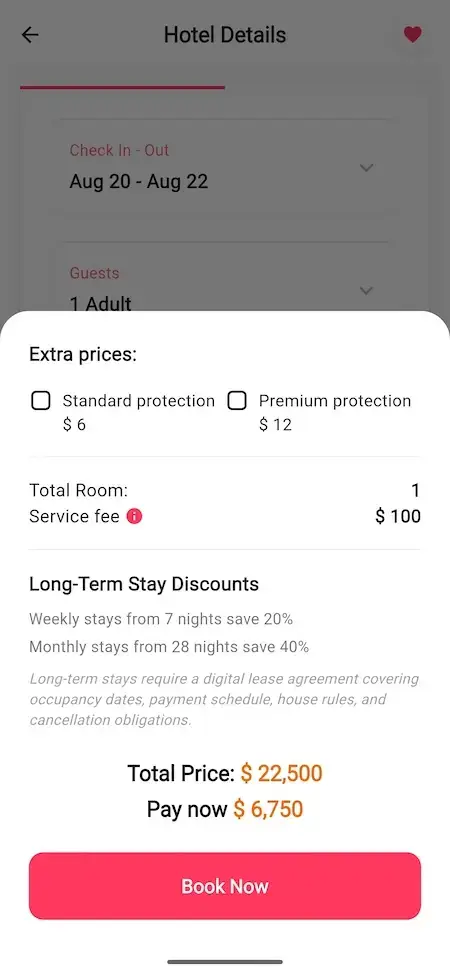
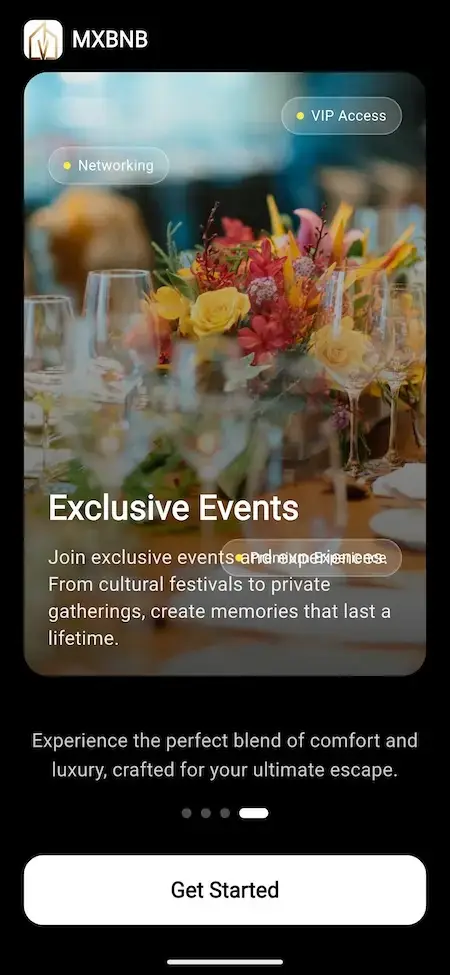
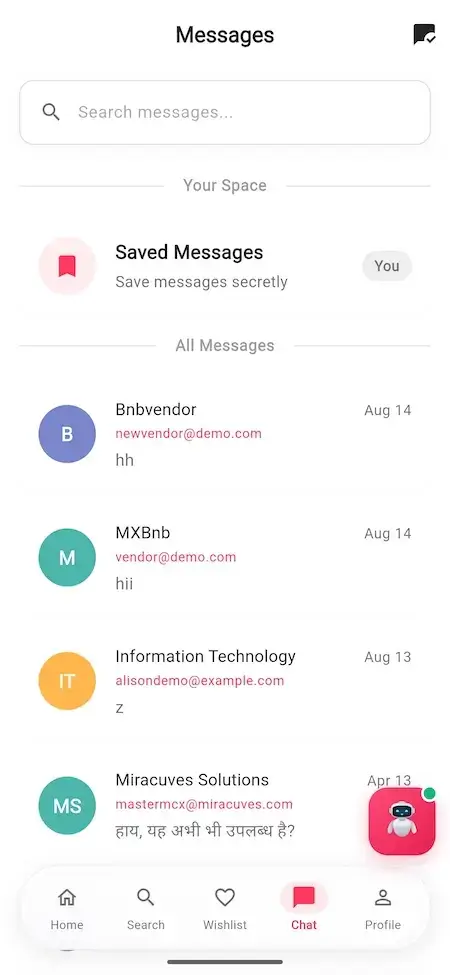
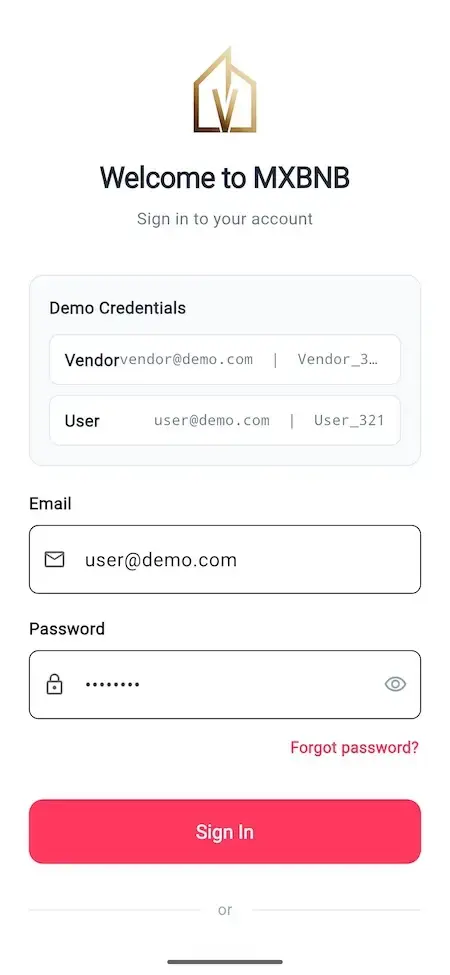
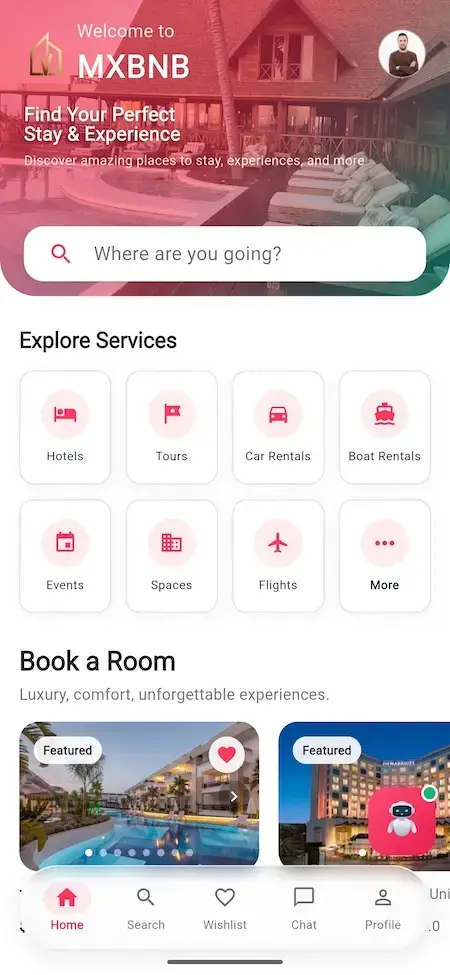
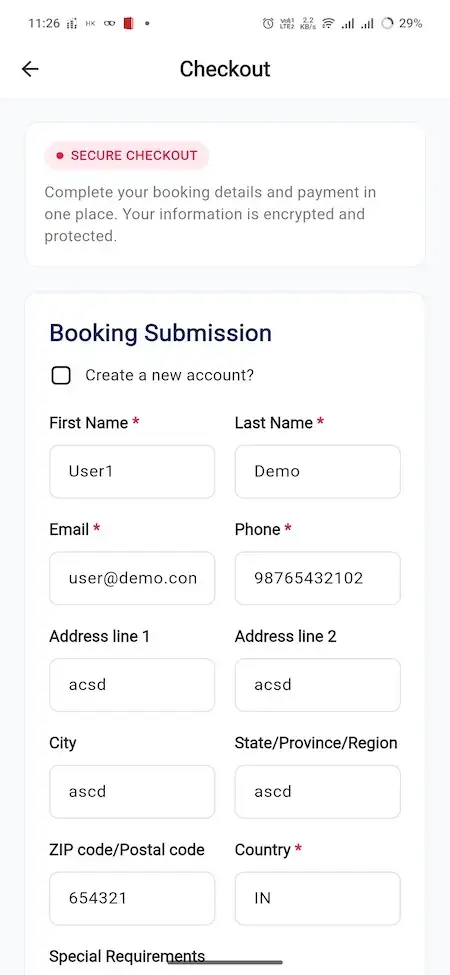
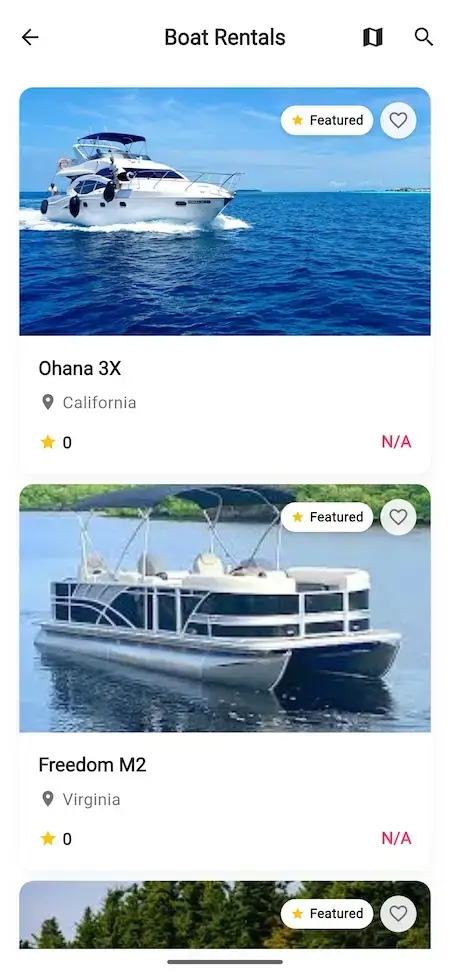
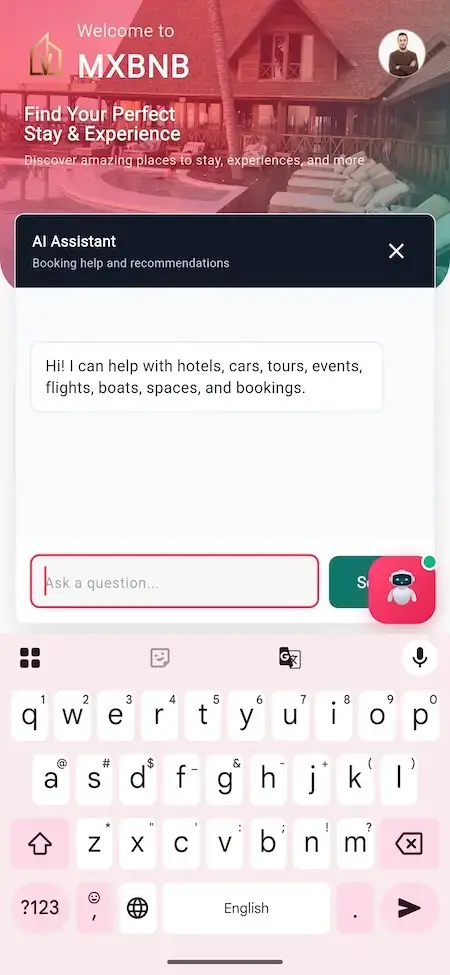

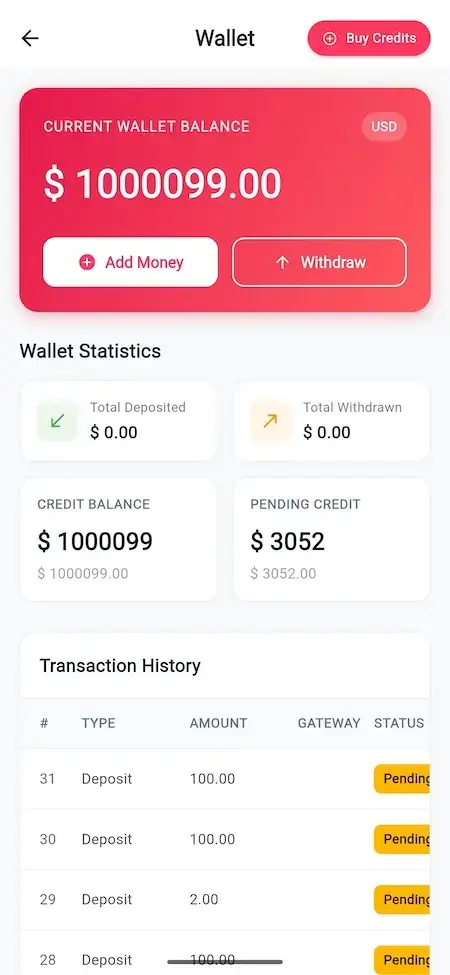
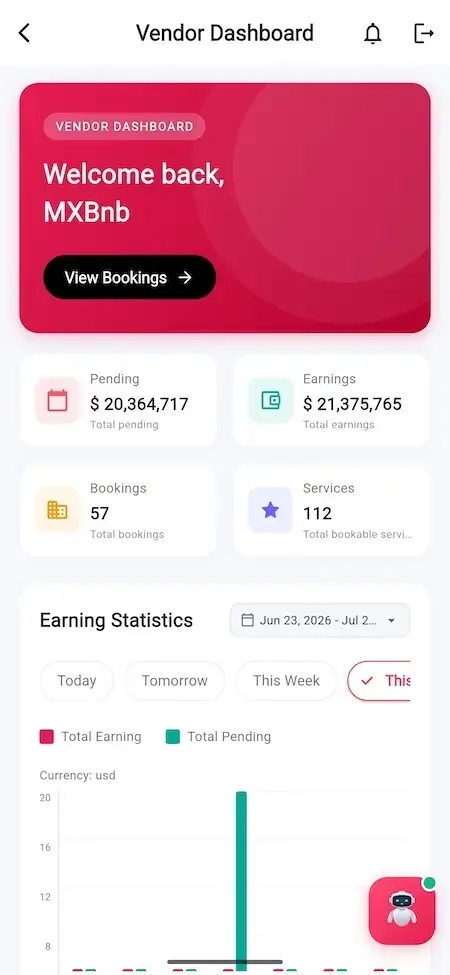
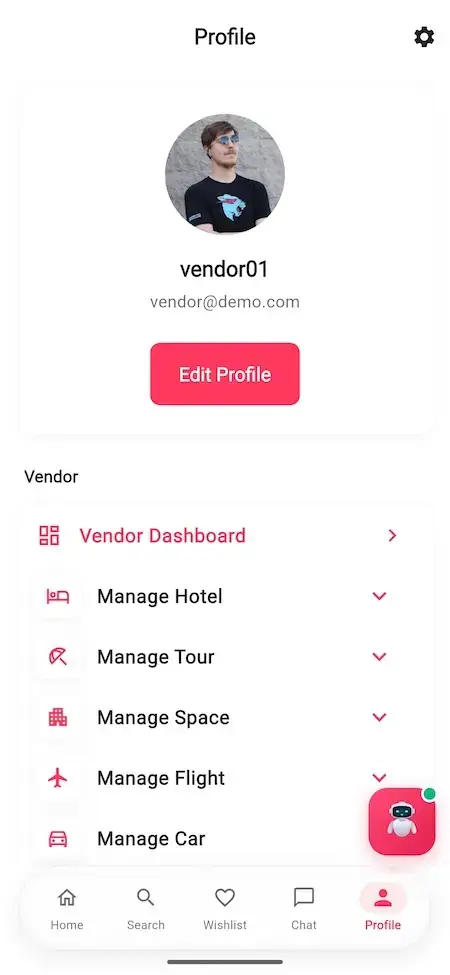
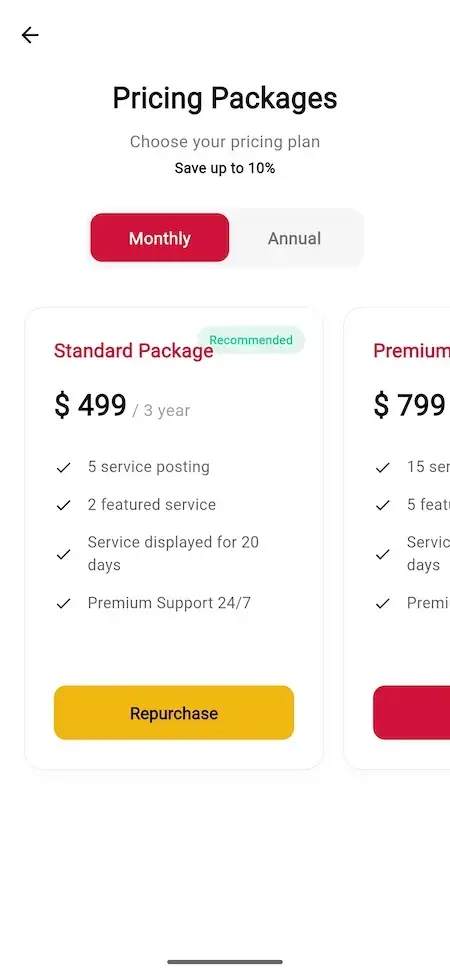
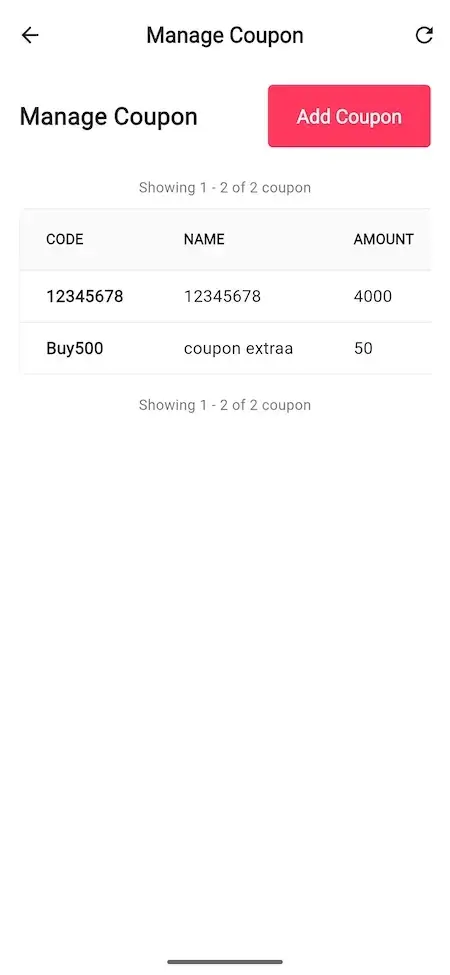
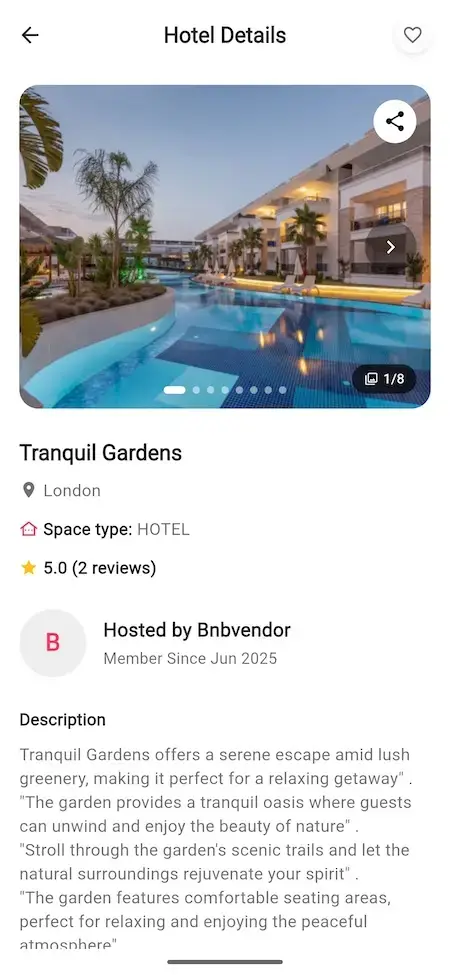
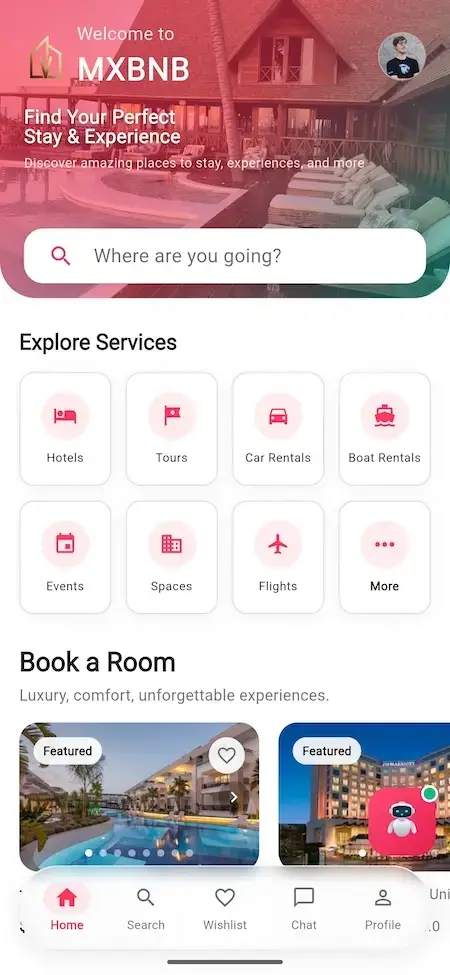
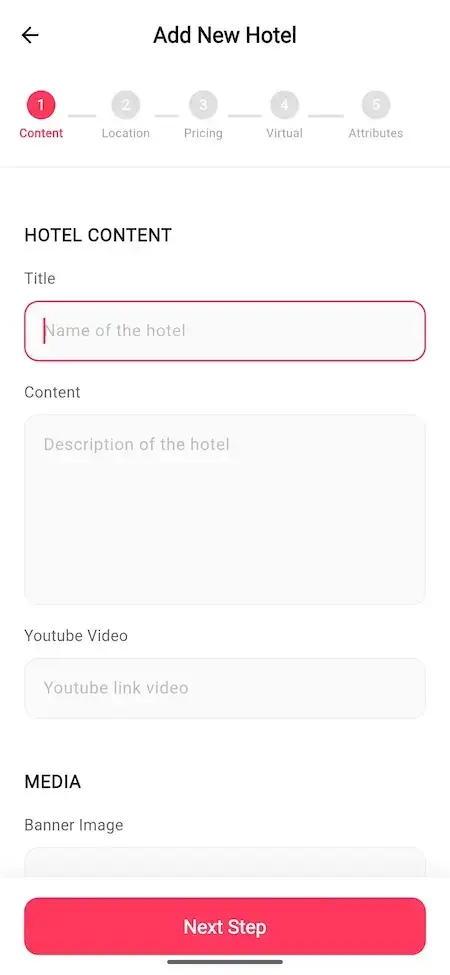
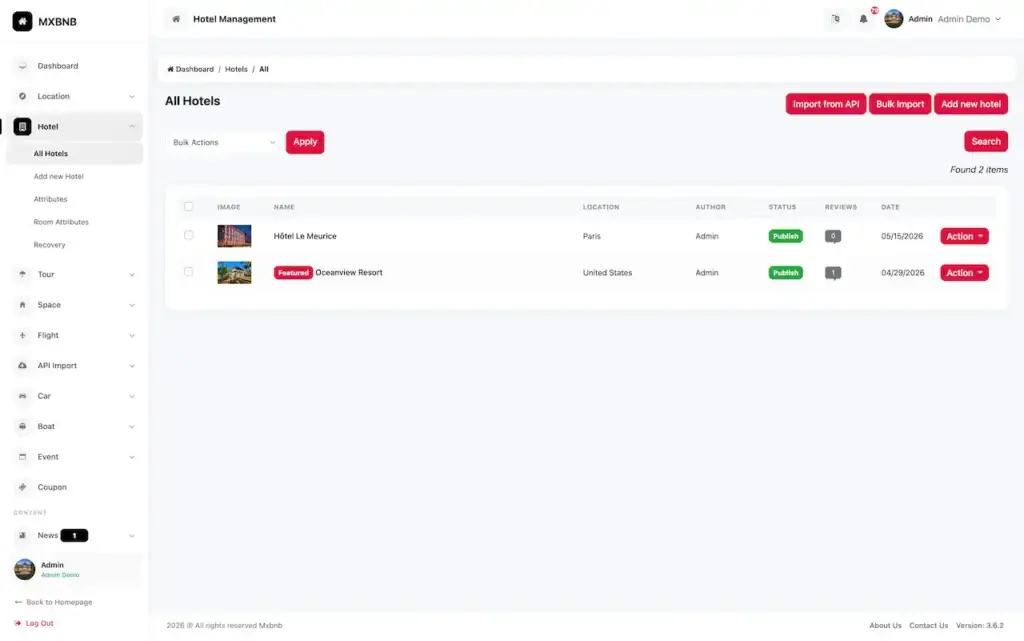
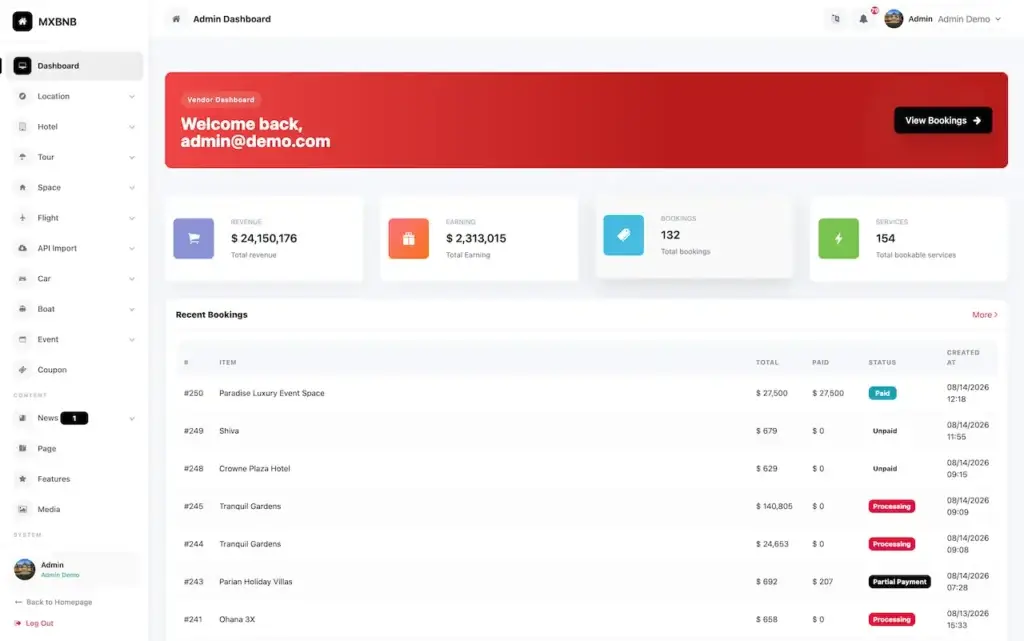
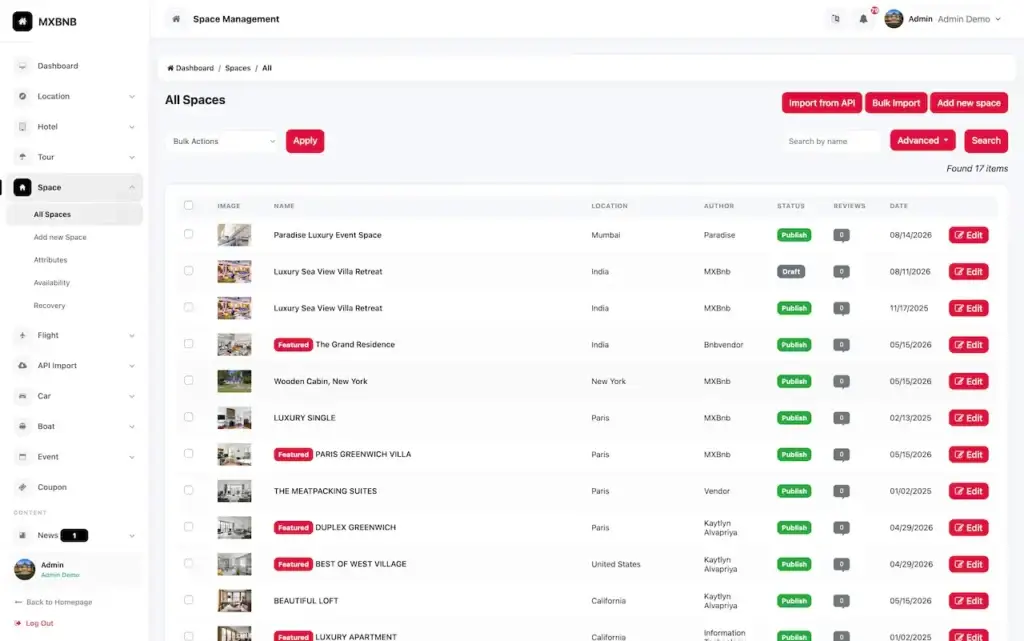
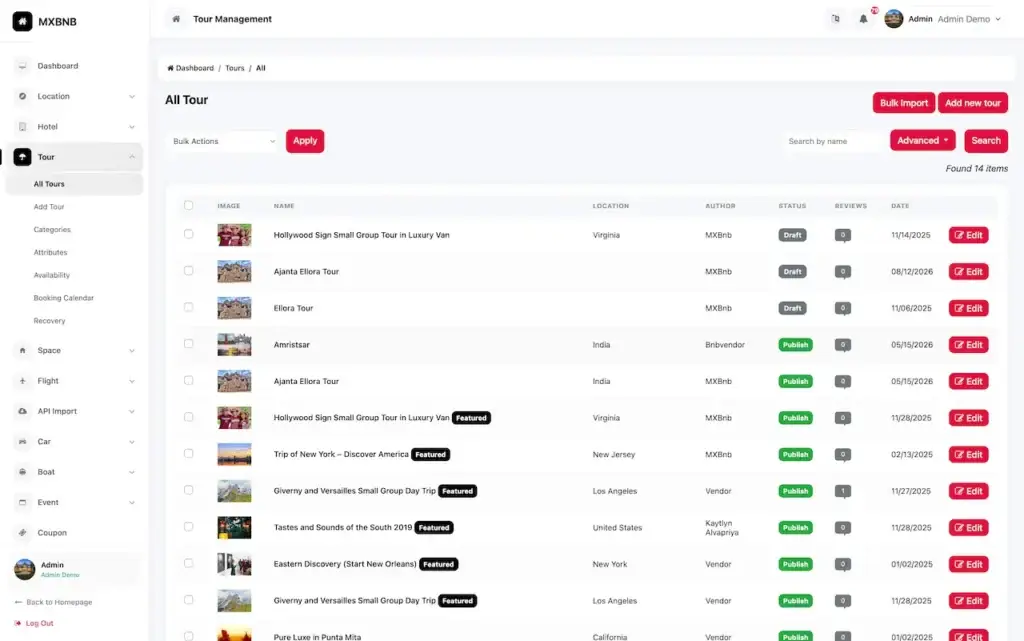
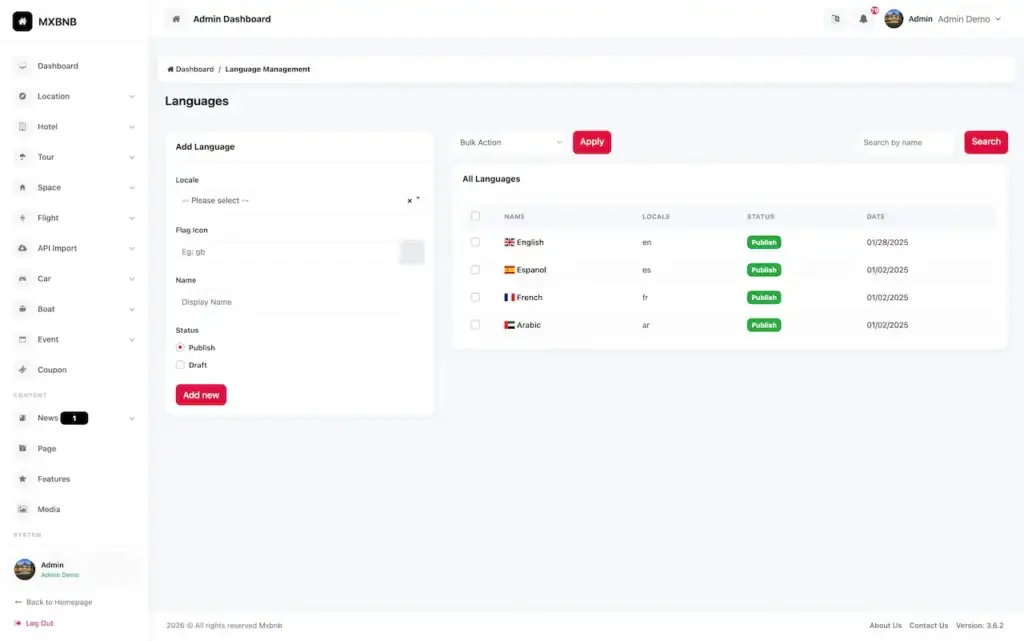
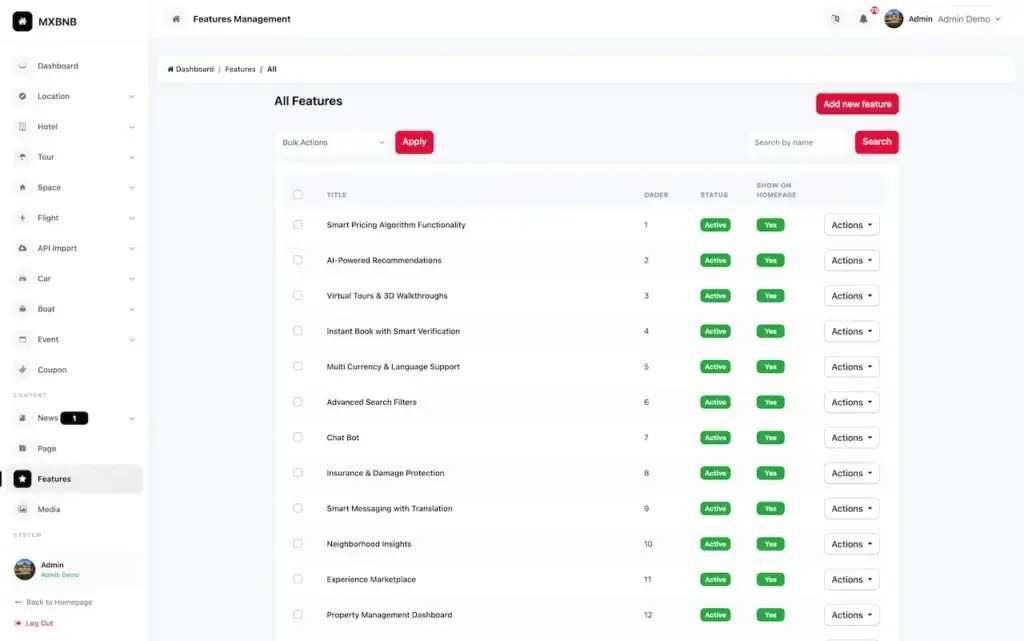
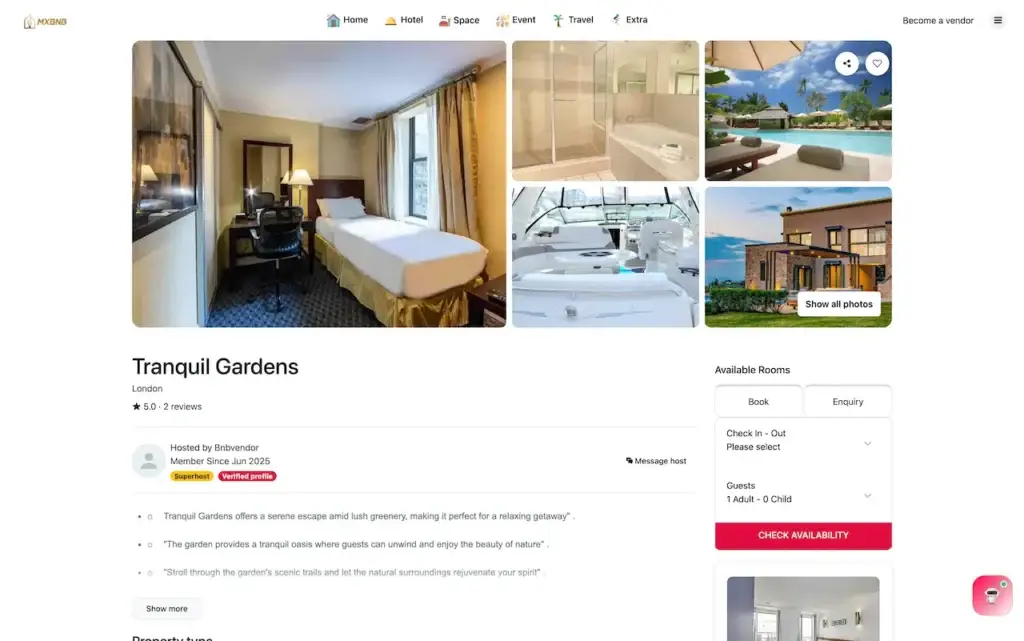
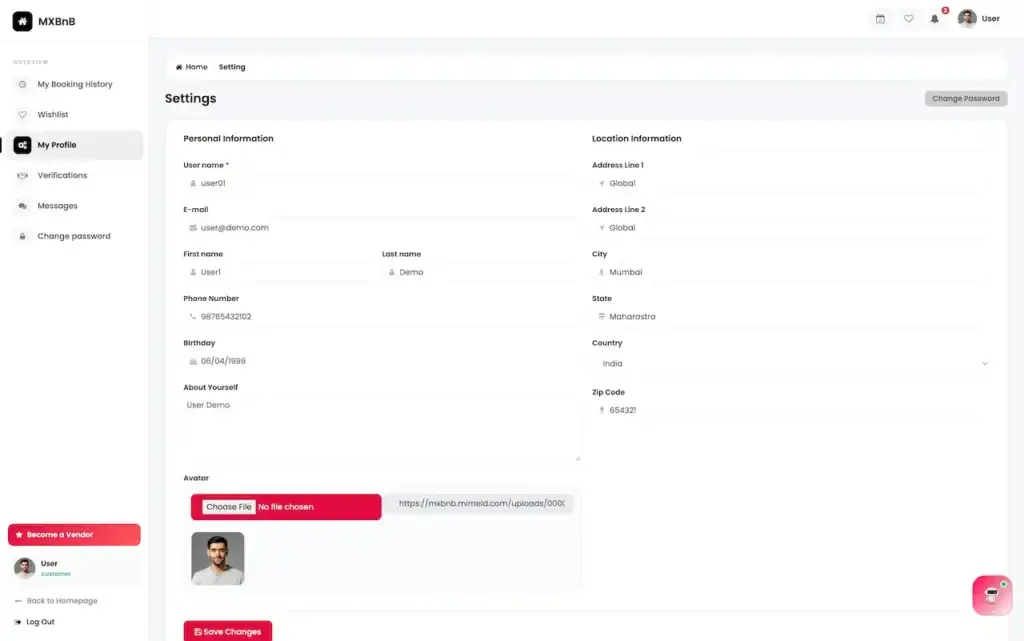
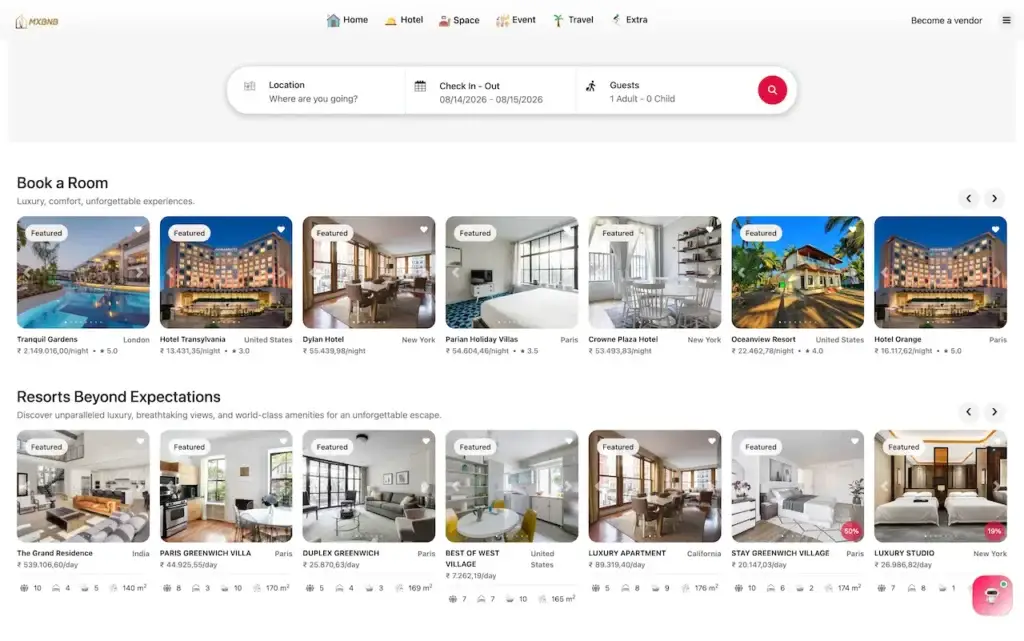
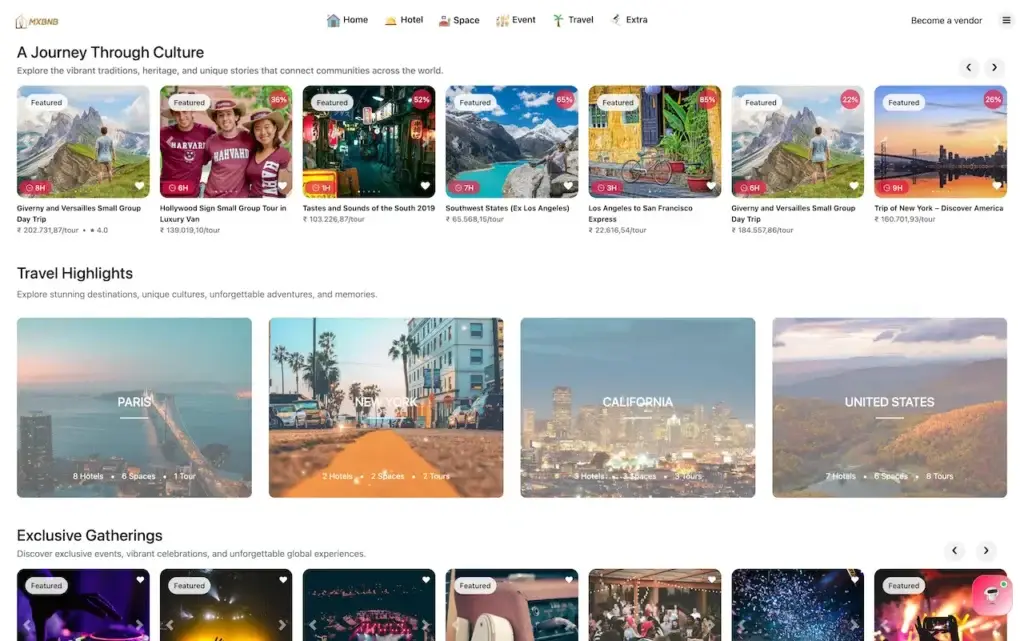
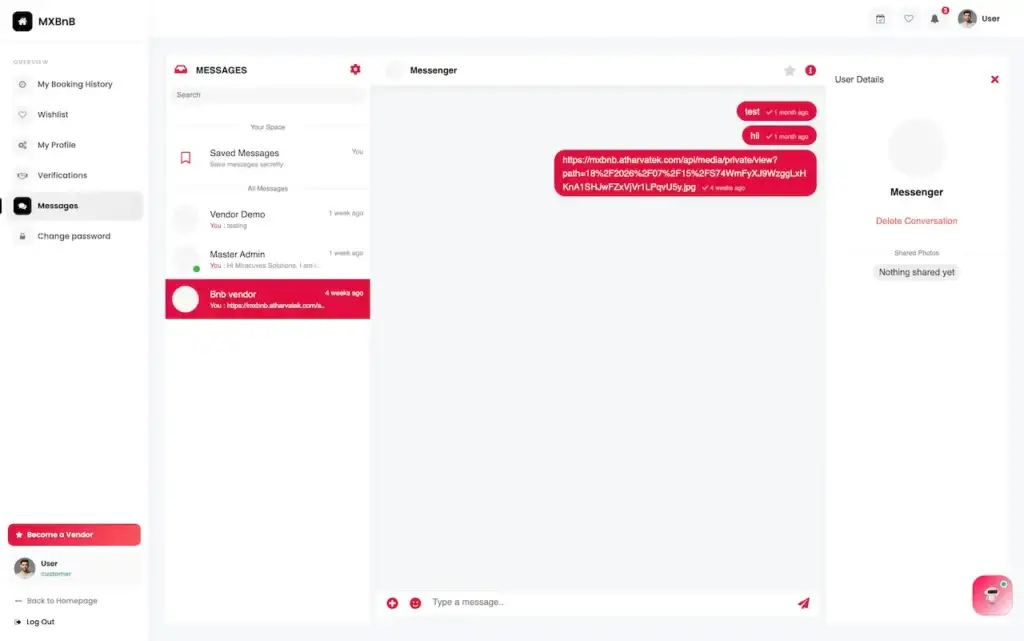
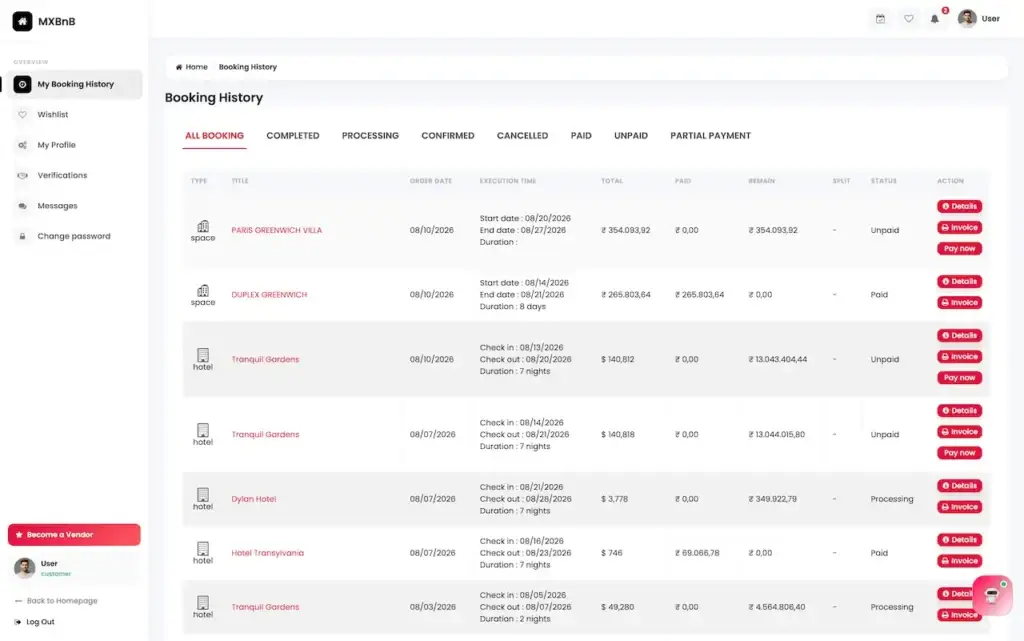
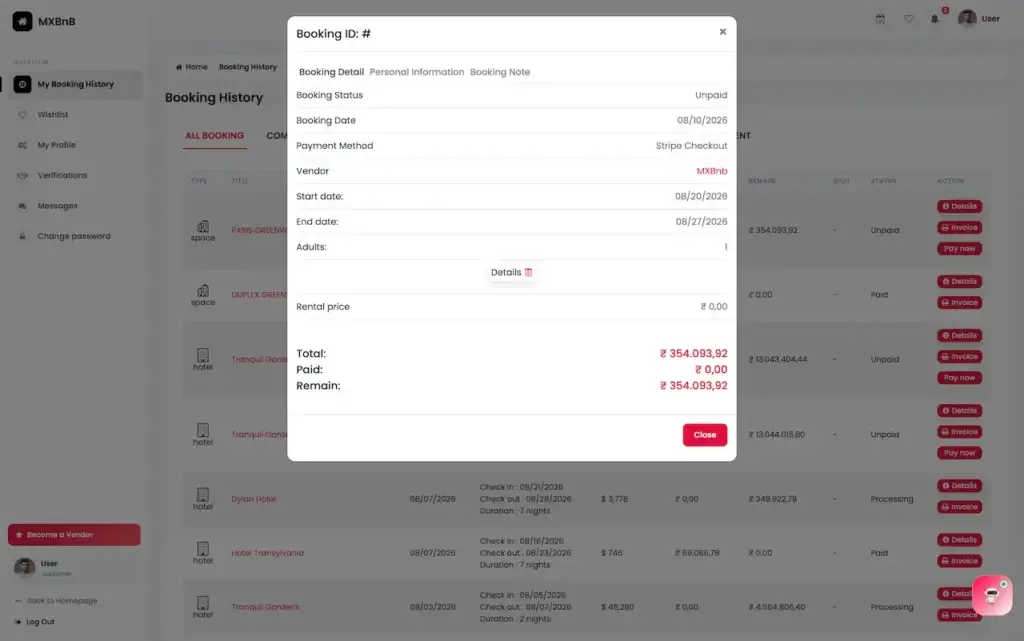
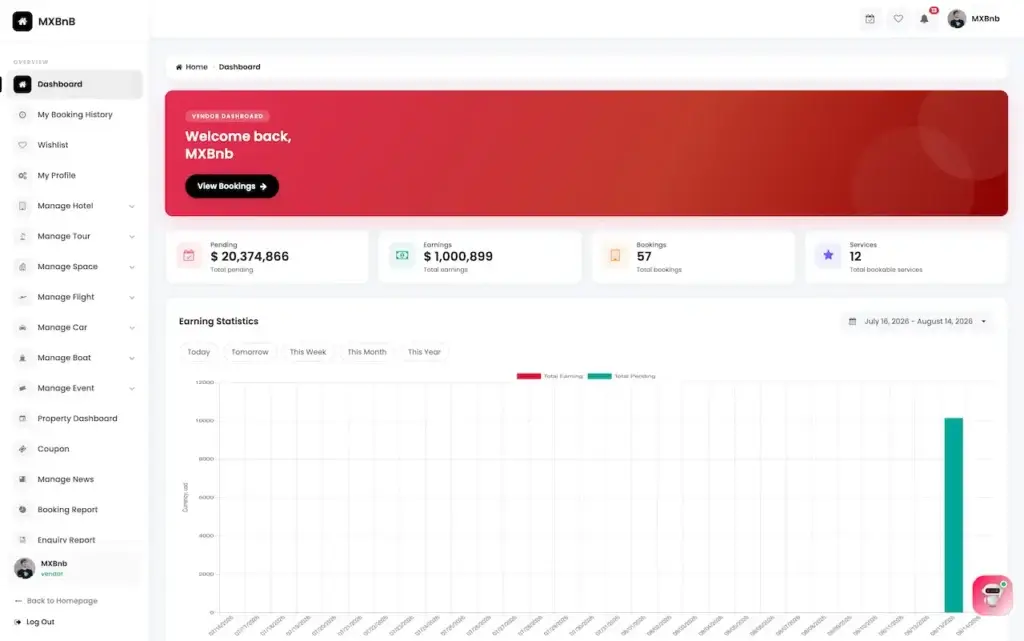
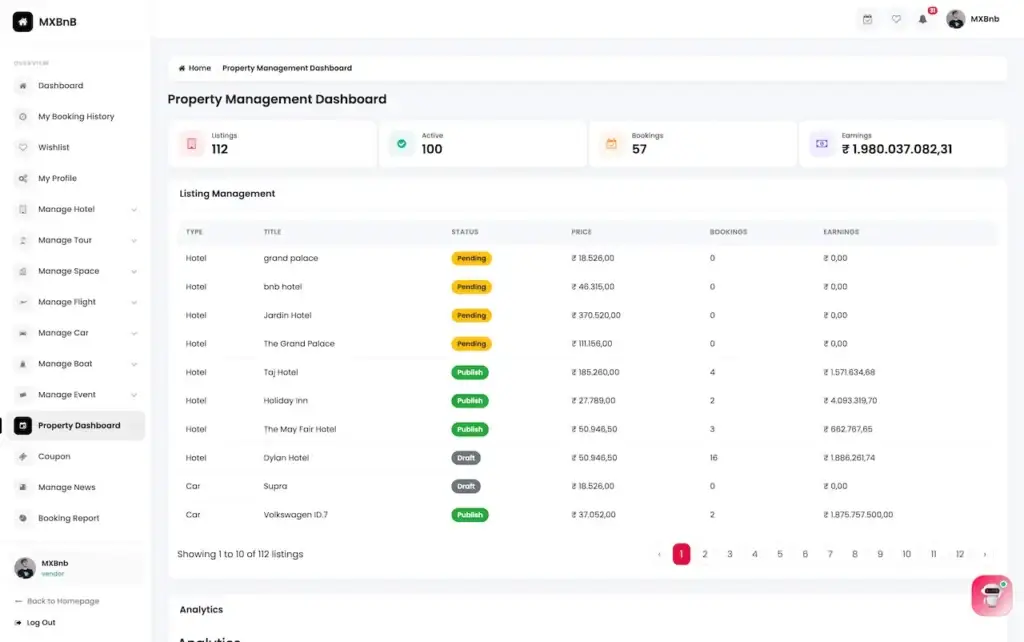
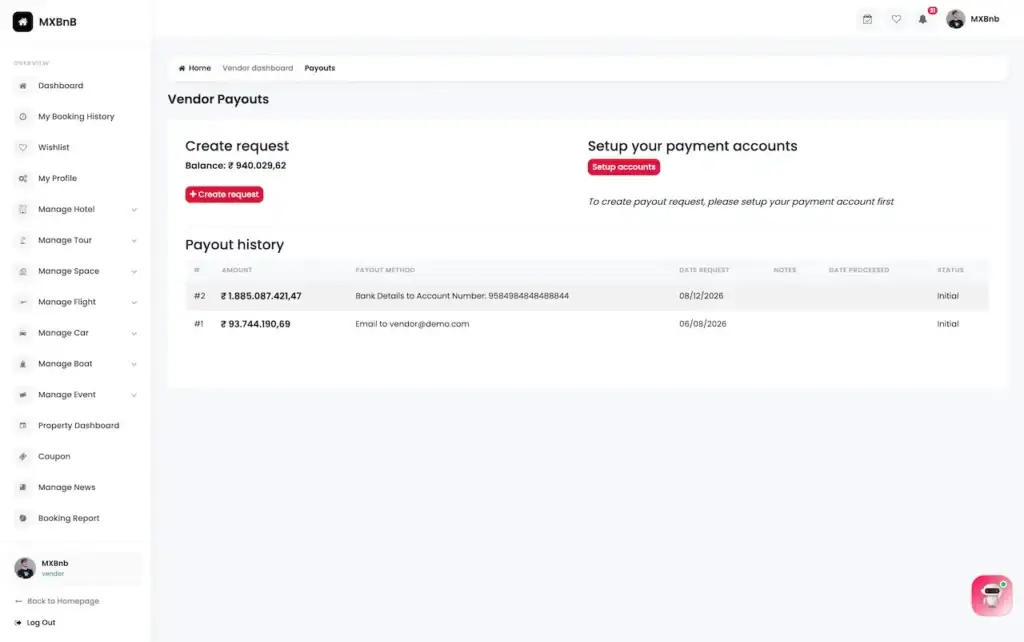
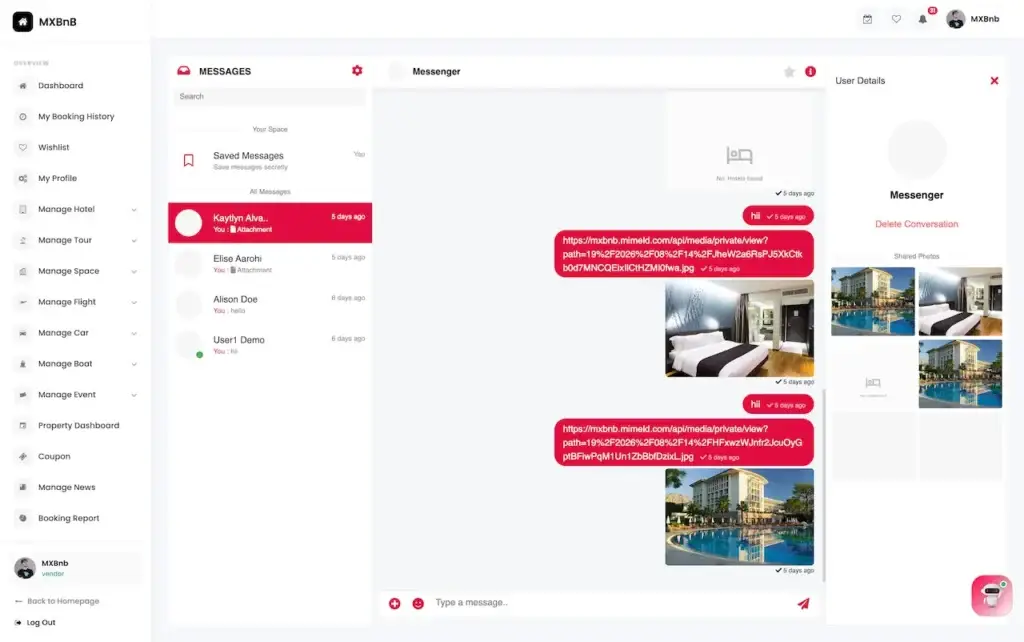
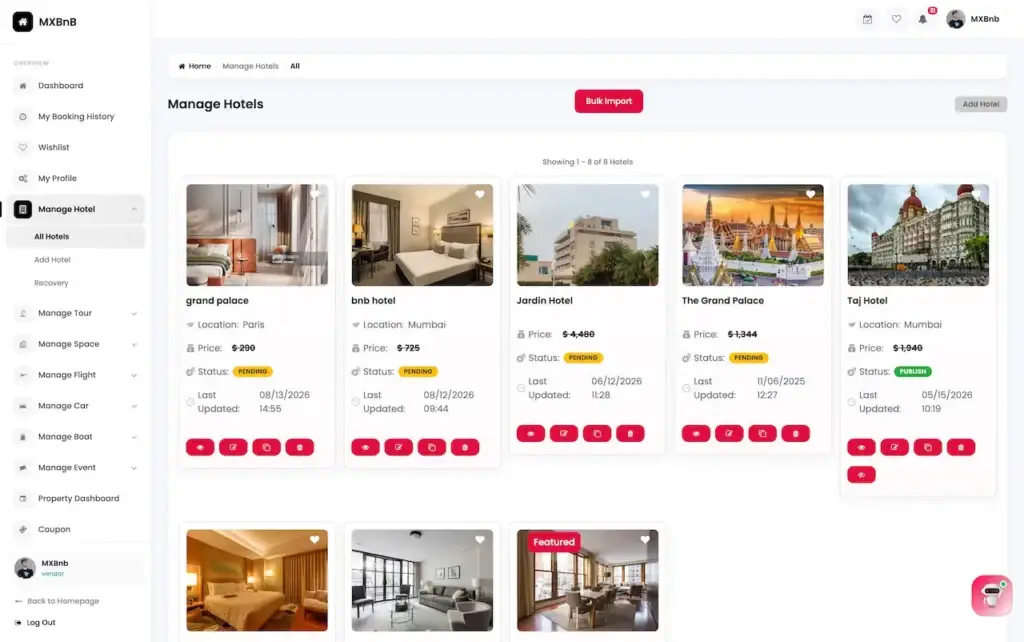
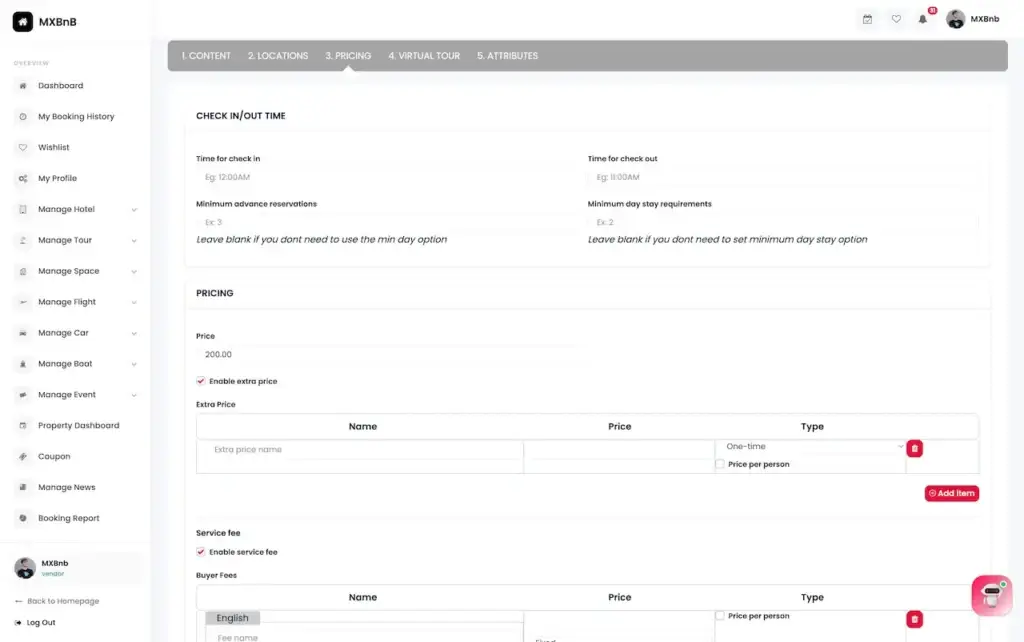
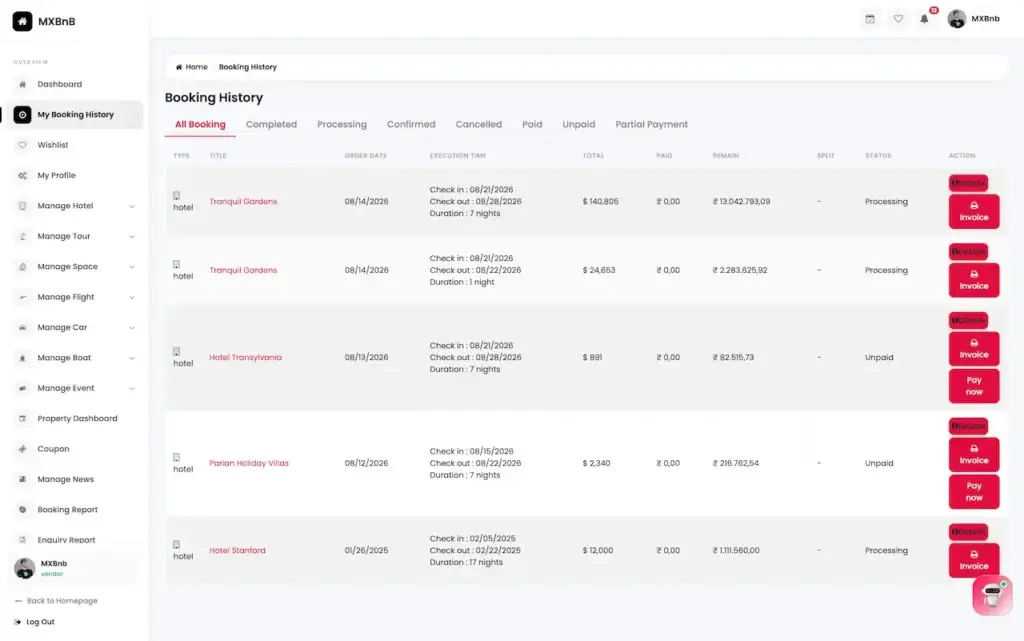
These are captured from the live demo build rather than drawn as mockups, so what you see here is what deploys. Every screen is rebrandable: name, logo, splash screen, colour theme and typography are configuration rather than a redesign. If you want a guided walkthrough of one specific flow, book a call and we will open that surface with live data and answer questions against it.
Client Voices
Airbnb Clone Client Reviews: Real Platforms, Real Results
Feedback from operators running rental marketplaces on this platform. Each is a named client with a published case study in our portfolio.
Case Studies
Airbnb Clone Case Study: A Short-Stay and Hotel Platform in Italy
Ischia Booking S.r.l runs short-stay rentals and hotel inventory on the island of Ischia. The mechanics of listings, calendars and payments already existed in this platform, so the engagement went into the parts that were specific to them.
Ischia Booking
Short-Stay & Hotel Platform
A short-stay rental and hotel booking platform for the island of Ischia, replacing a static site, a shared inbox and a phone line with a live booking engine.
- A few dozen properties run from a static site, email and a phone
- Availability held in one place while OTAs sold the same rooms
- Guests arriving in several languages with no self-service portal
- Put the whole property list online behind a real booking engine
- Stop the operations team living inside an email inbox
- Keep calendars honest across every channel that sells the rooms
- Listings, calendar and booking flow taken from the base platform
- A channel manager wired to the OTAs they already sold through
- A multilingual guest portal for arrivals from several markets
- A property manager console for day to day operations
- Source code transferred to the client account on handover
"We were running a few dozen properties off a static site, email and a phone. Calendar, booking flow and the property manager came off the shelf. They added a channel manager for our OTAs, a guest portal and a multilingual interface. The operations team no longer lives in the inbox."
The Basics
What Is an Airbnb Clone App?
An Airbnb Clone is a ready-made rental marketplace: guests search and book, hosts list inventory and get paid, and you take a commission on every transaction. This one is not restricted to accommodation. The same booking engine, wallet, review system and payout pipeline serve seven bookable types.

Not a Listings Directory
The value sits in the transaction: availability validated server side, pricing recalculated rather than trusted from the client, commission frozen onto the booking record, and a payout queue that settles hosts. A directory hands over a phone number and stops there.
One Engine, Seven Types
Bookings attach to any service type through a polymorphic reference, so adding cars beside stays does not fork the payment path, the review system or the reporting. That single design decision makes seven types practical rather than seven codebases.
Web and Mobile Do Not Drift
The Android and iOS builds consume the same REST API as the web app, so a rule you change in the admin applies everywhere at once instead of being reimplemented per client.
Built for Web, Android, iOS & API
What Is an Airbnb Clone Script?
The hard part of a rental marketplace is not the listing page. It is holding availability honestly across channels, calculating a total that survives a coupon and a seasonal rate, and settling money to hosts net of a commission that must not change retrospectively. Those are what this ships with.
-
Seven bookable service types, switchable per deployment
-
Instant booking and enquiry-based booking on the same listing
-
Six payment gateways plus an internal wallet
-
Host payouts with a request, review and completion workflow
-
Entity-level translations across fifteen pre-configured languages

In simple words, it is the shortcut to launching a booking marketplace where a guest can reserve a villa, an island tour, a hire car and a boat through one checkout. The platform runs on Laravel 10 and MySQL, carries more than forty database tables, six payment gateways, over twenty admin modules, and fifteen pre-configured languages with right-to-left support.
Features
Airbnb Clone Features: Seven Service Types, One Booking Engine
Everything below is in the base platform and demonstrable in the live demo. Service types you do not need are switched off in the admin without touching code.
Accommodation & Room Types
Property profiles with multiple room types, each carrying independent pricing, occupancy limits, bed configuration and amenities.
- Rich property profiles with gallery and video
- Multiple room types with independent pricing
- Occupancy limits and bed configuration per room
- Star rating, check-in windows and minimum stay
Spaces & Venues
Whole-home and venue rentals with capacity, room counts, square footage, house rules and extra pricing.
- Whole-home and venue listings
- Guest capacity with bedroom, bed and bathroom counts
- Square footage and house rules
- Cleaning fees and security deposits as extras
Car Rental
Vehicles with full specification, separate pickup and dropoff for one-way hire, and a complete extras system.
- Passenger, baggage and door counts
- Transmission and fuel type classification
- Separate pickup and dropoff for one-way hire
- Extras pricing for GPS, child seats and insurance
Tours & Experiences
Duration, group size, itinerary, meeting point, and included and excluded items so the price is unambiguous.
- Duration in hours or days
- Minimum and maximum group size per booking
- Itinerary, meeting point and pickup zones
- Included and excluded items, plus a per-tour FAQ
Boats & Charters
Vessel listings with capacity, duration tiers, extra services and date-based availability.
- Guest capacity and crew configuration
- Half-day, full-day and multi-day tiers
- Extra services such as captain or catering
- Date-based availability with deposits
Events & Flights
Ticketed capacity by date, plus flight inventory for operators selling transfers or seats alongside stays.
- Event dates, venue and organizer details
- Ticket capacity and age restrictions
- Flight routes with departure and arrival
- Seat pricing and availability tracking
Search & Discovery
Global or type-specific search with the filters that apply to each type, map view and autocomplete.
- Global search across every enabled type
- Location, dates, guests, price, amenities and rating
- Autocomplete on locations and listings
- Map view, plus sorting by price, rating or distance
Availability & Booking Rules
Real-time validation against inventory, with stay limits and booking windows enforced before payment.
- Availability checked against per-service date tables
- Minimum and maximum stay enforced
- Advance booking window respected
- Room-level sync prevents double-booking
Pricing Engine
Seasonal rates, length-of-stay discounts, extra guest charges, fees and a full coupon engine.
- Seasonal and date-based rate adjustment
- Length-of-stay discounts
- Extra guest charges and service fees
- Coupons with usage limits and minimum totals
Payments & Partial Payment
Six gateways plus wallet, deposit models, invoicing and refunds from the admin.
- Six gateways plus the internal wallet
- Partial payment for deposit-based models
- Balance reminders before arrival
- Invoice generation and refund processing
Reviews, Messaging & Enquiries
Verified reviews, moderation, live messaging and structured enquiry threads.
- Reviews restricted to completed bookings
- Moderation queue with host replies
- Real-time guest to host messaging over Pusher
- Structured enquiry threads for quoted bookings
Multi-Language & White-Label
Per-locale content on the listing itself, fifteen languages, and full branding control.
- Entity-level translation per listing and page
- Fifteen languages pre-configured
- Right-to-left layout for Arabic and Hebrew
- White-label branding across web, apps and email
Note for buyers: every capability above ships in the base platform and is white-label. Where something needs a third-party account, such as a channel manager or an additional payment rail, that is stated as an add-on rather than implied away.
Revenue Engine
Airbnb Clone Revenue Models: Commission, Plans, Fees and Promotion
A rental marketplace earns from several places at once, and this platform models each separately so you can tune one lever without disturbing the others.
| Revenue stream | How it is charged | What you set | What the incumbents actually earn |
|---|---|---|---|
| Commission on Every Booking | A platform fee on each transaction, taken out of the host payout when the booking completes. | Percentage or fixed amount, set globally or overridden per host. The rate is written onto the booking record at the moment of booking, so changing it later never rewrites past reporting. | The line the incumbents live on. Booking Holdings reported revenue at 14.5% of total gross bookings in 2025; the same calculation on Airbnb comes to 13.4%. |
| Platform Service Fees | Added on top of the booking total at checkout, so the guest sees it and the host payout is calculated around it. | One global rate, calculated into both the price the guest sees and the payout the host receives. | Both incumbents blend guest-side and host-side fees into a single take. Airbnb measures its against a booking value that already includes cleaning fees and taxes, which is why a headline rate always needs its denominator stated. |
| Host Subscription Plans | A recurring fee per host for a listing tier, billed monthly or with an annual option. | Tier price, duration, annual billing, and the listing allowance each tier carries. A plan maps to a role, so an entry tier is capped and upgrades to publish more. | No incumbent equivalent. Neither Airbnb nor Booking charges a host to be listed. That makes this the one line on the page you can run without competing on commission at all. |
| Featured Listings | A placement fee that lifts a listing in search results, sold per listing for a period. | The price, the duration and where the placement surfaces. | Booking Holdings reports $1.19 billion of advertising and other revenue in 2025 as a line separate from commission - the same idea, at scale. |
| Host-Configured Fees | Cleaning, security deposits and similar, set by the host and collected through the platform rather than off it. | Whether hosts may add them at all, and whether your commission applies on top of them. | These sit inside the incumbents' booking value too. It is the reason a published take rate and a commission rate are not the same number. |
| Wallet Float | Prepaid guest credit and host earnings held in the platform wallet between payout runs. | Payout frequency, which is what decides how long the balance stays with you. | Airbnb states it holds the guest payment until check-in and remits to the host the next business day, and that this timing is what shapes its free cash flow. |
How to read this. The middle columns describe this platform. The last one is what the two listed incumbents disclose in their own audited accounts, so you can size a rate against a filed number rather than a rumour. We have deliberately not printed a typical rate for you to copy. Commission here is configurable per booking and per host, and the right number depends on your category, your city, and whether you already hold the supply - an operator listing their own inventory can price very differently from one competing to attract hosts. Sources. Booking Holdings, Form 10-K for FY2025: total revenues $26,917m, stated as 14.5% of total gross bookings, and advertising and other revenues of $1,194m. Airbnb, Form 10-K for FY2025: revenue $12,241m against gross booking value of $91,273m, which Airbnb defines as inclusive of host earnings, service fees, cleaning fees and taxes. Both filed with the SEC in February 2026. Figures describe those companies, not any platform Miracuves builds.
Commission on Every Booking
A platform fee on each transaction, set globally or overridden per host, as a percentage or a fixed amount. The rate that applied when the booking was made is written onto the booking record, which keeps historical reporting honest after a rate change.
Host Subscription Plans
Tiered plans with their own duration, price and annual billing option. A plan maps to a role and carries a listing allowance, so an entry-tier host is capped at a number of listings and upgrades to publish more.
Platform Service Fees
A service fee added on top of the booking total, configurable globally, and calculated into both the price the guest sees and the payout the host receives.
Host-Configured Fees
Hosts attach their own fees, such as cleaning or a security deposit, which flow through the same total calculation rather than being collected off-platform.
Featured Listings
Paid promotion that lifts a listing in search results, sold as a placement rather than a commission, which gives you revenue that does not depend on booking volume.
Wallet Float
Prepaid guest credit and host earnings sit in the platform wallet between payout runs. That balance stays with you until it is withdrawn, and the ledger behind it is auditable per transaction.
The two that move the numbers most are commission and host subscription plans, because they capture two genuinely different things: the value of a transaction, and the value of being listed at all. Commission is stored per booking at the moment of booking, so changing your rate later never rewrites historical earnings.
Control Center
Airbnb Clone Admin Dashboard: Users, Hosts, Bookings, Payouts and Compliance
Over twenty admin modules, each behind its own permission. The role system is granular enough that a finance clerk can process payouts without reaching user management, and a moderator can approve listings without touching settings.
Operator Control
Platform Dashboard
Revenue, bookings, user growth and recent activity on one screen, with pending host and payout requests surfaced as actions rather than buried in a list.
User & Role Management
Search and filter users, assign roles, block or publish an account, override email verification, and define custom roles with permissions chosen per module.
Host Approval & Verification
The upgrade request workflow with identity document review, business profile capture and commission configuration, so a host is checked before they can publish.
Listing Moderation
One queue covering all seven service types with status filters, bulk approve and reject, featured-listing control and full editing rights over any listing.
Booking Oversight
Every booking across the marketplace with status filters, detail view, manual status changes, payment state and refund processing when a guest needs intervention.
Payments & Payouts
Transaction monitoring per gateway, the payout queue with review, approval and completion tracking, and payout history retained for reconciliation and tax.
Commission & Coupons
Commission set globally or per host as percentage or fixed, plus a coupon engine with usage limits, validity windows, minimum totals and per-user restriction.
Locations & Languages
A nested location tree from country through state and city to neighbourhood, and a translation interface covering interface strings and per-entity content.
Content & Templates
CMS pages, a news engine, email and page templates, a menu builder and a media library with a watermark module for protecting listing images.
- Platform revenue, bookings and user growth at a glance
- Pending host requests surfaced as actions
- Payout queue with review and completion tracking
- Refund processing and payment state per booking
System & Extensibility
Module and plugin management to switch capability on or off per deployment, cache and optimization tools, and a system log viewer behind its own permission.
- Nested location tree from country to neighbourhood
- Translation interface for interface and entity copy
- Email and page template management
- Media library with a watermark module
Need governance beyond this, such as territory-scoped admins or a scheduled export into your finance system? Both are extensions through the module and hook system rather than rebuilds.
Transparent Pricing
How Much Does It Cost to Build a Rental Marketplace Like Airbnb in 2026?
A launch-ready white-label Airbnb Clone starts from $3,099 as a one-time purchase, deployed in 6 working days with your branding on your own hosting. Cost moves from there with the number of service types you enable, gateway selection, language count, channel or OTA integrations, and store publishing scope.
Not sure which option
is right for you?
Talk to us - we'll understand your goals, timeline, and budget, and point you to exactly what you need. No upselling, just honest advice.
Deliverables
What's Included: Airbnb Clone Source Code, Apps and Deployment
The handover is the whole system, not a licence to run somebody else’s platform.
Android App
A branded build consuming the same REST API as the web app, carrying the guest experience and the host dashboard.
- Fully branded Android app for guests and hosts
- Search, book, message and review on mobile
- Host dashboard with calendar and payouts
- Push notifications and document upload
iOS App
The same feature set on iOS from the shared API, with App Store submission handled as part of publishing support.
- iOS build from the same shared API
- Feature parity with the Android app
- Branded icon, splash screen and colour scheme
- App Store submission handled for you
Guest Web App & Host Console
The public marketplace plus the host surface for listings, calendar, pricing, enquiries, earnings and payout requests.
- Guest web marketplace with full search
- Host console for listings and earnings
- SEO-friendly listing pages
- Responsive across desktop, tablet and mobile
Operator Admin Panel
More than twenty modules covering users, hosts, listings, bookings, payments, payouts, content and system logs.
- More than twenty admin modules
- Granular role and permission system
- Host approval and listing moderation
- Commission, coupons and payout processing
Full Laravel 10 Source Code
The complete backend, admin and public site with no encrypted files, yours to modify, rebrand and redeploy.
- Complete Laravel 10 source, no encrypted files
- REST API layer serving every client
- Database schema with migrations
- Version-to-version upgrade scripts
APIs & Integration Layer
Six gateways behind a common interface, plus mail drivers, Pusher realtime, Google Maps and social login.
- Six payment gateways pre-integrated
- Mail drivers for SMTP, Mailgun, Postmark and SES
- Pusher realtime for chat and notifications
- Google Maps and social login
Branding & Re-Skinning
App name, logo, splash screens, colour theme, fonts and branded transactional email across every surface.
- App name, logo, splash screen and colour theme
- Branded transactional email templates
- Custom domain configuration
- Full white-label across every surface
Deployment & Post-Launch Support
Server setup with SSL, mail and gateway configuration, then 60 days guidance, 6 months bug fixes and 12 months of product evolution.
- Server setup on your preferred provider
- SSL, mail and gateway configuration
- 60 days of launch guidance
- 6 months of priority bug fixes, 12 months of updates
Want to see exactly what you get? book a walkthrough and we will open the guest app, the host console and the operator admin with live data, then show you the repository structure you would be taking ownership of.
Explore Every Angle of the Airbnb Clone
Four focused guides covering features, cost, how to choose a builder, and how the business model makes money, each going deeper than this overview can.
Features
Every feature by role across seven service types, six payment gateways and more than twenty admin modules, plus what the base package leaves out.
See the full breakdown→Development Cost
Our fixed $3,099 price against agency and custom-build ranges, plus the 6-day path to live and why the number is fixed rather than "starting at".
See exact pricing→Development Company
Agency vs. freelancer vs. Miracuves compared, plus the territorial-rights and money-safety checks to run before you hire anyone.
Compare options→Business Model
Four revenue lines on one ledger covering commission, host plans, platform fees and featured placement, and why seven service types on one checkout changes the maths.
See the playbook→Who It's For
Who Is Our Airbnb Clone App Built For?
The same codebase serves quite different operators depending on which part leads. A property manager leans on room types and calendars; a tourism board leans on multiple service types and vendor onboarding; a charter fleet leans on capacity and deposits. Each is configuration rather than a fork.
Vacation Rental Operators
Tourism Boards & Destination Platforms
Multi-Service Travel Brands
Hotel Groups & Property Managers
Marine & Specialist Rental Businesses
White-Label & Multi-Brand Operators
If your business depends on inventory sold by date, on hosts or vendors you need to onboard and pay, or on selling more than one kind of thing to the same traveller, this platform is built for the shape you are already operating in.
Where It Fits
Airbnb Clone Use Cases: Stays, Experiences, Mobility & Multi-Service Hubs
The platform is the same in every case below. What changes is which service types are switched on and which part of the operating model leads.
Regional Short-Stay Marketplace
Accommodation listings, host onboarding, a booking calendar, guest payments and host payouts in one territory under one brand. This is what BNBinGreece and GoToRawanda both launched, and in each case the base carried listings, calendars and payments while the work went into local payment methods, guest languages and the property types those markets actually list.
Destination Platform Selling More Than Rooms
Stays, tours and car rental enabled together, so a guest books a villa, an island tour and a hire car in one session against one checkout. Every vendor involved is managed from one approval pipeline with one payout queue, which is where regional platforms usually lose their margin when they run three separate systems.
Hotel Inventory Alongside Private Rentals
Room-type management gives a property independent pricing, occupancy limits and minimum stay per category, while a whole-home listing beside it behaves like a private rental. Ischia Booking runs exactly this mix, with a channel manager keeping the OTAs that sell the same rooms in step.
Charter and Specialist Hire
Boats and yachts need capacity limits, half-day and full-day tiers, extras such as a captain or catering, and a deposit taken up front. The boat module carries those natively, which is why the same codebase family runs a Cabo yacht charter operation.
Mobility as a Companion Product
A rental operator adds car hire to an existing stay business, using separate pickup and dropoff locations, extras pricing and driver requirements, without standing up or paying for a second platform.
White-Label Marketplace for Clients
Agencies and networks launch a branded marketplace per client or per territory, each as its own deployment, sharing an operational model while keeping data and branding entirely separate.
Common thread: in every case the booking engine, wallet, review system and payout pipeline are the same. Adding a service type is a switch in the admin, not a second build.
Market Timing
Why Launch a Rental Marketplace in 2026?
Two structural facts make an owned platform worth more than another listing on somebody else’s. The first is commission: the large platforms take a meaningful percentage of every booking, and an operator running their own marketplace keeps it. The second is the guest relationship, which on a third-party platform you do not own, cannot market to, and lose entirely if your listing is downranked.
The Market, in the Incumbents' Own Numbers
The commission pool is not a forecast, and it does not need one. The two listed incumbents publish what they take, in audited accounts filed with the SEC in February 2026.
Those four numbers are the case and the caution at the same time. The pool is real, it is large, and roughly one dollar in seven of it is platform commission - which is the money an operator running their own marketplace keeps instead of paying. But it is currently being collected by two companies whose demand you will not have on day one, and no amount of software changes that.
So the opening is not scale. It is the part of the market they serve badly: a local payment rail, a language, a property type, a regulatory requirement - or a guest booking a stay, a car and a tour in one checkout, which is a product neither of them sells. That last one is ours to argue, not theirs; the figures above are simply what the incumbents disclose.
Sources. Airbnb, Inc., Form 10-K for the year ended 31 December 2025: gross booking value $91,273m, revenue $12,241m, nights and seats booked 533m. Booking Holdings Inc., Form 10-K for the year ended 31 December 2025: total revenues $26,917m, stated at 14.5% of total gross bookings. Airbnb defines gross booking value as inclusive of host earnings, service fees, cleaning fees and taxes, so a take rate measured against it is lower than a commission-only rate would be. These figures describe those two companies and are not a projection for any platform Miracuves builds.
You Keep the Commission
Every booking on your own platform pays your rate rather than an incumbent's. On a business already running meaningful volume, that difference is usually the whole case on its own.
You Own the Guest Relationship
Email addresses, booking history and repeat-stay behaviour sit in your database. That is what makes direct marketing and a returning-guest programme possible at all.
Supply You Already Control
Operators with existing inventory, a managed portfolio or a regional vendor network start with the hard half solved. The platform is the missing piece, not the business.
Markets the Incumbents Serve Badly
A local payment rail, a language, a property type or a regulatory requirement the global platforms do not handle is a durable opening, and all four are configuration here.
Combinations Nobody Else Sells
A guest booking a stay, a tour and a car in one session is a product the single-category platforms cannot offer. Seven service types on one checkout is the differentiator.
A Build That Does Not Take a Year
The unglamorous parts, availability, pricing, payouts, permissions and a console, are what consume a custom build. They are done here, which is what makes 6 working days to launch realistic.
Platform by the Numbers
The counter-argument deserves stating plainly. The large platforms bring demand and you will not, so an owned marketplace makes sense when you already hold supply or an audience, when your market has a payment rail or a language the incumbents serve badly, or when you sell a combination no single incumbent covers. If none of those apply, listing on an existing platform is the more honest answer.
Technology
Airbnb Clone Tech Stack: Laravel 10, MySQL, Vue.js & Flutter
A deliberately mainstream stack. None of this is exotic, and that is the point: any competent Laravel developer can maintain it, so you are not dependent on us to keep it running.
API & Business Logic
PHP 8.1+ · LARAVEL 10
- Modular monolith with 20+ domain modules
- Eloquent ORM with parameterized queries
- Sanctum tokens and JWT for API auth
- WordPress-style hook and plugin system
Bookings, Listings & Transactions
MYSQL 8 / MARIADB
- 40+ tables across all domains
- Polymorphic booking model across 7 types
- Composite indexes on the polymorphic pairs
- Full-text indexes on searchable content
Guest & Operator Interfaces
VUE.JS · BLADE · BOOTSTRAP
- Blade templating on the public marketplace
- Vue.js components in the admin surfaces
- Responsive across desktop, tablet and mobile
- Theme system with template overrides
Mobile Applications
FLUTTER
- Android and iOS from one codebase
- Consumes the same REST API as the web app
- Push notifications and camera upload
- Full guest and host feature parity
Realtime & Messaging
PUSHER · CHATIFY
- Guest to host direct messaging
- Live in-app notification delivery
- Unseen counts and read receipts
- File and image sharing in chat
Infrastructure & Scaling
REDIS · S3 / GCS · NGINX
- Cache, session and queue drivers
- Queue workers under Supervisor
- Media on S3 or Google Cloud behind a CDN
- Read replica support for reporting
Note for tech buyers: the architecture is a modular monolith, not microservices. More than twenty modules, each with its own models, controllers, views, routes and migrations, inside one deployable application. You get separation of concerns without the operational cost of running a distributed system for a marketplace that does not need one yet, and every driver, for cache, queue, mail and storage, can be swapped by configuration when it does.
How It Works
How the Airbnb Clone Works: Search, Book, Host, Settle
Six stages from a guest arriving to a host being paid. Every one is enforced server side, which is the difference between a booking engine and a contact form.

Discover and Select
A guest arrives and searches across whichever service types you have enabled, with the filters that apply to each.
- Global search across types, or a type-specific search with its own filters
- Location, date range, guest count, price band, amenities and rating
- Map view with coordinates, plus autocomplete on locations and listings
- Listing page with gallery, video, amenities, reviews and map

Check Availability
The platform validates the request against real inventory before it asks for any money.
- Availability checked against the per-service date tables
- Minimum stay, maximum stay and advance booking window enforced
- Conflicts with existing bookings rejected at source
- Room-level synchronization prevents a clash inside one property

Price and Apply Discounts
The total is recalculated on the server rather than trusted from the browser.
- Seasonal and date-based rates applied to the base price
- Extra guest charges, cleaning fees and security deposits added
- Coupon validated against usage limits, validity and minimum total
- Platform service fee and host fee calculated into the displayed total

Book and Pay
Guest details are collected, the booking record is created, and payment runs through the gateway you configured.
- Booking created with a unique code, initial status draft
- Payment through Stripe, PayPal, PayStack, Payrexx, offline transfer or wallet
- Partial payment supported where a deposit model is enabled
- Gateway webhook verified by signature, then the booking moves forward

Confirm and Notify
Confirmation is the point where inventory is committed and everyone is told.
- Dates blocked on the calendar and propagated to iCal consumers
- Confirmation email to the guest, booking alert to the host
- In-app notification delivered live through Pusher
- Commission calculated and frozen onto the booking record

Complete, Review and Settle
After the stay the platform closes the loop and moves the money.
- Booking moves to completed after the end date passes
- Review invitation sent, and only completed bookings can review
- Host earnings become available net of commission and fees
- Host requests a payout, the operator reviews and completes it
Visual Flow Diagram
Search → Availability → Pricing → Payment → Confirmation → Stay → Review → Host Payout
Behind The Scenes
Airbnb Clone Platform Architecture & Backend Flow
One API, Every Client
The guest web app, the host console and the mobile builds consume the same REST API and the same booking contracts, which stops a web demo and a store build from disagreeing about what a guest has actually reserved.
Polymorphic Booking Core
A single bookings table serves every service type through an object type and object id pair, so reporting, payments, reviews and payouts are written once and apply to all seven.
Availability Computed, Not Assumed
Availability is validated at request time against per-service date tables and existing bookings rather than read from a cached flag, which is the control that prevents a double sale.
Commission Frozen at Booking
The commission rate and type are written onto the booking when it is made. Changing your platform rate next quarter cannot retroactively alter what a host earned last quarter.
Driver Abstractions Throughout
Cache, queue, session, mail and file storage all sit behind drivers, so moving from file to Redis, or local disk to S3, is a configuration change rather than a migration project.
Hooks Instead of Forks
Action and filter hooks plus a plugin directory let your own logic attach to booking creation or price calculation without editing core files, so a platform update does not overwrite your work.
Build to Scale
Built to Scale: Caching, Queues and Storage That Move
The scaling path is ordinary and well understood, which is exactly what you want from infrastructure. Cache, session and queue move from file to Redis by changing a driver, and the slow work runs off the request.
Queued Background Work
Email, image processing, data exports and report generation all run as queued jobs under Supervisor, with failed job capture and retry on a backoff. A burst of bookings never blocks a page render, and a failing mail provider degrades delivery rather than checkout.
Storage and Media Delivery
Listing galleries are the heaviest asset a rental marketplace carries. Media moves to S3 or Google Cloud Storage behind a CDN through the storage driver, with several thumbnail sizes generated automatically on upload and an optional watermark applied to protect host photography.
Database Under Load
Composite indexes sit on the polymorphic object pairs, date-range indexes on bookings, and full-text indexes on searchable content. Read and write splitting is supported, so the reporting queries that get heavy on a mature marketplace stop competing with the booking path.
Query Discipline
Related models are eager loaded throughout to keep listing and booking views off the N+1 query path, which is the failure mode that surfaces first when a marketplace grows. Every list endpoint paginates server side rather than returning an unbounded set.
Queued Background Work
Email, image processing, exports and reports run as queued jobs under Supervisor, with failed job capture and retry.
Redis for Cache, Session and Queue
All three drivers move from file to Redis with a configuration change, the highest-value step when traffic grows past one server.
Read Replicas for Reporting
Read and write splitting keeps heavy analytics queries from competing with the booking path.
CDN-Backed Media
Galleries move to S3 or Google Cloud behind a CDN, with automatic thumbnail generation on upload.
Indexed for Real Queries
Composite indexes on polymorphic pairs, date indexes on bookings, full-text on content, pagination everywhere.
Eager Loading by Default
Related models are eager loaded to keep the busiest views off the N+1 query path.
Growing Beyond One Server
The application is stateless once session and cache are on Redis, so a second application server behind a load balancer is an infrastructure change rather than a code change. The modular structure means a heavy module can be optimized independently of the rest.
Note for founders and CTOs: you can start on a single modest instance and still be on a credible path to scale, because nothing here needs replacing to get there. The drivers change, the code does not.
Built to Be Audited
Airbnb Clone Security: OWASP-Mapped, GDPR-Ready and Candidly Documented
Security posture is mapped against the OWASP Top 10 in a dedicated VAPT reference. What is unusual about that document is the candour: it separates controls that ship enforced in code from controls that are deployment or configuration work, and it labels the second group plainly instead of folding everything into one green table. The cards below are what the platform enforces on its own. The list beneath them is what we configure with you before go-live, named rather than implied.
Rate Limiting Is Configuration, Not Default
HTTPS and Security Headers Belong to the Server
CAPTCHA Is an Integration, Not a Bundled Feature
Security Logging Ships at Baseline
Dependency Risk Is a Maintenance Job
Gateway SSL Verification Must Be Switched On
No Card Data Reaches Your Database
Cards are captured and tokenized by the gateway, so no primary account number is ever written to your MySQL instance. That keeps the deployment inside PCI DSS SAQ A rather than the far heavier SAQ D. Every payment webhook is verified by HMAC signature before a booking changes state, so a forged callback cannot confirm a reservation nobody paid for.
Uploads Inspected at the Byte Level
Every upload is read with finfo and validated against its magic bytes rather than its extension, so a renamed executable is rejected before the controller runs. Accepted files are rewritten to a cryptographically random 40 character name, stored with 0600 permissions, and resolved through realpath so a traversal sequence cannot escape the uploads directory.
Injection Closed at the ORM Layer
Every query runs through Eloquent with bound parameters, which removes the string concatenation that SQL injection depends on. Rich text a host or guest can submit passes through HTML Purifier with a per-field tag allow-list, and Blade escapes on output by default, so a stored payload has to survive three independent layers before it can render.
Authentication in Layers
Passwords are hashed with bcrypt, email verification runs on signed URLs that expire, and two-factor authentication uses TOTP through Laravel Fortify with single-use backup codes. API access is Sanctum tokens carrying explicit abilities and revocable one at a time, and password resets are signed links valid for sixty minutes rather than guessable strings.
Authorization That Scopes the Data
Role-based access control is granular per module, so a finance clerk can process payouts without reaching user management. Host accounts are scoped to their own records, which is the control that stops one host reading another host's bookings by editing an id in the URL, and every operator route sits behind admin middleware rather than an unlinked page.
Privacy Built Into the Data Model
GDPR export returns a structured file covering profile, bookings, reviews and payment history. Deletion anonymizes rather than orphans: financial records that must legally be retained keep their totals while the personal data is stripped out. Soft deletes give a thirty day recovery window, and retention periods are configurable per data class.
Note for serious operators: we build to the controls the common frameworks require, and we state which of them are configuration rather than shipped. We do not hold an ISO 27001 certificate and do not claim one. On a rental marketplace the two things carrying real risk are host payouts and guest personal data, so those are the paths documented most carefully and tested first in any VAPT engagement you commission.
Go Further
Airbnb Clone Add-Ons: Channel Manager, Dynamic Pricing & Custom Integrations
Out of the box the platform is complete and demonstrable. The modules below are what operators most often add once they know their market, either because they need a third-party account or because their scale demands it. Each is scoped and quoted separately.
Channel Manager & OTA Sync
Two-way synchronization with the OTAs you already sell through so availability and rates stay aligned and the same room is never sold twice. Ischia Booking took exactly this route.
Dynamic Pricing
Rate suggestions driven by demand, competitor pricing and historical occupancy, wired into the existing seasonal rate tables rather than bolted alongside them.
Additional Payment Rails
Local gateways and mobile money beyond the six that ship. Because gateways sit behind a common interface, a new rail is a class implementing that interface rather than a change to the booking flow.
iOS Store Publishing
App Store submission handled end to end, including account setup, build signing, review response and the metadata that store reviewers ask for.
Identity Verification & KYC
Automated document verification for hosts or guests where your jurisdiction requires it, replacing the manual admin review that ships as standard.
Housekeeping & Operations
Room status tracking across clean, dirty, inspected and out of service, with staff assignment and turnaround scheduling for operators running serviced inventory.
Accounting & Finance Export
Scheduled export of bookings, payouts and commission into QuickBooks, Xero or your own finance system, so month end stops being a manual reconciliation.
Multi-Brand & Multi-Region
Several branded marketplaces on separate deployments sharing an operational model, for agencies and networks running more than one territory.
Building in the Travel and Rental Space? We Have the Whole Category Covered.
The platforms below are siblings of this one, built on the same delivery model with the same source-code handover.

GetMyBoat Clone
Boat and yacht charter marketplace with vessel types, duration tiers, deposits and captain options.

Turo Clone
Peer-to-peer car rental with host fleets, trip flow, insurance handling and driver verification.

Expedia Clone
Online travel agency covering flights, hotels and packages with supplier inventory and booking management.

Blueground Clone
Furnished mid-term and corporate rentals with longer lease cycles, tenant screening and recurring billing.
The Commercial Case
Marketability, Revenue Potential & Business Prospects
A rental marketplace earns in more than one way at once, which is what makes the model durable. Commission scales with volume, host plans produce recurring revenue that does not, and featured placement sells attention rather than transactions.
Four Revenue Lines
Commission, host subscription plans, platform and host service fees, and featured placement. They stack, and only one of them depends on booking volume.
Supply Is the Constraint
Marketplaces fail on the supply side far more often than the demand side. Operators who already hold inventory or a vendor network start with the harder half solved.
Multi-Type Raises Order Value
A guest who books a stay, a tour and a car in one session is worth several times one who books a room. Seven types on one checkout is what makes that possible.
You Own the Asset
Source code, guest data and the commission rate all sit with you. That is the difference between building a business and renting a shopfront on someone else's.
- Commission on every booking, set globally or per host
- Host subscription plans with listing allowances
- Platform service fees and host-configured fees
- Featured listing placement sold as promotion
- Wallet float held between payout runs
- Cross-sell across service types raising order value
- An owned booking channel rather than a rented listing
- A guest database you can market to directly
- A vendor network that is an asset in itself
- A commission rate you set rather than one set for you
- Source code that can be sold, licensed or extended
Example Revenue Scenarios
The figures below are illustrative operating scenarios for modelling your own numbers, not results we are reporting. The client outcomes on this page are the named case studies, and those are the figures we stand behind.
Focused Rental Platform
Listings, One Territory
Commission-led, one service type, one market.
The model most operators start with, usually converting supply they already control. The lever that matters early is supply rather than traffic, because an empty marketplace converts nothing regardless of how much demand reaches it.
Multi-Service Destination Hub
Listings Across Types
Commission plus service fees, several types live.
Stays, tours and mobility on one platform, where average order value rises because a guest books more than one thing per trip. Cross-selling between types is where the margin improves rather than raw listing count.
Enterprise & White-Label
Listings, Multi-Region
Recurring plan revenue alongside commission.
Host subscription tiers, featured placement and territory or brand partners running on your infrastructure. Revenue becomes recurring rather than purely transactional, which changes how the business is valued.
Why Miracuves
Miracuves vs Other Airbnb Clone Developers
There are many ways to get a rental marketplace: generic scripts, freelancers, agencies, or owning the infrastructure outright.
Why Founders Choose Miracuves
Launch in Days, Not Months
A branded, deployed marketplace in 6 working days, against 6 to 9 months for a custom build. The unglamorous parts, availability, pricing, payouts and permissions, are already done.
Full Source-Code Ownership
The complete Laravel codebase with no encrypted files, transferred to your own account. Most script vendors ship encrypted or partial source, which makes real customization impossible.
Seven Types, Not One
A generic clone script gives you one listing type and leaves the rest to you. Adding cars or tours here is a switch in the admin, because they already share the booking, payment and payout path.
Security You Can Show a Reviewer
OWASP-mapped controls, VAPT-ready documentation and GDPR export and deletion flows, described honestly. We build to the controls the frameworks require and do not claim certificates we do not hold.
Named Client Deployments
Ischia Booking, BNBinGreece and GoToRawanda are published case studies with named clients, not anonymized claims. Each owns their source code and launched on a date agreed in writing.
A Clear Growth Path
Channel manager, dynamic pricing, extra payment rails and multi-brand deployments are scoped add-ons with prices, not vague promises. You know what the next step costs before you commit.
Compare & Discover Why Operators Choose Us for Ready-Made Rental Marketplaces
| Criteria | Miracuves Airbnb Clone | Generic Clone Script | Custom Dev Agency |
|---|---|---|---|
| Time to Launch | 6 days (Production) | Unknown / DIY | 6-9+ months |
| Source-Code Ownership | ✔ Full | Often limited / encrypted | Usually yes |
| Feature Depth (Airbnb-like) | High (7 service types, payouts, plans) | Basic (one listing type only) | Depends on budget |
| Security & Compliance | Strong (built to the controls, GDPR-ready) | Minimal | Varies widely |
| Scalability & Performance | Cloud & CDN-optimized | Rarely considered | Depends on architecture |
| Monetization Options | Multiple (commission, plans, fees) | Usually commission only | Custom (more time & cost) |
| Admin & Analytics | Full-fledged dashboard | Very basic or missing | Custom build (extra cost) |
| Cost vs Speed vs Quality | Balanced | Cheap but risky | High cost, slow |
| Ongoing Support & Updates | Available with clear plans | Usually none | Depends on contract |
Not every route to a rental marketplace survives its first paying guest. The comparison that matters is not a feature count. It is what you own at the end, how long it takes to get there, and whether the platform can still be changed a year later.
Industries
Industries We Serve
The Airbnb Clone suits any operator selling access to inventory over time. Vacation rental managers use room types, seasonal pricing and host payouts. Tourism boards run stays, tours and transfers under one regional brand. Hotel groups lean on room-type inventory and channel synchronization. Charter fleets need capacity limits, duration tiers and deposits. Car rental operators use dual pickup and dropoff with extras pricing. Event organizers sell ticketed capacity by date. Corporate housing providers run longer cycles with recurring billing. Agencies and white-label networks launch branded marketplaces per client or territory.
- 🏠 Vacation Rentals
- 🏨 Hotels & Resorts
- 🌍 Tourism Boards
- 🚗 Car Rental
- ⛵ Marine & Charter
- 🎟️ Events & Ticketing
- 🧭 Tours & Experiences
- 🏢 Corporate Housing
- 🏝️ Destination Platforms
- 🗝️ Property Management
- ✈️ Travel Agencies
- 🛠️ Agencies & Builders
Miracuves’ Airbnb Clone is built as a booking-first rental marketplace adaptable to any inventory sold by date, priced by your own rules, and white-labelled entirely under your brand.
Changelog
Airbnb Clone Release Log: Version History & Updates
| Version | Date | What's New |
|---|---|---|
| v4.0 | Aug 2026 | VR gallery for stays, spaces, cars and boats. Features module added. Seven service types on one booking engine. |
| v3.6 | 2023 | Wallet integration with transaction tracking and admin balance management. |
| v3.5 | 2023 | Plan payment integration and subscription billing for host tiers. |
| v3.0 | 2023 | Wallet system introduced and the booking workflow extended with partial payment. |
Blog & Resources
Airbnb Clone App: Latest Insights & Guides
Guides and analysis on rental marketplaces, host acquisition, commission models and multi-service travel platforms.
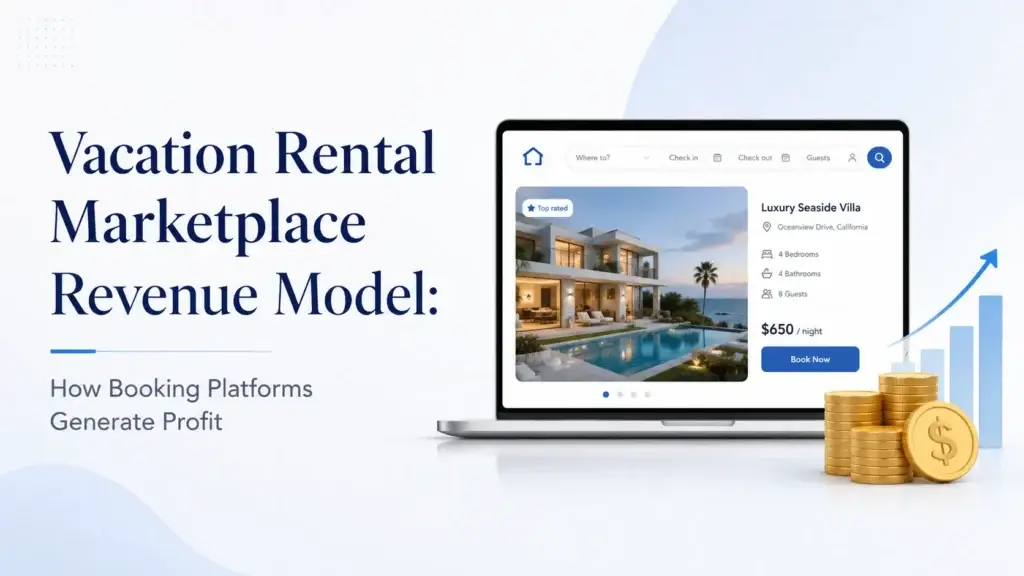
Vacation Rental Marketplace Revenue Model: How Booking Platforms Generate Profit
Last Updated on August 24, 2026 by sakshi Key Takeaways A vacation rental marketplace connects…
How Niche Rental Marketplaces Are Changing the Modern Travel Booking Experience
Last Updated on August 24, 2026 by Yash Narayan Key Takeaways A niche rental marketplace…

What Is a Vacation Rental Booking App? How Search, Listings, Calendars, and Payouts Work
Last Updated on August 24, 2026 by Yash Narayan Key Takeaways A vacation rental booking…

Rental Marketplace Marketing Strategy: How to Attract Hosts, Guests, and Repeat Bookings
Last Updated on August 26, 2026 by Yash Narayan Key Takeaways A rental marketplace marketing…

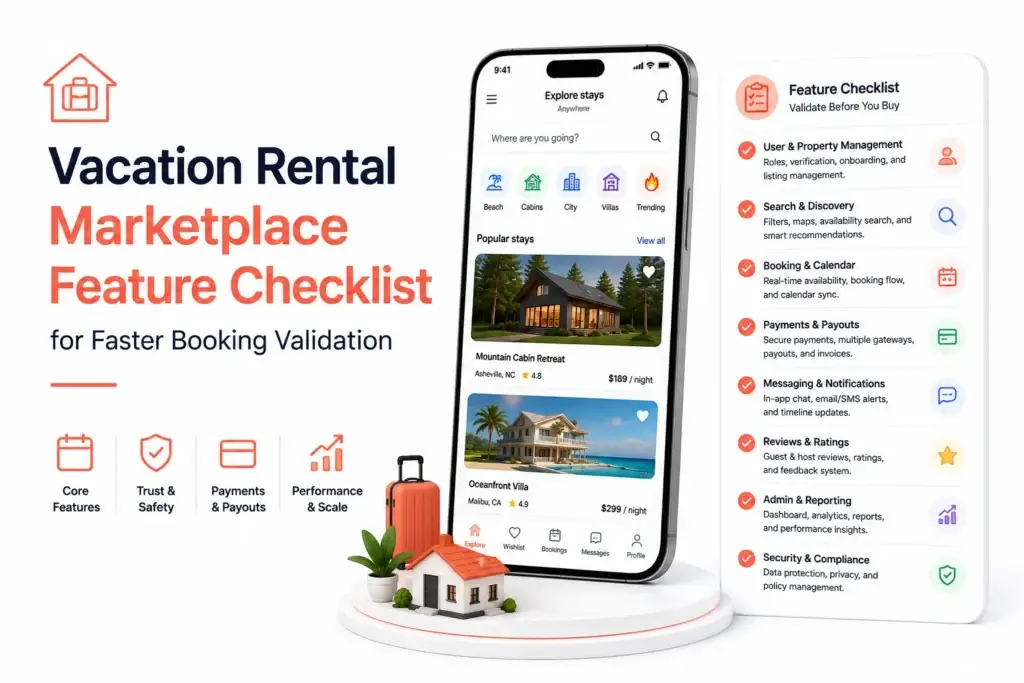
Vacation Rental Marketplace Feature Checklist for Faster Booking Validation
Last Updated on August 22, 2026 by Yash Narayan Key Takeaways A vacation rental marketplace…
FAQ
Airbnb Clone FAQ: Pricing, Service Types, Payments & Deployment
Everything you need to know about the Miracuves Airbnb Clone.
A ready-made rental marketplace where guests search and book, hosts list inventory and receive payouts, and you take commission on each transaction. This one covers seven bookable service types on one engine: stays, spaces, cars, tours, boats, events and flights, with a guest web app, a host console, an operator admin of more than twenty modules, and Android and iOS builds against the same REST API.
The white-label platform starts from $3,099 as a one-time purchase, deployed in 6 working days with your branding on your own hosting. Custom work beyond the base is quoted at 2 to 8 weeks depending on scope, and anything larger is scoped and quoted in writing before it starts.
No. Every service module can be switched off in the admin, which removes it from search, navigation and the host console. Most operators launch with one or two and enable more once supply exists. Enabling one later needs no rebuild, because they all share the same booking, payment and payout path.
Same underlying platform, different framing. The 9flats Clone page is written for operators thinking in terms of apartment and private-room inventory in European city markets. This page leads on the multi-service side: stays plus tours, mobility and charters on one engine. Choose by which description matches your supply, because the delivered system is the same product at the same price.
Yes. You receive the complete Laravel 10 codebase with no encrypted files, plus the mobile app source, the database schema with migrations and the upgrade scripts, transferred to your own account on handover. There is no per-booking fee and no dependency on us to keep it running.
Six ship pre-integrated: Stripe, PayPal, PayStack for African markets, Payrexx for European methods, an offline bank transfer flow with manual admin confirmation, and the platform wallet. Additional local rails are a customization, and because gateways sit behind a common interface, adding one does not change the booking flow.
Host earnings accumulate net of commission and fees, calculated per booking at the rate stored on that booking. The host requests a payout from their dashboard, you review it in the payout queue and mark it complete once the transfer is made. Bank transfer and PayPal are supported out of the box, and payout history is retained for reporting and tax.
Availability is validated at request time against the per-service date tables and existing bookings, not read from a cached flag, and room-level synchronization prevents a clash inside a single property. Where you also sell through OTAs, iCal export keeps external calendars in step, and a two-way channel manager is available as an add-on.
Yes, and at entity level rather than interface strings alone. Each listing, page and category carries its own per-locale content, with fifteen languages pre-configured and right-to-left layout supported for Arabic and Hebrew. Adding a language is an admin action, not a deployment.
Yes, globally or per host, as a percentage or a fixed amount. The rate is written onto each booking at the moment it is made, so changing it affects future bookings only and never rewrites what a host already earned. That is what keeps historical reporting and payout records defensible.
It carries bcrypt password hashing, two-factor authentication, role-based access control, Sanctum API tokens, HTML Purifier on rich content, Eloquent parameterized queries throughout, magic-byte file validation and signature-verified payment webhooks. Card data never reaches your database, which keeps PCI scope reduced. We build to the controls the common frameworks require; we do not hold an ISO 27001 certificate and do not claim one.
Yes. Android and iOS builds ship branded with your name, icon, splash screen and colour scheme, and store submission is handled as part of publishing support, including review responses and the metadata reviewers ask for.
Sixty days of launch guidance, six months of priority bug fixes and twelve months of product evolution updates. First response is under two hours, Monday to Saturday, 10:00 to 19:00 IST.
Let's turn your idea into
a live platform.
Get a free consultation, a clear timeline, and honest answers. We'd rather earn your trust than rush a sale.
Go deeper on this platform
The detail pages, the guides behind it, and where it fits.
Travel app development
See the service→ Case studyA short-stay rental and hotel booking platform, built on this product
Read the case study→ Talk to an expert →Business model
How this kind of platform is structured and where its revenue comes from.
Read the guide→ ProductFeatures
Every feature by role across seven service types, six payment gateways and more than twenty admin modules, plus what the base package leaves out.
See the full breakdown→ GuideFeatures and pricing
What a ready-made script includes and what it costs.
Read the guide→Travel and hospitality
See the industry→ GuideHow it works
The user journey, the core mechanics and what sits behind them.
Read the guide→ ProductDevelopment Company
Agency vs. freelancer vs. Miracuves compared, plus the territorial-rights and money-safety checks to run before you hire anyone.
Compare options→Development Cost
Our fixed $3,099 price against agency and custom-build ranges, plus the 6-day path to live and why the number is fixed rather than "starting at".
See exact pricing→ GuideRevenue model
The income streams and fee structure, broken down.
Read the guide→ ProductBusiness Model
Four revenue lines on one ledger covering commission, host plans, platform fees and featured placement, and why seven service types on one checkout changes the maths.
See the playbook→Miracuves is an independent software development company. We are not affiliated with, connected to, sponsored by, or endorsed by Airbnb.
“Airbnb Clone” is used descriptively. It is how the software industry refers to building a platform with functionality similar to Airbnb, and how clients search for it.
The entire design and codebase is built by our own team. The product contains no code, design, graphics, or content originating from the Airbnb website or applications.
Airbnb and all other third-party names and marks are the property of their respective owners, referenced here solely to describe the category of software offered.
