

Key Takeaways
- A Sugar Daddy app needs secure dating and matchmaking flows.
- Profiles, verification, chat, search, and subscriptions are core features.
- Privacy and safety controls are essential from launch.
- Monetization can include premium plans, boosts, and paid messaging.
- A focused launch scope helps reduce dating app development risk.
Feature Signals
- Users need signup, profile setup, search, matching, and chat.
- Admins need control over users, reports, payments, and moderation.
- Verification helps reduce fake profiles and scam activity.
- Blocking, reporting, and privacy settings improve user safety.
- Push notifications help improve matches, chats, and engagement.
Real Insights
- Dating platforms need trust before user growth.
- Weak verification can increase fake profile risks.
- Poor moderation can damage platform reputation quickly.
- Clear subscription rules help avoid payment disputes.
- Miracuves builds Sugar Daddy apps with secure dating workflows.
Building a Sugar Daddy App is not the same as building a generic swipe-based dating platform. The product sits inside a sensitive niche where users expect privacy, verified profiles, clear relationship preferences, premium access, and strong safety controls. For developers and founders, the challenge is not only matching people. The real challenge is building trust at every step.
A Sugar Daddy App should be designed as a niche dating platform for adults who want transparent, consent-based, lifestyle-oriented connections. That means the product needs responsible positioning, strict age controls, privacy-first design, safe messaging, moderation workflows, payment control, and clear community guidelines.
The dating app market has become more niche-driven, with users increasingly looking for platforms that match specific interests, goals, and relationship expectations. Broad dating apps still dominate, but vertical dating products can compete by offering stronger user intent and more tailored experiences. Recent dating app guides also show that safety, privacy, monetization, and phased product planning are now central to successful dating app development.
For founders planning to launch faster, Miracuves can help create a white-label dating app foundation with branded design, source code, admin control, and monetization-ready workflows.
What Is a Sugar Daddy App and Why Is It Different From a Generic Dating App?
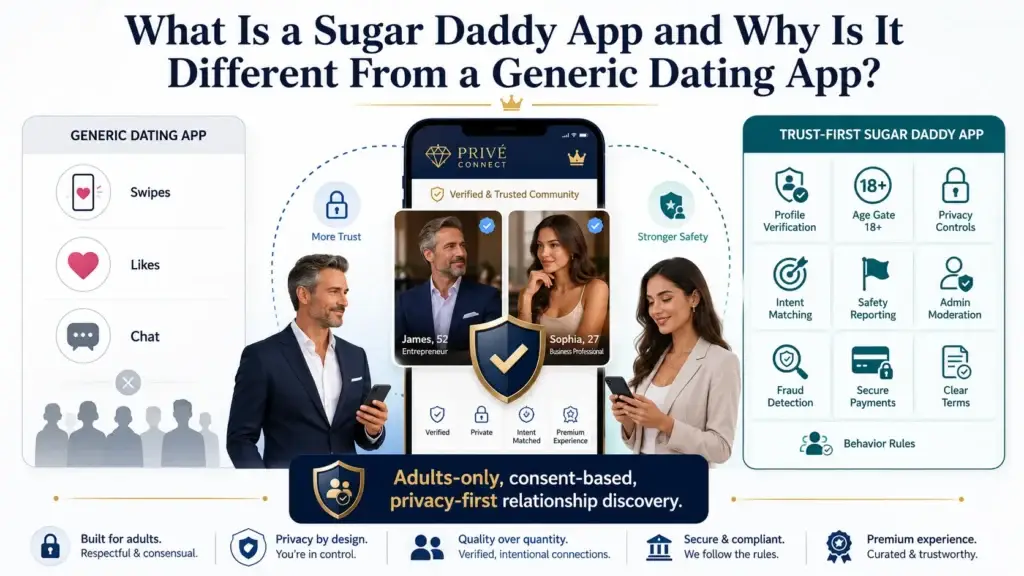
Image Source: AI-generated visual by Miracuves
A Sugar Daddy App is a niche dating platform designed for adults interested in lifestyle-based, mutually understood relationship preferences. Unlike generic dating apps that usually focus on casual discovery, serious relationships, or social matching, this category needs more careful product planning because user expectations involve privacy, profile authenticity, premium access, and transparent communication.
The app should never be positioned as a platform for escorting, paid sexual services, exploitation, or unsafe arrangements. A responsible Sugar Daddy dating app should focus on legal, adults-only, consent-based dating and relationship discovery.
From a development perspective, this changes the product architecture. A normal dating app may prioritize swipes, chat, and likes. A Sugar Daddy App also needs:
- Strong profile verification
- Age-gated onboarding
- Privacy controls
- Intent-based matching
- Safety reporting
- Admin moderation
- Fraud detection
- Secure payments
- Clear terms of service
- Content and behavior guidelines
This is why developers should treat the product as a trust-first dating ecosystem, not just a feature clone.
Read More: Finding Love Is a Science: Build a Dating App That Actually Matches
Why Founders Are Exploring Niche Dating App Development
Niche dating platforms are attractive because they serve users with specific intent. Instead of competing directly with broad dating apps, a founder can build around a focused audience, clearer value proposition, and stronger monetization behavior.
A general dating app has to serve everyone. A niche dating app can serve a specific relationship style, lifestyle preference, geography, community, or social segment. That gives founders a sharper product angle.
For a Sugar Daddy App, the business opportunity usually comes from:
- Premium user expectations
- Higher willingness to pay for privacy and verification
- Stronger demand for filtered discovery
- Paid visibility and profile boosts
- Subscription-based communication access
- Verified member communities
- Luxury dating positioning
However, the niche also carries higher operational responsibility. Founders need to think about safety, platform reputation, content moderation, app store compliance, user verification, and payment policies from day one.
Core Features Every Sugar Daddy App Should Include
A successful Sugar Daddy App needs features for users, premium members, administrators, moderation teams, and platform operators. The feature set should support discovery, communication, trust, monetization, and safety.
Core Sugar Daddy App Features and Business Value
| Feature | Business Value | Founder Impact |
|---|---|---|
| Age-Gated Registration | Ensures the app is restricted to adults only. | Reduces legal and safety risk from the first interaction. |
| Profile Creation | Allows users to present lifestyle preferences, interests, photos, and relationship goals. | Improves match relevance and user confidence. |
| Profile Verification | Helps reduce fake profiles, bots, impersonation, and scams. | Builds trust and improves premium conversion. |
| Advanced Search Filters | Lets users filter by location, age range, interests, lifestyle preferences, and verification status. | Makes discovery faster and more valuable for paid users. |
| Matching Engine | Connects users based on preferences, proximity, activity, and compatibility signals. | Improves engagement and repeat app usage. |
| Secure In-App Chat | Keeps communication inside the platform with moderation and safety controls. | Protects users while supporting retention and monetization. |
| Photo Privacy Controls | Allows users to hide, blur, or selectively share private images. | Supports user comfort in a privacy-sensitive category. |
| Premium Memberships | Enables recurring revenue through exclusive filters, messages, boosts, and visibility. | Creates predictable monetization. |
| Abuse Reporting | Lets users report harassment, scams, impersonation, or unsafe behavior. | Protects platform reputation and improves trust. |
| Admin Dashboard | Controls users, subscriptions, reports, verification, content, payments, and analytics. | Gives founders operational control without depending on developers for every action. |
User App Features
The user-facing app should feel premium, private, and easy to use. Users should be able to create profiles, browse relevant matches, control privacy, communicate safely, and upgrade when they see value.
Important user app features include:
- Email, phone, Apple, Google, or social login
- Adult-only onboarding confirmation
- Profile setup with photos, interests, lifestyle preferences, and relationship goals
- Verification badges
- Location-based discovery
- Search filters
- Likes, favorites, and profile saves
- Real-time chat
- Voice notes or video call options where appropriate
- Profile boost
- Private photo sharing controls
- Block and report buttons
- Subscription management
- Push notifications
- Account deletion and privacy settings
The first user experience matters. If onboarding feels unsafe or confusing, users leave. If the app asks for too much too early, privacy-conscious users may hesitate. The goal is to collect enough data for match quality without creating friction.
Matching and Discovery Features
The matching engine is where a Sugar Daddy App becomes more than a directory. It should help users discover compatible profiles based on intent, location, verification, preferences, and engagement signals.
Developers can start with rule-based matching and later add AI-supported recommendations.
A practical matching system may include:
- Location radius
- Age range
- Profile intent
- Lifestyle interests
- Verification status
- Recent activity
- Premium visibility
- Mutual likes
- Profile completeness
- Safety score or trust signals
For niche dating apps, matching quality is more important than showing endless profiles. If users see irrelevant or low-quality profiles, they lose trust quickly. A smaller number of better matches can outperform a large feed of weak suggestions.
Messaging and Communication Features
Real-time chat is one of the most important modules in a Sugar Daddy App. It must be fast, private, safe, and controllable.
Core chat features include:
- One-to-one messaging
- Media sharing controls
- Message requests
- Read receipts
- Typing indicators
- Voice notes
- Optional video calls
- Chat limits for free users
- Premium messaging access
- Automated scam warnings
- Report, block, and mute options
Developers should also think about moderation. For example, if users exchange suspicious payment language, harassment, spam, external contact requests, or unsafe content, the app should support automated flagging and manual review workflows. The goal is not to invade privacy, but to protect users and maintain platform integrity.
Admin Dashboard Features
The admin dashboard is the control center of the Sugar Daddy App. Many founders underestimate this part because users do not see it. In reality, the admin panel decides whether the platform can operate safely and scale.
A strong admin dashboard should include:
- User management
- Profile approval
- Verification review
- Report management
- Subscription control
- Payment and refund overview
- Content moderation queue
- Blocked user records
- Revenue analytics
- Match and engagement analytics
- Push notification control
- Role-based admin access
- Audit logs
- Community guideline enforcement
- Country or region-based configuration
For founders, admin control matters because niche dating apps require active governance. Without admin visibility, the platform becomes difficult to manage after launch.
Developer Architecture: How a Sugar Daddy App Works Behind the Scenes
A Sugar Daddy App usually includes mobile apps, backend services, real-time communication infrastructure, payment systems, admin dashboards, databases, and moderation workflows.
A clean architecture may include:
- Mobile frontend for iOS and Android
- Backend API for user, profile, match, chat, and payment logic
- Database layer for profiles, preferences, subscriptions, reports, and admin data
- Real-time messaging service for chat, typing indicators, and notifications
- Media storage for photos, videos, and verification files
- Payment gateway for subscriptions and in-app purchases
- Notification service for reminders, matches, and messages
- Moderation layer for reports, flags, and admin review
- Analytics layer for retention, conversion, and engagement metrics
GoodFirms’ 2026 dating app development guide lists a scalable dating app stack using React Native or Flutter, Node.js, PostgreSQL, Redis, Socket.IO, WebRTC, JWT, and OAuth 2.0. That stack direction works well for real-time, cross-platform dating apps when implemented carefully.
Suggested Backend Modules
A developer-friendly Sugar Daddy App backend can be divided into modules:
| Backend Module | What It Handles |
|---|---|
| Authentication Module | Login, signup, password reset, OTP, social login |
| User Profile Module | Photos, bio, preferences, interests, profile completion |
| Verification Module | Age checks, selfie verification, document review where applicable |
| Discovery Module | Search, filters, recommendations, geolocation |
| Matching Module | Likes, matches, compatibility signals, premium visibility |
| Chat Module | Real-time messages, media controls, blocks, reports |
| Subscription Module | Plans, renewals, upgrades, billing history |
| Payment Module | Gateway integration, refunds, transaction status |
| Moderation Module | Reports, flagged content, banned users, appeal workflows |
| Admin Module | Dashboard, roles, analytics, controls, configuration |
| Notification Module | Push notifications, email alerts, engagement triggers |
| Analytics Module | User activity, conversion, churn, retention, revenue |
This modular approach keeps the app easier to maintain. It also allows founders to launch with essential modules first and add advanced features later.
Safety, Verification, and Privacy Layers You Cannot Ignore
Safety is not a bonus feature in a Sugar Daddy App. It is part of the product foundation.
Because niche dating apps deal with identity, privacy, and relationship expectations, users need reassurance that the platform is managed responsibly. Developers should build safeguards into onboarding, profile management, messaging, payments, and admin operations.
Important safety layers include:
- 18+ age-gated onboarding
- Profile verification
- Selfie or video verification
- Phone and email verification
- Suspicious activity detection
- Fake profile reporting
- Block and mute controls
- Harassment reporting
- Manual moderation queues
- Community guidelines
- Privacy settings
- Secure password handling
- Encrypted data transfer
- Role-based admin access
- Audit logs
- Account deletion workflows
A responsible app should also include clear terms stating that the platform is for lawful, consensual adult dating and does not permit exploitation, harassment, trafficking, escorting, paid sexual services, or illegal activity.
Final legal compliance depends on jurisdiction, app store rules, payment provider policies, privacy laws, legal review, and the operating model.
Read More: Dating App Development: A Comprehensive Guide to Building Your Own Platform
Founder Decision Signals Speed
If you need to validate a niche dating idea quickly, a ready-made dating app foundation can reduce the time spent building basic profile, chat, matching, and admin modules from zero.
Cost
Cost depends on feature scope, platforms, verification depth, payment logic, moderation workflows, and customization requirements. Avoid building advanced AI or video features before validating demand.
Scalability
A Sugar Daddy App should be built with scalable chat, media storage, search, subscriptions, and moderation workflows because trust issues increase as the user base grows.
Market Fit
The strongest signal is not downloads. It is whether verified users return, complete profiles, start safe conversations, and pay for premium discovery or communication features.
Speed
If you need to validate a niche dating idea quickly, a ready-made dating app foundation can reduce the time spent building basic profile, chat, matching, and admin modules from zero.
Cost
Cost depends on feature scope, platforms, verification depth, payment logic, moderation workflows, and customization requirements. Avoid building advanced AI or video features before validating demand.
Scalability
A Sugar Daddy App should be built with scalable chat, media storage, search, subscriptions, and moderation workflows because trust issues increase as the user base grows.
Market Fit
The strongest signal is not downloads. It is whether verified users return, complete profiles, start safe conversations, and pay for premium discovery or communication features.
Monetization Models for a Sugar Daddy App
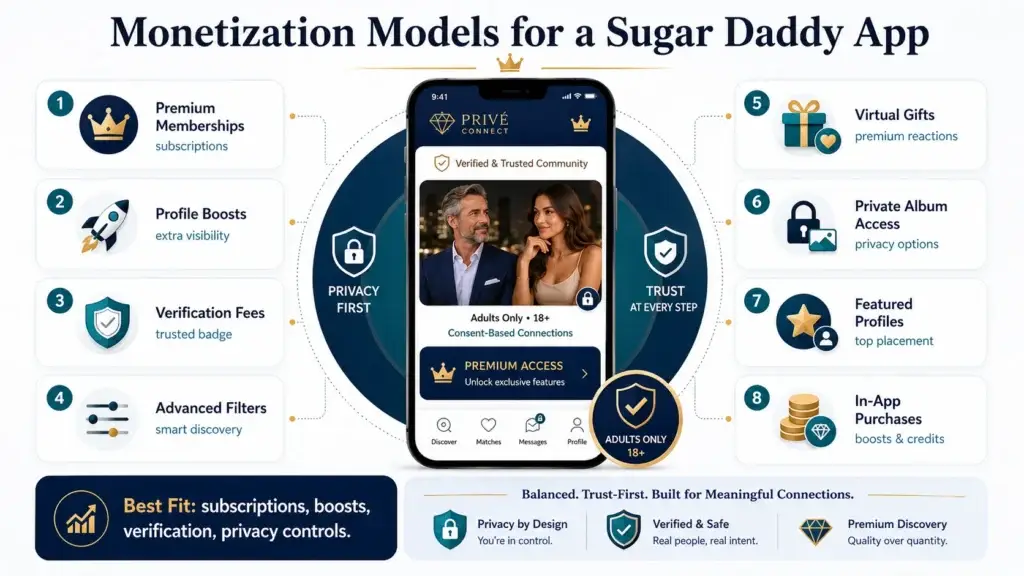
Image Source: AI-generated visual by Miracuves
A Sugar Daddy App usually has stronger monetization potential than a generic dating app because users expect premium access, privacy, and better discovery. However, monetization should be introduced carefully. If every useful action is locked too early, users may leave before seeing value.
Common monetization models include:
1. Premium Memberships
Users pay monthly, quarterly, or yearly for advanced features such as unlimited messaging, advanced filters, profile visibility, read receipts, and priority support.
2. Profile Boosts
A boost increases profile visibility for a limited time. This works well when the app already has enough active users in a location.
3. Verification Fees
The platform can offer optional premium verification to improve trust. This should be handled carefully and transparently.
4. Advanced Search Filters
Premium users can filter by verification status, distance, activity, lifestyle preferences, or profile completeness.
5. Virtual Gifts
Users can send virtual gifts, stickers, or premium reactions. This can support engagement, but the design should avoid manipulative patterns.
6. Private Album Access
Users can control who sees private photos. Premium access can include more privacy options, not forced exposure.
7. Featured Profiles
Users can pay for temporary placement in discovery sections.
8. In-App Purchases
One-time purchases can include boosts, super likes, profile highlights, or message credits.
Galaxy Weblinks’ dating app guide also identifies common monetization routes such as advertising, freemium models, subscriptions, and premium features. For a Sugar Daddy App, subscriptions, boosts, verification, and premium privacy controls are usually more aligned than broad advertising.
Sugar Daddy App Tech Stack: What Developers Should Consider
The right tech stack depends on budget, team skills, platform scope, performance expectations, and future roadmap.
A practical Sugar Daddy App tech stack can look like this:
| Layer | Recommended Options | Why It Matters |
| Mobile App | Flutter, React Native, Swift, Kotlin | Supports iOS and Android app experiences |
| Backend | Node.js, Laravel, Django, Spring Boot | Handles APIs, matching, chat, payments, and admin logic |
| Database | PostgreSQL, MySQL, MongoDB | Stores users, profiles, matches, subscriptions, and reports |
| Real-Time Chat | Socket.IO, Firebase, WebSockets | Enables instant messaging and live interaction |
| Cache | Redis | Improves performance for feeds, sessions, and active users |
| Media Storage | AWS S3, Google Cloud Storage, Azure Blob | Stores profile photos, videos, and verification media |
| Search | Elasticsearch, OpenSearch, database indexing | Powers filters and discovery |
| Payments | Stripe, Razorpay, Apple IAP, Google Play Billing | Supports subscriptions and in-app purchases |
| Notifications | Firebase Cloud Messaging, APNs | Sends match, message, and engagement alerts |
| Analytics | Firebase Analytics, Mixpanel, custom dashboards | Tracks retention, churn, conversion, and engagement |
| Admin Panel | React, Vue, Angular, Laravel Nova, custom dashboard | Gives operators control over users, moderation, and revenue |
The stack should be selected based on business priorities. A founder testing one city does not need the same infrastructure as a global dating platform. Start with a stable foundation, then scale based on real usage.
How Much Does It Cost to Build a Sugar Daddy App?
The cost to build a Sugar Daddy App depends on scope, platform, design, verification depth, chat features, payment integrations, admin controls, and moderation requirements.
Do not estimate cost only by screens. A simple-looking dating app can become expensive if it includes real-time chat, video calls, AI matching, geolocation, identity verification, subscriptions, and advanced moderation.
GoodFirms states that dating app development can range from smaller first versions to full-featured platforms, with cost varying by features, tech stack, development team, and ongoing post-launch needs. Galaxy Weblinks also notes that dating app cost varies based on complexity, developer location, selected platform, and technology choices.
Key Cost Factors
| Cost Factor | Why It Affects Budget |
| Platform Choice | iOS, Android, and web each add design, testing, and development scope. |
| UI/UX Design | Premium dating apps require polished, trust-building design. |
| Profile Verification | Age checks, selfie review, or document verification increase complexity. |
| Real-Time Chat | Messaging, media sharing, typing indicators, and read receipts require backend infrastructure. |
| Geolocation | Nearby discovery, distance filters, and location privacy need careful implementation. |
| Payment Integration | Subscriptions, in-app purchases, refunds, and renewals require secure payment logic. |
| Admin Dashboard | Moderation, reporting, analytics, and user controls add backend and frontend work. |
| Safety Features | Abuse reports, fraud flags, and moderation queues require workflow design. |
| AI Matching | Recommendation logic increases data, algorithm, and testing requirements. |
| App Store Readiness | Review preparation, compliance language, and privacy policies require careful planning. |
Cost Logic for Founders
A custom build gives maximum flexibility but takes longer and costs more because every module is built from the ground up. A white-label dating app foundation can reduce development effort because core flows such as profile creation, matching, chat, subscriptions, and admin controls may already exist.
Miracuves’ ready-made approach can help founders reduce launch complexity because the foundation already includes core app flows, admin control, and essential dating modules. Final pricing should be confirmed based on selected features, integrations, branding, and customization requirements.
Custom Development vs White-Label Sugar Daddy App Solution
Founders usually have two main options: build from scratch or customize a ready-made dating app foundation.
| Build Option | Best For | Advantages | Tradeoffs |
| Fully Custom Development | Founders with unique product logic, deep funding, and longer timelines | Maximum flexibility, custom architecture, unique UX | Higher cost, longer development, more testing, higher early risk |
| White-Label Dating App | Founders who want faster validation and proven dating workflows | Faster launch, existing modules, source-code ownership, branded experience | Requires customization to match niche, policies, and positioning |
| Hybrid Approach | Founders who want speed now and custom upgrades later | Launch faster, validate market, then improve based on data | Needs roadmap discipline and scalable architecture |
For most founders, the stronger decision is not always the longest build. It is the build that gets a safe, usable, monetization-ready product into the market with enough control to improve after launch.
A related Miracuves resource on Tinder Clone app development can help founders understand how matching, chat, subscriptions, and admin workflows work in a ready-made dating app foundation.
App Store and Policy Considerations for Sugar Daddy Apps
Sugar Daddy App development needs careful app store positioning. Apple and Google review dating apps based on safety, content, privacy, user-generated content controls, payment rules, and policy compliance.
Before submission, make sure the app includes:
- Clear 18+ age policy
- Terms of service
- Privacy policy
- Community guidelines
- User blocking
- Report abuse feature
- Moderation process
- No illegal or exploitative positioning
- Safe payment flow
- Account deletion option
- Data handling transparency
The app description should focus on luxury dating, relationship discovery, verified profiles, privacy, and safe communication. Avoid language that suggests escorting, paid sexual services, coercion, exploitation, or illegal arrangements.
Mistakes Founders Should Avoid When Building a Sugar Daddy App
Mistakes Founders Should Avoid
1. Building the App Around Monetization Before Trust
If users do not trust the platform, they will not pay. Verification, privacy, profile quality, and safe messaging should come before aggressive subscription locks.
2. Ignoring Age Verification and Safety Controls
A Sugar Daddy App must be adults-only and safety-conscious. Weak onboarding and missing reporting tools can create serious platform risk.
3. Copying a Generic Dating App Without Niche Logic
This audience expects premium discovery, verified profiles, privacy, and clear intent. A basic swipe clone will feel shallow.
4. Launching Without Admin Moderation Workflows
Reports, suspicious behavior, fake profiles, refunds, and user disputes need admin visibility from day one.
5. Using Risky App Store Language
The app should be positioned as a lawful, consent-based adult dating platform. Poor wording can create review, payment, and reputation issues.
How Miracuves Helps Build Niche Dating Apps Faster
Miracuves helps founders build ready-made and white-label app solutions with source code, branded design, admin dashboards, monetization workflows, and faster deployment. For a Sugar Daddy App, the right foundation can include dating app modules such as profiles, matching, chat, subscriptions, premium features, admin control, and user management.
Instead of starting from zero, founders can use a ready-made dating app base and customize it for luxury dating, verified profiles, privacy-first discovery, and niche relationship preferences.
For broader dating app planning, explore Miracuves’ dating app development services If your product is closer to swipe-based matching, Miracuves’ Tinder Clone app can provide a useful foundation for matching, chat, premium subscriptions, and admin workflows.
Final Thoughts: Build a Sugar Daddy App With Trust, Privacy, and Control
The real challenge in building a Sugar Daddy App is not creating profiles or adding chat. Those are expected features. The harder and more important work is building a platform users can trust.
A strong Sugar Daddy dating app needs verified profiles, secure messaging, privacy controls, safe discovery, monetization logic, admin moderation, and responsible positioning. Developers should think beyond screens and build the control layers that protect users, support growth, and help founders manage the platform after launch.
For founders, the best path depends on budget, launch pressure, customization needs, and risk tolerance. A fully custom app gives maximum flexibility. A white-label dating app foundation from Miracuves can help you move faster, validate demand, and customize the product around your niche without starting from zero.
FAQ
What is a Sugar Daddy App?
A Sugar Daddy App is a niche dating platform for adults interested in lifestyle-based, mutually understood relationship preferences. It should be built as a legal, consent-based dating platform with verification, privacy, messaging, and safety controls.
How do you build a Sugar Daddy App?
To build a Sugar Daddy App, start with market positioning, user flows, profile features, matching logic, real-time messaging, payment integration, verification, admin dashboard, and moderation workflows. Developers should also prepare privacy policies, terms of service, app store language, and safety controls before launch.
What are the must-have features of a Sugar Daddy App?
Must-have features include adult-only onboarding, profile creation, verification badges, search filters, location-based discovery, secure chat, premium subscriptions, profile boosts, privacy settings, reporting tools, and an admin dashboard.
How much does it cost to develop a Sugar Daddy App?
The cost depends on features, platform, tech stack, design complexity, payment integrations, verification depth, chat infrastructure, admin dashboard, and moderation requirements. A ready-made dating app foundation can reduce development effort compared with building every module from scratch.
Is a Sugar Daddy App legal?
A Sugar Daddy App can be legal when positioned and operated as a lawful adults-only dating platform. However, compliance depends on jurisdiction, app policies, payment provider rules, privacy laws, legal review, and operating model. The app should not support exploitation, escorting, paid sexual services, harassment, trafficking, or illegal activity.
What tech stack is best for a Sugar Daddy App?
A practical stack may include Flutter or React Native for mobile apps, Node.js or Laravel for backend, PostgreSQL or MySQL for databases, Redis for caching, Socket.IO or WebSockets for chat, Firebase or APNs for notifications, and Stripe, Razorpay, Apple IAP, or Google Play Billing for payments.
How can a Sugar Daddy App make money?
A Sugar Daddy App can monetize through premium subscriptions, profile boosts, verification badges, advanced filters, private album controls, virtual gifts, and featured profiles. Subscription-based monetization usually works best when users already trust the platform and see value.
Can Miracuves build a white-label Sugar Daddy App?
Yes. Miracuves can help founders build a white-label niche dating app foundation with source code, branded design, admin control, matching workflows, chat, subscriptions, and customization support based on the selected launch scope.
Create engaging social experiences with Miracuves – crafted for connection, interaction, and user growth:
Facebook Like Network – A social network built for connecting users, sharing content, and fostering digital communities.
LinkedIn Like Network – A professional network focused on career development, industry engagement, and showcasing expertise.
Twitter Like Network – A microblogging network enabling real-time conversations, trending topics, and fast-paced communication.
Tinder Like Network – A dating network built for smart discovery, quick matches, and easy connections.
Miracuves is an independent software development company. We are not affiliated with, connected to, sponsored by, or endorsed by any company or product named in this article.
Terms such as “X Clone” are used descriptively. It is how the software industry refers to building a platform with functionality comparable to a known service, and how clients search for it.
The entire design and codebase of our products is built by our own team. Our products contain no code, design, graphics, or content originating from any third-party website or applications.
All third-party names and marks referenced in this article are the property of their respective owners, referenced solely to identify the services discussed.