


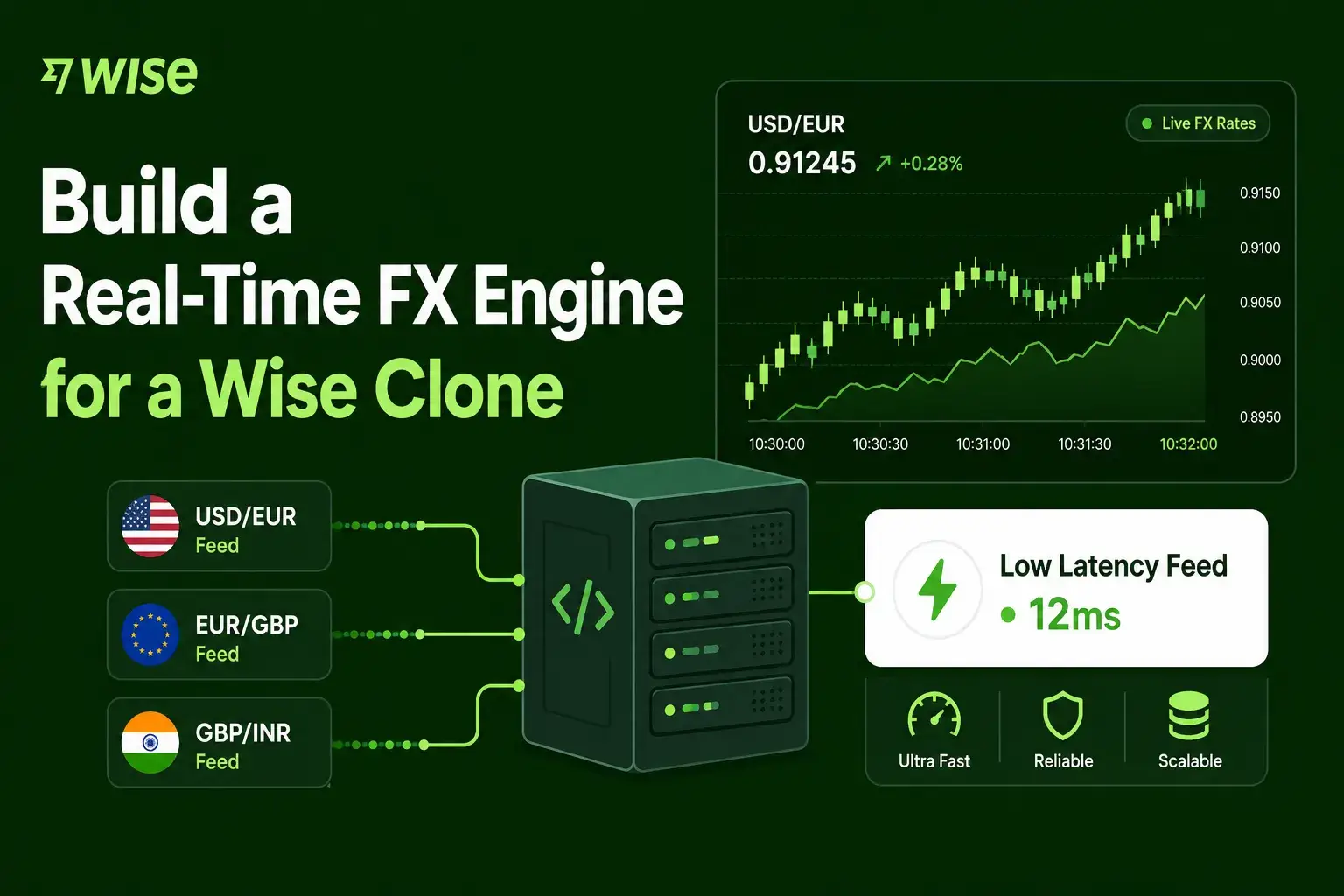
A Wise clone is not just a remittance app with attractive screens. The real product intelligence sits behind the interface: exchange-rate feeds, quote creation, spread logic, transfer fees, payout routing, transaction monitoring, and admin controls.
For developers, real-time foreign exchange API integration is one of the most important layers in a Wise-style money transfer platform. If the FX engine uses stale rates, fails to lock quotes correctly, or applies spreads inconsistently, the business can lose money on every transaction. If the architecture is too slow, users may see one rate on the calculator and another rate during checkout. That damages trust quickly.
Wise’s own API documentation shows how current and historical exchange rates can be retrieved through rate endpoints, including currency-pair-specific and timestamp-based queries. This confirms why rate access, historical lookup, and quote timing must be treated as core fintech infrastructure, not a secondary feature.
For founders planning a remittance product, a Wise clone solution needs more than currency conversion. It needs a low-latency FX engine that can ingest rates, validate them, apply business rules, lock customer quotes, and keep a traceable record of every pricing decision.
Key Takeaways
- Real-time foreign exchange API integration helps Wise clone platforms show accurate currency rates, calculate quotes, and reduce stale-rate risk.
- A strong FX engine should separate rate ingestion, normalization, caching, quote generation, spread calculation, and transaction audit logs.
- REST APIs are useful for structured requests, while WebSocket feeds are better for live updates and low-latency rate movement.
- Quote locking, expiry windows, spread rules, and fallback providers protect both user trust and business margin.
- Miracuves helps founders build fintech-ready remittance app foundations with source-code ownership, admin control, and launch-ready architecture.
Why the FX Engine Is the Core of a Wise Clone
In a normal app, pricing can be static. In a remittance app, pricing changes constantly.
The FX engine decides:
- What rate the user sees
- How long that rate remains valid
- What margin or spread is applied
- Whether a quote can still be honored
- How much the recipient receives
- Whether the platform earns or loses margin
- How the transaction is recorded for audit and dispute handling
A Wise-style app needs transparent currency conversion, fast quote generation, and reliable rate updates. Competitor Wise clone pages often mention “currency converter” and “rate alerts,” but they rarely explain the engine that powers those features. Suffescom, for example, lists multi-currency accounts, real-time rate alerts, currency converter, payment methods, money transfer, admin dashboard, and revenue models, but the public page does not deeply explain the FX feed architecture behind these features.
For a fintech founder, that missing layer is critical. Users do not only care that a calculator exists. They care that the final amount is predictable, fair, and consistent.
Core Architecture of a Real-Time FX Engine
A production-ready FX engine should not call an external exchange-rate API directly from the frontend. That creates latency, security, rate-limit, and consistency problems.
A better architecture uses backend services that ingest, validate, normalize, cache, and serve FX quotes through controlled internal APIs.
Recommended FX engine architecture
External FX Providers
|
v
Rate Ingestion Service
|
v
Rate Normalization Layer
|
v
Low-Latency Cache + Rate Store
|
v
Quote Engine
|
v
Spread + Fee Engine
|
v
Transfer Checkout API
|
v
Ledger + Audit Logs + Admin Dashboard
Each layer has a specific job.
| FX Engine Layer | Technical Role | Business Value |
|---|---|---|
| Rate ingestion service | Pulls or streams rates from providers | Keeps rate data fresh |
| Normalization layer | Converts provider formats into internal schema | Prevents provider lock-in |
| Rate cache | Stores latest rates for fast access | Reduces latency and API dependency |
| Quote engine | Creates customer-facing conversion quotes | Improves user trust |
| Spread engine | Applies markup, corridor rules, and business margin | Protects revenue |
| Transfer API | Uses locked quote during checkout | Prevents rate mismatch |
| Audit logs | Records rate source, timestamp, spread, and quote ID | Supports compliance and dispute handling |
| Admin dashboard | Lets operators manage corridors and spreads | Improves business control |
A ready-made fintech foundation from Miracuves can help founders avoid building every workflow from zero, especially when they need source-code ownership, branded apps, admin controls, and faster market validation.
REST vs WebSocket vs FIX for Foreign Exchange API Integration
The protocol choice depends on the product’s latency needs, provider access, and operational maturity.
REST APIs work well for request-response flows, while WebSocket APIs are useful when the system needs pushed live updates. A financial API architecture discussion from ipushpull explains that REST follows a request-response model, while WebSockets work alongside REST for pushed data such as market data and trade notifications.
Protocol comparison for a Wise clone FX engine
| Protocol | Best Use Case | Strength | Limitation |
|---|---|---|---|
| REST API | Fetch latest rate for a pair, historical rates, admin reports | Simple, stable, easier to integrate | Polling can increase latency and API calls |
| WebSocket | Stream live FX movements for active pairs | Lower latency, real-time updates | Requires connection management and reconnection logic |
| FIX API | Institutional trading and liquidity connectivity | High-performance financial messaging | More complex and costly to implement |
| Hybrid REST + WebSocket | Most fintech remittance apps | Practical balance of reliability and speed | Requires careful data consistency design |
For most Wise clone platforms, a hybrid model works best. Use REST for historical rates, fallback pulls, reports, and quote verification. Use WebSocket feeds for live rate ingestion where low latency matters.
Choosing the Right FX Rate Provider
An exchange-rate provider should not be selected only by price. A remittance platform needs accuracy, uptime, update frequency, currency coverage, historical data, commercial usage rights, and clear redistribution terms.
Xe, for example, describes its Currency Data API as supporting real-time, accurate exchange data, historical rates, monthly averages, volatility data, customizable margins, and developer SDKs. It also states that rates may update as often as every 60 seconds depending on package and configuration.
FX API provider evaluation checklist
| Evaluation Area | What Developers Should Check |
|---|---|
| Currency coverage | Does the provider support all send and receive corridors? |
| Update frequency | Are rates updated every few seconds, every minute, hourly, or daily? |
| Latency | What is the average and peak response time from your deployment region? |
| Rate type | Does the provider offer mid-market, bid/ask, bank, central bank, or blended rates? |
| Historical data | Can you retrieve past rates for reporting and disputes? |
| SLAs | Are uptime and support commitments suitable for fintech operations? |
| Redistribution rights | Can the app legally show rates to users? |
| SDK support | Are SDKs available for Node.js, Python, Java, PHP, or your stack? |
| Failover support | Can the provider work alongside secondary feeds? |
| Audit readiness | Can every quote be tied back to source, timestamp, and provider response? |
Do not assume that a free exchange-rate API is suitable for production remittance. Many free or low-cost APIs are useful for dashboards, SaaS tools, or prototypes, but production fintech apps need stronger guarantees.
Designing the Internal Rate Schema
Every provider returns rates differently. Some return base, target, and rate. Some return a large map of currencies. Some include timestamps. Some provide bid/ask rates. Others provide a blended rate.
A Wise clone should normalize all external provider responses into one internal schema.
Example internal rate schema
{
“pair”: “USD_INR”,
“base_currency”: “USD”,
“quote_currency”: “INR”,
“mid_rate”: 83.2451,
“bid_rate”: 83.2100,
“ask_rate”: 83.2800,
“provider”: “primary_fx_provider”,
“provider_rate_id”: “fx_20260522_153045_usd_inr”,
“received_at”: “2026-05-22T15:30:45Z”,
“valid_until”: “2026-05-22T15:31:15Z”,
“source_latency_ms”: 42,
“confidence_score”: 0.98
}
Why normalization matters
Without normalization, the quote engine becomes tightly coupled to one provider. That makes it harder to change providers, add a fallback feed, or compare rates. A normalized schema allows the platform to ingest multiple providers and still calculate quotes consistently.
For a fintech app, this is not just a clean-code decision. It is a risk-control decision.
Building the Rate Ingestion Service
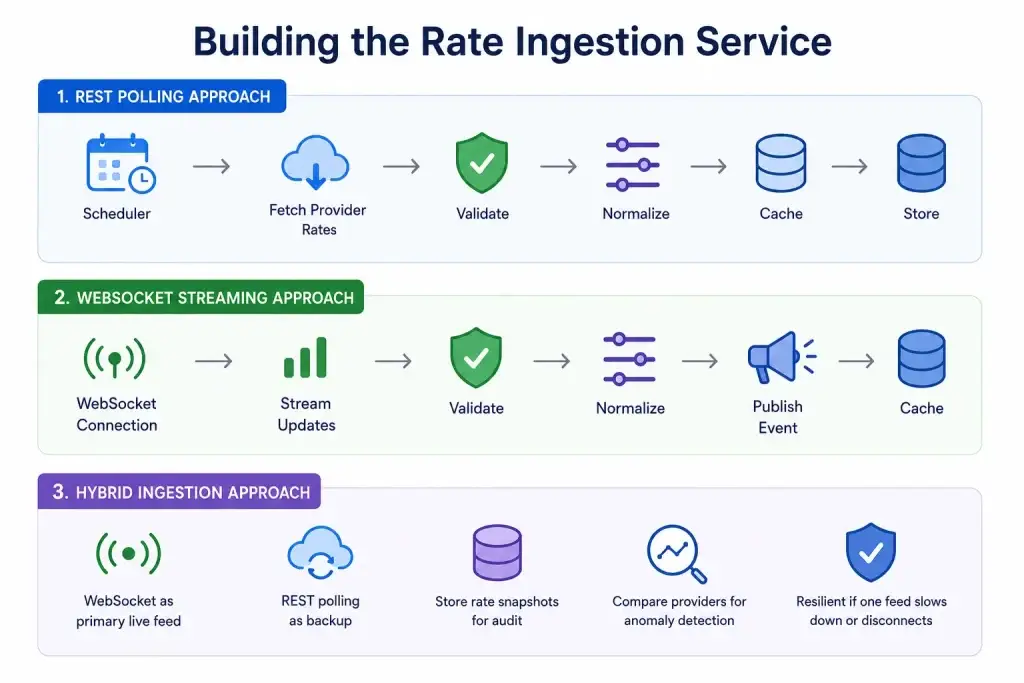
The rate ingestion service is responsible for collecting rates from external providers and feeding the internal FX system.
REST polling approach
REST polling is easier to start with. The service calls provider endpoints at fixed intervals, such as every 5 seconds, 15 seconds, or 60 seconds depending on the provider plan and business needs.
Scheduler → Fetch Provider Rates → Validate → Normalize → Cache → Store
REST polling is useful when:
- The provider does not support WebSocket streaming
- The app only supports limited currency corridors
- Quote refresh frequency is moderate
- Development simplicity matters
WebSocket streaming approach
WebSocket ingestion is better when the app needs more live movement tracking.
WebSocket Connection → Stream Updates → Validate → Normalize → Publish Event → Cache
WebSocket ingestion needs:
- Persistent connection handling
- Heartbeat checks
- Reconnection logic
- Message deduplication
- Sequence validation where supported
- Backpressure handling
- Monitoring and alerts
Hybrid ingestion approach
A hybrid approach is often strongest:
- Use WebSocket as the primary live feed
- Use REST polling as a backup
- Store rate snapshots for audit
- Compare provider responses for anomaly detection
This keeps the platform resilient if one feed slows down or disconnects.
Low-Latency Caching Strategy for FX Rates
The quote engine should not call the external provider every time a user opens the currency calculator. That creates unnecessary latency, cost, and failure risk.
Instead, use a low-latency cache such as Redis or an in-memory distributed cache.
Recommended cache keys
fx:latest:USD_INR
fx:latest:EUR_USD
fx:provider:primary:USD_INR
fx:provider:backup:USD_INR
fx:spread:USD_INR
fx:quote:quote_123456
Cache design principles
| Cache Rule | Why It Matters |
|---|---|
| Keep latest pair rate in memory | Enables fast calculator response |
| Use short TTLs for live rates | Reduces stale-rate exposure |
| Store provider timestamp | Prevents using old data unknowingly |
| Store quote separately from live rate | Protects locked checkout amount |
| Add fallback cache | Allows graceful degradation during outage |
| Monitor cache age | Alerts teams when feeds become stale |
A practical pattern is to cache the latest normalized rate and also persist periodic snapshots in the database. The cache serves speed. The database serves traceability.
Quote Locking: The Most Important User Trust Layer
The live FX rate and the customer quote are not the same thing.
A live rate keeps moving. A quote is a business commitment for a limited time.
When the user enters “send $500 to India,” the quote engine should calculate:
- Current mid-market rate
- Spread or markup
- Transfer fee
- Delivery method fee
- Recipient amount
- Quote expiry time
- Quote ID
- Rate source
- Timestamp
Example quote object
{
“quote_id”: “qt_987654”,
“source_currency”: “USD”,
“target_currency”: “INR”,
“send_amount”: 500,
“mid_rate”: 83.2451,
“customer_rate”: 83.1204,
“spread_bps”: 15,
“transfer_fee”: 3.99,
“recipient_amount”: 41451.65,
“expires_at”: “2026-05-22T15:32:00Z”,
“rate_provider”: “primary_fx_provider”,
“status”: “ACTIVE”
}
Quote validity window
Most remittance apps use a time-limited quote. The right validity window depends on currency volatility and business risk.
| Currency Pair Type | Suggested Quote Window Logic |
|---|---|
| Major pairs | Longer window may be acceptable |
| Volatile corridors | Shorter quote validity |
| Low-liquidity currencies | Conservative expiry and wider spread |
| High-value transfers | Real-time revalidation before checkout |
| Weekend or holiday flows | Special margin and liquidity rules |
The user experience should clearly show “rate valid for X seconds” or “refresh rate” before checkout. This prevents disputes and helps users understand why amounts may change.
Spread and Markup Engine Design
The spread engine protects the business model.
A Wise clone may show a competitive exchange rate, but the platform still needs controlled monetization. The spread should not be hardcoded into the frontend. It should be configurable by admins based on corridor, customer type, transfer volume, risk, and liquidity cost.
Spread rule examples
| Rule Type | Example |
|---|---|
| Currency pair rule | USD-INR spread = 15 bps |
| User segment rule | Business users get lower spread above volume threshold |
| Volatility rule | Increase spread during unusual market movement |
| Time rule | Apply weekend spread when liquidity is reduced |
| Transfer size rule | Large transfers require rate revalidation |
| Partner rule | Special corridors use partner-specific pricing |
Basic spread formula
customer_rate = mid_market_rate – platform_spread
For reverse direction or different quote structure, the formula should be adjusted carefully to avoid rounding and margin errors.
Developer caution
Always handle decimal precision properly. Do not use floating-point arithmetic for money calculations. Use decimal libraries or integer minor units wherever possible.
Rate Validation and Anomaly Detection
A real-time FX engine should not blindly trust every incoming rate.
Bad data can happen because of provider issues, network delays, malformed responses, or abnormal market movement. The engine should validate rates before making them available to the quote service.
Validation checks
| Check | Purpose |
|---|---|
| Timestamp freshness | Reject rates older than allowed threshold |
| Pair validation | Ensure currency pair is supported |
| Rate bounds | Reject unrealistic values |
| Provider comparison | Compare primary and backup feed |
| Change threshold | Flag sudden movement above configured percentage |
| Missing bid/ask | Trigger fallback if required fields are missing |
| Duplicate messages | Prevent repeated processing |
| Latency tracking | Monitor provider performance |
Example anomaly logic
If new_rate deviates more than 1.5% from rolling 5-minute average:
mark as suspicious
keep previous valid rate
alert operations team
The exact threshold should be configured by currency pair. A stable major pair and an illiquid corridor should not use the same anomaly rules.
Failover Strategy for FX Provider Downtime
Provider downtime should not break the remittance app.
A resilient Wise clone should support:
- Primary FX provider
- Secondary FX provider
- Last known good rate
- Manual admin override
- Corridor-level disablement
- User-facing maintenance message
- Alerting and incident logs
Recommended failover flow
Try primary provider rate
↓
If stale or unavailable, try backup provider
↓
If backup unavailable, use last known good rate only within safe TTL
↓
If safe TTL expired, disable new quotes for affected pair
↓
Notify admin and show user-friendly message
Do not silently use stale rates for high-value financial transactions. It is better to pause a currency pair temporarily than process transfers using unsafe pricing.
Admin Dashboard Controls for FX Operations
The admin dashboard is where the business team controls FX risk.
A strong Wise clone admin panel should include:
- Supported currency pairs
- Provider status
- Latest rate timestamp
- Spread by currency corridor
- Transfer fee configuration
- Quote expiry settings
- Rate alert thresholds
- Manual pair suspension
- Provider failover status
- Quote and transaction audit logs
- Suspicious activity flags
- Transaction monitoring reports
For founders, this matters because they should not depend on developers for every pricing update. Admin controls allow operations teams to react to market movement, provider downtime, or corridor risk quickly.
Security, Compliance, and Audit Requirements
A fintech FX engine must be built with trust controls from the beginning.
Important layers include:
- Encrypted data transfer
- Encrypted data storage
- Role-based access control
- Admin activity logs
- KYC workflow support
- AML workflow support
- Transaction monitoring
- Suspicious activity flags
- Secure API key management
- Secrets rotation
- Rate-source audit trail
- Quote-level logging
- Permission-based dashboards
A Wise clone should keep a record of every rate used in every transaction. This helps during user disputes, reconciliation, internal review, and regulatory preparation.
Use careful compliance language: the platform can be built with a compliance-ready foundation and KYC/AML workflow support, but final compliance depends on jurisdiction, legal review, integrations, and operating model.
Founder Decision Signals
Speed
If your team needs to validate a remittance product quickly, start with a launch-ready fintech foundation and customize the FX engine around priority corridors.
Cost
FX API cost depends on update frequency, request volume, currency coverage, SLA, and commercial rights. Do not choose a provider only because it is cheaper.
Scalability
Use normalized rates, cache-first quote APIs, event-driven ingestion, and provider failover so the platform can scale without rate inconsistency.
Market Fit
Begin with the currency corridors your users actually need. A smaller number of reliable corridors is stronger than wide coverage with poor liquidity and stale pricing.
Database Tables for a Wise Clone FX Engine
A practical FX engine should separate live rates, quotes, transactions, and audit logs.
Suggested database tables
| Table | Purpose |
|---|---|
fx_providers | Stores provider configuration and status |
currency_pairs | Defines supported corridors |
fx_rate_snapshots | Stores historical provider rates |
fx_quotes | Stores user-facing quotes |
fx_spread_rules | Stores margin and spread logic |
transfer_transactions | Stores money transfer records |
fx_audit_logs | Records rate decisions and admin actions |
provider_health_logs | Tracks latency, errors, and uptime |
manual_overrides | Stores approved admin overrides |
Important fields for fx_quotes
quote_id
user_id
source_currency
target_currency
send_amount
receive_amount
mid_rate
customer_rate
spread_bps
fee_amount
provider_id
rate_timestamp
expires_at
status
created_at
accepted_at
This structure makes it easier to answer the question: “Which rate did we show, why did we show it, and what did the user accept?”
API Design for the Internal Quote Service
The frontend should call your own backend, not the FX provider directly.
Example endpoint
POST /api/v1/fx/quotes
Example endpoint
{
“source_currency”: “USD”,
“target_currency”: “INR”,
“send_amount”: 500,
“delivery_method”: “bank_transfer”
}
Example response
{
  "quote_id": "qt_987654",
  "send_amount": 500,
  "source_currency": "USD",
  "target_currency": "INR",
  "exchange_rate": 83.1204,
  "transfer_fee": 3.99,
  "recipient_amount": 41451.65,
  "expires_at": "2026-05-22T15:32:00Z"
}
Checkout endpoint
POST /api/v1/transfersThe transfer endpoint should verify:
- Quote exists
- Quote belongs to user
- Quote has not expired
- Amount has not changed
- KYC status is acceptable
- Corridor is active
- Payment method is allowed
- Transaction risk checks pass
Only then should the platform create the transfer transaction.
Event-Driven FX Engine Design
For better scalability, the FX engine can use an event-driven pattern.
Event examples
fx.rate.received
fx.rate.normalized
fx.rate.flagged
fx.quote.created
fx.quote.expired
fx.quote.accepted
fx.provider.down
fx.provider.recovered
fx.spread.updated
Event-driven design helps separate rate ingestion from quote generation, analytics, alerting, and admin dashboards.
For example, when fx.rate.received is published, multiple services can respond:
- Cache service updates Redis
- Storage service writes a snapshot
- Monitoring service checks latency
- Anomaly service checks movement
- Admin dashboard updates provider health
This makes the FX architecture cleaner and easier to scale.
Monitoring Metrics Developers Should Track
A real-time FX engine should be observable.
Key FX metrics
| Metric | Why It Matters |
|---|---|
| Provider latency | Shows whether feed response is slowing down |
| Rate age | Detects stale data |
| Quote creation latency | Measures user-facing speed |
| Quote expiry rate | Shows whether users are taking too long |
| Quote acceptance rate | Helps optimize checkout UX |
| Provider error rate | Detects reliability issues |
| Spread margin | Tracks business profitability |
| Rate deviation | Finds abnormal provider values |
| Failed transfers | Highlights technical or risk issues |
| Manual overrides | Shows operational intervention frequency |
A dashboard should show both engineering health and business health. Developers need latency and errors. Founders need corridor performance, margin, conversion, and risk visibility.
Common Mistakes Developers Should Avoid
Mistakes Founders Should Avoid
Calling the FX provider directly from the frontend
This exposes provider logic, creates inconsistent quotes, increases latency risk, and makes audit tracking difficult. Always route FX requests through your backend quote engine.
Using live rate as the locked transaction rate
A live rate changes constantly. A customer quote must be locked for a defined validity window with a quote ID, timestamp, and expiry rule.
Hardcoding spreads
Spreads should be configurable by corridor, user segment, volatility, and transfer size. Hardcoded spread logic limits business control.
Ignoring provider failover
If the primary FX API fails, the platform needs a safe backup path. Without failover, the app may show stale rates or stop new transfers unexpectedly.
Recommended Tech Stack for Real-Time FX API Integration
The exact stack depends on the existing product architecture, but a strong FX engine commonly includes:
| Layer | Suggested Tools |
|---|---|
| Backend services | Node.js, Java, Go, or Python |
| API gateway | Kong, NGINX, AWS API Gateway, Apigee |
| Cache | Redis or managed Redis |
| Message broker | Kafka, RabbitMQ, AWS SNS/SQS, Google Pub/Sub |
| Database | PostgreSQL for transactional data |
| Time-series storage | TimescaleDB, ClickHouse, or analytics warehouse |
| Secrets management | AWS Secrets Manager, Vault, GCP Secret Manager |
| Monitoring | Prometheus, Grafana, Datadog, New Relic |
| Logs | ELK stack, OpenSearch, CloudWatch |
| Admin dashboard | React, Next.js, Laravel, or internal admin framework |
For a Revolut clone app or Wise-style remittance platform, the stack should also support wallet ledger accuracy, transaction history, user verification, risk controls, and payment gateway integrations.
How Miracuves Helps Build a Wise Clone FX Foundation
Miracuves helps founders launch fintech and remittance platforms using ready-made, white-label, and source-code-owned app foundations. For a Wise clone, that foundation can include customer workflows, admin controls, transaction modules, multi-currency logic, and customization support around the FX engine.
The advantage is not simply faster development. The real advantage is starting with a structured product foundation and then customizing the rate engine, corridor rules, user verification flows, payout logic, and admin controls around the business model.
For founders who want a faster route, Miracuves’ fintech app development approach can support a launch-ready product direction while still allowing technical customization where the FX and compliance layers require deeper planning.
Final Thoughts: A Wise Clone Needs More Than a Currency Converter
The FX engine is one of the most important systems inside a Wise clone. It affects user trust, margin control, transaction accuracy, audit readiness, and long-term scalability.
A basic currency converter can show a number. A production-grade FX engine must ingest rates, validate provider data, cache live values, generate locked quotes, apply spreads, handle fallback providers, and record every decision for future review.
For developers, the strongest architecture is usually a hybrid model: REST for structured rate requests and historical lookups, WebSocket for low-latency live updates, Redis for fast quote generation, and a transactional database for audit history. For founders, the stronger decision is to build the FX layer with business control from day one: corridor spreads, quote expiry, admin overrides, provider monitoring, and compliance-ready workflows.
Miracuves helps founders move from idea to launch faster with ready-made, white-label fintech app solutions built for branding, admin control, monetization, and source-code ownership.
FAQs
What is real-time foreign exchange API integration?
Real-time foreign exchange API integration connects a fintech app to external FX data providers so the platform can access live or near-live currency rates. In a Wise clone, this is used for currency calculators, transfer quotes, rate alerts, and multi-currency wallet conversions.
Should a Wise clone use REST or WebSocket for exchange rates?
A Wise clone can use both. REST works well for current-rate requests, historical rates, reports, and fallback checks. WebSocket is better for streaming live rate changes with lower latency. Most production fintech platforms benefit from a hybrid REST and WebSocket approach.
How do you prevent stale FX rates in a remittance app?
Use short cache TTLs, provider timestamps, rate freshness checks, anomaly detection, fallback providers, and quote expiry windows. The platform should also stop new quotes for a currency pair if the latest safe rate is too old.
What is quote locking in a Wise clone?
Quote locking means the app gives the user a fixed exchange rate for a limited time. The quote includes the exchange rate, fees, recipient amount, expiry time, and quote ID. This prevents the user from seeing one amount in the calculator and another at checkout.
How should spreads be managed in a Wise clone FX engine?
Spreads should be managed through backend rules, not frontend code. The admin dashboard should allow spread configuration by currency pair, transfer size, user segment, volatility, and payment method. This helps protect business margin while keeping pricing transparent.
Can a free exchange-rate API be used for a production fintech app?
A free API may be acceptable for testing or prototypes, but production fintech apps usually need stronger uptime, update frequency, commercial rights, historical data, support, and audit reliability. Final provider selection should match the app’s transaction volume and risk profile.