


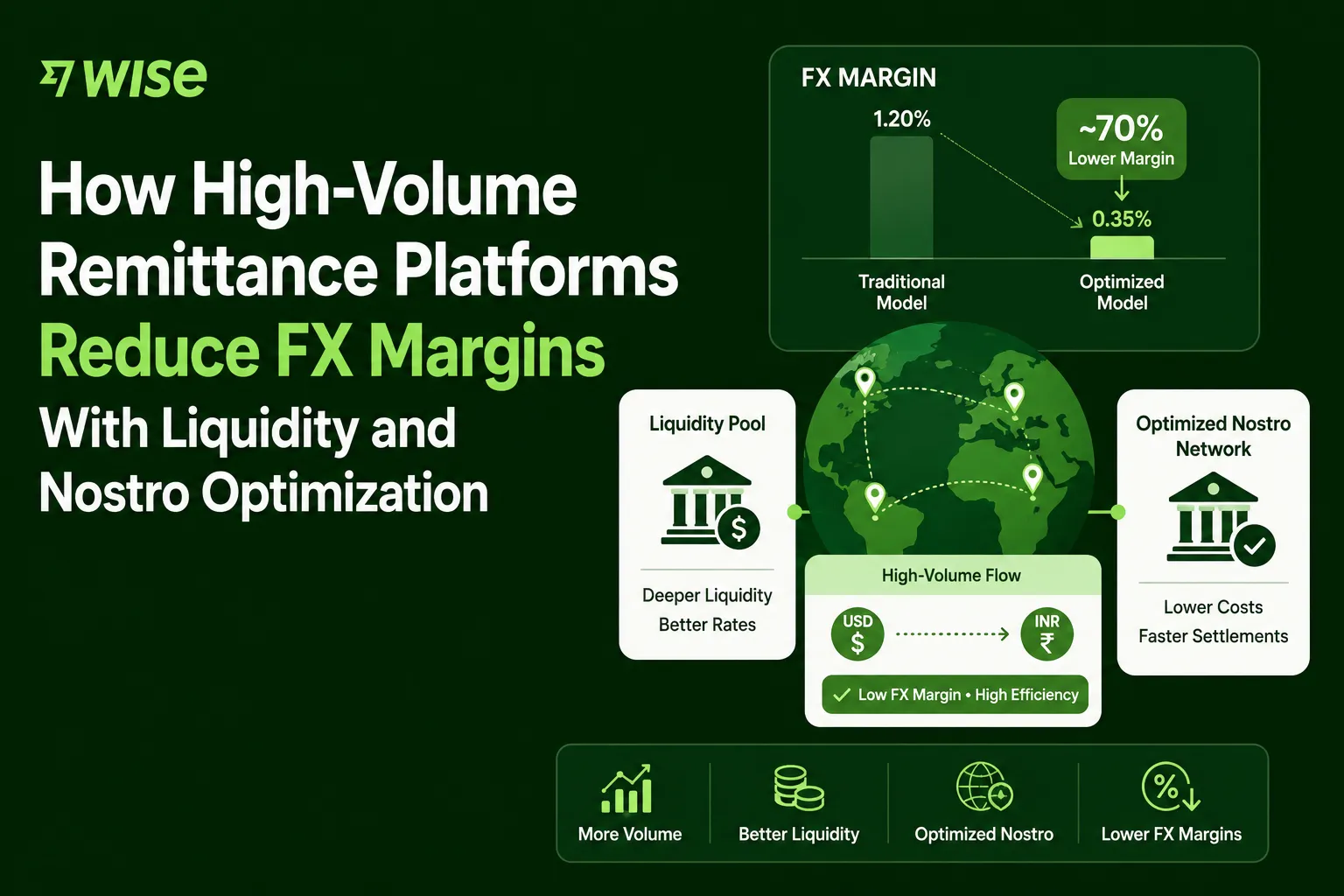
Foreign exchange margin reduction strategies matter most when a remittance platform begins processing serious corridor volume. At low volume, FX spreads may look like a simple pricing decision. At high volume, they become a treasury, liquidity, routing, settlement, and product-control problem.
A remittance business does not lose margin only because its FX provider charges more. It loses margin when money sits idle in the wrong currency, payout accounts are overfunded, settlement cycles are mismatched, failed payouts create reprocessing costs, and treasury teams lack real-time visibility into corridor-level liquidity.
This is why high-volume remittance operators focus on liquidity optimization and nostro account efficiency before simply reducing customer-facing spreads. A lower FX margin without strong liquidity control can damage profitability. A smarter liquidity model can protect both customer pricing and platform economics.
For fintech founders and operators building money transfer products, this is also a product architecture issue. Your remittance platform needs wallet logic, FX quote handling, ledger accuracy, transaction monitoring, admin controls, reconciliation workflows, and compliance-ready operations. Miracuves helps founders build fintech and remittance platforms with white-label, source-code-owned foundations that can be customized around business model, corridor strategy, and operational control.
Key Takeaways
- Foreign exchange margin reduction strategies work best when FX pricing, liquidity planning, payout routing, and treasury visibility are managed together.
- High-volume remittance platforms reduce margin leakage by forecasting corridor demand and avoiding excessive trapped capital in nostro accounts.
- Nostro optimization helps operators balance payout speed with working-capital efficiency.
- Dynamic spread rules, payout partner scoring, and real-time treasury dashboards can protect profitability without making pricing opaque.
- Miracuves helps fintech founders build remittance platforms with white-label app flows, admin dashboards, wallet logic, and source-code ownership.
Why FX Margin Reduction Becomes Harder as Remittance Volume Grows
A small remittance operator may treat FX margin as a simple spread over the market rate. A high-volume platform cannot do that for long.
As transaction volume increases, the platform must handle different currencies, payout methods, time zones, local holidays, banking cut-offs, failed transactions, partner limits, and compliance checks. Every corridor behaves differently. USD to INR is not the same as GBP to NGN, EUR to PHP, or AED to PKR.
The operator must answer difficult questions every day:
- How much local currency should be pre-funded in each payout market?
- Which corridor needs more liquidity before weekend demand spikes?
- Which payout partner gives the best effective rate after fees, failures, and settlement delays?
- How much spread can be reduced without increasing treasury risk?
- Which currency balances are overfunded and reducing working-capital efficiency?
Industry infrastructure providers increasingly describe liquidity as the core engine of cross-border payments because unavailable or poorly placed funds can delay payments, lock capital, and increase operational costs. For remittance platforms, this means FX margin reduction is not just about negotiating a better rate. It is about designing a smarter operating system for money movement.
What Actually Causes FX Margin Leakage in Remittance Platforms?
FX margin leakage happens when the platform’s expected spread is reduced by hidden operational costs.
A platform may quote a customer a clean exchange rate, but the final realized margin can shrink because of provider fees, settlement delay, currency volatility, failed payouts, manual reconciliation, emergency liquidity purchases, and idle nostro balances.
Common sources of FX margin leakage
| Margin Leakage Source | What Happens | Business Impact |
|---|---|---|
| Overfunded nostro accounts | Too much money sits in local payout accounts | Working capital gets trapped |
| Underfunded corridors | Liquidity runs out during payout demand | Emergency funding and payout delays increase cost |
| Poor partner routing | Transactions go through higher-cost rails | Effective FX cost rises |
| Static spread rules | Same margin applied across different corridors | Some corridors become unprofitable |
| Weak reconciliation | Settlement differences are found late | Finance teams lose control over true margin |
| Manual treasury workflows | Spreadsheets drive funding decisions | Delays, errors, and missed opportunities increase |
| Failed payout reprocessing | Transactions require correction or rerouting | Operational cost reduces net margin |
This is why mature remittance operators track realized FX margin, not only quoted FX margin.
Quoted margin tells you what the customer saw. Realized margin tells you what the business actually earned after liquidity, routing, settlement, and operational costs.
Liquidity Optimization: The First Layer of FX Margin Reduction
Liquidity optimization means making sure the right amount of money is available in the right currency, in the right location, at the right time.
For remittance platforms, liquidity is usually needed across multiple payout markets. The platform may collect money in one currency, convert it, and settle or pay out in another. If the payout side lacks enough local currency, the platform may need to buy liquidity quickly, often at worse rates or with higher fees.
How high-volume platforms optimize liquidity
The strongest platforms move from reactive funding to predictive liquidity planning.
They analyze:
- Corridor-level transaction volume
- Day-of-week and payday patterns
- Seasonal migrant remittance behavior
- Local banking cut-offs
- Wallet and bank payout mix
- Partner settlement cycles
- Refund and reversal patterns
- Currency volatility
- Historical liquidity shortfalls
The goal is not to hold the largest balance everywhere. The goal is to hold the right balance where it generates payout reliability without trapping unnecessary capital.
Traditional pre-funded accounts can support fast payouts, but they also tie up working capital when poorly managed. This is why liquidity optimization is one of the most practical foreign exchange margin reduction strategies for high-volume remittance businesses.
Nostro Optimization: Reducing Trapped Capital Without Slowing Payouts
A nostro account is an account a financial institution holds in a foreign currency with another bank. In cross-border payments, nostro accounts help platforms and banks maintain funds for settlement and payout activity.
For remittance operators, nostro optimization is about avoiding two extremes:
- Too much funding: Money sits idle in multiple currencies and reduces capital efficiency.
- Too little funding: The platform risks payout delays, failed transactions, and expensive emergency funding.
Thunes notes that maintaining funds across multiple nostro accounts can be essential for coverage and reliability, but without the right tools, this approach can become capital-intensive. Infosys has also highlighted that maintaining threshold balances across multiple nostro accounts creates more than just opportunity cost, with monitoring and risk management becoming major weaknesses in traditional models.
What effective nostro optimization includes
| Optimization Area | What It Means | FX Margin Impact |
|---|---|---|
| Minimum balance rules | Define corridor-specific funding floors | Prevents costly payout failures |
| Maximum balance alerts | Detect excess idle funds | Reduces trapped working capital |
| Intraday monitoring | Track balance movement during operating hours | Improves treasury response time |
| Corridor-level forecasting | Predict future funding needs | Reduces emergency FX purchases |
| Partner settlement mapping | Understand when funds are debited and credited | Improves funding timing |
| Netting logic | Offset inflows and outflows where possible | Reduces unnecessary conversions |
| Rebalancing workflows | Move liquidity between corridors or accounts | Improves capital efficiency |
The best operators do not view nostro balances as static reserves. They treat them as dynamic liquidity assets.
Founder Decision Signals: When FX Margin Optimization Should Become a Product Priority
Founder Decision Signals
Speed
If payout delays are increasing during high-volume windows, your liquidity model may be too reactive. Real-time balance visibility and corridor forecasting should become product priorities.
Cost
If customer-facing spreads look healthy but realized margins keep shrinking, the issue may be hidden in routing fees, failed payouts, settlement timing, or trapped nostro capital.
Scalability
If treasury decisions still depend on spreadsheets, the platform may struggle as corridors, currencies, and payout partners increase.
Market Fit
If users compare your exchange rate with competitors, margin reduction must be balanced with transparent pricing, payout reliability, and customer trust.
The Treasury Dashboard Layer Most Remittance Platforms Need
A remittance platform cannot reduce FX margins sustainably if treasury teams cannot see what is happening in real time.
The admin and treasury layer should show more than transaction counts. It should help operators understand liquidity exposure, currency balances, partner performance, margin movement, and settlement risk.
Key treasury dashboard modules
Essential Treasury Dashboard Features for FX Margin Control
| Feature | Business Value | Founder Impact |
|---|---|---|
| Corridor-level liquidity view | Shows available balances by currency, country, and payout method | Helps prevent underfunded payout corridors |
| Realized margin tracker | Compares quoted margin with actual earned margin after costs | Reveals hidden FX leakage |
| Nostro balance alerts | Flags excess or insufficient balances | Improves working-capital efficiency |
| Payout partner scoring | Tracks cost, speed, failure rate, and settlement performance | Supports smarter routing decisions |
| FX quote audit logs | Records rate source, spread rule, quote expiry, and user acceptance | Improves transparency and dispute resolution |
| Reconciliation workflow | Matches ledger, bank, payout partner, and customer transaction records | Reduces finance operations risk |
A strong treasury dashboard turns FX margin control from a monthly finance review into a daily operating discipline.
Dynamic Spread Rules: Reducing FX Margins Without Losing Control
A common mistake is assuming that FX margin reduction means applying a lower spread across all users and corridors.
That can be dangerous.
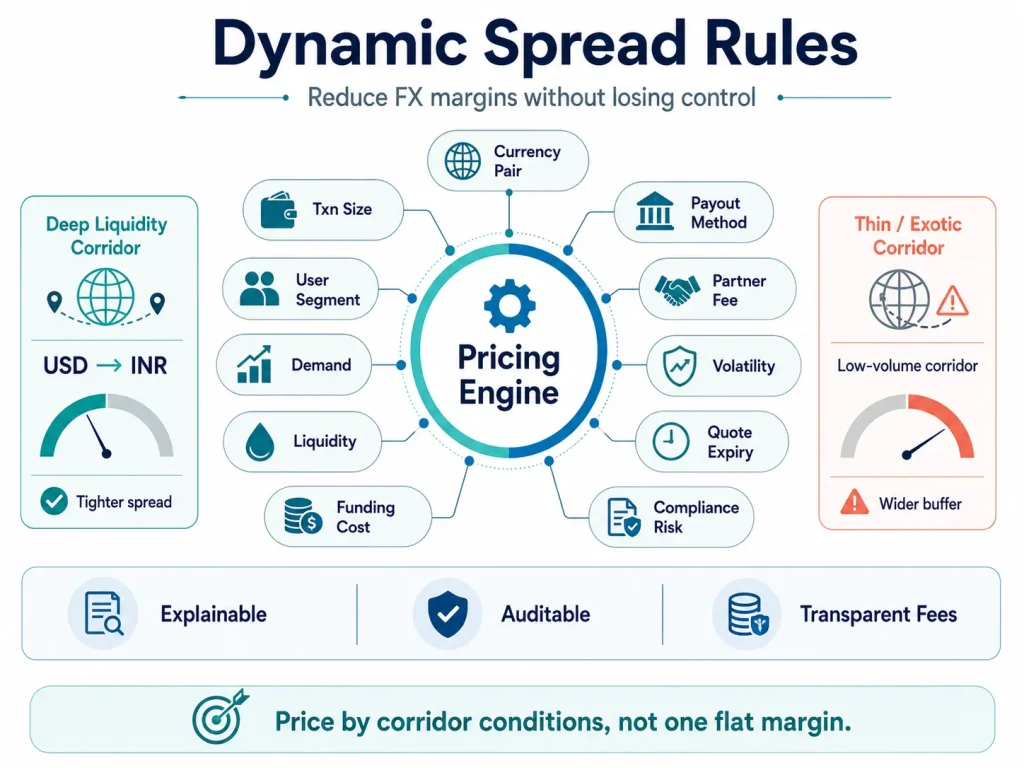
Different corridors have different liquidity depth, volatility, partner costs, settlement timelines, and failure rates. A corridor with deep liquidity and predictable payout volume can often support tighter pricing. A thin corridor with unpredictable demand may need a wider margin to cover operational risk.
Dynamic spread rules can consider:
- Currency pair
- Transaction size
- User segment
- Corridor demand
- Liquidity availability
- Funding cost
- Payout method
- Partner fee
- Volatility buffer
- Quote expiry time
- Compliance review risk
For example, a high-frequency USD to INR corridor with strong liquidity and reliable payout partners may allow tighter FX spreads. A lower-volume exotic corridor may require a larger buffer because emergency funding and failed payout handling can erase margin quickly.
The key is governance. Dynamic pricing should be explainable, auditable, and aligned with user trust. Remittance platforms should avoid confusing users with unclear fees or hidden charges.
Read more: AI Fraud Detection for Cross-Border Payments: Moving Beyond Rule-Based Remittance Security
Payout Partner Routing: A Practical Lever for FX Margin Protection
FX margin is not only determined by the exchange rate. It is also affected by the payout route.
A payout partner may offer a competitive rate but produce more failures. Another partner may be slightly more expensive but settle faster and reduce support tickets. A third may be useful only for certain transaction sizes or payout methods.
High-volume platforms reduce FX margin leakage by scoring payout partners across multiple dimensions.
Partner routing scorecard
| Routing Factor | Why It Matters |
|---|---|
| Effective FX rate | Determines core conversion cost |
| Payout fee | Affects net transaction margin |
| Settlement speed | Impacts liquidity recycling |
| Failure rate | Creates support and reprocessing cost |
| Corridor coverage | Determines market availability |
| Compliance support | Reduces operational friction |
| Reconciliation quality | Improves finance accuracy |
| Cut-off times | Affects same-day payout capability |
A platform that routes purely on nominal FX rate may miss the real economics. The best route is usually the one with the strongest combination of rate, reliability, speed, liquidity efficiency, and reconciliation quality.
Netting and Internal Liquidity Recycling
Netting is one of the most useful but under-discussed foreign exchange margin reduction strategies.
If a platform has inflows and outflows across currencies or corridors, it may be able to offset some obligations before initiating external conversions or transfers. This can reduce unnecessary FX trades, lower settlement costs, and improve liquidity usage.
For example, if a remittance platform has incoming GBP liquidity from one user segment and outgoing GBP obligations in another flow, internal treasury logic may reduce the need for external funding. The opportunity depends on regulatory permissions, operating model, banking partners, and internal ledger design.
This is why the wallet ledger and reconciliation system matter. Without accurate ledgers and settlement visibility, the platform cannot safely identify what funds are available, restricted, pending, settled, or reversible.
Hedging and Rate Locking for Predictable Corridors
Some high-volume remittance platforms use hedging or rate-locking strategies to reduce exposure to currency volatility.
This is especially relevant when:
- The customer receives a guaranteed rate
- Settlement happens later than quote acceptance
- The platform operates in volatile corridors
- Large transactions are involved
- Liquidity is sourced periodically rather than instantly
However, hedging is not a shortcut. It requires treasury expertise, risk limits, counterparty controls, and clear governance. Operators should not introduce hedging workflows without proper financial, legal, and compliance review.
For platform architecture, the important requirement is clear rate recordkeeping. The system should know:
- Source rate
- Applied spread
- Quote timestamp
- Quote expiry
- Accepted rate
- Settlement rate
- Realized gain or loss
- Partner route used
- Ledger impact
This data helps finance teams understand whether FX margin leakage is coming from pricing, liquidity, volatility, or operations.
Security and Compliance Controls That Support FX Margin Strategy
Security and compliance do not directly reduce FX spread, but they protect the operating foundation that makes margin optimization safe.
A remittance platform handling cross-border money movement should include KYC verification, AML workflow support, transaction monitoring, suspicious activity flags, audit logs, encrypted data transfer, role-based admin access, and secure payment gateway integration. Regulatory guidance for FX settlement emphasizes that institutions should identify, measure, monitor, and control liquidity needs and risks in each currency when settling FX transactions.
Practical compliance-ready controls
- KYC workflows
- AML workflow support
- Transaction monitoring
- Velocity checks
- Suspicious activity flags
- Audit logs
- Role-based admin dashboards
- Secure API integrations
- Reconciliation records
- User verification
- Admin approval controls
- Settlement status tracking
Final compliance depends on jurisdiction, legal review, licensing, integrations, banking partners, and operating model. A platform can be built with compliance-ready workflows, but no technology provider should claim universal regulatory approval without verified legal basis.
Miracuves’ fintech approach supports compliance-ready product foundations where founders can configure user verification, transaction flows, admin controls, and reporting workflows based on their target market.
White-Label Remittance Platforms Need Stronger Control Layers, Not Just Faster Launches
A ready-made remittance platform can help founders move faster, but speed alone is not enough in fintech.
The control layer matters.
A remittance platform should give operators visibility into users, wallets, transactions, payout partners, FX rates, KYC status, risk flags, admin actions, disputes, and reconciliation records. Without these controls, founders may launch quickly but struggle to manage liquidity, pricing, and financial risk later
For founders exploring a Wise clone solution or Revolut clone app, the stronger question is not only “Can we launch?” It is “Can we operate profitably, monitor risk, and adjust pricing as corridors scale?
Miracuves helps founders create white-label fintech and remittance platforms with source-code ownership, admin dashboards, wallet logic, and customizable workflows. For broader fintech planning, explore Miracuves fintech app development solutions.
Mistakes Founders Should Avoid
Mistakes Founders Should Avoid
Reducing FX spreads before understanding realized margin
A lower customer-facing spread may improve conversion, but it can damage profitability if the platform does not account for payout fees, failed transactions, settlement timing, and liquidity costs.
Overfunding every payout corridor
Keeping large balances everywhere may reduce payout delays, but it traps working capital and weakens capital efficiency. Smart platforms forecast demand and fund corridors based on actual behavior.
Choosing payout partners only by quoted rate
The cheapest quoted rate is not always the lowest-cost route. Failure rate, reconciliation quality, settlement speed, and support burden all affect real margin.
Managing treasury workflows manually for too long
Spreadsheets may work in the early stage, but high-volume remittance platforms need dashboards, alerts, logs, and automated reconciliation support.
How Miracuves Helps Founders Build Remittance Platforms With Operational Control
Building a remittance platform is not only about sender and receiver screens. It requires a backend that can support wallet balances, transaction history, exchange-rate logic, payout partner integration, user verification, admin control, risk monitoring, and reconciliation.
Miracuves helps founders build ready-made and white-label fintech platforms that can be customized for remittance, wallet, neobank, and cross-border payment use cases. For founders who want a faster path to market, Miracuves’ ready-made approach can provide a launch-ready foundation with source-code ownership, branded design, admin control, and customization support.
A strong remittance product should support:
- Sender and receiver workflows
- Multi-currency wallet logic
- Exchange-rate display and quote expiry
- Transaction tracking
- KYC and AML workflow support
- Admin approval controls
- Payout partner integrations
- Ledger and reconciliation records
- Role-based admin access
- Risk and transaction monitoring
- Reporting dashboards
- Customer support workflows
For operators focused on foreign exchange margin reduction strategies, the platform should also expose the treasury controls required to monitor liquidity, adjust spread rules, compare payout partners, and review realized margin.
Final Thoughts: FX Margin Reduction Is a Liquidity Discipline
The real opportunity in foreign exchange margin reduction is not simply charging users less. It is building a remittance operation that understands liquidity, corridor behavior, payout reliability, partner economics, and treasury risk.
High-volume remittance platforms reduce FX margin leakage by improving forecasting, optimizing nostro balances, routing intelligently, tracking realized margin, and giving finance teams the dashboards they need to act before costs compound.
For founders, the product lesson is clear: a remittance app should not only move money. It should help the operator manage the economics of moving money. Miracuves helps founders build white-label fintech and remittance platforms with the app, admin, wallet, and control layers needed to launch faster and operate with more clarity.
FAQs
What are foreign exchange margin reduction strategies?
Foreign exchange margin reduction strategies are operational, pricing, liquidity, and treasury methods used to reduce the cost gap between the market FX rate and the final rate offered to users. For remittance platforms, these strategies include liquidity forecasting, nostro optimization, payout routing, dynamic spread rules, netting, reconciliation, and partner performance tracking.
How do remittance platforms reduce FX spreads?
Remittance platforms reduce FX spreads by improving liquidity availability, negotiating better provider rates, routing transactions through lower-cost payout partners, reducing failed transactions, optimizing settlement timing, and using corridor-specific pricing rules. The strongest platforms focus on realized margin, not just customer-facing spread.
What is nostro optimization in remittance?
Nostro optimization means managing foreign-currency account balances so that a remittance platform has enough liquidity for fast payouts without trapping too much working capital. It includes minimum balance rules, maximum balance alerts, intraday monitoring, forecasting, and rebalancing workflows.
Why do nostro accounts affect FX margins?
Nostro accounts affect FX margins because overfunded accounts trap capital, while underfunded accounts can force expensive emergency funding or cause payout delays. Both situations reduce the platform’s effective profitability.
What is realized FX margin?
Realized FX margin is the actual margin earned after accounting for provider rates, payout fees, settlement timing, failed payouts, reconciliation differences, and liquidity costs. It is more useful than quoted margin because it shows the true economics of each transaction.
Can dynamic FX pricing improve remittance profitability?
Yes, dynamic FX pricing can improve profitability when it is governed properly. It allows platforms to adjust spreads based on corridor, liquidity, transaction size, volatility, payout method, and partner cost. However, it should remain transparent and auditable to protect user trust.