


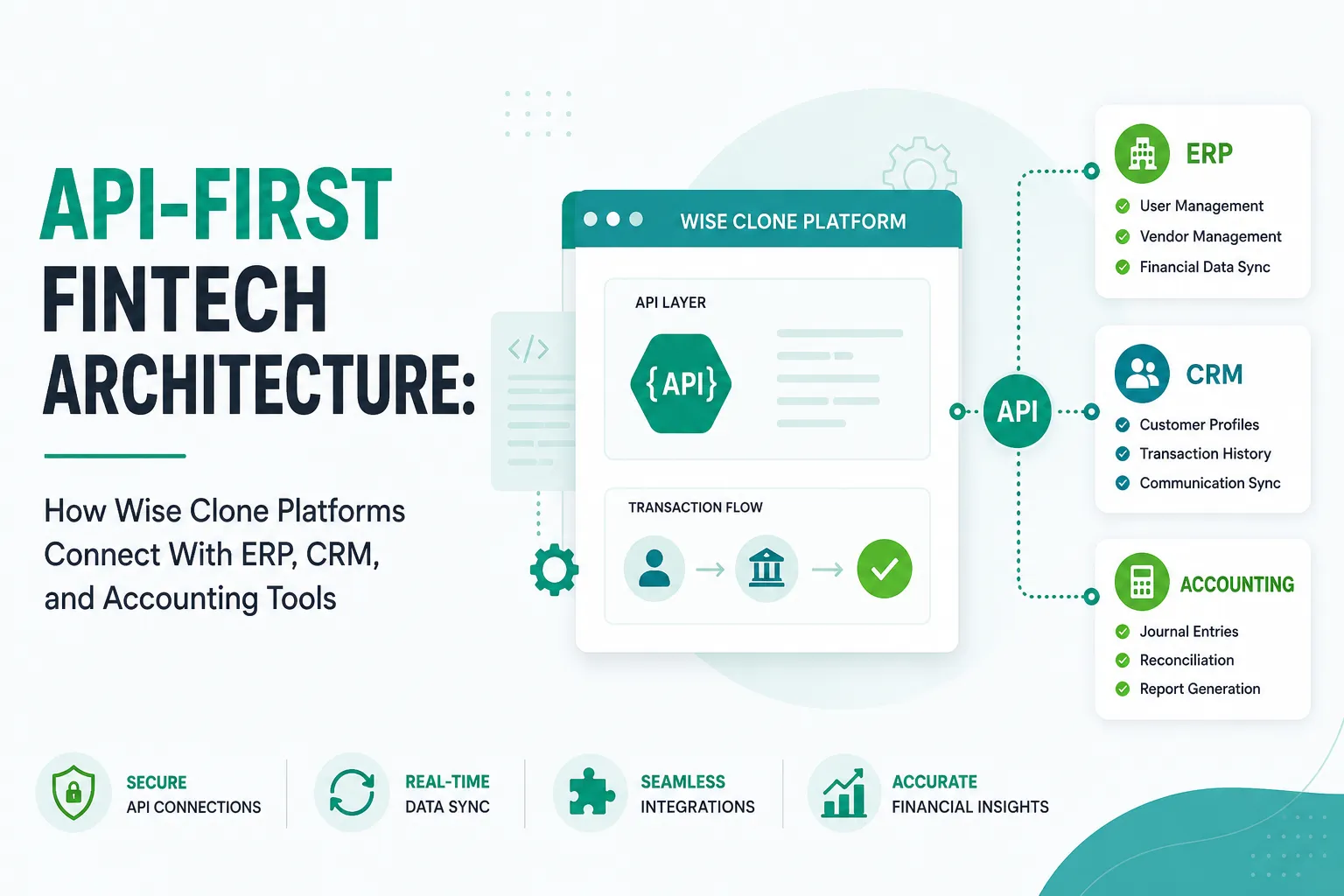
Building a Wise clone platform is not only about creating a remittance flow, multi-currency wallet, or payment dashboard. The real product strength comes from how well the platform connects with the business systems around it.
For fintech founders, this is where fintech API integration best practices become critical.
A remittance platform may need to exchange data with ERP systems, CRM tools, accounting software, identity verification providers, payment gateways, fraud monitoring services, and compliance workflows. If these connections are treated as one-off integrations, the platform becomes difficult to maintain. If they are designed as an API-first architecture, the platform becomes easier to scale, audit, automate, and extend.
Wise’s own business API positioning focuses on automated payments, business tool connectivity, sandbox testing, API documentation, and support, which shows how important integrations are for modern cross-border money movement. For founders planning a Wise-style fintech product, the lesson is clear: integration architecture should be part of the product foundation from day one.
Miracuves helps founders build fintech and remittance platforms with white-label foundations, source-code ownership, admin control, and configurable workflows. For a Wise clone platform, this matters because integrations are not just technical connectors. They directly affect financial accuracy, customer trust, operational control, and long-term scalability.
Key Takeaways
- Fintech API integration best practices help Wise clone platforms connect securely with ERP, CRM, accounting, payment, and compliance systems.
- API-first fintech architecture should include OAuth-based authorization, scoped access, webhooks, retry logic, idempotency, reconciliation jobs, and audit logs.
- ERP integrations support finance operations, approval workflows, treasury visibility, and payout reconciliation.
- CRM integrations improve onboarding, customer support, compliance visibility, and business account management.
- Accounting integrations help sync invoices, fees, payments, refunds, transaction records, and reconciliation data.
- Miracuves helps founders move from idea to launch faster with ready-made and white-label fintech app solutions.
Why API-First Architecture Matters in Fintech Platforms
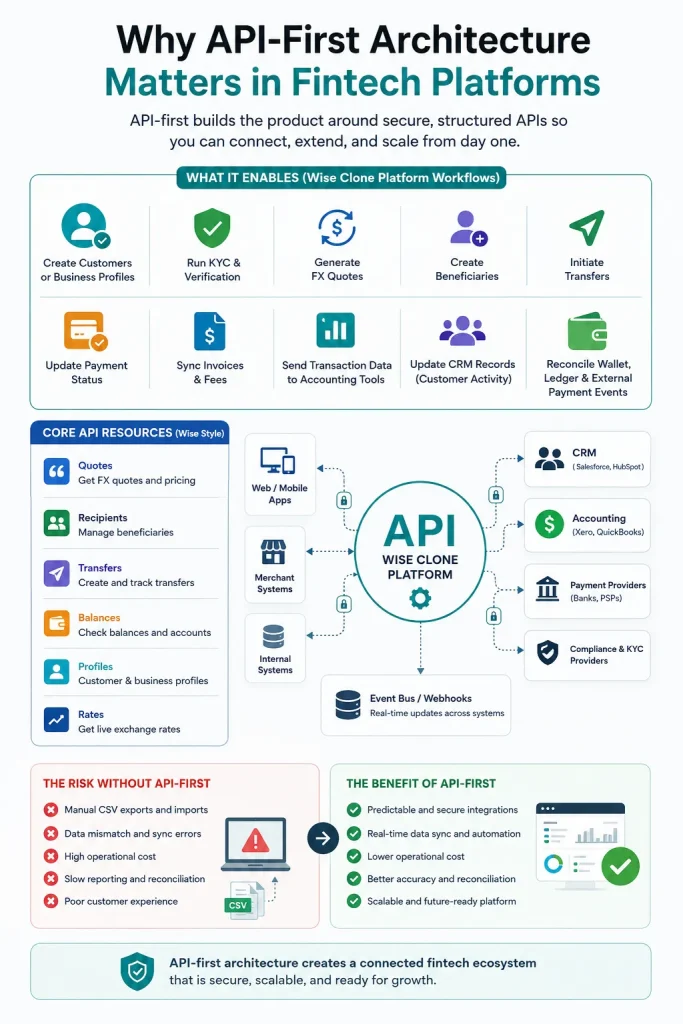
An API-first fintech platform is designed so that core business functions can be accessed, extended, and connected through structured APIs. Instead of adding integrations after launch, the product is built around clear data models, secure endpoints, event handling, and controlled access.
In a Wise clone platform, API-first architecture supports workflows such as:
- Creating customer or business profiles
- Running KYC and verification checks
- Generating FX quotes
- Creating beneficiaries
- Initiating transfers
- Updating payment status
- Syncing invoices and fees
- Sending transaction data to accounting tools
- Updating CRM records when customer activity changes
- Reconciling wallet, ledger, and external payment events
Wise API documentation highlights core resources such as quotes, recipients, transfers, balances, profiles, and rates. These are not isolated features; they represent a transaction ecosystem that external systems may need to read from or write to.
For founders, the business risk is simple. A fintech platform that cannot integrate cleanly with finance, customer, and accounting systems becomes operationally expensive. Teams start exporting CSV files, manually matching transactions, updating support records by hand, and fixing sync errors after customers complain.
API-first architecture reduces that friction by creating predictable, secure, and reusable integration paths.
What Makes Wise Clone API Integration Different From Generic App Integration?
Generic app integrations often move simple data between systems: user records, contact forms, notifications, or order updates. Fintech integrations are different because they touch regulated financial workflows, sensitive customer data, transaction states, balances, fees, and audit history.
A Wise clone platform usually needs to support:
| Fintech Object | Why It Matters | Integration Impact |
|---|---|---|
| Customer profile | Stores personal or business identity | CRM, KYC, support, and admin workflows depend on accurate profile data |
| Beneficiary | Stores recipient bank or payout details | Must be validated, secured, and connected to transfer workflows |
| FX quote | Defines exchange rate, fee, and delivery estimate | ERP/accounting systems may need quote and fee records |
| Transfer | Represents money movement | Requires lifecycle tracking, status updates, reconciliation, and audit logs |
| Wallet or balance | Shows available funds by currency | Must remain consistent with ledger and external payment events |
| Ledger entry | Internal financial source of truth | Should not be bypassed by external integrations |
| Invoice or bill | Business payment context | Accounting tools need mapped invoice, payment, and fee data |
| Compliance status | KYC/AML workflow state | CRM and admin teams need visibility without exposing unnecessary data |
The biggest difference is that fintech integrations must protect financial consistency. A failed CRM sync may inconvenience a support team. A failed payment-status sync can create customer anxiety, reconciliation gaps, and financial reporting issues.
That is why fintech API integration best practices must go beyond “connect tool A to tool B.” They must define how data moves, who can access it, how retries work, what happens during failure, and which system remains the source of truth.
Core Fintech API Integration Best Practices for Extensible Platforms
The strongest fintech platforms treat integrations as a product capability. Below are the best practices founders and technical teams should apply when building Wise clone platforms.
1. Design Around Stable Financial Data Models
Before writing endpoints, define the core financial objects:
- User
- Business account
- Wallet
- Currency
- Quote
- Transfer
- Beneficiary
- Fee
- Ledger entry
- Invoice
- Refund
- Dispute
- Compliance status
Each object should have a clear owner, lifecycle, allowed state transitions, and audit history. For example, a transfer may move from created to funded, processing, completed, failed, refunded, or cancelled. ERP, CRM, and accounting tools should receive events based on these states, not vague status labels.
A stable data model reduces integration rewriting when the platform adds new payment providers, currencies, or accounting tools.
2. Use OAuth 2.0 and Scoped Permissions
Fintech integrations should not rely on static credentials shared across multiple systems. OAuth-based authorization, scoped access, token refresh logic, and permission controls are safer and easier to manage.
QuickBooks Online requires OAuth 2.0 authorization for connected company files, and its webhooks only send change notifications for companies connected and authorized through OAuth 2.0. Wise also documents OAuth-based flows and sandbox/production environments for developers.
For a Wise clone platform, scopes should be separated by capability:
- Read customer profile
- Create transfer
- Read transfer status
- Manage beneficiaries
- Read ledger records
- Sync accounting entries
- Update CRM activity
- View compliance status
- Manage webhook subscriptions
This prevents a CRM integration from accessing sensitive accounting data it does not need.
3. Use Webhooks for Real-Time Event Updates
Polling external systems every few minutes creates unnecessary load and delayed visibility. Webhooks allow connected tools to receive event-driven updates when something changes.
QuickBooks webhooks notify apps when data changes in authorized company files. Xero also supports webhooks for subscribed events. In fintech, webhooks are especially useful for transfer status updates, KYC completion, failed payouts, refunded payments, invoice updates, and ledger events.
For Wise clone platforms, webhook events may include:
customer.createdbusiness.verifiedbeneficiary.addedquote.createdtransfer.initiatedtransfer.completedtransfer.failedpayment.refundedinvoice.syncedledger.entry.createdcompliance.review_required
The best practice is to receive webhooks quickly, validate them, store them, and process them asynchronously through a queue. This avoids timeout failures and allows retry handling when downstream systems are unavailable.
4. Build Idempotency Into Payment and Transfer APIs
Fintech systems must assume that network calls can fail, repeat, or arrive late. If a transfer request is submitted twice because of a timeout, the platform should not create two payments.
Idempotency keys help ensure repeated requests produce the same result rather than duplicating financial actions. This is especially important for transfer creation, payout execution, refunds, invoice payment syncing, and ledger posting.
For example:
- A CRM triggers a business payout request.
- The first API call reaches the fintech platform, but the CRM does not receive a response.
- The CRM retries the same request.
- The platform checks the idempotency key and returns the original result instead of creating a duplicate transfer.
Without idempotency, fintech integrations become dangerous under retry conditions.
5. Keep the Ledger as the Internal Source of Truth
ERP and accounting tools are important, but the fintech platform should maintain its own financial ledger. External systems may be delayed, unavailable, or configured differently across customers.
A ledger-first design means every financial movement creates internal records before external sync occurs. Accounting tools can then receive mapped entries, but they do not become the only place where financial truth exists.
This matters for:
- Wallet balances
- Fees
- FX margin
- Transfer status
- Refunds
- Reversals
- Failed payouts
- Reconciliation
- Audit reports
If the platform only trusts external accounting systems, it loses control over payment state and customer-facing balances.
6. Add Reconciliation Jobs for Delayed or Failed Syncs
Even strong APIs fail sometimes. Accounting tools may reject payloads. ERP systems may have downtime. CRM records may hit validation errors. Payment providers may send delayed status updates.
Reconciliation jobs compare internal records with external systems to detect gaps. They help answer:
- Did every completed transfer create an accounting entry?
- Did every fee sync to the correct account?
- Did every refund update the customer record?
- Did every ERP payout approval match the transfer request?
- Did the ledger balance match external bank or payment provider data?
For fintech platforms, reconciliation is not optional. It is a control layer that protects financial accuracy.
7. Use Versioned APIs and Backward Compatibility
Fintech integrations often support business customers, partners, accounting tools, and internal operations. Breaking an endpoint can break multiple workflows.
Use versioned APIs such as:
/api/v1/transfers/api/v1/beneficiaries/api/v2/accounting/sync
API versioning allows teams to improve payloads, add fields, and change business logic without immediately breaking connected systems.
8. Monitor API Health, Latency, Errors, and Sync Queues
Fintech API monitoring should track more than uptime. Teams should monitor:
- API response time
- Failed requests
- Webhook delivery success
- Queue backlog
- Token refresh failures
- Provider timeout rates
- Accounting sync errors
- ERP approval failures
- CRM update failures
- Reconciliation mismatch count
This gives the admin team operational visibility before integration issues become customer problems.
How Wise Clone Platforms Connect With ERP Systems
ERP integration is usually needed when the fintech platform serves business customers, enterprises, exporters, suppliers, vendors, or companies managing global payouts.
An ERP system may need to exchange:
- Vendor records
- Beneficiary details
- Payment requests
- Approval status
- Currency conversion details
- Fees and charges
- Transfer completion status
- Refunds
- Accounting references
- Cash position data
A finance API integration architecture for ERP connectivity typically requires more than point-to-point connectors. Modern systems often use APIs, middleware, event orchestration, and governance models to improve cash visibility, reconciliation accuracy, and operational scalability.
Example ERP Integration Flow
- A finance manager approves a supplier payment inside the ERP.
- The ERP sends a payment request to the Wise clone platform.
- The platform validates beneficiary, currency, amount, and compliance requirements.
- The platform creates an FX quote and transfer request.
- The admin dashboard shows the transfer as pending or processing.
- Webhooks update the ERP when the transfer is completed or failed.
- Ledger and accounting entries are created for reconciliation.
The founder benefit is operational control. Instead of asking finance teams to manually re-enter payment data, the platform becomes part of the business payment workflow.
How CRM Integration Improves Customer and Business Account Workflows
CRM integration helps fintech teams manage customer relationships, onboarding, support, and sales visibility. For Wise clone platforms, CRM tools may need access to customer lifecycle data without exposing unnecessary financial details.
A CRM integration can support:
- Lead-to-account conversion
- Business account onboarding
- KYC status visibility
- Support ticket context
- Transfer activity summary
- Failed payment alerts
- High-value customer tagging
- Account manager assignment
- Renewal or subscription workflows
For example, when a business customer completes verification, the fintech platform can send an event to the CRM. The CRM can then update the account stage, notify the relationship manager, or trigger onboarding emails.
The key best practice is data minimization. CRM teams may need to know that a business customer completed verification or had a failed transfer, but they may not need full beneficiary bank details or sensitive identity documents.
How Accounting Integrations Support Invoices, Payments, Fees, and Reconciliation
Accounting integration is one of the most important layers for Wise clone platforms serving businesses. Tools such as QuickBooks and Xero expose accounting APIs and webhook capabilities that support invoices, payments, contacts, and related financial records. QuickBooks provides developer resources for OAuth, accounting APIs, webhooks, and sandbox environments. Xero’s Accounting API exposes accounting functions and supports invoice and payment resources.
A Wise clone platform may sync:
| Platform Data | Accounting Object | Business Purpose |
|---|---|---|
| Customer or business profile | Contact/customer | Keep accounting records aligned with account ownership |
| Transfer fee | Revenue or fee line item | Track platform income |
| FX spread or margin | Revenue category | Support business reporting |
| Supplier payout | Bill payment or bank transaction | Record external payments |
| Refund | Credit note or refund entry | Maintain accurate books |
| Wallet funding | Bank transaction | Match incoming money movement |
| Completed transfer | Payment transaction | Support reconciliation |
| Failed transfer | Exception record | Avoid incorrect accounting entries |
Accounting Sync Design Pattern
A strong accounting integration usually follows this flow:
- The fintech platform records the ledger event.
- The integration service maps the event to the accounting tool’s schema.
- The platform checks whether the target contact, account, or invoice exists.
- If needed, it creates or updates the accounting object.
- It posts the transaction or payment entry.
- It stores the external accounting reference.
- It retries failed syncs through a controlled queue.
- It marks reconciliation status inside the admin dashboard.
This avoids a common mistake: pushing payment data directly to accounting tools without internal mapping, validation, or retry control.
Read more: API-First Fintech Architecture: How Wise Clone Platforms Connect With ERP, CRM, and Accounting Tools
Recommended API-First Architecture for a Wise Clone Platform
A scalable Wise clone architecture should separate core fintech logic from external integration logic. This keeps the remittance product stable even when third-party systems change.
Recommended API-First Architecture Layers
| Architecture Layer | Role in Wise Clone Platform | Founder Impact |
|---|---|---|
| API Gateway | Controls request routing, authentication, rate limits, and external access. | Protects the platform from uncontrolled integration traffic. |
| Identity and Access Layer | Manages OAuth, tokens, permissions, roles, and scopes. | Ensures ERP, CRM, and accounting tools only access approved data. |
| Core Fintech Services | Handles profiles, quotes, transfers, beneficiaries, wallets, and ledger logic. | Keeps financial workflows consistent and controlled. |
| Integration Service | Connects with ERP, CRM, accounting, KYC, payment, and notification systems. | Prevents third-party logic from polluting core fintech modules. |
| Event Queue | Processes webhooks, sync jobs, retries, and background tasks asynchronously. | Improves reliability when external tools are slow or unavailable. |
| Ledger and Reconciliation Layer | Stores financial truth and checks internal records against external systems. | Reduces financial mismatch risk and improves audit readiness. |
| Admin Dashboard | Shows integration status, failed syncs, transfer events, user records, and reports. | Gives operators control without depending on developers for every issue. |
| Audit and Monitoring Layer | Tracks API calls, data changes, access logs, webhook delivery, and sync errors. | Supports trust, troubleshooting, and operational governance. |
Founder Decision Signals: When Your Wise Clone Needs Deeper API Architecture
Founder Decision Signals
Speed
If your platform needs to launch with ERP, CRM, or accounting connections, API-first planning prevents rework after the first release.
Cost
One-off integrations may look faster at first, but they become expensive when every new tool requires custom logic and manual maintenance.
Scalability
Event queues, versioned APIs, and reconciliation jobs help the platform support more customers, more tools, and more transaction volume.
Market Fit
Business users are more likely to adopt a remittance platform that fits their existing finance, CRM, and accounting workflows.
Security and Compliance Considerations for Fintech Integrations
Security should not be treated as a marketing add-on in fintech architecture. It should be built into every integration workflow.
A Wise clone platform should include:
- Encrypted data transfer
- Encrypted data storage
- OAuth-based authorization
- Role-based access control
- Scoped API permissions
- Secure token storage
- Webhook signature verification
- Audit logs
- Admin access controls
- User verification workflows
- KYC workflow support
- AML workflow support
- Transaction monitoring
- Suspicious activity flags
- Secure payment gateway integration
- Activity logs
- Permission-based dashboards
For fintech blogs and products, Miracuves’ security guidance recommends careful compliance language such as “compliance-ready foundation,” “supports compliance workflows,” and “can be configured for KYC/AML requirements,” while avoiding guaranteed regulatory claims.
This caveat matters. Final compliance depends on jurisdiction, legal review, integrations, operating model, and how the platform is configured. A fintech platform can support compliance workflows, but no architecture should promise universal regulatory approval.
Common API Integration Mistakes Founders Should Avoid
Mistakes Founders Should Avoid
Building Point-to-Point Integrations Without an Integration Layer
Directly connecting every ERP, CRM, and accounting tool to core fintech services creates maintenance problems. A dedicated integration layer keeps external tool logic separate from transfer, wallet, and ledger logic.
Skipping Idempotency for Payment Requests
Without idempotency keys, retries can create duplicate transfers, refunds, or accounting entries. This is one of the most dangerous mistakes in fintech API design.
Treating Accounting Sync as a Simple Export
Accounting integration is not just data export. It requires mapping, validation, external references, retry logic, and reconciliation status tracking.
Allowing Broad API Access
CRM, ERP, and accounting tools should only access the data they need. Over-permissioned integrations increase security and privacy risk.
Ignoring Admin Visibility
If failed syncs, webhook errors, and reconciliation issues are invisible to operators, the business becomes dependent on developers for routine support and finance issues.
Wise Clone API Integration Checklist for Builders
Before connecting a Wise clone platform with ERP, CRM, or accounting tools, technical teams should confirm:
| Checklist Item | Why It Matters |
|---|---|
| Core financial objects are clearly defined | Prevents inconsistent data mapping |
| API authentication uses secure standards | Protects sensitive fintech workflows |
| API scopes are separated by function | Reduces unnecessary data exposure |
| Transfer and refund APIs support idempotency | Prevents duplicate financial actions |
| Webhook payloads are validated | Reduces spoofing and bad event processing |
| Webhooks are processed asynchronously | Improves reliability under load |
| Sync errors are stored and visible | Helps admin teams resolve issues faster |
| Reconciliation jobs run regularly | Protects financial accuracy |
| API versions are maintained | Prevents breaking existing integrations |
| Sandbox testing is available | Reduces production integration risk |
| Audit logs are enabled | Supports troubleshooting and governance |
| Admin dashboard shows integration status | Gives operators control over connected systems |
How Miracuves Helps Build Extensible Fintech Platforms
Miracuves helps founders create fintech and remittance platforms that are not limited to basic money transfer flows. A Wise clone solution can be shaped around customer onboarding, wallet logic, transfer workflows, admin control, security layers, and future integration readiness.
For founders evaluating a Wise clone solution, the stronger question is not only “Can the app send money?” It is:
- Can the platform support business users?
- Can it connect with accounting tools?
- Can ERP systems trigger payment workflows?
- Can CRM teams see onboarding and support context?
- Can admins track failed syncs and payment exceptions?
- Can the platform support KYC and AML workflows?
- Can the founder own the source code and adapt integrations later?
Miracuves’ white-label fintech approach is useful for founders who want a faster launch foundation while still keeping control over branding, workflows, admin operations, and future customization. Pricing and final scope should be confirmed based on selected modules, integrations, branding, and customization requirements; Miracuves’ pricing guidance avoids invented prices and recommends quote-based confirmation when exact pricing is not provided.
Final Thoughts: API-First Fintech Platforms Are Easier to Scale, Integrate, and Trust
The real value of API-first fintech architecture is not technical elegance. It is business control.
A Wise clone platform that connects cleanly with ERP, CRM, and accounting tools can support business users, automate finance workflows, reduce manual reconciliation, improve support visibility, and create stronger operational trust. But this only works when fintech API integration best practices are built into the product foundation.
Founders should prioritize secure authorization, scoped access, event-driven updates, idempotency, reconciliation, ledger-first design, admin visibility, and versioned APIs. These decisions make the difference between a basic remittance app and a fintech platform that can grow with real business customers.
Miracuves helps founders move from concept to launch-ready fintech products faster with white-label foundations, source-code ownership, admin control, and customization support for market-specific workflows.
FAQs
What are fintech API integration best practices?
Fintech API integration best practices include secure authentication, OAuth-based authorization, scoped permissions, webhook validation, idempotency keys, retry queues, ledger-first design, reconciliation jobs, API versioning, sandbox testing, audit logs, and continuous monitoring.
Why does a Wise clone platform need API-first architecture?
A Wise clone platform needs API-first architecture because remittance workflows often connect with ERP, CRM, accounting, payment, KYC, AML, and support systems. API-first design makes these integrations more secure, reusable, and easier to scale.
How does a Wise clone platform connect with accounting tools?
A Wise clone platform can connect with accounting tools by mapping internal ledger events to accounting objects such as contacts, invoices, payments, fees, refunds, and bank transactions. The platform should store external references and run reconciliation jobs to detect sync gaps.
What is the role of webhooks in fintech integrations?
Webhooks send real-time event notifications when something changes, such as transfer completion, failed payments, verification updates, invoice changes, or refund events. They reduce polling and help ERP, CRM, and accounting tools stay updated.
Why is idempotency important in fintech APIs?
Idempotency prevents duplicate financial actions when API requests are retried. For example, if a transfer creation request times out and is sent again, the same idempotency key ensures the platform returns the original result instead of creating another transfer.
Should ERP and accounting tools be the source of truth for fintech transactions?
No. A fintech platform should usually keep its own ledger as the internal source of truth. ERP and accounting tools are important for business operations and reporting, but the fintech platform needs its own accurate financial records for balances, transfers, fees, refunds, and reconciliation.