


Key Takeaways
What You’ll Learn
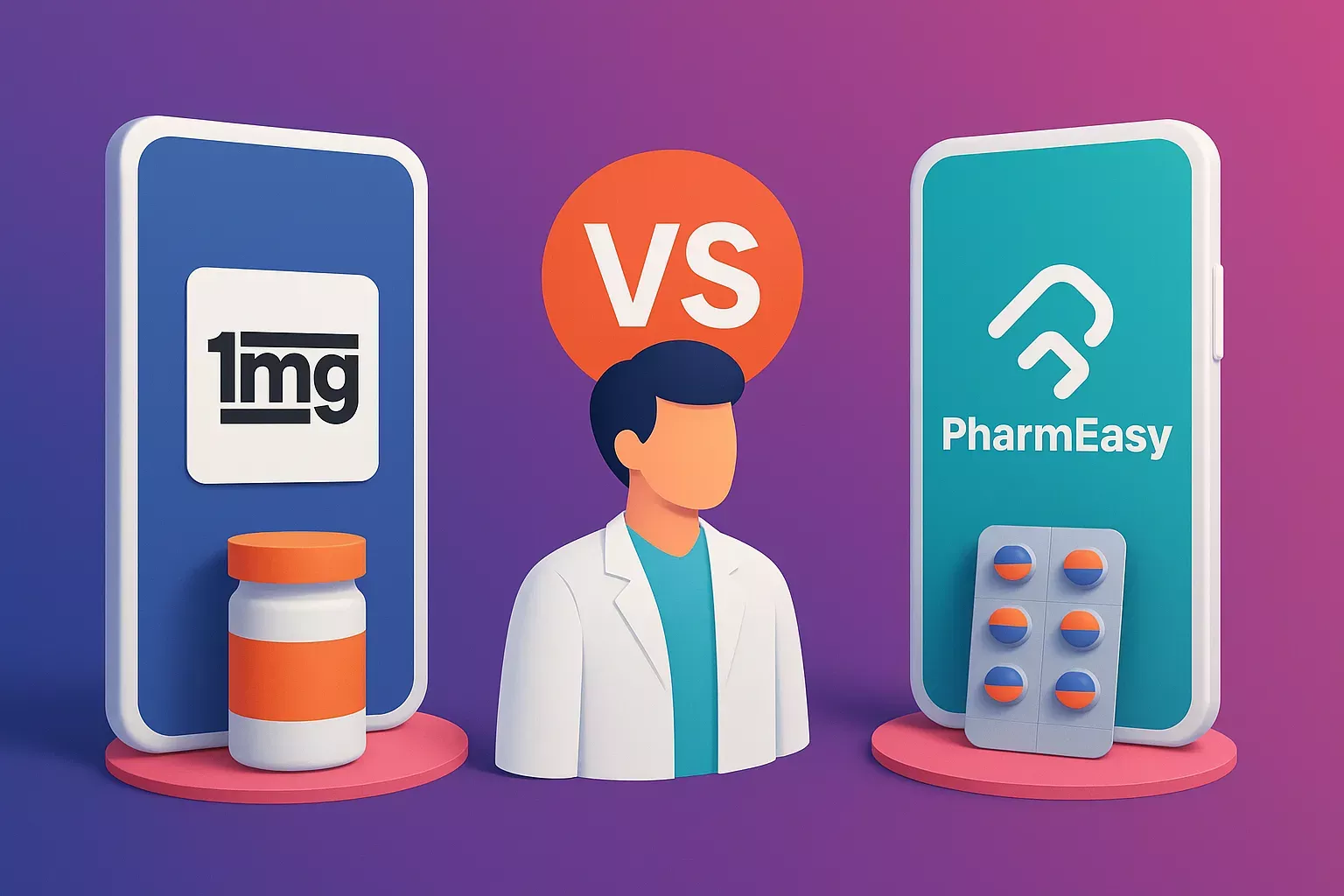
- The 1mg vs PharmEasy comparison shows how two major healthtech platforms use similar categories but different business strengths to compete in the market.
- 1mg focuses strongly on content-led trust, diagnostics, and medicine discovery, while PharmEasy leans heavily on pharmacy delivery scale, accessibility, and ecosystem convenience.
- Both platforms combine medicine delivery, diagnostics, and digital healthcare services, but their execution and positioning differ in meaningful ways.
- The comparison helps startups understand how platform structure, customer trust, and service mix shape long-term success in healthtech.
- The real takeaway is that a strong healthcare business model depends on trust, compliance, repeat demand, and operational efficiency working together.
Stats That Matter
- Both 1mg and PharmEasy operate as multi-service health platforms by combining medicine delivery with diagnostics and other digital healthcare touchpoints.
- Diagnostics and repeat medicine orders are important revenue and retention drivers across both business models.
- Trust, prescription compliance, and delivery efficiency remain some of the most important factors influencing platform growth in the online pharmacy space.
Real Insights
- 1mg’s model feels more knowledge-driven because healthcare content, product education, and discovery support its broader user trust strategy.
- PharmEasy’s model feels more convenience-driven because it emphasizes accessible pharmacy ordering, diagnostics, and fast repeat transactions.
- Both platforms prove that healthtech growth is not only about medicine delivery, but about creating a connected healthcare ecosystem around the user.
- For startups, the best model depends on positioning — whether the goal is trust-led health engagement or convenience-led healthcare commerce.
- The strongest digital healthcare businesses win when service depth, compliance, and customer trust are built into the model from the beginning.
The year 2026 is witnessing a monumental surge in healthtech innovation, and at the forefront of this revolution are online pharmacy platforms like 1mg and PharmEasy. As healthcare continues its digital transformation—fueled by rising consumer demand for convenience, post-pandemic healthcare access, and increased investment in AI-driven platforms—startup founders are racing to build the next big healthtech solution.
But the real question is: Which business model works best—1mg’s full-stack medical ecosystem or PharmEasy’s aggressive aggregator approach?
Understanding how these healthtech giants generate revenue, manage costs, form strategic partnerships, and scale their platforms is critical for entrepreneurs aiming to launch apps that are not just functional—but profitable and sustainable.
In this comprehensive breakdown, we’ll explore the 1mg vs PharmEasy business models, compare their strategies, and help you decide which framework is best suited for your startup in 2026.

What is 1mg?
1mg, now known as Tata 1mg, started as an online medicine delivery app but has evolved into an integrated digital healthcare platform. It offers:
- E-pharmacy (prescription & OTC drugs)
- Diagnostic tests & lab bookings
- Doctor consultations (telemedicine)
- Health & wellness content
- Supplements and devices
In 2021, the Tata Group acquired a majority stake in 1mg, transforming it into a highly credible and resource-rich brand under the Tata Digital umbrella.
Today, 1mg positions itself as a trust-first, medically backed platform, prioritizing verified doctors, accredited labs, and prescription-based medicine services.
What is PharmEasy?
PharmEasy, founded in 2015, is one of India’s largest and fastest-growing healthtech aggregators. It provides:
- Online pharmacy with prescription validation
- Diagnostics through the acquisition of Thyrocare
- Medical devices and healthcare essentials
- Teleconsultations
- B2B medicine delivery to clinics and pharmacies via Retailio
PharmEasy has scaled rapidly through mergers and acquisitions, including Medlife and Thyrocare, and operates on a multi-vertical healthtech stack. It emphasizes speed, scale, and convenience, catering to a wide consumer base from metros to tier-2 cities.
Business Model of 1mg
Revenue Streams
- Commission on medicines sold
- Diagnostics services (lab partnerships & home collection)
- Doctor consultation fees
- Featured listings and promotions
- Health subscriptions (1mgCare)
- Corporate health plans
Cost Structure
- Warehousing & inventory management
- Cold-chain logistics
- Doctor and lab network operations
- Technology development (mobile app, CRM)
- Customer acquisition (ads, coupons)
Key Partners
- Pharmaceutical companies & manufacturers
- NABL-accredited diagnostic labs
- Verified doctors and specialists
- Insurance providers
- Tata Group subsidiaries (cross-promotions)
Growth Strategy
- Expansion into corporate health programs
- Integration with Tata Digital ecosystem
- Focus on telemedicine credibility
- AI for prescription validation and medicine alternatives
- Reaching tier-3 cities with localized content
Learn More: Business Model of 1mg: How the Platform Earns Revenue
Business Model of PharmEasy
Revenue Streams
- Commissions from partner pharmacies
- Diagnostics revenue (via Thyrocare labs)
- Retailio B2B pharma supply
- Subscription plans & care packs
- Teleconsultation charges
- Ads & marketplace listings
Cost Structure
- Partner onboarding & fulfillment
- Last-mile delivery & logistics
- Technology infrastructure (AI, analytics)
- Customer loyalty & retention programs
- Brand partnerships & celebrity endorsements
Key Partners
- Pharmacies & diagnostic centers
- Healthcare influencers
- Retailio B2B network
- Logistics partners
- Insurance and telehealth networks
Growth Strategy
- Acquisitions to consolidate market share
- Scaling B2B pharma supply via Retailio
- Lab automation and tech-driven diagnostics
- Market penetration in rural India
- AI for demand prediction & dynamic pricing
Comparison Table: 1mg vs PharmEasy Business Model
| Feature | 1mg (Tata 1mg) | PharmEasy |
|---|---|---|
| Parent Company | Tata Digital | API Holdings |
| Revenue Streams | Commissions, diagnostics, consultations | Aggregator fees, diagnostics, B2B supply |
| B2B Presence | Corporate health & insurance | Retailio pharma supply |
| Diagnostics | Partner labs | Owns Thyrocare |
| Market Strategy | Quality-first, doctor-led | Speed & scale-driven |
| Tech Focus | Prescription safety, AI diagnosis | Fulfillment, demand prediction |
| Primary Model | Full-stack healthcare | Healthtech aggregator |
| Monetization Add-ons | Subscriptions, cross-sells | Ads, bundles, B2B commissions |
Pros & Cons of 1mg’s Business Model
Pros
- Backed by Tata trust and funding
- Strong doctor credibility
- High focus on compliance and prescription safety
- Clean UX for health-conscious users
Cons
- Slower growth pace than competitors
- Lower flexibility in pharmacy pricing
- Smaller B2B footprint than PharmEasy
Pros & Cons of PharmEasy’s Business Model
Pros
- Fastest-growing network in India
- Deep B2B and diagnostics integration
- Strong M&A play for vertical ownership
- Tech-led logistics for fast delivery
Cons
- Higher operational burn rate
- Risk of compliance gaps due to aggregator model
- Thinner margins in B2C due to scale discounts
Which Model is Better for Startups in 2026?
The answer depends on your vision and funding stage:
- Want credibility, compliance, and medical depth? → Go for a 1mg-style full-stack platform.
- Want scalability, multi-partner access, and fast rollouts? → Choose a PharmEasy-style aggregator model.
Choose 1mg-Style Business Model If…
- You’re targeting urban, health-conscious users
- Your focus is quality assurance and compliance
- You want to build corporate health partnerships
Launch your app with us: Build Your 1mg Clone
Choose PharmEasy-Style Business Model If…
- You’re entering with VC backing or scaling fast
- You want a wide product offering fast
- You aim to build a B2B plus B2C hybrid
Launch your app with us: Build Your PharmEasy Clone
Conclusion
Both 1mg and PharmEasy are iconic Indian healthtech success stories—but they took very different roads to get there. One relied on trust and integration, the other on speed and scale.
For your startup, the key is knowing whether you want to own the entire healthcare journey or become a powerful marketplace.
At Miracuves, we help founders craft custom healthtech platforms tailored to their strategy—whether it’s 1mg’s medical depth or PharmEasy’s expansive reach.
FAQs
1. What is the difference between 1mg and PharmEasy’s revenue models?
1mg earns via commissions, diagnostics, and subscriptions, while PharmEasy monetizes through aggregator fees, B2B pharma supply, and diagnostics via Thyrocare.
2. Is it easier to replicate 1mg or PharmEasy’s model?
PharmEasy’s model is more scalable but operationally complex. 1mg is slower to scale but easier to manage with a quality-first approach.
3. Which app is better for rural or tier-2 market reach?
PharmEasy’s logistics and partner-based model gives it an edge in wider reach.
4. Can I launch a healthtech app like 1mg or PharmEasy?
Yes! Miracuves offers full-scale 1mg and PharmEasy clone development for healthtech entrepreneurs.
5. Do these models support telemedicine?
Yes, both 1mg and PharmEasy integrate doctor consultations through their apps, with AI-powered features and secure prescription handling.