



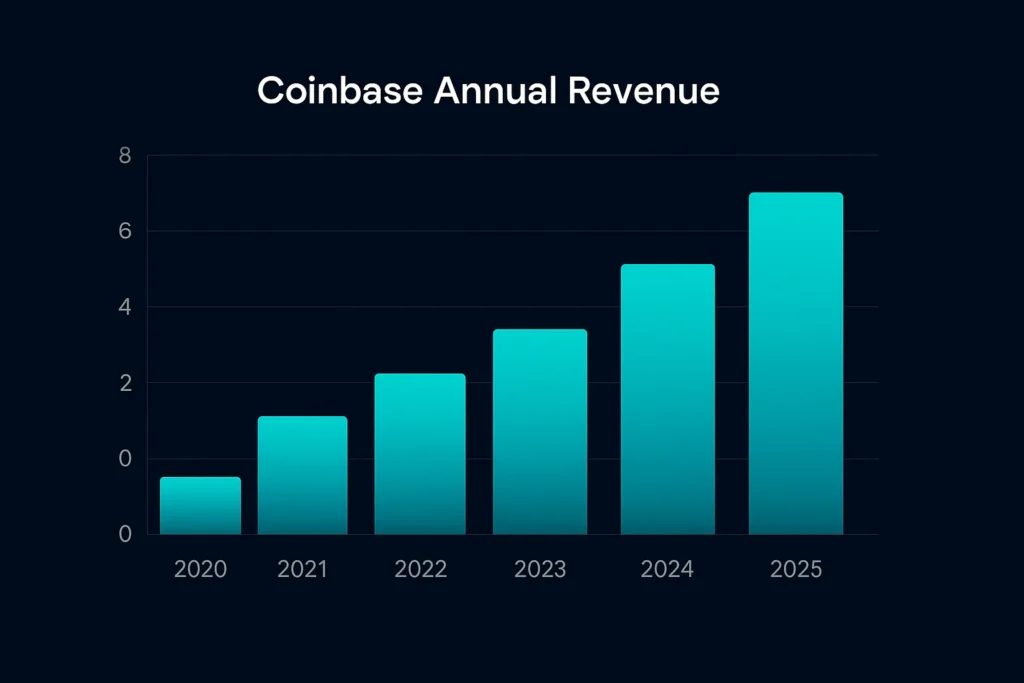
Coinbase earned $5.2 billion in 2024 and is projected to cross $6.5 billion in 2025 — making it one of the most profitable fintech businesses worldwide without storing or owning crypto assets. Instead of depending on investments, Coinbase built a transaction-driven financial engine that monetizes user activity, liquidity flow and institutional demand — not crypto speculation.
What makes Coinbase stand out is its regulation-first approach, which helped it become the leading compliance-friendly exchange in the United States and a trusted gateway for new investors entering the blockchain economy. While many platforms faced regulatory pressure, Coinbase leveraged it to build credibility — converting transparency into profitability.
Why it matters:
Coinbase’s revenue model is structured, scalable, regulation-ready, and replicable — especially for entrepreneurs who want to launch their own crypto exchange platforms without creating a native token or running liquidity pools. With the right blueprint, a Coinbase-style platform can be launched as a profitable SaaS + fintech hybrid — even at a micro-market scale.
This breakdown explores how Coinbase makes money, how it secures user trust, how it continues to expand, and how similar platforms can replicate this model with a smart architecture — not just big investment.
Coinbase Revenue Overview – The Big Picture
- Estimated Revenue (2025): $6.5 Billion (projected)
- 2024 Revenue: $5.2 Billion
- Current Valuation (2025): $60–70 Billion
- User Base: Over 120 million verified users
- Active Monthly Users: 11.5 million+
- Year-over-Year Growth: ~20%
- Revenue by Region:
- North America – 45%
- Europe – 22%
- Asia – 17%
- Others – 16%
Profit Margin: 45–50%
Market Position: Largest regulated crypto exchange in the USA — ahead of Kraken, Gemini, and Robinhood Crypto.
Read More: Inside the Coinbase App: What It Does, Who Uses It & How It Makes Money
Primary Revenue Streams – Deep Dive
| Revenue Stream | % Share (2025 est.) | Description |
|---|---|---|
| Transaction Fees | 48% | Trading, swaps & conversions |
| Subscription & Services | 22% | Coinbase One, API access |
| Blockchain Rewards (Staking) | 10% | Yield & staking services |
| Institutional Services | 8% | Prime services & custody |
| USDC Yield | 6% | Interest revenue from stablecoin |
| NFT Marketplace & Commerce | 3% | Low but growing |
| Others | 3% | Card, remittances, ads |
Revenue Stream #1 – Transaction Fees
- Core engine of Coinbase’s revenue
- Fees 0.5%–4% depending on trade size
- Generated $2.9B+ in 2024 alone
Revenue Stream #2 – Subscription Services (Coinbase One)
- $29.99/mo per user
- Priority support, 0% fees, tax tools
- Solid recurring revenue stream
Revenue Stream #3 – Staking & Blockchain Rewards
- 1.5%–3% fees on staking assets
- Earned over $500M+ in 2024
Revenue Stream #4 – Institutional Custody (Prime)
- Coinbase handles custody for large funds
- Custodies over $180B in assets today
Revenue Stream #5 – USDC Stablecoin Yield
- Generates interest via treasury investments
- Low-risk & regulation-compliant revenue stream
The Fee Structure Explained
| User Type | Fee Type | Range |
|---|---|---|
| Retail Traders | Transaction Fee | 0.5–4% |
| Institutional | Prime Service | Custom pricing |
| Staking Users | Staking Fee | 1.5–3% |
| API Users | Subscription | $30–$300/mo |
| NFT Sellers | Commission | 1–2.5% |
User-side Fees – Trading, network fee, instant buy/sell fee
Provider-side Fees – API access, custody fees, enterprise security
Hidden Layers – Spread pricing & maker/taker models
Regional Pricing: US & EU impose higher compliance fees
Read More: Coinbase Marketing Strategy: Ride the Crypto Wave
How Coinbase Maximizes Revenue Per User
- Segmentation — Retail vs Institutional
- Upselling — Tax reports, staking, subscriptions
- Cross-selling — NFT, API, and cloud security
- Dynamic pricing — High-frequency traders get reduced fees
- Retention monetization — Coinbase Earn & educational rewards
- Psychological pricing — Small fee feels negligible per trade
- LTV optimization — Educational onboarding → Active trader flow
Real Example (2024):
An average retail user generated $65/year, while institutional traders generated $2,700+ each in revenue.
Cost Structure & Profit Margins
| Cost Component | Annual Cost (2025 est.) |
|---|---|
| Technology Infrastructure | $850M |
| Legal & Compliance | $700M |
| Marketing & CAC | $500M |
| Operations | $380M |
| R&D | $450M |
| Total Cost | ~$2.8B |
Estimated Profit 2025: ~$3.3B
Profit Margin: ~50%
Unit Economics: Strong CAC payback — under 5 months
Scalability: High upon regulation alignment
Read More: Build an App Like Coinbase – Full Stack Developer Guide
Future Revenue Opportunities – 2025 to 2027
- Tokenized asset trading
- Crypto tax-as-a-service
- AI-powered investment tools
- Web3 identity & user authentication
- Virtual asset banking (CBDCs)
- Decentralized credit systems
- Global remittance rails (low fee)
Risks: SEC regulations, on-chain finance, decentralized rival models
Opportunity: Regulated markets are still open — entrepreneurs can launch micro-niche Coinbase-style platforms in emerging sectors.
Lessons for Entrepreneurs & Your Opportunity
What Works for Coinbase
- High trust with strict regulation
- Easy onboarding for first-time investors
- Subscription-based recurring revenue
- Staking + custody → stable income layer
What You Can Replicate
- Fee layering
- Prime services for institutions
- Subscriptions + add-ons
- USDC / stablecoin yield model
Final Thought
Fintech moves fast — but regulated, structured exchanges like Coinbase prove that profitability doesn’t depend on speculation, it depends on trust, compliance, and a scalable revenue model. With the right setup, even a new crypto exchange can start generating income from trading fees, subscriptions, staking, and institutional services — without ever holding crypto assets.
The next wave of crypto businesses won’t compete on features — they’ll compete on monetization efficiency. That means whoever builds smarter revenue layers will grow faster than those who only build trading platforms.
This is exactly where Miracuves gives entrepreneurs a major advantage. Instead of spending months building from scratch, you get a Coinbase-style architecture prebuilt — with fee systems, KYC/AML support, API layers, staking modules, and liquidity options already integrated. You can launch faster, test revenue earlier, and scale with confidence.
Miracuves delivers ready-to-launch solutions in just 6 Days, making it one of the fastest go-to-market options for crypto exchange startups.
FAQs
1. How much does Coinbase make per transaction?
Between 0.5% to 4% depending on user type and trade value.
2. What’s Coinbase’s most profitable revenue stream?
Transaction fees + subscription services.
3. How does Coinbase compare to competitors?
It leads in regulation, security, and user trust — a major competitive advantage. With Miracuves, you can build a similar high-trust platform starting at just $2899.
4. What percentage does Coinbase take from staking providers?
Around 1.5–3% management fee.
5. Has Coinbase’s model changed over time?
Yes — it evolved from trading-only to subscription, custody & AI services.
6. Can entrepreneurs replicate this model?
Yes — especially by targeting niche regions & sectors.
7. What’s the minimum requirement for profitability?
150K+ active traders OR B2B subscription-based model.
8. How to implement this revenue model?
Begin with trading & staking → scale to API + subscription products.
9. What are alternatives to Coinbase’s model?
DEX model, tokenized assets, hybrid wallet-exchange architecture.