


Imagine ordering something online and knowing exactly when it will arrive—whether it’s shipping across the city or across the world. Behind that reliability is a logistics system that handles millions of packages daily with near-clockwork precision. That’s the role UPS plays in global commerce.
UPS (United Parcel Service) is one of the world’s largest package delivery and logistics companies, best known for its brown delivery trucks and reliable shipping services. It moves documents, parcels, and freight for individuals, small businesses, enterprises, and global corporations—connecting manufacturers, retailers, and consumers through a massive logistics network.
What makes UPS unique is its scale and discipline. It operates a tightly coordinated system of hubs, vehicles, aircraft, technology platforms, and delivery teams that work together to move packages efficiently across countries and continents.
By the end of this guide, you’ll understand what UPS is, how it works step by step, how it makes money, its key services and features, and why many logistics and tech founders study UPS when building large-scale delivery and supply chain platforms—with insights into how Miracuves can help you build similar logistics solutions.
What Is UPS? The Simple Explanation
UPS is a global logistics and package delivery company that helps people and businesses ship documents, parcels, and freight reliably within countries and across international borders. In simple terms, UPS picks up packages, sorts them, transports them through its network, and delivers them to the final destination.
The Core Problem UPS Solves
Moving goods at scale is complex—especially when shipments must arrive on time, cross borders, or meet business-critical deadlines. UPS solves this by operating a highly structured logistics network that combines transportation, warehousing, technology, and trained personnel.
Target Users and Use Cases
UPS serves a wide range of customers, including:
• Individuals sending documents and parcels
• Small and medium businesses shipping products
• Large enterprises managing national and global supply chains
• E-commerce brands handling daily deliveries and returns
• Manufacturers moving parts and finished goods
Current Market Position
UPS is one of the largest and most recognized logistics companies in the world, with a strong presence in the United States and operations in many international markets. It competes with other global carriers but is widely known for reliability and operational discipline.
Why It Became Successful
UPS became successful by building an end-to-end logistics system focused on efficiency, consistency, and process optimization. Its emphasis on standard operating procedures, route planning, and technology-driven decision-making allowed it to scale while maintaining service quality.
How UPS Works — Step-by-Step Breakdown
For Customers (Senders)
Shipment Creation
A customer prepares a shipment by entering pickup and delivery details, package size, weight, and service level (ground, air, express, international). Labels are generated and attached to the package.
Pickup or Drop-Off
Packages are either:
- Picked up from homes, offices, or warehouses by UPS drivers, or
- Dropped off at authorized UPS locations
Each package is scanned at pickup, creating the first tracking record.
Sorting & Hub Processing
After pickup, packages move to local facilities and large sorting hubs. Here, automated systems scan labels and route packages based on destination, delivery speed, and transportation mode (truck or aircraft).
Line-Haul Transportation
Packages are transported between hubs using:
- UPS delivery trucks and trailers for ground shipping
- UPS aircraft for air and express shipments
The routing is optimized to reduce transit time and costs.
Last-Mile Delivery
At the destination facility, packages are assigned to delivery routes. Drivers load vehicles in sequence and deliver packages to homes or businesses, capturing proof of delivery.
Tracking & Notifications
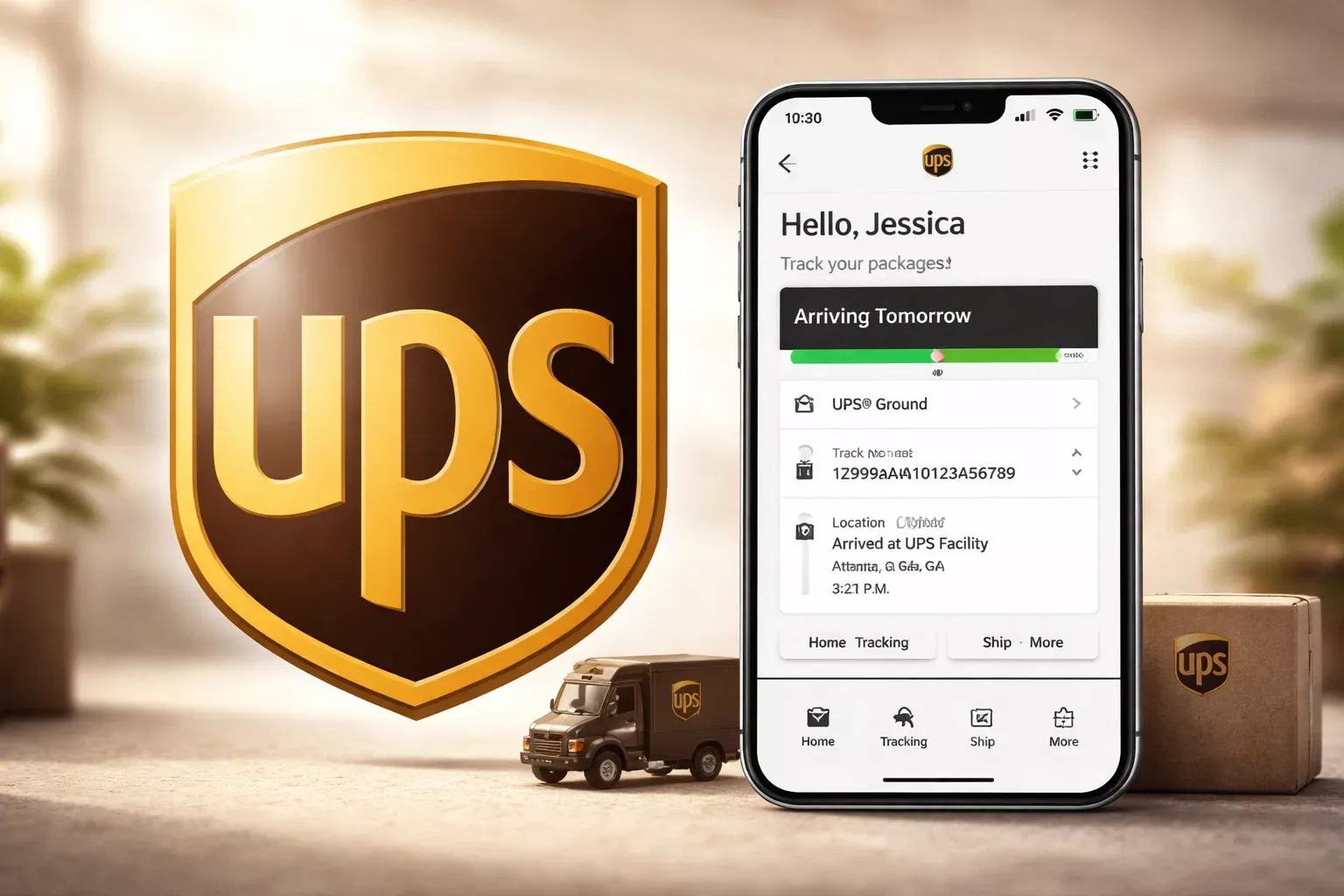
Throughout the journey, each scan updates the tracking system so customers can see where their package is and when it’s expected to arrive.
Example Shipment Journey
Sender creates shipment → package picked up → sorted at hub → transported via truck or plane → reaches local facility → delivered to recipient.
For Businesses & Enterprises
Contract Shipping & Logistics
Large businesses integrate directly with UPS systems for bulk shipping, returns, and supply chain services. UPS handles recurring pickups, scheduled deliveries, and large-volume logistics.
Freight & Supply Chain Services
UPS also manages freight, warehousing, and supply chain solutions, helping enterprises move pallets, containers, and inventory across regions and borders.
Technical Overview (Simplified)
UPS operates through a tightly coordinated system that includes:
- Package scanning and tracking systems
- Automated sorting and routing software
- Fleet management for trucks and aircraft
- Route optimization and delivery sequencing
- Customer-facing tracking and notification tools
All of these systems work together to ensure packages move efficiently and predictably at massive scale.
UPS’s Business Model Explained
How UPS Makes Money
UPS operates a fee-for-service logistics model. It earns revenue by charging customers for shipping, freight, and supply chain services based on speed, distance, size, and complexity. Unlike marketplaces, UPS owns and operates much of its logistics infrastructure, including vehicles, hubs, and aircraft.
Key revenue streams include:
- Domestic package delivery: Ground and air shipping within countries
- International shipping: Cross-border parcel and document delivery
- Freight services: Palletized and heavy shipments for businesses
- Supply chain solutions: Warehousing, fulfillment, and logistics management
- Value-added services: Insurance, customs brokerage, special handling
Pricing Structure
UPS pricing depends on several factors:
- Package weight and dimensions
- Distance and destination zone
- Delivery speed (standard vs express)
- Additional services (signature, insurance, customs handling)
Business customers often receive contract-based pricing, while individuals use published rate cards.
Fee Breakdown
- Per-shipment delivery charges
- Fuel surcharges based on market conditions
- International and customs-related fees
- Premium fees for faster delivery or special handling
UPS does not take commissions—it charges directly for logistics execution.
Market Size and Growth
Global shipping and logistics is a massive, ongoing market driven by e-commerce, international trade, and enterprise supply chains. UPS benefits from consistent demand across consumer, business, and industrial segments.
Profitability Insights
UPS improves profitability through:
- High asset utilization (trucks, hubs, aircraft)
- Route optimization and delivery density
- Automation in sorting facilities
- Long-term contracts with large customers
Revenue Model Breakdown
| Revenue Stream | Description | Who Pays | Nature |
|---|---|---|---|
| Domestic Shipping | Ground and air parcel delivery | Individuals & Businesses | Per shipment |
| International | Cross-border shipping | Businesses & Consumers | Per shipment |
| Freight | Large and palletized goods | Enterprises | Contract-based |
| Supply Chain | Warehousing & fulfillment | Enterprises | Subscription / usage |
| Value-Added | Insurance, customs, handling | Customers | Add-on |
Key Features That Make UPS Successful
1) Massive global logistics network
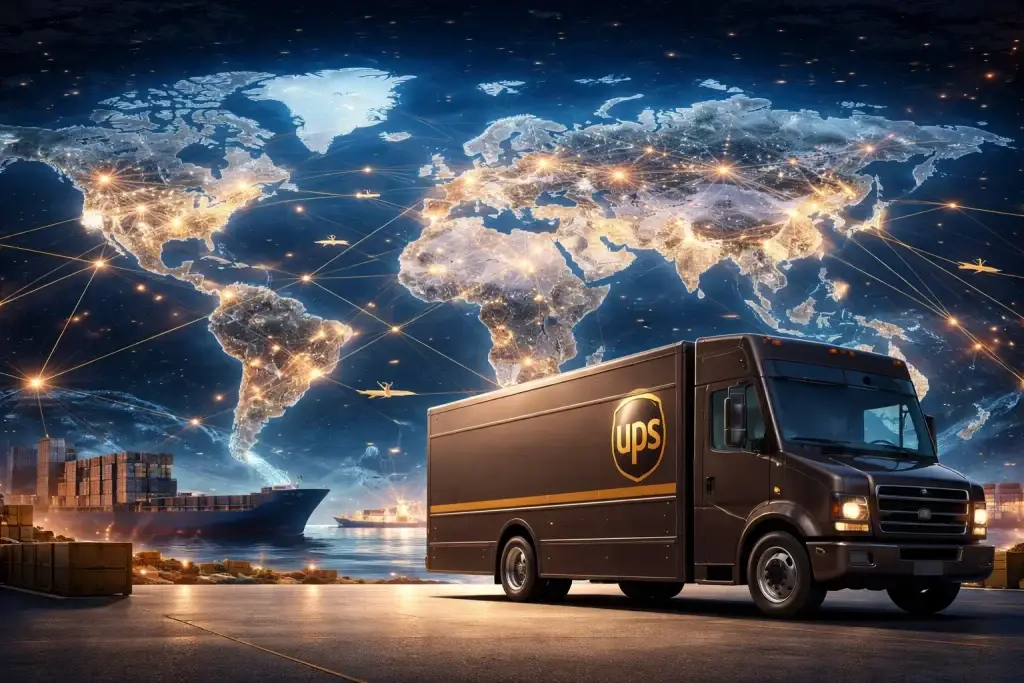
UPS operates one of the largest logistics networks in the world, with thousands of facilities, hubs, vehicles, and aircraft working together. This scale allows UPS to move packages efficiently across cities, countries, and continents.
2) Highly optimized routing and delivery planning
UPS is known for advanced route planning that minimizes distance, fuel usage, and delivery time. Drivers follow carefully sequenced routes that improve efficiency and consistency.
3) End-to-end tracking and visibility
Every package is scanned multiple times from pickup to delivery. These scan events feed real-time tracking systems that give customers visibility and predictable delivery timelines.
4) Reliable ground and air services
UPS combines ground transportation with a dedicated air network. This flexibility lets customers choose between cost-efficient ground shipping and time-critical air delivery.
5) Strong enterprise and contract logistics capabilities
Beyond parcels, UPS provides supply chain services such as warehousing, fulfillment, and freight management. This makes it a long-term logistics partner for large businesses.
6) International shipping expertise
UPS handles customs documentation, clearance, and compliance, making cross-border shipping easier for businesses and individuals.
7) Automation in sorting facilities
Many UPS hubs use automated sorting systems to handle large volumes quickly and accurately, especially during peak seasons.
8) Consistent service standards
UPS follows strict operating procedures across its network. This consistency helps maintain service quality even at massive scale.
9) Proof of delivery and accountability
UPS captures delivery confirmation and proof of delivery, which is critical for business shipments and high-value goods.
10) Brand trust and reliability
Decades of operational excellence have made UPS a trusted name in shipping. Reliability is a major reason businesses choose UPS repeatedly.
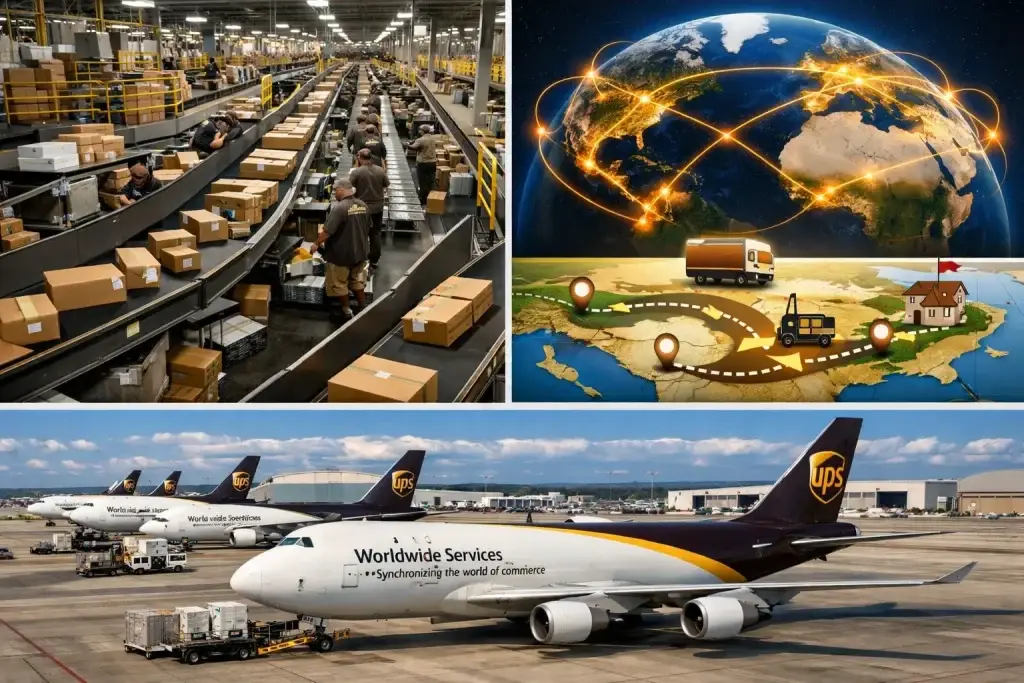
The Technology Behind UPS
Tech stack overview (simplified)
UPS runs logistics using a tightly integrated physical + digital system. The technology coordinates trucks, aircraft, hubs, drivers, and packages in real time so millions of deliveries move predictably every day.
Core technology layers include:
- Package scanning and identification systems
- Automated sorting and routing software
- Fleet and aircraft management systems
- Route optimization and delivery sequencing tools
- Tracking, notifications, and customer dashboards
- Billing, invoicing, and contract pricing systems
Scan-based tracking and data flow
Every package generates multiple scan events—at pickup, arrival at hubs, sorting, loading, and final delivery. These scans act as checkpoints that:
- Update customer-facing tracking
- Trigger routing decisions
- Measure on-time performance
- Flag exceptions like delays or misroutes
This event-driven design is what makes large-scale visibility possible.
Route optimization and delivery planning
UPS uses advanced route-planning logic to decide:
- The most efficient delivery order
- Which vehicle should handle which packages
- How to reduce mileage, fuel usage, and idle time
This planning happens before drivers leave the facility and adapts as conditions change.
Sorting automation and hub systems
Large UPS hubs rely heavily on automation. Software controls conveyor belts, scanners, and diverters that move packages to the correct outbound lanes. Automation improves speed, accuracy, and consistency—especially during peak shipping periods.
Fleet and aircraft coordination
UPS operates a combined ground and air network. Technology ensures that packages move seamlessly between trucks and planes, selecting the best transport mode based on delivery commitment and distance.
Data, analytics, and forecasting
UPS uses historical and real-time data to:
- Forecast shipment volumes
- Prepare for seasonal peaks
- Plan workforce and vehicle capacity
- Identify bottlenecks before they affect delivery
Predictive planning helps maintain reliability at scale.
Security and reliability
Technology also supports package security and chain-of-custody tracking. Systems log every handoff so accountability is maintained across the network.
Why this technology matters for business
UPS’s technology turns logistics into a repeatable, predictable process. For businesses, this means:
- Fewer delivery surprises
- Better planning and inventory control
- Reliable SLAs for customers
- Confidence shipping at scale
This is why UPS is often chosen for mission-critical deliveries.
Also Read :-Top 10 Ideas for Profitable Logistics and Courier Services Business Startups
UPS’s Impact & Market Opportunity
Industry disruption caused
UPS helped standardize modern parcel delivery by proving that logistics can run like a highly disciplined system—where every scan, hub transfer, and route decision is engineered for reliability. It pushed the industry toward predictable tracking, time-definite delivery options, and consistent operating procedures at scale.
As e-commerce exploded, UPS also became a core “commerce backbone,” helping businesses ship nationwide and globally without building their own delivery networks.
Market statistics and growth drivers
The logistics market keeps expanding because:
- E-commerce needs fast, reliable shipping and returns
- Businesses are distributing inventory across more locations
- Cross-border trade requires dependable global carriers
- Customers expect real-time tracking and shorter delivery windows
UPS sits in the middle of all these drivers, serving both consumers and enterprises with a mix of ground, air, and supply chain services.
User demographics and behavior (business-first platform)
UPS serves:
- Individuals shipping occasional parcels
- Small businesses shipping daily orders
- Enterprises moving high volumes under contracts
- Manufacturers shipping parts and supplies
- Retailers managing returns and replenishment
A key behavior pattern is trust-based retention: once a business builds shipping workflows around UPS reliability and pickup schedules, switching becomes operationally costly.
Geographic presence
UPS has a strong base in the United States while operating internationally across many regions. Its network supports domestic shipping, international export/import flows, and global supply chain movement.
Future projections
Logistics is moving toward:
- Faster delivery expectations (same-day/next-day in more lanes)
- More automation in hubs and warehouses
- Smarter routing and capacity forecasting
- Sustainability initiatives (route efficiency, EVs, alternative fuels)
- More integrated end-to-end supply chain services for enterprises
UPS’s scale positions it well to continue adapting, especially where reliability and speed matter.
Opportunities for entrepreneurs
There’s a big opportunity to build UPS-inspired platforms in focused segments such as:
- Hyperlocal and same-day delivery networks
- SME-first shipping platforms with simple onboarding
- Returns-first logistics systems for e-commerce
- Freight management and dispatch platforms
- Industry-specific logistics (cold chain, pharma, groceries)
This massive success is why founders want to build logistics products: once you become part of a business’s shipping workflow, volume is recurring and defensible.
Building Your Own UPS-Like Platform
Why businesses want UPS-style logistics systems
UPS proves that logistics becomes extremely valuable when it is reliable, predictable, and scalable. Businesses want similar platforms because shipping is not optional—it’s a core operation. A system that consistently delivers on time quickly becomes deeply embedded in business workflows.
Key considerations before development
If you plan to build a UPS-inspired logistics platform, you need to think about:
- Service scope: local, national, or international
- Delivery model: owned fleet vs partner network
- Hub-and-spoke vs direct routing
- Tracking and scan-event accuracy
- Route planning and vehicle utilization
- Customer SLAs and delivery commitments
- Billing, invoicing, and contract pricing
Cost Factors & Pricing Breakdown
UPS-Like App Development — Market Price
| Development Level | Inclusions | Estimated Market Price (USD) |
|---|---|---|
| Basic Parcel & Courier MVP | Core web console and basic customer portal for shipment creation, simple rate calculation, pickup request, shipment tracking by AWB, customer & shipper accounts, basic pickup & delivery status updates, standard admin panel, basic operational and billing reports | $70,000 |
| Mid-Level Logistics & Parcel Management Platform | Multi-service support (standard/express/international), zone- and weight-based pricing, hub–branch–route structure, bulk shipment uploads, label generation, improved tracking with scan events, customer notifications (SMS/email), COD flags, billing summaries, analytics dashboard, web + mobile-ready experience | $150,000 |
| Advanced UPS-Level Logistics Ecosystem | Large-scale multi-network logistics platform with advanced routing & optimization, multi-region and multi-country operations, complex tariff & contract logic, integrations with WMS/TMS/ERP, partner and franchise management, real-time tracking across hubs, rich SLA & performance analytics, cloud-native scalable architecture | $260,000+ |
UPS-Style Logistics Platform Development
The prices above reflect the global market cost of developing a UPS-like logistics and parcel management platform — typically ranging from $70,000 to over $260,000, with a delivery timeline of around 4–12 months for a full, from-scratch build. This usually includes shipment and network modeling, pickup and delivery workflows, pricing and contract logic, tracking and status flows, integrations with WMS/TMS/ERP and carriers, analytics, and infrastructure for high-volume logistics operations.
Miracuves Pricing for a UPS-Like Custom Platform
Miracuves Price: Starts at $14,999
This is positioned for a feature-rich, JS-based UPS-style logistics and parcel management platform that covers shipment creation, rate calculation, tracking, multi-service product setup (standard/express/international), customer and shipper accounts, pickup & delivery status workflows, notifications, billing overviews, analytics, and a modern operations console plus mobile apps for field staff. From this base, the solution can be extended into deeper route optimization, warehouse and fleet integrations, partner/franchise networks, and more advanced SLA, contract, and analytics modules as your logistics network grows.
Note: This includes full non-encrypted source code (complete ownership), complete deployment support, backend & API setup, admin panel configuration, and assistance with publishing on the Google Play Store and Apple App Store—ensuring you receive a fully operational logistics ecosystem ready for launch and future expansion.
Delivery Timeline for a UPS-Like Platform with Miracuves
For a UPS-style, JS-based custom build, the typical delivery timeline with Miracuves is 30–90 days, depending on:
- Depth of logistics features (services, hubs, routes, tracking detail, etc.)
- Number and complexity of WMS/TMS, carrier, billing, and notification integrations
- Complexity of operations workflows, partner management, and SLA reporting
- Scope of web portal, mobile apps, branding requirements, and long-term scalability plans
Tech Stack
We preferably will be using JavaScript for building the entire solution (Node.js/Nest.js/Next.js for the web backend + frontend) and Flutter / React Native for mobile apps, considering speed, scalability, and the benefit of one codebase serving multiple platforms. Other tech stacks can be discussed upon request — Contact us
Essential features to include
A strong UPS-like MVP should include:
- Shipment creation and label generation
- Pickup scheduling
- Scan-based tracking and proof of delivery
- Hub and route management
- Delivery confirmation workflows
- Customer dashboards and reports
- Admin tools for operations and exceptions
High-impact additions later:
- International shipping modules
- Freight and pallet handling
- Returns management
- Sustainability and route efficiency tools
- Advanced analytics and forecasting
Read Also :- How to Launch a Successful Logistics & Package Delivery App Business
Conclusion
UPS shows that logistics excellence comes from discipline, consistency, and technology working together. By treating every package as part of a carefully engineered system, UPS turned shipping into a predictable service that businesses and individuals can rely on every day.
For entrepreneurs, UPS is a reminder that the biggest opportunities often lie in operational problems. When logistics works smoothly in the background, it enables commerce to grow faster—and platforms that deliver reliability at scale become long-term pillars of the economy.
FAQs :-
What does UPS do?
UPS is a global package delivery and logistics company that provides domestic and international shipping, freight, and supply chain services for individuals and businesses.
How does UPS make money?
UPS earns revenue by charging shipping and logistics fees based on package size, weight, distance, delivery speed, and value-added services like insurance and customs handling.
Is UPS only for businesses?
No. UPS serves both individual customers and businesses. Individuals use UPS for one-time shipments, while businesses often use contract-based shipping solutions.
How does UPS track packages?
UPS uses scan-based tracking, where packages are scanned at pickup, hubs, and delivery. Each scan updates the tracking system so customers can see shipment progress in real time.
Does UPS offer international shipping?
Yes. UPS provides international shipping services, including customs clearance support, making cross-border delivery easier for customers.
What delivery options does UPS offer?
UPS offers multiple options, including ground delivery, air shipping, time-definite express services, and freight solutions for larger shipments.
How reliable is UPS?
UPS is known for high reliability due to standardized processes, optimized routing, and advanced logistics technology across its network.
Does UPS handle returns?
Yes. UPS supports returns logistics, allowing businesses to manage customer returns efficiently.
Can UPS handle large or heavy shipments?
Yes. UPS offers freight and palletized shipping services for large, heavy, or bulk shipments.
What makes UPS different from other carriers?
UPS stands out for its global scale, operational discipline, advanced routing, and enterprise-grade logistics services.
Can I build a platform like UPS?
Yes. With the right logistics software, tracking systems, routing logic, and operational processes, UPS-style platforms can be built for specific markets or niches.
How can Miracuves help build a UPS-like platform?
Miracuves helps founders build UPS-style logistics platforms in 30-90 days, offering shipment management, tracking, route optimization, dashboards, and scalable admin tools—fully customizable for your logistics model.