


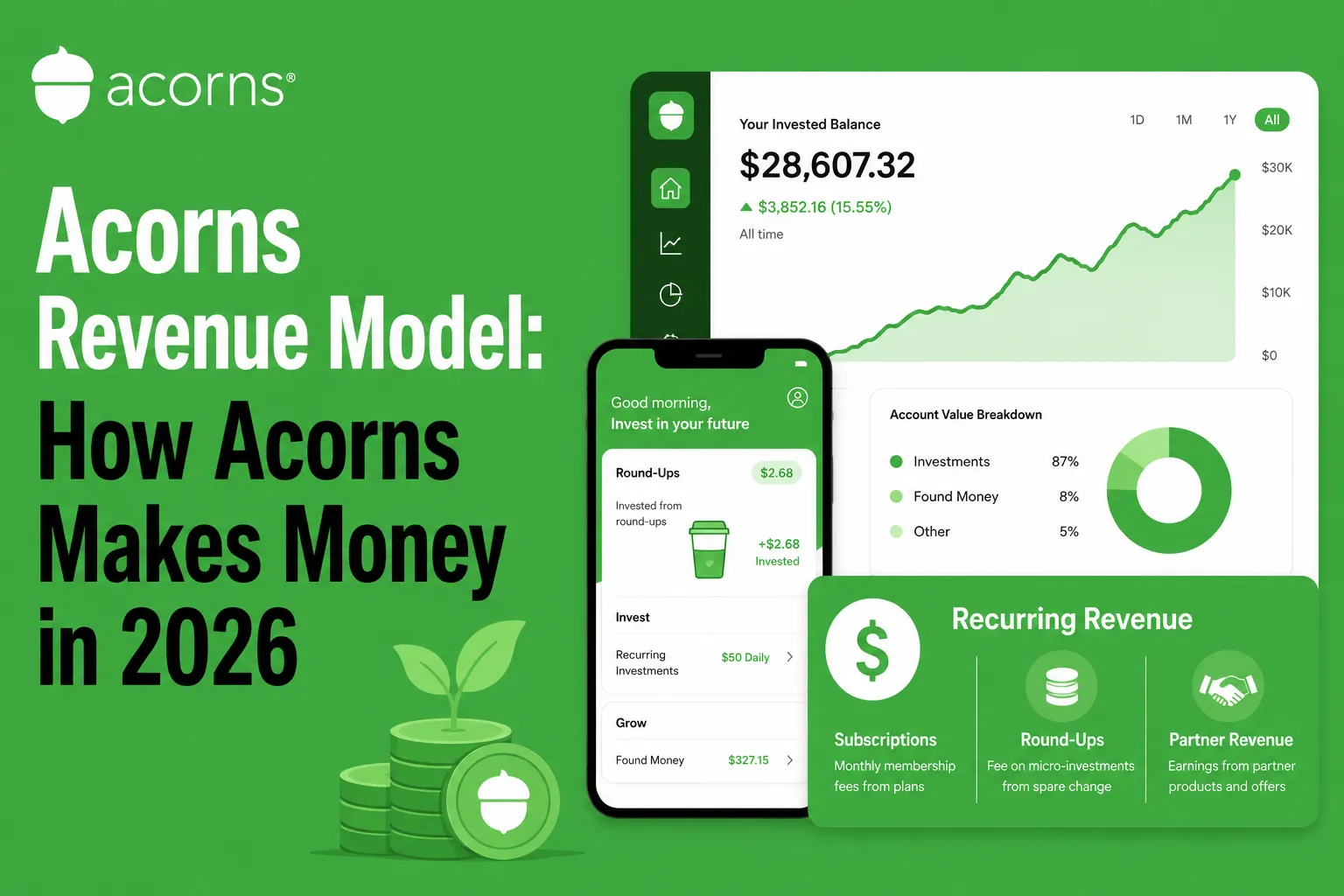
Key Takeaways
- Acorns uses a subscription-first fintech model.
- Recurring fees generate most of its revenue.
- Debit card usage creates interchange income.
- Partner rewards add affiliate revenue streams.
- Multiple products increase customer lifetime value.
Revenue Signals
- Monthly plans provide predictable recurring income.
- Round-up investing drives user engagement.
- Banking and retirement products support upselling.
- Merchant partnerships create additional revenue.
- Cross-selling improves profitability per user.
Real Insights
- Small monthly fees can scale into major revenue.
- Retention is more valuable than transaction volume.
- Product ecosystems strengthen monetization opportunities.
- Behavioral finance can improve long-term engagement.
- Acorns shows how fintechs monetize habits, not trades.
In 2026, Acorns crossed an estimated $400+ million in annual revenue, transforming spare-change investing into a scalable fintech business built on predictable, recurring income. Its growth is fueled by a subscription-first model that converts small monthly fees into long-term lifetime value, supported by strong retention, low churn, and high user trust.
What makes this milestone more impressive is Acorns’ ability to monetize financial habits rather than transactions, creating a revenue engine that compounds as users stay longer and adopt more products. For startups exploring similar fintech opportunities, scalable finance and investment app solutions can help build secure onboarding, portfolio dashboards, recurring payments, analytics, and compliance-ready investment workflows.
What began as a simple round-up investing app is now a multi-product financial ecosystem spanning investing, banking, retirement, and financial education, allowing Acorns to own more of the user’s financial journey. Each product feeds into the next, creating powerful cross-selling loops that increase average revenue per user without raising acquisition costs. This ecosystem approach also strengthens data-driven personalization, enabling Acorns to tailor offers, plans, and financial nudges based on user behavior and life stage.
For founders, Acorns is a masterclass in subscription-driven fintech growth, behavioral monetization, and lifetime value expansion. Its model shows how simplicity in pricing can unlock scale, while product bundling builds defensibility in competitive markets. The real lesson lies in designing platforms that grow with users over time—turning one-time app installs into long-term financial relationships that generate compounding revenue and brand loyalty.
Acorns Revenue Overview – The Big Picture
2026 Revenue: ~$400–450 million (estimated based on subscription ARPU, user base, and financial disclosures)
Valuation: ~$2.0–2.3 billion (private market estimates)
YoY Growth: ~18–25%
Revenue by Region:
- United States: ~92%
- Canada: ~6%
- Other Markets: ~2%
Profit Margins:
- Gross margin: ~65–72% (subscription-heavy model)
- Net margin: Still reinvesting in growth, product, and compliance
Competition Benchmark:
- Stash: ~$300M revenue
- Robinhood: ~$1.9B+ revenue
- Betterment: ~$250M+ revenue
Read More: How Acorns Works – Simple Saving & Investing for Beginners
Primary Revenue Streams Deep Dive
Revenue Stream #1: Subscription Plans (Core Revenue – ~68%)
Acorns operates on a tiered monthly subscription model that bundles investing, banking, and retirement features.
Pricing (2026):
- Personal: $3/month
- Family: $5/month
- Premium/Legacy Plans: $9/month
How it works:
Users pay flat monthly fees regardless of portfolio size, making Acorns attractive to beginners and high-margin at scale.
2026 Data:
- Active users: ~5.5 million
- Estimated ARPU: $72/year
- Subscription revenue contribution: ~$280M+
Revenue Stream #2: Interchange Fees (Debit Card – ~12%)
Acorns earns a percentage from every card transaction made through its Acorns Spend debit card.
How it works:
Each merchant pays a small interchange fee, of which Acorns receives a cut.
2026 Impact:
- Average user spend annually: ~$6,000
- Interchange yield: ~0.2–0.4%
- Estimated contribution: ~$50M+
Revenue Stream #3: Found Money Partner Commissions (~10%)
Acorns partners with brands like Walmart, Nike, and Airbnb, earning affiliate commissions when users shop through the app.
How it works:
Brands pay Acorns per transaction, and users receive cashback invested into their portfolios.
2026 Contribution: ~$40M+
Revenue Stream #4: Retirement Accounts (IRA & 401(k) Fees – ~7%)
Acorns charges premium fees for retirement account management.
How it works:
Flat monthly pricing covers automated portfolio management and tax-advantaged account services.
2026 Contribution: ~$30M+
Revenue Stream #5: Financial Partnerships & White-Label Services (~3%)
Revenue from financial institutions, education programs, and fintech partnerships.
2026 Contribution: ~$10–15M
Revenue Streams Percentage Breakdown
| Revenue Stream | % Share | Estimated Revenue |
|---|---|---|
| Subscriptions | 68% | $280M |
| Interchange Fees | 12% | $50M |
| Found Money | 10% | $40M |
| Retirement Services | 7% | $30M |
| Partnerships | 3% | $10M |
The Fee Structure Explained
User-Side Fees
- Monthly subscription: $3–$9
- ATM fees (out-of-network)
- Optional retirement upgrades
Provider-Side Fees
- Merchant affiliate commissions
- Banking interchange sharing
Hidden Revenue Layers
- Behavioral nudges increasing transaction volume
- Brand placement within Found Money marketplace
Regional Pricing Variation
- US: Full pricing model
- Canada: Simplified subscription structure
Table: Complete Fee Structure by User Type
| User Type | Fees Paid | Revenue Source |
|---|---|---|
| Beginner Investor | $3/month | Subscription |
| Family User | $5/month | Subscription |
| Premium User | $9/month | Subscription + IRA |
| Card User | None Direct | Interchange |
| Merchant Partner | % of Sale | Affiliate Fee |
How Acorns Maximizes Revenue Per User
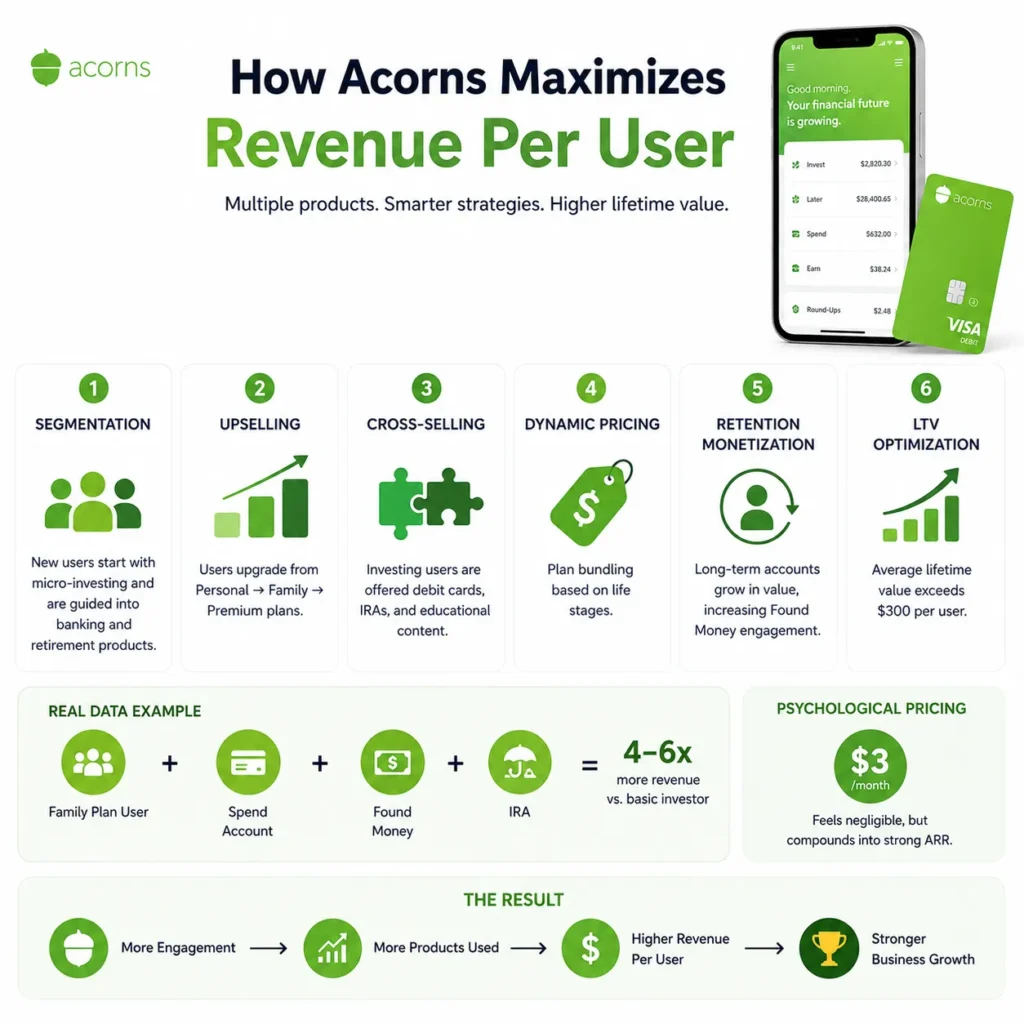
Segmentation:
New users start with micro-investing and are guided into banking and retirement products.
Upselling:
Personal → Family → Premium plans.
Cross-Selling:
Investing users are offered debit cards, IRAs, and educational content.
Dynamic Pricing:
Plan bundling based on life stages.
Retention Monetization:
Long-term accounts grow in value, increasing Found Money engagement.
LTV Optimization:
Average lifetime value exceeds $300 per user.
Psychological Pricing:
$3/month feels negligible but compounds into strong ARR.
Real Data Example:
A Family Plan user using Spend + Found Money + IRA can generate 4–6x revenue compared to a basic investor.
Cost Structure & Profit Margins
Infrastructure Costs:
Cloud hosting, financial APIs, compliance platforms.
CAC & Marketing:
~30% of revenue allocated to influencer, referral, and fintech partnerships.
Operations:
Customer support, compliance teams, fraud prevention.
R&D:
AI-based personalization, risk profiling, financial literacy tools.
Unit Economics:
- CAC: ~$35 per user
- Break-even: ~6 months subscription
Margin Optimization:
High automation, digital onboarding, minimal human advisory costs.
Profitability Path:
Scale-driven subscription margins and reduced acquisition costs over time.
Read More: Best Acorns Clone Scripts 2026 – Build a Micro-Investing App Fast
Miracuves Acorns-Like App Solution Cost and Tech Stack
Miracuves pricing for an Acorns-like micro-investment and automated savings platform built with JavaScript architecture is available on request. The final cost depends on investment modules, banking integrations, compliance requirements, portfolio management features, AI-based financial workflows, scalability needs, and deployment scope. Estimated delivery timeline: 30 to 90 days.
Build a secure fintech investment platform designed for startups, wealth-tech businesses, digital finance companies, savings platforms, robo-advisory startups, and personal finance service providers.
Core Workflows: Automated savings, round-up investments, linked bank accounts, portfolio management, recurring investments, investment tracking, financial goal planning, onboarding workflows, and user account management.
Investment Logic: Micro-investment automation, portfolio allocation systems, risk profiling, recurring contribution logic, savings intelligence, financial insights, investment reporting, and asset growth tracking.
Management Hub: Admin dashboards, portfolio monitoring, user management, financial analytics, investment controls, transaction logs, compliance workflows, reporting systems, and centralized operational management.
Enterprise Readiness: Customizable architecture for secure scaling, fintech compliance workflows, banking connectivity, investment infrastructure, performance optimization, and long-term financial platform growth.
Why an Acorns-Like Platform Requires JavaScript Architecture
An Acorns-like platform handles automated investing, financial data processing, recurring savings workflows, portfolio tracking, banking integrations, and real-time user financial insights. It requires scalable backend systems, secure financial workflows, smooth mobile experiences, intelligent automation logic, and advanced dashboard performance.
We recommend a modern JavaScript-based architecture for this type of platform because:
Built for Financial Automation: JavaScript backend systems support recurring investments, automated savings workflows, transaction processing, portfolio synchronization, and real-time financial calculations.
Advanced User Dashboard Experience: React.js or similar frontend frameworks can power interactive dashboards for portfolio performance, savings tracking, investment growth analytics, financial goal visualization, and spending insights.
Fintech Scalability: This architecture is suitable for handling growing user bases, multiple investment portfolios, banking integrations, recurring transactions, and expanding wealth-tech features.
Flexible Integration Layer: The platform can connect with banking APIs, payment gateways, investment systems, KYC providers, financial analytics engines, portfolio management tools, and compliance platforms.
You get a scalable, secure, automation-focused fintech investment platform designed for long-term financial growth operations and modern digital wealth management.
Note: Final pricing depends on selected investment modules, banking integrations, compliance requirements, security layers, automation workflows, deployment infrastructure, and custom platform development.
Future Revenue Opportunities & Innovations
New Streams:
- AI-powered financial coaching subscriptions
- Crypto & alternative asset investing
- Employer-sponsored financial wellness programs
AI/ML-Based Monetization:
Personalized upsell recommendations.
Market Expansion:
LATAM and Southeast Asia.
Predicted Trends 2026–2027:
- Embedded finance in lifestyle apps
- Gen Z-focused micro-investing tools
- Employer-based fintech platforms
Risks & Threats:
Regulatory changes, rising CAC, fintech saturation.
Opportunities for New Founders:
Niche investing platforms for creators, freelancers, and gig workers.
Lessons for Entrepreneurs & Your Opportunity
What Works:
- Flat pricing simplicity
- Behavioral finance integration
- Multi-product ecosystem
What to Replicate:
- Subscription-first fintech model
- Cashback-driven engagement loops
Market Gaps:
- Regional fintech platforms in emerging economies
- Industry-specific investment platforms
Improvements Founders Can Use:
- AI-powered advisory models
- Custom portfolio strategies for niche markets
Final Thought
Acorns proves that fintech growth doesn’t require complex trading systems—it requires trust, simplicity, and behavioral monetization designed around everyday financial decisions. By lowering the barrier to entry, the platform attracts first-time investors who might otherwise avoid traditional finance apps. This trust-first approach reduces churn, increases long-term engagement, and turns financial guidance into a core value proposition rather than a feature.
Its subscription-led model transforms small financial habits into predictable, scalable revenue that compounds over time. Instead of relying on volatile market activity or transaction fees, Acorns benefits from stable monthly recurring income that supports sustainable growth planning. As users adopt additional services like retirement accounts and debit cards, the platform deepens monetization without increasing acquisition costs, improving margins and lifetime value simultaneously.
For founders, the real opportunity lies in building focused financial ecosystems that grow with the user’s life journey, from first paycheck to long-term wealth management. The competitive advantage comes from designing platforms that evolve as user needs change, enabling continuous upselling, personalization, and data-driven engagement. This long-term relationship model not only increases revenue potential but also creates defensibility in crowded fintech markets.
FAQs
1. How much does Acorns make per transaction?
Primarily through subscriptions and a small percentage from debit card interchange and merchant partnerships.
2. What’s Acorns’ most profitable revenue stream?
Monthly subscription plans generate the highest margins and predictable cash flow.
3. How does Acorns’ pricing compare to competitors?
It’s cheaper than advisory platforms and simpler than trading-focused apps.
4. What percentage does Acorns take from providers?
Merchant partners typically pay affiliate commissions ranging from 2%–10% per sale.
5. How has Acorns’ revenue model evolved?
It shifted from pure investing to a full financial ecosystem.
6. Can small platforms use similar models?
Yes, subscription + cashback loops work well at any scale.
7. What’s the minimum scale for profitability?
Around 50,000–100,000 active subscribers.
8. How to implement similar revenue models?
Use tiered subscriptions, partner marketplaces, and embedded finance tools.
9. What are alternatives to Acorns’ model?
Commission-based trading, asset management fees, or employer-sponsored fintech.