


Key Takeaways
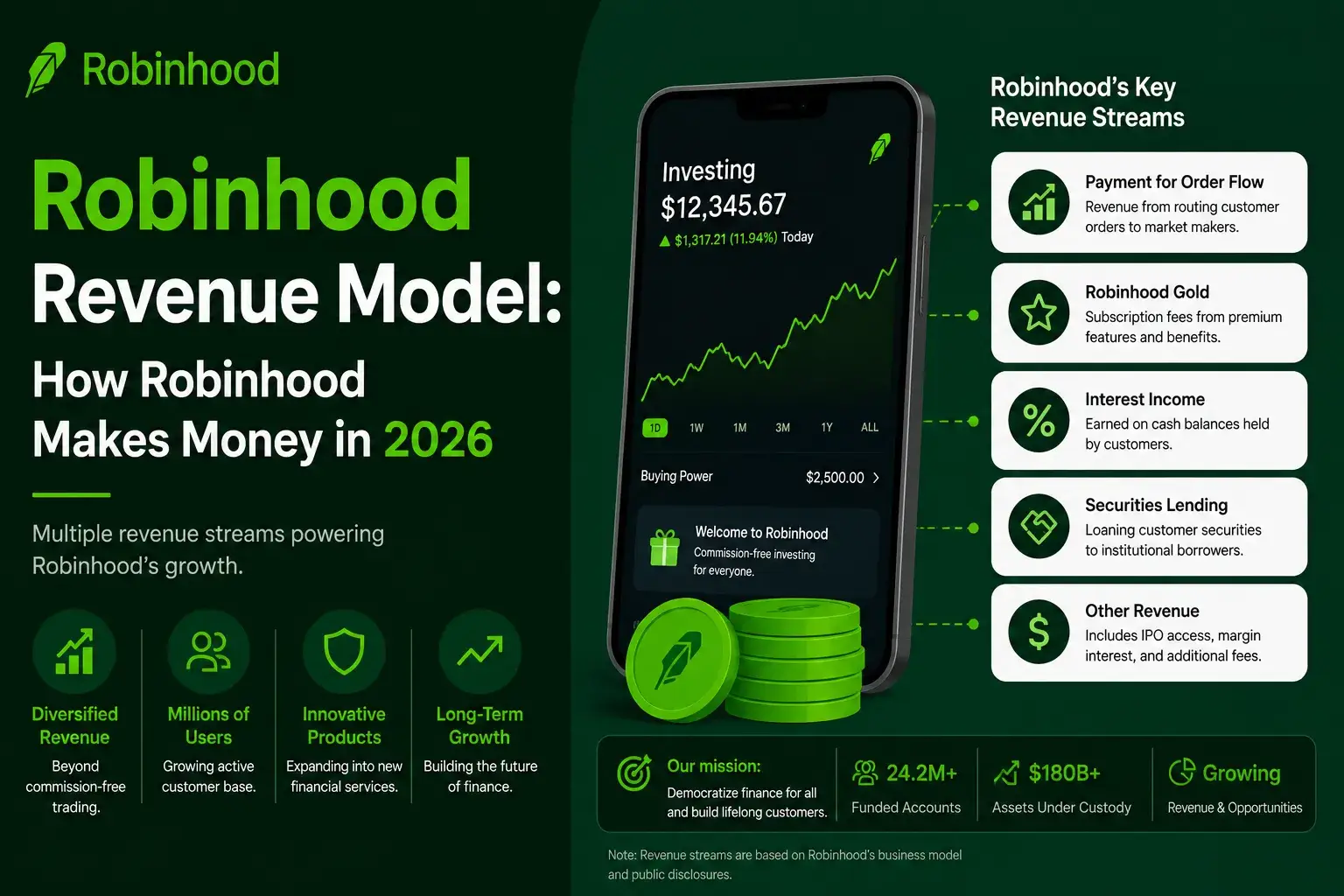
- Robinhood’s revenue model is built around commission-free trading, payment for order flow, net interest income, crypto transactions, and premium subscriptions.
- Its biggest revenue streams come from trading-based income, cash balance interest, margin lending, crypto activity, and Robinhood Gold memberships.
- The platform monetizes user activity without charging direct stock trading commissions, making financial access feel simple and low-cost for retail investors.
- Robinhood shows how fintech platforms can grow by combining free access, financial infrastructure, recurring subscriptions, and asset-based monetization.
- For founders, the main lesson is clear: a trading app becomes more profitable when it retains users, grows asset balances, and adds multiple revenue layers beyond transactions.
Revenue Signals
- Trading-based income works through payment for order flow, where market makers pay to execute user trades behind the commission-free experience.
- Net interest revenue grows from user cash balances, margin loans, securities lending, and interest spread opportunities.
- Crypto transactions create additional revenue through trading fees, spreads, and higher activity during volatile market cycles.
- Robinhood Gold adds recurring subscription revenue through premium analytics, margin access, higher interest benefits, and advanced investing tools.
- Ancillary services like debit cards, cash management, partner products, and future wealth tools help expand the platform beyond basic stock trading.
Real Insights
- Robinhood is not just a stock trading app; it is a financial ecosystem that monetizes trading volume, cash movement, user balances, and premium access.
- The strongest part of the model is its ability to make investing feel simple while monetizing through backend financial infrastructure.
- User segmentation helps Robinhood increase lifetime value by moving casual traders toward crypto, margin, Gold subscriptions, and long-term investment products.
- Founders can learn from Robinhood by building fintech platforms with trust, compliance, clean UX, diversified revenue streams, and strong retention loops.
- The future of Robinhood-style revenue will depend on AI investing tools, retirement products, international expansion, tokenized assets, and stronger regulatory-ready infrastructure.
Robinhood crossed an estimated $2.2 billion in annual revenue in 2026, reinforcing its position as one of the most influential fintech platforms shaping how retail investors interact with global markets. What began as a commission-free trading app has evolved into a multi-layered financial ecosystem spanning stocks, crypto, cash management, and premium financial services.
For founders, Robinhood’s model shows how accessibility can become a growth engine when paired with smart financial infrastructure. The company didn’t simply remove trading fees — it built alternative monetization paths that scale with user activity, asset growth, and market volatility.
Understanding how Robinhood turns millions of small transactions into a high-margin revenue machine gives entrepreneurs a real-world blueprint for building profitable, trust-driven fintech platforms in competitive markets. At Miracuves, this model is studied as a strong example of how fintech apps can grow through smart monetization, secure infrastructure, and user-first financial experiences.
Robinhood Revenue Overview – The Big Picture
2026 Revenue: ~$2.2B
Valuation: ~$11–13B (market-based estimates)
YoY Growth: ~15% (2024–2026)
Revenue by Region:
- United States: 82%
- Europe: 10%
- Asia-Pacific: 6%
- Rest of World: 2%
Profit Margins: Estimated 22–28% (improving with higher net interest income and subscription revenue)
Competition Benchmark: Competes with E*TRADE, Webull, eToro, Coinbase (crypto), and traditional brokerage platforms
Read More: Discover How Robinhood Works – Invest With Zero Commissions
Primary Revenue Streams Deep Dive
Revenue Stream #1 — Trading-Based Income (38%)
Robinhood earns through payment for order flow (PFOF), where market makers pay for executing trades. While users trade commission-free, Robinhood captures revenue per transaction behind the scenes. In 2026, this stream contributed roughly $830 million, heavily influenced by equity and options trading volume.
Revenue Stream #2 — Net Interest Revenue (32%)
Cash balances, margin loans, and securities lending generate interest income. Robinhood Gold users often hold higher balances, increasing this stream. Estimated $700 million+ in 2026, making it one of the most stable and scalable revenue drivers.
Revenue Stream #3 — Crypto Transactions (18%)
Trading fees and spreads on cryptocurrency transactions surged during periods of high market activity, contributing approximately $400 million in 2026.
Revenue Stream #4 — Subscription Revenue (8%)
Robinhood Gold, priced at around $5–$10/month, provides margin access, premium analytics, and higher interest rates on uninvested cash, generating consistent recurring revenue.
Revenue Stream #5 — Ancillary Financial Services (4%)
Includes debit cards, cash management services, and partner financial products.
Revenue Streams Percentage Breakdown (2026)
| Revenue Stream | % Share | Annual Revenue (USD) | Pricing Model |
|---|---|---|---|
| Trading-Based Income | 38% | ~$836M | Payment for order flow |
| Net Interest Revenue | 32% | ~$704M | Interest spread / lending |
| Crypto Transactions | 18% | ~$396M | Trading fees / spreads |
| Subscriptions (Gold) | 8% | ~$176M | Monthly recurring |
| Ancillary Services | 4% | ~$88M | Service & partner fees |
The Fee Structure Explained
User-Side Fees
- Free stock and ETF trades
- Crypto trading spreads
- Robinhood Gold subscription: $5–$10/month
- Margin interest for leveraged accounts
Provider-Side Fees
- Market makers pay per order flow
- Lending partners pay for access to cash balances
Hidden Revenue Layers
- Securities lending
- Idle cash interest arbitrage
- Crypto price spreads
Regional Pricing Variation
- US markets: Full feature set and pricing
- International markets: Limited assets and localized compliance-driven pricing
Complete Fee Structure by User Type
| User Type | Access Level | Pricing Model | Annual Cost Range |
|---|---|---|---|
| Casual Traders | Stocks, ETFs | Free / spreads | $0–$50 |
| Active Traders | Options, crypto, margin | Usage-based + spreads | $100–$1,000+ |
| Gold Members | Premium features | Subscription + margin | $60–$300+ |
| High-Net Users | Advanced access | Interest & service fees | $1,000+ |
How Robinhood Maximizes Revenue Per User
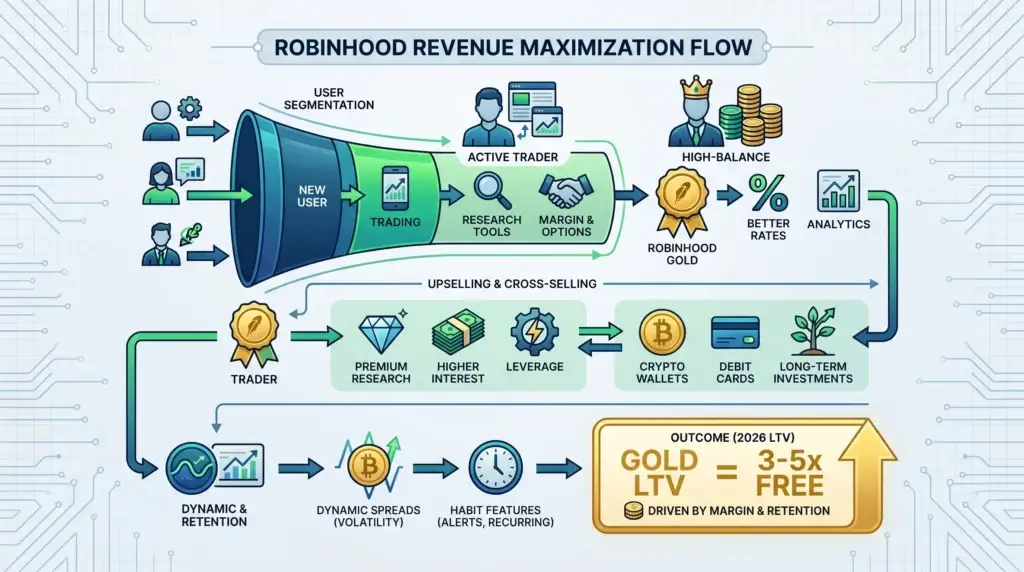
Robinhood segments users by activity, asset size, and risk appetite. New users are guided into trading, while active traders are introduced to margin and options. High-balance users are targeted with Robinhood Gold for better interest rates and analytics.
Upselling occurs through premium research tools, higher interest on idle cash, and leverage features. Cross-selling includes crypto wallets, debit cards, and long-term investment products.
Dynamic pricing adjusts crypto spreads based on volatility, while retention monetization comes from habit-forming features like recurring investments and real-time market alerts.
In 2026, Gold subscribers generated 3–5x higher lifetime value (LTV) compared to free users, driven by margin interest and higher asset retention.
Cost Structure & Profit Margins
Infrastructure Cost
Cloud hosting, real-time market data feeds, and transaction processing consume ~30% of operating expenses.
CAC & Marketing
User acquisition costs range between $40–$120 per funded account, driven by referral programs and digital advertising.
Operations
Compliance, legal, customer support, and regulatory infrastructure account for ~18% of costs.
R&D
Product development and security engineering consume ~15% of revenue.
Unit Economics
A funded user becomes profitable after maintaining an average balance of $2,500–$3,000 for six months.
Margin Optimization
Higher net interest income and subscription adoption improve gross margins year over year.
Profitability Path
Profitability accelerates as assets under custody grow, not just transaction volume.
Read More: Best Robinhood Clone Script 2026 | Secure Trading App Development
Miracuves Robinhood-Like Platform Solution Cost and Tech Stack
Miracuves Pricing for a Robinhood-Like Trading and Investment Platform developed using JavaScript architecture is available on request. Final pricing depends on trading modules, wallet workflows, brokerage integrations, KYC/AML requirements, portfolio features, security layers, scalability needs, and deployment scope. Estimated delivery timeline: 30 to 90 days.
Get a fully developed, custom investment platform modeled around Robinhood-style stock trading and wealthtech experiences. Built on a modern JavaScript foundation, this solution can be customized for fintech startups, trading platforms, investment apps, wealth management companies, brokerage businesses, and financial product founders.
- Core Workflows: User onboarding, KYC verification, stock discovery, portfolio management, watchlists, buy/sell order flows, transaction history, wallet balance, market data views, and investment tracking.
- Built-in Revenue Logic: Spread-based revenue, premium subscriptions, margin trading fees, referral programs, order-flow monetization, advisory add-ons, portfolio tools, and financial product cross-selling.
- Management Hub: Admin dashboard, user management, KYC review, trade monitoring, wallet controls, portfolio analytics, transaction records, compliance logs, payment tracking, and support management.
- Trading-Ready Architecture: Prepared for market data integrations, brokerage APIs, secure wallet workflows, real-time portfolio updates, risk controls, compliance operations, scalable user activity, and long-term fintech growth.
Why Does a Robinhood-Like Platform Require JavaScript Architecture?
A Robinhood-like platform needs more than a basic finance dashboard. It handles user onboarding, KYC checks, trading actions, portfolio updates, wallet balances, market data, transaction records, subscriptions, compliance workflows, and real-time investment activity. A modern JavaScript architecture helps manage these interactive fintech operations smoothly across users, admins, brokerage systems, and connected financial services.
We recommend JavaScript architecture for this type of platform because:
- Built for Real-Time Financial Workflows: JavaScript-based backend systems can manage market data requests, portfolio updates, trading actions, wallet activity, notifications, and high-volume user interactions.
- Advanced Frontend Experience: React.js or other JavaScript frameworks can power smooth trading screens, portfolio dashboards, watchlists, stock detail pages, transaction views, and admin panels.
- Scalable Fintech Logic: JavaScript architecture supports user verification, order workflows, subscription limits, transaction tracking, compliance logs, analytics, and growing investment activity.
- Flexible Integration Layer: The platform can connect with brokerage APIs, market data providers, KYC/AML tools, payment gateways, banking APIs, wallet systems, analytics tools, CRM platforms, and enterprise authentication systems.
You get a scalable trading and investment platform designed for smooth investing, user engagement, fintech monetization, and long-term product growth.
Note: Final pricing depends on selected trading modules, brokerage/API integrations, KYC/AML workflows, wallet features, compliance requirements, security layers, deployment infrastructure, and custom feature development.
Future Revenue Opportunities & Innovations
Robinhood is expanding into retirement accounts, AI-driven portfolio insights, and international market access. AI/ML-based monetization will focus on predictive investment tools and personalized financial coaching.
Market expansion in Europe and Asia, along with tokenized assets and digital wallets, could unlock new revenue streams between 2025–2027. Risks include regulatory pressure on order flow, crypto volatility, and interest rate sensitivity.
For founders, niche investment platforms targeting specific asset classes or regional markets present strong white-label opportunities.
Lessons for Entrepreneurs & Your Opportunity
What works is Robinhood’s ability to make complex financial systems feel simple. The interface hides infrastructure complexity while monetization happens through financial flows users rarely notice.
What to replicate is trust-based growth paired with financial literacy tools that keep users engaged and invested long-term.
Market gaps exist in localized investment platforms for emerging markets where regulatory compliance and user education remain underserved.
Final Thought
Robinhood’s success shows that fintech platforms don’t need to charge users directly to build profitable businesses. Instead, they can monetize financial infrastructure, interest flows, and premium access layered on top of free services.
For entrepreneurs, the deeper lesson is that long-term value comes from building financial ecosystems, not just transaction tools. Platforms that retain assets, trust, and data gain compounding revenue advantages over time.
As digital finance expands globally, founders who combine regulatory strength, intuitive design, and flexible monetization will shape the next generation of high-growth investment platforms. If you’re ready to build a secure, scalable fintech product for this future, let’s build together.
FAQs
1. How much does Robinhood make per transaction?
It earns a few cents per trade through payment for order flow and crypto spreads, depending on asset type and volume.
2. What’s Robinhood’s most profitable revenue stream?
Net interest revenue from cash balances and margin lending delivers the highest and most stable margins.
3. How does Robinhood’s pricing compare to competitors?
It remains more cost-friendly for retail traders while monetizing through backend financial infrastructure.
4. What percentage does Robinhood take from providers?
It doesn’t take a direct marketplace cut — it earns from market makers and financial partners.
5. How has Robinhood’s revenue model evolved?
It shifted from transaction-heavy income toward interest and subscription-based stability.
6. Can small platforms use similar models?
Yes, especially in regulated markets with strong banking and brokerage partnerships.
7. What’s the minimum scale for profitability?
Most platforms need at least 50,000–100,000 funded users to reach operational breakeven.
8. How to implement similar revenue models?
Combine free trading with backend monetization like interest income, subscriptions, and premium analytics.
9. What are alternatives to Robinhood’s model?
Flat-fee brokerage, robo-advisory subscriptions, or asset-based management fees.