


Key Takeaways
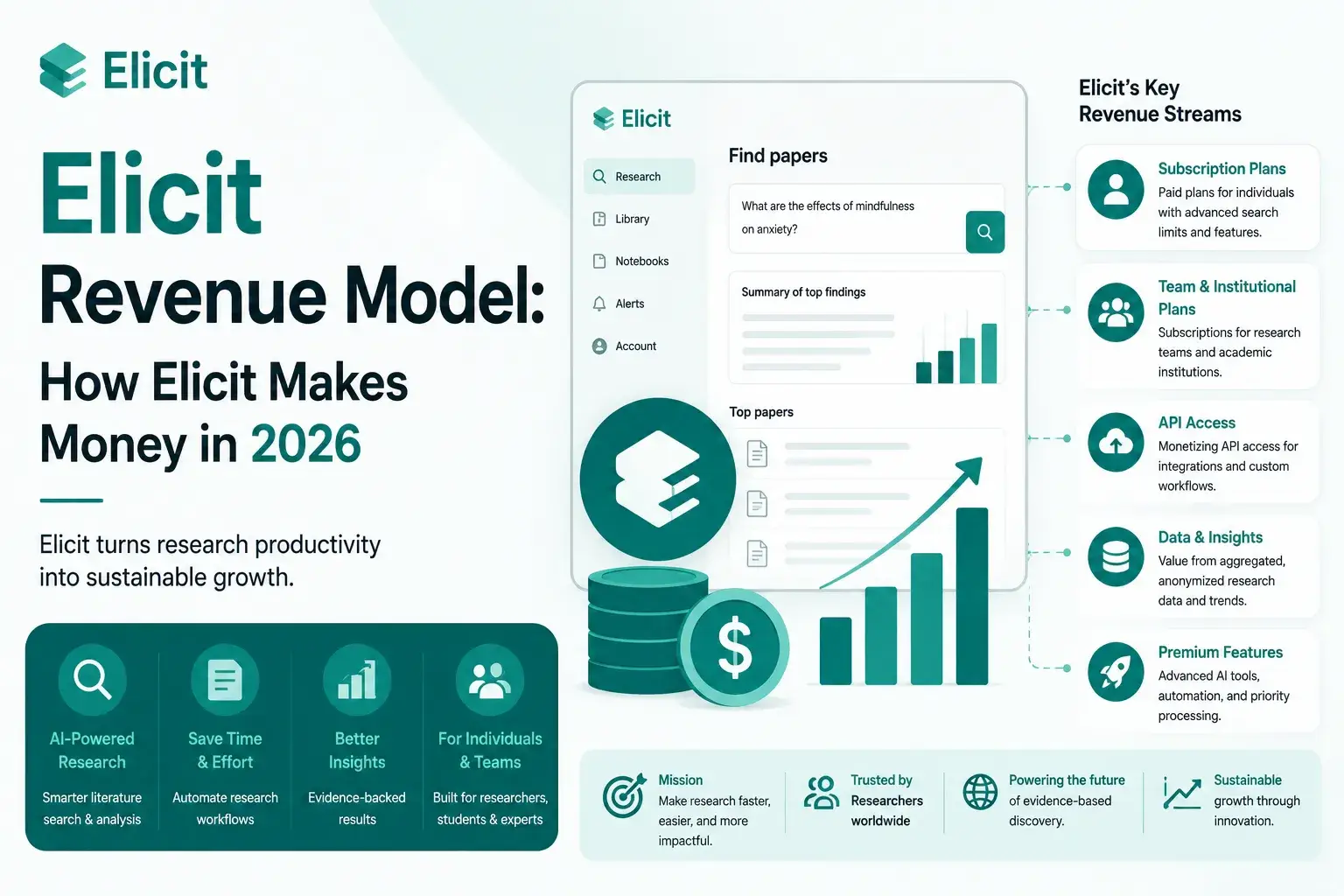
- Elicit’s revenue model is built around AI-powered research assistance, paid subscriptions, workflow automation, and productivity tools for researchers.
- Its main revenue stream comes from recurring plans that help users search papers, summarize findings, extract data, and speed up literature review workflows.
- Higher-value revenue can come from team plans, academic institutions, enterprise research teams, API access, and advanced research automation features.
- Elicit shows how AI research tools can monetize by reducing manual work for students, scientists, analysts, product teams, and knowledge workers.
- For founders, the main lesson is clear: AI SaaS tools become stronger when they solve repeated workflow pain points, not just single prompt-based tasks.
Revenue Signals
- Subscription pricing creates predictable recurring revenue from users who need regular AI support for literature reviews, research discovery, and evidence analysis.
- Usage-based limits can encourage upgrades when users need more paper searches, summaries, extractions, exports, saved projects, or advanced AI credits.
- Team and institutional plans can increase revenue through shared workspaces, collaboration tools, admin controls, billing management, and research workflow standardization.
- Enterprise research customers may pay more for secure data handling, custom workflows, API access, compliance controls, and integration with internal knowledge systems.
- Premium AI features such as automated extraction, evidence tables, citation support, and structured research reports can improve retention and lifetime value.
Real Insights
- Elicit is not just an AI search tool; it is a research workflow platform designed to reduce time spent reading, filtering, and organizing papers.
- The strongest monetization happens when users rely on the platform for repeated research tasks like paper discovery, summary comparison, and data extraction.
- AI research platforms become more valuable when they combine reliable sources, transparent outputs, citation context, and structured evidence workflows.
- Founders can learn from Elicit by building AI tools around high-friction professional tasks where time savings directly create user value.
- The future of Elicit-style revenue will depend on better research accuracy, deeper integrations, team collaboration, enterprise trust, and workflow-based pricing.
In 2026, Elicit’s AI-powered research platform is estimated to be generating over $18 million in annual recurring revenue, driven by a fast-growing base of academics, startups, and enterprise knowledge teams who rely on AI to speed up decision-making.
For founders, Elicit is more than just a research tool — it represents a powerful example of how vertical AI platforms can turn complex professional workflows into predictable, high-margin subscription businesses.
Studying Elicit’s revenue model reveals how AI infrastructure, premium access, and enterprise contracts can combine into a scalable monetization engine that grows alongside user trust and product value.
Elicit Revenue Overview – The Big Picture
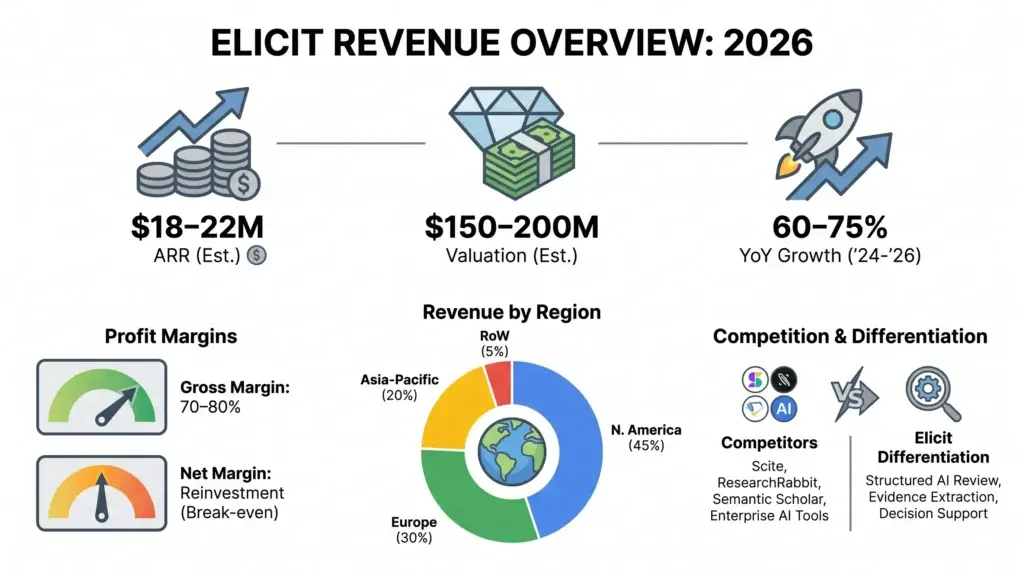
2026 Estimated Revenue: ~$18–22 million ARR
Valuation: ~$150–200 million (private market estimates based on funding rounds and SaaS multiples)
YoY Growth: ~60–75% growth from 2024 to 2026
Revenue by Region:
- North America: ~45%
- Europe: ~30%
- Asia-Pacific: ~20%
- Rest of World: ~5%
Profit Margins:
- Gross Margin: ~70–80% (typical for AI SaaS after compute costs)
- Net Margin: Reinvestment phase (near break-even or slight loss due to R&D and AI infrastructure scaling)
Competition Benchmark:
- Competes with platforms like Scite, ResearchRabbit, Semantic Scholar, and enterprise knowledge AI tools.
- Elicit differentiates by focusing on structured AI-assisted literature review, evidence extraction, and decision support.
Read More: Elicit Explained: The AI Tool That Automates Research and Literature Review
Primary Revenue Streams Deep Dive
Revenue Stream #1: Individual Subscriptions
How it works: Users pay monthly or annually for premium access to AI-powered research, unlimited searches, summaries, and data extraction.
Pricing: $12–25 per user/month (varies by tier and billing cycle)
% Share: ~55% of total revenue
2026 Data: Over 50,000 paying users globally, with strong adoption among researchers, consultants, and startup teams.
Revenue Stream #2: Enterprise & Team Plans
How it works: Companies purchase bulk licenses with admin controls, shared workspaces, API access, and compliance features.
Pricing: $1,500–15,000 per year per organization
% Share: ~25% of total revenue
2026 Data: Rapid growth among biotech, consulting firms, and AI-first startups.
Revenue Stream #3: API & Data Access Licensing
How it works: Businesses integrate Elicit’s research AI into internal tools and dashboards.
Pricing: Usage-based or fixed licensing contracts
% Share: ~10%
2026 Data: Used by analytics firms and SaaS platforms building AI-assisted insights.
Revenue Stream #4: Education & Institutional Deals
How it works: Universities and research labs purchase discounted bulk access.
Pricing: Custom contracts
% Share: ~7%
2026 Data: Growing in Europe and Asia-Pacific regions.
Revenue Stream #5: Custom AI Solutions
How it works: Tailored deployments for enterprises with proprietary datasets and internal research automation.
% Share: ~3%
2026 Data: High-margin, low-volume contracts.
Revenue streams percentage breakdown
| Revenue Stream | % Share | Monetization Model |
|---|---|---|
| Individual Subscriptions | 55% | Monthly/Annual SaaS |
| Enterprise Plans | 25% | Annual Contracts |
| API Licensing | 10% | Usage-Based |
| Education Deals | 7% | Institutional Licenses |
| Custom AI Solutions | 3% | Project-Based |
The Fee Structure Explained
User-Side Fees
- Free tier with limited searches and summaries
- Pro plans for unlimited AI-assisted research
- Annual discounts for long-term users
Provider-Side Fees
- None for content providers
- Data sources accessed via licensed or open datasets
Hidden Revenue Layers
- Priority compute access for premium users
- API overage fees
- Custom compliance and deployment fees for enterprises
Regional Pricing Variation
- Lower pricing tiers for students and developing markets
- Enterprise contracts priced based on region and compliance needs
Complete fee structure by user type
| User Type | Pricing Model | Features |
|---|---|---|
| Free Users | $0 | Limited searches, basic AI summaries |
| Pro Users | $12–25/month | Unlimited research, data export, saved workspaces |
| Teams | Custom | Admin controls, collaboration, analytics |
| Enterprises | Annual Contracts | API access, compliance, private deployment |
How Elicit Maximizes Revenue Per User
Segmentation: Individual, academic, startup, and enterprise tiers
Upselling: Pro → Team → Enterprise upgrades
Cross-Selling: API access and compliance add-ons
Dynamic Pricing: Market-based and region-based pricing tiers
Retention Monetization: Saved research libraries and collaboration tools
LTV Optimization: Annual billing discounts and long-term contracts
Psychological Pricing: Low entry price for individuals encourages upgrades
Real Data Example: Teams adopting Elicit for internal research show 3–4x higher lifetime value than solo users.
Read More: Best Elicit Clone Script 2026
Cost Structure & Profit Margins
Infrastructure Cost: AI compute, cloud hosting, data processing (~30% of revenue)
CAC & Marketing: SEO, academic partnerships, and SaaS outreach (~15%)
Operations: Support, compliance, and admin (~10%)
R&D: AI model improvements and product features (~20%)
Unit Economics:
- Average Revenue Per User (ARPU): ~$220/year
- Customer Acquisition Cost (CAC): ~$60–90
- Payback Period: 4–6 months
Margin Optimization:
- Model efficiency improvements
- Bulk compute contracts
- Enterprise-focused sales
Read More: How Elicit Makes Money in 2026
Future Revenue Opportunities & Innovations
New Streams: AI-powered decision dashboards for enterprises
AI/ML Monetization: Domain-specific models for legal, biotech, and finance
Market Expansion: Asia-Pacific education and startup ecosystems
Predicted Trends (2026–2027):
- Vertical AI platforms outperform general AI tools
- Increased enterprise adoption of private AI deployments
- Integration with internal knowledge management systems
Risks & Threats:
- Rising compute costs
- Open-source AI research tools
- Platform commoditization
Opportunities for Founders:
- Niche research AI platforms
- Regional knowledge automation tools
- Industry-specific evidence engines
Lessons for Entrepreneurs & Your Opportunity
What Works:
- Subscription-first monetization
- Strong free-to-paid conversion funnel
- Enterprise upsell strategy
What to Replicate:
- AI-driven workflow automation
- Transparent pricing tiers
- Data-backed product positioning
Market Gaps:
- Industry-specific research AI
- Multilingual evidence platforms
- Offline enterprise AI deployments
Improvements Founders Can Use:
- Faster onboarding experiences
- Custom AI training for client datasets
- Vertical-specific analytics
Miracuves Elicit-Like Platform Solution Cost and Tech Stack
Miracuves Pricing for an Elicit-Like AI Research Assistant Platform developed using JavaScript architecture is available on request. Final pricing depends on AI research modules, literature search workflows, document analysis features, citation management, subscription logic, AI model/API usage, scalability needs, and deployment scope. Estimated delivery timeline: 30 to 90 days.
Get a fully developed, custom AI research platform modeled around Elicit-style research discovery and paper analysis. Built on a modern JavaScript foundation, this solution can be customized for researchers, universities, SaaS founders, academic teams, healthcare research groups, enterprise knowledge teams, and AI productivity startups.
- Core Workflows: Research question input, academic paper discovery, literature search, paper summarization, abstract analysis, citation extraction, document Q&A, evidence comparison, saved research lists, and research history.
- Built-in Revenue Logic: Subscription plans, usage-based AI credits, premium research limits, team workspaces, institutional access, enterprise licensing, API access, and white-label research SaaS monetization.
- Management Hub: Admin dashboard, user management, AI usage tracking, search logs, research workspace controls, subscription management, billing records, document access controls, content moderation, and analytics.
- AI Research-Ready Architecture: Prepared for LLM integration, semantic search, RAG workflows, citation parsing, research database connections, document processing, scalable AI requests, and long-term SaaS growth.
Why Does an Elicit-Like Platform Require JavaScript Architecture?
An Elicit-like platform needs more than a basic AI search tool. It handles research questions, academic paper discovery, AI summaries, document analysis, citations, saved workspaces, user permissions, billing logic, and knowledge retrieval workflows. A modern JavaScript architecture helps manage these interactive AI research operations smoothly across users, teams, admins, and connected research systems.
We recommend JavaScript architecture for this type of platform because:
- Built for AI Research Workflows: JavaScript-based backend systems can manage AI API calls, literature search requests, document processing, citation extraction, research history, and high-volume query activity.
- Advanced Frontend Experience: React.js or other JavaScript frameworks can power smooth research dashboards, paper comparison views, summary panels, citation tables, document readers, and admin controls.
- Scalable Backend Logic: JavaScript architecture supports semantic search, RAG pipelines, usage tracking, team permissions, saved research workspaces, subscription limits, and scalable AI product operations.
- Flexible Integration Layer: The platform can connect with LLM APIs, academic databases, vector databases, cloud storage, citation tools, payment gateways, analytics platforms, and enterprise authentication systems.
You get a scalable AI research assistant platform designed for faster literature review, evidence discovery, academic productivity, recurring revenue, and long-term SaaS business growth.
Note: Final pricing depends on selected AI model/API, literature search modules, document analysis features, citation workflows, research database integrations, deployment infrastructure, and custom feature development.
Final Thought
Elicit’s growth in 2026 highlights a major shift in how professionals consume and trust AI. Instead of relying on generic tools, users increasingly prefer platforms designed around their exact workflow, terminology, and decision-making process. This shift creates powerful opportunities for founders who understand niche markets deeply.
For entrepreneurs, the real lesson is not just building an AI product — it’s building an AI business system. Elicit succeeds because it combines subscription revenue, enterprise contracts, and API monetization into a layered model that grows stronger as users embed the platform into their daily operations. At Miracuves, this model is studied as a strong example of how AI platforms can scale when product value, monetization, and workflow adoption are designed together.
If you’re looking to enter this space, the window is wide open. Industry-specific research tools, private AI deployments, and regional knowledge platforms are still underserved. The next major AI SaaS success story is likely to come from founders who specialize, not generalize. If you’re ready to build for that future, let’s build together.
FAQs
1. How much does Elicit make per transaction?
Elicit earns primarily through monthly and annual subscriptions rather than per-transaction fees, averaging about $18–25 per user per month for premium plans.
2. What’s Elicit’s most profitable revenue stream?
Enterprise and team plans are the most profitable due to long-term contracts and lower churn.
3. How does Elicit’s pricing compare to competitors?
Elicit is priced lower for individuals but competitive at the enterprise level compared to other AI research platforms.
4. What percentage does Elicit take from providers?
Elicit does not charge content providers; it monetizes user access and enterprise services.
5. How has Elicit’s revenue model evolved?
It shifted from a free academic tool to a subscription-based AI SaaS with strong enterprise monetization.
6. Can small platforms use similar models?
Yes, niche AI platforms can replicate this model with subscriptions and industry-specific features.
7. What’s the minimum scale for profitability?
Around 5,000–8,000 paying users or a few large enterprise contracts can cover operational costs.
8. How to implement similar revenue models?
Start with freemium access, introduce paid tiers, and build enterprise features for long-term contracts.
9. What are alternatives to Elicit’s model?
Usage-based pricing, API-only monetization, or data licensing models.