




Key Takeaways
- Hugging Face is an AI platform and community hub where developers can access, share, test, and deploy machine learning models.
- It is widely used for natural language processing, computer vision, speech AI, generative AI, embeddings, model hosting, and AI application development.
- Hugging Face works by offering model repositories, datasets, Spaces, APIs, inference endpoints, and open-source libraries that simplify AI development.
- Its biggest strength is accessibility because startups, researchers, and enterprises can build AI products without training models from scratch.
- For founders, Hugging Face shows how open AI infrastructure, community collaboration, and developer tools can turn complex machine learning into practical business solutions.
AI Platform Signals
- Model Hub helps developers discover ready-to-use models for text generation, translation, summarization, image generation, classification, and speech tasks.
- Datasets allow teams to train, test, fine-tune, and evaluate AI systems using structured machine learning data.
- Spaces lets developers create interactive AI demos and applications that users can test directly in the browser.
- Inference APIs and endpoints help businesses deploy AI models without managing complex infrastructure from the beginning.
- Open-source libraries like Transformers, Diffusers, Datasets, and Tokenizers make AI experimentation and production development easier.
Real Insights
- Hugging Face is not just a model library; it is an AI ecosystem for building, testing, deploying, and scaling machine learning products.
- The strongest use cases appear when founders combine Hugging Face models with business data, custom workflows, APIs, and user-facing applications.
- Businesses can reduce AI development time by using pre-trained models, fine-tuning workflows, managed inference, and community-tested resources.
- Security, model selection, licensing, data privacy, hosting cost, and performance monitoring are important when using Hugging Face for production apps.
- The future of Hugging Face-style AI platforms will depend on open model adoption, enterprise deployment, multimodal AI, responsible AI practices, and faster model hosting.
Imagine you’ve found a great open-source AI model (for chat, vision, or audio)… but then reality hits: where do you host it, version it, share it with your team, demo it to clients, and push it into production without weeks of setup?
That “from model to real product” gap is exactly what Hugging Face solves.
At its core, Hugging Face is a collaboration platform for the machine learning community—like a central home where people publish and discover models, datasets, and live demos (Spaces). The Hub documentation describes it as having 2M+ models, 500k datasets, and 1M demos—which hints at how massive the ecosystem has become.
Quick origin story: Hugging Face started in 2016 as a chatbot-focused startup, then pivoted toward open-source ML tools and the platform after realizing the bigger opportunity was enabling developers and companies to build with models more easily.
By the end of this guide, you’ll clearly understand what Hugging Face is, how it works step by step, how it makes money, the features that made it successful, and what it takes to build a similar platform—plus how Miracuves can help you launch a Hugging Face-like AI marketplace + deployment platform faster.
What Is Hugging Face? The Simple Explanation
Hugging Face is a platform where the AI community builds and shares machine learning assets—mainly models, datasets, and live demo apps. Think of it like a “GitHub for AI,” where you can discover a model, pull it into your project, and even deploy it—without building everything from scratch.
The core problem it solves
AI projects usually get stuck on boring-but-hard problems like:
- “Which model should we use?”
- “Where do we store and version models and datasets?”
- “How do we demo it to stakeholders?”
- “How do we deploy it reliably in production?”
Hugging Face makes those steps easier by giving you one place to:
- Find and compare models for many tasks (text, vision, audio, etc.)
- Access and manage datasets
- Host demos (so others can try your model instantly)
- Deploy models using managed services
Target users and common use cases
Who uses Hugging Face:
- Developers building AI features into apps
- ML engineers training or fine-tuning models
- Researchers publishing open models and benchmarks
- Startups and enterprises deploying AI to production
Common use cases:
- Discovering open-source LLMs and embedding models
- Using datasets for training/evaluation
- Creating a quick demo app to share with a team/client (Spaces)
- Deploying a model as an API endpoint (Inference Endpoints)
Current market position with stats
Hugging Face Hub describes itself as a massive ecosystem with 2M+ models, 500k datasets, and 1M demos—which shows how central it has become for open ML collaboration.
Why it became successful
- It made sharing AI models feel as easy as sharing code (repos, versioning, collaboration)
- It built a “one-stop shop” for models + datasets + demos, so teams don’t have to stitch together five different tools
- It offers a clear path from experiment → demo → deployment via products like Spaces and Inference Endpoints
Read More: How a Hugging Face–Style AI Platform Makes Money in 2026
How Does Hugging Face Work? Step-by-Step Breakdown
For users (developers, ML engineers, product teams)
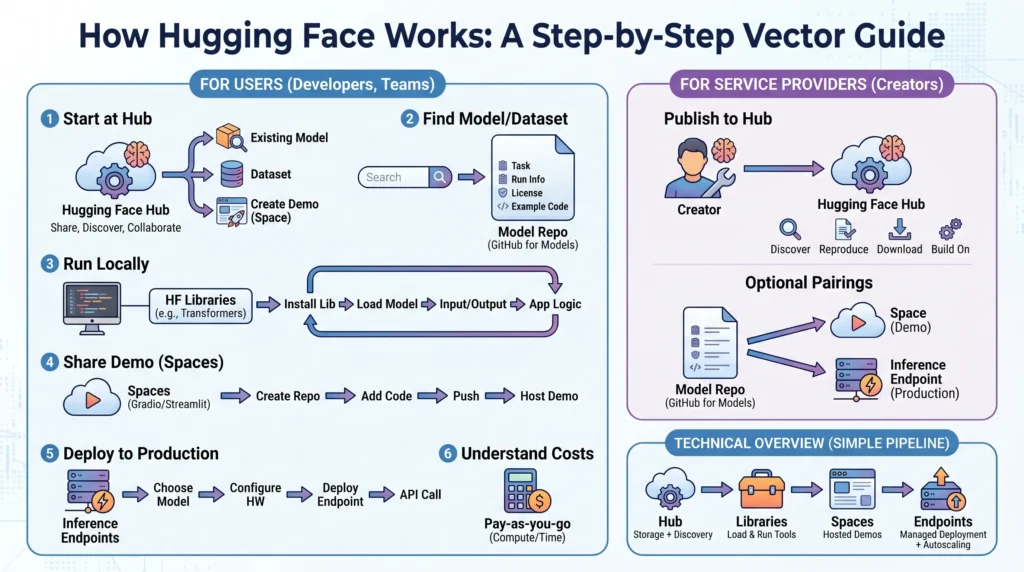
1) Create an account and pick what you want to build
Most people start on the Hugging Face Hub and choose one of three paths:
- Use an existing model
- Use a dataset
- Create a demo app (Space)
The Hub is designed as a central place to share, discover, and collaborate on ML assets.
2) Find a model (or dataset) that matches your task
You browse/search models by task (text generation, classification, image, audio, etc.), compare options, and open a model page to see:
- What it’s good at
- How to run it
- License/usage details
- Example code and files (like configs, weights, README)
This “model repo” pattern is a big reason people call it “GitHub for models.”
3) Run the model locally in your project
If you’re building an app, you’ll usually pull the model into your code using Hugging Face libraries (for example, Transformers). These libraries provide standard ways to load models and run inference or training across many modalities.
Typical workflow:
- Install library
- Load a model by name
- Send input → get output
- Wrap it in your product logic (UI, pipeline, API)
4) Turn it into a shareable demo using Spaces
Spaces are Hugging Face’s “demo hosting” product: you can create an interactive app (often with Gradio or Streamlit) so anyone can try your model in the browser. Hugging Face describes Spaces as a way to create and deploy ML demos quickly, and provides SDK docs for Gradio and Streamlit Spaces.
A simple Space flow looks like:
- Create a Space repo
- Add your app code (Gradio/Streamlit/Docker)
- Push changes (Git-style)
- Hugging Face builds and hosts the demo
5) Deploy to production using Inference Endpoints
When you need reliability, autoscaling, and a production API, Hugging Face offers Inference Endpoints. Their docs position it as a managed way to deploy models to production without spending weeks on infrastructure work.
Typical production flow:
- Choose a model from the Hub
- Configure hardware/region/replicas
- Deploy an endpoint
- Call it from your app like any other API
6) Understand how costs work (so you don’t get surprised)
Inference Endpoints are pay-as-you-go and billed based on compute over time (prices shown hourly, billed by the minute), with costs influenced by instance type and number of replicas.
For “service providers” (model creators and teams publishing assets)
Publishing a model or dataset to the Hub
If you train or fine-tune a model, you can publish it to the Hub as a repository so others can:
- Discover it
- Reproduce results
- Download and run it
- Build on top of it
This is part of what made the ecosystem explode in size.
Optional: provide a live demo (Space) or a production endpoint
Creators often pair a model repo with:
- A Space for “try it now” demos
- An Inference Endpoint for production-style usage
Technical Overview (Simple)
Think of Hugging Face as a pipeline:
- Hub = storage + discovery + collaboration for models/datasets/Spaces
- Libraries (like Transformers) = easy tools to load and run models
- Spaces = hosted demos (Gradio/Streamlit/Docker)
- Inference Endpoints = managed production deployment + autoscaling
Read More :- How to Develop an AI Chatbot Platform
Hugging Face’s Business Model Explained
How Hugging Face makes money (all revenue streams)
Hugging Face monetizes through a mix of subscriptions + usage-based compute services:
- Hub subscriptions for individuals and teams (Pro/Team/Enterprise)
- Production deployment services (Inference Endpoints) billed by compute time
- “Inference Providers” pay-as-you-go access to hosted models from multiple providers (with centralized billing)
- Other compute features on the platform (for example, Jobs billed by hardware usage)
Pricing structure (current plan style)
Hugging Face positions its paid offerings in two big buckets:
1) Hub subscriptions (accounts and orgs)
- Team subscription is shown starting at $20/user/month
- Enterprise is “contact sales” with flexible contracts
2) Compute usage (deployment/inference hardware)
- Inference Endpoints (dedicated) start from about $0.033/hour (instance-based pricing)
How deployment costs work (important detail)
For Inference Endpoints, Hugging Face shows prices by the hour, but documents that billing is calculated by the minute. Your cost depends on the instance type (CPU/GPU), replicas, and how long the endpoint is running.
Revenue streams in plain language
- Subscription revenue: teams pay per seat for collaboration, security, governance, and storage (especially for private repos)
- Compute revenue: customers pay for managed infrastructure to deploy models as production APIs (Inference Endpoints)
- Usage-based inference marketplace: customers pay as they use models via Inference Providers, with transparent pay-as-you-go pricing
- Optional compute tasks: features like Jobs are billed by hardware time (computed by the minute)
Market size and growth signals
Hugging Face Hub describes its ecosystem scale as 2M+ models, 500k datasets, and 1M demos, which is a strong signal of network effects: more creators attract more builders, which attracts more enterprise adoption and compute usage.
Profit margin insights
Hugging Face’s profitability typically improves when:
- Organizations expand seats (Team/Enterprise) and store more private assets
- Production deployments grow (more endpoints, larger hardware, longer uptime)
- Customers consolidate inference usage through Inference Providers with centralized billing
Revenue model breakdown
| Revenue Stream | Description | Who Pays | Nature |
|---|---|---|---|
| Hub subscriptions | Pro/Team/Enterprise access, collaboration, controls | Individuals & orgs | Recurring |
| Inference Endpoints | Dedicated, autoscaling production deployments | Product teams | Usage-based compute |
| Inference Providers | Pay-as-you-go model access via providers | Builders & teams | Usage-based |
| Jobs / compute tasks | Run tasks on HF infra, billed by minute | Pro/Team/Enterprise users | Usage-based |
Key Features That Make Hugging Face Successful
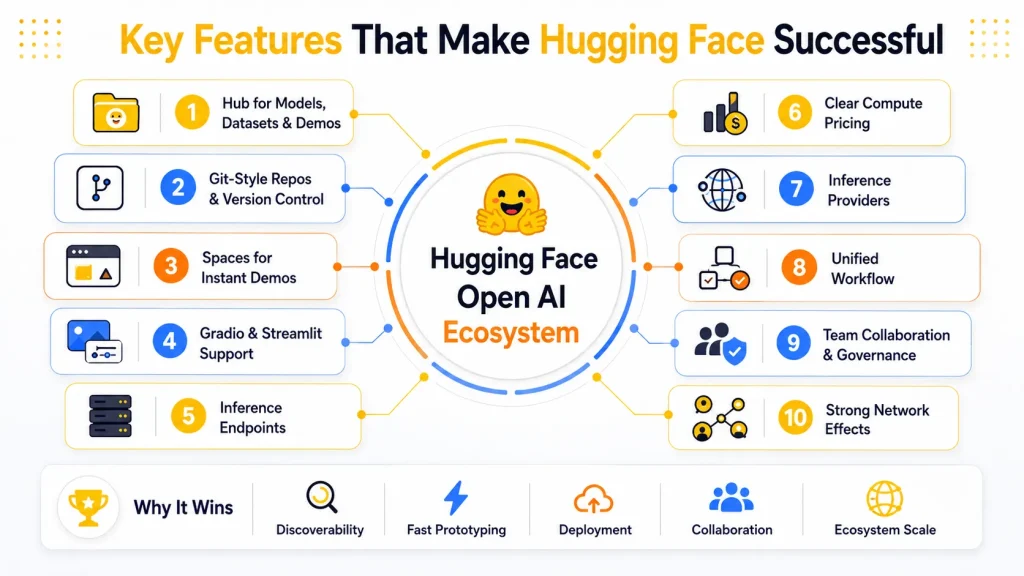
1) The Hub for models, datasets, and demos
Why it matters: It gives the AI community one place to publish, discover, and reuse ML assets.
How it benefits users: You can browse and pick from a massive ecosystem instead of starting from zero.
Technical innovation: Everything is organized like repositories with collaboration and discoverability baked in.
2) Git-style repositories and version control
Why it matters: ML work changes constantly (new weights, new dataset versions, new evaluation results).
How it benefits users: You can track versions, roll back, collaborate, and ship updates safely.
Technical innovation: Models, datasets, and Spaces are hosted as Git repositories on the Hub.
3) “Spaces” for instant demos people can actually try
Why it matters: A demo makes your model real for stakeholders, customers, and the community.
How it benefits users: You can share a working app link instead of screenshots or notebooks.
Technical innovation: Spaces are repositories too, so you can develop like software and deploy automatically.
4) Gradio and Streamlit support for fast app building
Why it matters: Most teams want a UI fast, not weeks of frontend work.
How it benefits users: You can build interactive ML apps in Python and host them quickly.
Technical innovation: Hugging Face provides dedicated Space SDK docs for Streamlit and for Gradio-based Spaces.
5) Inference Endpoints for production deployment
Why it matters: Demos are great, but products need reliability, scaling, and predictable ops.
How it benefits users: You can deploy models as managed endpoints without building infra from scratch.
Technical innovation: Dedicated endpoints on autoscaling infrastructure, configured directly from the Hub.
6) Clear compute-based pricing for deployments
Why it matters: Hosting models can get expensive if pricing is unclear.
How it benefits users: You can estimate cost based on instance type and uptime.
Technical innovation: Pricing is shown hourly, with cost calculated by the minute for Inference Endpoints.
7) Inference Providers for “try models without running servers”
Why it matters: Sometimes you want to evaluate models quickly without deploying anything.
How it benefits users: You get serverless-style access to many models with centralized billing.
Technical innovation: Hugging Face frames this as access to 200+ models from providers with pay-as-you-go pricing.
8) A single consistent ecosystem for experimenting and shipping
Why it matters: AI teams hate glue-work between tools.
How it benefits users: One platform can cover discover → build → demo → deploy.
Technical innovation: Hub + repos + Spaces + Endpoints are designed to connect as one workflow.
9) Collaboration for teams and organizations
Why it matters: Companies need private workspaces, permissions, and governance.
How it benefits users: Teams can work on private repos, share internally, and control visibility.
Technical innovation: The Hub is built around collaborative repo workflows (branches/tags/visibility controls).
10) Strong network effects (the “more people share, the better it gets” effect)
Why it matters: More models + datasets + demos means more starting points for every new project.
How it benefits users: Faster iteration, easier benchmarking, quicker prototyping.
Technical innovation: Hugging Face explicitly highlights the scale of the Hub (models, datasets, demos).
Recent platform shifts and “what’s new” direction
A big recent directional shift is how Hugging Face is emphasizing two paths side-by-side:
- Inference Providers for quick evaluation across many hosted options
- Inference Endpoints for dedicated production deployments with monitoring and a metrics dashboard experience
AI/ML integrations that matter
Hugging Face’s “integration” story is less about one AI feature and more about making models usable end-to-end: repository-based sharing, demo hosting, and managed deployment—so AI moves from “artifact” to “product.”
Hugging Face’s Impact & Market Opportunity
Industry disruption it caused
Hugging Face didn’t just popularize a few tools—it changed how teams ship AI. Before, sharing a model often meant a research paper + a messy repo + “good luck running it.” Hugging Face made the default expectation:
- models should be discoverable
- demos should be clickable
- deployments should be repeatable
- collaboration should feel like software development
That’s a big shift because it moved AI from “research artifact” to “usable product building block.”
Market demand and growth drivers
The demand behind Hugging Face-style platforms is powered by a few huge trends:
- Companies want AI features but don’t want to reinvent infrastructure
- Open-source models keep improving and multiplying
- Teams need faster ways to evaluate, compare, and deploy models
- Demos are now part of sales, fundraising, and stakeholder buy-in
- Production deployments need reliability, cost control, and governance
So the platform is sitting right in the path of both developer adoption and enterprise adoption.
User demographics and behavior
Hugging Face attracts a wide set of users, but their behavior tends to cluster into a few “loops”:
- Explore and compare models → pick one → run locally → iterate
- Publish a model → attach a demo → get feedback → improve
- Benchmark multiple models quickly → choose the best tradeoff → deploy an endpoint
- Build a demo for a client/stakeholder → convert that demo into a production workflow
In other words: people use it as a continuous pipeline, not a one-time download site.
Geographic presence
Because it’s a cloud platform and a global open-source community, adoption isn’t tied to one region. You’ll see usage from startups, universities, and enterprises worldwide.
Future projections
Where this category is heading:
- More “model marketplaces” with stronger evaluation and trust signals
- Easier production rollouts (scaling, monitoring, guardrails)
- More enterprise governance (permissions, audit logs, private registries)
- More end-to-end workflows that connect datasets → training → evaluation → deployment
Opportunities for entrepreneurs
This massive success is why many entrepreneurs want to create similar platforms—because the market rewards anything that helps teams:
- discover the right model faster
- prove it works via a demo
- deploy it without heavy infra work
- operate it safely and cost-effectively
This massive success is why many entrepreneurs want to create similar platforms…
Building Your Own Hugging Face–Like Platform
Why businesses want Hugging Face–style platforms
Hugging Face proved there’s massive demand for a “single home” where AI assets can be discovered, shared, tested, and deployed. Businesses want similar platforms because:
- AI teams waste time stitching tools together (storage, versioning, demos, deployment)
- Leaders want a reliable way to reuse models internally across teams
- Startups and agencies want quick demos to win clients and funding
- Enterprise teams want governance, privacy, and repeatability
- The open-source model ecosystem is growing too fast to manage manually
Key considerations for development
If you want to build a Hugging Face-like platform, the important building blocks are:
- Model registry and discovery (search, filters, categories)
- Dataset hosting and versioning
- Repo-style lifecycle (commits, releases, permissions, tags)
- Demo hosting (Spaces-like environment for interactive apps)
- Deployment layer (API endpoints with scaling options)
- Billing and usage tracking for compute
- Community and trust elements (docs, licenses, ratings, safety notes)
Read Also :- How to Market an AI Chatbot Platform Successfully After Launch
Miracuves Hugging Face-Like Platform Solution Cost and Tech Stack
Miracuves Pricing for a Hugging Face-Like AI Model Hub and Collaboration Platform developed using JavaScript architecture is available on request. Final pricing depends on AI model marketplace modules, dataset workflows, API access, developer tools, collaboration features, storage needs, scalability requirements, and deployment scope. Estimated delivery timeline: 30 to 90 days.
Get a fully developed, custom AI model platform modeled around Hugging Face-style machine learning collaboration. Built on a modern JavaScript foundation, this solution can be customized for AI startups, SaaS founders, developer communities, research teams, enterprise AI teams, ML tool providers, and AI infrastructure businesses.
- Core Workflows: AI model listing, model search, dataset management, user profiles, model uploads, API access, documentation pages, community discussions, version control, and developer collaboration.
- Built-in Revenue Logic: Subscription plans, API usage pricing, premium model access, enterprise licensing, team workspaces, hosted inference charges, private repository plans, and white-label AI marketplace monetization.
- Management Hub: Admin dashboard, user management, model approval, dataset moderation, API monitoring, usage tracking, billing records, access control, content review, and analytics.
- AI Model Hub-Ready Architecture: Prepared for model repository workflows, dataset hosting, inference API integration, developer documentation, secure file storage, scalable search, team collaboration, and long-term AI ecosystem growth.
Why Does a Hugging Face-Like Platform Require JavaScript Architecture?
A Hugging Face-like platform needs more than a simple AI directory. It handles model repositories, datasets, developer documentation, API requests, user collaboration, access permissions, usage tracking, billing logic, and scalable AI infrastructure workflows. A modern JavaScript architecture helps manage these interactive AI operations smoothly across developers, teams, admins, and enterprise users.
We recommend JavaScript architecture for this type of platform because:
- Built for Developer Collaboration: JavaScript-based backend systems can manage model uploads, dataset workflows, user activity, repository permissions, API access, and collaborative AI development features.
- Advanced Frontend Experience: React.js or other JavaScript frameworks can power smooth model discovery pages, documentation views, dataset dashboards, API consoles, community sections, and admin controls.
- Scalable Backend Logic: JavaScript architecture supports repository management, API usage tracking, team permissions, hosted inference workflows, private model access, billing systems, and high-volume platform activity.
- Flexible Integration Layer: The platform can connect with LLM APIs, inference engines, cloud storage, vector databases, authentication systems, payment gateways, analytics tools, CI/CD pipelines, and enterprise security systems.
You get a scalable AI model hub platform designed for developer adoption, model discovery, API monetization, collaboration, and long-term AI product growth.
Note: Final pricing depends on selected platform modules, AI model hosting needs, dataset workflows, API/inference setup, storage infrastructure, security requirements, deployment scope, and custom feature development.
Essential features to include
A strong Hugging Face-style MVP should include:
- Public/private model repositories
- Metadata pages (README, model card, usage examples)
- Search + category browsing
- Basic dataset hosting
- Demo hosting for at least one framework (like a “Space”)
- Simple deployment option (one-click endpoint)
- Usage tracking and billing
High-impact extensions later:
- Benchmarking and evaluation dashboards
- Built-in safety scanning and license compliance tools
- Multi-region deployments
- Enterprise governance and audit logs
- Provider marketplace (serverless inference)
Read More :- AI Chat Assistant Development Costs: What Startups Need to Know
Conclusion
Hugging Face became the default “home” for open AI because it solved a very real pain: AI is useless if it stays trapped in notebooks. By making models and datasets shareable like software repos—and pairing that with demos and deployment options—it made AI feel practical, reusable, and collaborative.
For founders and builders, the big lesson is this: the winners in AI aren’t only the teams with the best models. The winners are the teams that make models easy to find, easy to trust, easy to demo, and easy to ship into real products. If you’re building in this direction, Let’s build together.
FAQs :-
How does Hugging Face make money?
Hugging Face makes money through Hub subscriptions (Team/Enterprise) and compute-based services like Inference Endpoints and Inference Providers that charge based on usage and infrastructure.
Is Hugging Face free to use?
Yes. Many parts of Hugging Face are free, especially browsing public models and datasets. Paid plans unlock more collaboration, private assets, and enterprise features.
What is Hugging Face mainly used for?
Hugging Face is used to discover, share, and deploy AI models and datasets, and to build demos using Spaces.
What are Hugging Face Spaces?
Spaces are hosted demo apps where you can run and share interactive AI applications built using frameworks like Gradio, Streamlit, or Docker.
What are Inference Endpoints?
Inference Endpoints are Hugging Face’s managed production deployments that let you serve a model as a scalable API.
Can I deploy models without managing servers?
Yes. Hugging Face supports serverless-style access through Inference Providers and managed hosting through Inference Endpoints.
Is Hugging Face available in my country?
Generally yes, because it’s a web-based global platform. Availability can vary based on compliance and provider infrastructure.
Can I build something similar to Hugging Face?
Yes, but building a full ecosystem is complex. You’d need a model registry, storage, repo versioning, demo hosting, deployment infrastructure, and compute billing—plus strong community features.
What makes Hugging Face different from competitors?
Its biggest differentiator is the combination of a massive community Hub plus a full lifecycle path: discover → build → demo → deploy.
How can I create a Hugging Face-like platform with Miracuves?
Miracuves can help you build an AI hub with model/dataset hosting, marketplace discovery, demo hosting modules, scalable endpoint deployment, and billing—so you can launch a Hugging Face-style platform faster.