



Imagine a digital marketplace where artists, collectors, and developers trade truly unique digital assets — art, music, gaming items — all secured by blockchain. That’s Rarible, one of the original and most enduring NFT marketplaces born in the Web3 boom. Since its launch in 2019/2020, Rarible has grown into a multi‑chain platform supporting Ethereum, Polygon, Solana, Tezos, Immutable X, and more, serving millions and processing hundreds of millions in trading volume by 2025–26.
What makes business model of Rarible especially compelling for entrepreneurs in 2026 isn’t just transaction volume, it’s the blend of community governance, creator empowerment, and decentralized protocol architecture. In an era where platform economies are rapidly evolving, Rarible shows how a marketplace can shift from centralized control to a community‑owned ecosystem — and still sustain revenue.
This model matters for founders exploring how to build platforms that are scalable, creator‑friendly, and aligned with network participants, not just investors. Stay tuned to discover how it works and what lessons you can apply to your next scalable platform venture.
How the Rarible Business Model Works
Overview of Rarible’s Business Model
At its core, Rarible is a decentralized NFT marketplace where users can create, buy, and sell non-fungible tokens (NFTs) on a multi-chain network. Unlike traditional centralized platforms, Rarible empowers creators by providing full ownership over their digital assets and the freedom to set their prices. At the same time, the platform utilizes blockchain technology to ensure transparency and security for every transaction.
Rarible’s business model is deeply integrated into the Web3 philosophy: decentralization, community governance, and the tokenization of assets. The platform’s approach revolves around its community-driven marketplace, creator incentives, and tokenomics with the native RARI token.
Key Insights
1. Type of Model: Marketplace + Decentralized Governance
Rarible operates a marketplace model, but with a crucial difference: it integrates decentralized governance through its RARI token. This gives token holders voting rights on platform decisions, fee structures, and the allocation of rewards. The marketplace itself is a peer-to-peer (P2P) network, facilitating transactions between users without the need for intermediaries.
- Marketplace (P2P): Creators and collectors engage directly.
- Decentralized Governance: RARI token holders vote on key changes to the platform.
2. Value Proposition for Each User Segment
- Creators: The platform offers a decentralized, open marketplace where digital artists, musicians, and content creators can monetize their work via NFTs without relying on centralized platforms. They retain control over their creations and can set custom terms for royalties.
- Collectors: Users can buy, sell, and collect NFTs in an environment where authenticity and ownership are verified on the blockchain.
- Partners (Developers & Brands): Rarible’s open API allows developers to integrate Rarible’s marketplace into their own platforms, creating a larger network effect. Brands also collaborate by releasing limited edition NFTs for exclusive access.
3. Stakeholders and Ecosystem Balance
The Rarible ecosystem includes:
- Creators/Artists: Drive the content creation.
- Collectors: Drive the market demand for unique assets.
- Rarible DAO (Decentralized Autonomous Organization): The platform governance is decided by RARI token holders.
- Partners (API developers, brands): Help extend the marketplace’s utility and adoption.
The balance is sustained by rewarding users for active participation — whether they’re buying, selling, or creating NFTs. The DAO model ensures that power and decision-making aren’t concentrated with a single entity.
4. Evolution of the Business Model
Initially, Rarible operated like a typical centralized marketplace, but the platform quickly transitioned into a decentralized, community-led ecosystem as it introduced the RARI token. This change allowed users to participate in decision-making processes, earn rewards, and influence platform features and policies. Over time, Rarible diversified by integrating more blockchains like Polygon and Solana for a broader market reach and lower transaction costs.
- 2020: Centralized marketplace with NFT trading.
- 2021: Introduction of RARI token for governance and rewards.
- 2022-2025: Expansion to multi-chain ecosystem with Ethereum, Polygon, Tezos, and more.
Target Market & Customer Segmentation Strategy
Who Uses Rarible and Why They Stay
Rarible’s target market consists of a diverse group of users, each with unique needs and motivations for engaging with the platform. The beauty of Rarible’s model lies in its ability to cater to both creators and collectors, two key groups that power the NFT economy.
Primary Customer Segments
- Creators (Artists, Musicians, Developers)
- Demographics: Digital artists, musicians, photographers, game developers, and other content creators.
- Behavior: They use Rarible to mint, sell, and monetize their creations as NFTs. Creators are attracted to the ability to retain control over their work, set their own royalties, and directly engage with their audience.
- Motivation: The freedom to create and sell on a decentralized platform, coupled with transparent royalties and ownership rights.
- Demographics: Digital artists, musicians, photographers, game developers, and other content creators.
- Collectors (Investors, Fans, NFT Enthusiasts)
- Demographics: Collectors range from traditional art investors and crypto enthusiasts to casual fans and digital art lovers.
- Behavior: They actively buy and sell NFTs for investment or personal collection. Many are also driven by a desire to support creators or brands they love.
- Motivation: The opportunity to own unique digital assets, potentially profit from reselling, and be part of a growing community of NFT collectors.
- Demographics: Collectors range from traditional art investors and crypto enthusiasts to casual fans and digital art lovers.
Secondary Customer Segments
- Brands and Collaborators
- Demographics: Corporate brands, game developers, and digital entertainment companies.
- Behavior: These customers partner with Rarible to release exclusive NFTs, host branded digital assets, and engage with the NFT market.
- Motivation: The chance to tap into the growing NFT market and increase engagement with their target audience through unique collectibles.
- Demographics: Corporate brands, game developers, and digital entertainment companies.
- Platform Developers & API Integrators
- Demographics: Developers and third-party companies interested in integrating Rarible’s marketplace features into their platforms.
- Behavior: These users build on top of Rarible’s open-source code and API, creating an extended marketplace network.
- Motivation: The opportunity to enhance their platform’s capabilities and leverage Rarible’s established user base.
- Demographics: Developers and third-party companies interested in integrating Rarible’s marketplace features into their platforms.
Customer Journey — From Discovery to Retention
- Discovery
- Channels: Organic search (SEO), social media, content marketing, influencer partnerships, word of mouth in the NFT and crypto community.
- Conversion Strategy: Rarible focuses on community-driven marketing, leveraging its decentralization ethos and a network of artists and collectors to spread the word.
- Channels: Organic search (SEO), social media, content marketing, influencer partnerships, word of mouth in the NFT and crypto community.
- Conversion
- Onboarding: New users are onboarded through a simple and intuitive process for minting NFTs, buying, and selling. They are encouraged to engage with the platform via user-friendly wallet integration (e.g., MetaMask, WalletConnect).
- Incentives: The use of RARI token rewards for active participants, including creators and buyers, boosts early adoption.
- Onboarding: New users are onboarded through a simple and intuitive process for minting NFTs, buying, and selling. They are encouraged to engage with the platform via user-friendly wallet integration (e.g., MetaMask, WalletConnect).
- Retention
- Engagement: Rarible keeps its users engaged with daily trading stats, new drops, and community events like exclusive NFT auctions.
- Engagement: Rarible keeps its users engaged with daily trading stats, new drops, and community events like exclusive NFT auctions.
Loyalty Programs: By offering rewards through RARI tokens and engaging in DAO governance, users feel more connected to the platform’s future.
Revenue Streams and Monetization Design
How Rarible Makes Money
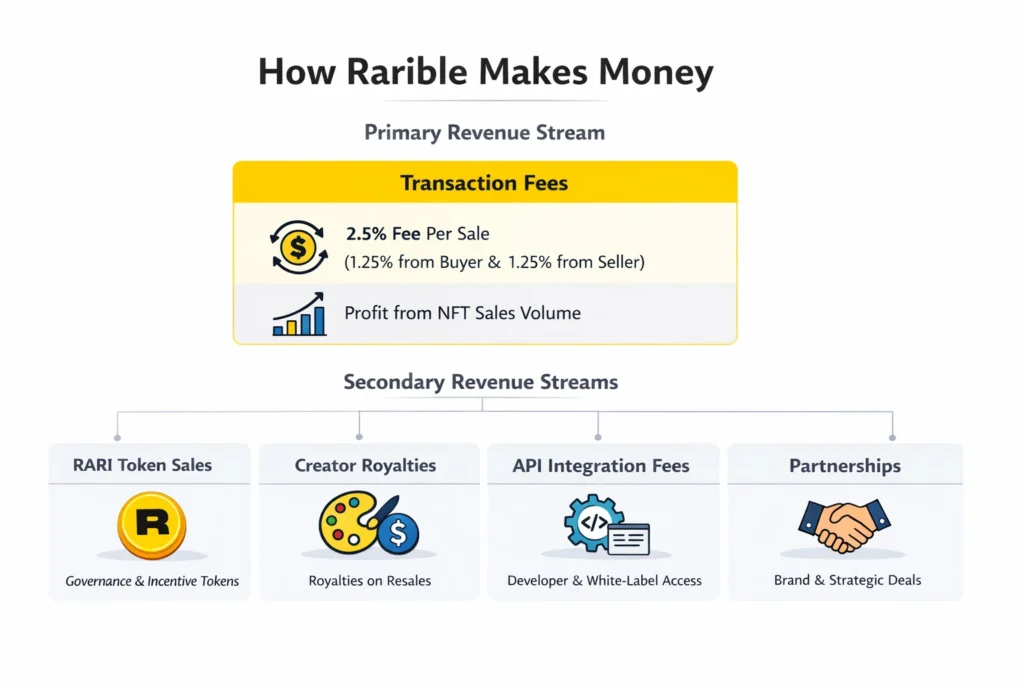
Rarible’s monetization strategy is designed to balance creator rewards, user incentives, and platform sustainability. The platform generates revenue from transaction fees, token sales, and partnerships, all while keeping its commitment to decentralization. Let’s break down its primary and secondary revenue streams.
Primary Revenue Stream: Transaction Fees
Rarible takes a transaction fee from every sale made on its platform, typically around 2.5%, though this can vary depending on the chain used (e.g., Ethereum vs. Polygon).
- Pricing Model: The fees are taken from both the buyer and the seller in the form of a percentage (each paying 1.25%). For high-value transactions, this can represent a significant sum, making the marketplace profitable while still being affordable compared to some competitors.
- Revenue Growth Trajectory: The volume of NFT transactions has increased significantly year over year, especially as new chains are integrated (e.g., Tezos, Solana). As Rarible grows its user base and the NFT market matures, its transaction volume has continued to rise.
Secondary Revenue Streams
- RARI Token Sales
- Mechanism: Rarible has its native token, RARI, which plays a dual role as both a governance token and an incentive token for active users. RARI tokens are distributed to both creators and collectors based on their activity, promoting engagement and loyalty.
- Revenue Impact: While not a direct revenue stream like transaction fees, the sale and governance features of the RARI token support long-term platform stability by ensuring decentralized control and encouraging active participation. Rarible has also conducted token sales in the past, further monetizing this asset.
- Mechanism: Rarible has its native token, RARI, which plays a dual role as both a governance token and an incentive token for active users. RARI tokens are distributed to both creators and collectors based on their activity, promoting engagement and loyalty.
- Creator Royalties
- Mechanism: Rarible empowers creators to set royalties for each NFT minted. These royalties are paid to creators whenever the NFT is resold on the platform, creating a long-term income stream for artists.
- Revenue Impact: Rarible takes a small cut (typically around 2.5%) from these royalties, benefiting from a share of the secondary market. As more high-value and desirable NFTs are minted, royalties can generate substantial revenue for the platform.
- Mechanism: Rarible empowers creators to set royalties for each NFT minted. These royalties are paid to creators whenever the NFT is resold on the platform, creating a long-term income stream for artists.
- Platform Integration Fees
- Mechanism: Rarible offers an API for developers who wish to integrate its marketplace into their own applications or create white-label NFT marketplaces. By charging a fee for API access and services, Rarible can generate additional income.
- Mechanism: Rarible offers an API for developers who wish to integrate its marketplace into their own applications or create white-label NFT marketplaces. By charging a fee for API access and services, Rarible can generate additional income.
Revenue Impact: This secondary stream allows Rarible to extend its ecosystem, tapping into a broader developer community while monetizing its technology stack.
Operational Model & Key Activities
How Rarible Operates Daily
Rarible’s operational model revolves around maintaining a decentralized ecosystem, ensuring a seamless user experience, and fostering innovation while keeping costs low and scalability high. The operations behind the platform are designed to be as frictionless as possible for both creators and collectors, while supporting a growing community of users and developers.
Core Operations
- Platform Management
- Rarible’s platform is hosted on multiple blockchain networks (Ethereum, Tezos, Solana, etc.), with each chain having its own set of operational requirements. The platform is continuously upgraded and maintained to ensure smooth performance across these different ecosystems.
- Blockchain Integration: Each blockchain offers different fee structures, speeds, and transaction security, so Rarible focuses on managing its integration with a wide array of blockchain networks.
- Rarible’s platform is hosted on multiple blockchain networks (Ethereum, Tezos, Solana, etc.), with each chain having its own set of operational requirements. The platform is continuously upgraded and maintained to ensure smooth performance across these different ecosystems.
- Tech Infrastructure
- As a multi-chain NFT marketplace, Rarible relies on robust blockchain infrastructure that supports fast and secure transactions. Rarible uses smart contracts to facilitate transactions and minting on different blockchains, which are coded to be transparent and tamper-proof.
- Security: Rarible invests heavily in smart contract audits and security protocols to prevent fraud, hacks, and other security issues that could harm user trust in the platform.
- As a multi-chain NFT marketplace, Rarible relies on robust blockchain infrastructure that supports fast and secure transactions. Rarible uses smart contracts to facilitate transactions and minting on different blockchains, which are coded to be transparent and tamper-proof.
- Quality Control
- The platform relies on an algorithmic approach to verify and track NFT authenticity. Rarible uses both on-chain and off-chain methods to ensure that the NFTs being traded on the marketplace are verified, ensuring buyers get what they expect.
- Community Reporting: Users can report suspicious or malicious activity, and Rarible’s decentralized governance model helps resolve disputes through community consensus.
- The platform relies on an algorithmic approach to verify and track NFT authenticity. Rarible uses both on-chain and off-chain methods to ensure that the NFTs being traded on the marketplace are verified, ensuring buyers get what they expect.
Strategic Partnerships & Ecosystem Development
How Rarible Builds Its Ecosystem through Partnerships
Rarible’s business model thrives on strategic partnerships that expand its platform’s utility, enhance its technological capabilities, and connect it with a broader user base. Through collaborations with technology providers, brands, developers, and other blockchain platforms, Rarible fosters an ecosystem that strengthens its marketplace and attracts new users.
Rarible’s Collaboration Philosophy
Rarible’s decentralized model is about empowering the community. Rather than acting as a centralized gatekeeper, Rarible actively seeks partnerships that are mutually beneficial and expand the overall utility of the platform. These partnerships provide the platform with not only technological enhancements but also a way to foster network effects, where the platform becomes more valuable as more users and collaborators join.
Here are the key partnership categories that Rarible focuses on:
Key Partnership Types
- Technology and API Partners
- Partnership with Blockchain Networks: Rarible integrates with multiple blockchain platforms like Ethereum, Tezos, Polygon, and Solana, among others, to offer users multiple transaction options, lower fees, and faster processing times.
- Developer Ecosystem: Through its open-source API, Rarible encourages developers to build on its technology stack and create custom NFT marketplaces. This expands Rarible’s ecosystem and creates new use cases for the platform.
- Partnership with Blockchain Networks: Rarible integrates with multiple blockchain platforms like Ethereum, Tezos, Polygon, and Solana, among others, to offer users multiple transaction options, lower fees, and faster processing times.
- Payment and Logistics Alliances
- Payment Solutions: To facilitate smooth transactions, Rarible partners with crypto payment providers like MetaMask and WalletConnect to allow users to pay and interact with the platform using different cryptocurrencies.
- Fiat onramps: Partnerships with fiat payment solutions are crucial for enabling users who don’t yet own crypto to buy NFTs using traditional currency. Services like MoonPay and Ramp allow users to convert fiat into crypto directly on the platform.
- Payment Solutions: To facilitate smooth transactions, Rarible partners with crypto payment providers like MetaMask and WalletConnect to allow users to pay and interact with the platform using different cryptocurrencies.
- Marketing and Distribution Partners
- Influencer Collaborations: Rarible works with NFT influencers, digital artists, and celebrities to promote the marketplace and exclusive NFT drops. This has helped elevate Rarible as a leading platform in the Web3 and NFT space.
- Brand Partnerships: High-profile brand partnerships, such as with Gucci or Prada, allow Rarible to showcase limited-edition digital collectibles. These collaborations help Rarible target luxury consumers and other niche markets looking to enter the NFT world.
- Influencer Collaborations: Rarible works with NFT influencers, digital artists, and celebrities to promote the marketplace and exclusive NFT drops. This has helped elevate Rarible as a leading platform in the Web3 and NFT space.
- Regulatory and Expansion Alliances
- Legal & Compliance Partners: Given the complex legal landscape around NFTs, Rarible works closely with legal partners to ensure that the platform complies with evolving regulations, particularly around intellectual property rights and tax laws.
- Legal & Compliance Partners: Given the complex legal landscape around NFTs, Rarible works closely with legal partners to ensure that the platform complies with evolving regulations, particularly around intellectual property rights and tax laws.
Geographic Expansion: As Rarible looks to enter new regions, partnerships with local influencers, regulatory bodies, and digital art communities are essential for its growth. Rarible has invested in regional partnerships in regions like Asia, Europe, and Latin America to grow its global footprint.
Growth Strategy & Scaling Mechanisms
How Rarible Grows and Sustains Momentum
Rarible’s growth strategy has been built on network effects, community engagement, and technology-driven expansion. As the NFT space matures, Rarible continues to refine its approach, expanding its footprint across multiple blockchains and introducing new features that keep users engaged.
Here’s a breakdown of Rarible’s growth engines and scaling mechanisms:
Growth Engines
- Organic Virality and Referral Loops
- Creator-Driven Growth: Creators are Rarible’s biggest advocates. They not only mint NFTs but also promote the platform through their networks. Artists and developers benefit from Rarible’s royalty system, which encourages them to continuously create and promote their work on the marketplace.
- Social Media and Communities: Social media platforms like Twitter, Instagram, and Discord are essential for Rarible’s viral growth. Creators and collectors share their NFT collections, drawing attention to the platform. Community-driven events and NFT drops also stimulate user engagement and virality.
- Creator-Driven Growth: Creators are Rarible’s biggest advocates. They not only mint NFTs but also promote the platform through their networks. Artists and developers benefit from Rarible’s royalty system, which encourages them to continuously create and promote their work on the marketplace.
- Paid Marketing and Acquisition Strategies
- Targeted Ads: To grow its user base, Rarible invests in targeted digital ads, including on Google and social media. Ads are often tailored to specific segments, such as new NFT buyers, investors, or artists.
- Influencer Marketing: Rarible collaborates with prominent figures in the NFT and crypto space, including artists, NFT collectors, and social influencers, to promote its platform and exclusive drops.
- SEO and Content Marketing: Organic growth is driven by high-ranking SEO content, tutorials, and educational materials around NFTs. This attracts new users and establishes Rarible as a thought leader in the space.
- Targeted Ads: To grow its user base, Rarible invests in targeted digital ads, including on Google and social media. Ads are often tailored to specific segments, such as new NFT buyers, investors, or artists.
- New Product Lines and Market Entries
- NFT Minting Tools for Developers: By providing minting tools and enabling developers to create and launch NFTs with ease, Rarible strengthens its position as an industry leader in the Web3 space.
- Exclusive NFT Drops: Partnering with major brands, celebrities, and artists to launch limited-edition collections keeps Rarible in the news and attracts attention from high-net-worth individuals and investors.
- NFT Minting Tools for Developers: By providing minting tools and enabling developers to create and launch NFTs with ease, Rarible strengthens its position as an industry leader in the Web3 space.
Competitive Strategy & Market Defense
How Rarible Stays Ahead in a Crowded Market
Rarible operates in the rapidly growing but highly competitive NFT marketplace space, where it faces fierce competition from platforms like OpenSea, SuperRare, and Foundation. However, Rarible’s business model and growth strategy have allowed it to carve out a unique position. Here’s a breakdown of its competitive advantages and market defense strategies.
Competitive Advantages
- Network Effects and Switching Barriers
- As Rarible continues to grow its user base, it benefits from network effects where more users on the platform lead to greater demand for NFTs, which in turn attracts more creators and collectors. This self-perpetuating cycle makes it harder for new entrants to replace Rarible, as users are increasingly tied to the network through their digital collections and creator rewards.
- Switching Barriers: Once creators and collectors have established themselves on Rarible, it becomes increasingly difficult to convince them to switch to a competing platform, especially given Rarible’s royalty system and decentralized governance, which offers more control to users.
- As Rarible continues to grow its user base, it benefits from network effects where more users on the platform lead to greater demand for NFTs, which in turn attracts more creators and collectors. This self-perpetuating cycle makes it harder for new entrants to replace Rarible, as users are increasingly tied to the network through their digital collections and creator rewards.
- Brand Equity and Customer Trust
- Rarible has established itself as a trusted NFT marketplace thanks to its early entry into the space and commitment to decentralization. The platform’s RARI token plays a key role in enhancing user trust, as it gives holders voting power on platform decisions, creating a sense of ownership and involvement in the platform’s future.
- Transparency: Since transactions on Rarible are executed on public blockchains, users have full transparency into their transactions, which is a major trust factor in the NFT space.
- Rarible has established itself as a trusted NFT marketplace thanks to its early entry into the space and commitment to decentralization. The platform’s RARI token plays a key role in enhancing user trust, as it gives holders voting power on platform decisions, creating a sense of ownership and involvement in the platform’s future.
- Innovation in Technology and Algorithms
- Rarible stands out in the market due to its multi-chain support, allowing users to buy and sell NFTs across multiple blockchain networks, including Ethereum, Polygon, Tezos, Solana, and Immutable X. This enables Rarible to offer lower fees and faster transactions compared to competitors that are confined to Ethereum.
- Rarible stands out in the market due to its multi-chain support, allowing users to buy and sell NFTs across multiple blockchain networks, including Ethereum, Polygon, Tezos, Solana, and Immutable X. This enables Rarible to offer lower fees and faster transactions compared to competitors that are confined to Ethereum.
Lessons for Entrepreneurs & Implementation
Key Factors Behind Rarible’s Success
Rarible’s growth and success in the crowded NFT marketplace provide valuable lessons for entrepreneurs looking to build scalable platforms. Here’s a look at what made Rarible a success story and the key elements you should consider when launching your own platform.
Replicable Principles for Startups
- Decentralization as a Core Value
- One of Rarible’s major differentiators is its decentralized governance model. By allowing users to participate in platform decisions via the RARI token, Rarible taps into the power of community, which not only enhances user engagement but also builds trust. Entrepreneurs looking to build scalable platforms should consider implementing governance models that empower users and foster long-term loyalty.
- One of Rarible’s major differentiators is its decentralized governance model. By allowing users to participate in platform decisions via the RARI token, Rarible taps into the power of community, which not only enhances user engagement but also builds trust. Entrepreneurs looking to build scalable platforms should consider implementing governance models that empower users and foster long-term loyalty.
- Creator-Centric Monetization
- Rarible’s focus on providing creators with control over their work, royalties, and the ability to mint NFTs directly on the platform sets it apart from competitors. In the creator economy, this creator-first model is essential for attracting top talent and ensuring continuous content generation. Building flexible and creator-friendly monetization systems should be a priority for any new platform..
- Rarible’s focus on providing creators with control over their work, royalties, and the ability to mint NFTs directly on the platform sets it apart from competitors. In the creator economy, this creator-first model is essential for attracting top talent and ensuring continuous content generation. Building flexible and creator-friendly monetization systems should be a priority for any new platform..
Implementation Timeline & Investment Priorities
- Short-Term Focus:
In the early stages, entrepreneurs should focus on developing a robust platform with user-friendly features and competitive fees. This includes building a strong foundation for technical infrastructure and launching an effective marketing strategy to attract early users. - Medium-Term Focus:
As the platform scales, investments should shift towards expanding multi-chain support, refining tokenomics, and securing strategic partnerships with key influencers, brands, and blockchain networks. - Long-Term Focus:
Long-term priorities should focus on scaling operations, global expansion, and maintaining a strong community governance model. This includes adapting to emerging technologies and expanding into new digital asset categories such as metaverse assets and virtual real estate.
“Ready to implement Rarible’s proven business model for your market? Miracuves builds scalable platforms with tested business models and growth mechanisms. We’ve helped entrepreneurs launch profitable apps. Get your free business model consultation today.”
Conclusion
Rarible’s business model exemplifies the power of innovation, decentralization, and creator empowerment in driving sustainable growth. By blending cutting-edge blockchain technology with a strong community-driven approach, Rarible has built an ecosystem that thrives on transparency, creativity, and user ownership.
For entrepreneurs, the lesson is clear: the future of digital platforms is decentralized, community-focused, and user-centric. Rarible’s success is a testament to the value of empowering creators, offering flexibility, and allowing users to shape their own experience. Whether you’re building
As we look ahead to the future of platform economies in 2026 and beyond, it’s clear that decentralized ecosystems and creator-driven innovation will continue to dominate. Entrepreneurs ready to tap into these trends have the chance to redefine industries and build the next generation of platforms that thrive on community collaboration and digital ownership.
FAQs
What type of business model does Rarible use?
Rarible uses a marketplace model combined with decentralized governance. Users can create, buy, and sell NFTs while participating in decision-making through the RARI token, making it community-driven.
How does Rarible’s model create value?
Rarible creates value by empowering creators with control over their NFTs, providing royalties on resales, and offering a decentralized platform that rewards active users with governance tokens, fostering long-term engagement.
What are its key success factors?
Rarible’s key success factors include its decentralized governance, multi-chain integration, creator-centric monetization, and robust community engagement, all of which contribute to its growing platform and loyal user base.
How scalable is Rarible?
Rarible is highly scalable due to its multi-chain integration, enabling low-cost transactions across various blockchains, and its open-source platform, which allows for continuous development and integration with third-party applications.
What are the biggest challenges?
Rarible faces challenges like regulatory uncertainty in the NFT space, increased competition, and the need for scalability as the platform grows, particularly in maintaining security across multiple blockchains.
How can entrepreneurs adapt it to their region?
Entrepreneurs can adapt Rarible’s model by focusing on localizing the platform, building partnerships with regional artists and influencers, and ensuring compliance with local regulations to better engage regional markets.
What are alternatives to this model?
Alternatives include centralized marketplaces like OpenSea, where platform governance is controlled by a central entity, or customizable NFT marketplaces that allow brands to create their own platforms.
How has it evolved over time?
Rarible has evolved from a simple Ethereum-based marketplace to a multi-chain platform that incorporates decentralized governance and creator-driven rewards, improving scalability and user engagement.