


Key Takeaways
What You’ll Learn
- 10-minute delivery works through logistics discipline, not just a fast-looking app.
- Dark stores are the real fulfillment engine behind hyper-local speed.
- Inventory accuracy protects customer trust by reducing cancellations and substitutions.
- Picker speed and dispatch control decide delivery performance under real demand.
- ROI depends on unit economics, fulfillment efficiency, and delivery cost control.
Stats That Matter
- Dark store location strategy affects delivery radius, order density, and speed consistency.
- Inventory sync AI helps predict demand spikes, prioritize replenishment, and balance stock across stores.
- Weak stock visibility leads to substitutions, cancellations, refund issues, and lower repeat orders.
- ROI tracking should include order volume, basket size, repeat rate, fulfillment time, delivery cost, and cancellation rate.
- Smart dispatch logic matters more than just adding more riders in a 10-minute model.
Real Insights
- Fast delivery starts inside the store, before the rider even begins the trip.
- Over-promising speed without operational control is one of the biggest reasons quick-commerce models fail.
- Technology should support operations first, not only customer-facing design.
- Scaling should stay disciplined through better dark store placement, stock accuracy, and delivery density.
- Long-term success depends on infrastructure, visibility, and sustainable execution.
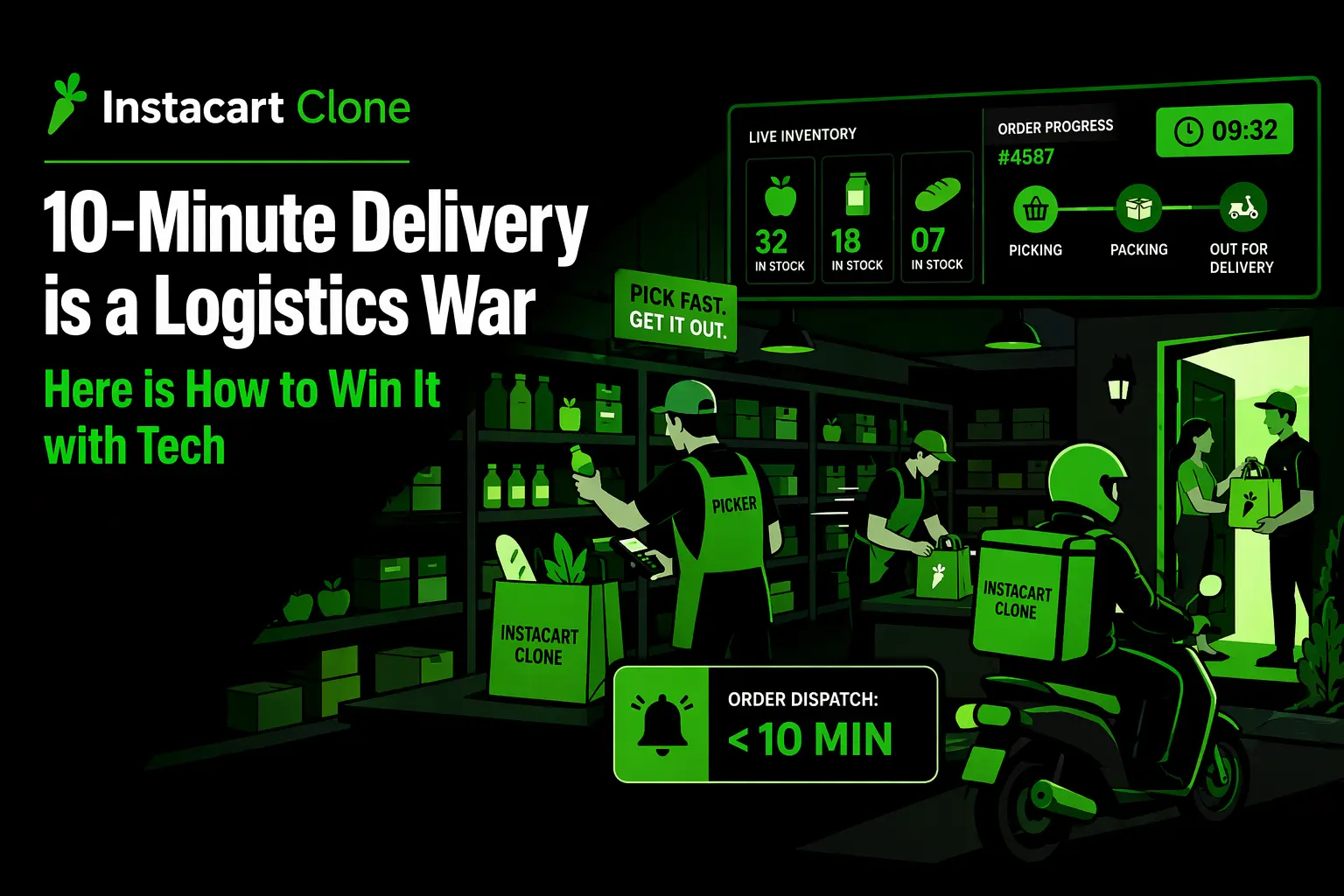
Delivering groceries in 10 minutes may look simple from the customer side. A user opens the grocery delivery app, selects products, places the order, and expects it to arrive almost immediately. On the surface, it feels like a smooth convenience feature built into the platform. But in reality, delivering on that promise is far more difficult than it appears.
Behind every fast grocery delivery app, there is a tightly connected operational system working in the background. The business needs well-placed dark stores, accurate real-time inventory, fast picking workflows, smart rider allocation, and efficient delivery coordination. If even one part of that system slows down or becomes inaccurate, the entire delivery promise begins to break.
This is where many platforms struggle. They may succeed in attracting users and generating orders, but they often underestimate how much planning, control, and operational discipline is required to deliver consistently within such a short window. Fast delivery is not created by the app interface alone, and it is not solved simply by adding more riders. It depends on how well the full grocery delivery app ecosystem is designed to perform under real demand conditions.
That is why building an Instacart Clone or any hyper-local delivery platform requires more than a good user interface. It needs a logistics-first approach, where technology is built around real operational speed, fulfillment accuracy, and delivery discipline. In this model, speed is not a feature. It is the result of a well-planned system.
Dark Store Management: The Real Fulfillment Engine
What Dark Stores Are and Why They Matter
Dark stores are small fulfillment centers built only for online orders. They are not designed for walk-in customers. Their role is to help the business pick, pack, and dispatch products quickly enough to support a 10-minute delivery promise.
In quick commerce, dark stores bring inventory closer to local demand. That is what makes fast fulfillment possible.
Why dark stores matter:
- Neighborhood-based fulfillment: They serve small local zones instead of large city-wide areas, which helps reduce order-to-door time.
- Faster operational flow: They are designed for picking and dispatch, not browsing and retail display, which makes order processing much quicker.
- Better delivery control: When inventory sits close to the customer, the platform can make more realistic delivery promises and maintain better consistency.
Location Strategy and Delivery Radius
A dark store can perform well only if it is placed in the right area. Location directly affects speed, cost, and order coverage. If the store is too far from demand clusters, even a strong app and delivery team will struggle to maintain performance.
Most quick-commerce models work best when each store serves a tight and disciplined delivery radius.
What good location planning improves:
- Shorter delivery distance: Riders spend less time on the road, which helps support faster delivery and more trips per shift.
- Higher local order density: More nearby orders make dispatch more efficient and improve rider productivity.
- Stronger promise accuracy: A tighter service zone makes it easier to maintain expected delivery timelines during busy periods.
What poor location planning creates:
- Longer fulfillment pressure: Orders may be packed on time but still arrive late because the rider has to travel too far.
- Higher operating cost: More distance means more time, more fuel, and lower delivery efficiency.
- Frequent service failure: When the radius becomes too wide, the 10-minute promise becomes difficult to sustain consistently.
SKU Planning and Inventory Layout
A dark store should not try to stock everything. It should focus on the products people order most often in that local area. The goal is to support fast-moving demand, not endless variety.
Store layout also plays a major role. Even the right inventory mix can underperform if products are placed poorly and pickers waste time moving around the store.
What strong SKU and layout planning should focus on:
- Local buying behavior: Stock should reflect what customers in that area regularly order, especially daily-use essentials.
- Fast-moving product priority: High-frequency items should get the most shelf visibility and easiest access.
- Faster picking movement: Products should be arranged in a way that reduces walking time and helps pickers complete orders quickly.
What weak dark store planning usually leads to:
- Stockouts on key items: Popular products run out too often, which hurts trust and repeat orders.
- Slower order preparation: Poor layout and poor product mix increase picking time.
- Higher cancellations and weaker experience: When the store cannot fulfill fast and accurately, the delivery promise starts to break down.
In quick commerce, the dark store is not just a storage point. It is the operating base that shapes speed, fulfillment quality, and customer experience.
Inventory Sync AI: The System That Protects Customer Trust
In quick commerce, inventory accuracy is not optional. It is directly tied to customer trust.
When a customer sees a product as available and places an order, they expect it to be delivered. If the system fails to reflect real stock levels, it leads to cancellations, substitutions, and frustration. Over time, this erodes trust and reduces repeat purchases.
Real-time inventory syncing ensures that what customers see on the app matches what is physically available in the dark store. This requires constant synchronization between warehouse systems and the customer-facing platform.
As the business scales, manual tracking becomes impossible. This is where AI and automation begin to play a role.
Smart inventory systems can:
- Predict demand spikes based on time, weather, and local behavior
- Identify fast-moving SKUs and prioritize replenishment
- Automatically adjust stock allocation across multiple dark stores
- Reduce dead inventory while ensuring availability of high-demand products
The complexity increases significantly when multiple dark stores are involved. Inventory must be balanced across locations to avoid overstocking in one area and shortages in another.
More importantly, inventory intelligence is not just about operations. It directly impacts customer experience. Reliable availability builds trust, and trust drives repeat orders.
Without strong inventory systems, even the best-designed platform will struggle to retain customers.
Picker Efficiency: Where Speed Actually Begins
Role of Pickers in Fulfillment
Pickers are responsible for collecting items from shelves and preparing orders for dispatch.
In a 10-minute model, their performance directly determines whether delivery timelines are achievable.
Even the fastest delivery fleet cannot compensate for slow picking.
Layout, Routing, and Batching Logic
Picker efficiency depends heavily on system design.
Key factors include:
- Shelf arrangement: Frequently ordered items should be placed closer to dispatch zones
- Smart routing: Pickers should follow optimized paths to reduce movement
- Order batching: Multiple orders can be grouped to improve efficiency
Without these optimizations, pickers waste time navigating the store instead of fulfilling orders.
Impact on Delivery Consistency
Slow picking leads to:
- Delayed dispatch
- Increased rider wait time
- Lower delivery density
Efficient picking, on the other hand:
- Improves order throughput
- Reduces operational cost per order
- Enhances delivery consistency
Speed does not start on the road. It starts inside the store.
Last-mile Speed: Orchestration, Not Just Delivery
Dispatch Logic and Rider Allocation
Last-mile speed depends heavily on how riders are assigned. It is not enough to simply have riders available. The platform must assign the right rider to the right order at the right time.
A strong dispatch system usually considers:
- Order location: The system should match riders based on how close they are to the delivery point and pickup store.
- Rider proximity: Nearby riders reduce waiting time and help orders leave the store faster.
- Current workload: Rider allocation should account for how many active deliveries a rider is already handling.
- Traffic conditions: Real-time road movement matters because the closest rider is not always the fastest option.
When dispatch is weak, the result is operational imbalance. Some riders remain idle, others get overloaded, and customers start receiving late orders.
Route Optimization and Delivery Density
Last-mile speed is not just about moving faster. It is about moving smarter with better route logic.
Strong route optimization helps improve:
- Shortest practical delivery paths: Riders should follow routes that reduce wasted travel time, not just distance on paper.
- Efficient order clustering: Orders in nearby areas can be grouped intelligently to improve rider productivity.
- Reduced travel delays: Better routing lowers turnaround time and supports more deliveries per rider.
Delivery density is one of the most important drivers of quick-commerce efficiency. When more orders are served within the same zone, riders can complete more trips with less wasted movement. This improves both delivery speed and cost control.
Balancing Cost, Speed, and Quality
A quick-commerce platform cannot focus only on speed. If the system pushes for faster deliveries without proper planning, the business starts losing money and service quality drops.
A balanced last-mile model should support:
- Timely deliveries: Orders should reach customers within the promised time window.
- Minimal order errors: Fast delivery should not come at the cost of damaged or mishandled orders.
- Controlled delivery costs: Speed must be achieved in a way that still protects margins.
Poor last-mile planning often creates:
- High fuel and movement costs: Longer or poorly managed routes increase operating expense.
- Rider burnout: Constant pressure without smart workload distribution reduces rider stability.
- Weaker unit economics: Fast delivery becomes expensive when the system is inefficient.
The goal in quick commerce is not just fast delivery. It is repeatable, efficient, and commercially sustainable delivery.
ROI Models: The Real Economics of Quick Commerce
Quick commerce is capital-intensive. Without clear unit economics, the model becomes unsustainable.
Key Performance Metrics
Founders should track:
- Order volume per store
- Average basket size
- Repeat purchase rate
- Fulfillment time
- Delivery cost per order
- Cancellation rate
Operational vs Financial Impact
| Metric | Operational Impact | Financial Impact |
|---|---|---|
| Order Volume | Store load balancing | Revenue growth |
| Basket Size | Picking efficiency | Profit margins |
| Delivery Density | Rider productivity | Lower delivery cost |
| Cancellation Rate | Inventory accuracy | Revenue leakage |
| Repeat Orders | Customer satisfaction | Lifetime value |
Unit Economics and Contribution Margin
A sustainable model depends on:
- High order frequency
- Efficient fulfillment
- Controlled delivery costs
Contribution margin improves when:
- Delivery density increases
- Picker productivity improves
- Inventory waste reduces
Scaling Sustainably
Growth without operational discipline leads to failure.
Scaling should focus on:
- Expanding dark store network strategically
- Maintaining inventory accuracy
- Improving delivery density
Quick commerce success is not defined by how fast you grow, but how efficiently you operate.
Building a Scalable Instacart Clone with Miracuves
Building a scalable Instacart like app is not just about creating a customer app. In hyper-local delivery, real success depends on how well the platform supports inventory flow, dark store operations, dispatch timing, and delivery coordination behind the scenes.
At Miracuves, the focus is not only on app development, but on building a system that fits real quick-commerce operations. That includes real-time inventory logic, dark store management workflows, smart dispatch and delivery orchestration, strong admin-level operational control, and modular architecture that can support future scaling.
This approach helps businesses launch faster without losing sight of operational realities. Instead of building a platform that looks good but struggles during real execution, the goal is to create a solution that is practical, flexible, and ready to grow with the business.
| Capability | Why It Matters |
|---|---|
| Real-time inventory logic | Reduces stock mismatch and cancellations |
| Dark store workflows | Improves fulfillment speed and control |
| Smart dispatch systems | Supports faster and more efficient delivery |
| Admin control panel | Gives visibility into daily operations |
| Modular architecture | Makes future scaling easier |
Rather than over-engineering or under-planning, the idea is to build a platform that matches current business needs while staying flexible enough to evolve as operations expand.
Conclusion
In quick commerce, 10-minute delivery should never be treated as only a marketing line. It works only when the full system behind it is planned properly. Fast delivery is the result of strong local infrastructure, real-time stock visibility, efficient order preparation, disciplined delivery execution, and close control over costs.
Each part of the model has a clear role. Dark stores decide how far and how fast you can serve. Inventory systems decide whether customers can trust what they see in the app. Picker efficiency decides how quickly an order is prepared inside the store. Delivery orchestration decides whether the order reaches the customer on time without increasing operational waste. ROI tracking decides whether the business can grow in a healthy and sustainable way.
If one of these layers becomes weak, the whole model starts to suffer. Delays increase, cancellations rise, customer trust drops, and profitability becomes harder to maintain.
That is why building an Instacart Clone is not just about launching a platform. It is about creating a delivery system that can perform consistently under real operational pressure.
Connect with Miracuves to explore how your quick commerce idea can be built for speed, efficiency, and long-term growth.
FAQs
What is an Instacart Clone?
An Instacart Clone is a grocery or hyper-local delivery platform built with features similar to leading quick-commerce apps. It usually includes customer ordering, real-time inventory visibility, picker workflows, rider dispatch, delivery tracking, admin controls, and store management. The real value is not just in the customer app, but in how the system supports fulfillment speed and operational control.
Can a 10-minute delivery platform really be profitable?
Yes, but only when the model is built with strong unit economics. Profitability depends on order density, basket size, repeat purchase frequency, fulfillment efficiency, cancellation control, and delivery cost discipline. A platform can generate high order volume and still lose money if dark stores, picking operations, and last-mile logistics are poorly managed.
Why are dark stores important in quick commerce?
Dark stores act as dedicated fulfillment hubs for fast-moving local orders. They are designed for speed, not walk-in shopping. In a 10-minute delivery model, dark store location, SKU planning, layout efficiency, and replenishment discipline directly affect order preparation time, stock accuracy, and delivery promise reliability.
How does inventory sync affect customer experience?
Real-time inventory sync helps ensure that what customers see in the app is actually available in the store. When inventory data is inaccurate, customers face substitutions, cancellations, delays, and refund issues. Over time, this reduces trust and repeat ordering. That is why inventory accuracy is one of the most important systems in a quick-commerce platform.
What role do pickers play in delivery speed?
Pickers are responsible for collecting and packing items inside the dark store. Their efficiency directly affects how quickly an order is ready for dispatch. Fast delivery does not begin with the rider leaving the store. It begins with how quickly and accurately the order is picked, packed, and handed over.
Is last-mile speed only about having more riders?
No. Last-mile speed depends more on dispatch logic than rider count alone. Smart rider assignment, delivery radius discipline, route optimization, traffic-aware dispatch, and delivery density all matter. A platform with too many riders but weak dispatch logic can still produce delays and poor economics.
What metrics should founders track in a quick-commerce business?
Founders should track order volume, average basket size, repeat order rate, fulfillment time, delivery cost per order, picker productivity, cancellation rate, delivery density, contribution margin, and per-store performance. These metrics give a much clearer picture of platform health than app installs or traffic alone.
What causes most 10-minute delivery platforms to fail?
Most failures happen because the business over-promises speed without building the operational foundation to support it. Common problems include poor dark store placement, weak inventory accuracy, slow picking processes, inefficient rider dispatch, and unsustainable unit economics. The front-end experience may look polished, but the system breaks under real order pressure.
How should businesses plan technology for an Instacart Clone?
The technology should be built around operations, not only interface design. That means real-time inventory syncing, dark store controls, picker workflow support, smart dispatch, live order tracking, admin-level visibility, and scalable multi-location management. The platform must support both present-day execution and future growth.
Why choose Miracuves for an Instacart Clone or hyper-local delivery platform?
Miracuves can be positioned as a practical development partner for businesses that want more than a basic ordering app. The strength lies in building scalable on-demand platforms with operationally relevant features, modular architecture, admin control readiness, customization flexibility, and faster launch capability.