


Key Takeaways
What You’ll Learn
- A Gojek clone becomes powerful when services work together, not when they simply exist inside the same app.
- Multi-service monetization grows through rides, food delivery, grocery, parcel movement, home services, payments, subscriptions, and cross-category transactions.
- A unified wallet acts as the financial backbone of the super app by reducing friction and increasing repeat usage across services.
- Cross-selling logic helps one service push another, which increases user value without constantly reacquiring customers.
- The real super app advantage comes from ecosystem thinking, where retention, revenue, operations, and user flow all strengthen each other.
Stats That Matter
- The blog positions the wallet as a retention tool because stored balance, faster checkout, cashback, and rewards make users more likely to return.
- True super app integration means one user account, one wallet, unified notifications, cross-service behavior tracking, and centralized admin visibility.
- Cross-selling improves business efficiency by increasing revenue per user, improving engagement, accelerating service adoption, and lowering customer acquisition pressure.
- The page highlights multiple revenue sources such as commissions, delivery fees, wallet transactions, ads, subscriptions, and cross-selling across services.
- A serious Gojek clone also needs microservices architecture, better UX flow, and scalable service layers so different categories can grow without breaking the whole platform.
Real Insights
- A super app should not feel like mini apps stitched together because disconnected services weaken loyalty and fragment revenue.
- Wallet logic is more than payments since it improves retention, supports loyalty offers, and keeps transaction value circulating inside the platform.
- Architecture decisions matter early because ride-hailing, food delivery, and payments all have different traffic and performance demands.
- UX is a business strategy in a super app, since users need simple navigation, smooth checkout, and easy service discovery to use more categories naturally.
- For founders, the strongest takeaway is that a Gojek-like platform wins by combining wallet-led retention, multi-service integration, cross-selling logic, scalable architecture, and a simple user experience.
Most startups begin with a single service. They launch with one focused use case such as ride-hailing, food delivery, payments, parcel movement, or home services. On the surface, that seems like the safest way to enter the market. It keeps operations simple, reduces early complexity, and helps founders validate demand faster.
But single-service platforms also have a clear business limitation. They depend too heavily on one user habit, one revenue stream, and one category of demand. If user acquisition costs increase, competitors offer lower prices, or market behavior shifts, growth becomes harder and more expensive to sustain. The platform may survive, but it often struggles to expand efficiently.
Super apps changed that model by creating a connected ecosystem instead of a single-use product. Rather than solving one problem, they give users many reasons to stay inside one platform. A customer may come for a ride, then order food later, pay through the wallet, book a home service, and continue using the same app across daily needs. That repeated movement creates stronger retention and more revenue opportunities over time.
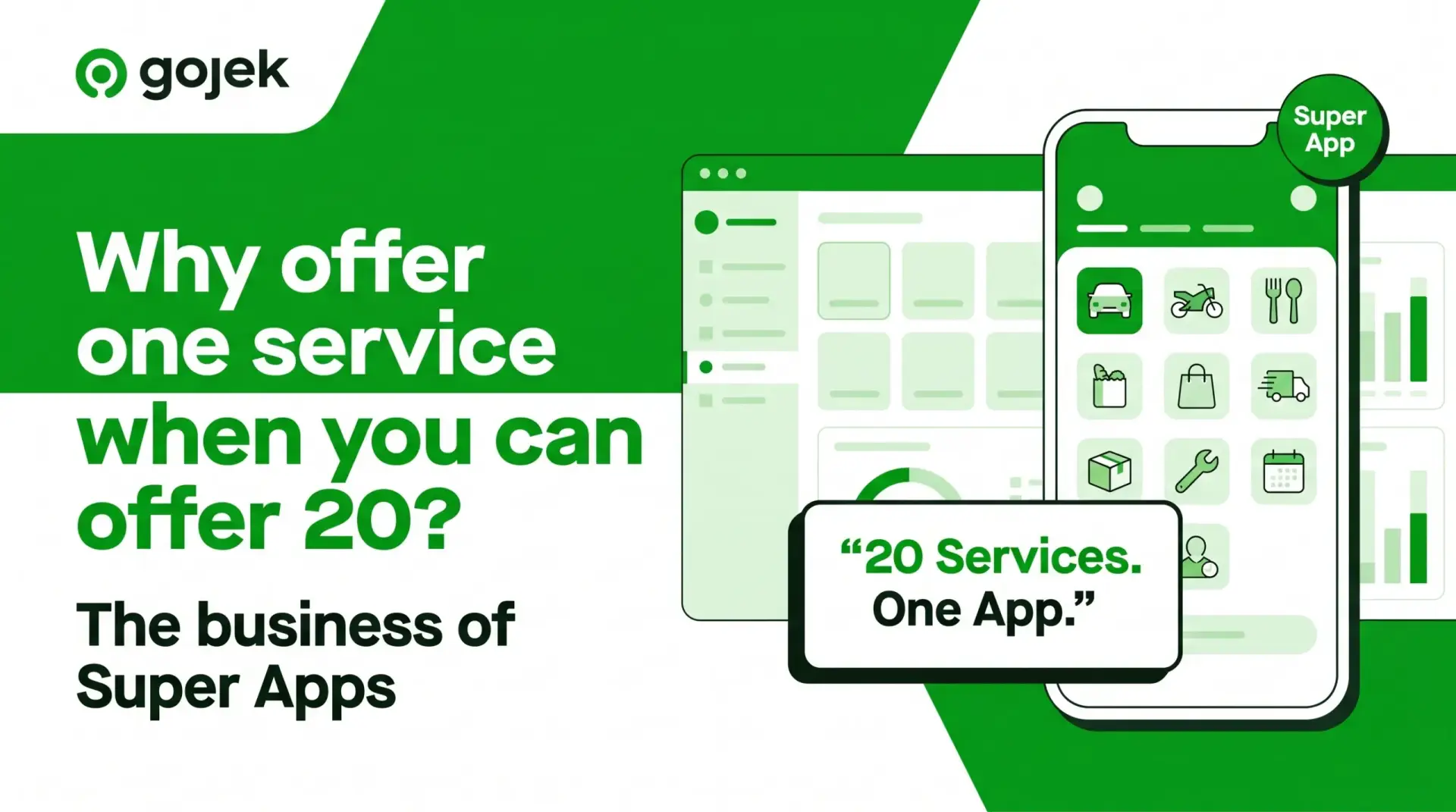
This is why a Gojek Clone is not just about copying features from a known app. It is about building a system where services, payments, data, and user activity all work together. The real strength of a super app is not the number of services it offers. The real strength is that every service can make the others more useful and more profitable.
A platform built with this logic does not depend only on acquiring new users every month. It grows by increasing the value of existing users inside the ecosystem. That is a smarter long-term growth model for founders who want to build something scalable and commercially strong.
Unified Wallet Logic: The Financial Backbone of a Super App
A super app without a wallet often feels like a group of services placed under one brand. A super app with a unified wallet feels like one connected system.
The wallet acts as the financial backbone of the ecosystem. It brings all transactions under one layer, making the user experience smoother and the business model stronger. Instead of asking users to complete separate payment processes for each service, the app creates one shared payment environment that works across rides, food delivery, bookings, offers, and more.
That convenience matters more than it looks. Faster transactions reduce friction. Stored balance encourages repeat use. Cashback and wallet rewards give users a reason to return instead of moving to another platform. Over time, the wallet becomes more than a payment feature. It becomes a retention tool.
Why wallet logic matters for retention and transactions
From a product and business perspective, wallet logic improves the ecosystem in several ways:
- It makes checkout faster across all services
- It encourages users to keep spending inside the platform
- It supports cashback, offers, and loyalty mechanisms
- It increases repeat usage through stored balance convenience
A user with wallet balance is more likely to return because the next transaction already feels easier. That small reduction in friction can improve conversion rates across multiple services.
How one wallet connects multiple services
| Service Type | Wallet Role |
|---|---|
| Ride-hailing | Instant payments after trips |
| Food delivery | Faster checkout with stored balance |
| Grocery orders | Easy prepaid transactions |
| Home services | Seamless booking payments |
| Offers & cashback | Rewards stored for future use |
The business value is simple: instead of ending the user journey after one service, the wallet helps carry that value forward into the next transaction. That is what makes unified wallet logic a core part of any serious Gojek Clone strategy.
Multi-service Integration: Building a Real Ecosystem, Not Just Features
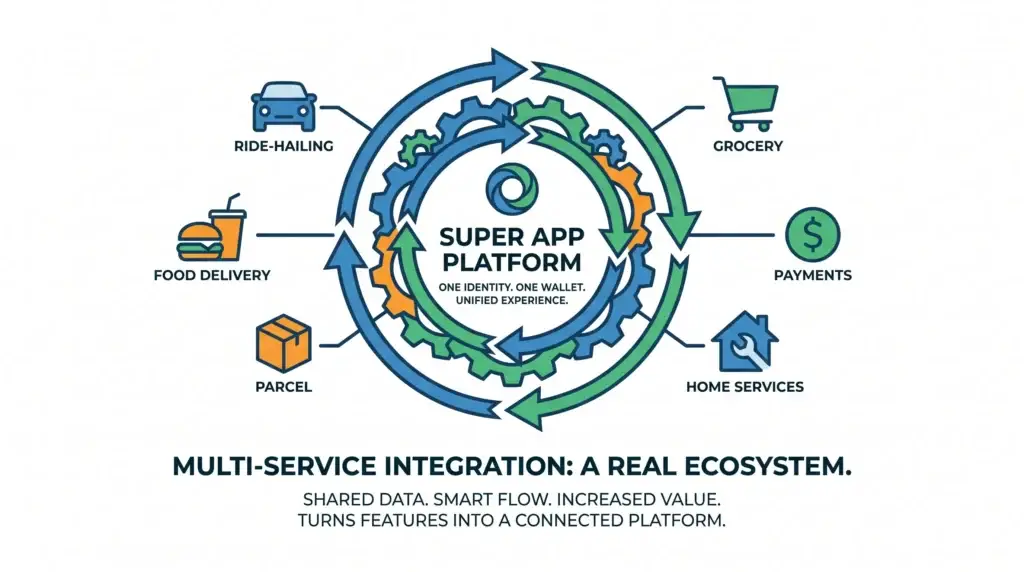
Adding many services to one app is not difficult. Integrating them properly is where the real work begins.
A super app should not feel like several mini apps stitched together. It should feel like one platform where everything is connected. That means ride-hailing, food delivery, parcel movement, grocery, payments, and home services should not operate like isolated verticals. They need shared user identity, shared wallet logic, connected offers, centralized operations, and smart service flow between one experience and the next.
This is what turns a feature-heavy product into an ecosystem.
What real integration looks like in a super app
A well-integrated Gojek Clone usually includes:
- One user account across all services
- One wallet for multiple transactions
- Unified notifications and promotional logic
- Cross-service user data and behavior tracking
- Centralized admin visibility over operations
For example, a customer who finishes a ride can receive a relevant food delivery offer. A user who adds wallet balance can be encouraged to try another paid service. A grocery customer can be nudged toward repeat orders or subscription-like convenience models. These are not just marketing tricks. They are product-level decisions that increase movement within the ecosystem.
Why integration increases stickiness and platform value
When services remain disconnected, users treat them as separate tools. Engagement stays shallow, loyalty stays weak, and revenue remains fragmented.
When services are integrated, users begin to rely on the platform more naturally. They stay longer, use more categories, and generate more value without the platform having to reacquire them from scratch. For founders, this improves some of the most important business metrics:
- Higher customer lifetime value
- Better acquisition cost efficiency
- Stronger repeat usage across categories
- More diversified revenue flow
That is why integration should never be treated as an afterthought. A super app only becomes valuable when the services strengthen each other.
Read More : Multi-Service Apps: Pros and Cons for Boosting Enterprise Growth
Cross-selling Tech: Turning Users into Multi-service Customers
Cross-selling is where super apps unlock one of their biggest commercial advantages. Instead of building separate growth systems for every service, they use one user base to drive demand across multiple categories.
This changes the economics of growth. A platform no longer has to spend heavily to find new users for each new service. It can convert existing users into multi-service customers through the right recommendation logic, wallet incentives, and service timing.
How super apps create cross-service movement
Cross-selling depends on understanding user behavior. A strong super app tracks how users transact, when they engage, which services they use most often, how they use the wallet, and what kind of offers they respond to.
That makes it possible to create relevant transitions such as:
- A ride user receiving a food offer after commute hours
- A wallet user getting incentives for home services
- A grocery customer being introduced to repeat-order plans
- A frequent user receiving bundled service discounts
These transitions matter because they feel connected to real user behavior, not random upselling.
Why cross-selling improves revenue efficiency
| Growth Factor | Business Impact |
|---|---|
| Customer acquisition cost | Decreases |
| Revenue per user | Increases |
| Platform engagement | Improves |
| Service adoption rate | Accelerates |
The real advantage of a Gojek Clone is not just that it offers many services. It is that one service can help grow another. That creates a compounding model where the same ecosystem keeps generating additional value from the same user base.
For founders, this is one of the strongest arguments for building a super app instead of several disconnected service businesses.
Global Cost of Development for a Gojek Clone App
Gojek-Like Super App Development — Market Price by Tech Stack
The tech stack affects service speed, booking flow, payments, user management, and multi-service performance in a Gojek-like super app. PHP/Laravel works well for cost-effective multi-service launches, Node.js/React.js supports real-time ride, delivery, booking, and wallet workflows, while Go microservices suit large super apps handling high traffic, multiple services, and city-wide operations.
PHP/Laravel is often the most practical choice for launching a Gojek clone quickly and affordably. Node.js/Python fits better when real-time workflows and heavier multi-service activity become more important, while Go microservices are better suited for enterprise-scale super app platforms with higher concurrency and more complex infrastructure needs.
These values reflect global development cost estimates. Final pricing varies based on ride-hailing, food delivery, grocery, courier, service booking, wallet, vendor panels, driver apps, admin controls, commission logic, live tracking, and platform complexity.
Miracuves Gojek-Like Super App Solution Cost and Tech Stack
Miracuves Pricing for a Gojek-Like Super App developed in PHP/Laravel with Flutter Apps for $3,699 USD (One-Time Price) in just 6 days
Get a fully developed, deployment-ready multi-service platform modeled after Gojek. Built on a stable PHP foundation, this complete package includes everything you need to launch and scale a super app business across multiple on-demand service categories:
- Core Workflows: Ride-hailing, food delivery, parcel delivery, grocery delivery, handyman services, beauty services, appointment booking, customer ordering, provider assignment, and real-time service tracking.
- Built-in Revenue Logic: Service commissions, delivery fees, ride commissions, provider subscriptions, featured listings, cancellation charges, promo codes, wallet logic, surge pricing, and provider payout setup.
- Management Hub: Centralized admin dashboard, customer management, provider management, driver management, vendor controls, service category management, booking monitoring, payment records, refund handling, and marketplace analytics.
- Launch-Ready: Fully prepared for your custom branding, configuration, payment gateway setup, map integration, provider onboarding, vendor setup, and immediate market entry.
Why Is Gojek-Like Super App Development More Affordable?
Most super apps become expensive because they are not just one app. They usually require multiple service modules, customer apps, provider apps, vendor panels, driver workflows, admin controls, payment systems, live tracking, wallet logic, and service-specific operations. Building all of this from scratch can push the cost very high and delay launch for months.
We took a smarter, more practical approach:
You Aren’t Paying for Ground-Up Development: Our multi-service super app engine is already developed, tested, and ready to deploy. You skip the inflated cost and long waiting period usually required for building a Gojek-style platform from scratch.
The Power of PHP: We built this solution on a reliable and cost-effective PHP architecture. This keeps the upfront price affordable while supporting essential super app workflows such as ride booking, food delivery, parcel delivery, service provider management, payments, tracking, and admin operations.
You get a launch-ready Gojek-like super app with practical multi-service features, source code access, and faster deployment without the high custom development price tag.
Note: This cost is for the solution, re-branding, deployment, and source code only.
Scalable Microservices: Architecture That Supports Growth
A super app may look simple to the user, but behind the interface it is handling many moving parts at the same time. Different services have different traffic patterns, different transaction loads, and different operational requirements. If the architecture is not designed for that complexity, the platform eventually becomes difficult to maintain and harder to scale.
That is why architecture decisions matter early.
Why multi-service platforms need scalable architecture
A monolithic approach may work for a basic app with one core service. But in a super app, it can create serious limitations. If one area slows down or fails, other areas may be affected. Updates become heavier. Service expansion becomes slower. Performance can drop when usage spikes in one category.
For a founder, these are not only technical issues. They directly affect uptime, user trust, and platform growth.
How microservices support performance and expansion
A microservices-based setup separates service layers so they can operate more independently. That allows the platform to scale different services based on actual demand.
For example:
- Ride-hailing can scale during peak commute hours
- Food delivery can handle lunch and dinner spikes
- Payments can stay responsive across all service activity
This brings real business advantages:
- Better reliability because failures are more isolated
- Greater flexibility when adding new services
- Improved performance under demand spikes
- Faster long-term development and expansion
A serious Gojek Clone should not be built only for launch speed. It should be built for future growth, operational stability, and service expansion. That is what makes scalable architecture such an important part of ecosystem planning.
User Experience (UX): Making Complexity Feel Simple
The biggest risk in a super app is confusion. When too many services are placed inside one product without clear structure, users feel lost instead of empowered.
That is why UX is one of the biggest reasons super apps succeed or fail.
A platform may have strong architecture, many services, and a wallet-ready system, but if users cannot move through it easily, adoption suffers. Service discovery becomes weaker. Transactions slow down. Repeat usage declines.
Why UX directly affects adoption and conversion
A good super app should make many services feel easy to access, not difficult to understand. Users should be able to move from one use case to another without friction. The app should feel organized, trustworthy, and fast.
Strong UX improves:
- Conversion rates
- Repeat usage
- Service discovery
- User confidence in payments and bookings
A poor UX does the opposite. It creates hesitation, abandoned actions, and weakens the value of the ecosystem.
The UX priorities founders should not ignore
For a Gojek Clone, UX should focus on a few essential principles:
- Simple navigation with clear categories
- Fast loading and low-friction interactions
- Easy wallet visibility and transaction confidence
- Smart recommendations without clutter
- Smooth checkout and booking flow
The goal is not to show users how much the app can do. The goal is to help them use more services naturally. In a super app, simplicity is not a design preference. It is a business strategy.
Building a Gojek Clone with Miracuves
Building a super app requires more than assembling features. It requires connecting payments, services, operations, scalability, and user journeys into one business-ready system.
At Miracuves, the focus is on helping founders build multi-service platforms with practical product logic. That includes wallet-ready systems, service integration flow, scalable backend thinking, admin control, customization readiness, and support for faster launch planning.
What matters in a serious super app build
Founders should prioritize:
- Connected wallet logic
- Real multi-service integration
- Cross-selling readiness
- Scalable architecture
- Strong admin and operational control
Why practical product logic matters more than hype
A super app is a long-term ecosystem investment, not just a trendy product launch. That is why the right development approach matters. Miracuves positions this process around usable structure and business logic, not empty claims. For founders planning a Gojek Clone, that practical foundation can make the difference between launching a feature-heavy app and building a platform that can actually grow.
Conclusion
Super apps are not powerful because they offer many services. They are powerful because those services work together.
A unified wallet keeps money flowing inside the platform. Multi-service integration creates stickiness. Cross-selling improves revenue efficiency. Microservices support scale. UX makes the whole system easy to use.
For founders, the opportunity is clear: build one ecosystem that can serve multiple daily needs instead of depending on one narrow service model. If you are planning a Gojek Clone, the technology choices you make today will shape how scalable, profitable, and sustainable your platform becomes tomorrow.
If you are exploring a serious multi-service platform, Miracuves can help you plan and build a super app with practical architecture, service integration logic, and ecosystem-ready foundations designed for real business growth. Let’s build together and create a scalable super app that is ready for long-term expansion, stronger user retention, and sustainable business success.
FAQs
How does a super app generate multiple revenue streams?
It earns through commissions, delivery fees, wallet transactions, ads, subscriptions, and cross-selling across different services.
Why is a unified wallet important in a Gojek Clone?
A unified wallet simplifies payments, improves user retention, and enables seamless transactions across multiple services.
What services can be included in a Gojek-like super app?
Common services include ride-hailing, food delivery, grocery, parcel delivery, home services, and digital payments.
How does cross-selling work in a super app?
It uses user behavior and transaction data to recommend other services, increasing engagement and revenue per user.
Why is microservices architecture important for super apps?
Microservices allow each service to scale independently, improving performance, flexibility, and long-term platform stability.