
Key Takeaways
What You’ll Learn
- Large marketplaces need strong product data management.
- Catalog structure affects search, filters, and user experience.
- Seller tools help manage listings, pricing, and inventory.
- Scalable backend supports high product and order volume.
- Automation reduces manual marketplace operations.
Stats That Matter
- Product catalogs require clean categories, attributes, and variants.
- Search and filters improve product discovery at scale.
- Inventory sync helps avoid overselling and stock errors.
- Admin dashboards manage sellers, products, orders, and disputes.
- Performance optimization keeps large marketplaces fast and stable.
Real Insights
- Scaling products is harder than launching a store.
- Bad catalog logic creates search and checkout problems.
- Marketplace growth depends on seller and product control.
- Automation becomes essential as listings and orders increase.
- The best solution combines catalog systems, seller tools, automation, and scalable architecture.
Most e-commerce businesses start with a manageable catalog. A few hundred products, a single seller, and a checkout flow that gets the job done. At that stage, the platform works. Orders come in, payments clear, and the operation feels under control.
But marketplaces are not built to stay small.
The moment a platform opens to multiple vendors, adds product categories, and starts attracting serious traffic, the cracks begin to show. Inventory goes out of sync. Search returns irrelevant results. Vendors struggle to manage their listings. Shipping timelines become unpredictable. And what looked like a functioning marketplace starts to feel like a system held together with workarounds.
This is the core challenge of building an Amazon Clone — not the idea, but the infrastructure.
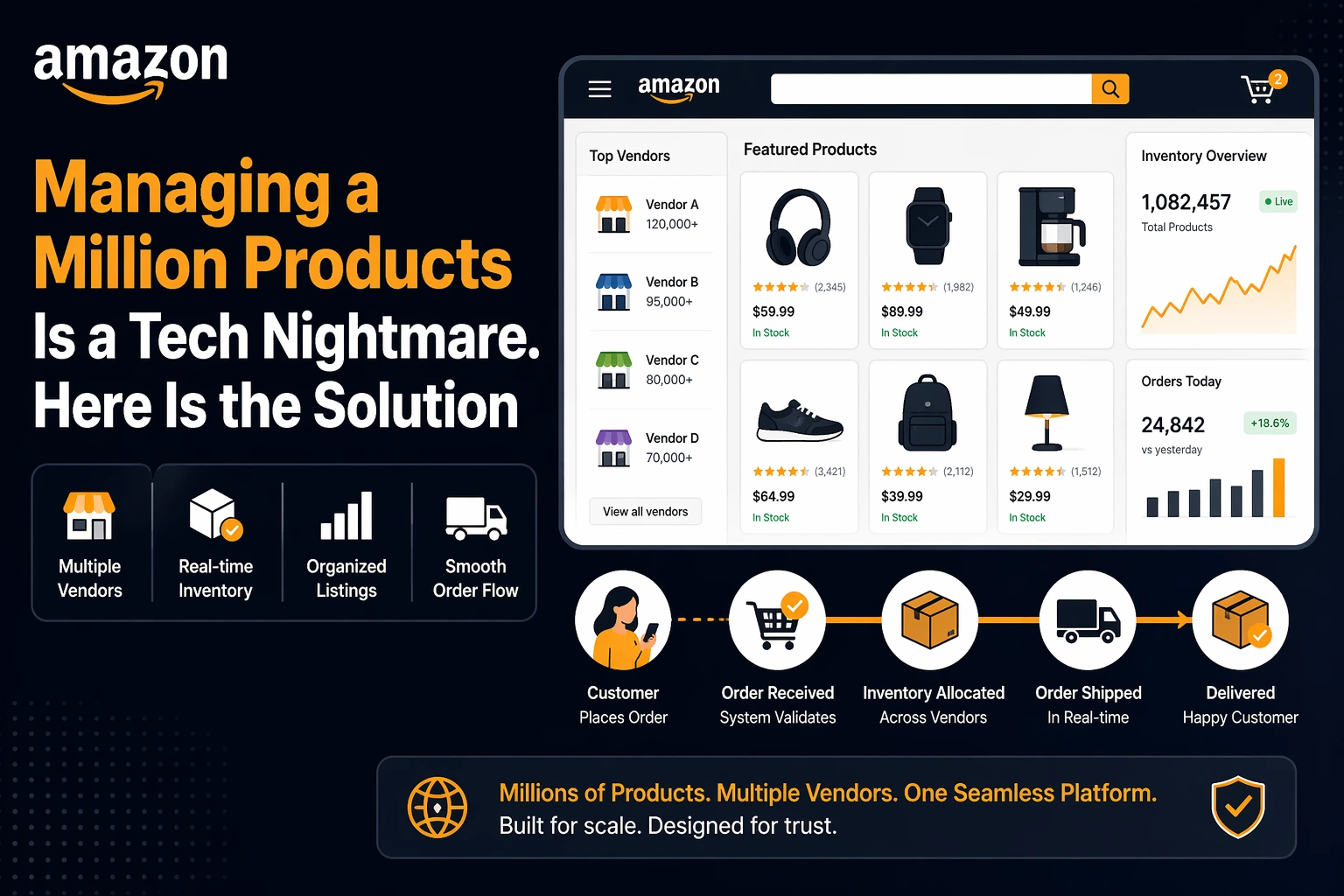
Scaling an e-commerce marketplace to millions of SKUs requires more than a good product page template. It demands a system where vendors, inventory, logistics, discovery, and operations all function as one coordinated engine. This blog breaks down each of those layers, explaining what founders need to understand before building a marketplace that is designed for real scale.
Why Most E-Commerce Platforms Break Before They Scale
The failure point for most marketplace builds is not traffic. It is architecture.
The Difference Between a Store and a System
Platforms built for a single seller can handle limited complexity. One inventory pool. One shipping logic. One dashboard. But a multi-vendor e-commerce marketplace introduces an entirely different set of operational requirements. Each vendor has their own catalog, their own stock levels, their own fulfillment setup, and their own performance benchmarks. When the platform is not designed to manage this separation from the start, growth creates chaos instead of momentum.
The platforms that scale — the ones that handle hundreds of thousands of vendors and millions of live SKUs — are built with systems thinking, not feature thinking. Every layer of the product has a job to do, and those layers have to work together without creating friction for vendors, customers, or operations teams.
Understanding those layers is where any serious Amazon Clone begins.
Read More: What is Amazon App and How Does It Work?
How Multi-Vendor Logic Turns a Store Into a Self-Sustaining Marketplace
A single-seller e-commerce store and a multi-vendor marketplace look similar on the surface. Both show products. Both process payments. But underneath, they operate entirely differently.
What the Platform Actually Manages
In a single-seller setup, the platform owner controls everything — catalog, pricing, shipping, and fulfillment. In a multi-vendor marketplace, that responsibility is distributed across hundreds or thousands of independent sellers. The platform no longer manages products directly. It manages the system that allows sellers to manage their own products.
This distinction is what multi-vendor logic is built around.
A well-designed vendor logic layer handles several things at once. Seller onboarding needs to be structured enough to verify legitimacy but simple enough to avoid drop-off. Catalog ownership needs to be clearly assigned so that each vendor controls their own listings without accidentally overwriting another seller’s data. Commission structures need to be configurable — different rates for different categories, different tiers for different seller levels, different rules for promotional periods.
Where Order Routing and Payouts Fit In
Beyond that, order routing needs to be automatic. When a customer places a single cart order that includes products from three different vendors, the system must split and route those sub-orders correctly, assign the right fulfillment responsibility, and trigger separate payout logic for each seller. None of this can be manually managed at scale.
Why Self-Sustaining Seller Activity Is the Real Growth Engine
The reason this matters commercially is straightforward. A marketplace where vendors can onboard without friction, manage their own catalog, and trust that payments are accurate becomes self-sustaining. Vendors list more products, fulfill more reliably, and grow their storefronts without constant platform intervention. That organic seller activity is what builds catalog depth — which in turn drives customer discovery, repeat purchases, and long-term platform revenue.
Why Inventory at Scale Is an Architecture Problem, Not a Storage Problem
The instinct when thinking about millions of SKUs is to think about storage. How much database capacity is needed? How many product records can the system hold?
But that framing misses the real problem entirely.
The Real Cost of Inventory Inaccuracy
Inventory at scale is not about how many products you can store. It is about how accurately and how quickly the system can reflect what is actually available, at any given moment, across all vendors and all warehouses.
When a customer searches for a product, adds it to their cart, and proceeds to checkout, the inventory system has a very short window to confirm that the item is actually in stock. If the system is slow, overselling happens. If the system is not syncing with vendor warehouse data in real time, customers receive cancellation notices after payment. Both outcomes damage trust — and in a marketplace with thousands of alternatives, a damaged customer experience almost always means a lost customer.
Variant Complexity and Real-Time Sync
At the SKU level, the complexity multiplies further. A single product — say, a running shoe — might have forty variants across size and color combinations. Each variant has its own stock level. Each level can change simultaneously from multiple sales channels. The inventory system has to track and update all of this without creating conflicts, duplicates, or sync delays.
Catalog Deduplication at Scale
When multiple vendors list the same product, the marketplace needs to decide whether to show separate listings or consolidate them into one canonical product page with multiple seller offers — much like the Amazon model. That consolidation logic requires intelligent product matching, attribute normalization, and a structured data schema that works across categories.
None of this is solved by storage capacity. It is solved by architecture. A serious Amazon Clone treats inventory as a real-time operational system, not a database table.
How Global Shipping APIs Transform a Marketplace Into a Borderless Commerce Engine
Shipping is where marketplace ambition meets operational reality.
A marketplace that can only fulfill orders within a single city or region is, by definition, a limited platform. The commercial ceiling is low. Customer acquisition is geographically constrained. And as soon as a competitor offers wider delivery coverage, the platform loses relevance.
Global shipping API integration removes that ceiling.
By connecting to multiple carrier APIs — covering local, national, and international logistics providers — a marketplace can offer customers real-time rate comparisons, accurate delivery timelines, and end-to-end tracking regardless of where an order is going. The platform does not need to operate its own logistics network. It connects to existing ones and orchestrates them intelligently.
What API-Driven Shipping Looks Like in Practice
- A customer selects a product from a vendor in one country and ships to another, with the rate calculated automatically at checkout based on weight, dimensions, destination, and carrier availability.
- Tracking updates are pulled from the carrier API and surfaced inside the customer’s order page, so they never need to leave the platform to check delivery status.
- Return workflows are initiated within the platform, with the appropriate carrier assigned and the return label generated automatically.
- Customs documentation for cross-border shipments is handled through integration, reducing manual processing and compliance risk.
Why Shipping Reliability Is a Revenue Decision
The business case for strong shipping integration is not just about convenience. Shipping reliability is one of the top drivers of repeat purchases in e-commerce. When customers know that a platform delivers on time, updates them accurately, and handles problems efficiently, they come back. When they do not, they do not.
For vendors, clear shipping logic also means fewer support requests, fewer disputes, and more predictable fulfillment costs — all of which contribute to a healthier seller ecosystem on any serious e-commerce marketplace.
Why AI Search Is the Highest-ROI Investment in a Large-Scale Marketplace
Search is not a feature in a large-scale e-commerce marketplace. It is the primary revenue interface.
When a catalog contains millions of products across dozens of categories, the only way a customer finds what they are looking for — and the only way the platform converts that intent into a transaction — is through search. If search performs poorly, it does not matter how strong the product catalog is. The inventory becomes invisible.
Why Keyword Search Breaks at Scale
Basic keyword search fails at scale for a simple reason: customer intent is rarely expressed in exact product terms. A customer searching for “comfortable office chair under 10000” is expressing a combination of intent signals — category, use case, constraint, and implicit preference. A keyword-matching system returns anything with those words. An AI-powered search system understands what the customer actually wants.
The difference in conversion rates between the two approaches is significant.
How AI Search Works Across a Million-SKU Catalog
AI search in a serious Amazon Clone works across several dimensions. Intent recognition allows the system to interpret natural language queries and map them to relevant product categories even when the exact words do not appear in a listing. Synonym matching ensures that a search for “sofa” also surfaces results for “couch” and “settee” without requiring vendors to manually add every possible variation. Behavioral personalization uses purchase history, browsing patterns, and session behavior to rerank results based on what a specific user is most likely to buy. Filtering and faceted navigation allow customers to refine results intelligently across price, rating, availability, and attributes specific to each category.
The Compounding Revenue Effect of Better Search
The commercial impact of getting search right is compounding. Better search means higher product discovery. Higher discovery means more add-to-cart events. More add-to-cart events mean higher revenue per session. And as the catalog grows, the AI model improves — making search a long-term competitive asset rather than a one-time feature build.
How Vendor Dashboards Define the Operational Health of Your Marketplace
The customer experience is what most founders focus on during a marketplace build. But in a multi-vendor platform, the vendor experience is equally important — and far more consequential for long-term catalog quality.
What Happens When Vendors Lack Tooling
A vendor who cannot manage their listings efficiently will list fewer products. A vendor who cannot see their payout breakdown clearly will trust the platform less. A vendor who cannot track their order status in real time will fulfill less reliably. All of these outcomes degrade the customer experience, even though they originate on the seller side.
This is why vendor dashboard design is a core product investment, not a secondary consideration.
What a Strong Vendor Dashboard Covers
A well-built vendor dashboard in an Amazon Clone gives sellers clear, actionable control over every aspect of their marketplace presence:
| Dashboard Capability | Business Impact |
|---|---|
| Product listing and variant management | Faster catalog expansion, fewer listing errors |
| Real-time order management and status tracking | Reliable fulfillment, fewer customer complaints |
| Performance analytics and sales reporting | Vendors optimize listings based on actual data |
| Payout visibility and earnings breakdown | Trust in the platform’s commission and payment logic |
| Inventory alerts and low-stock notifications | Reduced overselling, better stock management |
| Promotions and discount management | Vendor-driven sales activity, higher overall GMV |
When vendors have this level of clarity and control, their behavior improves naturally. They update listings more regularly, respond to orders faster, price more competitively, and use promotions strategically. The result is a marketplace where catalog quality improves over time without the platform operator having to manually intervene.
The inverse is also true. Platforms with poor vendor tooling see higher seller churn, lower catalog update frequency, and more operational support load — all of which limit the ability to scale.
Read More: How to Build an App Like Amazon: Full Developer Guide
Building an Amazon Clone with Miracuves
Bringing all of these systems together — multi-vendor logic, inventory architecture, global shipping, AI search, and vendor tooling — requires a development approach that treats marketplace infrastructure as a first-class concern from day one.
What Miracuves Focuses On
At Miracuves, the focus when building an Amazon Clone is not simply on delivering an app with product pages and a checkout flow. It is on building the operational layers that make a marketplace scalable, reliable, and commercially viable as the catalog and vendor base grows.
That means architecting multi-vendor systems that support flexible commission structures, clean order routing, and seller-level controls. It means building inventory management that handles real-time sync, variant complexity, and catalog deduplication without degrading platform performance. It means integrating carrier APIs that give customers accurate shipping rates and tracking across regions. It means implementing search systems that go beyond keywords to drive real product discovery. And it means designing vendor dashboards that give sellers the visibility and control they need to perform well on the platform.
For founders building in the e-commerce marketplace space, the technology foundation chosen at the start determines how far the platform can realistically grow. A system built for launch but not for scale will require expensive rebuilding at exactly the moment when momentum matters most.
Read More: How to Build an Ecommerce Marketplace Like Amazon
Conclusion
Scaling an e-commerce marketplace to millions of SKUs is not a product design problem. It is a systems problem.
The platforms that succeed at scale — the ones that handle massive catalogs, thousands of vendors, and complex global logistics without losing operational control — are built on architecture that treats every layer of the marketplace as a functional system. Multi-vendor logic creates a self-sustaining seller ecosystem. Inventory architecture ensures accuracy at any volume. Global shipping APIs remove geographic ceilings. AI search turns catalog depth into commercial discovery. Vendor dashboards keep the supply side healthy, consistent, and engaged.
Each of these layers supports the others. Remove any one of them and the platform develops a ceiling it cannot break through.
For founders entering the marketplace space, the decision is not whether to build these systems — it is whether to build them correctly from the start, or to rebuild them under the pressure of growth.
If you are planning to launch or scale an Amazon Clone, Miracuves can help you make the right architectural decisions before the first line of code is written. Contact us today to connect with our specialists, share your marketplace vision, and get a clear roadmap for building a scalable, commercially ready solution tailored to your specific market.
FAQs
What is an Amazon Clone and how is it different from a standard e-commerce store?
An Amazon Clone is a multi-vendor marketplace where multiple sellers list and manage their products, and the platform earns through commissions and fees. A standard e-commerce store is single-seller, where one owner controls products, pricing, and operations.
How many vendors can a marketplace support?
There’s no fixed limit. A well-built, scalable platform can support thousands of vendors. The key factor is strong architecture—poorly designed systems tend to fail as vendor numbers grow.
Why is inventory management difficult at scale?
Managing inventory across multiple vendors in real time is complex. Different stock updates, multiple warehouses, and product variants can lead to overselling, delays, and sync issues if not handled properly.
What role does AI search play in a marketplace?
AI search helps users find products based on intent, not just keywords. It improves relevance, personalization, and product discovery—directly boosting conversions and revenue.
How important are global shipping APIs?
They are essential for scaling. Shipping APIs automate rates, delivery timelines, tracking, and returns, making the experience smoother for both customers and vendors.
Related Articles:
Miracuves is an independent software development company. We are not affiliated with, connected to, sponsored by, or endorsed by any company or product named in this article.
Terms such as “X Clone” are used descriptively. It is how the software industry refers to building a platform with functionality comparable to a known service, and how clients search for it.
The entire design and codebase of our products is built by our own team. Our products contain no code, design, graphics, or content originating from any third-party website or applications.
All third-party names and marks referenced in this article are the property of their respective owners, referenced solely to identify the services discussed.