


Key Takeaways
- Cross-border payroll solutions help global HR platforms pay international employees, contractors, and remote teams more efficiently.
- HR teams, finance teams, employees, compliance teams, and payment partners need secure connected payroll workflows.
- Multi-currency payouts, tax handling, compliance checks, employee records, and payment tracking are core features.
- Success depends on payroll accuracy, local regulation support, secure payments, and transparent reporting.
- A strong payroll platform can help global businesses manage distributed teams without operational confusion.
Workflow Signals
- Employees need salary visibility, payslips, payment status, tax documents, and secure account access.
- HR teams need onboarding, employee data management, payroll cycles, benefits tracking, and compliance records.
- Finance teams need currency conversion, payout approvals, invoices, ledgers, reconciliation, and reporting tools.
- Admins need control over users, roles, payroll rules, countries, payment methods, approvals, and audit logs.
- Notifications keep employees, HR teams, and finance teams updated on payroll approvals, payouts, failed payments, and compliance tasks.
Real Insights
- Global payroll becomes complex when teams operate across multiple currencies, tax systems, and employment rules.
- Weak payroll logic can create delayed salaries, compliance errors, reconciliation issues, and employee trust problems.
- Clear payslips, exchange-rate visibility, approval flows, and audit records help reduce payroll disputes.
- Payroll platforms work best when HR, finance, compliance, and payment workflows are connected from day one.
- Miracuves builds cross-border payroll and HR fintech platforms with multi-currency payouts, compliance workflows, payment tracking, and admin control.
Hiring is no longer limited by geography. Startups now work with full-time employees, remote contractors, consultants, creators, and distributed teams across multiple countries. But while hiring has become global, payroll often remains fragmented.
HR teams may manage employee records in one platform, contractor invoices in another, FX conversion through a bank, and payout tracking through spreadsheets. For HR tech founders, this creates a clear product opportunity: build payroll and payout workflows directly into the HR platform instead of forcing users to leave the software.
That is where an international payroll API solution becomes valuable. It allows HR software, workforce management platforms, employer-of-record platforms, and contractor management tools to embed salary payouts, multi-currency payments, recipient management, FX visibility, and transaction tracking into the same product experience.
Wise’s payroll API content describes payroll automation for HR, finance, and operations teams and highlights international salary payments in 40+ currencies, showing how cross-border payroll is becoming an embedded finance use case rather than a standalone banking task.
For founders building HR tech products, Wise like app features can offer a practical product model: multi-currency accounts, transparent FX flows, recipient profiles, payout tracking, compliance-ready workflows, and admin-level payment control. Miracuves helps founders build ready-made and white-label fintech foundations that can be customized for remittance, payroll, wallet, and cross-border payment use cases.
Why Global Teams Need More Than Traditional Payroll Software
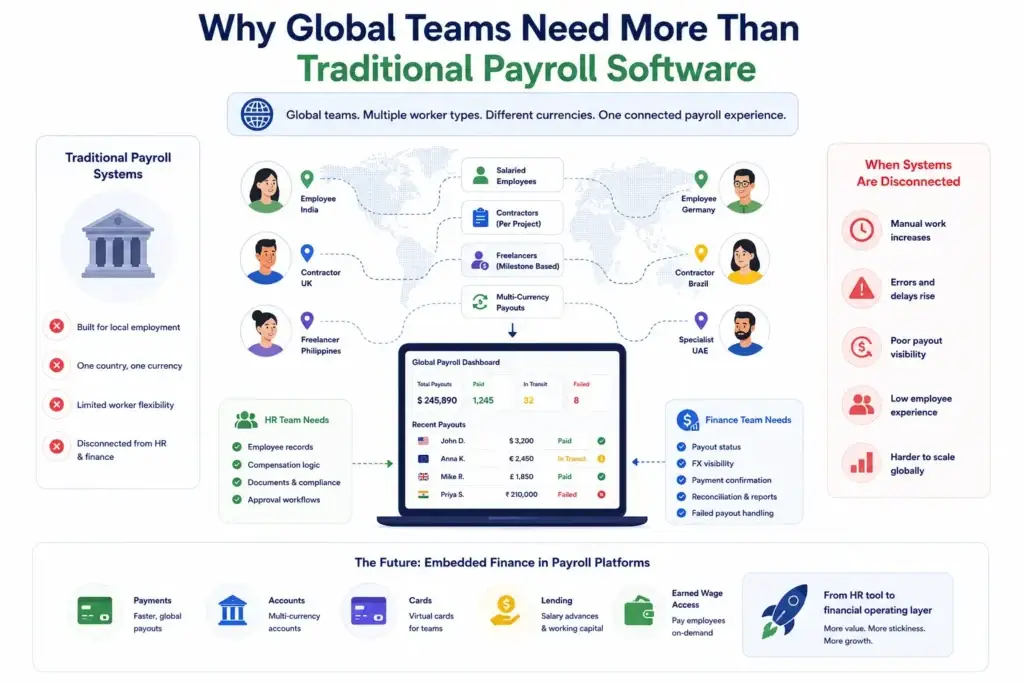
Image Source: AI-generated visual by Miracuves
Traditional payroll systems were built for predictable local employment. They usually work well when the employer, employee, bank account, tax rules, and currency all belong to the same country.
Global teams are different.
A modern HR platform may need to support employees in one region, contractors in another, freelancers paid per milestone, and remote specialists paid in different currencies. The finance team needs payout status, FX visibility, payment confirmation, failed payout handling, and reconciliation. The HR team needs employee records, compensation logic, documents, and approval workflows.
When these layers are disconnected, every payroll cycle becomes operationally heavy.
For an HR tech founder, this is not just a backend problem. It affects product stickiness. If a company already manages hiring, onboarding, attendance, documents, and compensation inside one HR platform, adding cross-border payroll can turn the product from a record-keeping tool into a financial operating layer.
That is why embedded finance is becoming relevant to payroll. Industry commentary on embedded payroll notes that financial products such as payments, accounts, cards, lending, and earned wage access can be embedded into payroll platforms to create faster and more integrated compensation experiences.
What Is an International Payroll API Solution?
An international payroll API solution is a set of payment, currency, identity, and transaction workflows that allows software platforms to initiate, manage, and track payroll-related payouts across countries.
For HR tech platforms, this can include:
- Employee and contractor payout profiles
- Multi-currency salary disbursement
- FX conversion and rate visibility
- Bank account, IBAN, SWIFT, or local rail payout details
- Payment status tracking
- Failed payout handling
- Payroll approval workflows
- Transaction history and reconciliation
- KYC workflows and AML workflow support
- Admin controls and audit logs
The key word is “embedded.” The user should not need to leave the HR product to manage global payroll operations. Embedded FX and cross-border payment guides describe this model as bringing foreign exchange and payment capabilities directly into non-financial software through APIs, so users can manage international currency transactions inside their primary workflow.
For HR SaaS products, this means the payroll layer can become a natural extension of onboarding, compensation, compliance documents, and workforce management.
Why Wise Clone Features Fit Cross-Border Payroll Workflows
Wise became known for international money movement, multi-currency accounts, transparent transfers, and global payment experiences. A Wise-style product pattern is useful for payroll because payroll is essentially a recurring, regulated, multi-party payout workflow.
A Wise like global financial platform for payroll does not mean copying a brand. It means using a proven fintech product pattern and adapting it to the HR tech use case.
A payroll-focused Wise like global financial platform foundation may include:
- Multi-currency wallet or balance management
- Recipient and beneficiary profiles
- Cross-border payout initiation
- FX conversion workflows
- Local and international bank transfer support
- Payment tracking and notifications
- Transaction receipts
- Business account controls
- Admin approval rules
- KYC/AML workflow support
- Reporting and reconciliation
For HR tech founders, the business value is clear: instead of building payroll, remittance, FX, and payout logic from zero, they can start with a fintech-ready foundation and customize it around employee compensation workflows.
Miracuves’ fintech solution mapping includes Wise like global financial platform, Revolut Clone, remittance app development, wallet app development, KYC/AML workflows, wallet ledger logic, FX conversion, transaction history, and compliance-ready architecture as relevant fintech content angles.
Core Features HR Tech Platforms Should Build for Cross-Border Payroll
Wise Clone Features for International Payroll API Solutions
| Feature | Business Value | Founder Impact |
|---|---|---|
| Multi-Currency Payroll Wallet | Allows companies to manage balances or payout flows in multiple currencies. | Helps HR platforms support international teams without forcing separate banking workflows. |
| FX Conversion Workflow | Shows currency conversion logic before salary or contractor payouts are processed. | Improves transparency and reduces payment confusion for finance teams. |
| Beneficiary Management | Stores employee, contractor, and vendor payout details securely. | Makes recurring payroll cycles easier to operate and audit. |
| Payroll Approval Rules | Allows finance managers to approve, reject, or hold payments before release. | Reduces operational risk when payout volume grows. |
| Payout Status Tracking | Shows whether payments are pending, processing, completed, failed, or refunded. | Reduces support tickets and gives HR teams better visibility. |
| Transaction History and Receipts | Creates a financial record of payroll activity. | Supports reconciliation, reporting, and dispute resolution. |
| KYC and AML Workflow Support | Helps prepare identity and risk checks for regulated payment operations. | Creates a safer foundation for fintech-enabled payroll growth. |
| Admin Risk Dashboard | Gives platform operators control over users, payments, limits, flags, and reporting. | Helps founders scale operations without depending on developers for every payout issue. |
How the Payroll Payment Flow Works Inside an HR Tech Platform
A strong international payroll workflow should feel simple to the user, even if the backend is complex.
A practical flow may look like this:
- Company creates a payroll batch
The HR or finance manager selects employees, contractors, or vendors to be paid. - Platform validates payout details
The system checks required fields such as recipient name, bank account details, country, currency, and payment method. - FX and payout logic are calculated
The platform displays source currency, destination currency, conversion logic, fees, and expected payout amount. - Payroll approval is triggered
Admins or finance managers approve the payroll batch based on role permissions. - Payment is initiated through the payout layer
The system routes payments through integrated rails, remittance workflows, or wallet balances depending on the product architecture. - Status updates are synced back into HR records
Employees, contractors, and admins can see payment status, receipts, and transaction history. - Reconciliation data is generated
Finance teams can export reports, review failed payouts, and match payroll records with accounting systems.
This is where Wise clone features become useful. A payroll product does not only need a “send money” button. It needs a complete financial workflow with user management, role controls, payout logic, reporting, and risk visibility.
Founder Decision Signals for Cross-Border Payroll Products
Speed
If customers are already asking for global payouts, adding embedded payroll can reduce product switching and improve retention.
Cost
Building every payment, wallet, FX, and admin module from zero can increase cost and risk. A ready-made foundation may help validate faster.
Scalability
Payroll volume grows with customer teams. The platform needs payout tracking, reconciliation, limits, and admin controls before scale becomes painful.
Market Fit
If the target users are remote-first companies, agencies, creator teams, or contractor-heavy businesses, cross-border payroll can become a strong differentiator.
Build vs API Integration vs White-Label Wise Clone Foundation
Founders usually have three routes when adding cross-border payroll to an HR platform.
| Approach | What It Means | Best For | Main Limitation |
|---|---|---|---|
| Build from zero | Build wallet, payout, FX, admin, reporting, and compliance workflows from scratch. | Large teams with deep fintech budgets and long timelines. | High complexity, longer development cycle, more operational risk. |
| API-only integration | Connect to payment, payroll, or banking APIs and build the UX layer around them. | Platforms that need fast connectivity but already have strong engineering capacity. | Product control depends heavily on API coverage and provider limitations. |
| White-label Wise clone foundation | Start with a ready-made fintech/remittance foundation and customize it for HR payroll workflows. | Founders who want faster validation, source-code ownership, and product flexibility. | Needs careful customization and compliance review for target markets. |
A white-label Wise clone foundation can be useful when the founder wants more control than a simple API integration but does not want to build every module from zero. Miracuves’ internal linking map recommends Wise Clone, Revolut Clone, fintech app development, remittance app development, white-label fintech platform, and source-code fintech solution as relevant anchors for this content cluster.
Security and Compliance Workflows Founders Should Plan Early
Cross-border payroll is not only a payment experience. It touches identity, financial records, employee data, payout approvals, and jurisdiction-specific operating requirements.
Founders should plan security and compliance workflows early, including:
- Encrypted data transfer
- Encrypted data storage
- Role-based access control
- Audit logs
- KYC workflows
- AML workflow support
- Transaction monitoring
- Suspicious activity flags
- Admin access controls
- Secure API integration
- Privacy-conscious data handling
- Compliance-ready workflows
This does not mean a software product is automatically compliant everywhere. Final compliance depends on jurisdiction, legal review, integrations, licensing, and operating model. Miracuves’ fintech security guidance recommends careful language such as “compliance-ready foundation,” “supports compliance workflows,” and “can be configured for KYC/AML requirements,” while avoiding guarantees of regulatory approval.
For HR tech founders, the practical point is simple: payment trust affects product trust. If salary payments fail, FX amounts are unclear, or admin controls are weak, the HR product becomes harder to scale.
Monetization Opportunities for HR Platforms Adding Payroll Finance
An international payroll API solution can create new monetization opportunities for HR SaaS platforms. The right model depends on the operating region, payment partners, licensing structure, and product scope.
Possible monetization models include:
| Revenue Model | How It Works | Founder Consideration |
|---|---|---|
| Subscription Add-On | Global payroll becomes a premium module inside the HR SaaS plan. | Works well when payroll is positioned as a productivity and finance upgrade. |
| Transaction Fee | The platform charges a small fee per payout or payroll batch. | Requires transparent pricing and careful user communication. |
| FX Margin | The platform earns from currency conversion spreads where legally and commercially appropriate. | Must be transparent and aligned with payment partner rules. |
| Employer Account Fees | Businesses pay for advanced payout controls, reports, and multi-country payroll tools. | Strong fit for mid-market HR platforms. |
| Contractor Payout Module | Companies pay extra to manage international contractors and freelancers. | Useful for remote-first companies, agencies, and creator teams. |
| API Access Pricing | The HR platform offers payroll payout APIs to other software partners. | Requires strong documentation, security, and developer support. |
The strongest business model is usually not one fee. It is a layered model where payroll improves retention, increases product usage, and creates paid finance workflows around the HR core.
How Miracuves Helps Build Wise-Style Payroll and Remittance Foundations
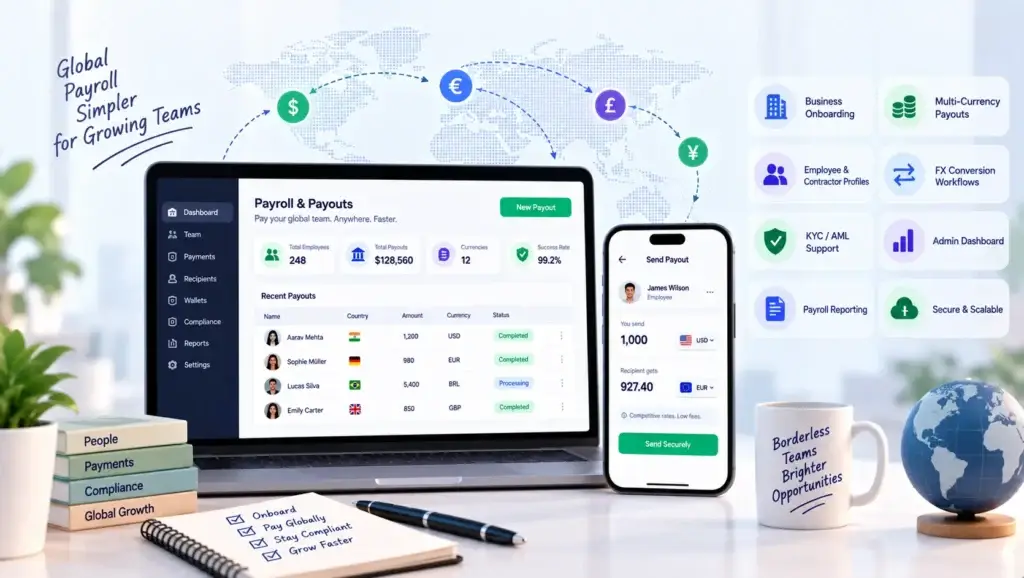
Miracuves helps founders build ready-made and white-label fintech platforms with source-code ownership, custom branding, admin dashboards, and faster deployment options. For a cross-border payroll product, this can include a Wise-style remittance foundation customized around HR tech workflows.
A payroll-focused solution can be shaped around:
- Business account onboarding
- Employee and contractor profiles
- Multi-currency payout flows
- Wallet or ledger logic
- FX conversion workflows
- Payment gateway and payout integrations
- Admin dashboards
- Payroll reporting
- Role-based access control
- KYC/AML workflow support
- Transaction history
- Payout status tracking
- Dispute and failed payout workflows
For founders planning a broader fintech roadmap, the Wise like solution can be connected with related fintech concepts such as Revolut Clone app features, wallet workflows, and the broader fintech app development ecosystem.
Pricing depends on features, integrations, tech stack, customization, and launch scope. Miracuves’ pricing guidance avoids invented pricing and recommends confirming final cost based on selected modules and customization requirements.
Mistakes Founders Should Avoid When Building Global Payroll Features
Treating payroll as a simple payout button
Cross-border payroll needs recipient validation, payout tracking, approval rules, reconciliation, error handling, and reporting. A send-money feature alone is not enough for HR teams managing global compensation.
Ignoring admin controls until scale
Without admin access controls, role permissions, limits, and audit logs, every failed payout or suspicious transaction becomes an operational burden.
Using vague compliance language
Founders should avoid claiming universal compliance. The safer approach is to build compliance-ready workflows and validate legal requirements by market.
Separating payroll from HR records
If payroll, employee data, approvals, and receipts sit in disconnected systems, the platform loses one of its biggest advantages: workflow consolidation.
Final Thoughts: Global Payroll Is Becoming a Product Advantage for HR Tech
The real opportunity in cross-border payroll is not just paying people in different countries. It is helping companies manage global compensation with clarity, control, and fewer disconnected workflows.
An international payroll API solution gives HR platforms a way to move beyond employee records and become part of the financial workflow of global teams. Wise like global financial platform features make this easier to understand because they already map to the core needs of international payroll: multi-currency movement, FX visibility, recipient management, payout tracking, and transaction history.
For founders, the stronger decision is not always to build everything from zero. It is to choose the right foundation, customize it around the payroll use case, protect the compliance workflow, and launch with enough control to learn from real users. Founders looking to accelerate global payroll and remittance product development can Talk to Miracuves Experts to explore white-label, source-code-owned solutions aligned with cross-border payroll, payout automation, and international money movement goals.
FAQ
What is an international payroll API solution?
An international payroll API solution allows HR tech platforms to manage salary, contractor, or vendor payouts across countries through embedded payment workflows. It can include multi-currency payouts, FX conversion, recipient management, payout tracking, compliance-ready workflows, and payroll reconciliation.
How can Wise clone features support global payroll?
Wise clone features such as multi-currency wallets, FX conversion, beneficiary profiles, transaction history, payout status tracking, and admin controls can be adapted into payroll workflows. This helps HR platforms support international teams without building every payment module from zero.
Is cross-border payroll only for full-time employees?
No. Cross-border payroll can support full-time employees, contractors, freelancers, consultants, remote workers, creator teams, and vendors. The workflow depends on the business model, legal structure, payout method, and target countries.
What features should an HR tech platform include for international payroll?
Important features include employee and contractor profiles, payout method management, multi-currency payment flows, FX visibility, payroll approvals, transaction records, failed payout handling, reporting, admin dashboards, and KYC/AML workflow support.
Does an international payroll API solution guarantee compliance?
No. A payroll API or fintech platform can support compliance workflows, but final compliance depends on jurisdiction, legal review, licensing, integrations, and operating model. Founders should use compliance-ready architecture and validate requirements for each target market.
Should founders build payroll payments from scratch or use a white-label foundation?
Building from scratch gives full control but can require more time, budget, and fintech expertise. A white-label Wise clone foundation can help founders validate faster while still allowing customization, branding, admin control, and source-code ownership.
How can HR platforms monetize embedded payroll?
HR platforms can monetize embedded payroll through premium payroll modules, transaction fees, employer account fees, contractor payout features, FX-related revenue where appropriate, and API access pricing. The right model depends on market, compliance structure, and payment partners.
Can Miracuves build a Wise-style payroll platform?
Miracuves can help founders build white-label fintech and remittance app foundations that can be customized for payroll, multi-currency payouts, wallet workflows, admin dashboards, and cross-border payment use cases. Final scope depends on features, integrations, and target markets.
Miracuves is an independent software development company. We are not affiliated with, connected to, sponsored by, or endorsed by any company or product named in this article.
Terms such as “X Clone” are used descriptively. It is how the software industry refers to building a platform with functionality comparable to a known service, and how clients search for it.
The entire design and codebase of our products is built by our own team. Our products contain no code, design, graphics, or content originating from any third-party website or applications.
All third-party names and marks referenced in this article are the property of their respective owners, referenced solely to identify the services discussed.