Key Takeaways
What You’ll Learn
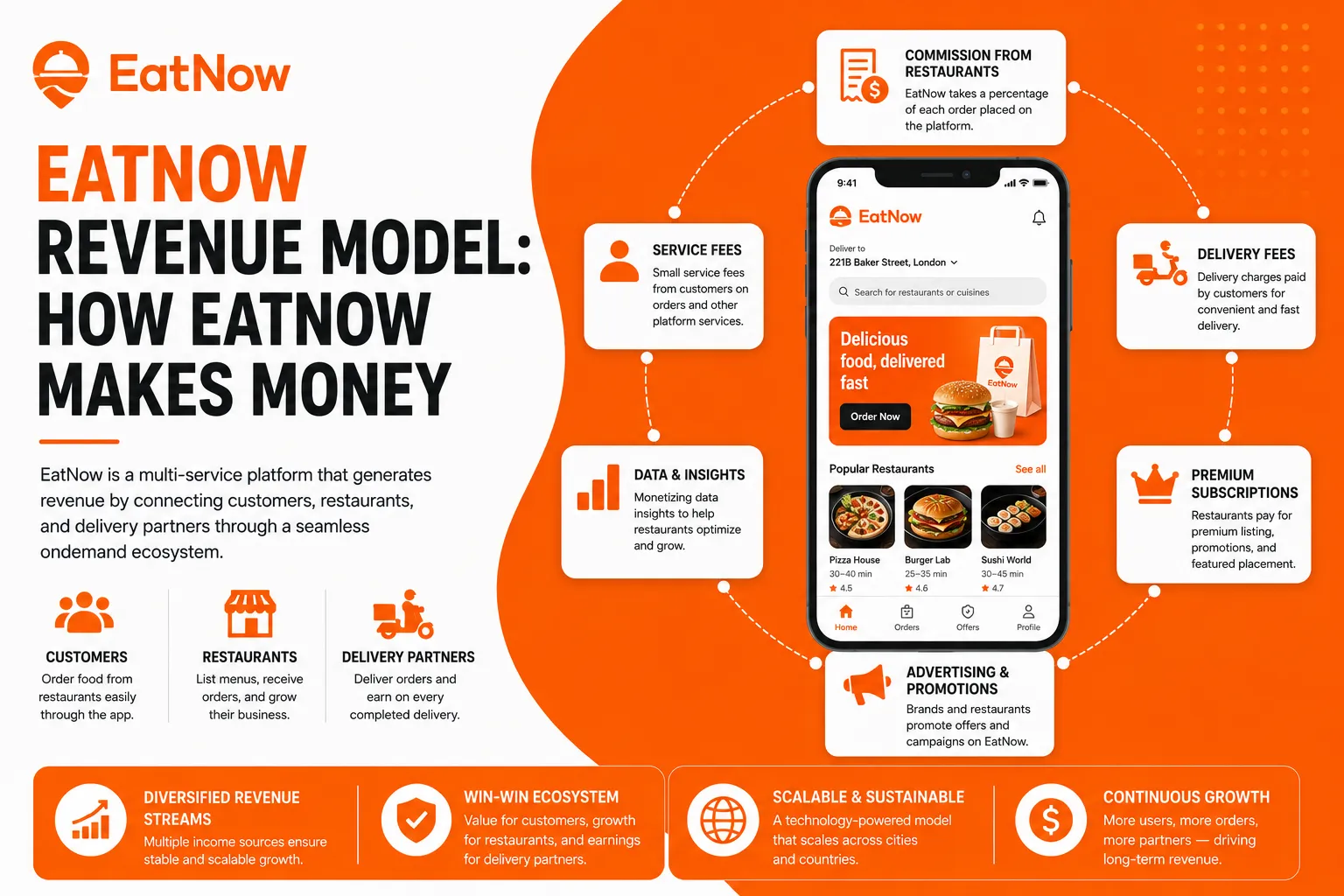
- EatNow-style food delivery platforms generate revenue through commissions, delivery fees, subscriptions, and advertising.
- Restaurant commissions are typically the primary source of platform earnings.
- Additional monetization comes from service fees, premium listings, and loyalty memberships.
- Scalable delivery ecosystems increase profitability through higher order frequency and repeat customers.
- Successful food delivery platforms rely on diversified revenue streams instead of a single monetization channel.
Stats That Matter
- Food delivery apps commonly charge restaurant commissions between 15% and 30% per order.
- Subscription plans help improve customer retention and recurring revenue.
- Sponsored listings and advertising create additional income opportunities.
- Delivery fees and peak-time pricing improve operational profitability.
- Modern delivery ecosystems also expand into groceries, logistics, and cloud kitchen services.
Real Insights
- Commission-based models scale efficiently because revenue increases with order volume.
- Subscription plans encourage repeat purchases and customer loyalty.
- Real-time logistics and smart pricing systems improve efficiency and profit margins.
- Advertising tools help restaurants gain more visibility inside the marketplace.
- Long-term success depends on balancing delivery efficiency, partnerships, retention, and scalable monetization.
Food delivery apps are among the fastest-growing on-demand marketplaces globally, with the industry expected to surpass $173 billion in global revenue in 2026.
EatNow follows the same proven monetization structure used by leading global delivery platforms. For founders, this model demonstrates how layered revenue streams—not just transaction volume—create scalable, profitable marketplaces.
For founders, understanding EatNow’s revenue model offers insight into building scalable, monetization-driven platforms in local markets where global giants dominate.
EatNow Revenue Overview – The Big Picture
| Metric | Estimated/Contextual Value |
|---|---|
| 2026 Revenue (estimated) | $5M–$15M range (inferred from industry mid-tier local apps) |
| Valuation | Modest regional valuation (no public figures)* |
| YoY growth | ~8–12% (industry median for local delivery platforms) |
| Profit margin | Narrow to break-even at scale |
| Regional focus | Australia, Canada, small urban markets |
| Competition benchmark | Uber Eats, DoorDash, Menulog competitors |
EatNow does not publicly disclose financials; figures are inferred from similar regional delivery platforms and Australian food delivery industry data.
Primary Revenue Streams Deep Dive
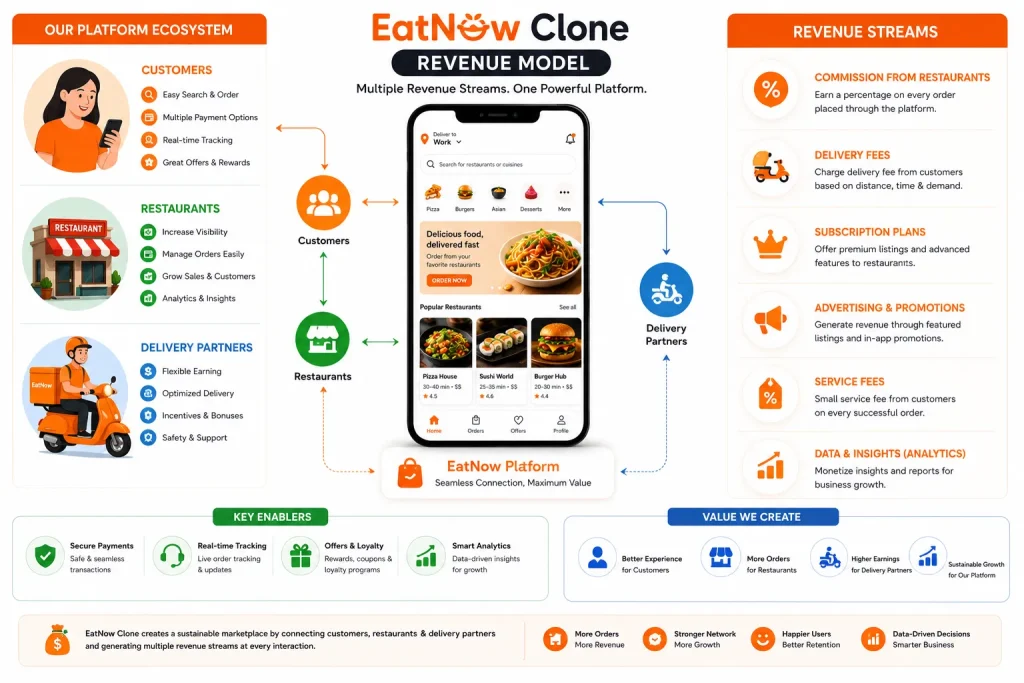
In 2026, EatNow earns through multiple channels typical of food delivery platforms:
1. Restaurant Commission Fees
Core revenue comes from commissions taken per order placed through the platform, often 15–30% of the order value, depending on service and exclusivity.
2. Delivery & Service Fees
Customers pay delivery fees (distance-based) plus service charges, a direct contribution to revenue.
3. Surge / Dynamic Pricing
Prices adjust during peak hours or high demand, improving per-order revenue.
4. Subscription Services
Memberships offering reduced delivery fees or priority support generate recurring income.
5. Sponsored Listings & Ads
Restaurants pay for premium placement and in-app ads to improve visibility.
| Revenue Stream | % Share (Est.) | Pricing / Example |
|---|---|---|
| Commission | 40% | 15–30% per order |
| Delivery Fees | 30% | $3–$8 per delivery |
| Surge Fees | 10% | Variable peak fees |
| Subscriptions | 10% | $5–$12 per user/month |
| Ads/Sponsored | 10% | $200–$800 per restaurant/mo |
The Fee Structure Explained
EatNow’s marketplace balances fees between users and restaurant partners:
| Fee Type | Charged To | Purpose |
|---|---|---|
| Commission | Restaurant | Platform revenue share |
| Delivery Fee | Customer | Logistics support |
| Service Charge | Customer | Operational cost |
| Surge Pricing | Customer | Demand balancing |
| Subscription | Customer | Loyalty & perks |
| Sponsored Listings | Restaurant | Visibility & ads |
Regional pricing varies; urban centers typically see higher fees than smaller towns.
How EatNow Maximizes Revenue Per User
- Segmentation: Tailored offers for occasional vs frequent diners.
- Upselling: Suggesting add-ons and combos increases order value.
- Cross-selling: Partner promos (e.g., beverage partners) expand spend.
- Dynamic Pricing: Peak pricing boosts margins without manual intervention.
- Retention Monetization: Loyalty programs drive repeat orders.
- LTV Optimization: Subscriptions and personalized deals extend lifetime value.
These tactics improve both Average Revenue Per User (ARPU) and long-term engagement.
Cost Structure & Profit Margins
Infrastructure Costs
- Cloud hosting
- API integrations
- Payment systems
- Maintenance & upgrades
Customer Acquisition & Marketing
- Paid advertising
- Referral incentives
- Restaurant onboarding campaigns
Operations
- Delivery fleet management
- Customer support
- Dispatch systems
R&D
- AI optimization
- UX improvements
- Logistics algorithms
Unit Economics Example (2026 Scenario)
Average Order Value: $22
Commission (25%): $5.50
Service Fee: $1.80
Total Gross Revenue per Order: $7.30
After logistics and marketing costs, contribution margin depends heavily on density and subscription penetration.
Margin improvement strategies include:
- Increasing ad revenue share
- Growing subscription base
- Expanding into high-density zones
Future Revenue Opportunities & Innovations
Looking toward 2027:
- AI-driven personalization: Boosting order frequency and average ticket.
- Dark kitchens/virtual brands: Higher margin fulfillment opportunities.
- Grocery or alcohol delivery adjacencies: Extended marketplaces.
- Hyperlocal ads: Targeted promotions based on user behavior.
- Partnerships with corporate clients: Bulk/catering services demand.
Risks: Competition, regulatory constraints, driver labor costs.
Lessons for Entrepreneurs & Your Opportunity
- Focus on operational efficiency to protect margins.
- Build diversified revenue streams beyond commissions.
- Leverage data for personalized upselling.
- Local market optimization beats global models every time.
- Partnership ecosystems expand reach with limited capital.
Global Cost of Development for an EatNow Clone App
EatNow-Like Food Delivery App Development — Market Price by Tech Stack
The tech stack affects the cost, launch speed, and scalability of an EatNow-like food delivery platform. PHP/Laravel works well for cost-effective launches, Node.js/React.js supports real-time order tracking and restaurant workflows, while Go microservices suit high-volume platforms with courier coordination and multi-location operations.
PHP/Laravel is often the most practical choice for launching an Eat Now-like app quickly and affordably. Node.js/Python fits better when real-time order flows and heavier platform activity become more important, while Go microservices are better suited for enterprise-scale food delivery platforms with higher concurrency and more complex infrastructure needs.
These values reflect global development cost estimates. Final pricing varies based on restaurant onboarding, customer ordering flow, delivery partner app, real-time tracking, payment integrations, commission logic, offers, admin dashboard, scalability goals, and platform complexity.
Miracuves EatNow-Like Platform Solution Cost and Tech Stack
Miracuves Pricing for a EatNow-Like Food Delivery Platform developed in PHP/Laravel with Flutter Apps for $2,199 USD (One-Time Price) in just 6 days
Get a fully developed, deployment-ready food ordering and delivery platform modeled after EatNow. Built on a stable PHP foundation, this complete package includes everything you need to launch and scale:
- Core Workflows: Restaurant listing, menu management, customer ordering, cart checkout, order confirmation, delivery assignment, order tracking, and customer notifications.
- Built-in Revenue Logic: Restaurant commissions, delivery fees, service charges, promo code setup, subscription plans, sponsored listings, and order-based monetization.
- Management Hub: Centralized admin dashboard, restaurant panel, customer management, delivery partner management, payment records, refund handling, and basic analytics.
- Launch-Ready: Fully prepared for your custom branding, configuration, payment gateway setup, restaurant onboarding, and immediate market entry.
Why Is EatNow-Like Platform Development More Affordable?
Most food delivery platforms become expensive when businesses choose fully custom development from scratch. Building separate apps for customers, restaurants, delivery partners, and admins with advanced architecture can increase cost, timeline, and technical complexity.
We took a smarter, more practical approach:
- You Aren’t Paying for Ground-Up Development: Our food delivery engine is already developed, tested, and ready to deploy. You skip the inflated cost and long waiting period usually required for building a platform from scratch.
- The Power of PHP: We built this solution on a reliable and cost-effective PHP architecture. This keeps the upfront price affordable while supporting essential food ordering, restaurant management, delivery workflows, payments, and admin operations.
You get a launch-ready food delivery platform with practical marketplace features, source code access, and faster deployment without the high custom development price tag.
Note: This cost is for the solution, re-branding, deployment, and source code only.
Final Thought
EatNow’s revenue model is a textbook case of a two-sided marketplace: connecting diners with restaurants efficiently while monetizing every interaction. Even without public numbers, industry dynamics show multiple monetization levers that can scale with user adoption.
Entrepreneurs studying this can combine solid pricing strategies with tech-driven retention to compete with bigger players and find niche opportunities locally.
In a landscape where delivery convenience is expected, platforms that execute smart monetization and cost discipline stand to capture loyal users and sustainable revenue.
FAQs
How much does EatNow make per transaction?
Roughly 15–30% commission plus delivery and service fees.
What’s EatNow’s most profitable revenue stream?
Restaurant commissions combined with delivery fees.
What percentage does EatNow take from providers?
Around 15–30% as typical industry commission.
How has EatNow’s revenue model evolved?
From simple marketplace orders to dynamic fees, subscriptions, and ads.
Can small platforms use similar models?
Yes — especially with local optimizations.
What’s the minimum scale for profitability?
Profitability usually requires significant order volume and repeat users.
How to implement similar revenue models?
Commission fees, dynamic pricing, subscriptions, and ads are essential.
What are alternatives to EatNow’s model?
Subscription-only models, hybrid restaurant logistics, or white-label platforms.
Miracuves is an independent software development company. We are not affiliated with, connected to, sponsored by, or endorsed by any company or product named in this article.
Terms such as “X Clone” are used descriptively. It is how the software industry refers to building a platform with functionality comparable to a known service, and how clients search for it.
The entire design and codebase of our products is built by our own team. Our products contain no code, design, graphics, or content originating from any third-party website or applications.
All third-party names and marks referenced in this article are the property of their respective owners, referenced solely to identify the services discussed.