
Key Takeaways
What You’ll Learn
- Fintech content marketing is fundamentally about building trust because money transfer users care about security, compliance, transparency, and reliability before making financial decisions.
- Educational content helps reduce customer hesitation by explaining fees, exchange rates, transfer timing, fraud prevention, onboarding, and compliance processes clearly.
- Content strategy directly supports fintech growth through SEO visibility, customer education, retention campaigns, referral trust, and long-term brand authority.
- Trust-building content performs better than aggressive promotion because users respond more positively to transparent explanations, security guidance, and financial clarity.
- The biggest takeaway for founders is that money transfer platforms should treat content as part of the product experience, not just a marketing activity.
Stats That Matter
- The article positions fintech content marketing as a trust-building framework for remittance apps, cross-border payment platforms, and digital finance businesses.
- Core content areas include security education, fee transparency, onboarding support, compliance guidance, exchange rate explanations, and fraud prevention awareness.
- SEO-focused educational content helps money transfer platforms increase visibility for searches related to remittance fees, transfer safety, international payments, and cross-border financial workflows.
- Trust signals improve conversion rates through customer testimonials, compliance messaging, transaction transparency, educational blogs, and security-focused communication.
- Long-term fintech growth depends heavily on customer confidence because users are more likely to transfer money repeatedly when they understand and trust the platform.
Real Insights
- Fintech users rarely trust platforms immediately because financial transactions involve personal risk, sensitive information, and regulatory concerns.
- The best fintech content simplifies financial complexity by making international transfers, fees, exchange rates, compliance, and security easier for normal users to understand.
- Educational SEO content compounds over time because well-optimized financial guides continue attracting users searching for payment solutions and transfer advice.
- Retention improves when content supports the customer journey through onboarding help, transaction updates, fraud alerts, financial education, and transparency-driven communication.
- For entrepreneurs, the biggest lesson is to build a Fintech Content Marketing Strategy around trust, security education, compliance transparency, SEO visibility, and long-term customer confidence for money transfer apps.
Fintech apps do not win trust with attractive screens alone. When users send money, store funds, verify identity, or compare exchange rates, they are making a financial decision. That means every piece of content around the app must reduce doubt, explain risk, and make the product feel clear before the user takes action.
A strong fintech content marketing strategy helps money transfer platforms educate users, explain fees, answer security questions, support onboarding, and build confidence around every transaction. For remittance apps, digital wallets, and neobank-style platforms, content is not just a traffic channel. It is part of the trust system.
This is especially important for founders building cross-border money transfer apps. Users want to know how the transfer works, what fees apply, how long the money takes to arrive, what happens if something goes wrong, and how their identity and transaction data are protected. If your content does not answer those questions, users may hesitate even if the app itself works well.
Miracuves helps founders launch fintech and remittance platforms with white-label, source-code-owned foundations that support wallet logic, transaction flows, user verification, and admin control. But even the strongest product foundation needs clear content to help users understand why they should trust the platform.
Why Trust Works Differently in Fintech Content Marketing
In many industries, content marketing is used to create awareness, explain benefits, and push conversions. Fintech content has a heavier job. It must make users feel safe enough to complete a money-related action.
A user comparing a food delivery app may ask, “Will my order arrive on time?” A user comparing a money transfer app asks, “Will my money arrive safely?” That difference changes the entire content strategy.
For money transfer platforms, content must answer practical trust questions:
- How does the transfer process work?
- What fees are charged?
- Is the exchange rate shown before payment?
- How long will the transfer take?
- What identity verification is required?
- What happens if the recipient does not receive funds?
- How can users contact support?
- How does the platform protect user and transaction data?
This is why content for fintech apps should be built around clarity, not hype. Users do not need exaggerated promises. They need plain explanations, transparent workflows, and visible support paths.
What Is a Fintech Content Marketing Strategy?
A fintech content marketing strategy is a structured plan for creating, publishing, and distributing content that helps users understand a financial product, trust the brand, and move through the customer journey with less confusion.
For a money transfer app, this strategy usually includes:
| Content Layer | Purpose | Example |
|---|---|---|
| Educational content | Explain how money movement works | “How international money transfers work” |
| Trust content | Reduce safety concerns | “How we verify users before transfers” |
| Product content | Explain app features | “How to track your transfer in the app” |
| Support content | Reduce friction after signup | “What to do if your transfer is delayed” |
| SEO content | Capture high-intent searches | “Best way to send money from UAE to India” |
| Compliance-aware content | Communicate responsibly | “What identity documents may be required for verification” |
| Retention content | Keep users engaged | “How to save frequent recipients for faster transfers” |
The goal is not to publish random blogs. The goal is to build a content system that supports acquisition, onboarding, conversion, transaction confidence, and repeat usage.
Why Money Transfer Platforms Need Education Before Conversion
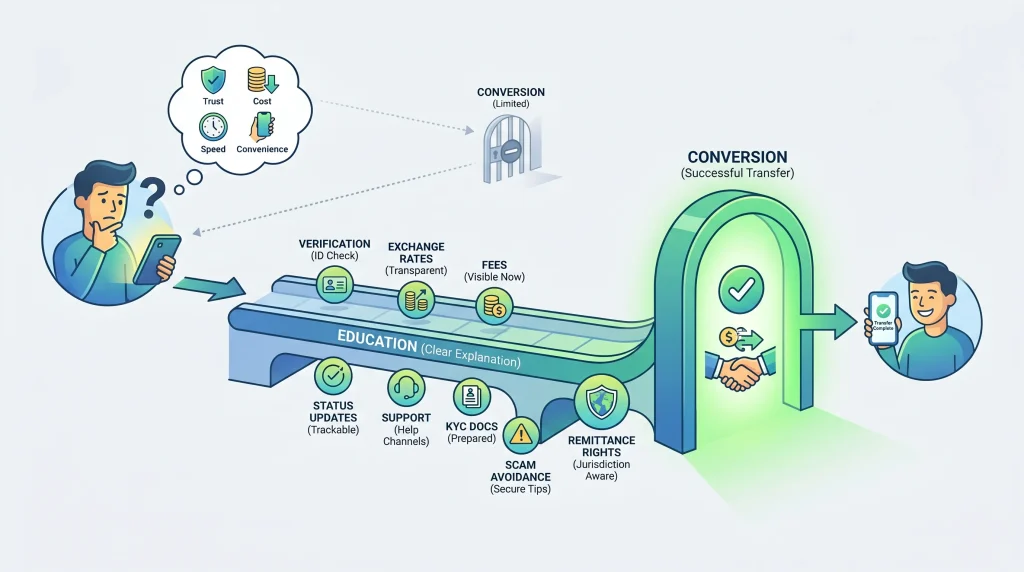
Money transfer users usually compare platforms based on trust, cost, speed, and convenience. But these factors are not always obvious at first glance.
A founder may assume that a lower fee or faster transfer flow will win users. In reality, many users hesitate because they do not fully understand what will happen after they press “send.”
Strong content can reduce that hesitation by explaining:
- how sender and recipient details are verified;
- why exchange rates may change;
- when fees are visible;
- what transaction status updates mean;
- what support channels are available;
- what documents may be needed for KYC;
- how users can avoid scams or incorrect transfers.
For remittance platforms, content should also explain customer rights, transfer disclosures, cancellation windows, and error resolution in a jurisdiction-aware way. Final legal and compliance language should always be reviewed based on the operating market, but the content strategy should still prepare users with clear, helpful education.
Core Content Pillars for a Fintech Content Marketing Strategy
A fintech app should not rely on one type of content. Trust is built through repeated signals across the website, app store listing, onboarding screens, help center, email, and in-app messages.
1. Transparency Content That Explains Fees, Rates, and Timelines
The most important trust-building content for a money transfer app is transparency content. Users want to know what they are paying, what the recipient receives, and when the money will arrive.
Useful content formats include:
help center articles on delayed transfers.
fee explanation pages;
exchange rate explainer blogs;
comparison pages by transfer corridor;
transfer timeline guides;
“before you send” checklists;
help center articles on delayed transfers.
Avoid vague phrases like “fastest transfers” or “lowest fees” unless you can support them. Better content says exactly what users need to know: where fees appear, how rates are displayed, and what may affect transfer speed.
2. Security Content That Builds Confidence Without Overpromising
Security content should explain how the platform protects users without making unsupported guarantees.
For fintech apps, security-related content may cover user verification, encrypted data transfer, transaction monitoring, suspicious activity flags, role-based admin access, audit logs, and secure payment gateway integrations. These are important because fintech trust depends on operational controls as much as front-end design.
Examples of useful security content:
- “Why identity verification is required before sending money”
- “How transaction monitoring helps protect users”
- “What to do if you notice suspicious account activity”
- “How secure payment gateway integrations support safer transfers”
- “How role-based access protects platform operations”
The wording matters. A fintech platform can say it supports compliance workflows or can be configured for KYC/AML requirements. It should not claim universal compliance, regulator approval, or guaranteed fraud prevention unless verified by legal and regulatory proof.
3. Onboarding Content That Reduces Signup Drop-Off
Many fintech users abandon onboarding when identity verification feels confusing. Content can reduce that friction by explaining the process before the user reaches a blocker.
Good onboarding content includes:
- step-by-step signup guides;
- document preparation checklists;
- KYC explanation pages;
- expected review timelines;
- common rejection reasons;
- support instructions for failed verification.
For founders, this matters because content does not only bring traffic. It can improve activation by helping users complete the first meaningful action inside the app.
4. Use-Case Content for Real Transfer Scenarios
Money transfer platforms should create content around real user scenarios, not only generic fintech keywords.
Examples include:
- sending money to family abroad;
- paying education fees internationally;
- supporting emergency transfers;
- sending recurring monthly remittances;
- transferring money for travel;
- helping freelancers receive payments;
- sending funds between business partners.
This type of content connects product features with user intent. It also supports SEO because people often search around specific transfer needs instead of broad fintech terms.
5. Support Content That Turns Problems Into Trust Moments
A delayed transfer can damage trust if the user feels ignored. But a clear support article can turn uncertainty into confidence.
Support content should explain:
- what “pending” means;
- what “processing” means;
- why additional verification may be requested;
- what happens if recipient details are wrong;
- how users can contact support;
- what information users should keep ready.
This content should be easy to find from inside the app, not hidden only in the blog. The most trusted fintech apps make help content part of the product experience.
Money Transfer Content Map by Funnel Stage
A strong fintech content marketing strategy should connect content to the user journey.
| Funnel Stage | User Question | Content Type | Business Outcome |
|---|---|---|---|
| Awareness | “What is the safest way to send money?” | Educational blog | Builds search visibility and trust |
| Consideration | “Which app has clear fees and reliable transfer tracking?” | Comparison guide | Helps users evaluate the platform |
| Signup | “Why do I need identity verification?” | KYC explainer | Reduces onboarding hesitation |
| First transfer | “What happens after I send money?” | Step-by-step transfer guide | Improves conversion confidence |
| Transaction issue | “Why is my transfer delayed?” | Help center article | Reduces support pressure |
| Repeat usage | “How do I save recipients or repeat transfers?” | In-app guide/email | Improves retention |
| Referral | “Can I invite family or friends?” | Referral campaign content | Supports organic growth |
SEO Strategy for Fintech Apps: Build Authority Without Thin Content
Fintech SEO is not about publishing high-volume keywords with shallow explanations. Financial content affects decisions about money, so quality, accuracy, and trust matter. Google’s guidance emphasizes helpful, reliable, people-first content rather than content created only to manipulate rankings.
For fintech apps, SEO should focus on topic clusters that match real user questions.
Recommended SEO Clusters for Money Transfer Apps
| Cluster | Example Keywords | Content Angle |
|---|---|---|
| Money transfer basics | how money transfers work, remittance transfer meaning | Educational foundation |
| Fees and exchange rates | transfer fees, exchange rate markup, hidden fees | Transparency and comparison |
| Transfer corridors | send money from USA to India, send money from UAE to Philippines | High-intent corridor content |
| Trust and safety | is money transfer app safe, KYC for money transfer | Security and verification |
| Product support | transfer pending, transfer failed, recipient did not receive money | Help center SEO |
| Compliance education | KYC requirements, AML checks, identity verification | Responsible education |
| App comparison | Wise alternative, Revolut alternative, remittance app comparison | Commercial comparison |
The strongest fintech SEO strategy combines blog content, landing pages, help center articles, app store copy, and product-led education.
Product Trust Signals Your Content Should Explain
Content should not operate separately from product design. For fintech apps, the content strategy should explain the product trust signals that users see in the app.
Product Trust Signals for Money Transfer Platforms
| Trust Signal | What Content Should Explain | Founder Impact |
|---|---|---|
| KYC Verification | Why identity checks are required and what documents may be needed. | Reduces onboarding confusion and supports safer platform operations. |
| Fee Transparency | Where users can see fees before confirming a transfer. | Builds confidence before the first transaction. |
| Exchange Rate Display | How rates are calculated, shown, and confirmed. | Reduces suspicion around received amounts. |
| Transaction Tracking | What each transfer status means. | Lowers support tickets and improves user confidence. |
| Audit Logs | How transaction records support platform visibility and issue review. | Strengthens operational control for the platform operator. |
| Fraud Monitoring | How suspicious activity flags help protect users and the platform. | Positions safety as a foundation, not an afterthought. |
| Admin Dashboard | How platform teams monitor users, transactions, disputes, and reports. | Gives founders the control layer needed to manage fintech operations. |
How Content Helps Reduce Risk Perception in Fintech Apps
Users do not always understand fintech risk in technical terms. They feel it emotionally.
A user may think:
- “What if my money disappears?”
- “What if the recipient does not receive it?”
- “What if the exchange rate changes?”
- “What if my ID is misused?”
- “What if support does not respond?”
Content should answer these fears before they become objections. This is where fintech content marketing becomes part of product adoption.
A money transfer app can use:
- homepage trust sections;
- app store screenshots that highlight transfer tracking;
- onboarding tooltips;
- pre-transfer fee explanations;
- post-transfer confirmation emails;
- support articles;
- educational blogs;
- scam-awareness content;
- transparent status notifications.
Scam education is also useful because financial users face constant fraud risks. FINRA warns investors to stay informed about scams and fraud issues, while the FTC regularly publishes consumer scam guidance, including warnings about impersonation and transfer-related fraud tactics.
Founder Decision Signals: What to Prioritize First
Founder Decision Signals
Speed
Start with content that supports onboarding and the first transfer. Fee explainers, KYC guides, and transfer tracking articles can reduce hesitation faster than broad awareness blogs.
Cost
Prioritize reusable content assets. A single transfer status guide can support SEO, customer support, email automation, and in-app help.
Scalability
Build content around product modules such as wallet history, verification, transaction monitoring, and admin controls so the strategy grows with the app.
Market Fit
Use corridor-specific and use-case-specific content to understand which user segments are most ready to trust and adopt the platform.
Content Formats That Work Well for Money Transfer Apps
A fintech content marketing strategy should include more than blogs. Different formats solve different trust problems.
Educational Blog Posts
Blogs are useful for explaining concepts users search before choosing an app. For example:
- “How do international money transfers work?”
- “What affects exchange rates when sending money abroad?”
- “Why do money transfer apps ask for identity verification?”
- “How to avoid mistakes while sending money internationally”
Comparison Pages
Comparison pages help users evaluate options, but they must be fair and factual. Avoid unsupported claims. Focus on decision criteria such as fees, delivery speed, transfer tracking, supported countries, verification requirements, and support availability.
Help Center Articles
Help center content is a trust asset. It should answer specific user questions in simple language.
Examples:
- “Why is my transfer pending?”
- “Can I cancel a transfer?”
- “What happens if recipient details are incorrect?”
- “How do I update my identity documents?”
In-App Microcopy
Microcopy is often more important than long blogs during transaction moments.
For example, next to a KYC step, the app can explain:
“We verify identity to help protect users and support safer transfers.”
Next to a fee breakdown, it can say:
“You will see the total fee and recipient amount before confirming.”
Email and Lifecycle Content
Email can reinforce trust after signup and after the first transfer.
Useful sequences include:
- welcome email explaining how the app works;
- KYC reminder with document checklist;
- first transfer guide;
- transfer confirmation email;
- support follow-up;
- referral education;
- security awareness reminders.
Short Video Explainers
Short video content works well for complex financial actions. A 45-second video can explain transfer steps better than a long article for some users.
Topics can include:
- how to send your first transfer;
- how to add a recipient;
- how to verify your account;
- how to track transfer status;
- how to avoid common transfer mistakes.
Compliance-Aware Content: What Fintech Brands Should Avoid
Fintech content must be careful. Trust is damaged when marketing overpromises.
Avoid claims such as:
- “100% safe transfers”
- “Guaranteed instant delivery”
- “Fully compliant everywhere”
- “No risk”
- “Best exchange rate guaranteed”
- “Regulator-approved app”
- “Banking license included”
Better wording:
- “Designed to support secure transfer workflows”
- “Fees and recipient amount are shown before confirmation”
- “Supports KYC/AML workflow configuration”
- “Final compliance depends on jurisdiction, legal review, integrations, and operating model”
- “Transfer speed may depend on payment method, corridor, verification, and receiving institution”
This wording builds trust because it respects the reality of fintech operations.
How Miracuves Supports Fintech Founders Beyond Content
Content can build trust, but it must be backed by a product that deserves trust.
For fintech founders, that means the app foundation should support user verification, wallet logic, transaction history, secure payment gateway integration, admin reporting, transaction monitoring, and support workflows. Miracuves offers ready-made and white-label fintech app foundations for founders who want to launch faster while keeping control over branding, source code, and business logic.
Founders exploring a Revolut clone app or Wise clone solution should treat content and product architecture as connected decisions. A strong fintech app needs both: a clear product experience and a content strategy that explains how the experience works.
For broader fintech planning, Miracuves’ fintech app development expertise helps founders think through app modules, remittance workflows, wallet functionality, and compliance-ready product foundations.
Mistakes Founders Should Avoid in Fintech Content Marketing
Mistakes Founders Should Avoid
Writing generic finance blogs without product connection
Broad articles may bring traffic, but they do not always build trust in your app. Connect content to real product flows such as transfer tracking, KYC, fees, wallet history, and support.
Overpromising speed, safety, or compliance
Fintech users need clarity, not exaggerated claims. Use careful language around security, transfer speed, regulations, and availability.
Ignoring support content until users complain
Help center content should be planned before launch. It reduces confusion during the exact moments when users feel financial anxiety.
Separating marketing from onboarding
Your blog, app store page, onboarding screens, and emails should explain the same trust story. Inconsistent messaging makes users hesitate.
A Practical 90-Day Fintech Content Marketing Plan
Days 1–30: Build Trust Foundations
Start with content that users need before signup and first transfer.
Create:
- homepage trust messaging;
- fees and exchange rate explanation;
- KYC verification guide;
- transfer tracking guide;
- security and data protection page;
- help center basics;
- app store description and screenshots.
Days 31–60: Build SEO and Use-Case Content
Publish content around high-intent transfer scenarios.
Create:
- corridor-specific landing pages;
- “how to send money” guides;
- use-case blogs for families, freelancers, students, and businesses;
- comparison content;
- FAQs around transfer speed, fees, and verification.
Days 61–90: Build Retention and Lifecycle Content
Use content to support repeat transfers and referrals.
Create:
- email onboarding sequence;
- security awareness emails;
- in-app education prompts;
- recipient management guides;
- referral explanation page;
- customer support knowledge base expansion.
Final Thoughts: Fintech Content Builds Trust Before the First Transfer
A fintech content marketing strategy is not just a publishing calendar. For money transfer platforms, it is a trust-building system.
The strongest content explains how the product works, why verification is needed, how fees and exchange rates are shown, what happens after a transfer is sent, and how users can get help when something feels uncertain.
For founders, the real opportunity is to connect content with product design. When marketing, onboarding, app flows, support, and security messaging all tell the same clear story, users are more likely to trust the platform with their first transaction.
Founders looking to build trust-ready fintech platforms can Talk to Miracuves Experts to explore ready-made, white-label, source-code-owned app foundations with admin control, wallet logic, transaction workflows, and faster deployment.
FAQ
What is a fintech content marketing strategy?
A fintech content marketing strategy is a plan for creating educational, trust-building, SEO, product, and support content that helps users understand a financial app before they take action. For money transfer platforms, it should explain fees, exchange rates, transfer speed, identity verification, security, and support workflows.
Why is content marketing important for money transfer apps?
Content marketing is important because users need confidence before sending money. Clear content helps explain how transfers work, what fees apply, how users are verified, and what happens if a transaction is delayed or needs support.
What type of content builds trust for fintech apps?
The most effective trust-building content includes fee explainers, KYC guides, transfer tracking articles, security pages, scam-awareness resources, help center content, comparison pages, and onboarding emails.
How can fintech apps use SEO without sounding generic?
Fintech apps should build SEO around real user questions. Instead of publishing broad finance articles, they should create corridor-specific guides, fee transparency pages, transfer support content, and educational resources around user verification and transaction safety.
What should money transfer apps avoid in marketing content?
Money transfer apps should avoid unsupported claims such as guaranteed instant delivery, universal compliance, zero risk, or guaranteed lowest fees. Content should be accurate, careful, and reviewed for legal and compliance context where required.
How does content support fintech user onboarding?
Content supports onboarding by explaining why identity verification is required, what documents users may need, how long review may take, and what to do if verification fails. This reduces confusion and improves first-action confidence.
Miracuves is an independent software development company. We are not affiliated with, connected to, sponsored by, or endorsed by any company or product named in this article.
Terms such as “X Clone” are used descriptively. It is how the software industry refers to building a platform with functionality comparable to a known service, and how clients search for it.
The entire design and codebase of our products is built by our own team. Our products contain no code, design, graphics, or content originating from any third-party website or applications.
All third-party names and marks referenced in this article are the property of their respective owners, referenced solely to identify the services discussed.