


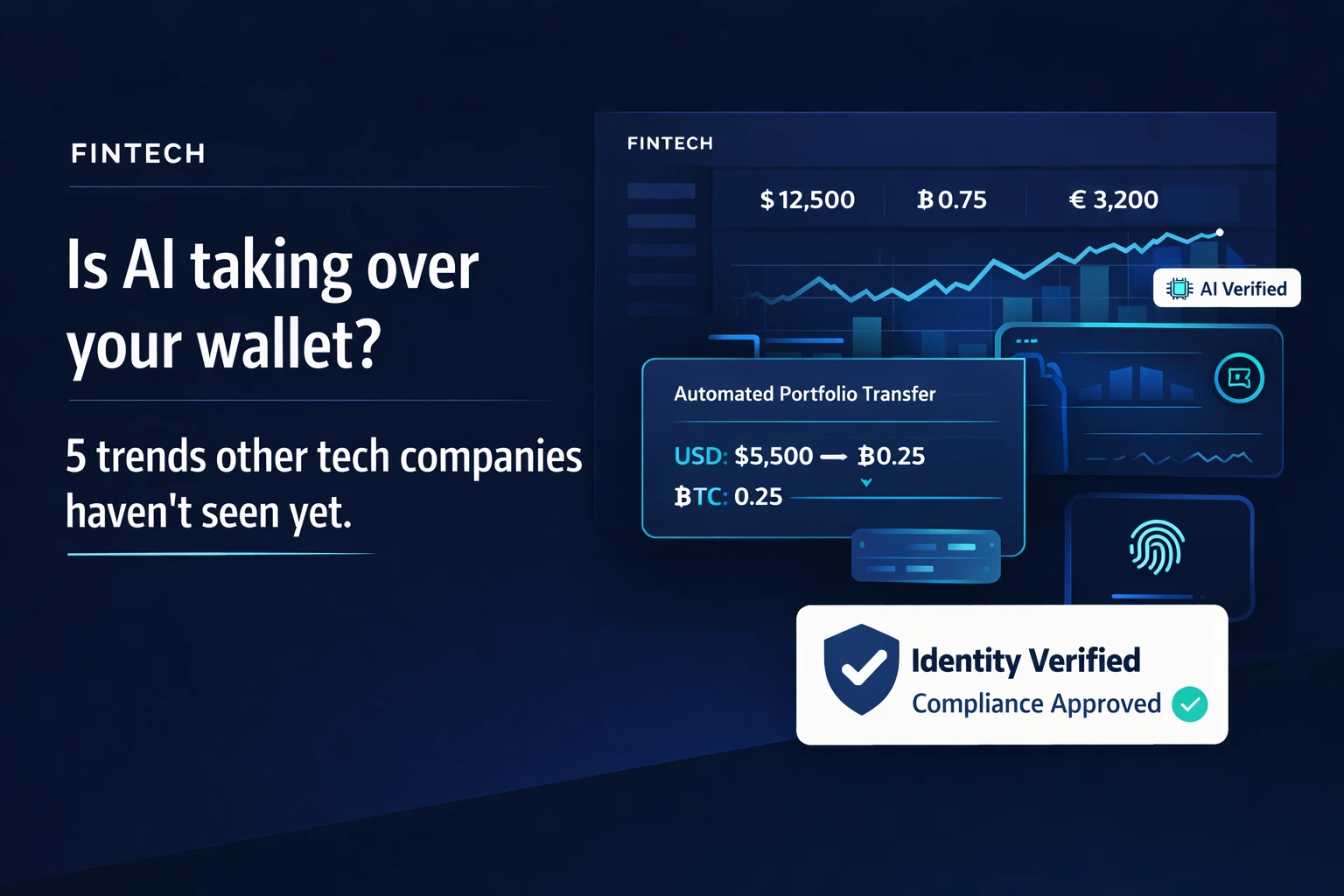
Neo-banking is no longer just about offering a better mobile interface than traditional banks. In Future of Fintech, the market is moving into a more demanding phase where users expect their banking app to be smarter, safer, faster, and more adaptive to how they actually manage money.
That shift is happening for a simple reason: user expectations are rising while the product landscape is becoming more competitive. A few years ago, fast onboarding and a clean dashboard were enough to feel modern. Today, that is baseline. Users want intelligent financial guidance, smoother global money movement, stronger identity trust, and products that feel secure without becoming difficult to use.
At the same time, regulators are setting higher expectations around financial data access, privacy, monitoring, and operational control. For founders, that changes the product conversation. The real question is no longer, “How do we launch a neo-banking app?” It is, “How do we launch one that people trust, regulators can accept, and the market will still value 12 months from now?”
That is where the future of neo-banking becomes practical.
This blog breaks down five trends shaping the next generation of digital banking products in Fintech , and what founders, product owners, and fintech entrepreneurs should prepare for now.
AI Financial Advisors Are Replacing Static Banking Experiences
AI is becoming one of the clearest product shifts in Fintech. It is no longer limited to back-end fraud detection or chat support. It is moving into the core customer experience, where banking products act less like transaction tools and more like financial co-pilots.
Recent fintech and financial-services reports show AI is increasingly being used to improve customer experience, risk operations, and personalized decision-making, while many fintech leaders now treat AI as a mainstream product priority rather than an experiment.
Why users now expect more than dashboards
A static dashboard tells users what happened. An AI-led neo-banking experience helps them understand what to do next.
That difference matters.
Users increasingly expect products that can:
- explain spending patterns in plain language
- identify unusual behavior before it becomes a problem
- suggest smarter saving habits
- recommend bill timing or cash-flow actions
- surface relevant offers or reminders based on actual usage
This is especially important for younger fintech users, freelancers, cross-border workers, and small business operators who want financial tools to reduce mental load, not add to it.
How AI improves engagement, retention, and trust
When used well, AI can strengthen more than convenience. It can also improve product stickiness.
Here is where AI creates practical value for neo-banking products:
| AI capability | User-facing value | Business impact |
|---|---|---|
| Spending analysis | Clear visibility into habits and waste | Higher engagement |
| Savings recommendations | Better money discipline | Stronger retention |
| Personalized alerts | Relevant, timely nudges | More recurring usage |
| Financial guidance | Product feels helpful, not passive | Better trust perception |
| Smart automation | Less manual effort | Improved customer satisfaction |
A neo-banking platform that says, “You spent 18% more on subscriptions this month” is useful. A platform that also says, “Two charges increased unexpectedly, and moving your rent transfer by two days could improve your balance stability,” is far more valuable.
That is the difference between a digital account and a truly intelligent financial product.
What founders should build into AI-led neo-banking products
Founders do not need to overbuild from day one. But they do need a roadmap that supports intelligent product evolution.
A practical AI-ready foundation usually includes:
- clean transaction categorization
- behavioral insight layers
- rules plus AI-based recommendation logic
- customer-permission-aware data usage
- human-readable explanations for suggestions
- audit visibility for sensitive automated actions
This matters because trust is everything in fintech. Users may accept AI in finance, but they still want clarity. If the product makes recommendations without transparency, trust drops fast.
The strongest neo-banking products in Fintech will not use AI just to look advanced. They will use it to make money management simpler, more personalized, and more dependable.
Crypto-Fiat Hybrids Are Becoming a Real Product Direction
For a long time, crypto products and neo-banking products were treated as separate categories. That division is now weakening.
In Fintech, more platforms are exploring hybrid models that combine familiar fiat experiences with selected crypto-enabled capabilities, especially around payments, treasury movement, multi-currency access, and cross-border value transfer. Recent reports from the BIS, Federal Reserve, IMF, and banking-industry research all point to rising attention on stablecoins and payment rails, while also emphasizing regulatory consistency, reserve quality, and compliance controls.
Why hybrid wallets are gaining attention
Users do not necessarily want a “crypto app.” Many want a smoother money experience.
That can include:
- holding standard balances in local currency
- moving value across borders faster
- accessing dollar-linked or stable-value instruments
- switching between fiat and digital asset rails when needed
- reducing friction in remittance or international business payments
For founders, this creates an important product insight: the demand is often less about speculation and more about flexibility.
Where stablecoin-linked experiences fit in
Stablecoin-linked product experiences are gaining attention because they can help address specific use cases, especially where users care about transfer speed, currency access, or cross-border movement. The BIS and IMF have both noted the appeal of stablecoins for cross-border use, especially in markets with inflation pressure, restricted access to foreign currency, or friction in traditional payment networks.
That does not mean every neo-bank should become a crypto-first platform. But it does mean founders should pay attention to use cases such as:
| Hybrid use case | Why it matters in neo-banking |
|---|---|
| Cross-border remittance | Faster and more flexible value movement |
| Multi-currency wallets | Better experience for international users |
| Merchant settlement options | More payment route flexibility |
| Treasury or stored-value features | Alternative value holding models |
| Dollar-linked user experiences | Useful in volatile or limited-access markets |
What makes crypto-fiat movement usable and trustworthy
This model only works when product design stays disciplined.
A crypto-fiat hybrid must feel:
- simple enough for normal users
- transparent about conversion and fees
- compliant with onboarding and monitoring rules
- controlled through strong admin visibility
- safe from a custody, fraud, and identity perspective
The failure point for many hybrid concepts is not technology. It is usability and trust.
Users will not adopt hybrid finance if the experience feels confusing, risky, or operationally unstable. That is why the best product direction is not “add crypto.” It is “design a flexible financial system that makes digital and traditional value movement feel understandable.”
In Fintech, this is becoming a serious strategic category, especially for founders building digital wallets, remittance products, neo-banking apps, or global financial access tools.
3. Biometric Payments Are Becoming a Core Trust Layer
Biometrics are often discussed as a convenience feature, but that framing is too narrow now.
In Fintech, biometric-led payment experiences are becoming more important because identity trust has become central to both security and usability. Industry standards groups and identity guidance bodies increasingly emphasize phishing-resistant authentication, device-based credentials, and stronger digital identity practices, while payment ecosystem groups are also pushing passkey-style authentication that can use biometrics, PINs, or device unlock patterns.
Biometrics are now about more than convenience
Fingerprint login and facial recognition used to feel like premium mobile features. Now they are part of a broader identity confidence model.
That includes:
- secure login without password fatigue
- faster transaction approvals
- lower account takeover risk
- better defense against phishing-heavy fraud patterns
- stronger identity continuity across app sessions
With fraud techniques becoming more advanced, static credentials alone are no longer enough. Payment and banking experiences need stronger assurance without creating constant friction for the user.
Where biometric-led payment experiences create value
A modern neo-banking or wallet product can use biometrics across multiple moments, not just login.
Examples of meaningful biometric use in product design:
- device-based authentication for account access
- fingerprint approval for transfers or withdrawals
- facial verification during sensitive account changes
- behavioral verification for suspicious activity checks
- passkey-driven sign-in to reduce password exposure
- re-authentication before card controls, beneficiary edits, or large-value actions
This creates a better balance between speed and security.
Security, identity confidence, and retention impact
Biometrics help on three levels:
1. Faster experience
Users complete actions more quickly when they do not need repeated passwords or OTP-heavy flows for every step.
2. Better fraud resistance
Phishing-resistant and device-bound authentication models can reduce certain account takeover risks, especially when combined with transaction monitoring and step-up verification.
3. Higher trust perception
When users feel their account is both easy to access and difficult for others to misuse, confidence rises.
That confidence matters for retention. In financial products, users stay longer when the experience feels secure by design.
What founders should keep in mind
Biometrics should not be treated as a standalone feature request. They need to be part of a wider security architecture.
A smart implementation plan should include:
- fallback authentication paths
- device trust logic
- anti-spoofing controls where relevant
- risk-based step-up flows
- privacy-aware biometric handling
- transaction-level security rules
For founders building in Fintech, biometric payments are not just about making an app feel modern. They are part of building a product that users can trust during high-value, high-sensitivity actions.
Regulatory Changes Are Reshaping Product Strategy
Regulation is one of the biggest forces shaping neo-banking right now, but founders should not treat it as a late-stage legal problem.
It is a product architecture issue from day one.
Recent regulatory developments have reinforced that direction. In the US, the CFPB’s personal financial data rights rule finalized in October 2024 requires covered data to be made available to consumers and authorized third parties, with privacy and security expectations built into the framework. At the same time, stablecoin-related regulation has advanced in 2025 and 2026, while global bodies continue warning that uneven implementation can create risk and regulatory arbitrage.
Compliance is now part of product architecture
Founders often think compliance begins after product-market fit. In fintech, that is usually too late.
A serious neo-banking platform should be designed with compliance-aware systems from the beginning.
That means planning for:
- customer identity verification
- onboarding checks
- sanctions and AML workflows
- suspicious transaction monitoring
- audit trails
- secure data access controls
- consent and privacy handling
- market-specific reporting logic
KYC, AML, privacy, and transaction monitoring expectations
Here is a simple view of what compliance-ready fintech architecture usually needs:
| Compliance area | Why it matters | Product implication |
|---|---|---|
| KYC | Confirms user identity | Onboarding and verification flow design |
| AML | Detects suspicious activity | Monitoring engine and case management |
| Data protection | Builds user confidence | Permission controls and secure storage |
| Auditability | Supports oversight and reviews | Admin logs and action tracing |
| Market-specific rules | Prevents expansion risk | Modular compliance configuration |
The more international the product vision, the more important modular compliance becomes. A remittance app, digital wallet, or neo-banking platform serving multiple regions cannot rely on one generic rule set.
Why regulation can strengthen user trust
Founders sometimes see compliance as friction. Users often see it differently.
Done poorly, compliance feels slow and confusing.
Done well, it signals seriousness.
Users are more likely to trust a platform that shows:
- responsible onboarding
- clear identity checks
- transparent data handling
- visible fraud prevention logic
- stable transaction controls
That is why regulation should not be treated only as a barrier. It is also part of the trust infrastructure of modern fintech.
In Fintech, the strongest products will not ask how little compliance they can get away with. They will ask how to turn compliance into operational maturity, product resilience, and long-term credibility.
Miracuves Vision for Future-Ready Neo-banking Platforms
Once you look at where neo-banking is heading, one thing becomes clear: founders do not just need developers. They need a technology partner that understands product logic, scalability, user trust, integrations, and launch practicality.
That is where Miracuves fits naturally.
What founders need from a modern fintech development partner
A future-ready neo-banking platform usually needs more than a polished mobile interface. It often requires:
- modular product architecture
- wallet and transaction logic
- secure third-party integrations
- admin-side visibility and controls
- onboarding and verification readiness
- customization options for market fit
- a launch path that balances speed with stability
This is especially important when building products such as:
- neo-banking apps
- digital wallets
- remittance platforms
- multi-currency systems
- hybrid finance products
- modern fintech marketplaces
How Miracuves approaches scalable fintech product design
Miracuves focuses on helping founders translate fintech ideas into practical, launch-ready products with room to evolve.
A grounded fintech development approach should include:
| Miracuves capability | Why it matters for founders |
|---|---|
| Scalable architecture | Supports growth without early rebuild pressure |
| Modular fintech product design | Makes features easier to adapt and expand |
| Secure integrations | Helps connect payments, identity, and operational tools |
| Admin controls | Gives business teams operational visibility |
| Customization readiness | Supports brand, workflow, and market-specific needs |
| Faster launch capability | Helps founders validate and enter the market sooner |
The goal is not to overpromise. The goal is to build correctly for the stage the business is in.
A founder launching a neo-banking idea in Fintech needs a product that can start lean, earn trust, and expand intelligently. That means combining product clarity with technical discipline.
Miracuves brings value when founders want to build with that balance in mind.
Additional Strategic Shifts Founders Should Not Ignore in Fintech 2026
Your outline already covers the biggest trend pillars, but a stronger neo-banking strategy also benefits from a few supporting realities.
Open finance is becoming a baseline expectation
As financial data portability and open-banking expectations grow, users will increasingly expect smoother switching, better account visibility, and more personalized services built on permissioned data access. The CFPB’s financial data rights rule is one example of how this direction is becoming more structured.
Fraud pressure is becoming more sophisticated
As fintech products become smarter, fraud patterns are also evolving. Payments and banking reports in 2025 and 2026 point to growing concerns around fraud, impersonation, APP scams, and more advanced attack tactics.
This means founders should think beyond feature velocity and ask:
- How will the platform detect risky behavior early?
- Can the product support adaptive authentication?
- Are admin teams equipped with clear review controls?
- Is trust visible at both user level and operations level?
The winning products will feel both intelligent and controlled
That is the real product standard emerging in Fintech.
Users want:
- personalization without confusion
- speed without insecurity
- innovation without compliance gaps
- flexibility without operational chaos
Founders who understand that balance will build stronger products than those chasing trend language alone.
Conclusion
The future of neo-banking is not being shaped by one trend alone. It is being redefined by the combination of intelligent financial guidance, hybrid money movement, biometric trust layers, and compliance-aware product architecture.
That is what Fintech really looks like.
For founders and product teams, the opportunity is strong, but the market is less forgiving than before. A neo-banking product now needs to do more than look modern. It needs to guide users intelligently, move money flexibly, protect identity confidently, and operate within real compliance expectations.
The good news is that this shift creates space for better products, not just more products.
Founders who build with clarity, trust, and future-ready architecture in mind can create platforms that feel relevant well beyond launch. And choosing the right technology partner becomes part of that strategy.
If you are planning to build a neo-banking app, digital wallet, remittance product, or multi-currency fintech platform, Miracuves can help you turn that vision into a practical, scalable product with the right balance of speed, flexibility, and product logic.
Contact Miracuves to explore a future-ready fintech platform built for where the market is actually going.