


Key Takeaways
- PayPal earns mainly through transaction fees from online payments and transfers.
- Merchant services drive revenue by supporting checkout, invoicing, and business payments.
- Cross-border payments add income through currency conversion and international fees.
- Venmo and digital wallet usage support PayPal’s wider payment ecosystem.
- The model depends on payment volume, merchants, users, trust, and global ecommerce growth.
What You’ll Learn
- How PayPal makes money through payments and financial services.
- Transaction fees come from merchants, buyers, sellers, and payment processing.
- Currency conversion fees help monetize global payment activity.
- Business tools like checkout, subscriptions, and invoicing support merchants.
- Revenue growth depends on active users, payment volume, ecommerce, and platform trust.
Real Insights
- PayPal grows when digital payments increase across ecommerce and services.
- Merchant adoption is key because businesses create repeat transaction volume.
- Cross-border payments improve revenue through added fee opportunities.
- Security and buyer protection build trust for both users and sellers.
- The best insight is that PayPal earns by powering trusted payment movement at scale.
In 2026, PayPal generated approximately $33.2 billion in net revenue while processing nearly $1.79 trillion in total payment volume (TPV). That means billions of individual transactions moving through its infrastructure across eCommerce, peer-to-peer transfers, subscriptions, and cross-border payments. Even a small percentage take rate applied to that volume compounds into massive revenue. More importantly, this scale gives PayPal negotiating power with merchants, financial institutions, and global partners.
That scale is extraordinary. But what makes PayPal truly powerful is not just volume — it’s how it monetizes every transaction flowing through its ecosystem. It layers transaction fees, cross-border spreads, value-added services, fraud tools, and financing products on top of the same payment flow. Instead of relying on one revenue stream, it extracts multiple monetization points from a single user journey. This multi-layer revenue architecture strengthens margins even when core transaction fees compress.
For founders building fintech platforms, digital wallets, or payment gateways, PayPal is a masterclass in fee-based scalability. The strategy is simple but powerful: integrate deeply into checkout, build trust, scale volume, then optimize take rates. Control the payment experience, reduce friction, and add monetizable features around it. When your platform becomes the default transaction route, recurring revenue becomes predictable and defensible.
PayPal Revenue Overview – The Big Picture
Revenue:
PayPal generates tens of billions in annual revenue through transaction fees, merchant services, cross-border payments, subscriptions, and value-added financial products.
Total Payment Volume (TPV):
PayPal processes payment volume at a trillion-dollar scale, supported by millions of merchants, consumers, and global checkout transactions.
Valuation:
As a publicly traded company, PayPal’s market capitalization changes regularly based on stock performance, investor sentiment, revenue growth, and broader fintech market conditions.
YoY Growth:
Moderate revenue growth compared to earlier hypergrowth years, reflecting maturity stage scaling.
Revenue by Region (Estimated Split):
- United States: ~55%
- Europe & UK: ~25%
- Asia-Pacific: ~12%
- Rest of World: ~8%
Profit Margins:
PayPal’s profit margins depend on transaction volume, operating efficiency, payment processing costs, fraud management, and product mix. The company generally benefits from scale, as higher payment volume allows it to spread infrastructure, compliance, and platform costs across a larger transaction base.
Competition Benchmark:
- Stripe: Privately valued fintech giant focusing on developer-first APIs
- Block (Square): Strong in POS and Cash App ecosystem
- Adyen: Enterprise-focused global payment processor
Read more: What is PayPal and How Does It Work?
Primary Revenue Streams Deep Dive
Revenue Stream #1: Transaction Fees (Core Engine)
How it works:
PayPal charges merchants a percentage fee plus fixed fee per transaction.
Typical Pricing (US):
Around 2.9% + $0.30 per transaction (varies by region and type).
Estimated Share: ~85% of total revenue.
This is the backbone of PayPal’s business. Even a small percentage applied to $1.79T TPV creates massive revenue.
Revenue Stream #2: Cross-Border Fees
How it works:
Additional percentage charged for international transactions and currency conversion.
Estimated Share: ~5–7%.
Cross-border payments carry higher margins due to FX spreads.
Revenue Stream #3: Value-Added Services
Includes:
- Fraud protection
- Advanced checkout solutions
- Recurring billing
- Subscription tools
Estimated Share: ~3–5%.
These increase merchant stickiness and average revenue per merchant.
Revenue Stream #4: Consumer Credit & BNPL
PayPal offers:
- Buy Now Pay Later
- PayPal Credit
Revenue comes from interest and merchant financing fees.
Estimated Share: ~3–4%.
Revenue Stream #5: Interest on Customer Balances
Funds held in user accounts generate interest income.
Estimated Share: ~2–3% (depending on interest rate environment).
Revenue Streams Percentage Breakdown:
- Transaction Fees — ~85%
- Cross-Border & FX — ~6%
- Value-Added Services — ~4%
- Credit & BNPL — ~3%
- Interest Income — ~2%
The Fee Structure Explained
User-Side Fees
- Sending money domestically (friends/family): Often free when funded by bank
- Card-funded transfers: Small percentage fee
- Currency conversion spread applied
Merchant-Side Fees
- Standard online transactions: Around 2.9% + fixed fee
- Cross-border surcharge
- Chargeback handling fees
Hidden Revenue Layers
- FX markup on currency conversion
- Instant transfer fees
- Advanced fraud tools subscription
Regional Pricing Variation
- Europe and UK pricing slightly different from US
- Emerging markets may have varied fee structures
- Cross-border fees higher due to FX risks
Complete Fee Structure by User Type:
- Consumers: Mostly free for domestic bank-funded transfers
- Merchants: Percentage + fixed fee per transaction
- International Merchants: Higher cross-border + FX charges
- Enterprise Clients: Negotiated custom rates
How PayPal Maximizes Revenue Per User
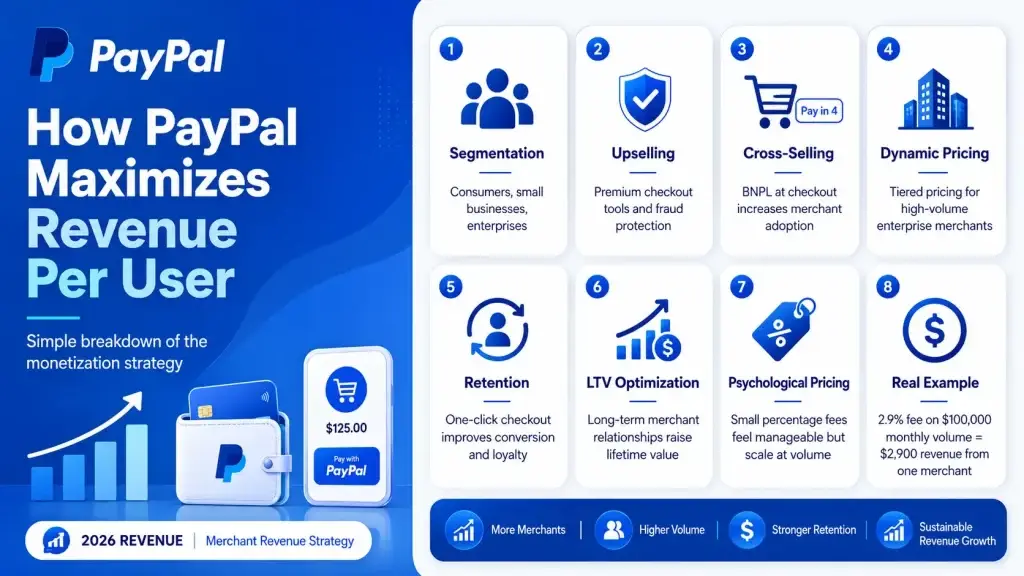
Segmentation:
Consumers, small businesses, large enterprises.
Upselling:
Merchants offered premium checkout tools and fraud prevention.
Cross-Selling:
BNPL integrated at checkout increases merchant adoption.
Dynamic Pricing:
Enterprise merchants receive tiered pricing based on volume.
Retention Monetization:
One-click checkout improves conversion, making merchants reluctant to switch.
LTV Optimization:
Long-term merchant relationships increase lifetime value.
Psychological Pricing:
Small percentage-based fees feel manageable while scaling massively at volume.
Real Example:
Even at a 2.9% fee, processing $100,000 monthly generates $2,900 revenue from one merchant.
Cost Structure & Profit Margins
Infrastructure Costs
Payment processing systems, compliance systems, cybersecurity.
Customer Acquisition Cost (CAC)
Merchant acquisition, advertising, partnerships.
Operations
Risk management, fraud prevention, regulatory compliance.
R&D
AI fraud detection, checkout optimization.
Unit Economics
High volume, low margin per transaction — but massive aggregate scale.
Margin Optimization
Cost reductions and automation improved operating margin in 2025.
Profitability Path
Scale + enterprise adoption + improved cost control.
Read More: Business Model of PayPal: Strategy & Revenue Breakdown 2026
Future Revenue Opportunities & Innovations (2025–2027)
- AI-powered fraud detection monetization
- Embedded finance partnerships
- Crypto integrations
- Super-app wallet ecosystems
- SME financing expansion
Risks & Threats:
- Regulatory changes
- Fintech competition
- Declining transaction take rates
Opportunities for Founders:
- Niche payment gateways
- Regional digital wallets
- Vertical-specific payment solutions
Lessons for Entrepreneurs & Your Opportunity
What Works:
- Small percentage on massive volume
- Trust-based brand positioning
- Integrated checkout ecosystem
What to Replicate:
- Clear fee structure
- Merchant tools beyond payments
- Cross-border monetization
Market Gaps:
- Industry-specific fintech platforms
- Emerging market wallet solutions
- Lower-cost SME payment rails
Digital payment platforms are custom work at Miracuves, handled by our payment gateway development team. FinTech builds start at $12,999 and typically take 15-30 days, extending to 45-60 days for larger scope. Money transmission licences and banking partners are arranged by you.
Final Thought
PayPal proves that even a small percentage fee can generate billions when applied at scale. A 2–3% transaction fee may look minor per payment, but when applied to trillions in annual payment volume, it transforms into a multi-billion-dollar revenue engine. The key is volume, frequency, and retention. By embedding itself into millions of merchant checkouts and consumer wallets, PayPal ensures continuous transaction flow. The lesson here is that micro-margins combined with massive throughput create exponential revenue.
The real power lies in ecosystem control — checkout, trust, and global reach. PayPal owns the payment moment, which means it controls conversion, fraud detection, cross-border processing, and data insights. This ecosystem approach increases switching costs for merchants and builds consumer trust over time. When users see the PayPal button, it signals security and convenience. That brand trust directly increases transaction completion rates and merchant dependency.
FAQs
1. How much does PayPal make per transaction?
Typically around 2.9% + fixed fee in the US, though enterprise rates vary.
2. What’s PayPal’s most profitable revenue stream?
Core transaction fees remain the dominant and most scalable revenue source.
3. How does PayPal’s pricing compare to competitors?
It is competitive but slightly higher than some enterprise-focused processors.
4. What percentage does PayPal take from merchants?
Standard rate around 2.9% per transaction in the US.
5. How has PayPal’s revenue model evolved?
From basic P2P transfers to full-stack merchant services and credit products.
6. Can small platforms use similar models?
Yes, especially marketplace and digital wallet platforms.
7. What’s the minimum scale for profitability?
Profitability improves significantly once transaction volume reaches meaningful monthly scale.
8. How to implement similar revenue models?
Build a wallet, integrate merchant checkout, charge percentage-based fees, and add value-added services.
9. What are alternatives to PayPal’s model?
Subscription-based fintech or flat-fee processing models.
Related Articles:
Miracuves is an independent software development company. We are not affiliated with, connected to, sponsored by, or endorsed by any company or product named in this article.
Terms such as “X Clone” are used descriptively. It is how the software industry refers to building a platform with functionality comparable to a known service, and how clients search for it.
The entire design and codebase of our products is built by our own team. Our products contain no code, design, graphics, or content originating from any third-party website or applications.
All third-party names and marks referenced in this article are the property of their respective owners, referenced solely to identify the services discussed.