



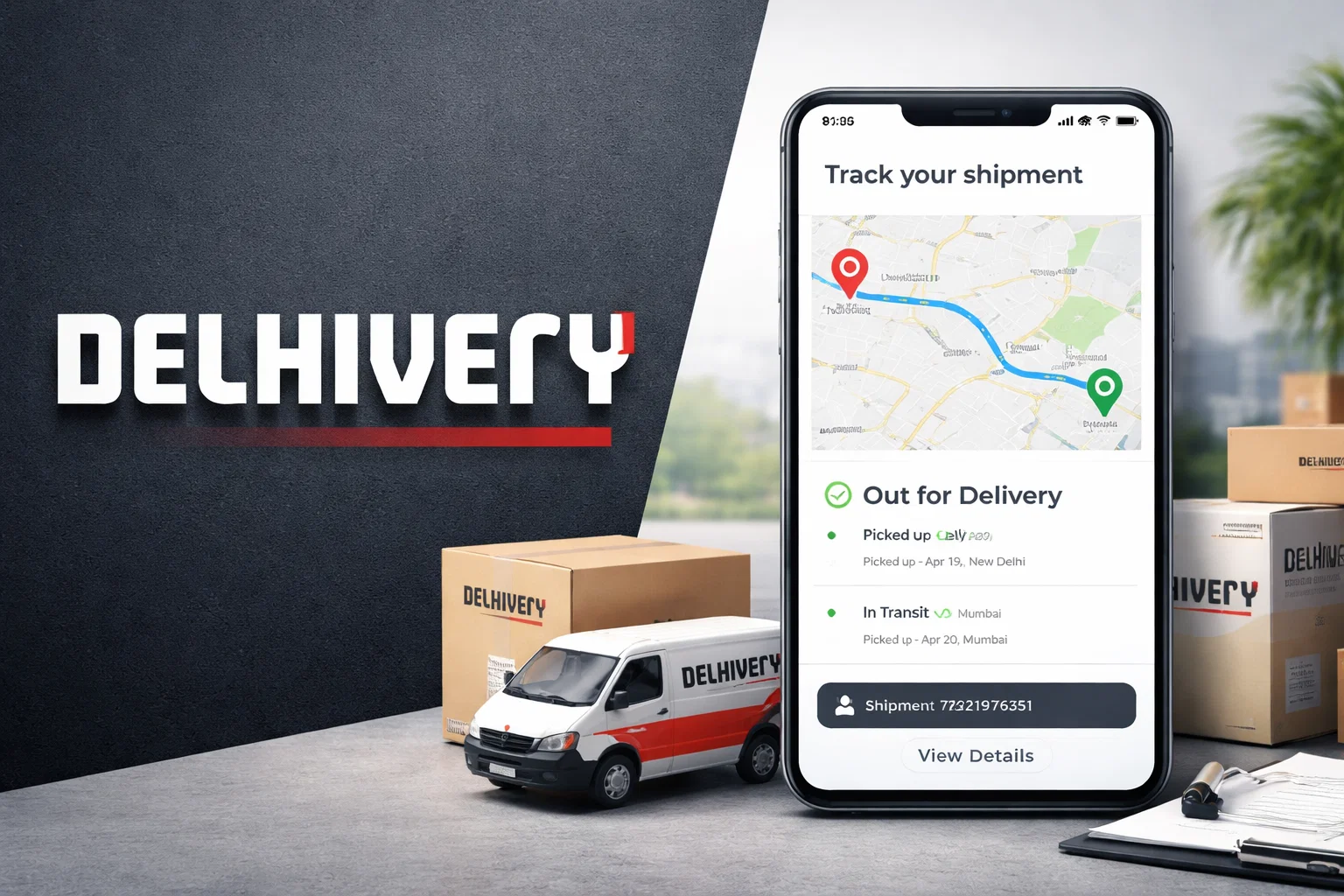
Imagine you run an online store and orders are flying in from all over India—metros, small towns, even remote pincodes. The hard part isn’t selling… it’s getting every package picked up, sorted, shipped, and delivered on time (and handling returns without chaos). That’s the real-world problem Delhivery exists to solve.
Delhivery is a fully integrated logistics services provider in India, offering services like express parcel, part-truckload (PTL), truckload (TL), supply chain, and cross-border logistics. Over time, it has built a large network and runs operations at massive scale—reporting revenue from services of ₹8,932 Cr in FY25 and profit after tax of ₹162 Cr in FY25 (its first full-year PAT profitability, per the company’s FY25 press release).
The impact is easy to understand: Delhivery’s network reach spans 18,850+ pin codes and it has fulfilled 3.6+ billion shipments since inception (company disclosure).
By the end of this guide, you’ll clearly understand what Delhivery is, how it works step-by-step, how it makes money, the features that drive reliability at scale, and what it takes to build a Delhivery-like logistics platform with Miracuves.
What Is Delhivery? The Simple Explanation
Delhivery is a technology-driven logistics and supply chain company that helps businesses move goods efficiently across India. In simple terms, it handles pickup, sorting, transportation, delivery, and returns for e-commerce companies, enterprises, and SMEs—at scale.
The Core Problem Delhivery Solves
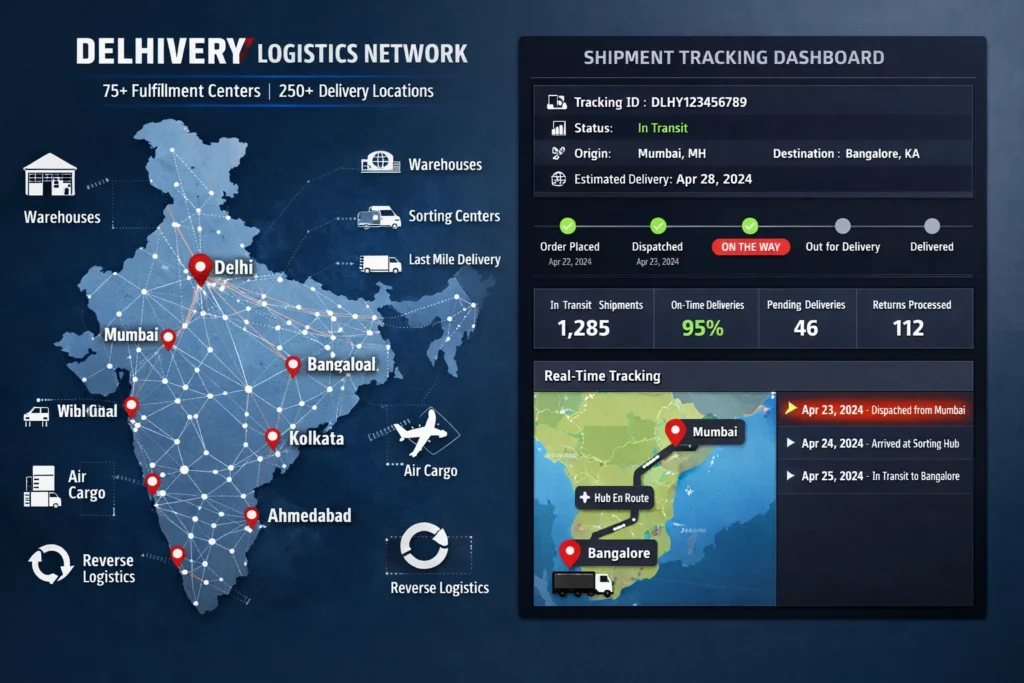
Shipping in a country as large and diverse as India is complex. Businesses struggle with inconsistent delivery times, limited reach, high return rates, and poor tracking visibility. Delhivery solves this by building a nationwide logistics network backed by software that coordinates every movement of a shipment from origin to destination.
Target Users and Use Cases
Delhivery is used by:
• E-commerce marketplaces and D2C brands
• SMEs shipping parcels across cities and states
• Enterprises moving large freight (PTL and TL)
• Businesses handling returns and reverse logistics
• Companies needing cross-border shipping support
Current Market Position
Delhivery is one of India’s largest integrated logistics players, competing with traditional courier companies and new-age logistics startups. Its strength lies in combining infrastructure + software + data rather than relying only on manpower or third-party networks.
Why It Became Successful
Delhivery succeeded by building logistics like a technology platform. Instead of treating deliveries as isolated tasks, it optimized the entire network—routing, sorting, capacity planning, and tracking—using data. This allowed it to scale faster, reach deeper pincodes, and serve high-volume customers reliably.
How Delhivery Works — Step-by-Step Breakdown
For Businesses (Shippers & Sellers)
Account Setup & Integration
Businesses sign up with Delhivery and integrate their systems using APIs or dashboards. E-commerce sellers can connect order management systems so shipment details flow automatically to Delhivery once an order is placed.
Pickup & First-Mile Collection
When an order is ready, Delhivery schedules a pickup from the seller’s warehouse, store, or fulfillment center. Parcels are scanned at pickup, creating the first tracking event in the system.
Sorting & Line-Haul Movement
Picked-up shipments are moved to sorting centers, where Delhivery’s systems automatically:
- Identify destination zones
- Assign optimal routes
- Group shipments efficiently
From there, parcels travel through line-haul networks (trucks, hubs, gateways) toward destination regions.
Last-Mile Delivery
At the destination hub, shipments are assigned to delivery partners. Customers receive:
- Live tracking updates
- Expected delivery timelines
- Delivery confirmations
Delhivery handles cash-on-delivery (COD), digital payments, and proof of delivery.
Returns & Reverse Logistics
If a delivery fails or a customer initiates a return, Delhivery manages reverse logistics—picking up the item, routing it back to the seller, and updating inventory status.
Example Shipment Journey
Seller ships order → Delhivery picks it up → package sorted at hub → transported across states → reaches local delivery center → delivered to customer → confirmation sent.
For Enterprises & Freight Customers
PTL (Part-Truckload) & TL (Truckload) Services
Enterprises use Delhivery to move bulk goods between warehouses or factories. Shipments are consolidated, routed efficiently, and tracked end-to-end.
Supply Chain & Fulfillment
For large customers, Delhivery offers warehousing, inventory management, and end-to-end supply chain services—integrated with enterprise systems.
Technical Overview (Simplified)
Delhivery operates through a coordinated logistics platform that includes:
- Shipment management systems
- Real-time tracking and scanning infrastructure
- Route optimization and capacity planning
- Hub and warehouse management software
- Payment, COD reconciliation, and returns systems
All these components work together to make nationwide logistics predictable and scalable.
Also Read :-Top 10 Ideas for Profitable Logistics and Courier Services Business Startups
Delhivery’s Business Model Explained
How Delhivery Makes Money
Delhivery operates a logistics-as-a-service model. Instead of owning inventory, it earns revenue by providing transportation, fulfillment, and supply chain services to businesses. Its income comes from multiple logistics verticals, which helps balance margins and scale efficiently.
Key revenue streams include:
- Express parcel delivery: Per-shipment fees from e-commerce and D2C brands
- Freight services (PTL & TL): Pricing based on weight, distance, and capacity usage
- Supply chain & warehousing: Storage, fulfillment, and value-added services
- Reverse logistics: Returns handling and RTO (return-to-origin) services
- Cross-border logistics: International shipping and customs support
Pricing Structure
Delhivery’s pricing varies by service type and volume:
- Parcel pricing: Based on weight slabs, distance, and service level
- Freight pricing: Based on tonnage, route, and utilization
- COD handling: Additional fees for cash collection and reconciliation
- Value-added services: Packaging, warehousing, and special handling
Large enterprise clients typically negotiate volume-based contracts, while SMEs use standard rate cards.
Commission / Fee Breakdown
- Per-shipment delivery fees
- Freight charges per route/load
- Warehousing and storage fees
- COD processing charges
- Return shipment fees
Unlike marketplaces, Delhivery doesn’t take commissions on product value—it charges for logistics execution.
Market Size and Growth
India’s logistics market is massive and growing due to:
- Rapid e-commerce adoption
- Growth of D2C brands
- Increasing interstate movement of goods
- Demand for faster, more reliable delivery
Delhivery benefits from this growth by serving both high-volume e-commerce and enterprise freight customers.
Profitability Insights
Delhivery improves margins through:
- Network optimization and route efficiency
- Higher asset utilization (sorting centers, trucks, hubs)
- Automation in sorting and tracking
- Reducing delivery failures and RTO rates
Revenue Model Breakdown
| Revenue Stream | Description | Who Pays | Nature |
|---|---|---|---|
| Express Parcel | E-commerce & D2C deliveries | Businesses | Per shipment |
| Freight (PTL/TL) | Bulk goods movement | Enterprises | Contract-based |
| Supply Chain | Warehousing & fulfillment | Enterprises | Subscription / usage |
| Reverse Logistics | Returns & failed deliveries | Sellers | Per shipment |
| Cross-Border | International shipping | Businesses | Transaction-based |
Key Features That Make Delhivery Successful
1) Pan-India reach (deep pin-code coverage)
Delhivery’s network reach is a major moat—its nationwide footprint covers 18,850+ pin codes, which helps brands deliver beyond metros into Tier 2/3 and rural demand pockets.
2) End-to-end express parcel execution (pickup → sort → line-haul → last mile)
For e-commerce and D2C brands, Delhivery manages the full journey—first-mile pickup, automated sortation, line-haul movement, and last-mile delivery—so sellers don’t stitch together multiple vendors. (Delhivery positions itself as an integrated logistics provider across express parcel, freight, warehousing, cross-border, etc.)
3) Strong reverse logistics (returns + RTO handling)
Returns are the “hidden tax” of e-commerce in India. Delhivery’s ability to move returned inventory back into the supply chain quickly (with scanning, tracking, and status updates) is a big reason large sellers stick with a single logistics partner.
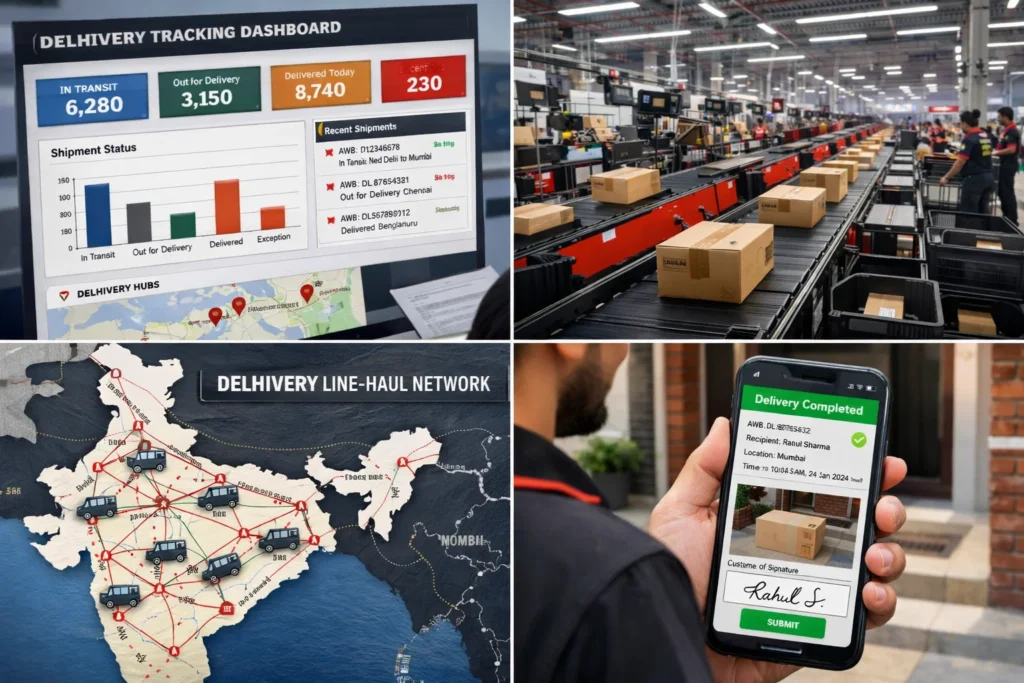
4) Real-time tracking built on scanning events
Delhivery’s operational discipline depends on scan-based tracking at pickup, hubs, and delivery centers—so both merchants and customers see where the shipment is and what’s happening next. This reduces support tickets and improves delivery confidence.
5) Freight services beyond parcels: PTL and TL
Delhivery isn’t only a courier company—it also runs freight services like Part Truckload (PTL) and Truckload (TL), which lets it serve enterprise movement between warehouses, factories, and distribution points.
6) Orion: freight exchange platform for Truckload
Delhivery’s FY25 annual report describes “Orion”, its freight exchange platform used for point-to-point and multi-point full-truckload (FTL/TL), with a centralized bidding and matching engine connecting shippers with verified fleet owners and brokers.
7) Intra-city and faster delivery formats (newer service lines)
Delhivery has been reported to invest in newer offerings such as Delhivery Direct (intra-city delivery) and Delhivery Rapid (sub-2-hour delivery)—important because brands increasingly want same-day/quick commerce style options, not just standard shipping.
8) Cross-border logistics capability
Delhivery lists cross-border as part of its integrated logistics portfolio—useful for brands that export or import and want shipping + documentation support under one umbrella.
9) Scale proof: billions of shipments fulfilled
A practical indicator of maturity is operational scale—Delhivery states it has fulfilled 3.6+ billion shipments since inception, which signals deep operational learning across peak seasons, failed deliveries, and returns.
10) Data products and transparency initiatives
Delhivery launched Freight Index One to provide lane-level freight pricing transparency for shippers and transporters—this is a strong “logistics + data” move that can improve decision-making and planning.
Recent updates and strategic moves
- Delhivery reported ₹8,932 Cr revenue from services in FY25 and ₹162 Cr PAT in FY25, marking its first full-year profitability.
- It also reported progress tied to network efficiencies and integration moves (including Ecom Express integration mentions in reporting), alongside investments into new services like Direct/Rapid.
The Technology Behind Delhivery
Tech stack overview (simplified)
Delhivery runs logistics like a large-scale distributed system. At its core, the platform connects physical movement (packages, trucks, hubs, delivery partners) with software that decides where, when, and how each shipment moves.
The main technology layers include:
- Shipment & order management systems for parcels, freight, and returns
- Warehouse & hub management systems for sorting, scanning, and routing
- Route optimization and line-haul planning engines
- Real-time tracking and visibility platforms
- Payment, COD, and reconciliation systems
- Data analytics and forecasting tools
Scan-based tracking and event architecture
Every shipment in Delhivery’s network generates multiple scan events—at pickup, arrival at hubs, sorting, dispatch, out-for-delivery, delivery, or return.
These scan events act as the single source of truth for:
- Customer-facing tracking updates
- Internal SLA monitoring
- Exception handling (delays, RTOs, misroutes)
- Performance measurement across hubs and partners
This event-driven design is critical for operating at national scale.
Sorting automation and hub technology
At major sorting centers, Delhivery uses automation and software-driven workflows to:
- Identify destination zones
- Auto-sort parcels into the right line-haul paths
- Reduce manual errors
- Increase throughput during peak demand
Software determines routing decisions, while physical automation improves speed and accuracy.
Route optimization and capacity planning
Delhivery’s systems continuously plan and re-plan routes based on:
- Shipment volume by lane
- Hub capacity
- Delivery partner availability
- Historical delivery performance
- Traffic and distance constraints
This helps maximize vehicle utilization and reduce cost per shipment.
Freight technology (PTL & TL)
For freight, Delhivery’s tech focuses on:
- Consolidation logic for PTL shipments
- Load planning and truck utilization
- Digital documentation and tracking
- Marketplace-style matching for truckload services
Platforms like Orion enable centralized booking, bidding, and allocation for full-truckload movement.
Data, analytics, and forecasting
Delhivery uses data to predict:
- Volume spikes (sales, festive seasons)
- Delivery success probability
- RTO risk by region or customer type
- Network bottlenecks before they occur
These insights help the company plan capacity ahead of time rather than reacting late.
Scalability approach
Logistics demand fluctuates heavily. Delhivery’s systems are designed to:
- Handle extreme peaks during sales and festivals
- Scale hubs, routes, and delivery partners dynamically
- Isolate failures so one hub or lane doesn’t disrupt the whole network
This resilience is essential for enterprise and e-commerce customers.
Merchant dashboards and APIs
Delhivery provides businesses with dashboards and APIs to:
- Create shipments programmatically
- Track deliveries in real time
- Access reports and performance metrics
- Manage returns and COD reconciliation
This tight integration reduces manual effort for sellers and enterprises.
Why this technology matters for business
Delhivery’s advantage isn’t just trucks and warehouses—it’s software-driven logistics. Technology allows it to:
- Lower cost per shipment
- Improve delivery predictability
- Scale faster than manual-first operators
- Offer transparency to merchants and customers
This is what turns logistics from a cost center into a competitive advantage.
Delhivery’s Impact & Market Opportunity
Industry disruption caused
Delhivery helped modernize Indian logistics by treating delivery like a network + technology platform, not just a courier service. For e-commerce brands, it reduced the dependence on fragmented local operators by offering more standardized pickup, tracking, last-mile delivery, and returns handling.
It also pushed the market toward better visibility. Real-time tracking, scan events, and SLA-style performance expectations became normal for businesses—especially as customer expectations for delivery speed and transparency increased.
Market statistics and growth drivers
India’s logistics demand continues to rise due to:
- Rapid growth of e-commerce and D2C brands
- Increased inter-state movement of goods
- Growth of SMEs shipping across regions
- Expansion of organized retail and omnichannel delivery
- Demand for faster fulfillment and smoother returns
Delhivery benefits because it serves both high-frequency parcel logistics and enterprise freight, which spreads risk and increases total addressable market.
User demographics and behavior (business-first platform)
Unlike consumer apps, Delhivery’s “users” are mostly businesses:
- Marketplaces and D2C brands shipping daily
- Sellers with high return volumes needing reliable reverse logistics
- Enterprises moving inventory between warehouses
- SMEs needing predictable shipping and COD handling
A key behavior pattern is integration-driven stickiness. Once a brand integrates APIs, operational workflows, and reporting with a logistics partner, switching costs become high.
Geographic presence
Delhivery’s network is built for India’s complexity—multiple regions, languages, transport constraints, and long-distance lanes. Its wide pincode coverage helps brands deliver beyond metro cities into deeper markets, which is where a lot of new e-commerce demand is growing.
Future projections
The future of Indian logistics is moving toward:
- Faster delivery options (same-day, intra-city, rapid fulfillment)
- Smarter freight marketplaces with price transparency
- More automation in sorting and hub operations
- Higher reliance on data for forecasting and capacity planning
- Better returns optimization and resale/refurb flows
Opportunities for entrepreneurs
There’s strong opportunity to build Delhivery-like platforms for:
- Hyperlocal and quick commerce logistics
- Reverse logistics specialists (returns-first platforms)
- Freight matching and digitized trucking networks
- Industry-specific logistics (pharma cold chain, FMCG distribution)
- MSME-first shipping platforms with simple onboarding and COD tools
This massive success is why many entrepreneurs want to build logistics platforms: once you become the default movement layer for businesses, volume compounds and the platform becomes deeply embedded.
Building Your Own Delhivery-Like Platform
Why businesses want Delhivery-style logistics platforms
Delhivery shows that logistics can be built as a scalable technology platform, not just an operations-heavy service. Entrepreneurs are drawn to this model because:
- Logistics is a high-volume, recurring business
- Once integrated, customers rarely switch providers
- Multiple revenue streams can run in parallel (parcel, freight, warehousing)
- Software-driven efficiency directly improves margins
- Data becomes a long-term competitive advantage
Key considerations before development
If you’re planning to build a Delhivery-like logistics platform, these decisions matter early:
- Target segment: e-commerce parcels, freight, MSMEs, enterprises, or hyperlocal
- Network model: owned hubs vs partner hubs
- First-mile and last-mile strategy
- Returns and RTO handling logic
- COD reconciliation workflows
- Service-level tracking (SLA definitions)
- Compliance, invoicing, and tax handling
- Merchant onboarding and API integration depth
Cost Factors & Pricing Breakdown
Delhivery-Like App Development — Market Price
| Development Level | Inclusions | Estimated Market Price (USD) |
|---|---|---|
| Basic Parcel & Logistics MVP | Core web console for shipment creation, simple rate calculation, shipment tracking by AWB, customer & shipper accounts, basic pickup & delivery status updates, standard admin panel, basic reports | $70,000 |
| Mid-Level Logistics & Parcel Management Platform | Multi-service support (surface/air/express), hub–branch–route structure, bulk shipment uploads, improved tracking with scans, basic route allocation, customer notifications (SMS/email), COD flagging, basic billing & reconciliation views, analytics dashboard, web + mobile-ready experience | $150,000 |
| Advanced Delhivery-Level Logistics Ecosystem | Large-scale, multi-network logistics platform with advanced routing & optimization, multi-region operations, real-time tracking across hubs, complex tariff & contract logic, fleet & partner management, deep WMS/TMS integrations, rich analytics & SLA reporting, cloud-native scalable architecture | $260,000+ |
Delhivery-Style Logistics Platform Development
The prices above reflect the global market cost of developing a Delhivery-like logistics and parcel management platform — typically ranging from $70,000 to over $260,000, with a delivery timeline of around 4–12 months for a full, from-scratch build. This usually includes shipment and network modelling, tracking and status flows, pricing and contracts logic, hub/branch operations tools, integrations with WMS/TMS and carriers, analytics, and infrastructure for high-volume logistics operations.
Miracuves Pricing for a Delhivery-Like Custom Platform
Miracuves Price: Starts at $14,999
This is positioned for a feature-rich, JS-based Delhivery-style logistics and parcel management platform that covers shipment creation and tracking, multi-service product setup, customer and shipper accounts, basic route and hub handling, notifications, billing overviews, analytics, and a modern operations console plus mobile apps for field staff. From this base, the solution can be extended into deeper routing optimization, warehouse and fleet integrations, partner networks, and more advanced SLA, contract, and analytics modules as your logistics network grows.
Note: This includes full non-encrypted source code (complete ownership), complete deployment support, backend & API setup, admin panel configuration, and assistance with publishing on the Google Play Store and Apple App Store—ensuring you receive a fully operational logistics ecosystem ready for launch and future expansion.
Delivery Timeline for a Delhivery-Like Platform with Miracuves
For a Delhivery-style, JS-based custom build, the typical delivery timeline with Miracuves is 30–90 days, depending on:
- Depth of logistics features (services, hubs, routes, tracking detail, etc.)
- Number and complexity of WMS/TMS, carrier, billing, and notification integrations
- Complexity of operations workflows, partner management, and SLA reporting
- Scope of web portal, mobile apps, branding requirements, and long-term scalability plans
Tech Stack
We preferably will be using JavaScript for building the entire solution (Node.js/Nest.js/Next.js for the web backend + frontend) and Flutter / React Native for mobile apps, considering speed, scalability, and the benefit of one codebase serving multiple platforms.
Other technology stacks can be discussed and arranged upon request when you contact our team, ensuring they align with your internal preferences, compliance needs, and infrastructure choices.
Essential features to include
A strong Delhivery-style MVP should include:
- Merchant onboarding and shipment creation
- Pickup scheduling
- Scan-based tracking events
- Sorting and routing logic
- Last-mile delivery workflows
- Returns and RTO management
- COD and payment reconciliation
- Admin dashboard for operations and exceptions
High-impact extensions you can add later:
- Freight (PTL/TL) modules
- Automated sorting support
- Intra-city or same-day delivery
- Cross-border shipping
- Analytics and forecasting dashboards
Read Also :- How to Launch a Successful Logistics & Package Delivery App Business
Conclusion
Delhivery shows how logistics becomes powerful when it’s built as a technology-led network, not just a delivery service. By combining nationwide infrastructure with data, automation, and software-driven decision-making, it turned shipping, freight, and returns into predictable, scalable operations for businesses of all sizes.
For entrepreneurs, Delhivery is proof that solving operational complexity with the right tech can create massive, defensible platforms. When logistics becomes reliable and transparent, it stops being a bottleneck—and starts becoming a growth engine.
FAQs :-
What does Delhivery do?
Delhivery is an integrated logistics and supply chain company that provides express parcel delivery, freight (PTL/TL), warehousing, reverse logistics, and cross-border shipping for businesses across India.
Who uses Delhivery?
Delhivery is used by e-commerce marketplaces, D2C brands, SMEs, and large enterprises that need reliable shipping, returns handling, and freight movement at scale.
How does Delhivery make money?
Delhivery earns through per-shipment delivery fees, freight charges, warehousing and fulfillment services, COD processing, and reverse logistics fees. It charges for logistics execution, not product value.
Does Delhivery handle cash-on-delivery (COD)?
Yes. Delhivery supports COD, including cash collection, reconciliation, and settlement for sellers, which is especially important in Indian e-commerce.
What is reverse logistics in Delhivery?
Reverse logistics covers returns, failed deliveries (RTO), and exchanges. Delhivery manages pickup from customers, routing back to sellers, and status updates end-to-end.
Does Delhivery offer freight services?
Yes. Delhivery provides Part-Truckload (PTL) and Truckload (TL) services for enterprise and bulk movement between warehouses, factories, and distribution centers.
How does shipment tracking work?
Delhivery uses scan-based tracking at every stage—pickup, hubs, line-haul, out-for-delivery, delivery, or return—so merchants and customers get real-time visibility.
Is Delhivery only for large companies?
No. Delhivery serves SMEs and D2C brands as well, with standard rate cards, dashboards, and APIs for easy onboarding and shipment creation.
Does Delhivery offer same-day or intra-city delivery?
Delhivery has introduced intra-city and faster delivery formats in select markets, depending on service availability and city coverage.
What makes Delhivery different from traditional courier companies?
Delhivery stands out because it combines nationwide infrastructure with software, data analytics, and automation, offering better visibility, scalability, and integration for businesses.
Can I build a platform like Delhivery?
Yes. Logistics platforms can be built for parcels, freight, or niche segments with the right tracking systems, routing logic, merchant dashboards, and operations tooling.
How can Miracuves help build a Delhivery-like platform?
Miracuves helps founders launch Delhivery-style logistics platforms in 30-90 days, with shipment tracking, merchant dashboards, routing logic, returns management, COD workflows, and scalable admin tools—fully customizable for your target logistics model.