



Trulia App Development Cost in 2026 : Complete Guide
Create a powerful, customizable streaming solution with Miracuves’ Trulia, equipped with high-performance features and next-gen technology.
Thinking of launching your own property listing platform like Trulia? Before diving into design or mapping out monetization, one question comes first: what will it cost to build?
A Trulia-style app is more than just a directory of homes. It blends property data, location intelligence, user reviews, price trends, and agent listings into one seamless real estate experience. That means the development cost depends on much more than just “pages and filters” — it’s about scalability, accuracy, and performance.
Whether you’re a proptech startup or an investor exploring the real estate app space, understanding the Trulia app development cost is key to making smart product decisions and setting a realistic budget.
In this guide, we’ll break down cost factors, regional pricing, complexity levels, and strategies to reduce expenses — so you can plan your product roadmap with confidence.
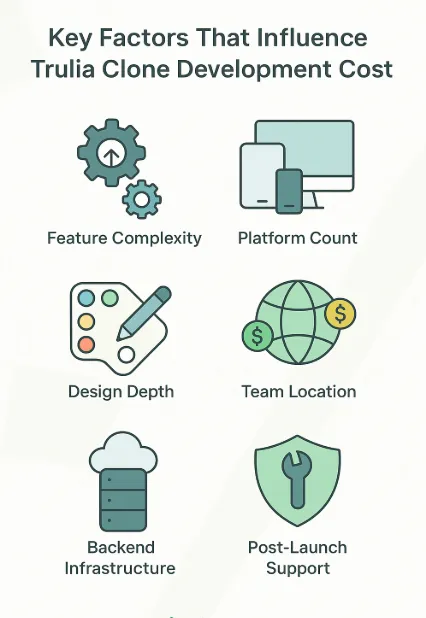
Key Factors That Influence Trulia Clone App Development Cost
There’s no universal price tag for a Trulia-like app. The total cost depends on your target market, feature set, tech stack, and how custom your solution needs to be.
Here are the major drivers:
App Features & Scale → A basic property search app costs far less than one with school data overlays, price trend graphs, and mortgage calculators.
Real Estate Data Sources → Connecting with MLS databases or real-time property feeds adds integration complexity and API licensing fees.
User Experience Design → Real estate apps need intuitive filters, map-based navigation, and detailed listings — all requiring thoughtful UI/UX.
Cross-Platform Development → Supporting Android, iOS, and Web multiplies dev time unless you use a cross-platform stack.
Backend Architecture → Handling map tiles, geospatial data, listing photos, and user-generated content calls for robust infrastructure.
Team Location → Hiring developers in the U.S. or Europe costs significantly more than working with a quality offshore team.
Compliance & Legal → Depending on the region, you may need to handle user data privacy laws or fair housing compliance features.
Understanding where your build stands on each of these variables helps align expectations with your available resources.
Trulia App Development Cost by App Complexity
To give you a clearer picture, here’s a breakdown of average development costs based on how advanced your real estate platform needs to be.
This range includes design, development, QA testing, and basic post-launch support — but not marketing, cloud fees, or licensing. For a breakdown of what goes into full-stack development, check our Trulia developer guide.
|
App Type
|
Estimated Cost Range (USD)
|
Description
|
|---|---|---|
|
MVP (Minimum Viable Product)
|
$15,000 – $30,000
|
Core features like property listings, search filters, user registration, and contact agent
|
|
Standard Version
|
$30,000 – $70,000
|
Adds saved searches, map view, mortgage calculator, user dashboards, and admin panel
|
|
Full-Featured App
|
$70,000 – $150,000+
|
Includes AI-based recommendations, virtual tours, push notifications, CRM integration, analytics, and more
|
Trulia App Development Cost by App Complexity (Miracuves 2026 Pricing)
When considering Trulia Clone app development, the overall cost depends on how advanced your real estate platform needs to be. A simple MVP focuses on listings and discovery, while a full-featured solution adds virtual tours, mortgage tools, agent communication, analytics, and mobile-first experiences. Here’s a breakdown of typical pricing stages—ending with Miracuves’ fixed package price.
|
App Type
|
Estimated Cost Range (USD)
|
Description
|
|---|---|---|
|
MVP (Minimum Viable Product)
|
$999 – $1,499
|
Property listings, advanced search filters (location/price/amenities), user registration, saved favorites, basic alerts, and clean listing pages with images/details.
|
|
Standard Version
|
$1,500 – $2,499
|
Adds saved searches, personalized profiles, secure messaging (buyer–agent), reviews/ratings, mortgage calculator, and an admin panel for property + user management.
|
|
Full-Featured App
|
$2,899 (Miracuves)
|
Complete Trulia-style ecosystem with Web + Mobile App + Admin Panel: virtual tours, analytics dashboard, ad/featured listing management, membership tiers, moderation tools, plus mobile features like GPS-based discovery, push notifications, AR viewing, one-tap calling/messaging, Face ID/Touch ID login, and offline saved listings.
|
Every Trulia-style solution developed by Miracuves comes as a complete package, including full source-code ownership, free 60-day post-launch support, and cloud deployment assistance for seamless scalability.
Each project is delivered within 3–9 days, ensuring a rapid go-to-market launch.
Launch your Trulia Clone App with Miracuves — built for speed, scalability, and long-term growth.
Average Cost Estimates by Region
Where you hire your development team can make a substantial difference in your final cost. Here’s a regional comparison based on hourly rates and typical development cycles:
|
Region
|
Hourly Rate (USD)
|
Typical Cost for Standard App
|
|---|---|---|
|
North America
|
$100 – $200/hr
|
$100,000 – $200,000+
|
|
Western Europe
|
$80 – $150/hr
|
$80,000 – $160,000+
|
|
Eastern Europe
|
$40 – $80/hr
|
$40,000 – $90,000+
|
|
India & Southeast Asia
|
$20 – $50/hr
|
$20,000 – $60,000+
|
Outsourcing to skilled teams in Asia or Eastern Europe can deliver a fully functional Trulia-style app at 40–60% less than Western markets.
Cost Breakdown by Development Stage : Trulia Clone
Understanding how your budget is distributed across each phase of development gives you better control and helps avoid surprise expenses. Below is a typical cost distribution for building a Trulia clone app:
|
Development Stage
|
Estimated % of Total Cost
|
Includes
|
|---|---|---|
|
Discovery & Planning
|
5–10%
|
Market research, competitor analysis, defining user personas, feature scoping, technical requirements.
|
|
UI/UX Design
|
10–15%
|
Wireframing, prototyping, responsive design, visual branding, user experience mapping.
|
|
Frontend & Backend Dev
|
40–50%
|
Core feature development, database architecture, APIs, payment integrations, dashboard and logic build.
|
|
Testing & QA
|
10–15%
|
Manual and automated testing, bug fixing, device/browser compatibility checks, performance tuning.
|
|
Deployment & Launch
|
5–10%
|
App store submission (Android/iOS), server setup, production deployment, performance monitoring tools.
|
|
Maintenance & Updates
|
10–20%
|
Post-launch bug fixes, new features, server maintenance, user support, compliance updates.
|
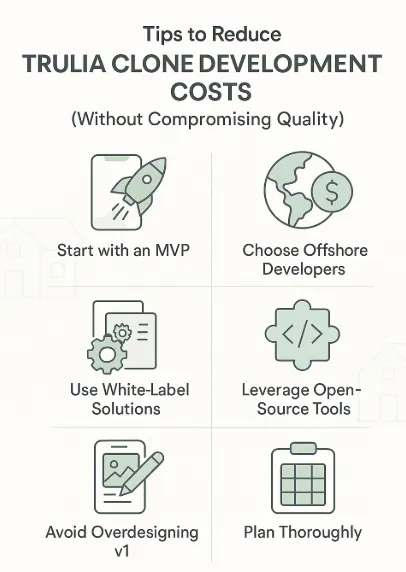
Tips to Reduce Development Costs Without Compromising Quality
You don’t have to overspend to build a solid, scalable real estate app. Here’s how to stay lean without cutting corners:
Start with an MVP → Launch fast with must-have features, then scale based on usage.
Work with a clone development team → Clone frameworks reduce build time and let you customize on top.
Use existing APIs → Integrate well-documented property listing, pricing, and mapping services to save time.
Choose open-source or white-label solutions → These reduce both upfront costs and long-term tech debt.
Plan for growth with modular architecture → Add advanced features like chatbots or CRM tools in later phases.
Miracuves supports this phased approach — helping you stay focused on growth while we handle the backend.
Choose the Right Development Partner
Even with a clear plan, launching a real estate platform is a major endeavor. The right tech partner can save you time, money, and missteps.
Here’s what to look for:
Real-world experience with property tech or listing platforms
Proven UI/UX design skills for high-converting map-based search
Teams offering post-launch maintenance, DevOps, and scaling
Familiarity with compliance requirements (GDPR, housing regulations)
At Miracuves, we specialize in clone app development for fast-moving startups. Whether you’re targeting local rentals or international listings, we help you go live faster — with scalable architecture and clean design that’s built to convert.
Let us handle the tech, while you focus on building your real estate brand.
Conclusion
The cost to develop a Trulia-style app in 2025 varies based on your platform size, feature depth, and how you build. From $30,000 MVPs to $250,000+ platforms, the range is wide — but with the right strategy, you can launch a reliable real estate platform on budget.
Looking to build a real estate app?
Talk to Miracuves for a detailed project scope, timeline, and cost estimate tailored to your goals.
For more insights on property tech solutions and app clone strategies, check out the rest of our blog series.
Frequently Asked Questions
A Trulia-like app with Miracuves starts at $2,899, with the final cost depending on the features you require—property listings, map integration, filters, chat/lead management, and admin dashboard customization.
Basic property search, filters, map integration, contact agent button, and admin dashboard are typically included.
Yes. White-label or clone solutions significantly reduce development time and cost, especially when paired with custom branding.
A Trulia-style app with Miracuves can be built and launched in 3–9 days, depending on the feature scope, integrations, and customization you choose.
Miracuves offers custom clone development with scalable architecture, travel-tested frameworks, and deep real estate app expertise.