


Service marketplaces are built on a simple promise: users need help, providers have skills, and the platform connects both sides at the right moment. But in reality, matching a customer with the right provider is not simple.
A user may need furniture assembly today, plumbing tomorrow, and moving help next week. One provider may be nearby but unavailable. Another may be highly rated but too expensive. A third may be new, affordable, and skilled, but not yet trusted by the platform.
This is where an AI service marketplace becomes more powerful than a traditional listing-based platform.
In a TaskRabbit-style marketplace, users do not want to scroll endlessly through profiles. They want the platform to understand the task, recommend the right provider, reduce uncertainty, and help them book faster. TaskRabbit itself connects users with local Taskers across categories such as furniture assembly, home repairs, moving, yard work, cleaning, TV mounting, plumbing, and electrical help.
For founders building a TaskRabbit clone, AI is no longer just a futuristic feature. It is becoming the intelligence layer that decides whether the marketplace feels useful, reliable, and scalable.
Miracuves helps founders build ready-made and white-label marketplace solutions where AI-powered workflows can be planned around matching, admin control, provider operations, monetization, and faster market validation.
Key Takeaways
- AI service marketplace platforms improve matchmaking by analyzing task intent, provider skills, location, availability, pricing, reviews, and reliability signals.
- A traditional TaskRabbit clone connects users and service providers, but an AI-powered TaskRabbit clone can recommend better matches with less manual effort.
- AI can improve task classification, provider ranking, price suggestions, fraud signals, support automation, and repeat booking recommendations.
- The strongest marketplace advantage comes when AI supports business logic, not when it is added only as a chatbot or search feature.
- Miracuves helps founders move from idea to launch faster with ready-made and white-label marketplace app solutions.
What Is an AI Service Marketplace?
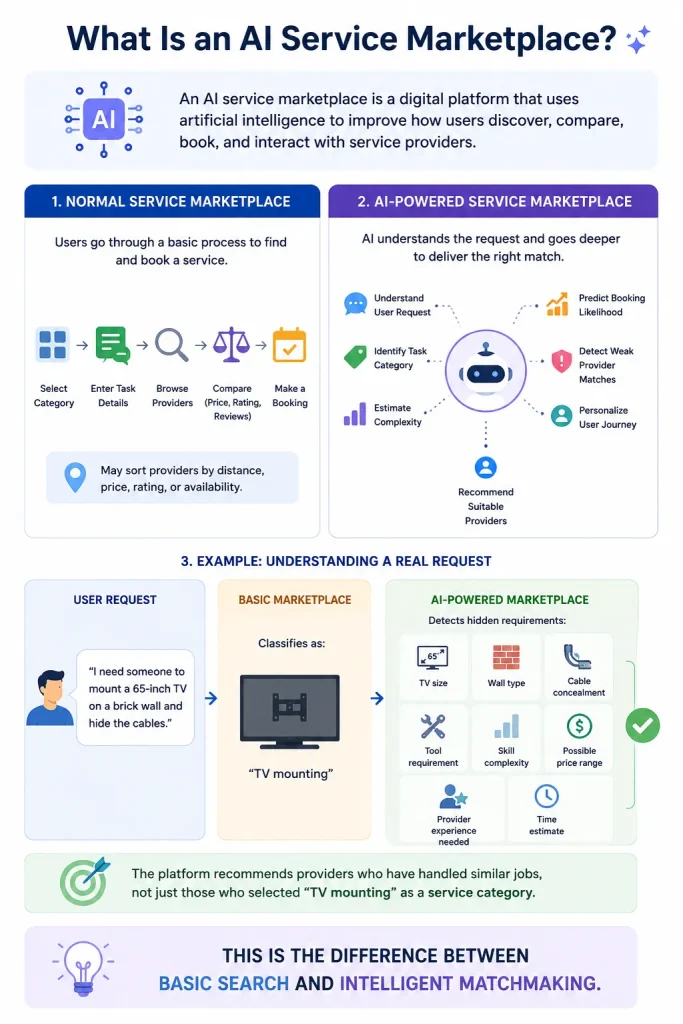
An AI service marketplace is a digital platform that uses artificial intelligence to improve how users discover, compare, book, and interact with service providers.
In a normal service marketplace, users select a category, enter task details, browse providers, compare prices, check reviews, and make a booking. The platform may sort providers by distance, price, rating, or availability.
In an AI-powered marketplace, the system goes deeper.
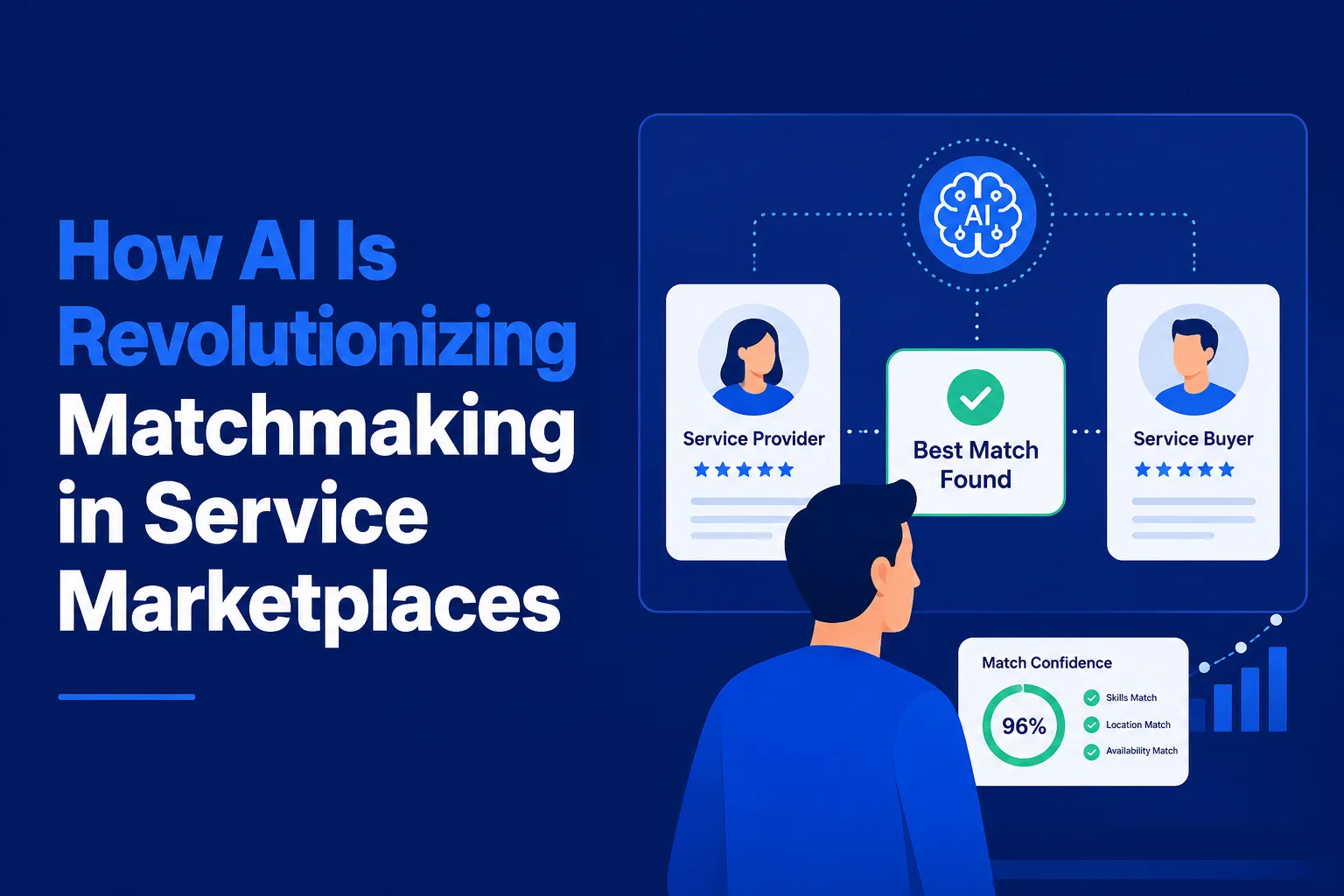
It can understand the user’s request, identify the task category, estimate complexity, recommend suitable providers, predict booking likelihood, detect weak provider matches, and personalize the user journey based on previous behavior.
For example, if a user writes:
“I need someone to mount a 65-inch TV on a brick wall and hide the cables.”
A basic marketplace may classify this as “TV mounting.”
An AI-powered marketplace can detect several hidden requirements:
- TV size
- Wall type
- Cable concealment
- Tool requirement
- Skill complexity
- Possible price range
- Provider experience needed
- Time estimate
That means the platform can recommend providers who have handled similar jobs, not just providers who selected “TV mounting” as a service category.
This is the difference between basic search and intelligent matchmaking.
Why Matchmaking Is the Real Engine of a TaskRabbit Clone
A TaskRabbit clone is not just an app where users post jobs and providers accept them. It is a trust-based marketplace where every match affects user confidence.
If the match is poor, the user may cancel.
If the provider is late, the user may not return.
If the price feels unclear, the booking may never happen.
If the provider gets irrelevant requests, they may leave the platform.
TaskRabbit-style platforms typically connect customers with local independent service providers for errands, repairs, moving, furniture assembly, cleaning, and similar physical services.
For founders, this creates a serious operational challenge. A marketplace does not grow only because it has many users and many providers. It grows when the right user is matched with the right provider at the right time.
AI helps improve this matching layer by considering more variables than a static filter can manage.
How AI Improves Matchmaking in Service Marketplaces
AI matchmaking works by combining task data, provider data, platform behavior, and marketplace rules. Instead of treating every provider equally, the platform learns which provider is most likely to complete a specific task successfully.
1. AI Understands Task Intent Better Than Static Categories
Traditional platforms depend heavily on category selection. The user chooses “cleaning,” “moving,” “handyman,” or “assembly.” But users often describe tasks in messy, incomplete, or mixed language.
AI can read user descriptions and detect intent more accurately.
For example:
“I need someone to move a sofa upstairs and assemble a bed frame.”
A static system may force the user to choose one category. AI can detect that the task includes moving, lifting, and furniture assembly. The platform can then recommend providers who are strong across both categories.
This improves the user experience because the customer does not need to understand the platform’s category structure. The marketplace understands the customer’s need.
2. AI Ranks Providers Based on Real Fit, Not Just Ratings
Ratings are useful, but they are not enough.
A provider with a 4.9 rating may be excellent for furniture assembly but not suitable for plumbing. Another provider may have fewer reviews but better experience with the exact task type.
AI can rank providers using signals such as:
- Service category expertise
- Past task completion history
- Similar task experience
- Distance from customer
- Availability window
- Price range fit
- Cancellation history
- Response speed
- Review sentiment
- Repeat customer rate
This creates a more practical ranking system. The top provider is not simply the highest rated. The top provider is the strongest fit for that task.
3. AI Can Reduce Booking Drop-Off
Many users leave service marketplaces before booking because they feel uncertain. They may not know which provider to choose, whether the price is fair, or whether the provider can handle the task.
AI can reduce this uncertainty by showing smarter recommendations:
- “Best match for your task”
- “Available today”
- “Experienced with similar jobs”
- “Highly rated for furniture assembly”
- “Popular choice in your area”
These recommendation labels help users make decisions faster. For founders, this matters because lower drop-off can improve marketplace efficiency without increasing advertising spend.
4. AI Helps Providers Receive Better Requests
A marketplace must serve both sides. If providers receive irrelevant or low-quality requests, they may stop responding.
AI can improve provider-side matching by filtering tasks based on:
- Skill relevance
- Service radius
- Preferred job size
- Schedule availability
- Price expectations
- Equipment requirements
- Past acceptance behavior
This helps providers spend less time declining poor-fit jobs and more time completing profitable work.
5. AI Supports Dynamic Pricing Suggestions
Pricing is one of the hardest parts of service marketplaces. If the price is too high, users may not book. If it is too low, providers may not accept.
AI can support pricing recommendations by analyzing:
- Task category
- Estimated task duration
- Location
- Demand level
- Provider availability
- Historical booking prices
- Urgency
- Complexity signals
The platform does not need to force one fixed price. It can suggest price ranges that help users and providers make better decisions.
6. AI Can Detect Trust and Safety Signals
Trust is critical in local service marketplaces because users often invite providers into homes, offices, or personal spaces.
AI can support trust and safety by identifying unusual activity patterns, suspicious reviews, repeated cancellations, duplicate accounts, spam messages, and risky booking behavior.
This does not replace human moderation or legal review. It helps the admin team detect problems earlier.
For a TaskRabbit clone, trust workflows should include user verification, provider verification, secure payments, refund and dispute workflows, review moderation, admin approval controls, fraud detection signals, booking history, and role-based dashboards.
AI Matchmaking Features and Business Value
| AI Feature | Business Value | Founder Impact |
|---|---|---|
| Task intent detection | Understands user requests beyond fixed categories | Improves provider relevance and reduces booking confusion |
| Provider fit scoring | Ranks providers based on task history, skill, location, availability, and reliability | Improves booking completion and user trust |
| Smart price suggestions | Recommends price ranges based on task complexity and marketplace demand | Reduces pricing friction between users and providers |
| Review sentiment analysis | Finds quality signals hidden inside written reviews | Helps the platform identify stronger providers |
| Fraud and abuse signals | Detects suspicious behavior, fake accounts, and risky activity patterns | Strengthens trust and reduces manual admin workload |
| Personalized recommendations | Suggests providers or services based on user behavior and previous bookings | Increases repeat bookings and platform retention |
AI Matchmaking vs Traditional Marketplace Search
Traditional marketplace search is rule-based. It usually depends on filters such as category, location, price, availability, and rating.
AI matchmaking is behavior-aware. It learns from user intent, booking patterns, provider performance, task complexity, and marketplace outcomes.
| Area | Traditional Service Marketplace | AI Service Marketplace |
|---|---|---|
| Task classification | User selects fixed category | AI understands written task descriptions |
| Provider ranking | Based on rating, price, or distance | Based on fit score, reliability, availability, and task history |
| Pricing | Static or provider-defined | Suggested using demand, complexity, and historical data |
| Search experience | User manually compares providers | Platform recommends the most relevant options |
| Admin control | Manual review and intervention | AI-assisted alerts, flags, and operational insights |
| Retention | Depends on user effort | Personalized repeat booking suggestions |
The founder lesson is simple: search helps users find options, but AI matchmaking helps them make decisions.
Where AI Fits Inside a TaskRabbit Clone App
A strong TaskRabbit clone app usually includes three main interfaces: customer app, provider app, and admin dashboard. AI can improve each layer.
Customer App
AI can help customers describe tasks, choose categories, compare providers, understand price expectations, and book faster.
Useful AI features include:
- Smart task description assistant
- Auto-category detection
- Provider recommendations
- Price range suggestions
- Similar task examples
- Personalized service suggestions
- Chat assistance before booking
Provider App
AI can help providers receive better requests, improve profile quality, and manage availability.
Useful AI features include:
- Recommended task alerts
- Profile improvement suggestions
- Smart availability planning
- Skill-based task routing
- Earnings opportunity insights
- Automated response suggestions
Admin Dashboard
The admin dashboard is where AI becomes operationally valuable. Founders need visibility into marketplace health, provider quality, failed bookings, cancellations, disputes, and user behavior.
Useful AI features include:
- Provider quality scoring
- Fraud risk signals
- Cancellation pattern detection
- Review sentiment monitoring
- Demand forecasting
- Category performance insights
- Support ticket classification
- Dispute priority alerts
This matters because marketplace founders cannot manually monitor every task as the platform grows. AI helps the admin team identify where attention is needed.
Founder Decision Signals
Speed
If your goal is to validate a local service marketplace quickly, a ready-made TaskRabbit clone foundation can reduce the time spent building standard booking, provider, payment, and admin flows from zero.
Cost
AI should be added where it improves booking conversion, provider utilization, or admin efficiency. Avoid adding AI features that look impressive but do not solve a marketplace problem.
Scalability
As more users and providers join, manual matching becomes harder. AI-assisted matching helps the platform handle more categories, locations, and service patterns with better control.
Market Fit
AI can reveal which services are in demand, which providers perform well, and where users abandon bookings. These insights help founders refine the marketplace model after launch.
Key AI Use Cases in Service Marketplaces
Smart Task Classification
Users do not always know the right service category. AI can classify tasks automatically based on text, images, location, urgency, and user history.
This improves marketplace navigation and helps providers receive relevant jobs.
Provider Recommendation Engine
The recommendation engine is the heart of AI matchmaking. It can rank providers based on fit instead of showing a generic list.
A practical provider score may consider:
- Distance
- Skill match
- Similar job history
- Availability
- Rating quality
- Review sentiment
- Response time
- Completion rate
- Cancellation risk
- Price fit
AI-Powered Search
Service marketplaces need search that understands intent. A user searching for “fix leaking tap” may need plumbing. A user searching for “put shelves on wall” may need mounting or handyman help.
AI-powered search can map natural language to marketplace services more accurately than keyword search.
Demand Forecasting
AI can help marketplace operators understand when and where demand will rise.
For example:
- Cleaning demand may increase before weekends.
- Moving help may increase at month-end.
- Furniture assembly may rise after shopping events.
- Yard work may be seasonal.
These signals help admins plan provider supply and marketing campaigns.
Provider Quality Monitoring
Not all providers with high ratings are equally reliable. AI can analyze patterns such as late arrivals, cancellations, negative review themes, refund requests, and support tickets.
This helps founders protect marketplace trust before quality problems become brand problems.
Personalized Repeat Booking
A user who booked cleaning may later need furniture assembly. A user who booked moving help may need unpacking or handyman services.
TaskRabbit has also published category upsell patterns showing how one booked category can lead to another related category, such as furniture assembly leading to mounting or minor home repairs.
AI can use this logic to recommend relevant services at the right time.
Why AI Matchmaking Improves Marketplace Monetization
AI does not monetize the marketplace by itself. It improves the conditions that make monetization stronger.
A service marketplace can earn through:
- Commission on completed bookings
- Provider subscriptions
- Featured provider listings
- Urgent booking fees
- Service fees
- Cancellation fees
- Business accounts
- Advertising placements
- Premium verification badges
AI supports these revenue models by improving the quality and frequency of transactions.
For example, if AI improves match quality, more users may complete bookings. If it improves provider utilization, providers may see more value in staying active. If it improves personalization, repeat bookings may increase.
For founders, the real value is not “AI as a feature.” The real value is AI as a marketplace efficiency layer.
Security and Trust Layers for an AI Service Marketplace
AI-powered marketplaces handle sensitive marketplace signals such as user behavior, location, provider performance, payment activity, and booking history.
A responsible AI service marketplace should include:
- Encrypted data transfer
- Encrypted data storage
- Role-based access control
- Secure payment gateway integration
- Provider verification workflows
- User verification workflows
- Review moderation
- Fraud monitoring
- Dispute management
- Admin activity logs
- Permission-based dashboards
AI should support trust workflows, but it should not be positioned as a guarantee of safety, compliance, or legal protection. Final compliance depends on jurisdiction, operating model, data handling practices, legal review, and selected integrations.
Ready-Made TaskRabbit Clone vs Custom AI Marketplace Development
Founders usually face two build paths: start from a ready-made foundation or build the entire marketplace from scratch.
| Build Option | Best For | Advantage | Limitation |
|---|---|---|---|
| Ready-made TaskRabbit clone | Founders who want faster launch and market validation | Faster deployment, existing user-provider-admin flows, lower starting complexity | May require customization for advanced AI workflows |
| Custom AI service marketplace | Businesses with unique workflows, enterprise requirements, or complex AI logic | Full flexibility and deeper AI architecture planning | Longer planning, development, and testing cycle |
| Hybrid approach | Founders who want speed plus differentiation | Start with core marketplace modules, then add AI matching and automation layers | Requires clear prioritization of AI features |
For many founders, the practical route is not to build every module from zero. A ready-made marketplace foundation can support faster validation, while AI features can be layered around the most important business problems.
Miracuves can help founders build a white-label TaskRabbit clone foundation with customer, provider, and admin workflows, then plan AI-powered enhancements around matchmaking, provider ranking, support automation, and marketplace insights.
Mistakes Founders Should Avoid When Adding AI to a Service Marketplace
Mistakes Founders Should Avoid
Adding AI Without a Clear Marketplace Problem
AI should solve a real problem such as poor matching, low booking conversion, weak provider quality, manual support load, or unclear pricing. Adding AI only because it sounds modern can increase cost without improving the business.
Depending Only on Ratings for Provider Ranking
Ratings are useful, but they do not show full task fit. A strong AI matching system should also consider skills, availability, distance, reliability, task history, and cancellation patterns.
Ignoring the Admin Control Layer
AI recommendations need admin visibility. Founders should be able to review provider scores, task categories, risk signals, and marketplace performance from the dashboard.
Overbuilding Before Market Validation
Founders do not need every possible AI feature on day one. Start with the AI workflows that directly affect bookings, provider quality, and user trust.
What Founders Should Build First
For a new AI service marketplace, the first version should focus on core marketplace reliability before advanced automation.
A practical first build should include:
- User registration and profile management
- Provider onboarding and verification
- Service category management
- Task posting or service booking
- Provider availability
- Smart provider matching
- Booking flow
- Secure payments
- Ratings and reviews
- Notifications
- Admin dashboard
- Dispute and refund workflows
- Basic AI task classification
- Provider recommendation logic
- Marketplace analytics
Advanced AI features can come later, such as predictive demand planning, automated dispute analysis, dynamic pricing, provider coaching, and personalized lifecycle campaigns.
The goal is not to launch the most complex product. The goal is to launch a marketplace that creates successful matches repeatedly.
How Miracuves Helps Founders Build AI-Powered Service Marketplaces
Miracuves helps founders, startups, and agencies launch marketplace platforms faster using ready-made, white-label, source-code-owned app foundations.
For an AI service marketplace or TaskRabbit clone, Miracuves can support the product foundation around:
- Customer app workflows
- Provider app workflows
- Admin dashboard
- Service categories
- Booking management
- Payment integration
- Ratings and reviews
- Provider verification
- Task management
- Marketplace monetization
- AI-ready matching logic
- Custom branding
- Source-code ownership
For ready-made solutions, Miracuves can support faster deployment with a 6-day launch approach where applicable. Final pricing and scope depend on features, integrations, AI requirements, branding, and customization needs.
Final Thoughts: AI Turns Service Marketplaces Into Smarter Matching Systems
The future of service marketplaces is not just about listing more providers. It is about helping users find the right provider with less effort and more confidence.
AI improves this by understanding task intent, ranking providers intelligently, supporting fairer pricing, detecting trust signals, and giving admins better marketplace visibility.
For founders building a TaskRabbit clone, the opportunity is clear: use the proven service marketplace model, but strengthen it with AI-powered matchmaking and operational intelligence.
The strongest marketplace is not the one with the most features. It is the one that creates the most successful matches.
FAQs
What is an AI service marketplace?
An AI service marketplace is a platform that uses artificial intelligence to improve how users find, compare, book, and interact with service providers. It can support task classification, provider recommendations, pricing suggestions, fraud detection, and personalized booking experiences.
How does AI improve a TaskRabbit clone?
AI improves a TaskRabbit clone by matching users with better-fit providers based on task type, location, availability, price fit, reviews, past performance, and reliability signals. This can reduce booking friction and improve marketplace efficiency.
Is AI matchmaking better than normal marketplace search?
Yes, for complex service marketplaces. Normal search depends on filters such as category, location, price, and rating. AI matchmaking can understand task intent and rank providers based on deeper fit signals.
What AI features should a service marketplace include first?
Founders should start with AI task classification, provider recommendation, smart search, review sentiment analysis, and admin risk signals. These features directly support booking quality, trust, and operational control.
Can AI help with provider quality control?
Yes. AI can identify provider performance patterns through cancellations, late arrivals, low review sentiment, refund requests, and repeated complaints. Admin teams can use these signals to improve marketplace trust.
How does an AI service marketplace make money?
An AI service marketplace can earn through commissions, provider subscriptions, featured listings, urgent booking fees, service fees, cancellation fees, business accounts, and advertising placements.