



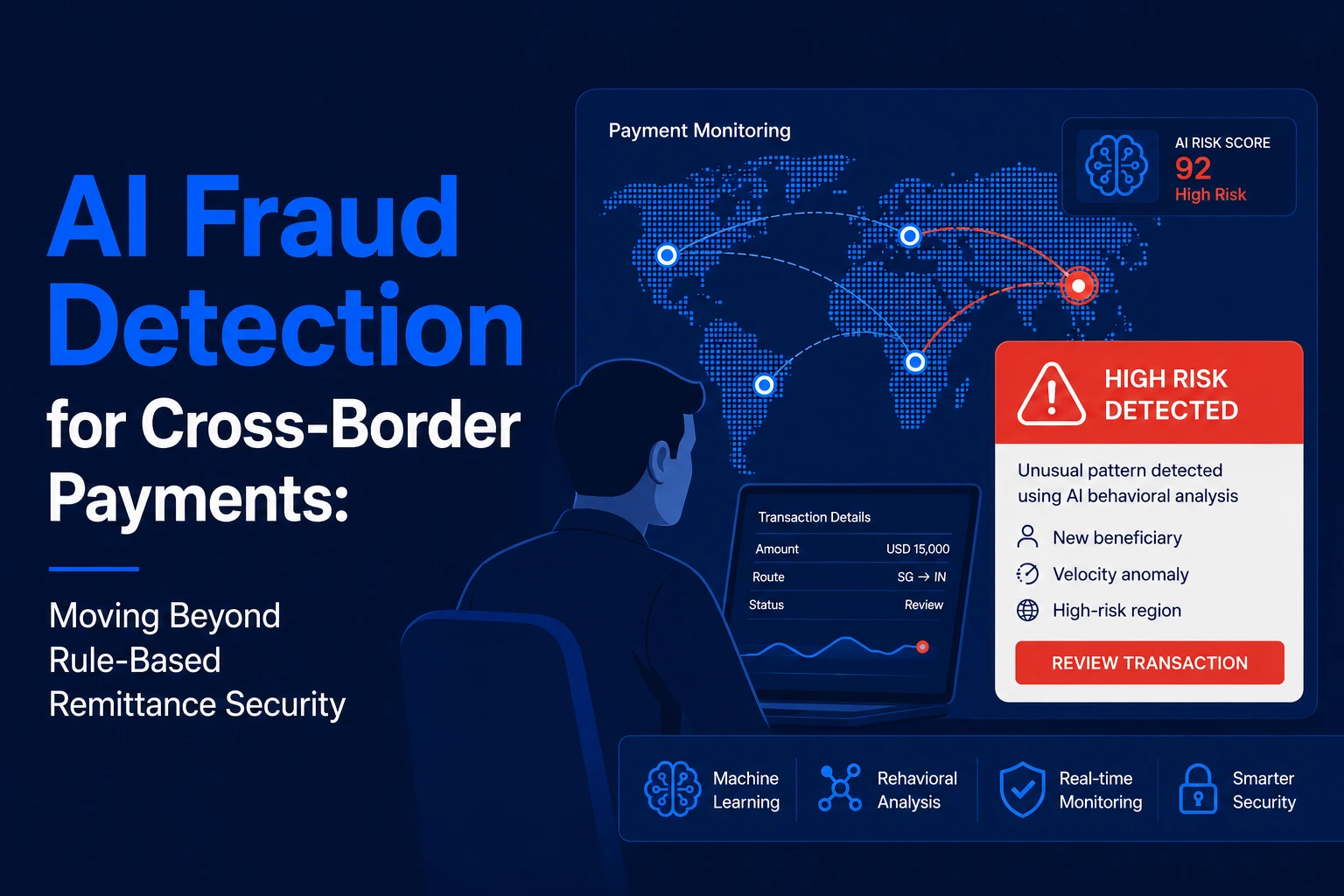
Key Takeaways
- AI fraud detection helps remittance platforms identify suspicious transactions faster than traditional rule-based systems.
- Modern remittance security combines machine learning, behavioral analysis, transaction monitoring, device intelligence, and risk scoring.
- AI systems can detect unusual patterns such as account takeovers, mule activity, transaction velocity spikes, and abnormal payout behavior.
- The strongest fraud prevention systems work in real time by combining user behavior, transaction context, location signals, and historical data.
- Long-term remittance security depends on adaptive models, continuous learning, compliance monitoring, and operational risk management.
Fraud Detection Signals
- Behavioral analysis helps detect unusual activity such as sudden transfer spikes, new devices, risky login patterns, or unexpected beneficiary changes.
- AI models improve transaction monitoring by analyzing relationships between senders, recipients, devices, IP addresses, and payout corridors.
- Risk scoring engines can evaluate transfer amount, velocity, geolocation, account history, and payout methods before approving transactions.
- Real-time anomaly detection reduces fraud exposure because suspicious transactions can be flagged before funds are fully processed.
- Modern remittance platforms often combine AI detection with AML screening, sanctions checks, KYC verification, and manual compliance review.
Real Insights
- Rule-based fraud systems alone are no longer enough because fraud patterns evolve faster than static security rules.
- The most effective remittance security systems combine AI automation with human compliance oversight and operational investigation workflows.
- AI fraud detection becomes more accurate over time because models learn from transaction history, false positives, and evolving fraud behavior.
- Founders should design fraud prevention architecture early because retrofitting compliance and security after scale becomes expensive and risky.
- The future of remittance security will depend on graph intelligence, behavioral biometrics, real-time analytics, AI orchestration, and adaptive risk engines.
Cross-border payments are built on trust. A sender expects money to reach the right recipient, in the right currency, through the right channel, without unnecessary delay. For fintech founders building remittance platforms, that trust depends on more than payment speed or attractive app design. It depends on whether the platform can detect suspicious behavior before money moves beyond recovery.
This is where AI fraud detection remittance systems are becoming important. Traditional fraud prevention often relies on fixed rules: block a transfer above a certain amount, flag too many transfers in a short time, or review transactions from high-risk locations. These rules still matter, but fraud no longer follows simple patterns.
Modern remittance fraud can involve synthetic identities, mule accounts, account takeovers, unusual beneficiary changes, corridor abuse, device manipulation, and coordinated transaction behavior across multiple users. AI-based fraud detection helps remittance platforms move beyond static rules by analyzing patterns, context, behavior, and risk signals in real time.
For founders, the goal is not to replace compliance teams with AI. The goal is to build a smarter fraud intelligence layer that helps teams detect risk faster, reduce unnecessary friction, and protect users while keeping legitimate transfers moving.
Miracuves helps fintech founders build ready-made and white-label remittance app foundations with user verification workflows, transaction flows, admin control, and security-ready architecture that can support AI-powered fraud monitoring where required.
Why Remittance Fraud Is Harder Than Normal Payment Fraud
Fraud detection in cross-border payments is more complex than fraud detection in a single domestic payment environment. A remittance platform must evaluate not only the payment amount, but also the sender, receiver, destination country, currency corridor, payout method, device, identity history, transaction purpose, and regulatory expectations.
A local card transaction might involve one merchant, one account, and one jurisdiction. A remittance transfer may involve multiple financial institutions, payment processors, payout partners, identity checks, FX conversion, sanctions screening, and local compliance requirements.
This creates several risk challenges:
- The sender and beneficiary may be in different regulatory environments.
- Fraud signals may be spread across multiple systems.
- Transaction behavior varies by corridor and culture.
- Legitimate migrant worker payment behavior can look unusual to generic fraud systems.
- Funds may become difficult to recover once released through a payout partner.
- Manual review teams may not scale during peak transfer periods.
This is why cross-border fraud prevention needs context. A $500 transfer may be normal for one user, suspicious for another, and urgent for a third. Rule-based systems often struggle with that level of nuance.
AI-based fraud detection improves the decision layer by learning what normal behavior looks like across users, devices, beneficiaries, corridors, and transaction histories. IBM describes AI fraud detection in banking as the use of machine learning algorithms to analyze large datasets, recognize suspicious activity, and identify fraud risks that human agents may miss.
Why Rule-Based Fraud Detection Is No Longer Enough
Rule-based fraud systems work by applying fixed conditions. For example:
- Flag transactions above a fixed value.
- Block transfers from specific regions.
- Review accounts with multiple failed login attempts.
- Hold payments after repeated beneficiary changes.
- Escalate transactions that exceed daily limits.
These rules are easy to understand and useful for compliance control. But they have limitations.
Fraudsters adapt. Once they understand thresholds, they can split transactions, rotate devices, use mule accounts, change timing, or mimic legitimate user behavior. A system that only asks, “Did this transaction break a rule?” may miss a transaction that looks normal in isolation but suspicious in context.
Rule-based systems also create false positives. A legitimate user sending money urgently to family may trigger a rigid rule because of amount, timing, or destination. If the platform blocks too many genuine transfers, users lose trust.
The real issue is not that rules are bad. The issue is that rules are static, while fraud is adaptive.
AI fraud detection adds a learning layer. Instead of only checking predefined thresholds, AI models evaluate combinations of signals and detect patterns that may not fit a known rule. This helps fraud teams move from reactive monitoring to proactive risk scoring.
What AI Fraud Detection Means in Remittance
AI fraud detection in remittance means using machine learning, behavioral analytics, anomaly detection, and risk scoring to identify suspicious transfer activity before funds are completed or released.
In practical terms, an AI-powered remittance fraud system can evaluate:
- Who is sending the money
- Who is receiving it
- Whether the sender’s behavior has changed
- Whether the beneficiary has unusual patterns
- Whether the device or IP looks risky
- Whether the transaction corridor is abnormal
- Whether similar transactions were previously linked to fraud
- Whether the transfer should proceed, pause, or move to manual review
The output is usually a risk score, decision recommendation, alert, or workflow trigger.
For example, a remittance platform may allow low-risk transactions to proceed instantly, ask medium-risk users for step-up verification, and send high-risk transfers to a fraud analyst. This balances security and customer experience.
SWIFT has also moved in this direction. In October 2024, SWIFT announced an AI-powered enhancement to its Payment Controls Service to help banks detect potential fraud in real time, using pseudonymised transaction data to detect and flag suspicious activity
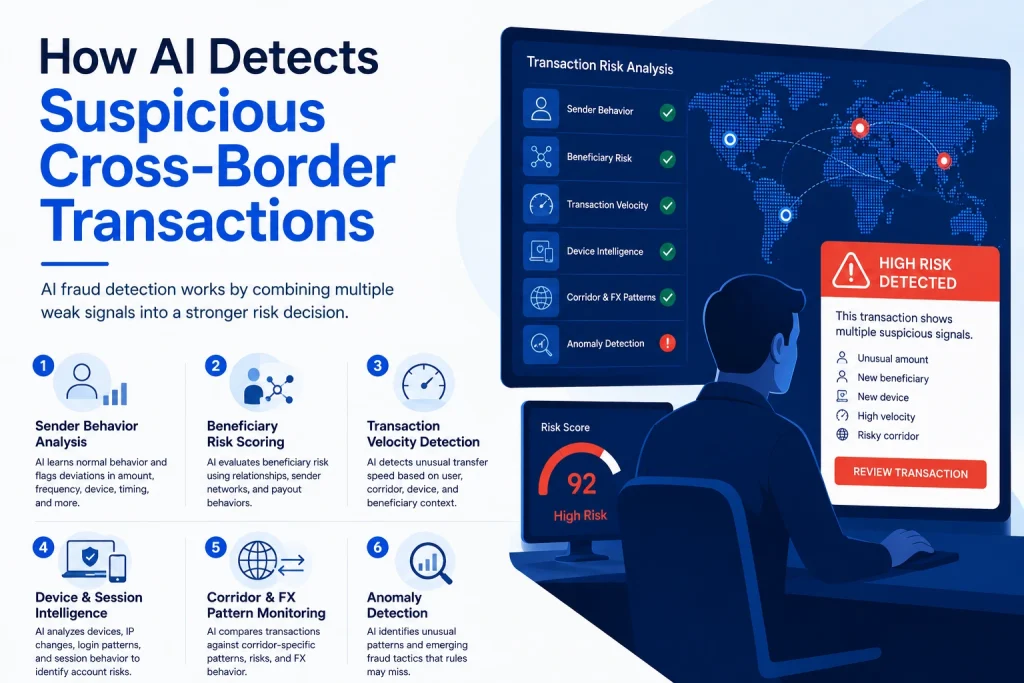
How AI Detects Suspicious Cross-Border Transactions
AI fraud detection works by combining multiple weak signals into a stronger risk decision. A single signal may not prove fraud. But several unusual signals together can indicate risk.
1. Sender Behavior Analysis
AI models learn how a sender normally behaves. They can track patterns such as:
- Typical transfer amount
- Usual recipient country
- Common payout method
- Normal transfer frequency
- Login timing
- Device consistency
- Funding source behavior
If a user who usually sends $200 once a month suddenly sends multiple transfers to new beneficiaries through a new device, the model may raise the risk score.
2. Beneficiary Risk Scoring
Fraud often hides on the recipient side. AI can help evaluate whether a beneficiary appears across multiple unrelated accounts, receives funds from unusual sender clusters, or is linked to suspicious payout behavior.
A beneficiary may not look risky in one transaction. But across the graph of senders, devices, accounts, and payout activity, the pattern may become clearer.
3. Transaction Velocity Detection
Velocity checks are common in rule-based systems, but AI makes them more contextual. Instead of simply asking, “How many transfers happened today?” AI can evaluate whether the velocity is unusual for that specific user, corridor, device, or beneficiary group.
This matters because normal transaction speed differs across markets. A rigid rule may block legitimate seasonal remittances, while AI can compare activity against relevant behavioral baselines.
4. Device and Session Intelligence
Device signals help detect account takeover, bot activity, and identity manipulation. AI can analyze:
- New device usage
- IP changes
- VPN or proxy indicators
- Session behavior
- Login rhythm
- Failed authentication attempts
- Device-to-account relationships
If a trusted user logs in from a new device, changes beneficiary details, and initiates a high-value transfer within minutes, AI can trigger additional verification.
5. Corridor and FX Pattern Monitoring
Cross-border payments involve corridors, such as UAE to India, US to Philippines, or UK to Nigeria. Each corridor has its own normal transfer patterns, payout behavior, compliance expectations, and fraud risks.
AI can compare a transaction against corridor-level patterns instead of applying one generic fraud rule globally.
6. Anomaly Detection
Anomaly detection identifies behavior that does not match expected patterns. This is useful for detecting new fraud tactics that rules have not yet captured.
For example, if a group of new accounts begins sending small transfers to related beneficiaries across multiple corridors, the pattern may not break a simple rule. But anomaly detection can flag the emerging structure.
7. Graph-Based Fraud Detection
Graph analysis connects users, devices, beneficiaries, bank accounts, cards, locations, and transactions. This helps identify fraud rings, mule networks, and coordinated activity.
A transaction may look safe when viewed alone. But if the sender shares a device, beneficiary, or payout account with previously suspicious activity, the risk profile changes.
Appinventiv’s AI fraud prevention content also highlights cross-channel risk correlation, where signals across payments, logins, accounts, and devices help detect patterns that fragmented systems may miss
Rule-Based vs AI-Based Remittance Fraud Detection
Rule-Based vs AI-Based Remittance Fraud Detection
| Detection Layer | Rule-Based Fraud Detection | AI-Based Fraud Detection | Founder Impact |
|---|---|---|---|
| Decision Logic | Uses predefined thresholds and conditions. | Learns from historical behavior, patterns, and outcomes. | AI helps detect risk even when no obvious rule is broken. |
| Adaptability | Requires manual rule updates. | Can adapt as new fraud patterns appear. | Reduces dependency on constant manual tuning. |
| False Positives | Can block legitimate users when rules are too rigid. | Uses context to separate unusual-but-valid behavior from high-risk activity. | Improves user experience while maintaining control. |
| Cross-Border Context | Often applies generic rules across corridors. | Can analyze corridor, beneficiary, FX, device, and user history together. | Better suited for international remittance complexity. |
| Operational Scale | Creates more manual review as volume grows. | Prioritizes alerts and scores transactions automatically. | Fraud teams can focus on higher-risk cases. |
| Explainability | Easier to explain because rules are explicit. | Requires model explainability, audit logs, and review workflows. | Founders must design AI with governance, not just automation. |
Core AI Models and Signals Used in Remittance Security
AI fraud detection is not one model. It is usually a combination of models, rules, risk signals, and operational workflows.
Supervised Machine Learning
Supervised models learn from labeled historical data. If previous transactions are marked as legitimate, fraudulent, disputed, or suspicious, the model learns patterns associated with each outcome.
This works well when the platform has enough quality data. However, early-stage fintech founders may not have large internal datasets, so they may need to begin with rules, third-party risk tools, and gradually train models as data matures.
Unsupervised Anomaly Detection
Unsupervised models detect unusual behavior without needing perfectly labeled fraud data. This is useful in remittance because new fraud patterns may appear before teams can classify them.
For example, anomaly detection can surface unusual beneficiary clustering, sudden corridor spikes, or abnormal login-to-transfer behavior.
Graph Machine Learning
Graph models are useful when fraud involves networks of connected accounts, devices, beneficiaries, and payment instruments. This is especially relevant for mule networks and coordinated remittance abuse.
A graph-based system can ask:
- Which accounts are connected by device?
- Which beneficiaries receive money from unrelated senders?
- Which payout accounts appear repeatedly in suspicious transactions?
- Which users share identity, behavioral, or funding patterns?
Behavioral Biometrics
Behavioral biometrics can include typing rhythm, navigation style, device movement, session behavior, and interaction patterns. It helps identify whether the current user behaves like the genuine account owner.
This can support account takeover detection without adding unnecessary friction for every user.
Natural Language Processing
NLP can help analyze unstructured data such as support messages, transaction notes, uploaded documents, or suspicious communication patterns. In compliance-heavy workflows, NLP may support document review and investigation assistance.
Risk Scoring Engines
A risk scoring engine combines signals into a decision score. The platform can then define workflows such as:
- Approve instantly
- Request additional verification
- Hold for manual review
- Block transaction
- Escalate to compliance team
- Add user or beneficiary to watchlist
The strongest systems use AI to recommend action, but keep sensitive decisions auditable and reviewable.
Where AI Fits Inside a Remittance Platform Architecture
AI fraud detection should not sit outside the product as an isolated tool. It should be embedded into the transaction lifecycle.
A practical remittance platform architecture may include:
- User onboarding and KYC
- Sender profile creation
- Beneficiary creation
- Payment initiation
- Real-time transaction risk scoring
- AML and sanctions screening workflow
- Step-up authentication where needed
- Admin review queue
- Transaction approval, hold, or rejection
- Audit logs and reporting
- Feedback loop from investigation outcomes
For fintech founders, this architecture matters because fraud prevention is not only a backend issue. It affects onboarding, transaction speed, user trust, admin workload, compliance review, and support operations.
Miracuves’ Revolut clone app and Wise clone solution positioning can support founders exploring remittance, wallet, and cross-border payment platform foundations. For broader fintech planning, founders can also review Miracuves’ fintech app development capabilities.
Founder Decision Signals
Speed
If your platform processes transfers in real time, fraud detection must also operate close to real time. Slow manual review can hurt user trust and payout experience.
Cost
AI fraud detection may reduce repetitive manual review, but implementation cost depends on data quality, integrations, model complexity, and compliance workflow scope.
Scalability
As transaction volume grows across corridors, static rules create more alerts. AI scoring helps prioritize high-risk cases so fraud teams can scale more efficiently.
Market Fit
A remittance platform must protect users without blocking legitimate transfers. AI helps founders balance fraud control with customer experience.
Security and Compliance Considerations for AI Fraud Detection
AI fraud detection should be designed as part of a compliance-ready foundation, not as an isolated automation feature.
For remittance and fintech platforms, important security layers include:
- KYC verification
- AML workflow support
- transaction monitoring
- suspicious activity flags
- role-based admin access
- audit logs
- encrypted data transfer
- encrypted data storage
- secure payment gateway integration
- user identity checks
- beneficiary risk review
- compliance reporting support
- fraud analyst review queues
Final compliance depends on jurisdiction, legal review, operating model, payment partners, licensing requirements, and regulatory expectations. AI can support compliance workflows, but it should not be described as guaranteeing regulatory approval.
FATF has noted that AI and machine learning tools can support transaction monitoring with greater speed, accuracy, and efficiency when properly trained, while also serving as a complement rather than a full replacement for compliance systems.
This distinction matters. A fintech founder should not ask, “Can AI make us compliant?” The better question is, “Can AI help our team detect risk earlier, document decisions better, and manage suspicious activity more consistently?”
Mistakes Founders Should Avoid
Mistakes Founders Should Avoid
Relying Only on Static Rules
Rules are useful, but fraud patterns change quickly. A remittance platform that only uses fixed thresholds may miss coordinated fraud that appears normal in isolated transactions.
Adding AI Without Clean Data
AI models depend on data quality. Poor transaction labels, inconsistent KYC records, and fragmented device signals can weaken fraud detection accuracy.
Ignoring Explainability
Fraud decisions must be reviewable. Admin teams need to understand why a transaction was held, escalated, or blocked.
Blocking Too Many Legitimate Transfers
Security should not destroy user experience. High false positives can frustrate genuine users and reduce trust in the platform.
Treating Compliance as a Plugin
KYC, AML, audit logs, transaction monitoring, and admin workflows should be part of the product foundation from the beginning.
How Miracuves Helps Fintech Founders Build Safer Remittance Platforms
Building a remittance platform requires more than sender screens and transaction history. Founders need onboarding logic, beneficiary management, wallet or payment flows, transaction records, admin dashboards, verification workflows, risk controls, and a backend foundation that can support future integrations.
A ready-made fintech foundation from Miracuves can help founders move faster by starting with core app flows instead of building every module from zero. For remittance and cross-border payment concepts, this can include user-facing workflows, admin control, transaction management, branded design, and source-code ownership.
AI fraud detection can then be planned as part of the risk architecture. Depending on the product scope, this may involve third-party fraud tools, custom scoring rules, machine learning integrations, KYC/AML workflow support, audit logs, and manual review queues.
Miracuves does not position AI as a shortcut around compliance. Instead, the stronger approach is to create a platform foundation that supports compliance-ready workflows, admin visibility, and scalable fraud monitoring.
Final Thoughts:
The future of remittance security is not rule-based or AI-based. It is both.
Rules provide clear control. AI adds adaptive intelligence. Human review adds judgment. Audit logs add accountability. KYC and AML workflows add operational discipline. Together, these layers help fintech platforms protect users, reduce fraud exposure, and maintain confidence as transaction volume grows.
For founders, the key decision is not whether to add AI because it sounds advanced. The real decision is whether the platform has the right data, workflows, admin controls, and compliance-ready foundation to use AI responsibly.
A remittance platform that moves money across borders must also move risk decisions faster. AI fraud detection helps make that possible when it is designed with context, governance, and product clarity from the start.
Miracuves helps founders build fintech and remittance app foundations that can support stronger transaction workflows, admin control, and future-ready risk architecture.
FAQs
What is AI fraud detection in remittance?
AI fraud detection in remittance uses machine learning, anomaly detection, behavioral analytics, and real-time risk scoring to identify suspicious cross-border transfers. It helps detect unusual sender behavior, risky beneficiaries, device changes, transaction velocity, and corridor-level fraud patterns.
How is AI better than rule-based fraud detection?
Rule-based fraud detection relies on fixed thresholds, while AI analyzes patterns and context. AI can detect suspicious behavior even when a transaction does not break a predefined rule. This makes it useful for adaptive fraud tactics in cross-border payments.
Can AI reduce false positives in remittance platforms?
Yes, AI can reduce false positives when trained and configured properly. It compares user behavior, transaction history, device signals, and beneficiary patterns instead of applying the same rigid rule to every customer. Human review is still important for sensitive decisions.
What fraud risks can AI detect in cross-border payments?
AI can help detect account takeover, mule account activity, unusual beneficiary patterns, synthetic identity risk, abnormal transfer velocity, corridor abuse, suspicious device behavior, and coordinated transaction networks.
Does AI fraud detection replace AML compliance?
No. AI supports AML and transaction monitoring workflows, but it does not replace compliance obligations. Final compliance depends on jurisdiction, legal review, operating model, licensed partners, and regulatory requirements.
Is AI fraud detection suitable for early-stage fintech startups?
Yes, but the approach should be phased. Early-stage startups may begin with rule-based monitoring, third-party verification tools, admin review workflows, and structured data collection. AI models can become more useful as transaction volume and quality data increase.
How can Miracuves help build a secure remittance platform?
Miracuves helps founders create ready-made and white-label fintech app solutions with source code, branded design, admin dashboards, transaction workflows, and security-ready architecture. AI fraud detection integrations can be planned based on the selected product scope and risk requirements.