Key Takeaways
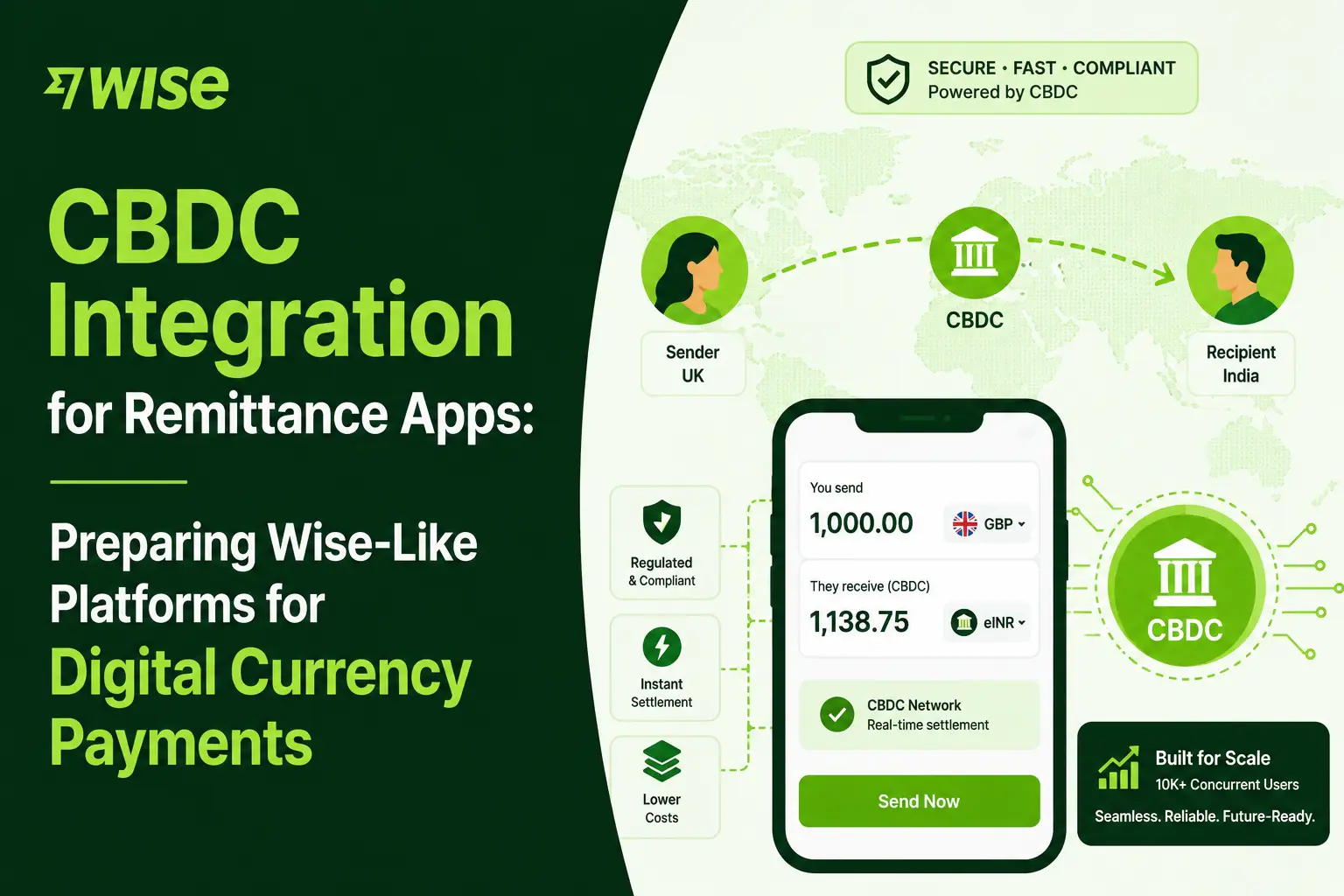
- CBDC integration can prepare remittance apps for future digital currency payment rails.
- Wise-like platforms need flexible architecture to support wallets, FX, compliance, and settlement flows.
- Regulation will play a major role in how CBDC payments are tested, launched, and scaled.
- Digital currency readiness helps founders plan for faster, cheaper, and more transparent transfers.
- The right strategy combines CBDC pilots, secure APIs, compliance checks, and future-ready payment infrastructure.
What You’ll Learn
- How CBDC integration can impact remittance and payment apps.
- Wallet architecture must support fiat, digital currency, and compliance-ready flows.
- Cross-border payments may become faster with future CBDC-enabled settlement systems.
- Compliance planning helps manage KYC, AML, transaction monitoring, and reporting needs.
- Growth depends on regulation, banking partners, API readiness, security, and user trust.
Real Insights
- CBDC adoption will not happen overnight, so founders should prepare gradually.
- Payment apps need modular systems to add new rails without rebuilding the platform.
- Trust and security matter when users move money through digital currency flows.
- Pilot-ready infrastructure helps remittance startups test CBDC use cases early.
- The best strategy is to build a Wise-like platform that can adapt as CBDC regulations and payment rails mature.
Cross-border payments are changing again.
For years, remittance apps competed on lower fees, faster transfers, better FX rates, cleaner user experience, and wider payout coverage. Platforms inspired by Wise, Revolut, PayPal, Remitly, and modern neobanks proved that users no longer want slow bank wires, unclear charges, or poor transfer visibility.
Now a new layer is emerging: central bank digital currencies, or CBDCs.
For founders building a remittance app, this does not mean every payment app must support CBDCs today. Most CBDC programs are still in research, pilot, sandbox, or limited rollout stages. But it does mean fintech founders should start designing platforms that can adapt when digital currency payment rails become commercially relevant.
A CBDC integration payment app is not just a normal wallet with another payment button. It requires a flexible payment architecture that can support central bank-issued digital money, user verification, corridor-specific rules, settlement visibility, wallet reconciliation, liquidity workflows, and regulatory reporting.
That is where the strategic opportunity sits.
Miracuves helps founders build white-label, source-code-owned fintech and remittance platforms that can be customized around business models, payment flows, KYC/AML workflows, wallet logic, and admin control. For founders planning Wise-like platforms, CBDC readiness should be treated as a future-proofing layer rather than a last-minute integration.
What Is CBDC Integration in a Payment App?
CBDC integration means enabling a payment app, wallet, or remittance platform to interact with digital currency issued by a central bank.
Unlike private cryptocurrencies or stablecoins, CBDCs are issued by monetary authorities. Depending on the country and design, they may be used for retail payments, wholesale interbank settlement, government disbursements, merchant payments, or cross-border transactions.
For a remittance app, CBDC integration could eventually support flows such as:
- User sends digital currency from one country to another.
- App converts funds through approved FX or settlement rails.
- Recipient receives funds in local CBDC, bank balance, wallet balance, or cash-out channel.
- Platform records the transaction in its internal ledger and regulatory reporting layer.
- Admin teams monitor compliance, fraud, settlement status, refunds, and reconciliation.
The IMF notes that many central banks are exploring CBDCs partly because they may help reduce frictions in cross-border payments, including intermediary layers and settlement risk.
For founders, the key question is not “Can we add a CBDC button?” The better question is: “Can our payment architecture support new forms of regulated digital money without rebuilding the product?”
Why CBDCs Matter for Wise-Like Remittance Platforms
Wise-like platforms solve a very specific pain: moving money across borders with more speed, transparency, and user control than legacy transfer methods.
CBDCs could become relevant because cross-border payments still face structural friction. Different countries use different payment systems, operating hours, messaging standards, regulatory rules, FX practices, and settlement methods. The IMF has described interoperability as one of the most practical paths for improving fragmented cross-border payment systems.
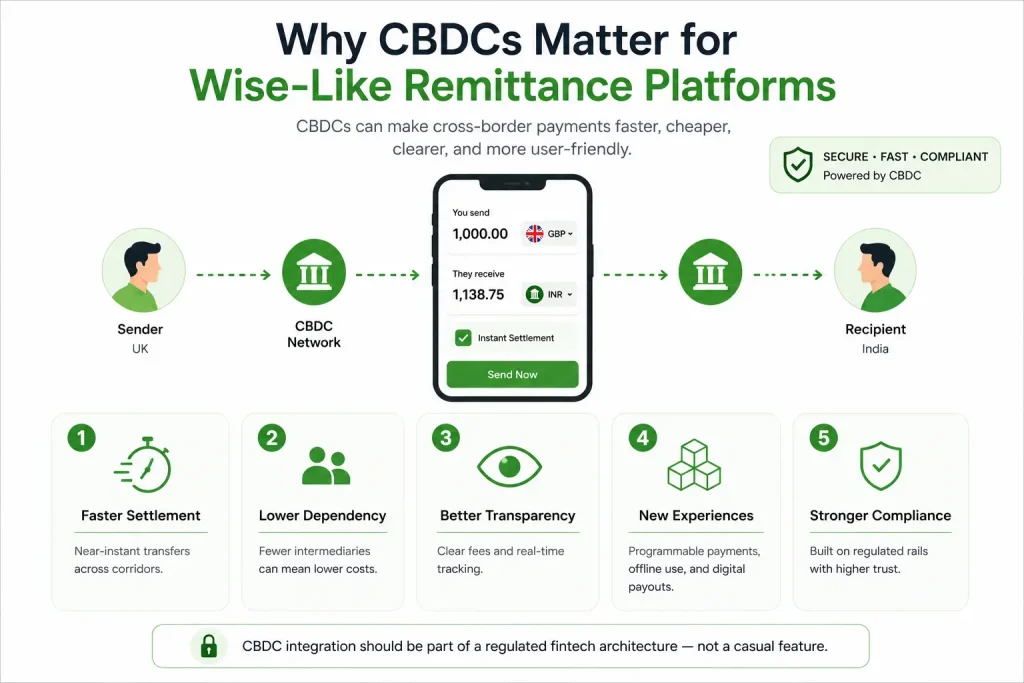
CBDCs could affect remittance apps in five major ways.
1. Faster Settlement Between Corridors
Traditional remittance chains often depend on correspondent banks, liquidity partners, local payout providers, and cut-off times. A CBDC-enabled corridor could reduce settlement delays if participating countries create interoperable digital currency rails.
BIS research on cross-border CBDCs highlights the potential for faster, cheaper, more transparent, and more inclusive cross-border payment services when countries coordinate on design and interoperability.
2. Lower Intermediary Dependency
If central bank digital currencies are designed for cross-border use, some payment flows may require fewer intermediaries. That does not remove the need for licensed entities, compliance, FX controls, or risk monitoring, but it may change the role of remittance operators.
For founders, this means the future remittance app may compete less on “who has the most banking partners” and more on user experience, corridor access, compliance orchestration, liquidity design, and trusted digital wallet infrastructure.
3. Better Transparency for Users
A major complaint in remittance is unclear fee deduction. Users often do not know whether the recipient will receive the expected amount after intermediary charges.
CBDC-enabled payment flows could improve traceability if designed with transparent settlement status, programmable rules, and better end-to-end visibility.
4. New Product Experiences
CBDCs may enable payment experiences that current rails do not handle well, such as programmable disbursements, conditional settlement, merchant CBDC acceptance, offline payments, or government-linked digital payouts.
India’s RBI has described its CBDC and Asset Tokenisation Sandbox as a non-live testing environment for interoperability, programmability, retail, wholesale, cross-border, and asset tokenisation use cases.
5. Stronger Regulatory Expectations
CBDC integration will likely come with stricter obligations around identity, transaction monitoring, data handling, reporting, wallet limits, access rights, and licensed participation.
This is why a CBDC integration payment app should never be treated as a casual crypto feature. It belongs inside a regulated fintech architecture.
The Current State of CBDC Pilots and Cross-Border Experiments
CBDC adoption is not uniform. Some countries have launched CBDCs, some are piloting, some are researching, and some have paused or opposed retail CBDC development.
The Atlantic Council’s CBDC Tracker reports that more than 130 countries, representing most of global GDP, are exploring CBDCs in some form. It also notes that all BRICS members are exploring CBDCs, with several already in pilot stages.
One of the most important cross-border CBDC experiments is Project mBridge, which was built as a multi-central-bank CBDC platform for participating central and commercial banks. BIS stated that Project mBridge reached minimum viable product stage in mid-2024 and was designed to enable instant cross-border payments and settlement using distributed ledger technology.
At the same time, the CBDC landscape remains politically and operationally complex. Reuters reported that BIS planned to leave Project mBridge in 2024, while stating that the project was ready to continue without BIS involvement and was not yet commercially mature.
For founders, the message is clear: CBDCs are important, but they are not plug-and-play global rails yet. A smart remittance founder should prepare architecture, not overpromise availability.
CBDC Integration Payment App: Core Architecture Layers
A CBDC-ready remittance app needs more than a wallet screen. It needs a flexible financial architecture that can support today’s rails and tomorrow’s regulated digital currency rails.
CBDC-Ready Architecture Table
| Layer | What It Does | Why It Matters for Founders |
|---|---|---|
| User wallet layer | Stores balances, linked accounts, transaction history, wallet status | Lets users manage fiat, wallet balance, and future CBDC balances cleanly |
| Ledger layer | Records debits, credits, fees, FX, reversals, settlements | Prevents accounting confusion when multiple rails are used |
| Payment rail abstraction | Connects banks, payment gateways, payout partners, CBDC rails, or sandbox APIs | Avoids rebuilding the app when a new rail becomes available |
| KYC/AML engine | Verifies users, monitors transactions, flags risk | Required for regulated remittance and digital currency flows |
| FX and corridor rules | Handles currency pairs, limits, fees, taxes, delivery methods | Keeps each country corridor configurable |
| Compliance reporting | Generates audit trails, reports, risk logs, and transaction evidence | Helps operators respond to regulator and partner requirements |
| Admin dashboard | Controls users, wallets, rails, fees, limits, disputes, and reports | Gives founders operational control without developer dependency |
| API integration layer | Connects with banks, licensed partners, CBDC sandboxes, identity providers | Keeps the platform adaptable as payment infrastructure evolves |
A ready-made fintech foundation from Miracuves can help founders start with wallet, admin, remittance, compliance, and source-code-owned architecture that can be customized for future rails instead of being locked into one rigid payment provider.
Retail CBDC vs Wholesale CBDC: Which One Matters for Remittance Apps?
Founders often hear “CBDC” as one category. In practice, the product impact depends on the type of CBDC.
| CBDC Type | Main Users | Possible Remittance Impact |
|---|---|---|
| Retail CBDC | Individuals, merchants, consumers | Could allow users to hold or receive digital central bank money in wallets |
| Wholesale CBDC | Banks, financial institutions, settlement participants | Could improve settlement between banks and payment institutions |
| Cross-border multi-CBDC platform | Central banks, commercial banks, licensed institutions | Could enable faster cross-border settlement between jurisdictions |
| Tokenized central bank reserves | Financial institutions | May improve institutional settlement without changing consumer wallet UX directly |
For a Wise-like platform, the earliest practical opportunity may not be direct retail CBDC holding by every user. It may be backend settlement improvement through licensed banks, payment institutions, or wholesale rails.
This distinction matters because founders should avoid building user-facing CBDC promises before understanding access rules. In many markets, fintechs may need to work through banks, licensed wallet providers, payment institutions, or central bank sandbox programs.
How CBDC Integration Could Work in a Remittance Flow
A future CBDC-enabled remittance flow may look like this:
- Sender completes KYC and selects a destination country.
- App checks whether the corridor supports CBDC, bank payout, wallet payout, or cash payout.
- Sender funds the transfer through bank account, card, wallet balance, or approved CBDC wallet.
- Platform applies FX, fees, limits, and compliance screening.
- Settlement happens through a CBDC rail, bank rail, multi-CBDC bridge, or partner institution.
- Recipient receives value through CBDC wallet, local bank account, mobile wallet, or merchant wallet.
- Admin dashboard records the transaction, settlement status, compliance checks, and reconciliation logs.
The user experience should remain simple. The architecture behind it should remain flexible.
That is the strategic difference between a normal transfer app and a future-ready remittance platform.
Founder Decision Signals: Is Your Remittance App Ready for CBDCs?
Founder Decision Signals
Use these signals to assess whether your payment app architecture is ready for future digital currency rails.
| Question | Why It Matters |
|---|---|
| Can your platform add a new payment rail without rebuilding the wallet? | CBDC access may arrive through APIs, banks, sandboxes, or regulated partners. |
| Does your ledger separate user balance, settlement balance, fees, FX, and reversals? | Digital currency flows require clean auditability and reconciliation. |
| Can each payment corridor have different rules? | CBDC regulations will vary by country, currency, user type, and transaction purpose. |
| Does your admin dashboard control limits, risk flags, wallet status, and rail availability? | Operators need control when rails are paused, restricted, or updated. |
| Can your compliance layer support KYC, AML, sanctions screening, and reporting? | CBDC-based remittance will not remove regulatory obligations. |
Digital Currency Readiness: What Founders Should Build Now
CBDC readiness does not mean building speculative features. It means making practical product and architecture decisions that keep your remittance platform adaptable.
1. Build a Rail-Agnostic Payment Architecture
Do not hardcode your app around one payment gateway or one bank partner. Use a payment orchestration layer that can route transactions through multiple rails.
Today, that may include card payments, bank transfers, local payout partners, mobile wallets, and fast payment systems. Tomorrow, it may include CBDC wallets, central bank sandbox APIs, tokenized deposits, or regulated digital settlement networks.
2. Separate Wallet Balance From Settlement Logic
Many early fintech products make a dangerous mistake: they treat displayed user balance, actual settlement status, and provider confirmation as the same thing.
A CBDC-ready remittance app should clearly separate:
- User-facing wallet balance
- Internal ledger entries
- Settlement confirmation
- FX conversion
- Partner payout status
- Refunds and reversals
- Compliance holds
This becomes even more important when a platform supports multiple currencies, jurisdictions, and payment rails.
3. Make KYC/AML Configurable by Corridor
CBDC rules will not be identical everywhere. One country may allow low-value retail wallets with simplified KYC. Another may require stricter verification. Another may restrict cross-border CBDC usage to banks or licensed institutions.
Your app should support corridor-specific compliance logic instead of using one generic onboarding flow for every market.
4. Prepare for Interoperability Standards
Cross-border payment modernization often depends on messaging standards, data formats, interoperability, and aligned operating rules. The World Bank and IMF have highlighted payment system access, operating hours, fast payment system interlinking, AML/CFT, and ISO 20022 harmonization as important areas for cross-border payment improvement.
For founders, this means your app should have clean APIs, structured payment data, strong transaction references, and flexible integration logic.
5. Add Admin Controls for Rail Availability
CBDC pilots may be limited, paused, expanded, or modified by regulators. Your admin panel should allow operators to enable or disable payment methods by:
- Country
- Currency
- User type
- Transaction size
- Risk score
- Compliance status
- Partner availability
- Settlement corridor
This is not just operational convenience. It is risk control.
CBDC Use Cases for Remittance and Wise-Like Platforms
CBDCs could support several future use cases in remittance apps, depending on regulation and access.
1. Instant Cross-Border Family Remittances
Workers sending money home could benefit from faster settlement, transparent fees, and better delivery tracking if CBDC corridors are interoperable.
2. Merchant and Freelancer Payouts
A Wise-like app could support business payments where freelancers, contractors, exporters, or small merchants receive digital currency settlement with clearer transaction records.
3. Government-to-Person Cross-Border Disbursement
CBDCs could support pension payments, aid disbursements, student payments, or social transfers across borders, though this would require strong identity and policy controls.
4. CBDC Wallet-to-Merchant Payments
In countries where CBDC merchant payments are supported, remittance apps may eventually allow recipients to spend funds directly through CBDC wallets or QR-based merchant acceptance.
In India, some bank digital rupee apps already describe merchant QR payment flows where users can pay merchants using CBDC wallets.
5. Programmable Payment Conditions
Some CBDC designs may support programmability, such as restricted-use payments, expiry-based disbursements, escrow-like settlement, or automated release conditions. RBI’s CBDC sandbox language explicitly includes programmability testing as one area of experimentation.
Regulation: The Hardest Part of CBDC Payment App Strategy
The biggest CBDC challenge is not the interface. It is regulation.
A founder cannot simply decide to “add CBDC” the way they add a normal payment gateway. Access may depend on central bank rules, licensed partners, wallet provider eligibility, transaction caps, identity checks, data residency, AML/CFT rules, sanctions screening, and reporting obligations.
For CBDC-enabled remittance apps, founders should prepare for:
| Regulatory Area | Founder Impact |
|---|---|
| Licensing | You may need payment institution, money transfer, wallet, or partner licensing support |
| KYC/AML | User verification and transaction monitoring remain essential |
| Sanctions screening | Cross-border payments require strong screening and risk controls |
| Data protection | Payment apps must protect identity and transaction data |
| Wallet limits | CBDC wallets may have holding or transaction limits |
| Corridor approvals | Some cross-border flows may only work in approved countries |
| Audit trails | Regulators and partners may require transaction evidence |
| Partner dependency | Fintechs may access CBDCs through banks or approved intermediaries |
Miracuves’ fintech approach should be understood as a product and technology foundation that can support compliance workflows. It should not be read as a guarantee of regulatory approval, licensing, or central bank access.
CBDC Integration vs Stablecoin Integration vs Traditional Payment Rails
Founders should not treat CBDCs, stablecoins, and bank rails as interchangeable. Each has different legal, operational, and user-trust implications.
| Payment Rail | Issuer / Operator | Main Strength | Main Risk |
|---|---|---|---|
| Traditional bank rails | Banks and payment networks | Established, widely regulated, trusted | Slower settlement, higher friction, intermediaries |
| Fast payment systems | Domestic payment infrastructure | Real-time domestic payments | Often limited cross-border coverage |
| Stablecoins | Private issuers on blockchain networks | Speed, programmable movement, global crypto liquidity | Regulatory uncertainty, issuer risk, compliance complexity |
| CBDCs | Central banks | Sovereign digital money, potential settlement trust | Limited availability, regulatory access, interoperability challenges |
| Tokenized deposits | Commercial banks | Bank-backed digital settlement | Requires bank participation and standardization |
Japan’s central bank leadership has recently emphasized that future money systems should consider not only CBDCs but also tokenized bank deposits and blockchain-based central bank reserves, showing that the future payment stack may be multi-rail rather than CBDC-only.
For founders, the safest strategic posture is payment rail flexibility.
Read more: Breaking Down the Hidden Costs of Cross-Border Money Transfers
Features a CBDC-Ready Remittance App Should Include
A CBDC integration payment app should include both standard remittance features and future digital currency controls.
User App Features
- User registration and identity verification
- Multi-currency wallet
- Send money flow
- Recipient management
- Exchange rate preview
- Transfer fee transparency
- Payment method selection
- Transaction tracking
- Notifications
- Refund and dispute requests
- CBDC wallet option where legally available
- Transfer purpose selection
- Limits and verification prompts
Recipient Features
- Bank payout
- Wallet payout
- Local currency payout
- CBDC wallet receipt where supported
- QR-based payment use cases where available
- Transfer confirmation
- Transaction receipt
Admin Dashboard Features
- User management
- KYC status management
- Payment rail configuration
- CBDC rail enable/disable controls
- Corridor rules
- FX margin control
- Fees and commissions
- Transaction monitoring
- Compliance alerts
- Refund and reversal management
- Settlement reconciliation
- Partner management
- Audit logs
- Reports and analytics
Compliance Features
- KYC verification
- AML monitoring
- Sanctions screening support
- Device and behavior risk flags
- Transaction limits
- Source of funds workflows
- Suspicious activity review
- Regulatory report export
- User risk scoring
For a Wise-like product, the backend matters as much as the mobile experience. Users see a clean transfer screen. Operators need a control layer that can handle real money movement safely.
Technical Architecture for CBDC Integration Payment Apps
A future-ready CBDC payment app should be built around modular components.
Recommended Technical Layers
| Component | Role |
|---|---|
| Mobile apps | Sender and recipient experience |
| Web dashboard | Business and admin management |
| Wallet service | Balance, wallet status, limits |
| Ledger service | Immutable transaction accounting |
| Payment orchestration | Routing across banks, wallets, gateways, CBDC partners |
| FX engine | Currency conversion, rates, spreads |
| Compliance service | KYC, AML, sanctions, transaction monitoring |
| Notification service | SMS, email, push, transfer alerts |
| Partner API layer | Bank, payout, identity, CBDC sandbox, payment APIs |
| Reporting service | Audit trails, settlement reports, compliance exports |
| Security layer | Encryption, access control, fraud protection |
API Strategy
Your app should be designed so CBDC access can be added as a rail, not as a rebuild.
That means the app should support:
- Payment rail adapters
- Webhook-based status updates
- Idempotent transaction handling
- Secure API authentication
- Event logs
- Sandbox testing
- Partner-specific configurations
- Country-level rail rules
This is where source-code ownership matters. If a founder does not control the codebase, adapting to new CBDC rails, payment APIs, or partner requirements can become slow and expensive.
Monetization Models for CBDC-Ready Remittance Apps
CBDC integration may reduce some settlement friction, but it does not remove the need for a clear revenue model.
| Revenue Model | How It Works | Founder Consideration |
|---|---|---|
| Transfer fee | Flat or percentage fee per transaction | Must remain transparent and competitive |
| FX spread | Margin added to exchange rate | Needs clear disclosure to preserve trust |
| Subscription | Premium users get lower fees or advanced limits | Works better for frequent senders |
| Business accounts | SMEs pay for bulk payouts or international transfers | Useful for freelancer and merchant corridors |
| Wallet services | Stored value, payout options, wallet features | Must comply with local rules |
| API access | Businesses use your payment infrastructure | Requires strong reliability and compliance |
| Partner commissions | Revenue from payout, card, wallet, or banking partners | Must not harm user transparency |
CBDC rails may change cost structures in some corridors, but they will not automatically create a profitable business. Founders still need corridor strategy, user acquisition, liquidity planning, pricing logic, and operational discipline.
Common Mistakes Founders Should Avoid
Mistake 1: Treating CBDC as a Crypto Feature
CBDCs are not private crypto assets. They are central bank-issued digital money. The compliance, access, and trust model is completely different.
Mistake 2: Building Around One Payment Provider
If your whole remittance product depends on one payment gateway or one payout partner, future CBDC integration becomes harder.
Mistake 3: Ignoring Ledger Design
A remittance app without a strong ledger can become fragile when refunds, reversals, FX changes, settlement delays, and compliance holds appear.
Mistake 4: Promising CBDC Support Before Regulation Allows It
Founders should avoid marketing claims that suggest CBDC availability in corridors where the rail is not approved or commercially live.
Mistake 5: Underestimating Compliance
Digital currency does not remove the need for KYC, AML, sanctions screening, reporting, and transaction monitoring. It may increase the importance of these controls.
Mistake 6: Designing Only for Today’s Rails
A fintech app that cannot adapt to new payment rails may become outdated as digital currency infrastructure matures.
How Miracuves Helps Founders Prepare Wise-Like Platforms for Future Rails
A future-ready remittance app needs more than a transfer form. It needs a strong foundation for wallets, users, payment routing, compliance, FX, admin controls, reports, and integrations.
Miracuves helps founders launch white-label fintech and remittance platforms with source-code ownership, branded interfaces, admin dashboards, and customizable payment workflows. For a founder planning a Wise-like platform, this creates a stronger foundation for adding new payment rails, including CBDC-related integrations when they become commercially and legally available.
Relevant Miracuves paths include:
- Wise clone solution for remittance-inspired platforms
- Revolut clone app for fintech wallet and neobank-style experiences
- Fintech app development for custom financial product planning
For ready-made solutions, Miracuves can support faster launch paths where applicable, but CBDC-specific features should always be planned based on jurisdiction, licensing, partner access, and regulator-approved availability.
Conclusion
CBDCs are not yet a universal payment rail for remittance apps. Some markets are testing, some are piloting, some are building sandboxes, and some are still debating the role of digital central bank money.
But the direction is important enough for founders to prepare.
The right move is not to overbuild speculative CBDC features. The right move is to design a remittance platform that can adapt: modular payment rails, clean wallet logic, strong ledger design, configurable compliance, corridor-level rules, and admin control.
For Wise-like platforms, future readiness will depend on architecture. Founders who build flexible systems today will be better positioned when CBDC corridors, digital currency wallets, tokenized deposits, or new settlement rails become commercially useful.
Miracuves helps founders move toward that future with white-label fintech platforms, remittance app foundations, source-code ownership, and customisable payment workflows designed for faster market validation.
Ready to prepare your remittance app for future payment rails? Contact Us to build a CBDC-ready fintech platform with wallet logic, admin control, compliance workflows, and source-code ownership.
FAQs
What is a CBDC integration payment app?
A CBDC integration payment app is a fintech or wallet platform designed to support central bank digital currency payments where legally and technically available. For remittance apps, this may involve CBDC wallets, digital settlement rails, compliance checks, corridor rules, and integration with approved banks or payment institutions.
Can a Wise-like app support CBDC payments?
A Wise-like app can be architected to support CBDC payments in the future, but actual availability depends on central bank rules, licensed access, country-specific regulations, and partner integrations. Founders should prepare the wallet, ledger, compliance, and payment rail layers first.
Are CBDCs available for cross-border remittance today?
Some cross-border CBDC experiments and pilots exist, but CBDCs are not yet universally available for commercial remittance apps. Project mBridge reached minimum viable product stage in 2024, but commercial maturity and regulatory access remain important considerations.
How can founders prepare a remittance app for CBDC integration?
Founders should build modular payment rail architecture, configurable KYC/AML workflows, strong ledger systems, wallet abstraction, settlement tracking, API-ready integrations, and admin controls for corridor-level rules.
Is CBDC the same as stablecoin integration?
No. CBDCs are issued by central banks, while stablecoins are issued by private entities. They differ in regulation, trust model, settlement design, issuer risk, user access, and compliance expectations.
Will CBDCs reduce remittance costs?
CBDCs may reduce some cross-border payment frictions if they are interoperable and properly regulated. However, final user cost still depends on FX spreads, compliance costs, partner fees, payout methods, liquidity, and corridor-specific rules.
What features should a CBDC-ready remittance app include?
A CBDC-ready remittance app should include multi-currency wallets, KYC/AML, transaction monitoring, rail abstraction, FX management, settlement tracking, admin dashboard controls, audit logs, and API integration support.
Can Miracuves build a CBDC-ready payment app?
Miracuves can help founders build white-label fintech and remittance platforms with wallet logic, admin dashboards, source-code ownership, compliance workflow support, and customizable payment architecture. CBDC-specific integration depends on jurisdiction, licensing, central bank access, and available partner APIs.