


Key Takeaways
What You’ll Learn
- Referral programs are one of the strongest growth engines for remittance apps because trusted recommendations can reduce customer acquisition costs while improving user quality.
- The best fintech referral programs reward real financial activity instead of simple app installs or low-quality signups that do not generate long-term value.
- Referral systems in remittance apps must be tied to compliance workflows including KYC verification, transaction completion, fraud monitoring, and wallet controls.
- Good incentive design balances growth with sustainability because rewards that are too aggressive can increase fraud, abuse, and poor-quality acquisition.
- The biggest takeaway for founders is that referral programs work best when growth incentives, transaction logic, analytics, and compliance systems are connected from the beginning.
Stats That Matter
- The article highlights referral program fintech app examples like Wise, Remitly, WorldRemit, and Revolut which use referral rewards tied to verified transfers and completed financial activity.
- Strong referral systems reward meaningful actions such as KYC completion, first successful transfer, repeat transactions, or verified referrals instead of empty registrations.
- Fraud prevention is positioned as a core requirement because referral abuse can damage margins through fake accounts, self-referrals, bonus farming, and identity manipulation.
- Analytics and admin visibility are critical for optimization so fintech teams can monitor referral conversion, reward cost, fraud patterns, retention, and lifetime value.
- The article emphasizes that referral logic should be integrated into the product architecture early rather than added later as a disconnected marketing feature.
Real Insights
- The best remittance referral programs are built around trust because people are more likely to recommend financial apps that feel reliable, transparent, and easy to use.
- Reward timing directly affects user behavior since incentives tied to successful transfers and verified usage encourage stronger transaction quality.
- Referral growth becomes sustainable only when economics are controlled by balancing acquisition rewards against transfer fees, retention, and user lifetime value.
- Admin systems matter as much as user-facing rewards because fintech operators need visibility into abuse patterns, reward triggers, blocked accounts, and referral performance.
- For entrepreneurs, the biggest lesson is to build a Referral Program for Fintech and Remittance Apps around verified transactions, KYC logic, fraud protection, analytics visibility, and long-term user retention instead of short-term signup growth.
Referral Programs for Remittance Apps are one of the strongest growth levers in fintech because money transfer is naturally trust-driven. People do not choose a remittance app only because it has a discount. They choose it because someone they trust says it is fast, reliable, affordable, and safe enough to send money home.
That is why referral programs work differently in fintech compared with casual consumer apps. In a food delivery app, a referral may lead to a small order. In a remittance app, a referral can lead to repeat transfers, wallet usage, FX revenue, and long-term customer value. The reward is not just about the first signup. It is about building a reliable transfer habit.
For founders studying referral program fintech app examples, the real lesson is not simply “give users a bonus.” The stronger lesson is to design a referral system that connects incentives with KYC, first transfer completion, fraud checks, corridor-level economics, and retention. Miracuves helps founders build remittance and fintech app solutions where referral programs are part of a broader product foundation, including wallet flows, admin controls, payment integrations, transaction history, and compliance-ready workflows.
Why Referral Programs Work So Well for Remittance Apps
Remittance is personal. Users often send money to family, support relatives, pay education costs, handle medical needs, or transfer funds across borders for essential expenses. That emotional layer makes trust more important than in many other fintech categories.
A referral program works because it turns an existing user into a trust bridge. Instead of a new user discovering your app through an ad, they hear about it from someone who has already completed a transfer. That reduces hesitation.
For a remittance founder, this matters because paid acquisition can become expensive when multiple brands compete for the same migrant worker, expat, freelancer, or cross-border family audience. Referral growth can reduce dependency on paid channels, but only when the product experience is good enough to recommend.
A referral program will not fix weak transfer reliability, poor FX transparency, slow onboarding, confusing fees, or failed payouts. The product experience must earn the referral before the incentive amplifies it.
Referral Program Fintech App Examples Founders Can Learn From
Public fintech and remittance brands provide useful patterns for founders designing referral systems.
| Fintech App Example | Referral Mechanic | Founder Lesson |
|---|---|---|
| Wise | Users invite friends and receive rewards when referrals qualify. Some invite programs are tied to transfer activity or spending behavior. | Reward qualification should be tied to meaningful financial actions, not low-intent signups. |
| Remitly | Users share a referral link or QR code. The referred friend signs up and sends a first transfer. The referrer receives a reward for the next transfer. | The first successful transfer is a strong activation milestone for remittance referrals. |
| WorldRemit | Referrer and referred user can receive reward vouchers after qualifying transfer conditions are met. | Two-sided rewards can reduce friction for both the inviter and the new user. |
| Revolut | Referral programs may use fixed, variable, or tiered rewards depending on eligibility and completed actions. | Tiered incentives can push users beyond signup toward deeper onboarding steps. |
Wise’s referral page highlights a model where users can invite friends and get rewarded after friends qualify, while Remitly’s referral flow shows a clear three-step path: share link or QR code, friend signs up and sends their first transfer, then the referrer receives a reward.
WorldRemit explains a two-sided reward voucher model where both the referrer and referred friend can receive a reward after the referred user sends a specified minimum amount. Revolut’s public referral terms show that fintech referral programs can use fixed amount rewards, variable rewards, and tiered rewards.
The takeaway is clear: strong fintech referral programs reward verified financial behavior. A signup is useful, but a verified user who sends money is far more valuable.
The Core Referral Flow Every Remittance App Should Design Carefully
A remittance app referral flow should be simple for users but controlled in the backend. The user-facing experience should feel effortless, while the admin and risk layer should validate eligibility before rewards are released.
A practical flow looks like this:
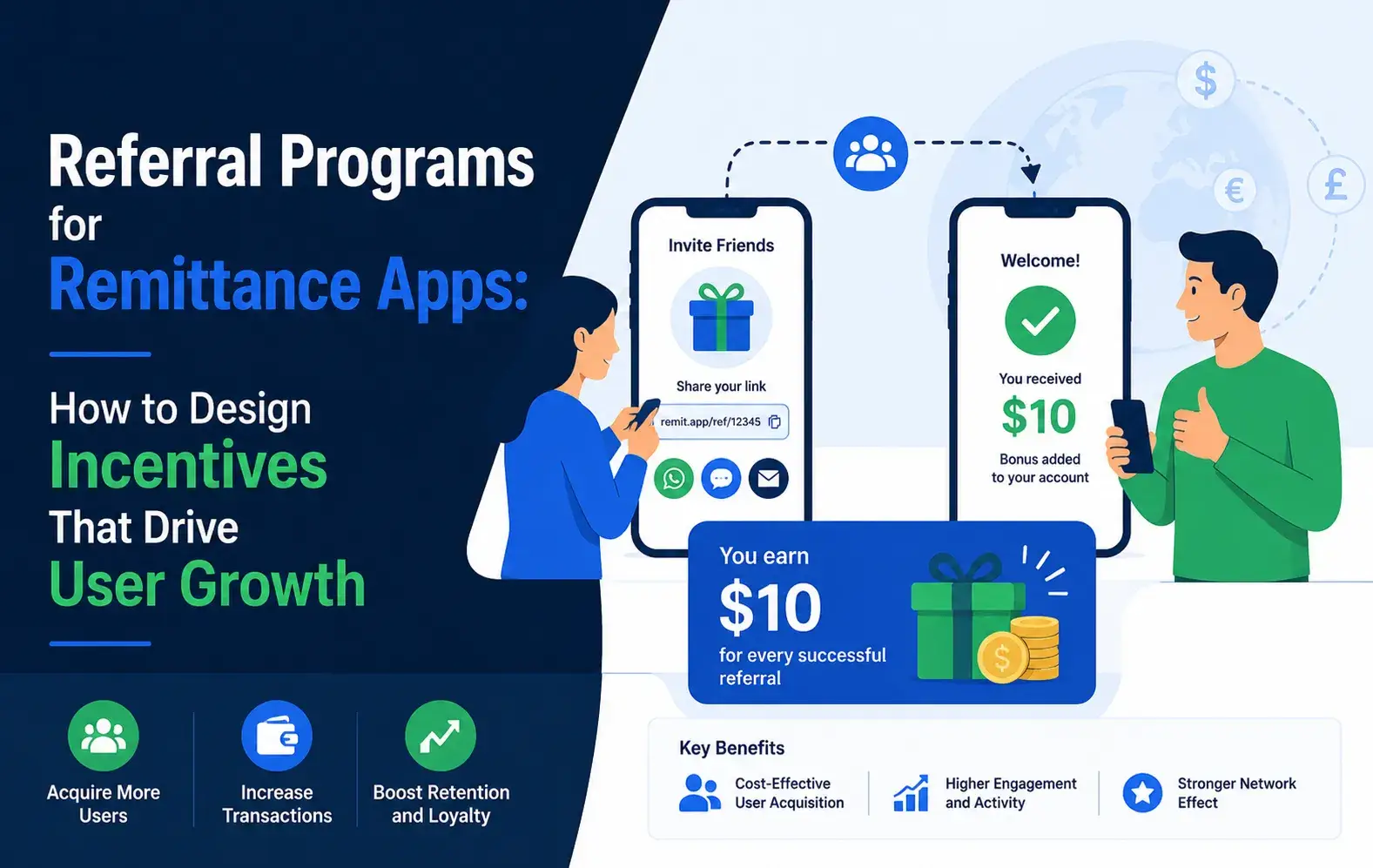
- Existing user opens the referral section.
- The app generates a unique referral link, code, or QR code.
- The user shares it through WhatsApp, SMS, email, or social channels.
- The referred user signs up using the referral identifier.
- The referred user completes KYC or required verification.
- The referred user sends a qualifying first transfer.
- The system checks eligibility, transfer status, fraud signals, and reward rules.
- The referrer and/or referred user receive the reward.
- The app nudges both users toward the next transfer.
The most important decision is when the reward should unlock. In fintech, it is usually risky to reward only for signup because signups can be gamed. It is safer to trigger rewards after a verified, successful, non-reversed transaction.
For remittance apps, “successful transfer” should mean more than payment initiation. The transaction should clear, pass risk rules, and reach the payout stage before the reward is confirmed.
Choosing the Right Incentive Model for a Money Transfer App
The right incentive depends on your margin, user behavior, transfer corridor, payout model, and acquisition goal. A founder should not copy another fintech app’s reward amount without understanding the economics behind it.
| Incentive Model | How It Works | Best For | Risk |
|---|---|---|---|
| Fee credit | User gets a discount or credit toward transfer fees | Price-sensitive remittance users | May reduce fee revenue if overused |
| Wallet credit | Reward is added to in-app wallet balance | Wallet-based fintech apps | Requires strong wallet ledger accuracy |
| Cashback | User receives cash or balance after qualifying action | High-competition corridors | Can attract bonus hunters |
| Voucher reward | User gets a voucher for the next transfer | Repeat transfer growth | Less useful if users transfer rarely |
| Two-sided reward | Both referrer and referred user benefit | Faster adoption and trust-building | Higher reward cost |
| Tiered reward | Higher rewards after more referrals or completed steps | Power users and community-led growth | Can increase fraud risk if not controlled |
| Corridor-specific reward | Reward changes by country pair, currency, or route | Markets with different margins | Requires dynamic admin controls |
The strongest model for many remittance apps is a two-sided reward tied to first successful transfer. The referred user gets a reason to try the app, and the existing user gets a reason to recommend it.
However, corridor economics matter. A $10 reward may make sense in one transfer corridor but not another. If transfer fees, FX margins, payout costs, or compliance costs differ by market, referral rewards should be adjustable by region.
What Makes a Referral Program Profitable Instead of Expensive
A referral program becomes dangerous when the reward is larger than the user’s expected value. Founders should calculate incentives based on business behavior, not marketing excitement.
Before launching a referral program, define:
- Average transfer amount
- Average fee or FX margin per transfer
- Expected repeat transfer frequency
- Cost of payment processing and payout
- KYC and compliance cost
- Fraud risk exposure
- Customer support cost
- Expected user lifetime value
- Reward redemption rate
For example, if users typically send only once, a large reward may not make sense. But if users send every month, a referral reward can be justified because the first transfer may lead to long-term volume.
The reward should encourage the behavior that improves business quality. That may be first transfer, second transfer, wallet funding, card usage, or recurring remittance setup. In a remittance app, rewarding repeat transfer behavior may be more valuable than rewarding only acquisition.
Referral Fraud Risks Fintech Founders Should Plan For Early
Referral fraud is one of the most important risks in fintech growth. A referral program that works well can attract real users. A referral program that is poorly controlled can attract fake accounts, self-referrals, synthetic identities, and reward abuse.
Common risks include:
- One user creating multiple accounts
- Referring themselves using different phone numbers
- Using fake or stolen identity documents
- Completing low-value transfers only to unlock rewards
- Cancelling or reversing transactions after reward release
- Using device farms or referral code spam
- Exploiting country-specific reward differences
- Creating groups solely to farm referral bonuses
This is why referral programs for remittance apps need risk controls built into the product foundation. Important controls include KYC verification, AML workflow support, transaction monitoring, suspicious activity flags, audit logs, role-based admin access, and reward eligibility rules. Miracuves’ fintech content guidelines also position security and compliance workflows as foundational to transaction trust and long-term growth.
A practical rule is simple: do not release the reward until the referred user has completed required verification and a qualifying transfer has been successfully processed.
Features Needed to Build a Scalable Referral Program in a Remittance App
A referral program is not just a coupon field. It needs product, backend, admin, analytics, and risk modules working together.
Referral Program Features for Remittance Apps
| Feature | Business Value | Founder Impact |
|---|---|---|
| Unique referral links and codes | Tracks who invited whom across signup and transaction flows | Creates measurable user acquisition attribution |
| QR code referral sharing | Makes referrals easier in community, family, and offline settings | Useful for migrant communities and local ambassador campaigns |
| KYC-linked reward eligibility | Prevents rewards from being issued to unverified or risky users | Reduces bonus abuse and supports compliance workflows |
| First transfer trigger | Rewards users only after real remittance activity | Improves acquisition quality instead of chasing empty signups |
| Minimum transfer amount rules | Protects margins by requiring meaningful transaction value | Helps align reward cost with revenue potential |
| Country and corridor-based rewards | Allows different incentives based on market economics | Gives founders control over growth spend by geography |
| Admin reward dashboard | Lets operators create, pause, edit, and monitor referral campaigns | Reduces developer dependency for campaign changes |
| Fraud monitoring and audit logs | Tracks suspicious referral behavior and reward history | Protects the fintech business from uncontrolled incentive leakage |
For founders building a remittance product, these modules should connect naturally with wallet history, user verification, payment gateways, transaction status, reward ledgers, and admin reporting.
That is where a strong fintech app foundation matters. A referral program should not sit outside the product. It should be part of the user account, transaction, wallet, and admin ecosystem.
Founder Decision Signals Before Launching Referral Incentives
Founder Decision Signals
Speed
Launch referral campaigns only when onboarding, KYC, first transfer, and payout flows are stable enough to handle new user volume without support friction.
Cost
Set rewards based on expected transfer margin, repeat usage, and user lifetime value. Do not choose reward amounts only because competitors offer them.
Scalability
Use admin controls for country-specific rewards, campaign limits, fraud reviews, and reward status changes so the team can scale without developer dependency.
Market Fit
Referral programs work best after users already trust the transfer experience. If users are not completing transfers, fix product friction before increasing incentives.
How to Structure Referral Rewards by User Journey Stage
A strong referral program rewards the right action at the right time. In remittance apps, every stage has a different business value.
Signup Reward
A signup reward can improve conversion, but it should be small or conditional. If the reward unlocks too early, it may attract low-quality users.
KYC Completion Reward
This is stronger than a signup reward because verified users are more valuable. However, founders still need fraud checks because KYC completion alone does not guarantee transfer intent.
First Transfer Reward
This is usually the most practical activation trigger. It connects the reward to real product usage.
Second Transfer Reward
A second-transfer reward can improve retention. Many users try a fintech app once because of an offer, but the second transfer is a stronger sign of trust.
Milestone Referral Reward
This model rewards users after inviting multiple qualified users. It can work well for community-led growth, but it needs strong fraud detection.
Mistakes Founders Should Avoid
Mistakes Founders Should Avoid
Rewarding signups without transaction proof
Signup-based rewards can create inflated user numbers without real money movement. For remittance apps, first successful transfer is usually a stronger reward trigger.
Using one reward amount for every country
Transfer corridors have different margins, payout costs, and competition levels. A flat global incentive can damage unit economics in low-margin routes.
Ignoring referral fraud controls
Without device checks, identity verification, transaction monitoring, and admin review, referral campaigns can be exploited by fake accounts and self-referrals.
Not tracking repeat transfer behavior
A referral program should not stop at acquisition. Founders should measure whether referred users come back for a second and third transfer.
How Miracuves Helps Build Referral-Ready Remittance Apps
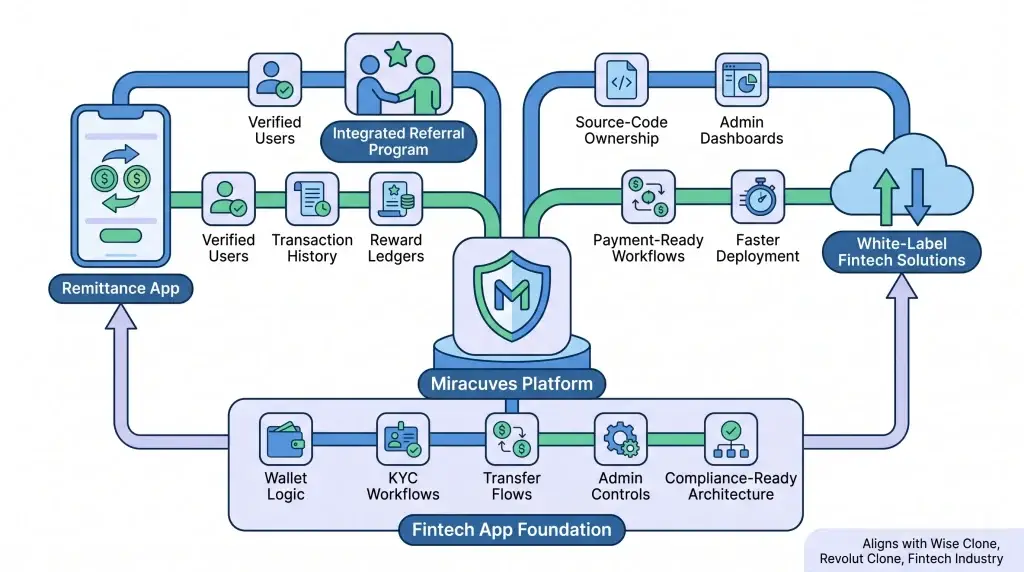
Referral programs work best when they are built into the fintech product foundation from the start. That means the app should support verified users, transaction histories, wallet or reward ledgers, admin campaign controls, payout status tracking, and fraud monitoring.
Miracuves helps founders build white-label fintech and remittance app solutions with source-code ownership, admin dashboards, payment-ready workflows, and faster deployment. For founders exploring a Wise clone solution or Revolut clone app, referral incentives can be planned as part of the growth layer rather than added later as a disconnected promotion.
A remittance founder can also explore fintech app development to understand how wallet logic, KYC workflows, transfer flows, admin controls, and compliance-ready architecture fit together. Miracuves’ internal fintech mapping recommends linking remittance topics to Revolut Clone, Wise Clone, and the fintech industry page because these pages align closely with remittance, wallet, neobank, FX, and compliance-focused use cases.
Final Thoughts: Referral Growth Works When Trust, Timing, and Controls Work Together
Referral programs can help remittance apps grow faster, but only when incentives are tied to real user value. The strongest programs do not reward empty signups. They reward verified users, completed transfers, repeat behavior, and trusted sharing.
The best fintech referral programs balance three things: user motivation, business economics, and risk control. If the reward is too small, users ignore it. If it is too generous, the business loses margin. If it lacks fraud controls, the program can attract the wrong users.
For founders, the smarter approach is to build referral incentives into the product architecture from the beginning. With the right admin controls, KYC logic, transaction triggers, wallet records, and analytics, referral programs can become a sustainable user acquisition engine rather than a short-term discount campaign.
Founders looking to build scalable referral systems for remittance platforms can Talk to Miracuves Experts to explore launch-ready fintech app foundations with referral workflows, user verification, transaction management, and admin control built into the core platform architecture.
What are the best referral program fintech app examples?
Useful referral program fintech app examples include Wise, Remitly, WorldRemit, and Revolut. Wise uses invite-based rewards, Remitly uses referral links or QR codes tied to first transfers, WorldRemit uses reward vouchers, and Revolut shows fixed, variable, and tiered reward structures.
What should a remittance app referral program work?
A remittance app referral program should let existing users invite friends through a unique link, code, or QR code. The referred user should sign up, complete verification, and send a qualifying transfer before the reward is released.
Should fintech apps reward signups or completed transfers?
Completed transfers are usually a stronger reward trigger than signups. Signup-only rewards can attract low-intent users or referral abuse, while transfer-based rewards connect incentives to real business value.
What referral rewards work best for money transfer apps?
Fee credits, wallet credits, cashback, transfer vouchers, two-sided rewards, and tiered rewards can all work. The best option depends on transfer margins, user frequency, country corridors, payout costs, and customer lifetime value.
How can remittance apps prevent referral fraud?
They can use KYC verification, transaction monitoring, device checks, duplicate account detection, minimum transfer thresholds, suspicious activity flags, audit logs, and admin approval controls. Final compliance depends on jurisdiction, legal review, integrations, and operating model.
Are two-sided referral rewards better for fintech apps?
Two-sided rewards often work well because both users benefit. The inviter has a reason to share, and the invited user has a reason to try the app. However, the reward should be tied to a qualifying action such as first successful transfer.
Can referral programs reduce fintech user acquisition costs?
Referral programs can reduce reliance on paid acquisition when the product experience is strong and users trust the service. However, founders should track reward cost, fraud risk, transfer margins, repeat usage, and lifetime value before scaling.
What features are needed to build referral programs in fintech apps?
Key features include referral links, referral codes, QR sharing, KYC-linked eligibility, transfer-based reward triggers, wallet or voucher rewards, admin campaign controls, fraud monitoring, audit logs, and analytics dashboards.