



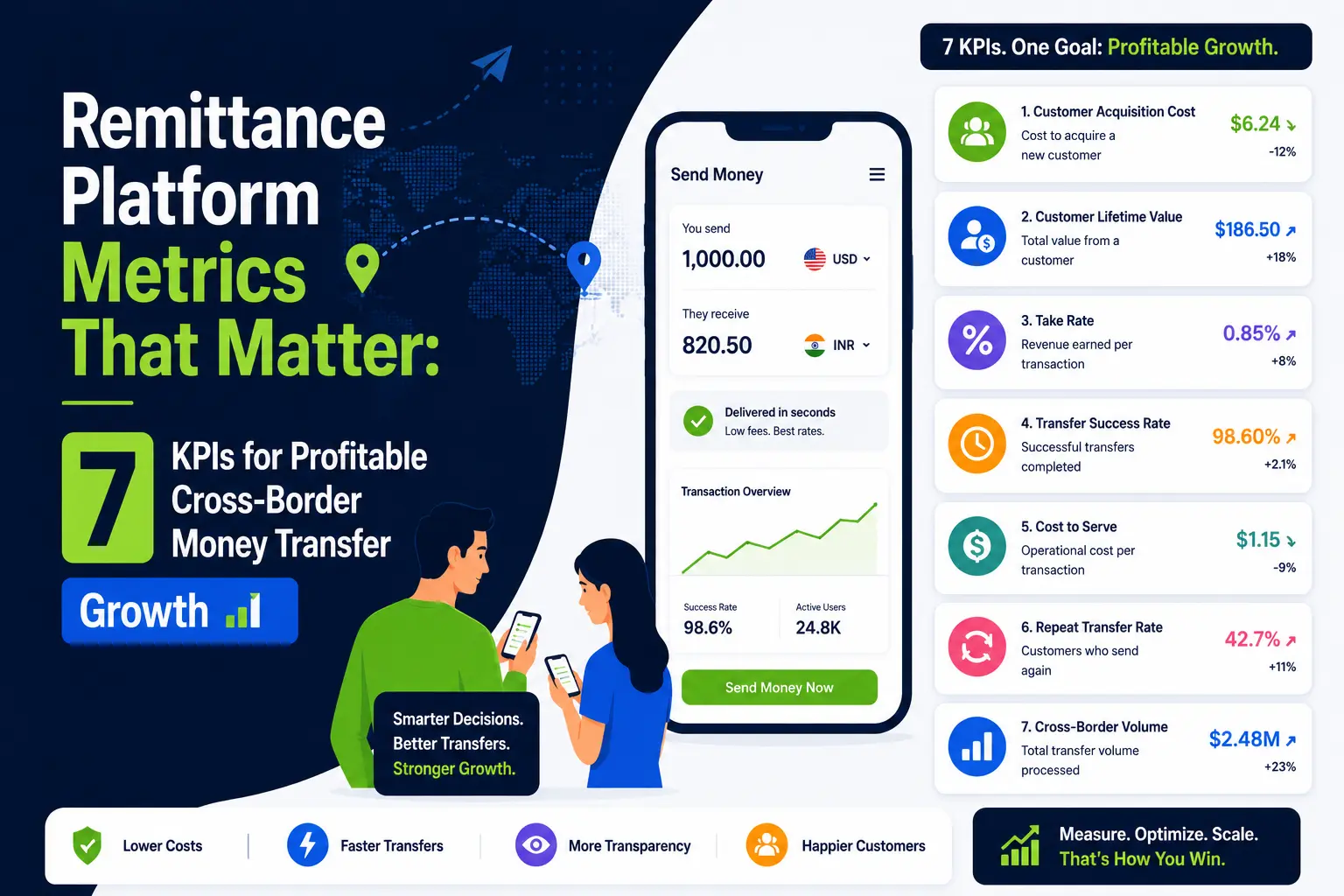
Key Takeaways
- Remittance platform KPIs help founders track profitable cross-border growth.
- LTV:CAC shows whether customer acquisition is financially sustainable.
- Activation metrics reveal how many users complete signup, KYC, and first transfer.
- Corridor profitability matters because every route has different costs and margins.
- The right KPI dashboard helps teams improve growth, retention, compliance, and revenue.
What You’ll Learn
- The 7 remittance KPIs that matter most for money transfer growth.
- Transfer success rate shows how reliable the payment flow is.
- Compliance cost tracking helps measure KYC, AML, and review workload.
- Churn and repeat transfers reveal customer trust and long-term value.
- Growth depends on activation, margins, retention, payout reliability, and cost control.
Real Insights
- High app installs mean little if users do not complete their first transfer.
- Profitable growth depends on corridors, not just total transaction volume.
- Failed transfers hurt trust and increase support and refund costs.
- Compliance should be measured as both a risk and operating cost.
- The best strategy is to track KPIs that connect product usage with real business profit.
Cross-border remittance platforms do not grow profitably just because transaction volume is increasing. A money transfer app can show rising signups, growing transfer value, and more active users while still losing money on expensive corridors, high-friction onboarding, compliance-heavy users, failed payouts, and weak repeat transfer behavior.
That is why the right remittance platform KPIs metrics matter.
For a founder, product manager, or fintech operator, the real question is not simply, “How much money moved through the platform?” The stronger question is, “Which users, corridors, payment methods, and compliance workflows are creating profitable, repeatable growth?”
Remittance businesses operate in a more complex environment than many consumer apps. They deal with sender acquisition, KYC checks, AML monitoring, FX visibility, transfer fees, payout partners, failed transactions, refund handling, regulatory controls, and customer trust. Global remittance pricing is also closely watched; the World Bank’s Remittance Prices Worldwide database tracks costs and speed across major corridors, with the latest highlighted global average remittance cost at 6.36% of the amount sent.
For teams building a money transfer product, the KPI dashboard should connect product usage, revenue quality, risk cost, and corridor economics. Miracuves helps founders build ready-made and white-label fintech platforms with source-code ownership, admin control, and compliance-ready workflows, which makes analytics planning easier from the beginning.
Why Transaction Volume Alone Misleads Remittance Founders
Transaction volume is useful, but it is not enough.
A remittance platform may process a high total transfer value and still struggle if the business is acquiring users through expensive incentives, serving corridors with low margins, spending heavily on manual compliance review, or losing users after one transfer.
For example, two corridors can look similar at the surface:
| Corridor | Monthly Transfer Volume | Revenue | Compliance Workload | Refunds / Failures | Profitability |
|---|---|---|---|---|---|
| Corridor A | High | Medium | Low | Low | Strong |
| Corridor B | High | High | High | High | Weak |
The second corridor may look attractive because of high revenue, but after KYC workload, payout partner cost, support tickets, refunds, and failed transfer handling, the margin may be weaker than expected.
This is why remittance analytics must be corridor-aware, user-cohort-aware, and compliance-aware. A founder should be able to see not only how much money moved, but which transfer flows create sustainable contribution margin.
Read More : The Hidden Cost of Remittance Compliance: Budgeting for KYC, AML, Screening, and Audits
What Makes Remittance KPIs Different From Generic Fintech Metrics?
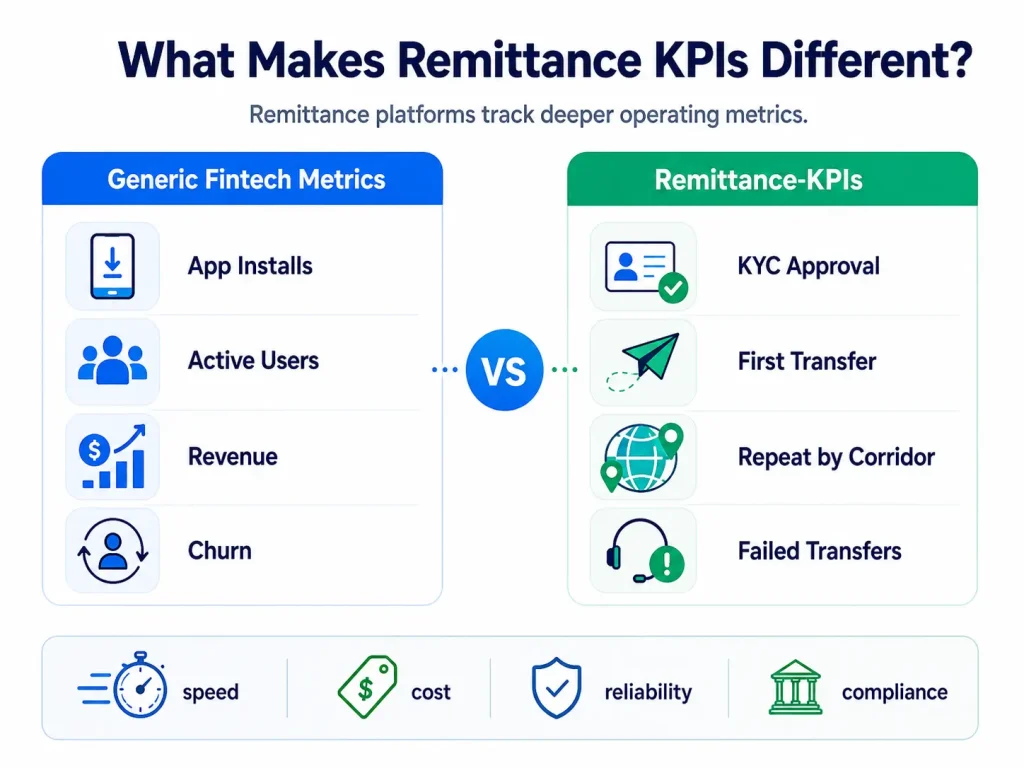
Generic fintech metrics often focus on app installs, active users, wallet balance, revenue, CAC, and churn. Remittance platforms need those numbers, but they also need deeper operating metrics.
A remittance business depends on:
- sender onboarding and KYC approval,
- first successful transfer,
- repeat transfers by corridor,
- average transfer value,
- fee and FX revenue,
- payout rail reliability,
- compliance review cost,
- transaction monitoring workload,
- refunds and failed transfers,
- support effort per transfer,
- sender trust and repeat usage.
Stripe’s cross-border payment guidance highlights speed, cost, error rates, and compliance as important performance dimensions when comparing cross-border providers. In remittance products, those dimensions should not sit only inside operations. They should become product analytics KPIs that founders review regularly.
Read more: Remittance Funnel Optimization: How to Improve Signup, KYC, and First Transfer Conversion
The 7 Remittance Platform KPIs Metrics That Matter Most
1. LTV:CAC by Corridor
LTV:CAC compares the lifetime value of a customer with the cost of acquiring that customer. In simple terms, it tells whether customer acquisition is economically justified. Klipfolio defines LTV:CAC as the relationship between customer lifetime value and customer acquisition cost, with the ratio calculated by dividing LTV by CAC.
For remittance platforms, the mistake is calculating one blended LTV:CAC across the entire business.
A user sending money from the UK to India may behave differently from a user sending money from the US to Mexico, UAE to Philippines, Canada to Nigeria, or Australia to Nepal. Each corridor may have different acquisition cost, transfer frequency, average transfer value, payout cost, FX spread, refund rate, and compliance workload.
Formula:
LTV:CAC by corridor = Estimated lifetime gross profit per sender in corridor / acquisition cost per sender in corridor
What to include in LTV:
- transfer fees,
- FX margin,
- repeat transfer frequency,
- expected retention period,
- referral value,
- gross margin after payout and processing costs.
What to include in CAC:
- paid ads,
- affiliate commission,
- referral bonuses,
- onboarding incentives,
- sales or partnership cost,
- campaign-specific creative and tooling cost.
Founder insight:
If one corridor has high signup volume but low LTV:CAC, scaling that corridor may increase losses. If another corridor has slower acquisition but stronger repeat transfer behavior and lower compliance cost, it may deserve more investment.
2. Activation Rate: Signup to First Successful Transfer
In remittance, activation should not mean “user created an account.” It should mean the user completed the first successful transfer.
A sender who signs up but never completes KYC, never adds a recipient, or abandons the transfer quote is not yet activated. For remittance platforms, activation is the moment trust turns into action.
Formula:
Activation rate = Users who complete first successful transfer / New registered users
You can also break activation into micro-conversion steps:
| Funnel Step | What It Measures | Why It Matters |
|---|---|---|
| Account created | Initial interest | Shows acquisition quality |
| KYC started | Compliance willingness | Reveals onboarding clarity |
| KYC approved | Verification success | Shows identity workflow health |
| Recipient added | Transfer intent | Indicates user is close to value |
| Quote viewed | Price evaluation | Tests fee and FX transparency |
| Transfer funded | Payment confidence | Shows checkout trust |
| Transfer completed | True activation | Confirms product value |
Founder insight:
If signup is strong but first transfer is weak, the issue may be onboarding friction, unclear fees, failed KYC, poor payment method coverage, or lack of trust signals.
3. Compliance Cost Per Verified User
Compliance is not only a legal requirement. It is also an operating cost that directly affects remittance unit economics.
FATF’s risk-based guidance for money or value transfer services emphasizes controls that are commensurate with identified ML/TF risks. For founders, that means compliance should be measured in relation to user risk, corridor risk, and operational workload.
Formula:
Compliance cost per verified user = Total compliance-related cost / Number of verified users
You can also track:
Compliance cost per completed transfer = Total compliance-related cost / Completed transfers
Include costs such as:
- identity verification vendor fees,
- document verification,
- sanctions screening,
- AML monitoring tools,
- manual review team cost,
- compliance operations software,
- suspicious activity review workload,
- audit preparation and reporting effort.
Founder insight:
A high compliance cost is not automatically bad if it supports high-value, high-retention users. But if low-value users require heavy review and rarely repeat transfers, they can damage profitability.
4. Corridor Profitability
Corridor profitability is one of the most important remittance KPIs because every corridor behaves like a separate business line.
A corridor includes origin country, destination country, currencies, payment methods, payout methods, bank partners, FX spread, local regulations, customer support patterns, and fraud risk. That means one global average margin can hide serious business problems.
Formula:
Corridor profit = Fee revenue + FX margin - payment cost - payout cost - compliance cost - support cost - refund/failure cost - promotional cost
Track this by:
- country pair,
- currency pair,
- payment method,
- payout method,
- customer segment,
- acquisition channel.
Founder insight:
A corridor with lower volume but strong repeat usage, low failure rate, and low support cost may be more valuable than a high-volume corridor with thin margins and frequent disputes.
5. Transfer Success Rate and Failure Cost
Transfer success rate measures whether the platform reliably completes money movement from sender to recipient.
Formula:
Transfer success rate = Completed transfers / Initiated transfers
But the deeper metric is not only failure rate. It is failure cost.
Formula:
Failure cost per transfer = Refund cost + support cost + payout reversal cost + partner fee loss + user incentive recovery / Failed transfers
Failures can happen due to:
- incorrect recipient details,
- payment authorization failure,
- payout partner downtime,
- KYC or AML hold,
- bank rejection,
- currency or settlement issue,
- sender funding failure,
- recipient account mismatch.
Founder insight:
Failed transfers hurt more than revenue. They damage trust. In remittance, a failed transfer may mean a family member does not receive urgent funds on time. Teams should treat transfer success rate as a trust metric, not only an operations metric.
6. Repeat Transfer Rate and Churn
Churn in remittance is different from subscription churn. A sender may not transact every week or month, but still be a healthy customer if their transfer pattern is seasonal, salary-based, family-based, or event-based.
This makes cohort analysis important.
Track:
- first-to-second transfer conversion,
- 30-day repeat transfer rate,
- 60-day repeat transfer rate,
- 90-day active sender rate,
- transfer frequency per active sender,
- inactive sender reactivation rate.
Formula:
Repeat transfer rate = Users who make another transfer within period / Users who completed first transfer
Churn signal:
Churned sender = Previously active sender with no transfer activity after expected transfer window
Founder insight:
Do not define churn too aggressively. A monthly salary remitter, quarterly education payer, and seasonal family sender may have different expected behavior. Better churn analysis comes from segmenting users by corridor, use case, and historical transfer rhythm.
7. Net Revenue Per Transfer After Risk and Operating Costs
Many remittance teams track gross revenue per transfer. The better KPI is net revenue after direct cost, risk cost, compliance workload, and support effort.
Formula:
Net revenue per transfer = Transfer fee + FX margin - payment processing cost - payout cost - compliance cost allocation - refund/failure cost - support cost
This metric helps founders understand whether each transfer is truly contributing to the business.
Track it by:
- corridor,
- transfer size,
- user type,
- payment method,
- payout method,
- acquisition cohort,
- risk segment.
Founder insight:
A high transfer fee does not guarantee profitability if the payment method is expensive, payout rail is unreliable, or compliance review is heavy. Net revenue per transfer gives a cleaner view of scalable growth.
7 Remittance Platform KPIs and Their Business Value
| KPI | What It Measures | Founder Impact |
|---|---|---|
| LTV:CAC by Corridor | Whether acquisition spend creates long-term value in each route | Helps decide which corridors deserve more marketing budget |
| Activation Rate | Signup-to-first-successful-transfer conversion | Reveals onboarding, KYC, pricing, and trust friction |
| Compliance Cost Per Verified User | Operational cost of verification and risk review | Shows whether compliance workload is hurting unit economics |
| Corridor Profitability | True margin by country pair, currency, and payout route | Prevents teams from scaling high-volume but weak-margin corridors |
| Transfer Success Rate | Reliability of completed transfers | Protects trust, retention, and support efficiency |
| Repeat Transfer Rate | Whether activated users return and send again | Indicates product-market fit and sender trust |
| Net Revenue Per Transfer | Revenue after direct costs, risk, compliance, and support | Clarifies whether growth is profitable or subsidized |
How to Build a Remittance KPI Dashboard Founders Can Actually Use
A useful dashboard should not be a wall of numbers. It should help teams decide what to fix, scale, pause, or investigate.
A practical remittance KPI dashboard should have four layers.
Product Layer
This layer tracks user behavior.
Include:
- signup conversion,
- KYC start rate,
- KYC approval rate,
- recipient creation rate,
- quote-to-transfer conversion,
- first transfer completion,
- repeat transfer rate.
This helps product teams identify friction before it becomes churn.
Business Layer
This layer tracks economic quality.
Include:
- LTV:CAC by corridor,
- CAC by channel,
- net revenue per transfer,
- gross margin by corridor,
- contribution margin,
- promo cost per activated sender.
This helps founders understand whether growth is financially healthy.
Operations Layer
This layer tracks transfer reliability.
Include:
- transfer success rate,
- payout failure rate,
- average completion time,
- refund rate,
- support tickets per transfer,
- dispute resolution time.
This helps operations teams protect customer trust.
Compliance Layer
This layer tracks risk and review workload.
Include:
- KYC approval time,
- manual review rate,
- AML alert rate,
- compliance cost per verified user,
- blocked transfer rate,
- audit log completeness,
- high-risk user share.
Miracuves’ fintech solution positioning emphasizes admin control, KYC/AML workflows, wallet ledger accuracy, transaction history, and compliance-ready architecture for remittance and fintech platforms.
Founder Decision Signals
Speed
If users register quickly but fail to complete their first transfer, the platform may have onboarding, KYC, payment, or trust friction rather than an acquisition problem.
Cost
If CAC looks acceptable at a blended level but weak by corridor, the team may be overspending on channels that attract low-margin or low-retention senders.
Scalability
If transfer volume grows faster than compliance and support efficiency, the platform may scale operational burden instead of scalable profit.
Market Fit
If first-to-second transfer conversion is strong in a corridor, that route may have deeper product-market fit than a larger but less loyal corridor.
What Healthy vs Risky Remittance Growth Looks Like
The most useful insight comes from reading KPIs together.
| KPI Pattern | What It May Mean | Founder Action |
|---|---|---|
| High signup, low first transfer | Acquisition works, activation fails | Fix onboarding, KYC, quote clarity, and trust signals |
| High volume, low net revenue | Growth may be subsidized | Review corridor pricing, payout cost, and promotions |
| Strong activation, weak repeat usage | Users test once but do not build trust | Improve delivery reliability, pricing transparency, and lifecycle communication |
| High LTV:CAC, high compliance cost | Valuable users but operationally heavy | Automate risk review carefully and segment by risk level |
| Low failure rate, low margin | Reliable but under-monetized corridor | Review fee model, FX margin, and partner costs |
| High CAC, high repeat rate | Expensive but potentially valuable acquisition | Calculate payback period before scaling spend |
Mistakes Teams Make When Measuring Remittance Growth
Mistakes Founders Should Avoid
Using Transaction Volume as the Main Success Metric
Transaction volume can grow while margins decline. Founders should track net revenue per transfer, corridor profitability, and repeat transfer behavior alongside volume.
Blending All Corridors Into One Average
A global average hides corridor-level differences in CAC, FX margin, payout cost, compliance workload, and churn. Corridor-level reporting is essential for profitable scaling.
Ignoring Compliance Cost in Unit Economics
KYC, AML monitoring, manual review, audit logs, and risk operations all affect profitability. Treat compliance as part of the product foundation, not an afterthought.
Counting Signup as Activation
In remittance, the real activation event is the first successful transfer. Anything before that is only funnel progress.
Read More : Referral Programs for Remittance Apps: How to Design Incentives That Drive User Growth
How Miracuves Helps Build Analytics-Ready Remittance Platforms
A remittance KPI strategy works better when the product foundation is designed to capture the right data from day one.
A fintech app needs more than attractive screens. It needs user onboarding, KYC workflows, transfer creation, recipient management, wallet ledger logic, transaction history, FX visibility, payout workflows, admin review, risk flags, and reporting. Without those layers, teams struggle to measure the metrics that matter.
For founders planning to launch a cross-border money transfer business, Miracuves offers a Wise clone solution that can be customized around remittance flows, admin controls, fee logic, FX visibility, and compliance-ready workflows. Teams exploring broader digital banking models can also review the Revolut clone app or the fintech app development page for related wallet, neobank, and money movement use cases.
Miracuves does not guarantee legal approval or regulatory authorization. Final compliance depends on jurisdiction, legal review, banking partners, payment integrations, operating model, and regulator expectations. The product advantage is having a stronger operational foundation to support KYC, AML workflows, transaction monitoring, admin access controls, audit logs, and growth analytics.
Conclusion
The strongest remittance platforms do not measure growth only by transaction volume. They measure whether the right users are activating, returning, sending through profitable corridors, completing transfers successfully, and creating net revenue after compliance, payout, support, and risk costs.
For founders, the goal is not to build a dashboard full of vanity numbers. The goal is to create a decision system.
Track LTV:CAC by corridor. Measure activation by first successful transfer. Watch compliance cost per verified user. Understand repeat transfer behavior. Separate gross revenue from net revenue. Most importantly, treat every corridor as its own business case.
That is how remittance teams move from growth to profitable growth.
Ready to build a remittance platform that tracks growth, compliance, and profitability from day one? Contact Us to launch a white-label, source-code-owned money transfer solution with admin control and scalable fintech workflows.
FAQs
What are the most important remittance platform KPIs metrics?
The most important remittance platform KPIs are LTV:CAC by corridor, activation rate, compliance cost per verified user, corridor profitability, transfer success rate, repeat transfer rate, and net revenue per transfer. These metrics help teams measure profitable growth instead of only tracking transaction volume.
Why should remittance platforms track LTV:CAC by corridor?
Remittance platforms should track LTV:CAC by corridor because each country pair has different acquisition costs, transfer frequency, FX margin, payout cost, compliance workload, and retention behavior. A blended LTV:CAC ratio can hide unprofitable corridors.
What is activation in a remittance app?
Activation in a remittance app should mean the first successful transfer, not just signup. A user becomes truly activated when they complete onboarding, pass verification, add a recipient, fund the transfer, and the recipient receives the money successfully.
How do you calculate corridor profitability in a money transfer platform?
Corridor profitability is calculated by adding transfer fee revenue and FX margin, then subtracting payment processing cost, payout cost, compliance cost, support cost, refund cost, failed transfer cost, and promotional cost for that corridor.
Why is compliance cost an important KPI for remittance platforms?
Compliance cost is important because KYC, AML monitoring, manual reviews, audit logs, and transaction checks directly affect unit economics. A platform may grow quickly but become operationally expensive if compliance workload increases faster than revenue.
How should remittance platforms measure churn?
Remittance platforms should measure churn based on expected transfer behavior. Instead of using one fixed monthly churn definition, teams should segment users by corridor, transfer frequency, salary cycle, family transfer pattern, and seasonal use case.
What dashboard should a remittance founder review weekly?
A remittance founder should review activation rate, first-to-second transfer conversion, corridor profitability, transfer success rate, failed payout reasons, compliance review workload, net revenue per transfer, and LTV:CAC by acquisition channel.
How can Miracuves help with remittance platform development?
Miracuves helps founders build ready-made and white-label remittance and fintech app solutions with source-code ownership, admin dashboards, custom branding, transaction workflows, and compliance-ready foundations that can support KYC, AML, wallet, and transfer management needs.