

Key Takeaways
What You’ll Learn
- Remittance compliance involves far more than payment processing and requires continuous regulatory oversight.
- KYC, AML, sanctions screening, fraud monitoring, audits, and reporting systems create significant operational costs.
- Compliance infrastructure becomes more complex as fintech platforms expand across countries and currencies.
- Automated compliance systems help reduce risk, improve scalability, and support regulatory readiness.
- The goal is to help founders understand the hidden compliance expenses involved in launching and scaling remittance platforms.
Stats That Matter
- Remittance platforms must comply with evolving regulations across multiple countries and financial jurisdictions.
- Identity verification, transaction monitoring, and sanctions screening often require third-party compliance providers.
- Manual compliance operations become difficult to manage as transaction volume and user activity increase.
- Regulatory audits, reporting requirements, and fraud prevention systems add ongoing operational overhead.
- Scalable fintech infrastructure depends heavily on strong compliance automation and risk management systems.
Real Insights
- Many founders underestimate compliance costs because they focus only on payment APIs and app development.
- Compliance failures can create legal exposure, transaction restrictions, operational delays, and reputational damage.
- Automated KYC and AML workflows improve scalability while reducing manual review workloads.
- Flexible compliance architecture helps fintech platforms adapt to future regulations and market expansion.
- Long-term remittance platform growth depends on balancing compliance readiness, operational efficiency, scalability, and customer trust.
Building a remittance app is not just about creating a sleek money transfer experience. The real cost often sits behind the interface: KYC, AML, sanctions screening, transaction monitoring, audit logs, legal review, compliance staffing, reporting workflows, and ongoing regulator readiness.
That is why founders searching for a remittance compliance cost breakdown need more than a generic app development estimate.
A money transfer platform handles sensitive user data, cross-border transactions, sender and receiver identities, payment rails, FX workflows, and transaction histories. Every one of those layers can create compliance obligations depending on the target jurisdiction, licensing model, operating structure, corridors, transaction volume, and partner integrations.
The mistake many fintech founders make is budgeting only for app development. They plan screens, wallets, transfer flows, dashboards, and payment integrations, but underestimate the cost of staying compliant after launch.
FATF guidance for money or value transfer services emphasizes a risk-based approach, where AML/CFT controls should be proportionate to the risks of the business model, product, transaction behavior, customer base, and operating corridors. For U.S. money services businesses, FinCEN registration rules and AML program obligations can also apply depending on the business model.
Miracuves helps founders build fintech and remittance app foundations with compliance-ready workflows, admin controls, KYC/AML support layers, audit logs, and source-code-owned flexibility. Final legal compliance always depends on jurisdiction, legal review, licensing, integrations, and the operating model.
Why Remittance Compliance Costs Are Often Underestimated
Most early-stage fintech budgets focus on visible product work
- mobile app design
- sender and receiver flows
- wallet or balance screens
- transaction history
- payment gateway integration
- admin dashboard
- notifications
- support workflows
Those features matter. But a remittance business also needs invisible infrastructure that regulators, banking partners, payment providers, and auditors care about.
This can include identity checks, customer risk scoring, transaction monitoring, sanctions screening, suspicious activity workflows, audit trails, data retention, reporting, staff training, and policy documentation.
The cost is underestimated because compliance is not a single feature. It is a continuous operating system.
A founder may ask, “How much does it cost to build a remittance app?” But the stronger question is:
How much does it cost to launch, monitor, review, and operate a remittance business responsibly?
That difference changes the budget.
What Counts as Remittance Compliance Cost?
A proper remittance compliance budget should include both technical and operational costs.
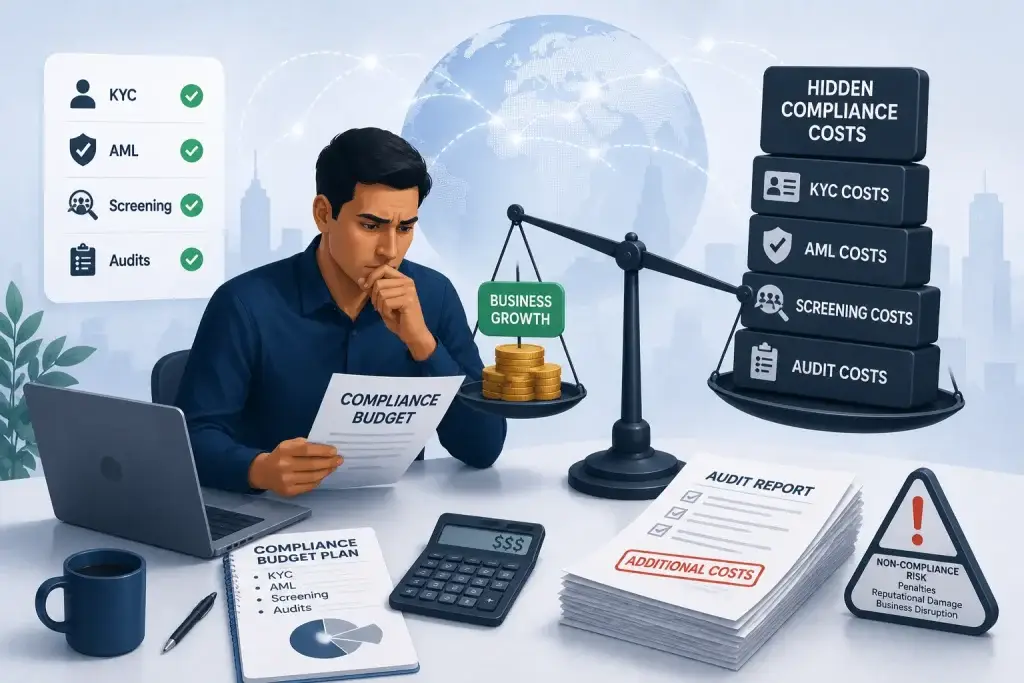
Remittance Compliance Cost Breakdown
| Cost Category | What It Covers | Why It Matters |
|---|---|---|
| Legal and licensing review | Jurisdiction analysis, money transmitter rules, operating model review, legal documentation. | Helps founders understand whether they need licenses, partners, registrations, or specific operating structures. |
| KYC verification | ID verification, document checks, selfie/liveness checks, address checks, business verification where needed. | Helps verify users before allowing transfers and reduces identity fraud risk. |
| AML transaction monitoring | Rules, alerts, thresholds, suspicious behavior detection, case review workflows. | Helps detect unusual transaction patterns and supports AML program operations. |
| Sanctions and PEP screening | Screening users against sanctions lists, politically exposed person data, watchlists, and adverse media sources. | Helps reduce risk of prohibited or high-risk transactions. |
| Compliance case management | Alert queues, manual review, escalation, investigation notes, evidence storage. | Gives compliance teams a structured way to review and resolve risk alerts. |
| Audit logs and reporting | Records of user actions, admin decisions, transaction changes, screening results, and review outcomes. | Supports accountability, internal audits, partner review, and regulator readiness. |
| Compliance staffing | Compliance officer, analysts, operations support, training, escalation ownership. | Tools alone do not run a compliance program. People must review, document, and act. |
| External audits and reviews | Independent AML reviews, security assessments, policy reviews, partner due diligence support. | Helps validate that controls are working and that gaps are addressed over time. |
| Ongoing monitoring and updates | Policy updates, rule tuning, new corridor risk review, vendor updates, regulatory changes. | Compliance costs continue after launch as the platform scales. |
KYC Costs: Identity Verification Is Only the First Layer
KYC, or Know Your Customer, is often the first compliance cost founders notice. It usually appears during onboarding when users submit personal information and documents before sending or receiving money.
KYC costs may include:
- identity document verification
- selfie or liveness verification
- address verification
- phone and email verification
- duplicate account detection
- business verification for corporate accounts
- beneficial ownership checks where applicable
- manual review for failed verification
- re-verification for expired documents
- vendor API charges
- storage and audit records
The cost is not only the API fee. Founders also need to budget for failed checks, manual review, user support, user drop-off, and product design.
A poor KYC flow can reduce conversion. A weak KYC flow can increase fraud and compliance risk. A strong KYC flow balances verification, friction, and risk.
For a remittance app, KYC should be connected to transaction limits, corridor risk, user risk level, payout method, and transfer size. Low-risk users may need a lighter flow, while higher-risk users may require enhanced review. This is where the risk-based approach becomes practical.
AML Costs: Transaction Monitoring Is a Recurring Expense
AML, or Anti-Money Laundering, goes beyond user onboarding. It includes ongoing controls designed to detect suspicious activity after users start transacting.
ACAMS defines AML controls as measures that help prevent criminals from disguising illegally obtained funds as legitimate funds, and AML programs typically include a wider set of controls beyond KYC. ACI Worldwide similarly notes that AML includes transaction monitoring, suspicious activity reporting, sanctions screening, employee training, and internal controls beyond identity checks.
AML costs may include:
- transaction monitoring software
- rule configuration
- alert generation
- suspicious pattern detection
- case management tools
- analyst review time
- escalation workflows
- report preparation
- audit logs
- periodic rule tuning
- fraud monitoring integration
- ongoing customer risk scoring
This is where remittance compliance becomes expensive over time. As transaction volume grows, alerts grow. If rules are too strict, compliance teams drown in false positives. If rules are too loose, risk increases.
A founder’s AML budget should account for both technology and human review.
Sanctions Screening and Watchlist Costs
Sanctions screening is a major cost layer for cross-border remittance apps. A platform may need to screen senders, receivers, business users, counterparties, and sometimes transaction metadata depending on the operating model.
Screening may include:
- sanctions lists
- politically exposed persons checks
- adverse media screening
- watchlist screening
- country risk checks
- repeated screening after list updates
- receiver screening
- business entity screening
- name matching and fuzzy matching
- false positive review
Sanctions screening can create hidden operational costs because names may match partially, transliteration can create ambiguity, and common names can generate false positives. The tool may produce the alert, but a trained team often needs to review and document the decision.
For founders, this matters because a low-cost screening tool may still create high manual review costs if the alert quality is poor.
Audit and Reporting Costs
Audits are often missing from early fintech budgets. Yet remittance platforms need records that show what happened, who approved it, when it happened, why a decision was made, and what evidence supported the decision.
Audit-related costs may include:
- system audit logs
- admin action logs
- transaction change history
- KYC result storage
- screening result storage
- compliance case notes
- suspicious activity documentation
- internal review records
- external AML audit support
- policy version history
- staff training records
- regulator or partner reporting preparation
Audit readiness is not something to add later. If the app does not record the right events from the beginning, the business may struggle to prove how decisions were made.
This is why a remittance app should include audit logs, permission-based dashboards, admin access controls, secure API integration, encrypted data transfer, and transaction monitoring support as part of the product foundation.
Legal, Licensing, and Partner Due Diligence Costs
Legal cost depends heavily on jurisdiction and operating model. A remittance platform may need to evaluate whether it requires licensing, registration, sponsorship by a licensed partner, banking partnerships, money transmitter approval, or other regulatory arrangements.
For example, in the U.S., FinCEN says MSB registration must be filed within 180 days after the MSB is established and renewed every two years. The IRS MSB information center also states that MSBs are required to develop and implement an AML compliance program.
Legal and licensing costs may include:
- jurisdiction review
- corridor risk review
- licensing research
- regulator communication
- compliance policy drafting
- banking partner due diligence
- terms and privacy policy review
- data protection review
- money transmitter analysis
- cross-border payout model review
- agent or partner structure review
Founders should not assume that a remittance app can launch globally with one universal compliance setup. The target countries, transaction corridors, user types, payout methods, and partner model all affect the compliance budget.
Compliance Staffing Costs
Many founders budget for software tools but forget people.
A remittance compliance program may need:
- compliance officer
- AML analyst
- KYC operations reviewer
- fraud analyst
- customer support escalation team
- legal advisor
- audit partner
- data protection advisor
- technical security support
Even with automation, humans are needed for policy ownership, case review, escalations, exception handling, staff training, and documentation.
This cost grows with:
- transaction volume
- number of corridors
- number of currencies
- false positive rates
- customer risk level
- regulatory obligations
- manual review percentage
- support ticket volume
- partner reporting requirements
A founder planning a remittance launch should think in terms of monthly operating cost, not only launch cost.
Technology Costs Behind Compliance-Ready Remittance Apps
Compliance also affects the product architecture.
A remittance app needs more than user onboarding and transaction screens. It may need backend modules such as:
- identity verification integration
- customer risk scoring
- receiver risk scoring
- transaction limits
- corridor-based rules
- AML monitoring rules
- sanctions screening integration
- fraud monitoring
- document storage
- case management
- admin review queues
- transaction hold and release workflows
- suspicious activity flags
- compliance notes
- audit logs
- reporting dashboard
- role-based access control
- secure API integration
This is why compliance can increase development scope. It touches onboarding, transaction flow, admin dashboard, data storage, reporting, customer support, and finance operations.
App development competitors often mention broad cost ranges for money transfer apps, but the important lesson is that compliance and integrations are major budget drivers, not minor add-ons.
Build vs Integrate: How Compliance Tooling Affects Budget
Founders usually face two choices: build compliance tooling internally or integrate third-party RegTech providers.
| Approach | Best For | Cost Logic | Risk |
|---|---|---|---|
| Third-party KYC/AML APIs | Early-stage and growth-stage fintechs that need faster launch | Vendor fees, API usage, setup, integration, monthly subscriptions | Dependency on vendor coverage, pricing, and rules |
| Custom compliance modules | Platforms with unique workflows or high control needs | Higher development cost, more technical ownership | Requires strong compliance expertise and maintenance |
| Hybrid approach | Most serious remittance platforms | Use vendors for verification and screening, build internal workflows for case management, limits, reporting, and admin controls | Requires careful architecture and reconciliation |
For many founders, the practical route is hybrid. Use verified third-party tools where needed, but build your own compliance-ready workflow layer inside the app so your team can manage cases, limits, audit logs, reporting, and admin controls.
This is where source-code ownership matters. A source-code-owned fintech app gives the founder more flexibility to adapt compliance workflows as requirements change. Miracuves’ ready-made and white-label fintech solutions are positioned around faster launch, source-code ownership, admin dashboards, and scalable product foundations.
Founder Decision Signals
Founder Decision Signals
Jurisdiction
If your remittance app operates across multiple countries, budget for legal review, corridor risk assessment, licensing research, and partner due diligence before launch.
Transaction Volume
Higher transaction volume increases KYC checks, AML alerts, sanctions screening events, reconciliation work, and compliance staffing needs.
Risk Level
If your platform supports high-risk corridors, cash-like flows, crypto, agents, business users, or high-value transfers, compliance cost will usually increase.
Operating Model
A licensed remittance business, white-label fintech platform, API-powered payout model, and partner-led model can each create different budget requirements.
Practical Budget Buckets for Remittance Compliance
Founders should not ask for one universal compliance number. The better approach is to create budget buckets.
1. Pre-Launch Compliance Planning
This includes legal review, licensing analysis, partner model review, risk assessment, compliance policy drafting, and vendor selection.
This bucket helps answer:
- Can we legally operate in the target market?
- Do we need a license or regulated partner?
- Which corridors are higher risk?
- Which user types will we serve?
- What data must we collect?
- Which reports and records must we maintain?
2. Compliance Technology Setup
This includes KYC vendor integration, AML rules, sanctions screening, risk scoring, admin review queues, audit logs, and secure document storage.
This bucket connects compliance requirements to actual app development.
3. Compliance Operations
This includes staff, manual reviews, customer support escalations, failed verification handling, suspicious activity review, periodic risk review, and case documentation.
This is usually a recurring monthly cost.
4. Monitoring and Reporting
This includes transaction monitoring, alert review, report generation, audit-ready logs, data exports, compliance dashboards, and partner reports.
5. Independent Reviews and Audits
This includes external AML audits, policy reviews, security assessments, penetration testing where relevant, and compliance health checks.
6. Ongoing Updates
This includes updating rules, adding countries, changing KYC vendors, responding to regulatory updates, improving fraud controls, and retraining staff.
Read More :- Remittance for Gig Economy Platforms: How Marketplaces Can Enable Global Contractor Payouts
Mistakes Founders Should Avoid
Mistakes Founders Should Avoid
Budgeting Only for App Development
A remittance app budget should include compliance planning, KYC, AML, screening, reporting, audits, legal review, and operations. The app interface is only one part of the business.
Assuming One Compliance Setup Works Everywhere
Compliance requirements vary by jurisdiction, transaction corridor, user type, payout method, and operating model. A global launch usually needs corridor-specific planning.
Choosing KYC Tools by Price Alone
A low-cost KYC vendor can become expensive if it creates poor verification rates, high manual review effort, weak coverage, or poor user experience.
Ignoring False Positives
AML and sanctions tools generate alerts. If too many alerts are false positives, your team spends more time reviewing low-risk cases instead of focusing on real risk.
Skipping Audit Logs
If the platform does not record verification results, admin decisions, transaction changes, and case notes, it becomes harder to prove compliance controls later.
How Miracuves Helps Founders Plan Compliance-Ready Remittance Apps
Miracuves helps founders build fintech and remittance app solutions with product architecture that can support compliance workflows from the beginning.
For remittance and money transfer platforms, this may include:
- KYC workflow support
- AML monitoring workflow support
- user verification
- receiver verification
- transaction limits
- admin approval controls
- suspicious activity flags
- audit logs
- secure payment gateway integration
- wallet and ledger logic
- transaction history
- role-based admin access
- encrypted data transfer
- reporting dashboards
- API-ready architecture
- source-code-owned product foundation
Final Thoughts: Compliance Is Not a Feature. It Is an Operating Budget.
The hidden cost of remittance compliance is not hidden because founders ignore it. It is hidden because compliance touches every part of the business: onboarding, transfers, monitoring, fraud, reporting, support, audits, legal review, and partner trust.
A strong remittance compliance cost breakdown should include KYC, AML, sanctions screening, audit logs, staffing, reporting, legal review, and ongoing updates. It should also account for transaction volume, corridor risk, user type, payout methods, and jurisdiction.
For founders, the practical decision is not whether compliance matters. It clearly does. The real decision is whether the product foundation is designed to support compliance workflows before the business scales.
Miracuves helps founders build fintech and remittance app solutions with compliance-ready workflows, admin control, source-code ownership, and scalable architecture, giving teams a stronger foundation for regulated fintech execution.
FAQs :-
What is included in a remittance compliance cost breakdown?
A remittance compliance cost breakdown should include legal review, licensing research, KYC verification, AML monitoring, sanctions screening, PEP checks, adverse media checks, case management, audit logs, reporting, compliance staffing, external audits, and ongoing policy updates.
Why is KYC expensive for remittance apps?
KYC costs include identity verification APIs, document checks, selfie or liveness verification, manual review, failed verification handling, user support, data storage, and ongoing re-verification. Costs increase as user volume, regions, and risk levels grow.
What makes AML compliance costly for money transfer platforms?
AML compliance becomes costly because it requires transaction monitoring, alert review, suspicious activity workflows, case documentation, rule tuning, reporting, compliance staff, and ongoing risk management. It is a recurring operational cost, not a one-time setup.
Do remittance startups need sanctions screening?
Most remittance and money transfer platforms need some form of sanctions and watchlist screening depending on jurisdiction, operating model, and partner requirements. Screening helps identify prohibited or high-risk users and transactions.
Can a white-label remittance app reduce compliance development cost?
A white-label remittance app can reduce product development effort if it already includes onboarding, transaction workflows, admin controls, audit logs, and API-ready architecture. However, legal compliance, licensing, KYC/AML vendor setup, and jurisdiction-specific requirements still need proper review.
Is remittance compliance a one-time cost?
No. Remittance compliance is ongoing. After launch, founders must budget for monitoring, alert review, reporting, audits, policy updates, vendor fees, staff training, legal review, and operational changes as the business scales.
How can founders reduce remittance compliance costs?
Founders can reduce avoidable costs by choosing a risk-based approach, starting with carefully selected corridors, using reliable KYC/AML vendors, building audit logs early, automating repetitive checks, designing admin workflows properly, and avoiding expensive rework after launch.
Can Miracuves help build compliance-ready remittance apps?
Yes. Miracuves can help founders build fintech and remittance app foundations with KYC workflow support, AML-ready admin controls, audit logs, secure API integrations, role-based dashboards, transaction visibility, and source-code-owned flexibility. Final compliance depends on legal review, jurisdiction, integrations, licensing, and operating model.
Related Articles :-
Miracuves is an independent software development company. We are not affiliated with, connected to, sponsored by, or endorsed by any company or product named in this article.
Terms such as “X Clone” are used descriptively. It is how the software industry refers to building a platform with functionality comparable to a known service, and how clients search for it.
The entire design and codebase of our products is built by our own team. Our products contain no code, design, graphics, or content originating from any third-party website or applications.
All third-party names and marks referenced in this article are the property of their respective owners, referenced solely to identify the services discussed.