


Key Takeaways
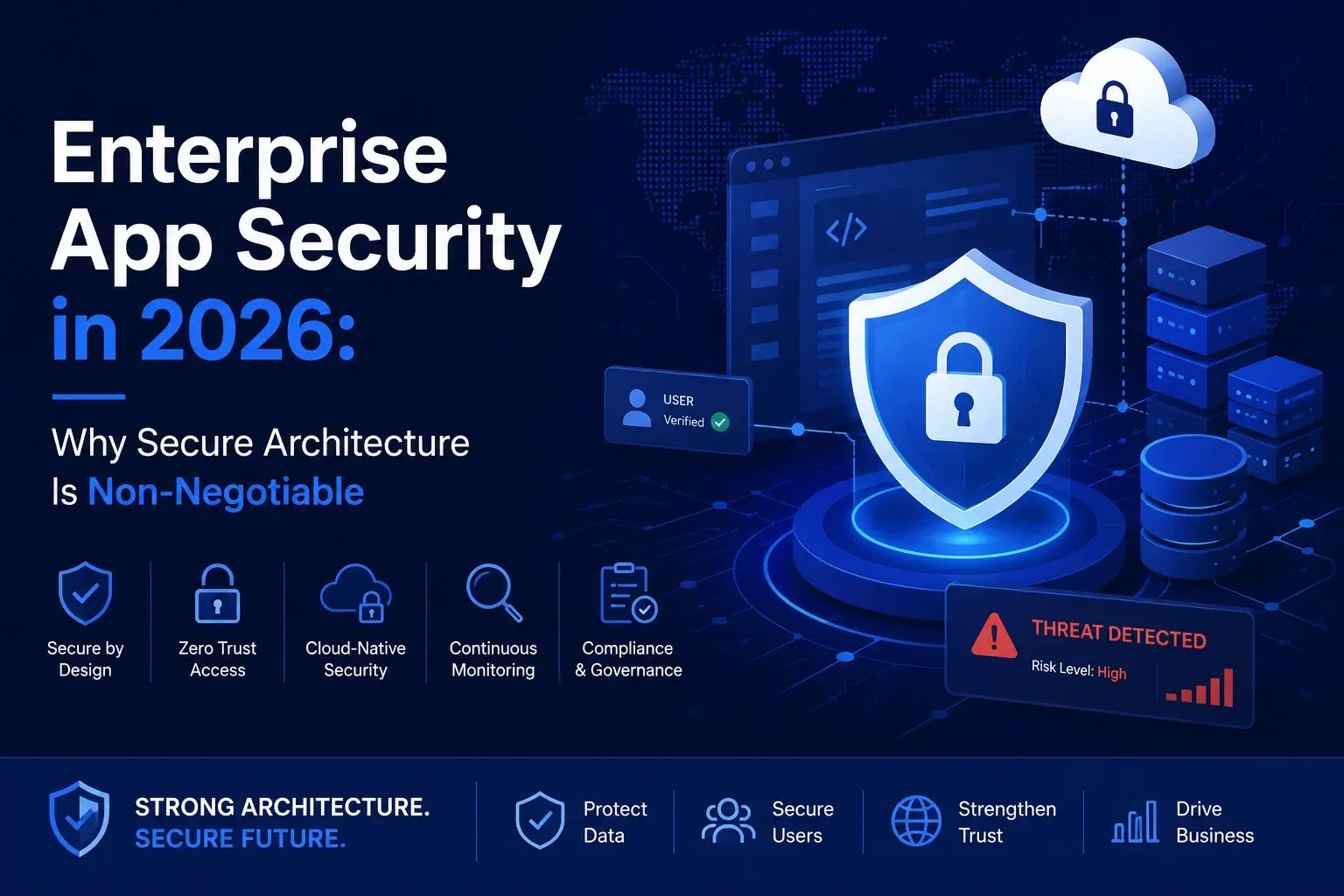
- Enterprise app security architecture is critical because modern applications handle sensitive user data, financial transactions, APIs, and distributed systems.
- Strong enterprise security requires layered protection including authentication, encryption, access control, API security, monitoring, and infrastructure hardening.
- Security architecture should be planned from the beginning instead of being added after the platform scales.
- Modern enterprise systems often use zero-trust models, multi-factor authentication, role-based access, audit logging, and continuous threat monitoring.
- Long-term protection depends on secure development practices, cloud security, compliance readiness, vulnerability testing, and operational governance.
Security Architecture Signals
- Authentication and identity management help protect enterprise systems from unauthorized access, credential abuse, and account compromise.
- API security becomes essential because modern apps rely heavily on third-party integrations, microservices, mobile clients, and cloud communication.
- Encryption protects sensitive information during storage and transmission, reducing exposure to interception, leaks, and data theft.
- Monitoring systems, audit logs, and anomaly detection help security teams identify suspicious behavior before incidents escalate.
- Compliance frameworks such as GDPR, HIPAA, PCI DSS, SOC 2, and ISO standards influence how enterprise applications handle security and privacy operations.
Real Insights
- Enterprise app security is not just about firewalls and passwords; it is about securing the full application lifecycle and operational ecosystem.
- The biggest risks often come from weak APIs, poor access control, outdated dependencies, cloud misconfiguration, and human operational mistakes.
- Security architecture should evolve alongside business growth because scaling infrastructure also increases attack surfaces and compliance pressure.
- Founders and enterprises should treat security as a business requirement because trust, uptime, compliance, and reputation directly affect long-term growth.
- The future of enterprise app security will depend on AI-driven monitoring, zero-trust systems, behavioral analytics, automated response workflows, and resilient cloud infrastructure.
Enterprise buyers no longer judge an app only by its design, features, or speed. They judge whether the product can protect data, control access, support audits, integrate safely with other systems, and scale without exposing the business to unnecessary risk.
That is why enterprise app security has become a board-level product decision in 2026.
For startups selling into enterprises, agencies building platforms for clients, and businesses modernizing internal systems, security cannot be treated as a final testing step. It must be part of the product architecture from the beginning. NIST’s Secure Software Development Framework, SP 800-218, is built around reducing software vulnerabilities through secure development practices, which reinforces the shift from reactive patching to security built into the development lifecycle.
At Miracuves, this is how we approach serious app development: security, scalability, admin control, and business usability must work together. A product may look polished on the surface, but if its architecture cannot support secure access, encrypted workflows, API protection, monitoring, and compliance-ready operations, it will struggle to win enterprise trust.
Why Enterprise App Security Matters More in 2026
Enterprise applications now sit at the center of business operations. They manage customer data, employee access, payments, workflows, documents, vendors, partners, analytics, and sometimes AI-powered decision layers.
This makes them valuable targets.
A weak application is not just a technical issue. It can delay enterprise procurement, damage customer confidence, increase support load, create compliance exposure, and make future integrations harder. For enterprise buyers, app security is not only about preventing attacks. It is about proving that the product can be trusted inside a serious business environment.
Modern security expectations are also shaped by frameworks and procurement standards. CISA’s Secure by Design guidance emphasizes that software manufacturers should build products in a way that reasonably protects against malicious cyber actors from the start, rather than placing the burden entirely on customers.
What Enterprise-Grade App Architecture Actually Means
Enterprise-grade architecture means the app is designed to support secure operations at scale. It is not one security plugin, one encryption setting, or one login feature. It is the complete foundation that controls how users, systems, data, permissions, integrations, and infrastructure interact.
A secure enterprise app typically includes:
- Strong authentication and authorization
- Role-based access control
- Encrypted data transfer and encrypted data storage
- Secure API design
- Audit logs and activity tracking
- Secure payment or transaction integrations where relevant
- Admin access controls
- Environment separation
- Secure cloud deployment
- Monitoring and alerting
- Backup and recovery planning
- Vulnerability testing and patch management
- Compliance-ready workflows
For mobile applications, OWASP’s Mobile Application Security Verification Standard is widely used by architects, developers, and testers as a security standard for building and testing secure mobile apps.
The practical point for enterprise buyers is simple: a secure app cannot depend on surface-level protection. Security must be present in the product structure.
Enterprise App Security Starts With Identity and Access Control
Identity is the first serious layer of enterprise security.
In a small consumer app, basic login may be enough for early usage. In an enterprise application, that is rarely sufficient. Different users need different access levels. Admins, managers, staff, partners, vendors, customers, support teams, and auditors should not all see or control the same data.
This is where role-based access control becomes essential.
A secure enterprise app should define who can view, edit, approve, delete, export, assign, pay, refund, publish, suspend, or manage sensitive records. The goal is not only to stop external threats. It is also to reduce internal misuse, accidental exposure, and operational confusion.
For example, a marketplace app may need separate access for platform operators, vendors, delivery partners, finance teams, and support agents. A fintech app may need different workflows for KYC review, transaction monitoring, risk alerts, and customer support. A healthcare app may need careful access separation between patients, doctors, clinic admins, and support teams.
Miracuves’ security language and product thinking treat role-based admin access, audit logs, verification, encrypted workflows, and secure integrations as foundational security concepts, not optional marketing extras.
Data Protection Is the Trust Layer Enterprise Buyers Look For
Data is often the real asset behind an enterprise app. It may include customer records, payment details, business documents, health information, location data, chat history, vendor data, invoices, contracts, or operational analytics.
Enterprise buyers want to know how that data is protected across the app lifecycle.
A strong architecture should consider:
- Encrypted data transfer between client apps, servers, and third-party services
- Encrypted data storage for sensitive information
- Tokenized payment handling where relevant
- Secure session management
- Data minimization
- Secure file uploads
- Controlled export permissions
- Backup and recovery workflows
- Privacy-conscious data handling
This matters because data protection is not only about avoiding breaches. It also affects procurement confidence, legal review, customer trust, and long-term enterprise adoption.
A product that cannot explain its data security model may look unfinished to enterprise buyers, even if the UI feels modern.
Secure APIs Decide Whether Your App Can Safely Scale
Most enterprise apps are not isolated products. They connect with payment gateways, CRMs, ERP systems, analytics tools, identity providers, notification services, AI tools, internal dashboards, and third-party APIs.
That makes API security a major part of enterprise app security.
A secure API layer should include authentication, authorization, rate limiting, input validation, secure tokens, logging, error handling, and protection against excessive data exposure. API endpoints should not reveal sensitive information simply because a request is technically valid.
This is especially important for marketplace, fintech, healthcare, ecommerce, logistics, AI, and SaaS applications where multiple systems exchange business-critical data.
For founders and enterprise product teams, API security is also a scalability issue. Weak API design may not create problems during early demos, but it can break trust when the product faces integrations, partner onboarding, higher traffic, or security review.
Cloud and Infrastructure Security Must Be Designed Before Scale
Enterprise applications often run across cloud infrastructure, databases, storage systems, background jobs, queues, analytics services, and third-party integrations. Security must extend across that complete environment.
A secure cloud-ready architecture should include:
- Environment separation for development, staging, and production
- Secure secrets management
- Access controls for cloud resources
- Logging and monitoring
- Backup policies
- Secure deployment workflows
- Infrastructure-level permissions
- Network-level protections
- Vulnerability patching
- Incident response planning
Enterprise buyers do not only evaluate whether the app works today. They evaluate whether it can continue working securely as usage grows.
This is where architecture quality matters. A product with weak infrastructure planning may become expensive to fix later because core assumptions around access, data storage, hosting, deployment, and monitoring were never designed for enterprise use.
Secure Software Development Is Now a Procurement Signal
Security is not only what happens after development. It is how development is planned, built, tested, reviewed, released, and maintained.
For enterprise buyers, this means a vendor should be able to explain:
- How requirements are reviewed for security risk
- How authentication and authorization are implemented
- How sensitive data is handled
- How code is reviewed
- How vulnerabilities are tested
- How dependencies are managed
- How updates are deployed
- How logs and incidents are monitored
- How admin actions are tracked
The strongest security posture is not created by one final penetration test. It is created by a development process where security decisions are made throughout the product lifecycle.
Security and Compliance Are Related, But Not the Same
Enterprise buyers often ask whether an app is “compliant.” The honest answer depends on the industry, geography, operating model, data type, integrations, hosting setup, and legal requirements.
A development partner can build a compliance-ready foundation. That may include audit logs, role-based access control, encrypted storage, secure APIs, consent workflows, verification flows, reporting support, and admin controls.
But final compliance depends on jurisdiction, legal review, policy documentation, third-party integrations, operational processes, and how the business runs the product after launch.
This distinction matters because unrealistic compliance promises are dangerous. A trustworthy development partner should avoid saying an app is “fully compliant everywhere” unless verified proof exists. Miracuves’ security guidance uses careful language such as “compliance-ready foundation,” “supports compliance workflows,” and “can be configured for KYC/AML requirements” where relevant.
For enterprise app security, trust comes from clarity, not exaggeration.
Enterprise-Grade Architecture vs Basic App Security
Enterprise-Grade Architecture vs Basic App Security
| Security Area | Basic App Approach | Enterprise-Grade Architecture |
|---|---|---|
| Authentication | Simple email and password login | Strong authentication, session controls, and identity-aware access workflows |
| Authorization | Limited user roles or hardcoded permissions | Role-based access control with clear permission boundaries |
| Data Protection | Basic database storage and standard transport security | Encrypted data transfer, encrypted storage, controlled exports, and privacy-conscious handling |
| API Security | Endpoints built mainly for functionality | Authenticated, authorized, validated, logged, and rate-limited APIs |
| Admin Control | Single admin panel with broad permissions | Permission-based dashboards, audit logs, approval flows, and activity records |
| Monitoring | Issues discovered after users report them | Logging, alerts, activity tracking, and incident response readiness |
| Compliance Support | Added later when needed | Compliance-ready workflows considered during architecture planning |
| Scalability | Security may weaken as users and integrations grow | Security controls are designed to scale with teams, data, traffic, and systems |
Founder Decision Signals: When Security Architecture Becomes Non-Negotiable
Founder Decision Signals
Enterprise Sales
If your product will be sold to enterprises, security documentation, access controls, audit logs, and data protection become part of the buyer’s evaluation process.
Sensitive Data
If the app handles financial, healthcare, identity, location, employee, customer, or transaction data, security must be planned before development begins.
Multi-Role Operations
If different teams, vendors, admins, partners, or customers use the platform, role-based permissions are essential for operational control.
Future Integrations
If the app will connect with CRMs, ERPs, payment gateways, AI systems, or partner APIs, secure API architecture is required for safe scaling.
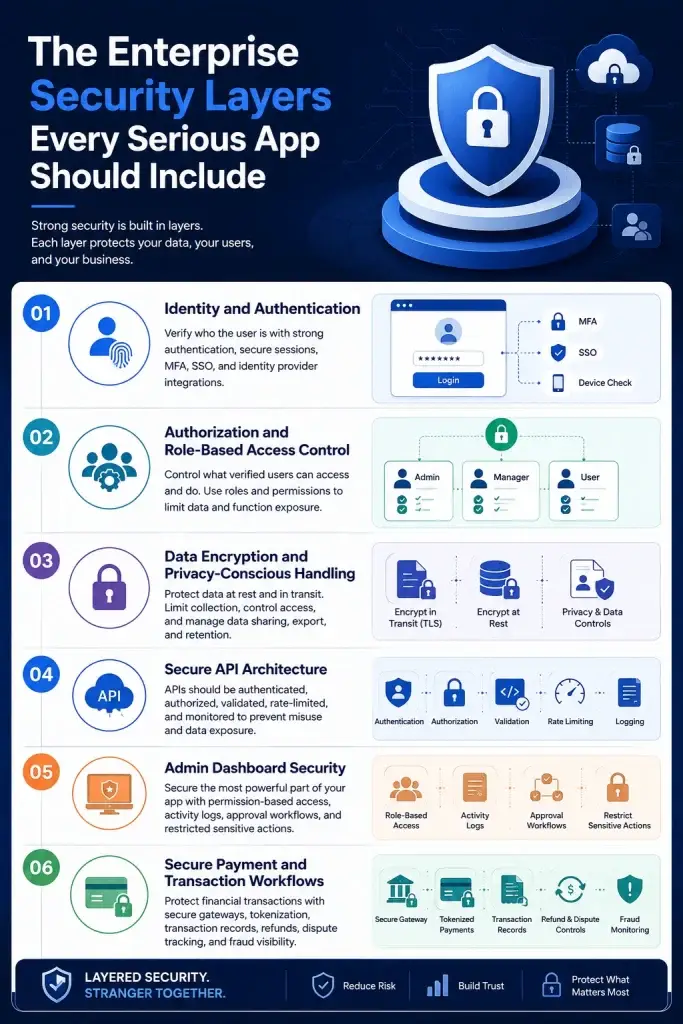
The Enterprise Security Layers Every Serious App Should Include
Enterprise security is strongest when each layer supports the next. A secure login system is useful, but it is not enough if APIs expose too much data. Encryption matters, but it is not enough if admin permissions are too broad. Cloud security matters, but it is not enough if development practices introduce vulnerable dependencies.
A serious enterprise app should include these security layers.
1. Identity and Authentication
Authentication verifies who the user is. Enterprise apps may need password policies, secure session handling, single sign-on support, multi-factor authentication, device checks, or integration with identity providers depending on buyer requirements.
The goal is to prevent weak access from becoming the easiest path into the product.
2. Authorization and Role-Based Access Control
Authorization decides what each verified user can do. Role-based access control helps prevent overexposure of data and functions.
For enterprise platforms, this is crucial because the app may support multiple departments, admins, vendors, field teams, customers, or support roles.
3. Data Encryption and Privacy-Conscious Handling
Sensitive data should be protected during transfer and storage. The app should also avoid collecting unnecessary information and should control who can export, download, delete, or share records.
This is especially important for fintech, healthcare, marketplaces, ecommerce, logistics, and internal enterprise systems.
4. Secure API Architecture
APIs should be designed with authentication, authorization, validation, rate control, error handling, and logging. This helps protect against unauthorized access, broken object-level authorization, excessive data exposure, and integration misuse.
5. Admin Dashboard Security
The admin dashboard is one of the most powerful parts of an enterprise app. It may control users, payments, refunds, approvals, content, vendors, disputes, reports, pricing, and system settings.
A secure admin dashboard should include permission-based access, activity logs, approval workflows, and controlled access to sensitive actions.
6. Secure Payment and Transaction Workflows
For apps handling payments or financial activity, security should include secure payment gateway integration, tokenized payments where relevant, transaction records, refund controls, dispute tracking, and suspicious activity visibility.
For fintech products, additional workflows such as KYC, AML workflow support, transaction monitoring, wallet ledger accuracy, and audit logs may be needed depending on the business model.
7. Monitoring, Logging, and Incident Readiness
Enterprise buyers want visibility. Logs help teams understand what happened, who performed an action, when it happened, and whether something needs investigation.
Strong monitoring also helps detect unusual patterns before they become larger operational or security problems.
8. Secure Development and Maintenance
Security must continue after launch. Dependency updates, vulnerability scanning, code reviews, access reviews, patching, and post-launch support all affect long-term trust.
This is why enterprise app security should be considered a lifecycle discipline, not a one-time checklist.
Why Enterprise Buyers Reject Apps With Weak Architecture
Enterprise buyers are cautious because they carry risk across customers, teams, compliance, contracts, and brand reputation. Even when a product solves a real business problem, weak security architecture can slow or stop adoption.
A buyer may reject or delay an app if:
- Security controls are unclear
- Admin access is too broad
- Data flows are not documented
- APIs lack proper authorization
- Logs are insufficient for audits
- Compliance support is vague
- Cloud access is poorly controlled
- The vendor cannot explain security decisions
- The app cannot support enterprise onboarding requirements
This is why secure architecture is not only a technical benefit. It is a sales enabler.
A well-architected product gives enterprise buyers confidence that the app can be reviewed, deployed, monitored, governed, and scaled responsibly.
Mistakes Founders Should Avoid When Building Secure Enterprise Apps
Mistakes Founders Should Avoid
Treating Security as a Final Testing Step
Security added at the end usually becomes expensive and incomplete. Authentication, permissions, data flows, API controls, and audit logging should be considered during architecture planning.
Building One Admin Role for Everyone
A single broad admin role creates unnecessary risk. Enterprise apps need permission-based dashboards so each user only accesses what their responsibility requires.
Ignoring API Security During Early Development
APIs often become the backbone of integrations. Weak API authorization, poor validation, and excessive data exposure can create serious risks when the app scales.
Making Compliance Claims Too Early
A product can support compliance-ready workflows, but final compliance depends on legal review, jurisdiction, hosting, operations, integrations, and documentation.
How Miracuves Helps Businesses Build More Secure App Foundations
Miracuves helps founders, startups, agencies, and businesses launch digital products faster using ready-made, white-label, source-code-owned clone app solutions and custom app development services. Core positioning includes source-code ownership, custom branding, admin dashboards, scalable backend foundations, monetization-ready platforms, and faster market validation where relevant.
For enterprise-focused products, that foundation matters because the app must support more than basic user activity. It needs the right control layers:
- Secure user and admin access
- Role-based dashboard workflows
- Scalable backend logic
- Secure API integrations
- Encrypted data handling
- Activity logs and operational visibility
- Payment or transaction controls where relevant
- Compliance-ready workflows where required
- Source-code ownership for long-term flexibility
This is especially important when building fintech apps, marketplaces, healthcare platforms, creator platforms, delivery systems, SaaS tools, or internal enterprise software.
A ready-made or white-label foundation from Miracuves can help businesses move faster, but the stronger advantage is control. When the architecture is source-code-owned and customizable, founders are not trapped inside a rigid system that cannot evolve with enterprise buyer requirements.
Enterprise App Security Checklist for 2026
Before building or buying an enterprise application, use this checklist to evaluate the architecture.
| Security Question | Why It Matters |
|---|---|
| Does the app support role-based access control? | Prevents users from accessing data or actions outside their responsibility |
| Is sensitive data encrypted during transfer and storage? | Reduces exposure risk and supports enterprise trust |
| Are APIs authenticated, authorized, validated, and logged? | Protects integrations and prevents data exposure |
| Does the admin dashboard include permission controls? | Reduces operational and internal misuse risk |
| Are audit logs available for important actions? | Supports investigation, accountability, and audit readiness |
| Is the cloud environment separated by development, staging, and production? | Prevents accidental exposure and improves deployment control |
| Are dependencies and vulnerabilities reviewed? | Reduces software supply chain and maintenance risk |
| Are compliance workflows supported where relevant? | Helps buyers prepare for regulated operations |
| Is there a clear post-launch maintenance plan? | Security requires updates, monitoring, and ongoing improvement |
Final Thoughts:
Enterprise app security is not just about avoiding threats. It is about earning trust before the buyer signs, before the procurement team approves, before users onboard, and before the app becomes part of a serious business workflow.
In 2026, enterprise buyers expect more than attractive screens and fast feature delivery. They expect secure architecture, responsible data handling, controlled access, API protection, audit visibility, and compliance-ready foundations.
The strongest decision is not to build security later. It is to design the product so security, scalability, and business control work together from the beginning.
Miracuves helps businesses build secure, scalable, and source-code-owned app foundations that can support faster launch, stronger admin control, and long-term product flexibility.
FAQs
What is enterprise app security?
Enterprise app security is the process of designing, building, testing, and maintaining an application so it can protect users, data, APIs, infrastructure, workflows, and business operations in an enterprise environment. It includes authentication, access control, encryption, secure APIs, audit logs, monitoring, and compliance-ready workflows.
Why is enterprise app security important in 2026?
Enterprise applications now manage sensitive business data, integrations, payments, documents, users, vendors, and internal workflows. In 2026, enterprise buyers expect secure architecture before adoption because weak security can create procurement delays, compliance risk, data exposure, and operational disruption.
What makes an app enterprise-grade?
An enterprise-grade app is built with scalable architecture, secure access control, encrypted data handling, reliable backend systems, secure APIs, monitoring, audit logs, admin governance, and maintainable development practices. It must support business growth without weakening security or operational control.
Can Miracuves build compliance-ready app architecture?
Miracuves can help build compliance-ready foundations with access controls, encrypted workflows, audit logs, secure integrations, admin permissions, and verification workflows where relevant. Final compliance depends on jurisdiction, legal review, operating model, hosting, integrations, and business processes.
What should enterprise buyers ask before choosing an app development partner?
Enterprise buyers should ask how the vendor handles authentication, authorization, encryption, API security, admin permissions, audit logs, cloud security, vulnerability testing, dependency management, and post-launch maintenance. A serious vendor should be able to explain security at the architecture level, not just feature level.