


Key Takeaways
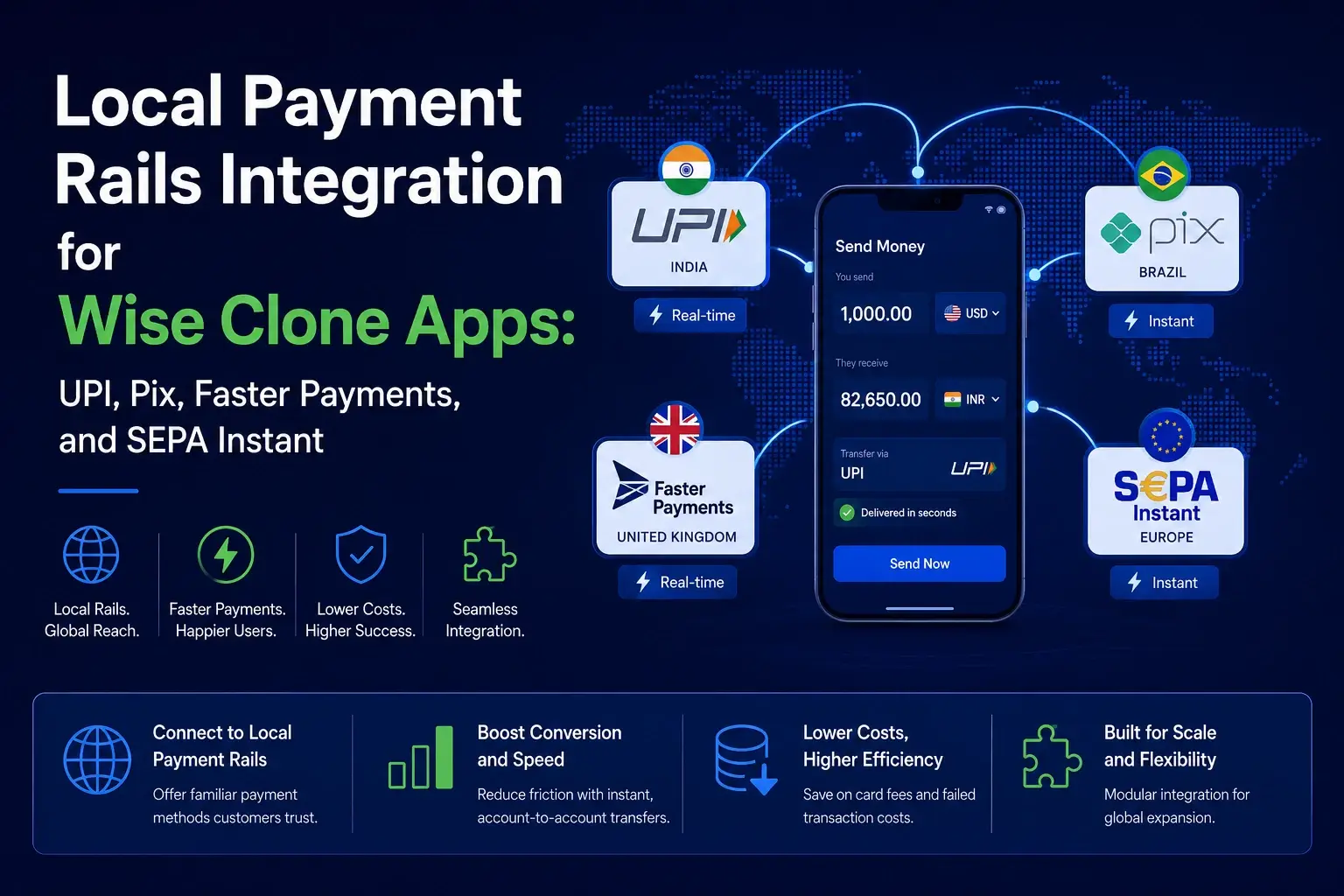
- Local payment rails help Wise clone apps move money faster and more efficiently within specific countries or regions.
- Popular rails like UPI, Pix, Faster Payments, and SEPA Instant reduce settlement delays, lower fees, and improve user experience.
- A strong integration strategy requires routing logic, payout orchestration, transaction monitoring, webhook handling, and compliance workflows.
- Modern remittance apps increasingly rely on multi-rail infrastructure to optimize cost, speed, reliability, and regional payment coverage.
- Long-term scalability depends on modular payment architecture, failover handling, reconciliation systems, and flexible provider integrations.
Payment Rail Signals
- UPI in India and Pix in Brazil enable near real-time domestic transfers with lower transaction costs compared to traditional banking flows.
- Faster Payments and SEPA Instant improve settlement speed by reducing dependency on slower batch-based banking systems.
- Multi-rail systems help remittance platforms dynamically select the most efficient payout route based on country, currency, speed, and transaction cost.
- Webhook-first architecture is important because payment status updates, settlement confirmations, reversals, and failures must sync reliably in real time.
- Smart routing and local settlement infrastructure can significantly reduce operational costs, FX exposure, intermediary fees, and payout delays.
Real Insights
- Integrating local payment rails is not only about connectivity; it is about creating a reliable and scalable money movement infrastructure.
- The strongest Wise-style platforms combine local collection methods, FX systems, payout orchestration, compliance monitoring, and transaction visibility.
- Payment rail abstraction layers become important as remittance businesses expand into multiple regions with different banking standards.
- Founders should plan for retries, settlement reconciliation, duplicate prevention, and provider failover before scaling transaction volume.
- The future of cross-border fintech infrastructure will depend on instant payment networks, API-driven banking, real-time settlement, and intelligent payment routing.
Building a Wise clone app is not only about creating a clean transfer screen, showing exchange rates, and letting users send money across borders. The real technical challenge sits deeper: how the platform connects to local payment rails, confirms funds movement, updates ledgers, handles failures, reconciles transactions, and gives the admin team enough control to manage financial risk.
That is why a local payment rails integration guide matters for fintech founders and developers planning a remittance product. Rails such as UPI in India, Pix in Brazil, Faster Payments in the UK, and SEPA Instant in Europe can make transfers faster and more local-market friendly, but each rail has different rules, identifiers, settlement behavior, availability, limits, compliance expectations, and integration workflows.
For a Wise clone app, local rails are not simple payment add-ons. They influence the core architecture of the product: wallet balances, FX quotes, transaction state machines, KYC checks, payout routing, webhook handling, dispute flows, audit trails, and reconciliation logic.
Miracuves helps founders build white-label fintech and remittance app solutions with source-code ownership, admin control, wallet workflows, and faster deployment. For payment-heavy fintech products, the goal is not just to launch screens quickly. The goal is to launch with a product foundation that can support real money movement responsibly.
What Are Local Payment Rails in a Wise Clone App?
Local payment rails are domestic account-to-account payment systems used to move money within a specific country or region. In a remittance platform, these rails are usually used for collection, payout, or both.
For example, a user may fund a transfer through UPI in India, send money to Brazil, and the recipient may receive funds through Pix. Another user may send GBP through Faster Payments in the UK and settle EUR through SEPA Instant in Europe.
Local rails matter because they reduce dependency on card networks and traditional correspondent banking flows. Several modern payment systems support real-time or near-real-time movement, improving user experience and lowering friction compared with slower bank transfer routes. Instant payment systems are commonly designed for continuous availability and faster settlement compared with batch-based systems.
In a Wise clone app, rail integration usually affects five backend layers:
| Layer | Why It Matters |
|---|---|
| Payment initiation | Starts collection or payout through the selected rail |
| User and beneficiary validation | Confirms account, alias, or identifier before transfer |
| Ledger posting | Records every debit, credit, fee, FX spread, refund, and reversal |
| Transaction status tracking | Moves transfers through pending, processing, settled, failed, reversed, or refunded states |
| Reconciliation | Matches internal records with rail, PSP, bank, or settlement reports |
A simple payment gateway integration is not enough for this use case. A remittance app must know where the money is, what state the transaction is in, what fees apply, which party owns the balance, and what happens if the rail confirms late or fails after initiation.
Why Local Payment Rails Matter for Wise Clone App Development
A Wise clone app competes on speed, trust, transparency, and predictable delivery. Local payment rails directly influence all four.
When a user sends money, they do not care about backend complexity. They care about whether the money leaves their account, whether the recipient receives it, whether the fee is clear, and whether the status is accurate.
From a founder’s perspective, local rails matter because they can improve:
- Local payment acceptance
- Payout speed
- Transfer completion rates
- User trust in familiar payment methods
- Corridor-specific monetization
- Operational control over failures and refunds
- Reduced friction compared with card-only flows
But every new rail also adds complexity. Developers must handle rail-specific transaction references, webhook events, downtime behavior, cut-off rules, risk checks, transaction limits, refunds, reversals, and reconciliation files.
A founder should not treat UPI, Pix, Faster Payments, and SEPA Instant as interchangeable APIs. They are different financial infrastructures with different rulebooks and operating models.
UPI vs Pix vs Faster Payments vs SEPA Instant: Developer Planning Comparison
Local Payment Rails Comparison for Wise Clone Apps
| Payment Rail | Region | Common Use in Wise Clone Apps | Developer Planning Focus |
|---|---|---|---|
| UPI | India | Local collection, user funding, account-to-account payments | VPA validation, payment intent, bank response handling, transaction status checks, failure handling |
| Pix | Brazil | Instant collection and payout using Pix keys or QR codes | Pix key lookup, QR code flow, webhook confirmation, refund/reversal handling, beneficiary validation |
| Faster Payments | United Kingdom | GBP local deposits and payouts | Sort code/account validation, confirmation of payee, payment limits, status updates, reconciliation |
| SEPA Instant | Europe | EUR instant credit transfers | IBAN validation, SCT Inst message handling, ISO 20022 fields, sanctions screening, timeout logic |
Core Architecture for Local Payment Rails Integration
Before integrating any payment rail, developers should define the internal architecture of the Wise clone app. Without this foundation, each new rail becomes a patchwork integration and makes the platform harder to scale.
A strong fintech backend usually includes these modules:
| Module | Role in Rail Integration |
|---|---|
| User identity service | Stores verified user profile, KYC status, risk level, and jurisdiction |
| Beneficiary service | Manages recipient accounts, aliases, Pix keys, IBANs, sort codes, and validation status |
| Quote engine | Calculates FX rate, fee, payout amount, expiry, and corridor rules |
| Payment orchestration layer | Selects rail, PSP, bank partner, fallback route, and retry policy |
| Ledger service | Records immutable financial entries for debits, credits, fees, holds, refunds, and reversals |
| Transaction state machine | Tracks transfer lifecycle from quote created to settled or failed |
| Webhook/event processor | Receives asynchronous rail or PSP updates |
| Reconciliation engine | Matches internal ledger entries with external reports |
| Risk and compliance engine | Supports KYC, AML checks, sanctions screening, fraud monitoring, and velocity rules |
| Admin dashboard | Gives operators control over stuck transfers, refunds, risk holds, disputes, and reporting |
The biggest mistake is letting each payment provider directly update user balances. In a serious remittance platform, the ledger should be the source of truth. Payment provider events should trigger controlled state changes, not uncontrolled balance mutations.
Recommended Transaction State Machine for Wise Clone Payment Rails
A Wise clone app should not rely on vague statuses such as “success” and “failed.” Payment rails are asynchronous. A transaction may be accepted, pending, under review, timed out, settled, rejected, reversed, or refunded.
A cleaner state machine may look like this:
| State | Meaning |
|---|---|
| Quote created | User has requested transfer pricing |
| Quote accepted | User accepted FX rate and fee before expiry |
| Collection initiated | App has started debit or funding through local rail |
| Collection pending | Rail or PSP has not confirmed final status |
| Collection confirmed | Sender-side funds are confirmed |
| Compliance review | Transfer is held for risk, AML, or manual review |
| FX locked | Exchange rate has been applied according to product rules |
| Payout initiated | Recipient-side payout rail has been triggered |
| Payout pending | Payout has not reached final status |
| Settled | Recipient funds are confirmed available |
| Failed | Transfer cannot continue |
| Reversed/refunded | Funds are returned based on failure or user refund flow |
This logic protects the founder from one of the most damaging fintech failures: showing a user that money is delivered before the platform has final confirmation.
UPI Integration Planning for Wise Clone Apps
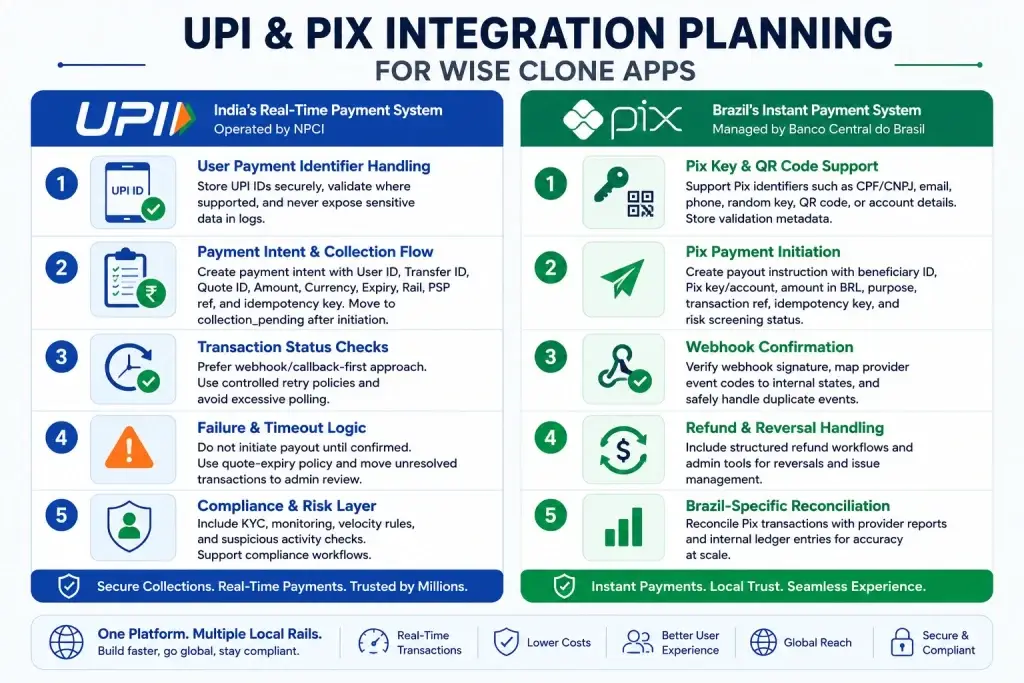
UPI is India’s real-time payment system operated by NPCI. For a Wise clone app, UPI may be used for collecting funds from Indian users or enabling domestic account-to-account payment flows where supported by the operating model.
UPI integration planning should focus on:
1. User Payment Identifier Handling
UPI commonly uses a virtual payment address or app-based payment flow. Your Wise clone backend should store user payment identifiers carefully, validate them where supported, and avoid exposing sensitive payment data in logs.
2. Payment Intent and Collection Flow
For a remittance product, UPI may be used to collect INR from the sender. The app should create a payment intent with:
- User ID
- Transfer ID
- Quote ID
- Amount
- Currency
- Expiry timestamp
- Rail name
- PSP reference
- Internal idempotency key
Once the payment is initiated, the transaction should move into collection_pending, not settled.
3. Transaction Status Checks
UPI-scale systems require careful status-check logic. Excessive polling can create unnecessary load and operational risk. Developers should use webhook or callback-first architecture where available and apply controlled retry policies for pending transactions.
4. Failure and Timeout Logic
UPI payments may fail, time out, or remain pending before final confirmation. The Wise clone app should define what happens if the user’s quote expires while the payment is pending.
A practical rule is:
- Do not initiate payout until collection is confirmed.
- Do not lock final FX indefinitely.
- Use a clear quote-expiry policy.
- Move unresolved transactions to admin review after a defined threshold.
5. Compliance and Risk Layer
For Indian corridors, user verification, transaction monitoring, velocity rules, and suspicious activity flags should be part of the workflow. The platform should support compliance workflows without claiming regulatory approval automatically.
Pix Integration Planning for Wise Clone Apps
Pix is Brazil’s instant payment system, created and managed by Banco Central do Brasil. It allows payments and transfers at any time, year-round, and can use Pix aliases or QR codes.
For a Wise clone app, Pix is especially useful for Brazil payout and collection experiences because Brazilian users are highly familiar with Pix flows.
1. Pix Key and QR Code Support
A Pix transfer may use a Pix key, QR code, or account information. Your beneficiary module should support the required recipient identifier type and store validation metadata.
Common Pix identifier types may include:
- CPF/CNPJ-linked keys
- Phone number
- Random key
- QR code payment data
- Bank/payment account information
2. Pix Payment Initiation
For Pix payouts, the orchestration layer should create a payout instruction with:
- Beneficiary ID
- Pix key or account details
- Amount in BRL
- Transfer purpose
- Internal transaction reference
- Provider idempotency key
- Risk screening status
The payout should not be executed until funding, compliance, and FX logic are complete.
3. Webhook Confirmation
Pix is real-time, but your app should still treat confirmation events as asynchronous. The webhook processor must verify signature authenticity, map provider event codes to internal states, and reject duplicate events safely.
4. Refund and Reversal Handling
Pix integration should include refund workflows. If a payout fails after debit or a user reports an issue, the admin team needs structured workflows rather than manual database edits.
5. Brazil-Specific Reconciliation
Pix transactions must be reconciled against provider reports and internal ledger entries. This is especially important when the app handles high-volume transfers, partial refunds, charge adjustments, or multiple PSP accounts.
Faster Payments Integration Planning for Wise Clone Apps
The UK Faster Payment System supports real-time domestic payments and operates 24/7, according to Pay.UK. For a Wise clone app, Faster Payments is typically relevant for GBP funding, GBP payouts, or local wallet withdrawals.
1. Account Details and Beneficiary Validation
UK bank transfers commonly rely on sort code and account number. A production-grade fintech app should also consider beneficiary verification workflows such as confirmation of payee where available through partners.
The beneficiary service should store:
- Beneficiary name
- Sort code
- Account number
- Bank name
- Validation status
- User ownership status
- Risk flags
- Last successful payout date
2. Payment Limits and Rail Rules
Pay.UK states that Faster Payments supports real-time payments up to £1 million, though actual limits may depend on participating banks and providers. Developers should avoid hardcoding assumptions and instead configure limits by rail, partner, account type, user tier, and risk level.
3. GBP Ledger Entries
For GBP collection, the ledger must separately record:
- User funding amount
- Platform fee
- FX conversion amount
- Pending payout obligation
- Refund liability if payout fails
This prevents a common fintech accounting problem: confusing received funds with settled and available platform-owned revenue.
4. Operational Monitoring
Even real-time payment rails can experience downtime or provider issues. The Wise clone admin panel should show rail health, stuck transfers, delayed confirmations, failed payouts, and retry queues.
SEPA Instant Integration Planning for Wise Clone Apps
SEPA Instant Credit Transfer, also known as SCT Inst, enables euro credit transfers with funds made available in less than ten seconds at any time, according to EPC. The EPC also published an updated 2025 SCT Inst rulebook that entered into force on 5 October 2025.
For a Wise clone app, SEPA Instant is useful for EUR payouts and wallet movement across supported European markets.
1. IBAN Validation
The beneficiary module should validate IBAN format before payout initiation. It should also store country, bank identifier, account ownership status, and whether the recipient bank supports SEPA Instant.
2. ISO 20022 Message Awareness
SEPA schemes commonly involve structured payment messages. Developers do not always work directly with scheme-level XML if using a PSP or banking partner, but the internal data model should still be rich enough to preserve payer, payee, purpose, reference, address, and regulatory fields required by the partner.
3. Timeout and Finality Handling
Because SEPA Instant is designed around very fast execution, timeout behavior matters. Your state machine should distinguish:
- Technical timeout
- Scheme rejection
- Beneficiary bank unavailable
- Compliance hold
- Provider processing delay
- Final failure
- Successful settlement
4. Sanctions and Screening Workflows
EUR payments require careful screening. Your Wise clone app should support sanctions screening, transaction monitoring, and audit logs. Final compliance obligations depend on jurisdiction, licensing model, banking partners, and legal review.
Payment Orchestration: How to Choose the Right Rail for Each Transfer
A Wise clone app should not hardcode “one rail per country” forever. A better architecture uses a payment orchestration layer.
The orchestration layer decides:
- Which rail is available for the corridor
- Which provider supports the rail
- Whether the user is eligible
- Whether the beneficiary is valid
- Whether the transfer amount is within limits
- Whether compliance screening is complete
- Whether a cheaper or faster route exists
- Whether fallback is allowed
- Whether manual review is required
Example:
A user sends GBP to EUR. The app may collect GBP via Faster Payments, convert through the FX engine, then pay out EUR through SEPA Instant. If SEPA Instant is unavailable for the recipient bank, the platform may fall back to a standard SEPA transfer if the product policy allows it.
This orchestration logic is where many fintech products become either scalable or fragile.
Ledger Design: The Source of Truth for Wise Clone Apps
The ledger is the heart of a remittance product. Every money movement should create balanced entries.
A simplified transfer might include:
| Ledger Entry | Debit | Credit |
|---|---|---|
| User funds wallet | User bank account | User wallet balance |
| Platform charges fee | User wallet balance | Platform fee revenue |
| FX conversion | Source currency balance | Destination currency obligation |
| Payout initiated | Platform settlement account | Recipient payout obligation |
| Payout settled | Recipient payout obligation | Recipient account |
| Refund if failed | Platform liability | User wallet or original payment method |
The point is not to copy this table directly into code. The point is to design a ledger where every change is traceable, reversible where needed, and auditable.
A payment rail webhook should never simply say, “Add money to user balance.” It should trigger an approved ledger posting flow tied to a transaction, provider reference, and reconciliation record.
Reconciliation: The Part Founders Often Underestimate
Reconciliation is the process of matching your internal records against external payment rail, PSP, bank, or settlement reports.
For UPI, Pix, Faster Payments, and SEPA Instant integrations, reconciliation should answer:
- Did the rail confirm the same amount?
- Did the provider reference match the internal transaction?
- Did the fee match expected pricing?
- Was the payout settled or only accepted?
- Were any transactions duplicated?
- Were any transactions reversed?
- Are there pending transactions older than the acceptable threshold?
- Does the ledger balance match provider statements?
A developer-friendly reconciliation system should include:
- Daily settlement import
- Provider reference matching
- Exception queue
- Duplicate detection
- Manual review workflow
- Exportable reports
- Audit logs for every admin action
Without reconciliation, founders may not discover balance mismatches until users complain or financial statements fail to match.
Security and Compliance Workflows for Local Payment Rails
Payment rail integration must be planned with security from the start. Miracuves’ recommended fintech security language treats security as a product foundation, not a marketing add-on.
For a Wise clone app, important security and compliance workflows include:
- KYC verification
- AML workflow support
- Transaction monitoring
- Suspicious activity flags
- Wallet ledger accuracy
- Payment gateway or banking partner integration
- Audit logs
- Role-based admin access
- Data encryption
- User identity checks
- Compliance reporting support
A careful caveat is important: a fintech app can be built with a compliance-ready foundation, but final compliance depends on jurisdiction, licensing, legal review, banking partners, integrations, and the operating model. Miracuves should not claim that a Wise clone app is automatically compliant in every market. This follows the security and compliance wording rules for fintech content.
Founder Decision Signals
Speed
If your target users expect instant transfers, local rails can improve product experience. But speed should not bypass ledger accuracy, webhook validation, or compliance review.
Cost
Local account-to-account rails can be more cost-efficient than card-first flows in some corridors, but final cost depends on providers, licensing, compliance, and transaction volume.
Scalability
Each new rail adds event types, limits, reconciliation formats, exception flows, and admin workflows. A rail-agnostic orchestration layer prevents future rebuilds.
Market Fit
UPI, Pix, Faster Payments, and SEPA Instant are familiar to users in their markets. Supporting the right local rail can reduce payment friction and improve trust.
Ready-Made vs Custom Rail Integration for Wise Clone Apps
| Build Route | What It Means | Best For | Risk |
|---|---|---|---|
| Fully custom build | Build wallet, ledger, admin, KYC, rail integrations, and remittance logic from scratch | Large teams with deep fintech engineering capacity | Longer build cycle and higher architecture risk |
| Ready-made Wise clone foundation | Start with existing remittance app modules, admin panel, wallet logic, and customize rail integrations | Founders who want faster validation and source-code ownership | Must verify customization depth and provider compatibility |
| API-first PSP integration | Use third-party payment providers for rail access | Teams that want faster rail connectivity | Vendor dependency and possible limited control |
| Hybrid approach | Ready-made product foundation plus selected custom rail integrations | Founders balancing speed, control, and localization | Requires strong architecture planning |
Miracuves’ white-label fintech approach can help founders start with a launch-ready product foundation while still planning rail integrations around business rules, corridor priorities, admin workflows, and source-code ownership. Pricing should be confirmed based on selected modules, integrations, branding, and customization scope; Miracuves guidance avoids inventing fixed pricing unless officially provided.
How Miracuves Helps With Wise Clone App Payment Rail Planning
A Wise clone app becomes valuable when it combines user-friendly money transfer flows with reliable backend control. Miracuves helps founders plan and build fintech platforms with the right product modules, including:
- User onboarding
- KYC workflow support
- Wallet and transaction history
- FX and fee logic
- Beneficiary management
- Admin dashboard
- Payment gateway or rail partner integration
- Transaction monitoring
- Audit logs
- Role-based access
- Source-code ownership
- White-label branding
For founders planning a multi-corridor remittance product, Miracuves can help define which rails should be prioritized first. A smart launch may start with one source market, one payout market, and one controlled corridor before expanding into more payment networks.
This is usually safer than trying to integrate UPI, Pix, Faster Payments, SEPA Instant, cards, wallets, and crypto rails at the same time.
Final Thoughts:
Local payment rails can make a Wise clone app faster, more familiar, and more competitive in target markets. But they also increase backend responsibility.
UPI, Pix, Faster Payments, and SEPA Instant are not just checkout options. They affect how the product confirms money movement, handles delays, manages risk, records ledger entries, reconciles settlement, and protects users.
For founders, the strongest approach is to avoid treating payment integration as a final development task. It should be part of the first architecture discussion.
A Wise clone app that is built with rail-aware orchestration, clean ledger logic, admin controls, compliance workflow support, and source-code ownership gives founders a stronger foundation for scaling across corridors.
Miracuves helps founders build white-label fintech and remittance app platforms that can be customized around payment flows, admin operations, and market-specific launch priorities.
FAQs
What is local payment rails integration in a Wise clone app?
Local payment rails integration means connecting a Wise clone app to domestic payment systems such as UPI, Pix, Faster Payments, or SEPA Instant. These rails help users fund transfers or receive payouts through familiar local bank-transfer methods.
Is payment rail integration the same as payment gateway integration?
No. A payment gateway may process a payment, but rail integration for a remittance app also affects ledger entries, settlement status, transaction monitoring, reconciliation, refunds, reversals, and compliance workflows.
What backend modules are needed for local payment rails integration?
A fintech app should include a user identity service, beneficiary service, quote engine, payment orchestration layer, ledger service, transaction state machine, webhook processor, reconciliation engine, compliance workflow, and admin dashboard.
What security features are important for Wise clone app payment rails?
Important security features include encrypted data transfer, encrypted data storage, KYC workflows, AML workflow support, transaction monitoring, audit logs, role-based admin access, suspicious activity flags, and secure API integration.
Can Miracuves build a Wise clone app with local payment rail integrations?
Miracuves can help founders build white-label fintech and remittance app solutions with source-code ownership, admin dashboards, wallet flows, and payment integration planning. Final rail availability depends on selected providers, target countries, compliance requirements, and customization scope.