


Key Takeaways
- Appfolio-style app security protects owners, managers, and residents.
- Rent payments, documents, leases, and maintenance data need protection.
- Role-based access is critical for property management workflows.
- Audit logs help track payments, approvals, and admin actions.
- A secure property app needs privacy and payment controls from day one.
Security Signals
- Use separate roles for owners, managers, residents, and admins.
- Protect rent payments, invoices, refunds, and payout records.
- Secure lease documents, IDs, reports, and maintenance files.
- Log login activity, permission changes, and manual overrides.
- Verify APIs, uploads, webhooks, and third-party integrations.
Real Insights
- Property apps handle sensitive financial and personal data.
- Weak access control can expose private property records.
- Payment errors can damage manager and resident trust.
- Security must cover login, payments, documents, and dashboards.
- Miracuves builds Appfolio Clone apps with secure property management workflows.
You’ve probably heard the horror stories — property management apps leaking tenant data, payment systems getting compromised, or landlords facing legal trouble because of poor app security.
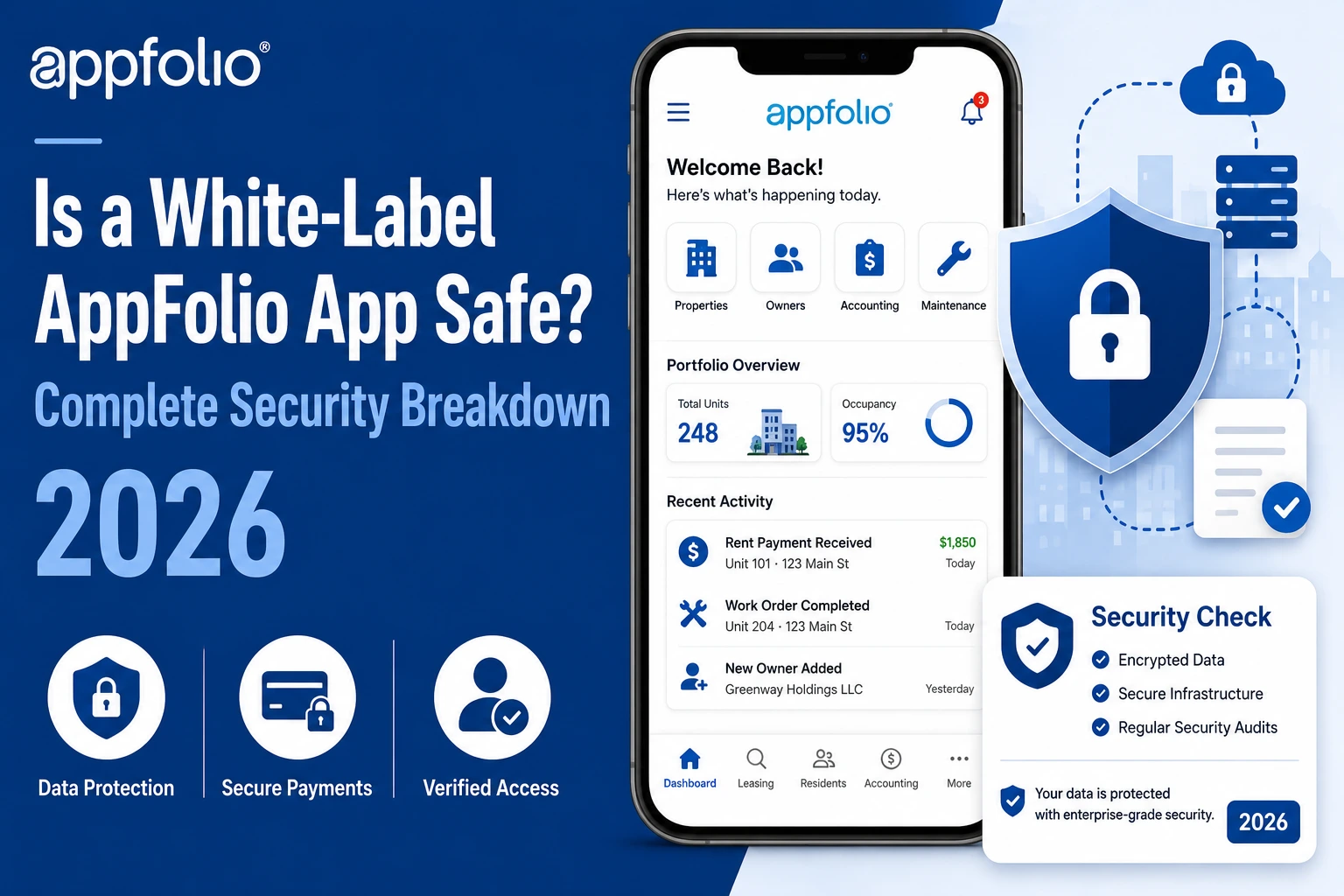
When you’re considering a white-label AppFolio-style app, the biggest question isn’t features or pricing anymore. It’s safety.
In 2026, property management platforms handle extremely sensitive information — tenant identities, lease contracts, rent payments, bank details, maintenance records, and even access schedules. One security failure doesn’t just hurt your app; it can damage your business reputation permanently and trigger serious legal consequences.
This is why white-label app safety matters more today than ever before.
In this guide, we’ll take an honest, no-hype look at:
- How secure a white-label AppFolio app really is
- Where the real security risks lie
- What standards your app must meet
- And how to choose a provider that puts security first, not last
You’ll get practical guidance, real-world context, and a clear understanding of what “secure” truly means in 2026 — so you can make informed decisions with confidence.
Understanding White-Label AppFolio App Security Landscape
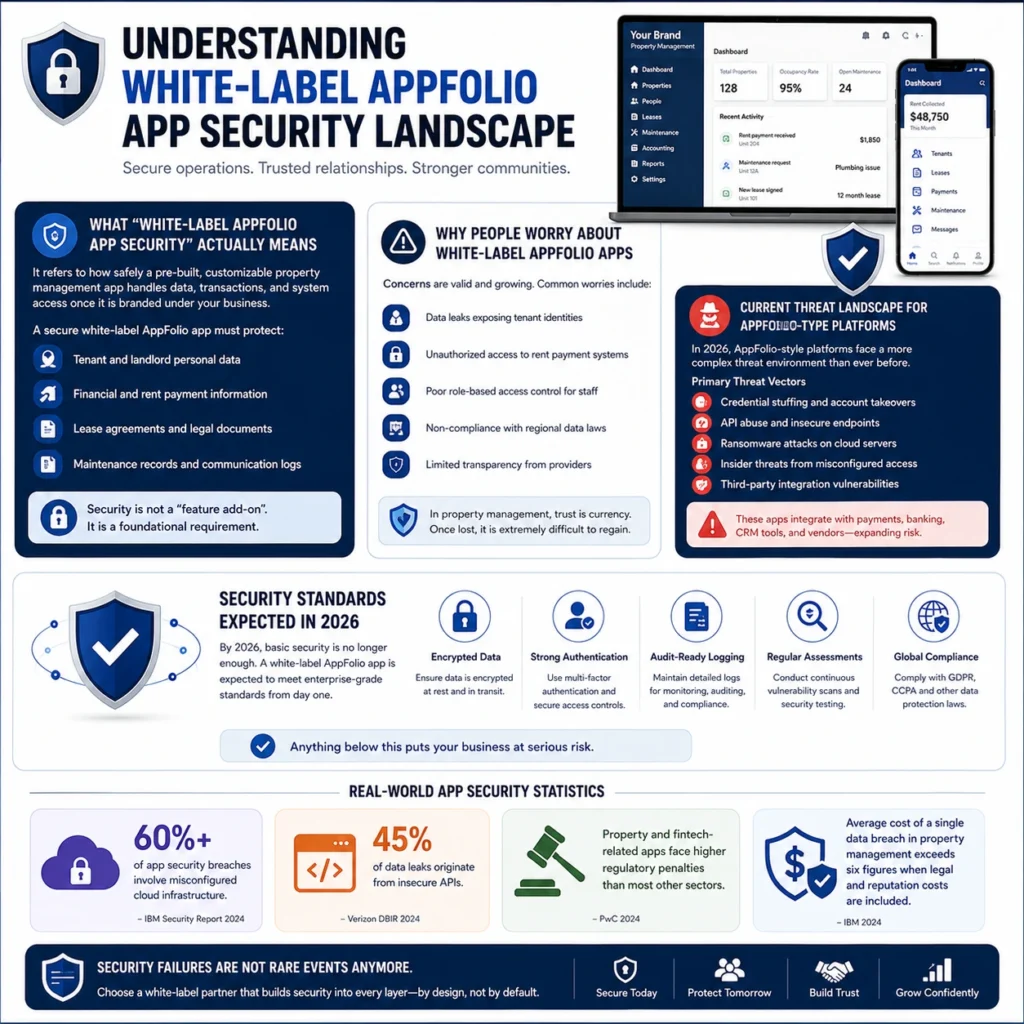
What “White-Label AppFolio App Security” Actually Means
White-label AppFolio app security refers to how safely a pre-built, customizable property management app handles data, transactions, and system access once it is branded and launched under your business name.
Unlike custom-built apps, white-label apps use a shared core architecture. This makes security highly dependent on the provider’s engineering practices, not just how you configure the app.
A secure white-label AppFolio app must protect:
- Tenant and landlord personal data
- Financial and rent payment information
- Lease agreements and legal documents
- Maintenance records and communication logs
Security is not a “feature add-on” here. It is a foundational requirement.
Why People Worry About White-Label AppFolio Apps
Concerns around white-label AppFolio apps are valid and growing. Property management apps sit at the intersection of finance, identity, and housing, making them attractive targets.
Most worries come from:
- Data leaks exposing tenant identities
- Unauthorized access to rent payment systems
- Poor role-based access control for staff
- Non-compliance with regional data laws
- Limited transparency from providers
In property management, trust is currency. Once lost, it is extremely difficult to regain.
Current Threat Landscape for AppFolio-Type Platforms
In 2026, AppFolio-style platforms face a more complex threat environment than ever before.
Primary Threat Vectors
- Credential stuffing and account takeovers
- API abuse and insecure endpoints
- Ransomware attacks on cloud servers
- Insider threats from misconfigured access
- Third-party integration vulnerabilities
Property management apps are especially exposed because they often integrate with payment gateways, banking systems, CRM tools, and maintenance vendors.
Security Standards Expected in 2026
By 2026, basic security is no longer enough. A white-label AppFolio app is expected to meet enterprise-grade standards from day one.
Baseline expectations include:
- Encrypted data at rest and in transit
- Strong authentication mechanisms
- Audit-ready logging systems
- Regular vulnerability assessments
- Compliance with global data protection laws
Anything below this puts your business at serious risk.
Real-World App Security Statistics
Recent industry data highlights why caution is necessary:
- Over 60% of app security breaches involve misconfigured cloud infrastructure
- Nearly 45% of data leaks originate from insecure APIs
- Property and fintech-related apps face higher regulatory penalties than most other sectors
- Average cost of a single data breach in property management exceeds six figures when legal and reputation costs are included
These numbers show one clear truth: security failures are not rare events anymore.
Read more : – Business Model of AppFolio : Complete Strategy Breakdown 2026
Key Security Risks & How to Identify Them
High-Risk Area 1: Data Protection & Privacy
Property management apps process highly sensitive personal and financial data. Any weakness here creates immediate legal and trust risks.
User Personal Information
White-label AppFolio apps store tenant names, phone numbers, addresses, ID documents, and employment details. If databases are not encrypted or access controls are weak, this data becomes an easy target.
Payment Data Security
Rent payments, late fees, and deposits involve direct financial transactions. Without PCI DSS–compliant handling, payment data can be exposed through logs, APIs, or third-party plugins.
Location and Property Data
Property addresses, unit numbers, and access-related information are often overlooked security risks. If leaked, this data can be misused for fraud or unauthorized access.
GDPR and CCPA Compliance
If your app serves users in Europe or California, failure to manage consent, data deletion, and user rights can lead to heavy penalties, even without a breach.
High-Risk Area 2: Technical Vulnerabilities
Many white-label AppFolio apps fail not because of hackers, but because of poor engineering practices.
Code Quality Issues
Hardcoded credentials, outdated libraries, and lack of secure coding standards create silent vulnerabilities that attackers actively scan for.
Server and Infrastructure Gaps
Improper cloud configuration, open ports, or weak firewall rules can expose entire databases to the public internet.
API Vulnerabilities
APIs connect mobile apps, dashboards, and third-party services. Poor authentication, missing rate limits, or exposed endpoints are among the most common breach sources.
Third-Party Integrations
Payment gateways, analytics tools, and maintenance service APIs expand functionality but also increase attack surface if not carefully audited.
High-Risk Area 3: Business-Level Risks
Security failures extend far beyond technical damage.
Legal Liability
Landlords and property managers can be held legally responsible for tenant data exposure, even if the breach originated from the app provider.
Reputation Damage
Trust is essential in property management. One public security incident can permanently damage brand credibility.
Financial Losses
Costs include breach response, legal fees, customer compensation, regulatory fines, and loss of future business.
Regulatory Penalties
Non-compliance with data protection laws can trigger audits, forced shutdowns, or ongoing monitoring by regulators.
Risk Assessment Checklist
Before launching a white-label AppFolio app, evaluate the following:
- Is all sensitive data encrypted at rest and in transit?
- Are payment systems PCI DSS compliant?
- Is role-based access control properly enforced?
- Are APIs protected with authentication and rate limiting?
- Are third-party integrations security-audited?
- Is compliance documented and verifiable?
- Is there a clear incident response plan?
If any of these answers are unclear, the risk level is high.
Security Standards Your White-Label AppFolio App Must Meet
Essential Security Certifications
In 2026, security claims without certifications are meaningless. A white-label AppFolio app must align with globally recognized compliance standards to be considered safe.
ISO 27001 Compliance
ISO 27001 ensures that the provider follows a structured Information Security Management System. This covers risk assessment, access control, incident handling, and continuous improvement.
For property management apps, ISO 27001 indicates that tenant data, financial records, and internal systems are protected by formal security governance.
SOC 2 Type II
SOC 2 Type II validates how a provider handles data security over time, not just at a single point.
This certification confirms:
- Secure system operations
- Controlled data access
- Continuous monitoring
- Incident response readiness
A white-label AppFolio app without SOC 2 alignment is a red flag for enterprise use.
GDPR Compliance
GDPR is mandatory if your app serves European users. It governs:
- User consent collection
- Data storage and processing
- Right to access and deletion
- Breach notification timelines
Non-compliance can result in penalties reaching millions, even for small platforms.
HIPAA (If Applicable)
If your AppFolio-style app manages medical accommodations, senior housing, or health-related tenant data, HIPAA compliance becomes relevant.
This ensures protected health information is handled securely and lawfully.
PCI DSS for Payments
Any app processing rent payments or deposits must follow PCI DSS standards. This prevents exposure of cardholder data and reduces fraud risk.
Technical Security Requirements
Certifications alone are not enough. Technical implementation determines real-world safety.
End-to-End Encryption
All sensitive data must be encrypted:
- In transit using HTTPS and TLS
- At rest using strong encryption algorithms
Encryption ensures that even if data is intercepted, it remains unreadable.
Secure Authentication Systems
A secure white-label AppFolio app must support:
- Two-factor authentication
- OAuth-based login systems
- Strong password policies
- Session management controls
This reduces the risk of account takeovers.
Regular Security Audits
Scheduled audits help identify vulnerabilities before attackers do. Audits should cover:
- Application code
- Server configuration
- Database security
- Third-party services
Penetration Testing
Penetration testing simulates real-world attacks to expose weaknesses. This should be performed at least annually or after major updates.
SSL Certificates
SSL certificates are non-negotiable. All web and mobile endpoints must enforce secure connections.
Secure API Design
APIs must include:
- Authentication and authorization checks
- Rate limiting
- Input validation
- Logging and monitoring
Poor API security remains one of the top causes of data breaches.
Security Standards Comparison Overview
| Security Area | Minimum Requirement | Enterprise-Grade Expectation |
|---|---|---|
| Data Encryption | TLS for data in transit | Encryption at rest and in transit |
| Authentication | Password-based login | 2FA and OAuth |
| Compliance | Basic privacy policy | ISO 27001, SOC 2, GDPR |
| Audits | One-time review | Ongoing security audits |
| Payments | Gateway integration | Full PCI DSS compliance |
| Monitoring | Manual checks | 24/7 automated monitoring |
Meeting only minimum requirements exposes your business to avoidable risks. Enterprise-grade standards are now the baseline expectation.
Red Flags – How to Spot Unsafe White-Label Providers
Warning Signs You Should Never Ignore
Choosing the wrong white-label AppFolio app provider can expose your business to long-term security and legal problems. The following red flags indicate serious risk.
No Security Documentation
If a provider cannot share security architecture details, audit reports, or compliance documentation, it usually means security was never a priority.
Unusually Cheap Pricing Without Explanation
Security infrastructure is expensive. Extremely low pricing often signals shortcuts in encryption, hosting, audits, or staff expertise.
No Compliance Certifications
A provider claiming “secure by design” but lacking ISO, SOC 2, GDPR, or PCI DSS alignment is operating on trust, not proof.
Outdated Technology Stack
Old frameworks, unsupported libraries, and unpatched systems are common entry points for attackers.
Poor Code Quality
Messy, undocumented, or copy-pasted code increases the risk of hidden vulnerabilities and makes future security updates difficult.
No Security Update Policy
Security is ongoing. Providers who cannot explain how often they patch systems or respond to vulnerabilities are unsafe choices.
Lack of Data Backup and Recovery Systems
Without regular backups, a ransomware attack or system failure can permanently destroy critical tenant and payment data.
No Insurance Coverage
Cyber liability insurance protects both provider and client in case of incidents. Absence of insurance shifts all risk to you.
Evaluation Checklist Before Selecting a Provider
Questions You Should Ask
- What security standards do you follow?
- How is tenant and payment data encrypted?
- How often are security audits conducted?
- Who is responsible for compliance updates?
- What happens if a data breach occurs?
Documents You Must Request
- Security architecture overview
- Compliance certificates or audit summaries
- Data processing agreements
- Incident response policy
- Backup and disaster recovery plan
Testing and Validation Steps
- Request a demo with security features enabled
- Review role-based access controls
- Test authentication and session management
- Validate API security mechanisms
Due Diligence Actions
- Verify certifications independently
- Check past security incidents or disclosures
- Review client testimonials focused on reliability
- Confirm long-term update and support commitments
Ignoring these steps can result in avoidable security failures that damage your business beyond repair
.Best Practices for Secure White-Label AppFolio App Implementation
Pre-Launch Security Practices
Security work must begin long before your app goes live. Most breaches occur because security was treated as an afterthought.
Security Audit and Risk Assessment
Before launch, conduct a full security audit covering codebase, infrastructure, APIs, and integrations. This identifies vulnerabilities early and reduces exposure.
Code Review Requirements
Ensure secure coding standards are followed. Code reviews should check for hardcoded credentials, insecure data handling, and outdated libraries.
Infrastructure Hardening
Servers and cloud environments must be configured securely. This includes firewall rules, access restrictions, environment isolation, and secure storage systems.
Compliance Verification
Verify GDPR, PCI DSS, and other relevant compliance requirements before onboarding users. Documentation should be complete and accessible.
Internal Access and Staff Training
Limit system access based on roles. Train internal teams on data handling, security awareness, and incident reporting procedures.
Post-Launch Security and Monitoring
Launching the app is not the end of security responsibility. It is the beginning.
Continuous Security Monitoring
Implement automated monitoring for suspicious activity, login anomalies, and unauthorized access attempts.
Regular Updates and Patch Management
Security vulnerabilities evolve constantly. Apply patches, library updates, and framework upgrades on a defined schedule.
Incident Response Planning
Have a documented response plan outlining detection, containment, communication, and recovery steps in case of a breach.
User Data Management
Maintain strict data retention policies. Remove inactive data and provide users with access and deletion controls as required by law.
Backup and Recovery Systems
Schedule encrypted backups and test recovery procedures regularly. This ensures business continuity even during cyber incidents.
Security Implementation Timeline Overview
| Phase | Key Security Actions |
|---|---|
| Planning | Risk assessment and compliance mapping |
| Development | Secure coding and API protection |
| Pre-Launch | Audits, testing, infrastructure hardening |
| Launch | Monitoring and access control enforcement |
| Post-Launch | Updates, audits, and incident readiness |
Following a structured timeline significantly reduces security risks and ensures long-term platform stability.
Legal & Compliance Considerations
Regulatory Requirements You Must Address
Operating a white-label AppFolio app means handling legally protected data. Compliance is not optional; it is a core operational requirement.
Data Protection Laws by Region
Different regions impose different obligations:
- GDPR for European users
- CCPA and CPRA for California residents
- Local data protection laws in Asia-Pacific and other regions
Your app must support lawful data collection, storage, and processing based on user location.
Industry-Specific Regulations
Property management apps may fall under additional housing, financial, or consumer protection regulations depending on jurisdiction. Ignoring these can trigger audits and penalties.
User Consent Management
Users must clearly understand what data is collected and why. Consent records should be stored securely and be easily retrievable for audits.
Privacy Policy Requirements
A legally valid privacy policy must clearly explain:
- What data is collected
- How it is used
- Who it is shared with
- How users can exercise their rights
Generic or copied policies increase legal exposure.
Terms of Service Essentials
Terms must define platform responsibility, user obligations, payment handling, and dispute resolution. This protects your business during conflicts or incidents.
Liability Protection Measures
Cyber Insurance Requirements
Cyber liability insurance helps cover breach-related costs such as legal fees, investigations, and user notifications.
Legal Disclaimers and User Agreements
Clear disclaimers limit liability by defining acceptable use, security boundaries, and user responsibilities.
Incident Reporting Protocols
Regulations often require breaches to be reported within fixed timeframes. Your app must support fast detection and reporting.
Ongoing Compliance Monitoring
Laws evolve. Regular reviews ensure your app remains compliant as regulations change across regions.
Compliance Checklist by Region
| Region | Key Compliance Focus |
|---|---|
| Europe | GDPR, breach notification rules |
| United States | CCPA, CPRA, PCI DSS |
| Asia-Pacific | Local data residency laws |
| Global | Secure consent and data access |
Strong legal foundations prevent security incidents from turning into business-ending events.
Read More: AppFolio Revenue Model: How AppFolio Makes Money in 2026
Why Miracuves White-Label AppFolio App Is Your Safest Choice
Miracuves Security-First Architecture
At Miracuves, security is not treated as an optional add-on or a post-launch patch. It is built into the foundation of every white-label AppFolio-style app from day one.
Our approach focuses on preventing risks before they turn into incidents.
Enterprise-Grade Security Advantages
Hardened Infrastructure by Design
Miracuves apps are deployed on secure, isolated cloud environments with strict access controls, firewall protection, and encrypted storage.
Compliance-Ready Framework
Every white-label AppFolio app is built with GDPR and CCPA compliance in mind, making it easier for businesses to operate across regions without legal friction.
Secure Payment Processing
Rent payments and financial transactions follow PCI DSS guidelines, ensuring sensitive payment data is never exposed or stored insecurely.
Encrypted Data Transmission
All data transfers use strong encryption protocols, protecting tenant and landlord information during every interaction.
Continuous Security Monitoring
Real-time monitoring helps detect suspicious activity early, reducing response time and limiting potential damage.
Regular Security Audits and Updates
Miracuves conducts ongoing security reviews, vulnerability scans, and updates to keep apps aligned with evolving threat landscapes.
Risk Mitigation and Insurance Coverage
Our delivery model includes structured risk management practices and insurance coverage support, reducing financial exposure for clients.
Why Businesses Trust Miracuves
With 600+ successfully delivered projects, Miracuves has maintained a strong security track record across multiple industries, including property management platforms.
Clients choose Miracuves because:
- Security practices are transparent and documented
- Compliance requirements are addressed proactively
- Long-term updates and support are guaranteed
- Safety scales as the business grows
Final Thought
Miracuves white-label AppFolio app solutions are built with enterprise-grade protection, compliance readiness, and long-term safety in mind. Get a free security assessment and see why businesses trust Miracuves to build secure, compliant property management platforms.
White-label AppFolio apps can be safe, scalable, and legally compliant — but only when security is treated as a core foundation, not an afterthought. The real risk lies in choosing providers who cut corners on compliance, infrastructure, and ongoing protection.
In 2026, app safety is no longer a technical detail. It is a business decision.
FAQs
1. How secure is a white-label AppFolio app compared to custom development?
A white-label AppFolio app can be equally or more secure than custom development when built on audited infrastructure, secure codebases, and compliance-ready frameworks.
2. What happens if there is a security breach?
A proper incident response process includes detection, containment, user notification, regulatory reporting, and recovery backed by logs and backups.
3. Who is responsible for security updates?
Security is a shared responsibility. The provider maintains core infrastructure and patches, while the business ensures correct configuration and usage.
4. How is user data protected in a white-label AppFolio app?
User data is protected through encryption, access control, secure authentication, and compliance-driven data handline
5. What compliance certifications should I look for?
At minimum, look for ISO 27001 alignment, SOC 2 practices, GDPR compliance, and PCI DSS for payment handling.
6. Can white-label AppFolio apps meet enterprise security standards?
Yes. When built with enterprise-grade architecture, audits, and monitoring, white-label apps can meet and sustain enterprise security requirements.
7. How often should security audits be conducted?
Security audits should be conducted annually at minimum and after any major system update or feature release.
8. What is included in the Miracuves security package?
Miracuves includes secure architecture, encrypted data handling, compliance readiness, monitoring, and ongoing security updates.
9. How is security handled across different countries?
Security policies adapt to regional data protection laws using location-based compliance, consent management, and data handling controls.
10. What insurance is needed for app security?
Cyber liability insurance is recommended to cover legal costs, breach response, regulatory penalties, and user compensation.
Related Articles: