

Key Takeaways
- Short-term rental marketplace revenue model should extend beyond booking commissions to create more predictable and diversified platform income.
- Host subscriptions, guest service fees, featured listings, partner add-ons, corporate stays, and premium host tools can create additional revenue layers.
- New marketplaces should start with fewer monetization methods and introduce additional revenue streams as bookings, supply, and user trust increase.
- Hosts are more likely to pay for better visibility, operational tools, analytics, and earning opportunities when the value is clear.
- Transparent fees and payout reporting are essential because aggressive or hidden monetization can reduce guest conversion and increase host churn.
Revenue Signals
- Host subscription plans can create recurring revenue through listing allowances, lower commissions, analytics, calendar tools, team access, and priority support.
- Featured listings monetize supply competition by allowing qualified properties to receive greater visibility in search, destination pages, and promotional campaigns.
- Cleaning, maintenance, insurance, airport transfers, tours, and other local services can generate direct margins or partner referral revenue.
- Corporate and mid-term stays can diversify demand through longer bookings, company billing, reporting, employee permissions, and business-focused inventory.
- Property management tools, premium analytics, payment workflows, regional licensing, and multi-brand operations can add recurring or expansion-stage revenue.
Real Insights
- Commission-only revenue is vulnerable to seasonality, lower occupancy, pricing pressure, and changes in booking volume.
- Not every revenue stream belongs at launch; monetization should evolve with marketplace maturity and demonstrated user value.
- Host subscriptions work better for professional operators and property managers who receive ongoing value from advanced marketplace tools.
- Product architecture affects monetization because commissions, subscriptions, promotions, payouts, add-ons, and reporting require platform-level controls.
- The strongest monetization path is: simple commission → transparent service fees → host tools → paid visibility → partner services → corporate programs → recurring platform revenue.
Most founders assume a short-term rental marketplace earns money mainly through booking commissions. That is true in the early stage, but it is not the full business model.
Booking commissions are usually the first revenue stream because they are easy to understand: a guest books a stay, the platform takes a percentage, and the host receives the remaining payout. But as the marketplace grows, relying only on commission can create pressure. Revenue becomes seasonal, margins depend heavily on occupancy, and the platform must keep increasing booking volume just to grow.
A stronger rental marketplace business model looks beyond the transaction. It combines booking fees with host plans, guest service fees, featured listings, corporate stays, cleaning add-ons, insurance partners, payment fees, loyalty programs, property management tools, and data-backed host services.
Before exploring revenue streams, founders should understand how guest discovery, host listings, booking flows, payments, reviews, and admin control work together inside a rental marketplace. For readers who need a beginner-friendly breakdown, this guide on how short-stay rental platforms work explains the core marketplace flow before moving into monetization strategy.
This guide explains how short-term rental marketplaces make money beyond booking commissions, why diversified monetization matters, and how founders can design revenue layers without hurting guest trust or host retention.
Why Booking Commissions Alone Are Not Enough
Booking commissions are simple, but they are also limited.
A commission-only model means the platform earns only when a successful booking happens. If bookings slow down during low season, revenue slows down too. If hosts lower prices, the platform earns less per transaction. If a market becomes competitive, the platform may have to reduce fees to keep hosts active.
That is why mature rental marketplaces usually build multiple monetization layers around the booking flow.
The goal is not to charge users everywhere. The goal is to create revenue streams that match real value:
- Hosts pay when they get better visibility, better tools, or more control.
- Guests pay when they receive convenience, support, flexibility, or protection.
- Partners pay when they gain access to qualified travel demand.
- Businesses pay when they need managed stays, long-term inventory, or reporting.
- Platform operators earn more when they control payments, payouts, listings, and marketplace rules.
For founders, the real question is not “What commission should we charge?” It is “What value can the platform create before, during, and after a booking?”
Core Revenue Streams in a Short-Term Rental Marketplace
A strong short-stay rental marketplace can combine several revenue layers. Some are transaction-based, while others are recurring, promotional, or service-based.
| Revenue Stream | Who Pays? | Revenue Type | Best Used When |
|---|---|---|---|
| Booking commission | Host, guest, or both | Transaction-based | Platform has steady booking volume |
| Guest service fee | Guest | Transaction-based | Platform provides support, secure checkout, and convenience |
| Host subscription plan | Host | Recurring | Hosts need ongoing tools or listing allowances |
| Featured listing fee | Host | Promotional | Marketplace has enough supply competition |
| Cleaning and maintenance add-ons | Guest or host | Service-based | Platform controls partner services |
| Travel insurance or protection add-ons | Guest | Partner or affiliate revenue | Guests want booking confidence |
| Corporate stay programs | Businesses | Contract or negotiated revenue | Platform supports longer stays and reporting |
| Payment processing margin | Guest or host | Transaction-based | Platform manages payment flow |
| Property management tools | Host or operator | SaaS-style recurring | Hosts need calendar, pricing, or team workflows |
| Advertising partnerships | Local brands or service providers | Promotional | Platform has targeted travel audience |
The right mix depends on the marketplace stage. A new platform should usually start with fewer revenue layers and add more as trust, supply, and booking frequency improve.
Booking commissions, host plans, guest fees, paid visibility, corporate stays, and partner add-ons all need to connect with the platform’s wider revenue architecture. Founders who want a deeper breakdown of monetization structure can explore this rental marketplace business model before deciding which revenue streams to prioritize at launch.
1. Host-Side Commission on Completed Bookings
Host commission is the most common starting point. The platform deducts a percentage from the host payout after a successful booking.
This model works because the host pays only after earning revenue. That makes it easier to onboard early hosts who may not want to pay monthly fees before they receive bookings.
However, commission rates should be handled carefully. If the platform charges too much, hosts may increase listing prices or move guests off-platform. If the platform charges too little, it may struggle to cover support, payment, marketing, and operations.
A good host commission model should consider:
- Average booking value
- Host acquisition cost
- Guest support cost
- Payment gateway cost
- Refund and dispute handling
- Market competition
- Repeat booking potential
- Host churn risk
Commission is a foundation, not the entire revenue strategy.
2. Guest Service Fees for Convenience and Trust
Guest service fees are charged on top of the booking amount. They usually help the platform cover checkout, payment processing, support, fraud monitoring, cancellation handling, and booking protection workflows.
This revenue stream works best when the guest can clearly understand the value.
For example, guests are more likely to accept a service fee when the platform provides:
- Secure payment processing
- Verified hosts or listings
- Transparent cancellation rules
- Booking confirmation and support
- Dispute management
- Review and trust systems
- Mobile booking convenience
- Saved traveler profiles
- Multi-language or local payment support
The mistake founders should avoid is hiding fees until the final checkout step. Surprise fees can reduce conversion and damage trust. A better approach is to show fees clearly in the price breakdown before payment.
3. Host Subscription Plans for Recurring Revenue
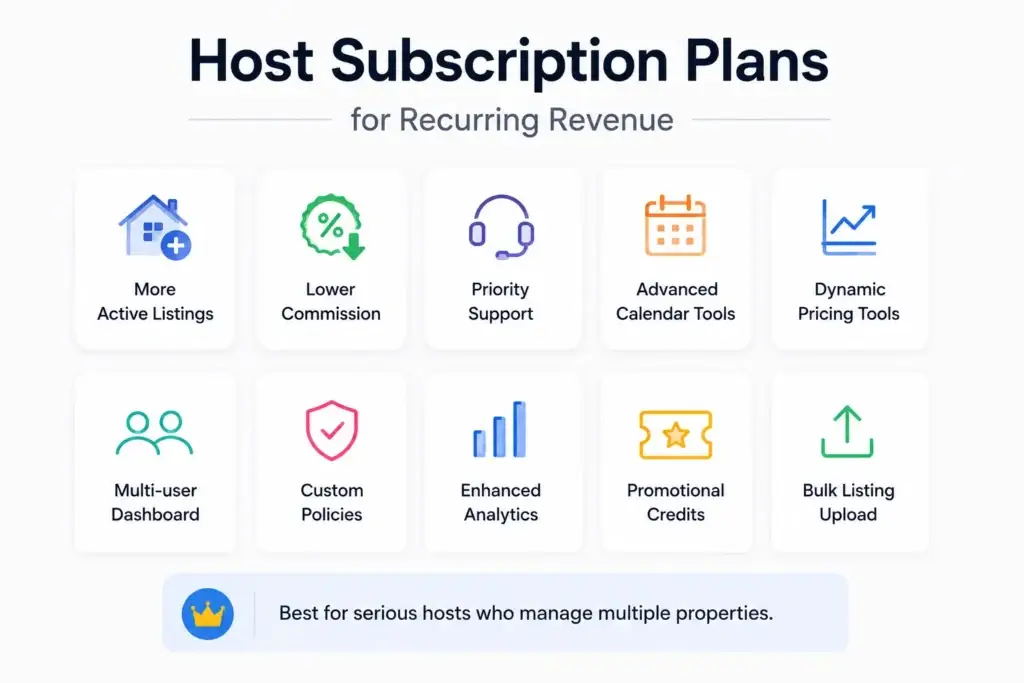
Subscription plans can make a rental marketplace more predictable because revenue does not depend only on completed bookings.
A host subscription plan may include:
- More active listings
- Lower commission rate
- Priority support
- Advanced calendar tools
- Dynamic pricing tools
- Multi-user host dashboard
- Custom cancellation policies
- Enhanced analytics
- Promotional credits
- Bulk listing upload
This model works best when hosts are serious operators, not casual one-listing users. Property managers, boutique apartment owners, vacation rental agencies, and regional stay operators are more likely to pay for tools that help them manage supply better.
A simple structure could look like this:
| Host Plan | Best For | Possible Revenue Logic |
| Free Plan | Individual hosts testing the platform | Higher commission per booking |
| Growth Plan | Hosts with multiple listings | Monthly fee plus lower commission |
| Professional Plan | Property managers or agencies | Higher monthly fee plus advanced tools |
| Enterprise Plan | Regional stay operators | Custom pricing, team access, reporting, and support |
For founders, host plans are powerful because they shift the platform from purely transactional revenue to recurring revenue.
4. Featured Listings and Paid Visibility
Featured listings allow hosts to pay for better placement in search results, destination pages, category collections, or seasonal campaigns.
This revenue stream works only when the marketplace has enough supply. If there are only a few hosts, charging for visibility will not make sense. But once many listings compete for attention, paid placement can become valuable.
Featured placement can be sold through:
- Sponsored search positions
- Homepage listing slots
- Destination landing pages
- Weekend getaway collections
- Family-friendly stay collections
- Workation-friendly stay collections
- Seasonal campaign placements
- Email newsletter features
- App notification promotions
The key is to protect guest experience. Sponsored listings should still meet quality standards. If low-quality properties can simply pay to appear first, the platform may earn short-term revenue but lose guest trust.
5. Cleaning, Maintenance, and Local Service Add-Ons
Rental marketplaces can earn from operational services connected to the stay experience.
These add-ons may include:
- Cleaning services
- Linen replacement
- Maintenance support
- Key exchange services
- Photography packages for hosts
- Listing setup support
- Interior staging partners
- Local concierge services
- Airport pickup
- Grocery stocking
- Tour booking
- Local experience packages
There are two ways to monetize these add-ons.
The first is a direct service margin. The platform sells the service and keeps a margin after paying the provider.
The second is partner referral revenue. The platform sends customers to a trusted local vendor and earns a referral fee or revenue share.
This works especially well when the marketplace targets a specific city, region, or niche. Local service partners become easier to manage when the platform is not trying to cover every market at once.
6. Travel Insurance and Booking Protection Partnerships
Guests want confidence when booking short stays, especially for higher-value trips, international travel, family stays, and longer bookings.
A rental marketplace can partner with insurance or protection providers and offer optional add-ons such as:
- Trip cancellation protection
- Damage protection
- Stay interruption coverage
- Security deposit alternatives
- Host damage coverage
- Emergency support packages
This revenue stream should be handled carefully. The platform should not overpromise coverage or make legal claims without verified partner terms. It should explain what is included, what is excluded, and who provides the protection.
For founders, this model works best when the add-on improves trust and reduces anxiety at checkout.
7. Corporate Stays and Business Travel Programs
Corporate stays can become a strong revenue stream for short-term rental marketplaces because businesses often need reliable accommodation for employees, contractors, relocation teams, project staff, or remote teams.
A corporate stay model may include:
- Monthly billing
- Company dashboards
- Employee booking permissions
- Longer-stay discounts
- Invoice management
- Approved property collections
- Admin reporting
- Dedicated account support
- Flexible cancellation terms
This model usually works better once the marketplace has stable supply in business-friendly locations. Companies care about reliability, clean records, support, and invoice handling more than casual travelers do.
Corporate programs can also reduce seasonality because business stays may not follow the same travel patterns as holiday bookings.
8. Property Management Tools as SaaS Revenue
Some rental marketplaces can monetize the host side by offering software-like tools.
These tools may include:
- Availability calendar management
- Multi-listing dashboards
- Team access for property managers
- Automated pricing suggestions
- Payout reports
- Occupancy reporting
- Booking analytics
- Message templates
- Review management
- Channel management integrations
- Maintenance request tracking
This creates a SaaS-style revenue layer where hosts pay for better operations, not just bookings.
The advantage is predictable recurring revenue. The challenge is that the tools must be genuinely useful. If the host dashboard is too basic, subscription revenue will be weak.
For a founder, this is where product depth matters. A marketplace that gives hosts better control can often retain supply more effectively.
9. Payment Processing and Payout Workflow Revenue
Payments are not only a checkout function. They can also influence revenue design.
A rental marketplace may earn through:
- Service fees linked to payment processing
- Currency conversion margin where legally and operationally appropriate
- Faster payout fees for hosts
- Wallet-based guest credits
- Refund handling fees where allowed
- Split payment convenience fees
- Deposit handling workflows
This area requires careful compliance and transparent communication. Founders should avoid hidden financial charges that damage user trust. Any fee related to payments, refunds, deposits, or payouts should be clearly explained in the booking and host payout screens.
Payment and payout revenue should always be supported by trust-focused infrastructure. When a marketplace handles guest payments, host earnings, refunds, deposits, and payout approvals, security becomes part of the revenue system. Founders can use this rental marketplace security guide to understand the role of secure payment handling, role-based access, verification workflows, and activity logs.
A strong payout workflow also improves host retention. Hosts are more likely to stay when they understand when they will be paid, what commission was deducted, and why any payout is on hold.
10. Data Insights and Market Intelligence for Hosts
As a rental marketplace grows, it collects valuable operational signals:
- Search demand by destination
- Booking conversion by property type
- Seasonal occupancy trends
- Average nightly rate by area
- Guest preference patterns
- Cancellation patterns
- Popular amenities
- Length-of-stay trends
- Host response time impact
- Repeat guest behavior
These insights can help hosts improve pricing, listing quality, and availability.
A platform can monetize this through premium host analytics, market reports, pricing intelligence, or professional dashboards. However, the platform must respect privacy and avoid selling personal user data. Any analytics product should use aggregated, privacy-conscious insights.
This revenue stream becomes more realistic when the platform has enough booking and search activity to produce meaningful patterns.
11. Local Advertising and Destination Partnerships
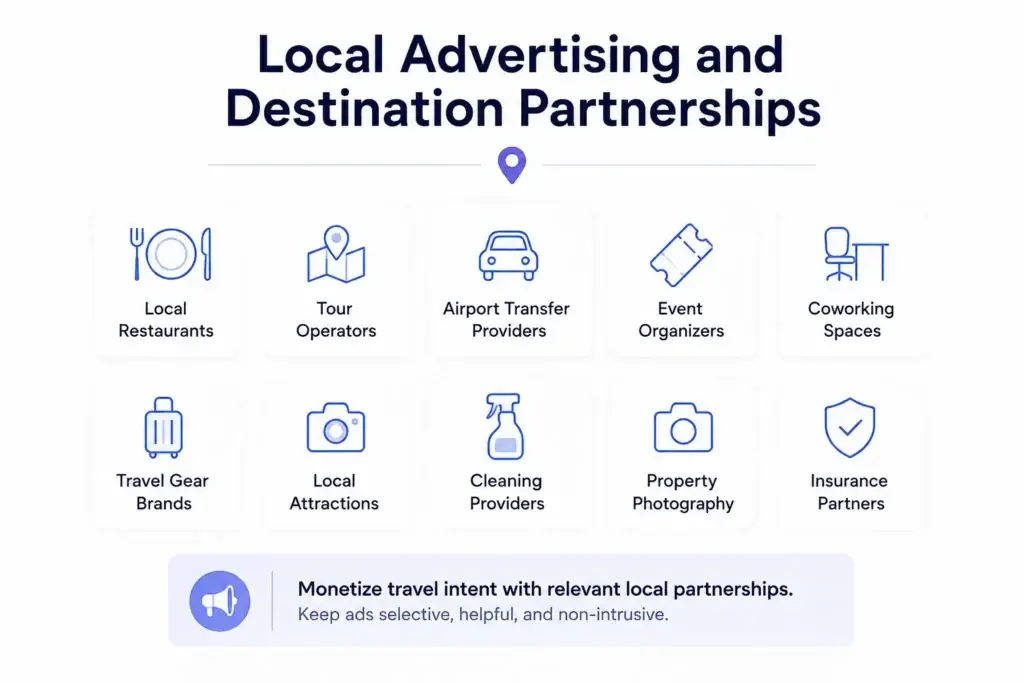
Short-term rental platforms can create advertising opportunities around travel intent.
Possible advertisers include:
- Local restaurants
- Tour operators
- Airport transfer providers
- Event organizers
- Coworking spaces
- Travel gear brands
- Local attractions
- Cleaning providers
- Property photography agencies
- Insurance partners
This can work through banner placements, destination guides, email campaigns, curated recommendations, or partner listings.
Advertising partnerships work better when the marketplace already has a clear demand-generation strategy. Destination campaigns, host acquisition, referral loops, SEO pages, seasonal promotions, and local partnerships all influence how quickly new revenue streams can grow. Founders planning this layer can explore this rental marketplace marketing strategy for post-launch growth ideas.
The platform should be selective. Too many ads can make the marketplace feel cluttered and reduce booking confidence. The better approach is to integrate partners where they genuinely help the traveler or host.
12. Long-Stay and Mid-Term Rental Revenue
Short-term rental marketplaces can also expand into longer stays.
Mid-term rentals may serve:
- Digital nomads
- Students
- Relocating employees
- Traveling nurses
- Remote workers
- Project teams
- Families in transition
- Corporate housing users
This model can produce higher booking values and lower turnover. It may also create demand for different features such as monthly pricing, deposit rules, utility handling, document verification, extended cancellation policies, and lease-like agreements depending on the market.
Longer stays are not always better, but they can reduce dependence on weekend or holiday booking spikes.
13. Franchise, Multi-Brand, or Regional Operator Models
Some founders do not want to run one marketplace directly. They may want to create a system that can be used across multiple regions, brands, or business partners.
In this model, revenue can come from:
- Setup fees
- Monthly platform licensing
- Regional operator fees
- Revenue share with partners
- White-label deployments
- Admin access packages
- Support and maintenance plans
- Feature upgrade fees
This approach is especially relevant for agencies, travel operators, real estate networks, and entrepreneurs who want to run multiple local marketplaces under separate branding.
A source-code-owned and customizable product foundation becomes important here because the operator needs control over branding, workflows, pricing, and future expansion.
Founder Decision Signals
Supply Quality
If hosts have high-quality properties and repeat availability, host subscriptions and featured placements become more realistic.
Booking Volume
If bookings are still low, focus on conversion and trust before adding too many monetization layers.
Host Retention
If hosts need better tools, add calendar, pricing, analytics, and payout features before charging recurring fees.
Operational Control
If the platform manages payments, payouts, refunds, and disputes, admin controls become essential for sustainable monetization.
How to Choose the Right Revenue Mix for Your Marketplace
Not every revenue stream should be added at launch. Adding too many fees too early can confuse users and reduce adoption.
The revenue model also affects development scope. A simple commission-based marketplace may need fewer modules, while a platform with subscriptions, paid promotions, corporate bookings, partner add-ons, and advanced payout rules requires deeper planning. Founders estimating the budget can review these rental platform development cost factors to understand how monetization choices influence build complexity.
Founders should choose revenue streams based on the stage of the marketplace.
| Marketplace Stage | Main Priority | Better Revenue Focus | Avoid |
| Pre-launch | Build supply and validate demand | Simple commission, clear guest fee | Too many paid host features |
| Early launch | Increase bookings and host trust | Commission, transparent service fee | Aggressive ads or hidden checkout fees |
| Growth stage | Improve repeat revenue | Host plans, featured listings, partner add-ons | Charging for features hosts do not value |
| Expansion stage | Increase margin and predictability | Corporate stays, SaaS tools, regional plans | Weak payout reporting |
| Mature stage | Diversify and deepen platform value | Data insights, licensing, multi-brand models | Monetization that hurts trust |
The strongest model is usually phased. Start simple, prove trust, then add revenue layers around real user value.
Miracuves Perspective: Monetization Needs Product Control
Mistakes Founders Should Avoid
Depending Only on Booking Commission
Commission is useful, but it makes revenue highly dependent on booking volume, seasonality, and pricing pressure. Add other revenue layers when the platform has enough trust and supply depth.
Adding Hidden Fees at Checkout
Surprise charges can reduce conversion and damage guest trust. Every fee should be visible, explainable, and connected to real value.
Charging Hosts Before Delivering Value
Host plans work only when hosts receive better tools, better visibility, lower friction, or higher earning potential. A paid plan without value increases churn.
Ignoring Payout Transparency
Hosts need to understand booking value, platform commission, deductions, payout timing, and hold reasons. Poor payout visibility weakens supply retention.
When to Build Custom Monetization Logic
Not every rental marketplace needs the same revenue model.
A boutique homestay platform may need host subscriptions and destination promotions. A corporate housing platform may need company billing and invoice workflows. A property manager marketplace may need multi-listing dashboards and analytics. A regional travel marketplace may need local service add-ons, tour packages, and partner revenue.
If your marketplace needs custom commission rules, corporate booking flows, regional pricing, partner add-ons, host subscription tiers, or advanced payout approvals, the development partner becomes important. A team that understands marketplace logic can help connect monetization with booking, payment, host, and admin workflows. Founders evaluating implementation options can review how to choose a rental marketplace development partner.
Custom monetization logic may be useful when the platform needs:
- Region-specific payment methods
- Custom host commission rules
- Different revenue models by city
- Corporate booking workflows
- Monthly invoicing
- Long-stay pricing
- Multi-property operator dashboards
- Partner service integrations
- Advanced payout approval rules
- Custom reports for hosts or operators
If your business model requires deeper workflows than a standard marketplace foundation, Miracuves can support both ready-made deployment and custom mobile app development based on your launch roadmap.
Revenue Model Checklist for Short-Term Rental Platforms
Every revenue stream needs the right product feature behind it. Host subscriptions require account plans and dashboard controls. Featured listings require search placement logic. Guest service fees require transparent checkout. Payout revenue requires strong payment and settlement workflows. To understand the product modules behind these models, review these short-term rental platform features.
Marketplace Monetization Checklist
| Revenue Layer | Required Platform Capability | Founder Impact |
|---|---|---|
| Booking commission | Booking engine, payment flow, payout logic | Creates the first transaction-based revenue stream |
| Guest service fee | Transparent price breakdown and secure checkout | Helps cover support, payment, and platform operations |
| Host plans | Host dashboard, listing limits, analytics, pricing tools | Adds recurring revenue and improves host segmentation |
| Featured listings | Search ranking controls and promotional placement logic | Monetizes supply competition without changing booking flow |
| Partner add-ons | Service integrations, checkout upsells, partner reporting | Expands revenue beyond accommodation bookings |
| Corporate stays | Long-stay pricing, invoicing, company dashboards | Creates higher-value and less seasonal demand |
| Host analytics | Reporting, occupancy data, pricing insights | Supports premium tools and host retention |
| Regional licensing | Multi-brand control, admin roles, source-code flexibility | Supports expansion through operators or partners |
Miracuves Perspective: Monetization Needs Product Control
A short-term rental marketplace can only monetize what it can control. If the platform cannot control booking fees, host commissions, payout rules, promotional placements, service add-ons, refunds, listing limits, and subscription access, revenue growth becomes difficult to manage.
That is why founders should think about monetization before development begins. Revenue logic affects the admin dashboard, host dashboard, payment gateway, payout workflow, coupon engine, listing visibility, and reporting system.
Miracuves helps founders build rental marketplace platforms with ready-made and white-label apps that can support multiple revenue layers. Instead of treating monetization as an afterthought, founders can plan booking commissions, host plans, service fees, payout rules, and promotional features from the beginning.
For founders who want to explore a launch-ready product foundation, the Miracuves short-stay rental marketplace solution is the most relevant next step.
Final Thoughts
Short-term rental marketplaces do not need to depend only on booking commissions. Commission may be the first revenue stream, but long-term growth usually comes from a smarter mix of host plans, guest service fees, paid visibility, partner services, corporate stays, analytics tools, payment workflows, and regional expansion models.
For founders, the strongest monetization strategy is not the one with the most fees. It is the one that matches real value. Guests should pay for convenience and trust. Hosts should pay for visibility, tools, and better earning potential. Partners should pay for access to relevant travel demand. The platform should earn more because it improves the marketplace, not because it hides charges.
The best time to plan this is before launch. Once booking, payment, payout, listing, and admin systems are designed around clear revenue logic, the marketplace becomes easier to scale, easier to manage, and easier to monetize.
Some short-term rental businesses need unique mobile workflows beyond standard marketplace features. This may include custom guest apps, host apps, loyalty systems, local payment integrations, operator dashboards, or region-specific booking rules. In those cases, Miracuves’ custom mobile app development services can help shape the product around the business model and launch roadmap.
FAQs
How do short-term rental marketplaces make money?
Short-term rental marketplaces usually make money through booking commissions, guest service fees, host subscriptions, featured listings, partner services, corporate stay programs, payment-related fees, and premium host tools.
Are booking commissions enough for a rental marketplace?
Booking commissions can work in the early stage, but they may not be enough long term. A commission-only model depends heavily on booking volume, seasonality, and pricing. Additional revenue streams can make the business more predictable.
What are the best revenue streams beyond commissions?
The best revenue streams depend on the marketplace stage. Host plans, paid listing visibility, cleaning service add-ons, guest service fees, corporate stays, and host analytics are common options once the platform has enough supply and demand.
Should a new rental marketplace charge hosts a subscription fee?
A new marketplace should be careful with host subscriptions. Subscriptions work better when hosts receive clear value, such as more listings, analytics, calendar tools, reduced commission, priority visibility, or professional dashboard features.
How can a rental platform increase revenue without hurting trust?
A rental platform can increase revenue by keeping fees transparent, offering useful host tools, adding optional guest services, improving payout clarity, and making promotional placements quality-controlled rather than purely paid.
Can corporate stays be a revenue stream for short-term rental platforms?
Yes. Corporate stays can create higher-value bookings, longer stays, and repeat business. This model usually requires company billing, reporting, approved listings, flexible policies, and reliable support workflows.
What features are needed to support multiple revenue streams?
A platform needs booking management, payment processing, commission settings, host dashboards, coupon tools, featured listing controls, partner integration options, payout workflows, admin reporting, and role-based access control.
When should founders consider a ready-made rental marketplace foundation?
Founders should consider a ready-made foundation when they want to launch faster, reduce development complexity, validate demand, and start with core workflows such as listings, bookings, payments, commissions, host dashboards, and admin controls already structured.
Miracuves is an independent software development company. We are not affiliated with, connected to, sponsored by, or endorsed by any company or product named in this article.
Terms such as “X Clone” are used descriptively. It is how the software industry refers to building a platform with functionality comparable to a known service, and how clients search for it.
The entire design and codebase of our products is built by our own team. Our products contain no code, design, graphics, or content originating from any third-party website or applications.
All third-party names and marks referenced in this article are the property of their respective owners, referenced solely to identify the services discussed.