


Key Takeaways
What You’ll Learn
- A Shopify Clone revenue model is built around subscription-based eCommerce infrastructure helping businesses create online stores, manage products, process payments, and scale digital commerce operations.
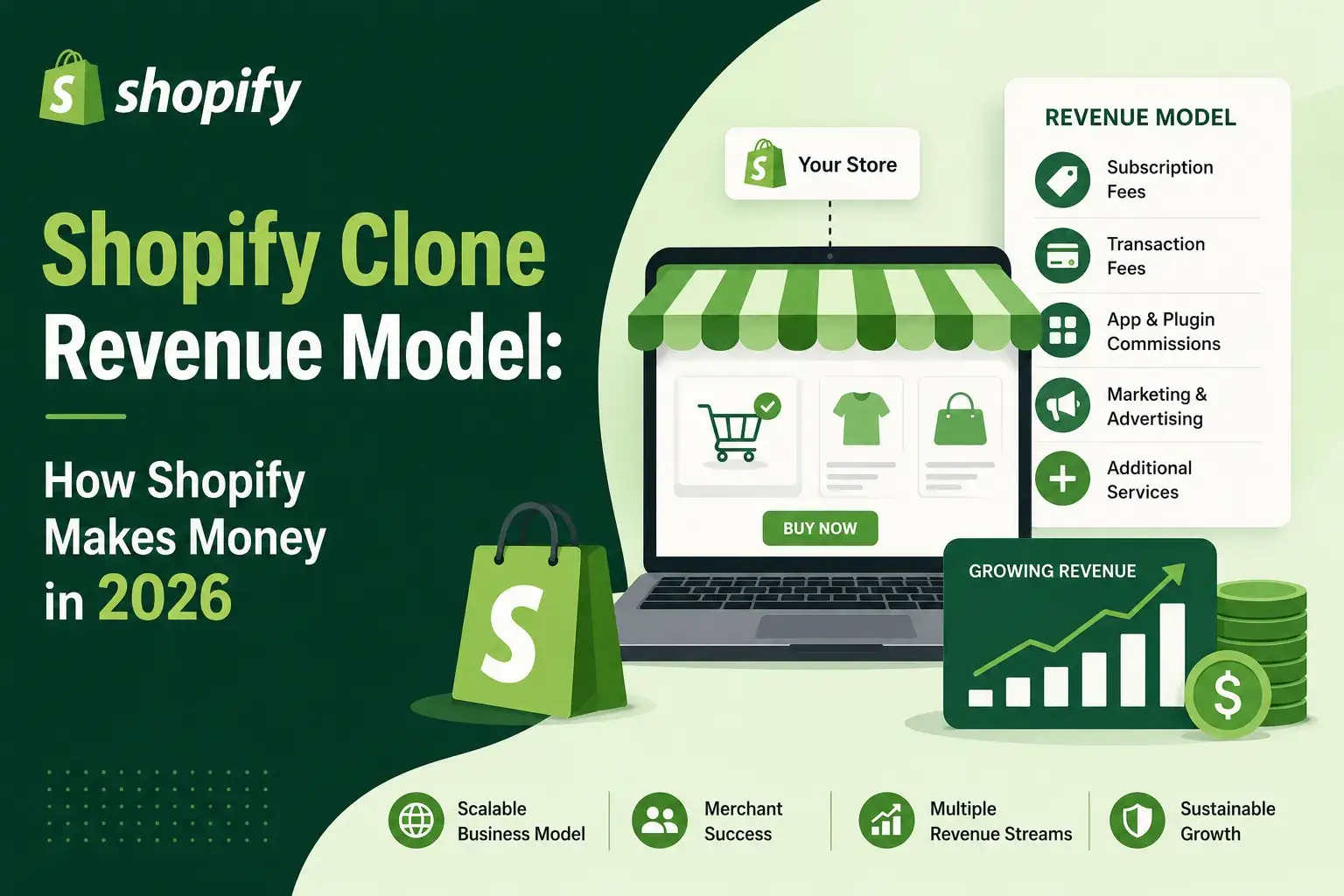
- The platform earns through multiple monetization layers including monthly subscriptions, transaction fees, payment processing, app marketplace revenue, themes, and enterprise services.
- Ecosystem expansion is the biggest growth driver because merchants increasingly depend on integrated tools for marketing, logistics, payments, analytics, and store customization.
- Recurring subscriptions improve revenue predictability while merchant growth increases long-term customer lifetime value across the platform ecosystem.
- The biggest takeaway for founders is that Shopify-style platforms scale successfully when SaaS infrastructure, merchant tools, payments, and ecosystem monetization work together.
Stats That Matter
- The article positions Shopify clone platforms as scalable eCommerce SaaS businesses supporting merchants, startups, D2C brands, and enterprise online sellers.
- Core revenue comes from subscription plans and transaction-based fees generated through online store hosting, payment processing, and merchant operations.
- Additional monetization comes from app ecosystems and value-added services including plugins, premium themes, marketing tools, shipping integrations, and enterprise support.
- The platform benefits from growing global eCommerce adoption as businesses increasingly shift toward digital storefronts and direct-to-consumer selling models.
- Merchant ecosystem growth directly improves platform scalability because developers, logistics partners, payment providers, and third-party apps expand overall marketplace value.
Real Insights
- The real strength of a Shopify Clone comes from ecosystem dependency because merchants rely on integrated payments, inventory systems, marketing tools, and fulfillment operations daily.
- Recurring SaaS revenue improves long-term sustainability since subscription-based merchant platforms generate predictable monthly income as businesses scale.
- Third-party integrations improve retention and monetization because merchants increasingly expect app marketplaces, automation tools, analytics, and multichannel selling capabilities.
- Platform scalability depends heavily on infrastructure performance since online stores require secure checkout, uptime reliability, mobile responsiveness, and fast transaction handling.
- For entrepreneurs, the biggest lesson is to build a Shopify Clone platform around recurring SaaS subscriptions, merchant ecosystems, integrated payments, scalable infrastructure, and long-term eCommerce enablement.
In 2026, Shopify is operating at an estimated $10.7 billion in annual revenue, proving that commerce infrastructure can be more powerful than selling products themselves.
What makes Shopify remarkable is not just subscriptions—but how it monetizes every layer of a merchant’s journey, from store creation to payments, shipping, marketing, and ecosystem expansion.
For founders, Shopify’s model is a blueprint for building a high-margin, recurring, and compounding platform business rather than a traditional e-commerce store.
Shopify Revenue Overview – The Big Picture
Shopify operates as a commerce operating system powering millions of merchants globally.
2026 Snapshot
- 2026 Revenue: ~$10.7 billion
- Valuation: ~$80–90 billion range
- YoY Growth: ~20%
- Profit Margins: 22–28% blended
Revenue by Region
- North America: ~55%
- Europe: ~25%
- Asia-Pacific: ~15%
- Rest of World: ~5%
Competition Benchmark
- Higher ARPU than pure SaaS competitors
- Stronger margins than logistics-heavy platforms
- Superior ecosystem monetization compared to storefront-only tools
Read More: What is Shopify and How Does It Work?
Primary Revenue Streams Deep Dive
Revenue Stream #1: Subscription Plans
How it works: Merchants pay monthly fees for access to the platform.
Revenue Share: ~29%
Pricing: Tiered plans from entry-level to enterprise
2026 Insight: Enterprise subscriptions now contribute a growing share of predictable revenue.
Revenue Stream #2: Shopify Payments (Transaction Fees)
How it works: Shopify takes a percentage of every transaction processed.
Revenue Share: ~38%
Pricing: ~2%–3% per transaction
2026 Insight: Payments have become Shopify’s single largest revenue engine.
Revenue Stream #3: Merchant Services
How it works: Shipping, capital advances, POS hardware, tax tools.
Revenue Share: ~18%
2026 Insight: Embedded services improve merchant retention and lifetime value.
Revenue Stream #4: App & Theme Ecosystem
How it works: Revenue share from third-party apps and themes.
Revenue Share: ~9%
2026 Insight: App ecosystem acts as a growth multiplier without Shopify building everything.
Revenue Stream #5: Shopify Plus & Enterprise Services
How it works: High-value contracts with large brands.
Revenue Share: ~6%
2026 Insight: Fewer merchants, but significantly higher ARPU.
Revenue Streams Percentage Breakdown
| Revenue Stream | % Share (2026) |
|---|---|
| Payments & Transaction Fees | 38% |
| Subscriptions | 29% |
| Merchant Services | 18% |
| App & Theme Ecosystem | 9% |
| Enterprise Services | 6% |
The Fee Structure Explained
Shopify monetizes primarily on the merchant side, but with layered fees.
User-Side Fees
- Monthly subscription fees
- Transaction processing fees
- Shipping and fulfillment margins
- Capital financing fees
Provider-Side Fees
- App developer revenue share
- Theme marketplace commissions
Hidden Revenue Layers
- Payment float income
- Foreign exchange conversion margins
- Advanced analytics upsells
Regional Pricing Variation
- Higher subscription tiers in North America
- Payment-driven monetization in emerging markets
- Enterprise customization in Europe
Complete Fee Structure by User Type
| User Type | Fee Type | Typical Range |
|---|---|---|
| Small Merchants | Subscription + payments | Monthly + 2–3% |
| Growing Brands | Subscription + services | Mid-tier plans |
| Enterprise Brands | Custom contracts | High ARPU |
| App Developers | Revenue share | ~20–30% |
| Logistics Partners | Commission | Variable |
How Shopify Maximizes Revenue Per User
Shopify focuses on merchant success first, then monetizes that success.
- Segmentation: SMBs, D2C brands, enterprises
- Upselling: Payments, shipping, POS, analytics
- Cross-selling: Capital, marketing tools, fulfillment
- Dynamic Pricing: Volume-based incentives
- Retention Monetization: High switching costs
- LTV Optimization: Merchants using payments + apps generate ~2.5× LTV
- Psychological Pricing: Tier anchoring encourages upgrades
- Real Data Example: Merchants using 4+ Shopify services generate significantly higher ARPU.
Miracuves Shopify-Like Ecommerce Platform Solution Cost and Tech Stack
Miracuves Pricing for a Shopify-Like Ecommerce Platform developed using JavaScript architecture is available on request. Final pricing depends on multi-store workflows, subscription systems, payment gateway integrations, app marketplace modules, scalability requirements, AI-powered ecommerce features, and deployment scope. Estimated delivery timeline: 30 to 90 days. For custom architecture planning, enterprise AI workflows, and feature-specific pricing — Contact us.
Get a fully developed, custom ecommerce platform modeled around Shopify-style online store creation and ecommerce management capabilities. Built on a modern JavaScript foundation, this solution can be customized for ecommerce startups, SaaS founders, online retailers, D2C brands, multi-vendor marketplaces, agencies, and enterprise commerce businesses.
- Core Workflows: Store creation, product management, inventory tracking, order processing, payment handling, storefront customization, customer management, shipping workflows, discount systems, analytics dashboards, and app integrations.
- Built-in Revenue Logic: Monthly subscription plans, transaction fees, premium store themes, app marketplace commissions, payment gateway commissions, enterprise plans, add-on services, and white-label SaaS monetization.
- Management Hub: Admin dashboard, merchant management, order analytics, subscription controls, app monitoring, payment reporting, customer insights, inventory management, and platform-wide analytics.
- AI-Ready Architecture: Prepared for AI product recommendations, automated marketing workflows, smart inventory systems, AI-powered analytics, scalable SaaS infrastructure, customer behavior tracking, and enterprise-grade ecommerce scalability.
Read More: Best Shopify Clone Scripts 2025 | Launch eCommerce SaaS Platform
Why Does a Shopify-Like Platform Require JavaScript Architecture?
A modern ecommerce SaaS platform requires more than a basic online store builder. It manages storefront rendering, subscriptions, merchant dashboards, payment systems, inventory operations, app integrations, customer workflows, analytics tracking, and scalable ecommerce infrastructure. A modern JavaScript architecture helps manage these highly interactive ecommerce operations smoothly across merchants, admins, customers, and third-party integrations.
We recommend JavaScript architecture for this type of platform because:
- Built for Interactive Ecommerce Experiences: JavaScript supports dynamic storefronts, real-time cart updates, instant inventory synchronization, live analytics, and smooth customer interactions.
- Advanced Frontend Experience: React.js or similar JavaScript frameworks can power customizable storefronts, merchant dashboards, checkout systems, analytics panels, app marketplaces, and admin controls.
- Scalable Backend Logic: JavaScript-based backend systems can efficiently manage subscriptions, transactions, merchant operations, inventory systems, API traffic, customer sessions, and high-volume ecommerce requests.
- Flexible Integration Layer: The platform can connect with payment gateways, logistics providers, CRM systems, analytics tools, marketing platforms, AI recommendation engines, cloud infrastructure, and third-party ecommerce apps.
You get a scalable ecommerce SaaS platform designed for merchant growth, recurring subscription revenue, ecommerce automation, and long-term platform scalability.
Note: Final pricing depends on selected ecommerce modules, SaaS architecture complexity, payment systems, AI capabilities, scalability goals, infrastructure requirements, security layers, and custom feature development.
Final Thought
Shopify didn’t win by selling stores—it won by becoming commerce infrastructure.
Instead of competing on storefront features alone, Shopify embedded itself into every operational layer of online businesses, including payments, fulfillment, analytics, and financial services. This positioning transformed Shopify from a tool into a platform that merchants depend on daily, creating strong switching costs and long-term platform loyalty.
Its revenue model compounds as merchants grow, making it resilient and scalable.As merchants scale their sales volume, Shopify earns more through transaction fees, premium services, and ecosystem participation—without proportionally increasing its costs. This alignment between merchant success and platform revenue allows Shopify to grow even during market slowdowns, making its business model structurally durable.
FAQs
1. How much does Shopify make per transaction?
Typically around 2–3% depending on payment volume.
2. What’s Shopify’s most profitable revenue stream?
Subscription fees and enterprise plans carry the highest margins.
3. How does Shopify’s pricing compare to competitors?
It’s higher long-term but delivers more integrated value.
4. What percentage does Shopify take from merchants?
Primarily through transaction fees and app revenue shares.
5. How has Shopify’s revenue model evolved?
From SaaS-only to payments-first platform monetization.
6. Can small platforms use similar models?
Yes, by combining subscriptions with transaction fees.
7. What’s the minimum scale for profitability?
Usually a few thousand active merchants.
8. How to implement similar revenue models?
Start with subscriptions, then layer payments and services.
9. What are alternatives to Shopify’s model?
Marketplace-only or logistics-first platforms.