

























Key Takeaways
- Multi-asset investment platforms generate revenue through brokerage, product distribution, subscriptions, margin funding, and value-added services.
- Brokerage creates transaction-based income but can fluctuate with trading activity and market conditions.
- Distribution partnerships can generate recurring income from mutual funds, bonds, insurance, and other approved financial products.
- Premium analytics, portfolio tools, tax reports, advisory features, and research services can support subscription revenue.
- A balanced revenue model should protect investor trust while supporting platform sustainability and long-term engagement.
Revenue Model Signals
- Define brokerage, transaction fees, subscription plans, distribution income, referral commissions, and premium-service charges.
- Connect every fee with orders, taxes, settlements, user ledgers, refunds, disputes, and audit records.
- Provide transparent disclosures for financial products, partner relationships, risks, charges, and eligibility requirements.
- Give administrators control over products, fees, subscriptions, partners, commissions, reports, and suspicious activity.
- Evaluate licensing, integrations, compliance obligations, operational risk, and local regulations before activating each revenue stream.
Real Insights
- Relying only on brokerage can expose platform revenue to changing market activity and investor sentiment.
- Recurring revenue becomes stronger when users continue investing, tracking portfolios, and using valuable financial tools.
- Promoting high-commission products without suitability and transparency can weaken investor confidence.
- Financial software can support compliance workflows but cannot replace licensing, qualified legal review, or regulatory approval.
- Miracuves develops multi-asset investment platforms with onboarding, portfolio management, monetization workflows, partner integrations, reporting, and admin controls.
Multi-asset investment platforms have changed the way retail investors discover, compare, and manage financial products. Instead of using one platform for stocks, another for mutual funds, another for digital gold, and another for market learning, users increasingly prefer a single investing ecosystem where they can open an account, complete verification, invest across products, track portfolio performance, and access financial tools from one dashboard.
For founders, this creates a powerful business opportunity. A modern investment app is not just a trading interface. It can become a monetization engine built around transactions, distribution partnerships, recurring subscriptions, portfolio tools, advisory workflows, lending integrations, and long-term user retention.
The real question is not simply, “How does an investment app make money?” A better question is: how can a multi-asset investment platform design revenue streams without damaging user trust?
That is where the business model becomes strategic. Brokerage can generate immediate transaction revenue, but it may fluctuate with market cycles. Distribution income can create recurring revenue, but it depends on product depth and user retention. Premium tools can improve average revenue per user, but only when users see clear value. A strong platform combines these layers carefully.
This guide breaks down how multi-asset investment platforms generate revenue from brokerage, distribution, subscriptions, value-added services, and backend financial workflows. It also explains what founders should consider when building a launch-ready investment platform foundation with monetization, compliance workflows, admin control, and scalability in mind.
What Is a Multi-Asset Investment Platform Revenue Model?
A multi-asset investment platform revenue model explains how a digital investing app earns money across different financial products and user actions. Unlike a single-purpose trading app, a multi-asset platform may support stocks, mutual funds, exchange-traded funds, bonds, fixed-income products, digital commodities, systematic investment plans, derivatives, alternative assets, lending products, insurance, and financial education tools.
This wider product range allows the platform to monetize different user segments in different ways.
A beginner may start with mutual funds or recurring investment plans. An active trader may generate brokerage revenue through intraday trades or derivatives. A long-term investor may pay for portfolio insights, tax reports, or advisory tools. A high-value user may explore premium products, managed portfolios, or lending-related services.
The strongest platforms do not depend on a single income source. They create a revenue mix where each monetization layer supports a different stage of the user journey.
For founders, this is important because investment products are trust-sensitive. Aggressive monetization can hurt retention. Weak monetization can hurt sustainability. The right model balances user affordability, regulatory readiness, operational control, and business margin.
Why Multi-Asset Monetization Matters for Fintech Founders
A single-product investment app is easier to launch, but it can become limited as user expectations mature. Once users complete onboarding and begin investing, they often want more options: portfolio tracking, tax-saving products, recurring investment plans, research tools, risk insights, and better asset diversification.
A multi-asset approach helps founders build deeper user relationships. Instead of earning from one transaction type, the platform can expand across the user’s financial lifecycle.
This matters for three reasons.
First, user acquisition in fintech can be expensive. If the platform only earns from one product, the payback period may be slow. Multiple revenue streams improve the chance of recovering acquisition costs over time.
Second, market activity is cyclical. Brokerage revenue may rise during active trading periods and slow down during quiet markets. Distribution income, subscription revenue, and value-added services can help smooth out those cycles.
Third, long-term trust creates monetization depth. Users who start with simple investing may later explore premium tools, advisory workflows, portfolio rebalancing, tax reports, lending products, or wealth management features.
This is why founders planning an investment product should think beyond the first feature set. The business model should shape the product architecture from the beginning.
Core Revenue Streams in a Multi-Asset Investment Platform
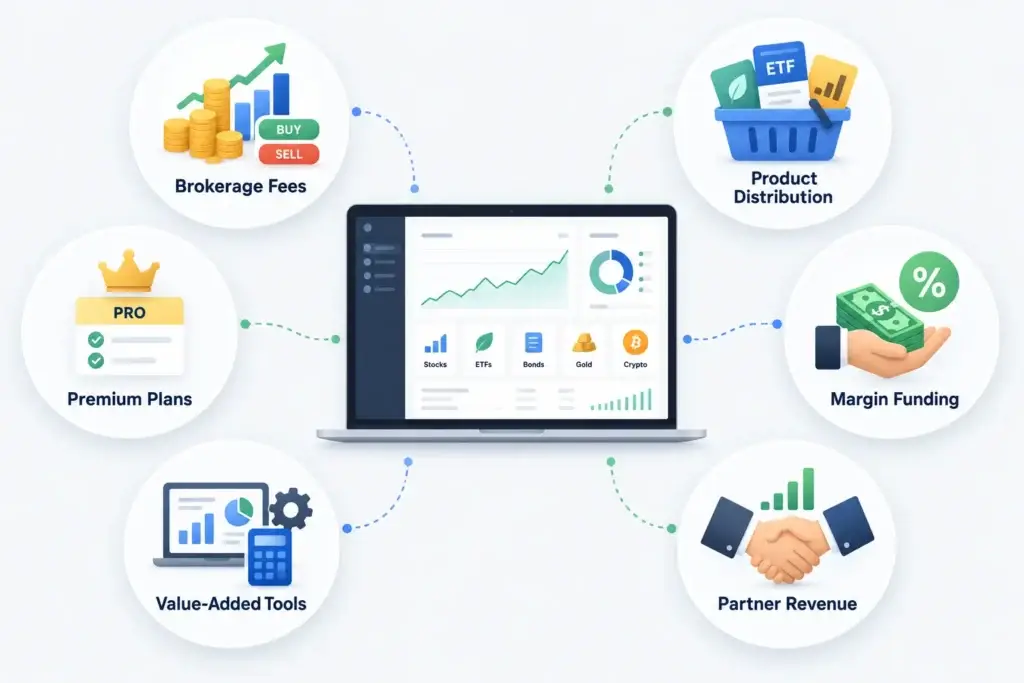
Image Source: AI-generated visual by Miracuves
A modern investment platform can generate revenue from several layers. The exact model depends on the market, licensing structure, integrations, product scope, and compliance requirements.
1. Brokerage and Transaction Fees
Brokerage is one of the most direct revenue streams for investment platforms that support stock trading, derivatives, intraday trading, commodities, or other transaction-based products.
The platform may earn through:
- Flat brokerage per executed order
- Percentage-based transaction fees
- Intraday or derivatives brokerage
- Platform convenience charges
- Exchange or transaction processing markups where applicable
- Premium execution tools for active users
Brokerage works well when the platform attracts active investors and traders. However, it should not be the only revenue pillar. Trading volume can fluctuate based on market sentiment, regulations, product availability, and user confidence.
For founders, the key question is not just how much brokerage can be charged. The deeper question is how the platform can make trading simple, transparent, secure, and operationally trackable. The backend should record orders, fees, taxes, settlement status, user ledgers, disputes, refunds, and audit trails clearly.
A brokerage-led model needs strong admin visibility because even small errors in transaction records can damage user trust.
2. Mutual Fund and Financial Product Distribution
Distribution revenue is generated when the platform helps users discover and invest in financial products offered by approved providers. This may include mutual funds, fixed-income products, bonds, insurance products, retirement products, tax-saving instruments, or other regulated financial offerings.
In many markets, platforms can earn distribution income through trail commissions, referral arrangements, partner fees, or product placement agreements, depending on local rules and product structure.
This model is attractive because it can support recurring revenue. A user who invests through a recurring plan may continue contributing over months or years. That creates a longer relationship than a one-time trade.
However, distribution monetization must be handled carefully. Users need transparency, suitability, risk information, and clear product disclosures. A founder should avoid designing the app purely around pushing high-commission products. The stronger long-term approach is to make discovery, comparison, education, and goal-based investing easier for users.
A good distribution layer includes:
- Product discovery filters
- Risk category labels
- Past performance views with clear caveats
- Goal-based investment journeys
- Recurring investment setup
- Portfolio allocation insights
- Provider-side reporting
- Admin controls for product approval and visibility
Distribution income becomes stronger when the platform helps users make more informed decisions rather than simply increasing product volume.
3. Subscription Plans and Premium Memberships
Subscriptions are useful when the platform offers ongoing value beyond basic investing access. A free investing app can attract users, but premium features can monetize serious investors, active traders, and high-intent users.
Subscription features may include:
- Advanced portfolio analytics
- Premium market research
- Stock screeners
- Smart alerts
- Tax reports
- Goal-planning tools
- Watchlist intelligence
- Advisory workflow access
- Early access to new tools
- Priority support
The advantage of subscriptions is predictability. Transaction income may change with market cycles, but subscription income can create recurring revenue if users continue seeing value.
The challenge is packaging. Founders should avoid locking basic trust-building features behind a paywall too early. Instead, the free plan should help users understand the platform, while the paid plan should clearly improve decision-making, convenience, or insight depth.
A subscription model works best when pricing is aligned with user maturity. Beginners may not pay for complex analytics immediately. Active investors may pay for alerts, screeners, tax tools, or research. High-value users may pay for managed workflows or advisory access.
4. Margin Funding and Interest-Based Revenue
Some investment platforms generate revenue through margin funding, credit-linked products, or interest-based services. This can include interest charged on borrowed trading capital, short-term financing, or partner-led lending products.
This model can be profitable, but it also carries higher risk. Credit workflows require strong eligibility checks, risk controls, repayment logic, exposure limits, account monitoring, and compliance oversight.
For founders, margin and credit features should not be treated as simple add-ons. They require careful backend design.
Important system requirements include:
- Risk scoring workflows
- Exposure limits
- Real-time balance tracking
- Margin utilization records
- Interest calculation logic
- Liquidation or risk alert workflows where applicable
- Admin approval controls
- Audit logs
- User notifications
- Legal and compliance review based on jurisdiction
Interest-based revenue can expand platform profitability, but only when risk management is built into the operating model.
5. Value-Added Services and Financial Tools
Value-added services help investment platforms monetize convenience, insight, automation, and user outcomes. These services are not always required for basic investing, but they improve user engagement and retention.
Examples include:
- Tax-saving reports
- Capital gains statements
- Portfolio health checks
- Risk profiling
- Automated investment reminders
- Goal planning
- Rebalancing suggestions
- Premium calculators
- Family portfolio dashboards
- Learning modules
- Advanced notification systems
- Investment document storage
These services are powerful because they solve practical user problems. Many retail investors do not only need access to products. They need help understanding performance, tax impact, risk, diversification, and next steps.
For founders, value-added services can create revenue without forcing more transactions. This is healthier for trust. Instead of encouraging users to trade more, the platform can charge for better insight, better organization, and better decision support.
6. Partner Revenue and Financial Marketplace Integrations
A multi-asset platform can also operate as a financial marketplace. Once the platform has a verified user base and financial behavior data, it may integrate with approved partners for additional products.
Potential partner-led monetization includes:
- Insurance referrals
- Lending referrals
- Credit products
- Wealth advisory partners
- Tax filing partners
- Financial education partners
- Payment or banking integrations
- Premium product discovery
This model can help founders expand revenue without building every financial product internally. However, partner integrations must be selected carefully. Poor partner experiences can damage the platform’s reputation even if the core app works well.
The admin dashboard should allow operators to manage partner visibility, track referrals, monitor conversions, review complaints, and control product availability by region or user segment.
Revenue Stream Comparison Table
| Revenue Stream | How It Works | Business Value | Founder Consideration |
|---|---|---|---|
| Brokerage | The platform earns from executed trades, intraday activity, or transaction-based investing products. | Creates direct revenue from active users and market participation. | Requires reliable order records, fee logic, settlement tracking, and audit trails. |
| Distribution Income | The platform earns from approved financial products distributed through the app. | Can support recurring revenue through long-term investments and product depth. | Needs transparent disclosures, product controls, and compliance-ready workflows. |
| Subscriptions | Users pay for premium research, analytics, alerts, reports, or advanced tools. | Improves recurring revenue and increases average revenue per user. | Paid features must deliver clear value beyond basic investing access. |
| Margin and Interest | The platform earns from credit-linked investing workflows or margin usage. | Can improve monetization among active traders and advanced users. | Requires strong risk controls, eligibility checks, and legal review. |
| Value-Added Services | Users pay for tax reports, portfolio insights, goal planning, or convenience tools. | Monetizes decision support without forcing more transactions. | Works best when tied to real user pain points and long-term retention. |
| Partner Revenue | The platform earns through approved referrals, integrations, or financial marketplace partnerships. | Expands monetization beyond core trading and investing. | Partner quality, user trust, and admin control are critical. |
How User Segments Affect Investment Platform Monetization
Not every user generates revenue in the same way. A strong investment platform understands user intent and designs monetization around different investor profiles.
Beginner Investors
Beginners usually want simple onboarding, education, low-friction investing, and confidence. They may start with recurring investments, goal-based products, or low-risk financial instruments. This segment may not generate high brokerage revenue at first, but it can become valuable over time through distribution income, education-led engagement, and long-term portfolio growth.
Active Traders
Active traders may generate more transaction-based revenue through frequent trades, advanced tools, alerts, derivatives, or premium analytics. They are more likely to pay for speed, insights, execution support, and deeper market data.
Long-Term Wealth Builders
These users care about portfolio growth, tax planning, asset allocation, and recurring investment discipline. They may generate revenue through distribution income, premium reports, portfolio tools, advisory workflows, and long-term engagement.
High-Intent Premium Users
Premium users may want advanced dashboards, personalized insights, partner products, advisory access, or specialized investment options. This segment can support higher average revenue per user if the platform delivers trust and convenience.
For founders, segmentation matters because a one-size-fits-all monetization model often fails. Beginners should not feel pressured. Active users should not feel limited. Premium users should not feel underserved.
The Role of Admin Control in Revenue Management
Revenue models only work when the platform operator can control them from the backend. Without a strong admin dashboard, every pricing change, product update, commission adjustment, or partner integration becomes dependent on development work.
A serious investment platform needs admin control over:
- User onboarding and verification status
- Product listing approvals
- Asset category visibility
- Brokerage and fee rules
- Subscription plans
- Partner products
- Commission records
- Referral tracking
- Payment and settlement status
- Refunds and disputes
- Reports and analytics
- Role-based staff access
- Audit logs
- Risk flags and suspicious activity records
This backend layer is not just operational. It directly affects monetization. If the admin team cannot adjust pricing, test premium plans, manage partner campaigns, or review revenue reports, the business becomes slower to optimize.
Miracuves builds fintech platforms with admin control as a core layer, helping founders manage users, products, monetization, and operational workflows from a structured backend rather than relying on manual processes.
Founder Decision Signals Before Choosing a Revenue Model
Speed
If the goal is to validate demand quickly, start with the most essential asset classes and monetization flows. A launch-ready platform can help reduce the time spent building basic modules from zero.
Revenue Depth
If the business depends only on brokerage, revenue may fluctuate with market cycles. Add distribution, subscriptions, and value-added services to create a more balanced model.
Trust
Investment users need clarity before they transact. Transparent fees, risk information, secure workflows, and clean reporting help protect long-term platform credibility.
Scalability
Revenue logic should be built into the architecture early. Product expansion, partner integrations, and premium tools become harder when the backend is not designed for growth.
Security and Compliance Workflows That Support Monetization
In fintech, revenue cannot be separated from trust. Users will only invest, trade, subscribe, or explore partner products if they believe the platform is secure and professionally managed.
Important security and compliance-ready workflows include:
- Encrypted data transfer
- Encrypted data storage
- User verification
- KYC workflow support
- AML workflow support where relevant
- Role-based access control
- Transaction monitoring
- Suspicious activity flags
- Audit logs
- Secure payment gateway integration
- Admin access controls
- Activity logs
- Permission-based dashboards
- Privacy-conscious data handling
Founders should be careful with compliance language. A software platform can support compliance workflows, but final compliance depends on jurisdiction, legal review, financial partners, operating model, and regulatory requirements.
This is why investment app monetization should be designed with controls from the beginning. The more revenue streams the platform adds, the more important it becomes to track user actions, product disclosures, payments, partner activity, and admin decisions.
Why Value-Added Services Improve User Lifetime Value
Many investment platforms start by focusing on transactions. But the most valuable user relationships often come from ongoing financial decision support.
A user may trade once, but they may check portfolio performance weekly. They may invest monthly. They may need tax reports yearly. They may adjust goals as income changes. They may seek new products as their confidence grows.
This creates opportunities for value-added monetization.
A platform can offer free basic access while charging for deeper services such as:
- Detailed portfolio analytics
- Advanced performance breakdowns
- Tax reports
- Risk scoring
- Goal-based planning
- Premium watchlists
- Smart alerts
- Research summaries
- Family account views
- Advisory workflow access
The business advantage is simple: value-added services increase retention without depending entirely on trading frequency. They give users a reason to keep returning even when they are not actively buying or selling.
For founders, this is a healthier monetization path because it aligns platform revenue with user clarity, convenience, and confidence.
Common Mistakes Founders Should Avoid
Building the app first and adding revenue logic later
Brokerage, subscriptions, distribution income, partner tracking, and reporting should be planned early. Retrofitting monetization into a weak backend can create operational and accounting problems.
Depending only on transaction revenue
Transaction-led income can fluctuate. A stronger platform balances brokerage with recurring plans, distribution income, premium tools, and value-added financial services.
Ignoring admin visibility
Founders need control over fees, plans, product listings, partners, users, and reports. Without admin visibility, revenue optimization becomes slow and dependent on developers.
Over-monetizing beginners
New investors need trust and clarity. Pushing too many paid features or financial products too early can reduce retention and weaken brand credibility.
Custom Build vs Launch-Ready Foundation: Which Path Helps Founders Monetize Faster?
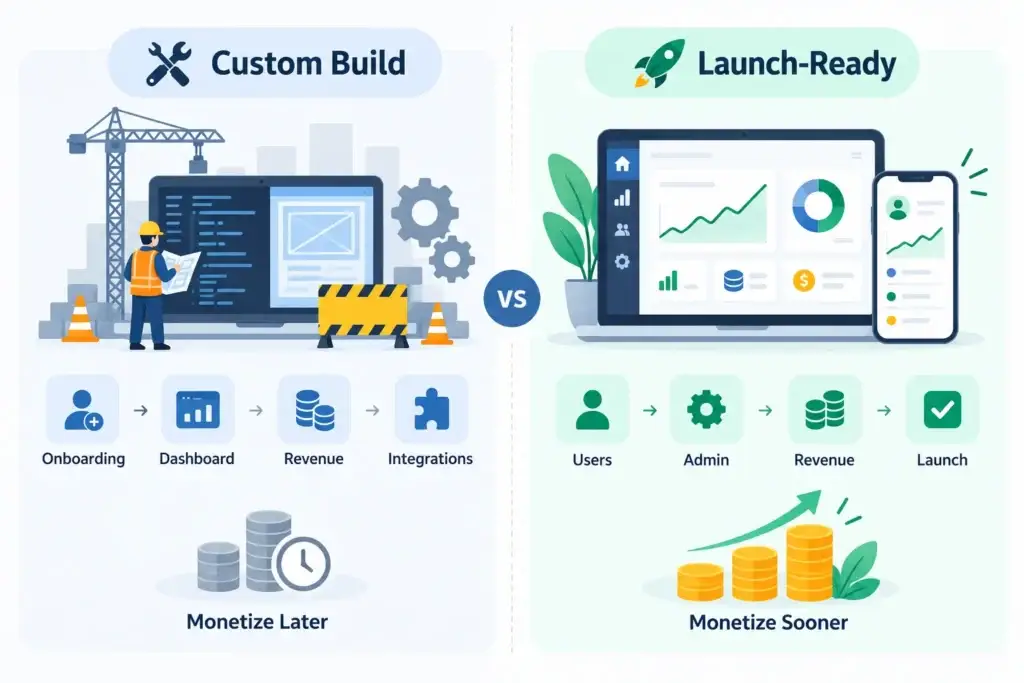
Image Source: AI-generated visual by Miracuves
For a multi-asset investment platform, the build path directly affects how quickly founders can test revenue. The two common options are building from zero or starting with a launch-ready foundation.
Custom Build From Zero
A custom build gives more flexibility, but it also delays market testing because every core layer has to be created before launch, including:
- User onboarding and verification
- Portfolio dashboard and asset tracking
- Transaction and order workflows
- Brokerage, subscription, and distribution revenue logic
- Admin control, reports, and audit logs
- Payment and third-party integrations
This path works when the product needs highly specific workflows. However, founders may wait longer before testing real monetization signals such as paid tools, partner products, transaction fees, or user retention.
Launch-Ready Investment Platform Foundation
A launch-ready foundation helps founders move faster because the essential product structure is already in place. It usually includes core app flows, white-label branding, source-code ownership, admin control, and monetization-ready modules.
This approach helps founders:
- Launch earlier with a branded investing experience
- Test brokerage, distribution, and subscription models sooner
- Reduce early development complexity
- Manage users, fees, products, and reports from the admin dashboard
- Add custom integrations after validating demand
Miracuves helps founders launch a branded multi-asset investing platform with a ready-made foundation, source-code ownership, and 6-day solution delivery where the selected scope fits the ready-made deployment model.
Faster Monetization Depends on Faster Validation
For most founders, the faster path is the one that gets a controlled, usable product into the market sooner. A custom build may offer deeper flexibility, but it can delay feedback, revenue experiments, partner conversations, and product iteration.
A launch-ready foundation is more practical when the goal is to validate demand, test revenue streams, and refine the platform based on real user behavior.
Final Thoughts: Revenue Comes From Trust, Depth, and Control
A multi-asset investment platform does not become profitable only by adding more products. It becomes stronger when the revenue model is built around user trust, product depth, recurring engagement, and operational control.
Brokerage can monetize active users. Distribution income can support long-term investing behavior. Subscriptions can create recurring revenue. Value-added services can improve user lifetime value. Partner integrations can expand monetization without building every financial product internally.
But all of these revenue streams need the right foundation. The platform must support secure onboarding, product discovery, transaction records, fee logic, admin control, audit trails, partner management, reporting, and compliance-ready workflows.
For founders, the stronger decision is not to copy the surface of a popular investing app. It is to understand the revenue architecture behind multi-asset investing and build a branded platform that can grow with users over time.
Miracuves helps founders move from idea to launch faster with ready-made, white-label fintech solutions designed for branding, source-code ownership, admin control, and faster market validation.
FAQs
How do multi-asset investment platforms make money?
Multi-asset investment platforms usually make money through brokerage fees, distribution income, subscriptions, value-added financial tools, partner referrals, margin interest, and premium analytics. The strongest models combine transaction revenue with recurring and trust-based monetization.
Is brokerage the main revenue stream for investment apps?
Brokerage can be an important revenue stream, especially for platforms with active traders. However, relying only on brokerage can be risky because trading activity changes with market conditions. Distribution income, subscriptions, and value-added services can create a more balanced model.
What is distribution income in an investment platform?
Distribution income is revenue earned when a platform helps users discover and invest in approved financial products such as mutual funds, bonds, insurance, or other partner products. The exact structure depends on local regulations, product type, and commercial agreements.
Can an investment app earn recurring revenue?
Yes. Investment apps can earn recurring revenue through subscription plans, premium analytics, advisory tools, recurring investment products, portfolio reports, tax tools, and long-term distribution relationships.
What features help increase revenue in an investment platform?
Features that support revenue include easy onboarding, KYC workflows, product discovery, watchlists, trading modules, recurring investment plans, premium analytics, tax reports, subscription management, partner integrations, and an admin dashboard for revenue control.
Why is admin control important for fintech monetization?
Admin control helps platform operators manage users, product listings, fees, subscriptions, partner products, reports, disputes, and compliance workflows. Without admin control, revenue optimization becomes slower and more dependent on technical teams.
Should founders launch with all asset classes from day one?
Not always. Many founders can start with a focused set of asset classes and expand based on licensing, user demand, partner readiness, and operational capacity. A scalable platform foundation should allow future product expansion.
How can Miracuves help build a multi-asset investment platform?
Miracuves can help founders launch a white-label, source-code-owned investment platform with branded design, admin control, monetization-ready workflows, and 6-day solution delivery where the selected scope fits the ready-made deployment model.
Miracuves is an independent software development company. We are not affiliated with, connected to, sponsored by, or endorsed by any company or product named in this article.
Terms such as “X Clone” are used descriptively. It is how the software industry refers to building a platform with functionality comparable to a known service, and how clients search for it.
The entire design and codebase of our products is built by our own team. Our products contain no code, design, graphics, or content originating from any third-party website or applications.
All third-party names and marks referenced in this article are the property of their respective owners, referenced solely to identify the services discussed.