


Key Takeaways
What You’ll Learn
- A Crate & Barrel Clone revenue model is built around premium home and lifestyle commerce generating revenue through furniture sales, home decor products, subscriptions, and design-focused retail experiences.
- The platform monetizes through multiple revenue streams including direct product sales, premium collections, interior consultation services, memberships, and omnichannel retail operations.
- Premium branding is the biggest competitive advantage because customers increasingly value curated design experiences and high-quality home products.
- Omnichannel retail improves customer retention through seamless integration between online commerce, mobile shopping, and physical showroom experiences.
- The biggest takeaway for founders is that premium home commerce platforms scale successfully when branding, customer experience, logistics, and digital retail infrastructure work together.
Stats That Matter
- The article positions Crate & Barrel clone platforms as premium lifestyle commerce businesses focused on furniture retail, home decor, and curated shopping experiences.
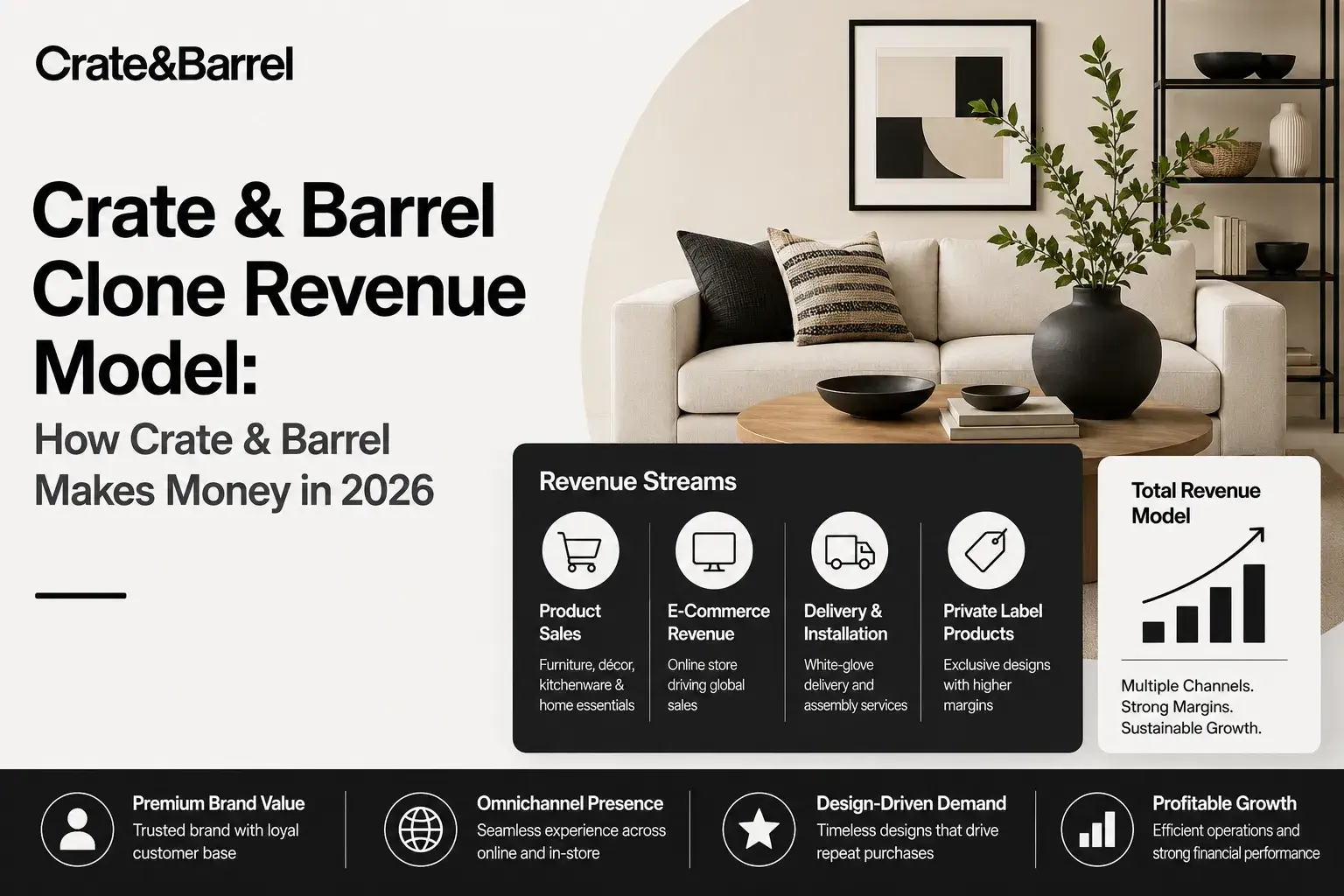
- Core revenue comes from direct product sales including furniture, dining collections, decor products, kitchenware, lighting, and premium home accessories.
- Additional monetization comes from premium services and memberships such as design consultations, loyalty programs, exclusive collections, and seasonal campaigns.
- The platform benefits from rising online furniture and home shopping adoption as consumers increasingly purchase home products through digital commerce platforms.
- Brand positioning directly improves customer loyalty because premium design identity and curated product experiences strengthen long-term retention.
Real Insights
- The real strength of a Crate & Barrel Clone comes from lifestyle branding because customers buy premium home products as part of a broader design and living experience.
- Omnichannel commerce directly affects scalability since customers increasingly expect connected experiences across websites, apps, and physical stores.
- Logistics and fulfillment are critical for profitability because furniture and decor businesses involve warehousing, delivery coordination, and inventory complexity.
- Curated shopping experiences improve customer engagement by helping users discover products through design inspiration, personalization, and premium visual presentation.
- For entrepreneurs, the biggest lesson is to build a Crate & Barrel Clone platform around premium branding, scalable eCommerce infrastructure, omnichannel retail, curated product experiences, and customer retention systems.
In 2026, Crate & Barrel operates as one of the most profitable premium furniture and home décor brands globally, generating over $2.4 billion in annual revenue. This performance is driven by high average order values, strong repeat purchase behavior, and premium margins supported by exclusive product designs and consistent brand positioning across physical and digital channels.
Unlike pure marketplaces, Crate & Barrel blends direct-to-consumer retail, private-label manufacturing, omnichannel sales, and premium pricing into a highly defensible revenue model. By controlling product design, sourcing, pricing, and customer experience end-to-end, the brand reduces dependency on third-party sellers while capturing higher margins and predictable demand.
For founders, this model shows how design leadership, brand trust, and operational control can outperform discount-led marketplaces. Rather than competing on price, Crate & Barrel demonstrates that experience-driven retail, bundled selling, and long-term customer relationships create more sustainable revenue and profitability over time.
Crate & Barrel Revenue Overview – The Big Picture
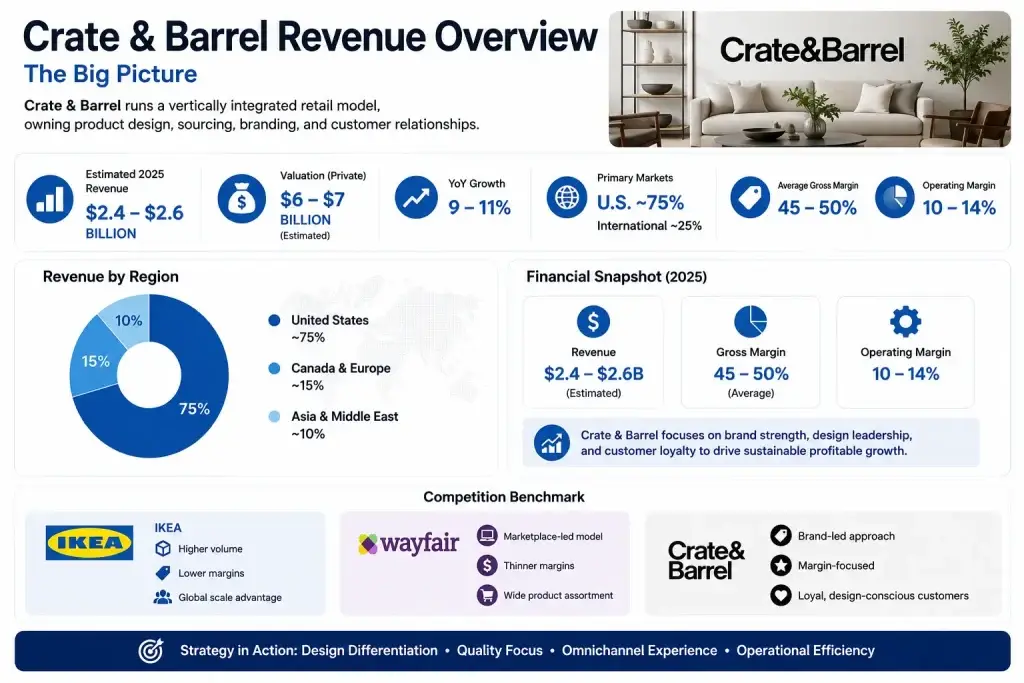
Crate & Barrel runs a vertically integrated retail model, owning product design, sourcing, branding, and customer relationships.
2025 Snapshot
- Estimated 2025 Revenue: ~$2.4–2.6 billion
- Valuation (private): ~$6–7 billion (estimated)
- YoY Growth: ~9–11%
- Primary Markets: United States (~75%), International (~25%)
- Average Gross Margin: 45–50%
- Operating Margin: 10–14%
Revenue by Region
- United States: ~75%
- Canada & Europe: ~15%
- Asia & Middle East: ~10%
Competition Benchmark
- IKEA: Higher volume, lower margins
- Wayfair: Marketplace-led, thinner margins
- Crate & Barrel: Brand-led, margin-focused
Read More: What is Crate & Barrel and How Does It Work?
Primary Revenue Streams – Deep Dive
Revenue Stream #1: Direct Furniture & Home Décor Sales
Crate & Barrel earns most of its revenue by selling its own branded products.
- Revenue Share: ~68%
- Average Order Value (AOV): $350–$900
- 2025 Contribution: ~$1.6B+
- High margins driven by private-label manufacturing.
Revenue Stream #2: Omnichannel Retail (Stores + Online)
Physical stores act as experience centers that drive online conversions.
- Revenue Share: ~14%
- 2025 Contribution: ~$340M
- Customers visiting stores have 2–3× higher lifetime value.
Revenue Stream #3: Delivery, Assembly & Installation Fees
White-glove services generate additional high-margin revenue.
- Revenue Share: ~7%
- Fee Range: $99–$299 per order
- 2025 Contribution: ~$170M
Revenue Stream #4: Trade Program & B2B Sales
Interior designers, hotels, and commercial buyers receive bulk pricing.
- Revenue Share: ~6%
- 2025 Contribution: ~$145M
- Extremely high repeat purchase rates.
Revenue Stream #5: Extended Warranties & Add-on Services
Protection plans and care services increase per-order margins.
- Revenue Share: ~5%
- 2025 Contribution: ~$120M
Revenue Streams Breakdown
| Revenue Stream | % Share |
|---|---|
| DTC Product Sales | 68% |
| Omnichannel Retail | 14% |
| Delivery & Assembly | 7% |
| Trade & B2B Sales | 6% |
| Warranties & Add-ons | 5% |
The Fee Structure Explained
Crate & Barrel focuses on transparent pricing with premium upsells.
Customer-Side Fees
- Product pricing (premium margin built-in)
- Delivery & installation fees
- Warranty & care plans
Supplier-Side Fees
- None (vertically integrated model)
Hidden Revenue Layers
- Bulk manufacturing margin advantages
- Inventory financing efficiency
- Repeat purchase economics
Regional Pricing Variation
- Higher margins in urban markets
- Localized delivery pricing
Fee Structure Table
| User Type | Fee Type | Typical Range |
|---|---|---|
| Customers | Delivery & setup | $99–$299 |
| Customers | Warranty plans | 5–12% of order |
| Trade Buyers | Bulk discounts | Volume-based |
| B2B Clients | Custom pricing | Contract-based |
How Crate & Barrel Maximizes Revenue Per User
Crate & Barrel monetizes experience and trust, not discounts.
- Segmentation: Homeowners, designers, premium renters
- Upselling: Bundled room collections
- Cross-selling: Furniture + décor + lighting
- Dynamic Pricing: Seasonal collections & exclusives
- Retention Monetization: Trade accounts & repeat collections
- LTV Optimization: Design consistency across years
- Psychological Pricing: Premium anchoring over discounts
Real Example (2025):
Customers buying room bundles spend 42% more than single-item buyers.
Cost Structure & Profit Margins
Vertical control gives Crate & Barrel strong margin discipline.
Cost Breakdown
- Manufacturing & sourcing: ~38%
- Logistics & warehousing: ~20%
- Marketing & brand: ~12%
- Operations & retail staff: ~15%
- R&D & design: ~6%
Unit Economics
- Gross margin: This model supports 45–50%
- Contribution margin per order: 28–35%
Profitability Path
- Private-label dominance
- Lower return rates vs marketplaces
Read More: Best Crate-Barrel Clone Scripts 2025 | Furniture E-Commerce App
Future Revenue Opportunities & Innovations
New Revenue Streams
- Subscription home refresh programs
- Smart furniture integrations
- AR/VR home planning tools
AI/ML Monetization
- Personalized room recommendations
- Predictive inventory planning
Market Expansion
- Emerging luxury urban markets
- Hospitality & commercial furniture
2025–2027 Trends
- Experience-led retail
- Sustainable materials premium pricing
- Faster white-glove delivery
Risks
- Inventory holding risk
- Housing market slowdowns
Opportunities for Founders
- Vertical furniture niches
- Region-specific premium brands
Lessons for Entrepreneurs & Your Opportunity
What Works
- Brand-first monetization
- Vertical integration
- Experience-based pricing
What to Replicate
- Private-label control
- Bundled selling strategy
Market Gaps
- Affordable premium furniture
- Digital-first design platforms
Founder Improvements
- Faster customization
- AI-led home visualization
Miracuves Crate & Barrel-Like Ecommerce Platform Solution Cost and Tech Stack
Miracuves Pricing for a Crate & Barrel-Like Ecommerce Platform developed using JavaScript architecture is available on request. Final pricing depends on ecommerce workflows, inventory systems, product visualization features, payment integrations, scalability requirements, AI-powered recommendations, and deployment scope. Estimated delivery timeline: 30 to 90 days. For custom architecture planning, enterprise ecommerce workflows, and feature-specific pricing — Contact us.
Get a fully developed, custom ecommerce platform modeled around Crate & Barrel-style premium furniture and home décor shopping experiences. Built on a modern JavaScript foundation, this solution can be customized for furniture brands, lifestyle retailers, home décor marketplaces, D2C ecommerce businesses, interior design platforms, online retail startups, and enterprise commerce operations.
- Core Workflows: Product catalog management, customer accounts, shopping cart systems, order processing, inventory tracking, payment handling, product visualization, wishlist systems, personalized recommendations, shipping workflows, and loyalty programs.
- Built-in Revenue Logic: Product sales, premium memberships, featured product placements, marketplace commissions, subscription models, promotional campaigns, advertising systems, and white-label ecommerce monetization.
- Management Hub: Admin dashboard, inventory management, customer analytics, order monitoring, payment reporting, product moderation, promotion management, customer support controls, and ecommerce analytics.
- AI-Ready Architecture: Prepared for AI product recommendations, smart search optimization, customer behavior analytics, personalized shopping experiences, automated inventory insights, scalable ecommerce infrastructure, and enterprise-grade scalability.
Why Does a Crate & Barrel-Like Platform Require JavaScript Architecture?
A modern ecommerce platform requires more than a standard online store. It handles customer engagement, inventory synchronization, personalized shopping, payment processing, recommendation engines, product discovery, support workflows, and scalable ecommerce operations. A modern JavaScript architecture helps manage these highly interactive ecommerce experiences smoothly across customers, admins, support teams, and retail systems.
We recommend JavaScript architecture for this type of platform because:
- Built for Interactive Ecommerce Experiences: JavaScript supports real-time product browsing, smooth checkout systems, instant inventory updates, dynamic product rendering, and live shopping interactions.
- Advanced Frontend Experience: React.js or similar JavaScript frameworks can power modern storefronts, recommendation panels, customer dashboards, analytics systems, loyalty programs, and admin controls.
- Scalable Backend Logic: JavaScript-based backend systems can efficiently manage transactions, inventory operations, customer sessions, analytics workflows, API traffic, and high-volume ecommerce requests.
- Flexible Integration Layer: The platform can connect with payment gateways, logistics providers, CRM systems, analytics platforms, AI recommendation tools, cloud infrastructure, customer support systems, and third-party ecommerce services.
You get a scalable ecommerce platform designed for premium retail experiences, customer engagement, recurring revenue growth, ecommerce automation, and long-term retail scalability.
Tech Stack
We preferably will be using JavaScript for building the entire solution (Node.js/Nest.js/Next.js for the web backend + frontend) and Flutter / React Native for mobile apps, considering scalability, ecommerce workflow efficiency, customer experience optimization, and the advantage of one codebase serving multiple platforms.
Note: Final pricing depends on selected ecommerce modules, AI capabilities, scalability goals, payment systems, infrastructure requirements, security layers, and custom feature development.
Final Thought
Crate & Barrel proves that owning the brand often beats owning the marketplace. By controlling product identity, pricing, and customer experience, the company avoids margin dilution, reduces price competition, and builds stronger emotional connections with buyers—advantages that most open marketplaces struggle to maintain.
Its revenue strength comes from design authority, operational control, and long-term customer trust. Exclusive collections, consistent quality standards, and reliable delivery experiences encourage repeat purchases, higher order values, and lower return rates, all of which compound profitability over time.
For founders, this model shows how premium positioning can unlock sustainable profitability when paired with disciplined execution. Instead of racing to the bottom on price, entrepreneurs can focus on brand differentiation, vertical integration, and experience-led monetization to build resilient, high-margin businesses.
FAQs
1. How much does Crate & Barrel make per order?
Margins vary, but average contribution margin ranges from 28–35%.
2. What’s Crate & Barrel’s most profitable revenue stream?
Private-label furniture sales.
3. How does its pricing compare to competitors?
Higher than marketplaces, justified by quality and service.
4. Does Crate & Barrel charge sellers commission?
No, it sells its own products.
5. How has the revenue model evolved?
From store-led retail to omnichannel dominance.
6. Can small brands use this model?
Yes, especially niche furniture verticals.
7. What’s the minimum scale for profitability?
Typically $10–20M annual GMV with private labels.
8. How to implement similar revenue models?
Start with DTC, then layer experiences and services.
9. What are alternatives to this model?
Marketplace or dropship-led furniture platforms.