



Key Takeaways
What You’ll Learn
- Pika Labs is an AI-powered video generation platform that converts text prompts and creative ideas into AI-generated cinematic videos and animations.
- The platform simplifies video creation using generative AI workflows allowing users to create animated scenes, visual storytelling content, and motion videos without advanced editing skills.
- AI-powered text-to-video generation is the biggest product advantage because creators can generate dynamic visuals faster than traditional production methods.
- Pika Labs supports creators, marketers, and digital storytellers across social media content, short films, advertising, concept visualization, and creative experimentation.
- The biggest takeaway for founders is that AI video platforms scale successfully when creativity, automation, speed, and user-friendly workflows work together.
Stats That Matter
- The article positions Pika Labs as a next-generation AI video creation platform focused on text-to-video generation, AI animation, and creative automation workflows.
- Core features include AI-generated videos, text-to-video prompts, animation effects, cinematic transitions, editing tools, and AI-powered visual generation.
- The platform focuses heavily on creator accessibility by reducing the technical complexity traditionally associated with video animation and production.
- AI automation significantly reduces production time because users can generate visual scenes, animations, and storytelling content without large creative teams.
- The broader opportunity is AI-driven media creation where creators increasingly expect fast, automated, and scalable visual content production tools.
Real Insights
- Pika Labs succeeds because it lowers the barrier to cinematic content creation allowing creators to generate visually rich videos without advanced production expertise.
- The strongest value comes from creative speed because users can move from ideas to visual output much faster than traditional animation workflows.
- AI-generated video tools expand creator possibilities by enabling experimentation, storytelling, concept visualization, and rapid content iteration.
- User simplicity directly affects adoption since creators increasingly prefer intuitive AI interfaces over complex editing software and time-consuming workflows.
- For entrepreneurs, the biggest lesson is to build a Pika Labs-style AI video platform around text-to-video generation, creative automation, scalable rendering infrastructure, and intuitive creator experiences.
Imagine you’ve got a cool video idea for Instagram or YouTube—maybe a cinematic shot, a funny meme clip, or a talking character—but you don’t have the time (or budget) for filming, editing, and VFX. With Pika, you can type a prompt, upload an image, add effects, and generate a short video clip in minutes.
Pika (often referred to as Pika Labs) is a generative AI video platform that helps creators produce short videos from text prompts, images, and edits—including effect-style tools like swaps, additions, twists, scenes, and audio-synced expression features (marketed as “Pikaformance”).
It’s become popular because it feels “creator-first”: quick results, lots of remix-friendly effects, and a credit-based system that makes usage easy to understand. Pika’s pricing pages describe monthly plans that include video credits, with different credit costs depending on the model/tool used (Turbo vs Pro, twists vs swaps/additions).
By the end of this guide, you’ll understand what Pika Labs is, how it works step by step, how it makes money, the key features creators love, the tech behind AI video generation (in simple language), and how Miracuves can help you build a Pika-like AI video platform.
What Is Pika Labs? The Simple Explanation
Pika Labs is an AI video generation platform that helps creators turn text prompts and images into short, animated video clips. In simple terms, it lets you create motion content without cameras, actors, or complex editing software.
The Core Problem Pika Labs Solves
Creating short videos usually means filming, editing, adding effects, and syncing audio—all of which take time and skill. Pika Labs simplifies this by:
- Turning text or images directly into video
- Adding motion, effects, and scene changes automatically
- Making video creation accessible to non-editors
- Speeding up content production for social platforms
It’s built for fast, creative output, not heavy post-production.
Target Users and Use Cases
Pika Labs is commonly used by:
• Social media creators and influencers
• Meme creators and short-form video makers
• Marketers producing quick visual content
• Designers experimenting with motion
• Storytellers prototyping scenes
Typical use cases include cinematic clips, animated memes, short ads, visual storytelling, and experimental videos.
Current Market Position
Pika Labs is positioned as a creator-first, short-video AI tool. Compared to heavier platforms, it focuses on speed, fun effects, and remixability—making it especially popular for social and experimental content.
Why It Became Successful
Pika Labs grew quickly because it lowered the barrier to video creation. The ability to generate engaging clips from simple prompts—and experiment freely with effects—made it attractive to creators who value speed and creativity over complex workflows.
How Pika Labs Works — Step-by-Step Breakdown
For Creators (Social, Marketing, Storytelling)
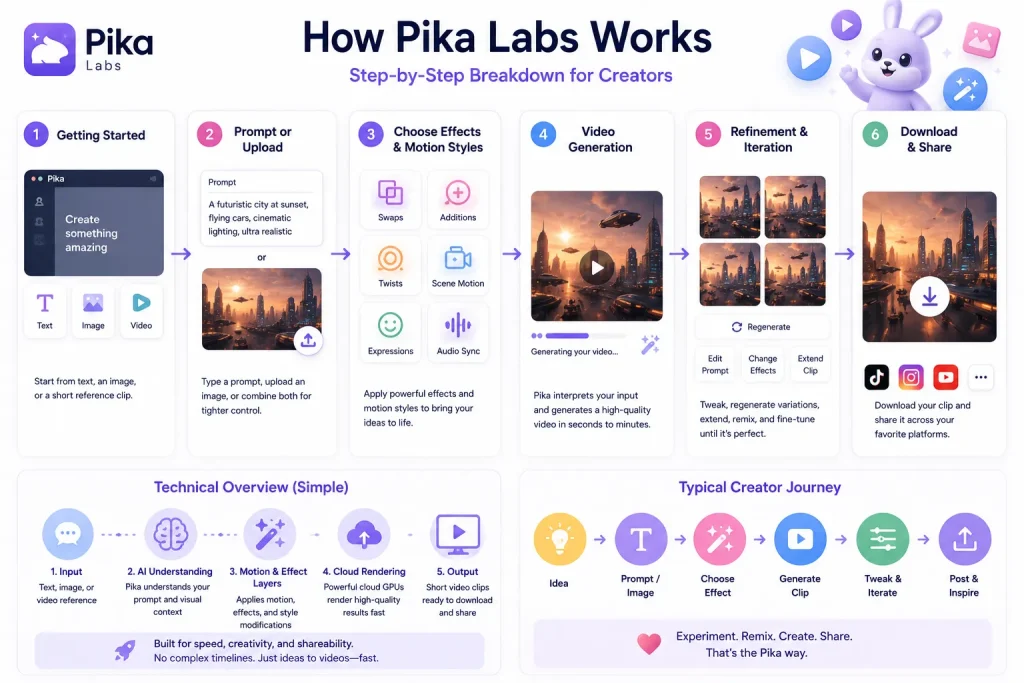
Getting started
Creators start inside Pika’s web interface. You can begin from text, an image, or a short reference clip depending on the effect you want. The goal is quick creation with minimal setup.
Writing a prompt or uploading an image
You can either:
- Type a text prompt describing the scene, motion, and style
- Upload an image and ask Pika to animate it
- Combine both (image + text) for tighter control
Prompts typically include subject, action, mood, camera feel, and style.
Choosing effects and motion styles
Pika stands out for its effect-driven tools. Creators can apply options such as:
- Swaps (change elements in a scene)
- Additions (insert objects or characters)
- Twists (creative transformations)
- Scene motion (camera movement, zooms, pans)
- Expression or audio-synced motion (for character-driven clips)
These effects are designed to be playful and remix-friendly.
Video generation
Once submitted, Pika:
- Interprets the prompt and visual context
- Generates a short video clip with motion and effects
- Returns results in seconds to minutes
Creators usually receive clips optimized for short-form platforms.
Refinement and iteration
After generation, creators can:
- Regenerate variations
- Adjust prompts or effects
- Extend or remix clips
- Download and post directly
This fast loop encourages experimentation.
Typical creator journey
Idea → prompt/image → choose effect → generate clip → tweak → post.
Technical Overview (Simple)
Pika Labs combines:
- Text-to-video and image-to-video models
- Motion and effect layers on top of base video generation
- Audio and expression mapping for character clips
- Cloud-based rendering for fast turnaround
The focus is on speed, creativity, and shareability, not complex timelines.
Read More :- How to Develop an AI Chatbot Platform
Pika Labs’ Business Model Explained
How Pika Labs Makes Money
Pika Labs uses a freemium + subscription + credits model. The core idea is simple: casual users can try it, and serious creators pay for more speed, higher limits, and better tools.
Main revenue streams include:
- Monthly subscriptions: Paid plans include a set number of credits each month
- Credit-based usage: Generations consume credits, and certain tools/models cost more credits than others
- Higher-tier creator plans: Designed for frequent creators who generate lots of clips
- Potential team/creator upgrades: For heavier usage and priority access
This model matches pricing to compute usage, which is important for video generation.
Pricing Structure (How it usually works)
Pika’s plans generally revolve around:
- A monthly fee
- Included credits per month
- Different credit costs depending on what you generate (example: faster “Turbo” options vs higher-quality “Pro” options, and effect tools that may consume varying credits)
So users aren’t paying per minute of video directly—they’re paying in credits tied to compute.
Fee Breakdown
- Monthly subscription fee
- Credits spent per generation, extension, or effect
- Priority or premium quality options consuming more credits
- No ads and no commissions
Market Size and Demand
Demand for Pika-style AI video tools is driven by:
- Growth in short-form content on social platforms
- Creators needing fresh visuals constantly
- Brands and marketers producing many variants quickly
- Rising interest in AI-powered motion and effects
- Lower cost compared to traditional editing and VFX
Profitability Insights
Pika improves profitability by:
- Using subscriptions to create predictable revenue
- Using credits to control compute-heavy usage
- Encouraging daily experimentation and retention
- Offering premium tools that justify upgrades
Revenue Model Breakdown
| Revenue Stream | Description | Who Pays | Nature |
|---|---|---|---|
| Subscriptions | Monthly creator plans | Users | Recurring |
| Credits | Generation and effects usage | Power users | Usage-based |
| Premium Tiers | Faster/better models | Creators | Tiered |
| Add-ons | Extra credits/features | Heavy users | Expansion |
Key Features That Make Pika Labs Successful
Fast text-to-video creation
Pika lets creators generate short video clips from simple text prompts. This makes it easy to turn ideas into content without filming.
Image-to-video animation
Creators can upload a single image and animate it into motion, which is perfect for turning artwork, photos, or AI-generated images into short clips.
Effect-style tools (remix culture built-in)
Pika is known for tools that feel like “video effects for everyone,” such as:
- Swaps (replace elements)
- Additions (add objects/characters)
- Twists (transform scenes creatively)
These tools make clips more viral-friendly and fun to experiment with.
Character performance and expression tools
Pika supports performance-style features that help make characters feel more alive, including expression and audio-synced motion capabilities (positioned as creator-friendly character performance tools).
Multiple variations per prompt
Instead of giving one result, Pika provides variations so creators can choose the best output and iterate quickly.
Quick iteration loop
The prompt → generate → remix cycle is fast, which encourages experimentation and daily usage—especially for short-form creators who need constant new content.
Creator-first interface
The UI is designed to be simple and quick, with minimal technical friction, making it accessible even for non-editors.
Credit-based usage clarity
Creators understand how much they can generate because everything runs on credits. Different tools use different credit amounts, making pricing feel transparent.
Social-ready outputs
Pika outputs are optimized for short clips that work well on social media, ads, and quick storytelling.
Constant feature drops and model upgrades
Pika stays relevant by shipping new effects, improved generation quality, and updated tools frequently, which keeps creators coming back.
The Technology Behind Pika Labs
Tech stack overview (simplified)
Pika Labs is built on generative video models optimized for short-form creation, layered with motion, effects, and performance controls. Instead of complex timelines, the tech is tuned for speed and remixability.
At a high level, the stack includes:
- Text-to-video and image-to-video generation models
- Motion and camera movement layers
- Effect modules (swaps, additions, twists)
- Audio and expression mapping for character clips
- Cloud-based rendering and delivery
- Credit-based usage controls tied to compute
How Pika interprets prompts
When a creator submits a prompt or image, Pika:
- Identifies the subject, action, and visual style
- Applies motion logic (camera moves, transitions)
- Layers selected effects on top of the base scene
- Generates a short, coherent clip optimized for quick viewing
The goal isn’t perfect realism—it’s visually engaging motion that works well on social platforms.
Image-to-video animation logic
For image-based clips, Pika:
- Reads depth and structure from the image
- Predicts plausible motion paths
- Animates elements to create life and movement
- Preserves the core look of the original image
This is why a single still image can become a dynamic clip.
Effects and remix engine
Pika’s effects are modular. Swaps, additions, and twists act as layers that can be applied without rebuilding the entire scene. This makes remixing fast and encourages experimentation.
Character performance and audio sync
For character-focused clips, Pika maps motion and expression to audio or performance cues, helping characters feel animated and expressive—even in short videos.
Performance and scalability
Video generation is compute-heavy, so Pika relies on scalable cloud infrastructure to:
- Handle large bursts of creator activity
- Deliver results quickly
- Allocate resources based on credit usage
- Balance speed vs quality across tiers
Safety and controls
Pika applies content safeguards and moderation layers to reduce harmful outputs while keeping the creative experience flexible and fun.
Why this technology matters for business
Pika’s tech shows how short-form, effect-driven AI video can be packaged into a creator-friendly product. By focusing on speed, clarity, and remix culture, it turns advanced AI into something creators can use daily.
Pika Labs’ Impact & Market Opportunity
Industry impact
Pika Labs has helped push AI video creation toward short-form, creator-first workflows. Instead of focusing on long cinematic sequences or heavy editing pipelines, it showed that fast, remixable clips can drive massive daily usage—especially on social platforms.
By emphasizing effects, motion, and playful transformations, Pika made AI video feel less intimidating and more like a creative playground. This lowered the barrier for non-editors and accelerated adoption among creators who just want quick, eye-catching results.
Market demand and growth drivers
Demand for Pika-style platforms is driven by:
- Explosive growth of short-form video across social media
- Creators needing constant fresh content
- Brands experimenting with rapid video variations
- Lower tolerance for long production cycles
- Rising comfort with AI-assisted creativity
Short-form video rewards speed and experimentation, which aligns perfectly with Pika’s design.
User segments and behavior
Pika Labs attracts:
- Social media creators and influencers
- Meme creators and remix artists
- Marketers producing lightweight video ads
- Designers experimenting with motion
- Casual users exploring AI creativity
A common behavior pattern is high-frequency creation. Users generate many clips, try different effects, and post quickly—leading to strong engagement and retention.
Creator culture and remix ecosystem
Pika benefits from remix culture. Users take one idea, apply multiple effects, and share variations, which naturally fuels discovery and platform visibility. This loop is especially powerful in creator-driven markets.
Future direction
Pika-style platforms are likely to evolve toward:
- Better character consistency across clips
- Longer clip generation with continuity
- Stronger audio and lip-sync capabilities
- More creator tools for storytelling
- Deeper integrations with social publishing workflows
Opportunities for entrepreneurs
There are strong opportunities to build Pika-inspired platforms for:
- Niche creator communities
- Branded short-form ad generation
- Meme and remix-focused tools
- Educational or storytelling clips
- Region-specific creator markets
This momentum explains why many founders are exploring short-form AI video platforms as a high-growth opportunity.
Building Your Own Pika-Labs-Like Platform
Why businesses want Pika-style AI video platforms
Pika Labs proves that speed and simplicity win in short-form video. Businesses are interested in this model because:
- Short videos dominate social media and ads
- Creators need tools that work in minutes, not hours
- AI removes the need for filming and heavy editing
- Effect-driven tools encourage daily usage
- Subscription + credit models scale well with creators
This makes Pika-style platforms ideal for creator economies and marketing use cases.
Key considerations before development
If you plan to build a Pika-Labs-like platform, think about:
- Your target audience (social creators, marketers, brands, casual users)
- Clip length and quality focus (short-form vs cinematic)
- Effect systems (swaps, additions, twists, motion presets)
- Ease of prompting and remixing
- Credit-based usage limits and pricing
- Content moderation and safety controls
- Export formats optimized for social platforms
Clear focus on fast creation is more important than advanced editing depth.
Read Also :- How to Market an AI Chatbot Platform Successfully After Launch
Miracuves Pika Labs-Like AI Video Generation Platform Solution Cost and Tech Stack
Miracuves Pricing for a Pika Labs-Like AI Video Generation Platform developed using JavaScript architecture is available on request. Final pricing depends on AI video generation workflows, rendering infrastructure, GPU processing requirements, API integrations, scalability needs, storage systems, and deployment scope. Estimated delivery timeline: 30 to 90 days.
Get a fully developed, custom AI-powered video generation platform modeled around Pika Labs-style creative AI video capabilities. Built on a modern JavaScript foundation, this solution can be customized for AI startups, content creators, marketing platforms, SaaS businesses, media companies, educational tools, creative agencies, and enterprise AI solutions.
- Core Workflows: AI text-to-video generation, image-to-video transformation, prompt-based video creation, AI animation workflows, video rendering, content editing, media uploads, workspace management, project history, and export systems.
- Built-in Revenue Logic: Subscription plans, AI generation credits, premium rendering access, API pricing, enterprise licensing, creator plans, team collaboration packages, and white-label SaaS monetization.
- Management Hub: Admin dashboard, user management, rendering analytics, AI usage tracking, project controls, subscription management, moderation systems, API monitoring, storage controls, and reporting dashboards.
- AI-Ready Architecture: Prepared for generative AI models, GPU-based rendering systems, scalable AI processing, media optimization pipelines, secure file management, cloud rendering workflows, and long-term AI platform scalability.
Why Does a Pika Labs-Like Platform Require JavaScript Architecture?
A modern AI video generation platform requires more than a basic editing interface. It handles AI prompts, rendering queues, media processing, user workspaces, GPU-intensive operations, subscription systems, API requests, content management, and scalable AI workflows. A modern JavaScript architecture helps manage these highly interactive AI and media operations smoothly across creators, admins, teams, and AI systems.
We recommend JavaScript architecture for this type of platform because:
- Built for Interactive AI Creative Workflows: JavaScript supports live rendering updates, dynamic media previews, AI generation workflows, project management, and real-time user interactions.
- Advanced Frontend Experience: React.js or similar JavaScript frameworks can power smooth AI video editors, rendering dashboards, prompt panels, media libraries, creator workspaces, and admin systems.
- Scalable Backend Logic: JavaScript-based backend systems can efficiently manage AI rendering queues, GPU requests, user sessions, subscription limits, media storage, project history, and high-volume AI processing.
- Flexible Integration Layer: The platform can connect with generative AI APIs, GPU cloud infrastructure, storage systems, analytics platforms, payment gateways, editing tools, authentication systems, and third-party media services.
You get a scalable AI video generation platform designed for creative automation, content production, recurring revenue generation, and long-term AI product growth.
Note: Final pricing depends on selected AI models, GPU infrastructure, rendering complexity, storage requirements, usage limits, scalability goals, security layers, and custom feature development.
Delivery Timeline for a Pika Labs–Like Platform with Miracuves
For a Pika Labs–style, JS-based custom build, the typical delivery timeline with Miracuves is 30–90 days, depending on:
- Depth of video generation features (scene control, motion, regeneration, etc.)
- Number and complexity of AI model, GPU infrastructure, storage/CDN, and billing integrations
- Complexity of usage limits, analytics, and moderation requirements
- Scope of web portal, mobile apps, branding, and long-term scalability targets
Tech Stack
We preferably will be using JavaScript for building the entire solution (Node.js/Nest.js/Next.js for the web backend + frontend) and Flutter / React Native for mobile apps, considering speed, scalability, and the benefit of one codebase serving multiple platforms. Other tech stacks can be discussed upon request — Contact us
Essential features to include
A strong Pika-style MVP should include:
- Text-to-video generation
- Image-to-video animation
- Effect modules (swap, add, transform)
- Multiple variations per generation
- Fast iteration and remix workflow
- Credit-based usage system
- Simple, creator-friendly UI
High-impact extensions later:
- Audio-driven animation and lip-sync
- Character consistency across clips
- Longer scene generation
- One-click social publishing
- Creator analytics and performance insights
Read More :- AI Chat Assistant Development Costs: What Startups Need to Know
Conclusion
Pika Labs shows how powerful AI becomes when it’s designed around creator behavior, not technical complexity. By focusing on speed, effects, and remix-friendly workflows, it turns advanced video generation into something creators can use every day without friction.
For founders and product builders, the key lesson from Pika Labs is clear: short-form, effect-driven AI tools can achieve high engagement when they prioritize fun, simplicity, and rapid output. In creator economies where attention moves fast, platforms that help users create quickly will always have an edge.
Key Takeaways
What You’ll Learn
- Pika Labs is an AI-powered video generation platform that converts text prompts and creative ideas into AI-generated cinematic videos and animations.
- The platform simplifies video creation using generative AI workflows allowing users to create animated scenes, visual storytelling content, and motion videos without advanced editing skills.
- AI-powered text-to-video generation is the biggest product advantage because creators can generate dynamic visuals faster than traditional production methods.
- Pika Labs supports creators, marketers, and digital storytellers across social media content, short films, advertising, concept visualization, and creative experimentation.
- The biggest takeaway for founders is that AI video platforms scale successfully when creativity, automation, speed, and user-friendly workflows work together.
Stats That Matter
- The article positions Pika Labs as a next-generation AI video creation platform focused on text-to-video generation, AI animation, and creative automation workflows.
- Core features include AI-generated videos, text-to-video prompts, animation effects, cinematic transitions, editing tools, and AI-powered visual generation.
- The platform focuses heavily on creator accessibility by reducing the technical complexity traditionally associated with video animation and production.
- AI automation significantly reduces production time because users can generate visual scenes, animations, and storytelling content without large creative teams.
- The broader opportunity is AI-driven media creation where creators increasingly expect fast, automated, and scalable visual content production tools.
Real Insights
- Pika Labs succeeds because it lowers the barrier to cinematic content creation allowing creators to generate visually rich videos without advanced production expertise.
- The strongest value comes from creative speed because users can move from ideas to visual output much faster than traditional animation workflows.
- AI-generated video tools expand creator possibilities by enabling experimentation, storytelling, concept visualization, and rapid content iteration.
- User simplicity directly affects adoption since creators increasingly prefer intuitive AI interfaces over complex editing software and time-consuming workflows.
- For entrepreneurs, the biggest lesson is to build a Pika Labs-style AI video platform around text-to-video generation, creative automation, scalable rendering infrastructure, and intuitive creator experiences.
FAQs :-
What is Pika Labs used for?
Pika Labs is used to create short AI-generated videos from text prompts and images. It’s popular for social media clips, memes, visual storytelling, and quick marketing content.
How does Pika Labs make money?
Pika Labs makes money through monthly subscriptions combined with a credit-based system, where users spend credits to generate or modify videos.
Is Pika Labs free to use?
Pika Labs usually offers limited free access for testing, with paid plans unlocking more credits, faster generation, and advanced tools.
What kind of videos can Pika Labs create?
Pika Labs focuses on short-form videos, including cinematic clips, animated images, meme-style content, and effect-driven transformations.
What makes Pika Labs different from other AI video tools?
Pika Labs stands out for its speed, simplicity, and effect-based remix tools. It’s designed for quick creation rather than complex timelines or long-form filmmaking.
Do I need video editing skills to use Pika Labs?
No. Pika Labs is built for non-editors. Basic text prompts and image uploads are enough to create engaging video clips.
Can Pika Labs videos be used commercially?
Commercial usage depends on the subscription plan and platform terms, but many creators and brands use Pika Labs outputs for marketing and social content.
How long does it take to generate a video?
Most clips are generated in seconds to a few minutes, depending on video length, quality, and server load.
Can I create multiple versions of the same clip?
Yes. Pika Labs encourages variations and remixing, allowing creators to generate multiple versions of an idea quickly.
Can I build a platform like Pika Labs?
Yes. Pika-Labs-style platforms can be built by combining text-to-video models, image animation, effect layers, and a credit-based usage system.
How can Miracuves help build a Pika-Labs-like platform?
Miracuves helps founders build short-form AI video platforms with video generation engines, remix-style effects, scalable infrastructure, and subscription billing—allowing rapid launch and customization for creator markets.