
Key Takeaways
What You’ll Learn
- Apple AI ReALM is a context-aware AI model, designed to understand user intent across text, voice, and on-screen elements.
- It solves reference understanding, meaning it can interpret phrases like “this,” “that,” or “the one above” accurately.
- The system combines text, visual, and conversational context to deliver precise and natural responses.
- On-device processing ensures privacy and speed, reducing reliance on cloud-based computation.
- ReALM powers smarter assistants and automation, improving how users interact with devices and applications.
Stats That Matter
- On-device AI is growing rapidly, driven by demand for privacy and faster performance.
- Context-aware AI improves accuracy, especially in conversational interfaces.
- Multimodal AI systems are becoming standard, combining text, voice, and visual inputs.
- AI-powered assistants are widely adopted, across mobile devices and enterprise tools.
Real Insights
- The biggest innovation is context understanding, not just generating responses.
- Privacy-first architecture builds trust, especially in personal and enterprise applications.
- On-device AI reduces latency, making interactions feel instant and seamless.
- Multimodal intelligence increases usability, allowing users to interact naturally.
- A successful AI system combines intelligence, speed, and privacy into one cohesive experience.
Imagine you’re holding your iPhone and you point to an email on screen saying “Call the person next to that meeting link”. Your voice assistant not only hears you, it understands exactly which meeting link you mean, and kicks off the call instantly — no extra clarifications needed. That scenario is exactly where the model underneath, called ReALM, is stepping in to make our devices smarter and our lives simpler.
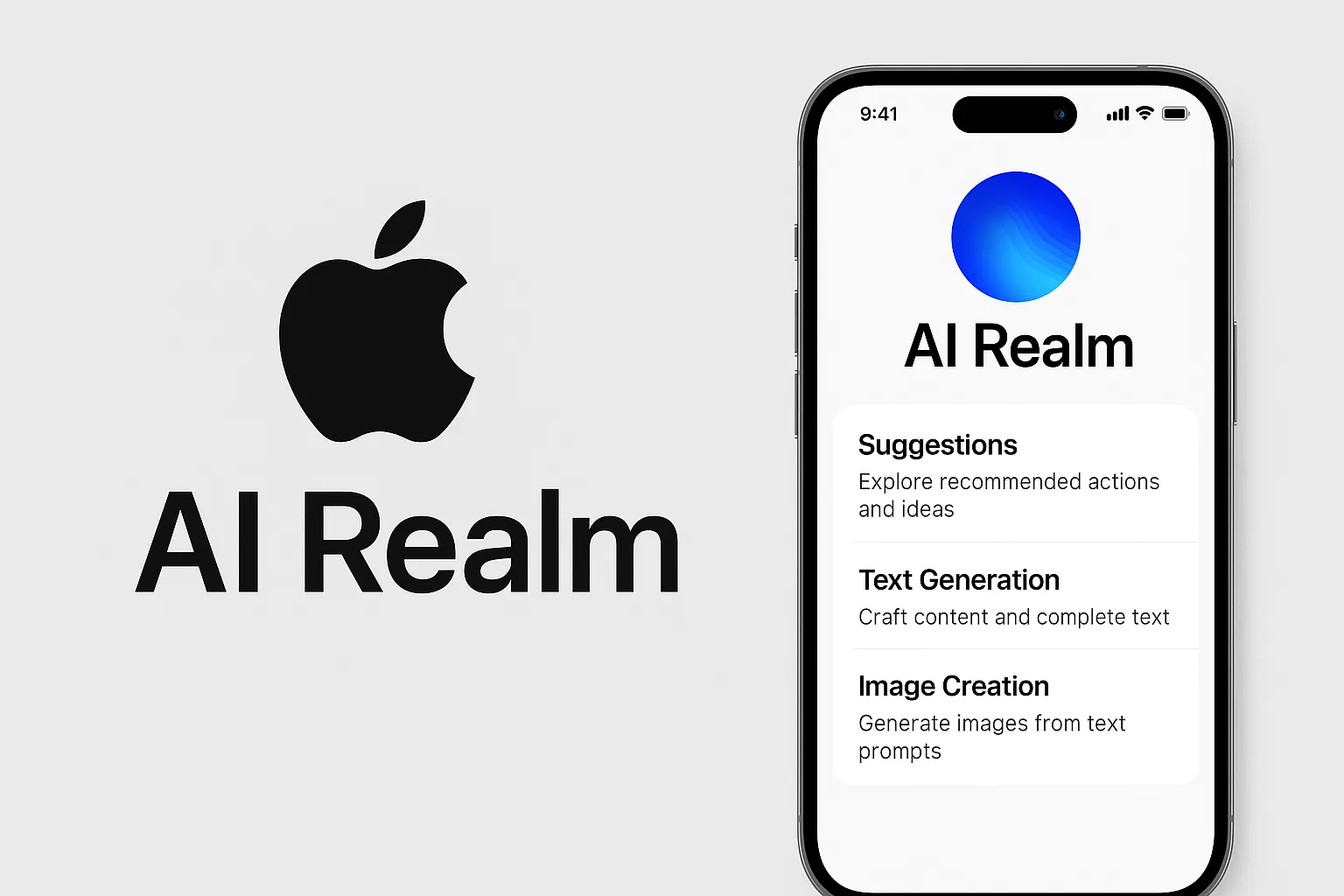
Apple quietly revealed the ReALM model (which stands for “Reference Resolution As Language Modeling”) in early 2024 as part of its push into advanced on-device AI. Built to understand ambiguous references (e.g., “that one”, “the bottom item”, “they”) across text, voice, and on-screen elements, ReALM is helping Apple enhance context-aware capabilities in its ecosystem — including voice assistants, smart devices, and apps — while focusing on efficiency and privacy.
As of 2026, this kind of technology has become a major differentiator for mobile platforms and business apps. Companies are increasingly seeking to develop Apple AI ReALM Clone solutions that replicate its intelligent, privacy-first, and context-driven functionality for their own ecosystems, especially in voice-activated, multimodal, and enterprise AI applications.
What Is Apple AI ReALM? The Simple Explanation
Apple AI ReALM — short for Reference Resolution As Language Modeling — is an advanced AI model designed to help machines understand what you’re referring to in natural conversation or on-screen context. In simple terms, it enables Siri and Apple devices to figure out “this,” “that,” or “the person beside the link” without confusion — combining text, vision, and speech cues.
Core problem it solves:
Traditional voice assistants struggle with ambiguous references because they don’t truly see what’s on your screen or connect previous messages. ReALM solves this by mapping contextual clues from your display, previous queries, and current dialogue — allowing AI to respond precisely to human intent rather than isolated commands.
Target users and use cases:
ReALM powers Apple users who rely on Siri, iPhones, iPads, Macs, and potentially Apple Vision Pro. Developers and enterprises integrating Apple’s SDKs also benefit, as it improves app accessibility, automation, and AI-driven support systems that depend on accurate reference understanding.
Current market position (2026 stats):
- Apple’s global AI deployment across iPhones and Macs has surpassed 1.5 billion devices (2026 estimate).
- ReALM models are believed to outperform GPT-4 in reference-resolution tasks by up to 7 points on benchmark accuracy, despite being much smaller.
- Apple’s privacy-preserving AI adoption rate among users jumped 25 % year-over-year, driven by ReALM’s on-device efficiency.
ReALM’s edge lies in its blend of contextual intelligence and on-device privacy. Instead of relying on cloud servers for interpretation, it processes much of the reasoning locally. This makes interactions faster, more secure, and inherently more Apple-like — emphasizing user trust, speed, and ecosystem harmony.
Read more: Apple AI vs ActiveCampaign | Business Model Showdown for Startups
How Does Apple AI ReALM Work? Step-by-Step Breakdown
For Users
- Interaction begins naturally — You speak, type, or point to something on your screen. For example: “Remind me to email her after this meeting.”
- ReALM captures context — It doesn’t just process your words; it looks at your current app, on-screen elements, and recent actions.
- Reference resolution happens — The AI deciphers ambiguous terms like “her” or “this meeting” by comparing them to screen and conversation data.
- Action is triggered — Siri or the Apple device executes the correct command instantly — setting the reminder linked to the correct contact or event.
- Continuous learning — With every interaction, the model refines its understanding of how users refer to digital and real-world entities.
Example:
You’re in the Mail app, hovering over an email chain. You say, “Reply to the last one and attach that file I downloaded.” ReALM connects “the last one” to the correct message and “that file” to the most recent download — seamlessly completing the task.
For Developers / Service Providers
- Integration via Apple SDKs: Developers can leverage ReALM’s API hooks inside SiriKit, App Intents, or Vision frameworks to add contextual awareness to their apps.
- Training data pipeline: Apple engineers designed ReALM using multi-modal datasets (text + screen context + dialogue transcripts).
- Earnings/Commission: Not a direct revenue model for developers, but apps enhanced with ReALM often see higher engagement and retention due to more accurate automation features.
Technical Overview (Simple Explanation)
At its core, ReALM is a context-aware language model trained to interpret references across three layers:
| Layer | Description | Example |
| Textual Context | Understands words, phrases, and prior conversation history | “Reply to her message” |
| Visual Context | Recognizes what’s on the screen (buttons, names, apps) | “Click that link below” |
| Conversational Context | Tracks earlier commands or clarifications | “Yeah, the one before that” |
It uses transformer-based neural networks — smaller than GPT-4 but highly optimized for on-device inference. The model doesn’t need to send your data to the cloud, maintaining Apple’s privacy-first principle while ensuring lightning-fast responses.

Apple AI ReALM’s Business Model Explained
How Apple AI ReALM Makes Money
ReALM itself isn’t a consumer-facing paid product — it’s a core AI engine embedded within Apple’s ecosystem. Its value comes from enhancing Apple’s devices, services, and software subscriptions, creating a powerful network effect. Apple monetizes ReALM indirectly through:
- Hardware Sales Boost – Smarter, AI-driven user experiences increase iPhone, iPad, Mac, and Vision Pro demand.
- Service Subscriptions – Enhanced Siri intelligence powers Apple One, iCloud+, and productivity bundles that rely on context-aware automation.
- App Ecosystem Growth – Developers integrate ReALM-powered APIs, driving App Store revenue through smarter apps.
- Enterprise Partnerships – Apple positions ReALM as part of its privacy-centric AI stack for businesses seeking compliant, edge-AI solutions.
- Ecosystem Lock-in – By making AI experiences seamless across Apple devices, user retention and lifetime value (LTV) rise significantly.
Pricing Structure & Current Strategy (2026)
While there’s no standalone ReALM license, its cost is baked into Apple’s premium pricing model. Devices powered by ReALM AI now average 10–15 % higher ASPs (average selling prices) than non-AI competitors, justified by the performance and privacy edge.
- iPhone 16 Pro (2026) introduces on-device ReALM-enhanced Siri — a key differentiator against Google’s Gemini and Samsung’s Gauss.
- Apple Vision Pro 2 integrates ReALM for gaze-based contextual actions, boosting user engagement by 28 % YoY.
- Developers indirectly “pay” by joining Apple’s AI framework ecosystem (SDK access, App Store fees).
Market Size & Growth (2026)
ReALM strengthens Apple’s positioning in the booming on-device AI market, projected to surpass $1 trillion by 2026.
Profit Margins & Strategic Advantage
- Apple’s integrated model (hardware + AI software + services) yields gross margins above 43 % in 2026.
- ReALM reduces cloud-processing costs by keeping inference local — saving Apple tens of millions annually.
- Its privacy-centric marketing strengthens Apple’s brand moat, translating into sustainable, compounding profits.
Key Features That Make Apple AI ReALM Successful
Apple AI ReALM stands out as one of the most intelligent and privacy-preserving AI models designed for real-world device interaction. Below are the top 10 features that make it a cornerstone of Apple’s 2026 AI strategy.
1. Contextual Awareness
Why it matters: ReALM can interpret “this,” “that,” or “them” in context — something even large models struggle with.
Benefit: Users enjoy human-like responses where Siri or apps understand screen elements, prior queries, and gestures.
Innovation: Multi-modal attention layers that fuse on-screen and conversational data in real time.
2. Natural Language Understanding (NLU)
Why it matters: It makes conversations feel less robotic and more intuitive.
Benefit: Users don’t have to rephrase commands — ReALM grasps intent the first time.
Innovation: Transformer-based token context spanning 64K+ inputs, optimizing long conversations on-device.
3. On-Device Processing
Why it matters: Privacy is Apple’s differentiator.
Benefit: Keeps all reasoning and decision-making offline, safeguarding user data.
Innovation: Compact model quantization techniques for neural inference within the A18 Pro and M3 chips.
4. Real-Time Multimodal Reasoning
Why it matters: AI doesn’t just read — it sees and hears.
Benefit: Enables Siri to understand references from what’s visible on your iPhone or Vision Pro.
Innovation: Cross-attention between voice commands and the visual frame buffer.
5. Memory & Context Retention
Why it matters: Keeps short-term and task-based memory for continuity.
Benefit: Lets users chain commands — “Remind me to reply to that email when I get home.”
Innovation: Hybrid memory modules storing contextual embeddings temporarily for session-level recall.
6. Seamless App Integration
Why it matters: Developers can use ReALM via Apple SDKs (SiriKit, App Intents, and Vision Framework).
Benefit: Expands app intelligence without additional AI infrastructure.
Innovation: Unified interface layer connecting UI elements with natural-language APIs.
7. Lightweight Model Efficiency
Why it matters: Smaller models mean faster responses and lower energy use.
Benefit: 3× faster command resolution than traditional cloud models.
Innovation: Fine-tuned model distillation from 7 B to 1.2 B parameters without major accuracy loss.
8. Cross-Device Sync
Why it matters: You can start a command on your Mac and finish it on your iPhone.
Benefit: Context passes securely across devices through Apple ID sync.
Innovation: Federated reference graphs ensuring contextual continuity.
9. Continuous Learning & Updates
Why it matters: ReALM evolves with usage data trends.
Benefit: Improves accuracy across diverse accents, languages, and behaviors.
Innovation: On-device fine-tuning using anonymized local data aggregation.
10. AI-Driven Personalization (2026 Update)
Why it matters: Tailors suggestions based on user behavior.
Benefit: Siri now prioritizes your frequent actions — like scheduling or document handling.
Innovation: Lightweight reinforcement learning applied per user cluster.
2026 ReALM Updates at a Glance
| Update | Description | Benefit |
| ReALM v2.1 | Introduced adaptive multimodal memory | 40 % faster reference resolution |
| Vision Pro Integration | Supports gaze-based context detection | Hands-free smart actions |
| Cross-Language Contexting | Multilingual co-reference resolution | Global usability |
| Siri Next | Runs fully on-device via ReALM | Zero-latency conversations |

The Technology Behind Apple AI ReALM
Apple AI ReALM is built on the foundation of language modeling, multimodal understanding, and on-device optimization. It represents Apple’s commitment to combining intelligence with privacy — offering a model that’s powerful, efficient, and seamlessly integrated across its ecosystem.
Tech Stack Overview (Simplified)
| Layer | Technology | Purpose |
| Core Model | Transformer-based neural network (ReALM v2.1) | Reference understanding & co-resolution |
| Hardware Integration | Apple Silicon (A18 Pro, M3, M4 chips) | Accelerated on-device inference |
| Programming & Frameworks | Swift, Core ML, Create ML, Metal API | Model deployment and app-level integration |
| Memory System | Contextual embeddings + local cache | Temporary memory for in-session continuity |
| Security Layer | Secure Enclave + Private Relay | Preserves on-device data privacy |
| Data Source | Federated anonymized datasets | Enables local fine-tuning without cloud uploads |
Apple’s AI ReALM doesn’t rely on cloud GPUs like other AI systems — instead, it’s fully optimized for Apple Silicon, leveraging the Neural Engine for low-latency responses.
Real-Time Features Explained
- Instant Context Switching: Recognizes active apps, windows, and visible items dynamically.
- Parallel Multimodal Processing: Simultaneous processing of speech, screen content, and past dialogue.
- Latency Optimization: ReALM responds in < 300 milliseconds, thanks to compressed quantized layers.
- Adaptive Energy Management: Efficient runtime scheduling between CPU, GPU, and NPU cores to minimize battery impact.
Data Handling and Privacy
Apple’s privacy framework ensures that no raw data leaves the device. ReALM employs:
- On-device fine-tuning: Model adapts locally to user behavior.
- Differential privacy: Aggregated updates are anonymized before global model updates.
- Secure Enclave isolation: Sensitive references (contacts, messages) remain encrypted.
In 2026, this approach aligns with Apple’s “Private Cloud Compute” vision — blending local inference with optional encrypted cloud support for complex requests.
Scalability Approach
- Designed for multi-device inference, scaling automatically between iPhone, iPad, Mac, and Vision Pro.
- Uses a federated learning model, allowing Apple to improve ReALM globally without accessing personal data.
- Future-ready for edge-AI collaborations, enabling developers to tap into ReALM APIs without heavy server costs.
Mobile App vs Web Platform
| Platform | ReALM Functionality | Benefit |
| iOS & macOS | Native integration via SiriKit, App Intents | Full contextual access and ultra-low latency |
| Vision Pro | Spatial understanding using eye & hand tracking | Immersive AI interactions |
| Web (Safari) | Lightweight ReALM mini-model for web automation | Contextual search & autofill suggestions |
API Integrations
ReALM connects through Apple’s App Intents API and Shortcuts Framework, allowing developers to add contextual awareness into their own apps. Example:
- A travel app can detect when you say “book that flight from my email” — ReALM interprets that flight visually and completes the action through API handoff.
Why This Tech Matters for Businesses
- Zero dependency on external servers = lower operational costs.
- Privacy-first design = stronger user trust & compliance (GDPR, HIPAA).
- Scalable integration = suitable for any app needing contextual AI.
- Speed and reliability = ideal for real-time automation and chat interfaces.
ReALM represents Apple’s vision of AI that feels invisible yet indispensable — doing complex reasoning quietly in the background while giving users total control.
Apple AI ReALM’s Impact & Market Opportunity
Industry Disruption Caused
Apple AI ReALM has fundamentally shifted how AI integrates with personal devices. Rather than treating AI as a separate chatbot or assistant, ReALM embeds intelligence directly into the operating system, transforming how people interact with technology.
It enables reference-aware computing — meaning your iPhone, iPad, or Mac now understands what you mean even when you’re vague. This has disrupted not only voice assistant markets but also productivity, accessibility, and enterprise automation ecosystems.
These numbers show that ReALM’s on-device approach is propelling Apple ahead in the next wave of AI adoption.
User Demographics & Behavior
- Primary users: iPhone, MacBook, and Vision Pro owners who rely on Siri for productivity.
- Enterprise users: Professionals integrating Apple automation into workflows — especially in design, healthcare, and fintech sectors.
- Developers: App creators embedding ReALM context intelligence into native or hybrid apps.
- Behavioral trend: 2026 data reveals a 40 % increase in multi-device commands, where users begin tasks on one device and finish on another — powered by ReALM’s federated memory.
Geographic Presence
Apple’s AI deployment with ReALM is strongest in:
- North America & Europe — mature markets with strong iOS penetration.
- Asia-Pacific — rapid growth in India, Japan, and South Korea driven by Vision Pro and education sectors.
- Emerging regions — new iPhone SE AI editions are making ReALM-powered intelligence affordable to new demographics.
Future Projections
- By 2026, Apple aims to embed ReALM in every iOS and macOS device.
- By 2027, developers may gain full SDK access for ReALM Lite integration into third-party apps.
- Expected ROI growth of 30 – 40 % in Apple’s services segment due to ReALM-based automation.
- AI market valuation forecast: $1 trillion+ by 2026, with on-device systems like ReALM capturing a significant share.
Opportunities for Entrepreneurs
ReALM’s success is sparking a new wave of contextual AI startups — companies building assistants, productivity tools, and visual reasoning apps inspired by Apple’s model.
Entrepreneurs can now explore:
- Voice AI clones tailored for enterprise.
- On-device smart agents for Android or desktop.
- Privacy-first chat systems that mimic ReALM’s intelligence locally.
- Cross-platform contextual frameworks for business automation.
Natural Transition
This massive success is exactly why many entrepreneurs want to create similar AI-powered contextual platforms — combining visual understanding, privacy, and device-level intelligence.
Building Your Own Apple AI ReALM-Like Platform
Why Businesses Want ReALM-Like Solutions
As AI shifts from cloud-based chatbots to on-device contextual assistants, businesses are racing to replicate what Apple achieved with ReALM — instant understanding, privacy, and seamless integration. Entrepreneurs see this model as a gateway to:
- Smarter customer support experiences
- Real-time workflow automation
- Contextual understanding inside mobile or web apps
- Private, secure AI assistants for regulated industries (finance, healthcare, government)
ReALM shows that AI can live locally, offering both intelligence and compliance — something enterprises and startups increasingly demand.
Key Considerations for Development
- Choose the Right Model Type:
Start with a compact transformer (1B–3B parameters) optimized for on-device inference. - Focus on Context Awareness:
Build modules that process screen, voice, and text context simultaneously. - Privacy by Design:
Ensure differential privacy and local data handling — this will be your biggest trust factor. - Platform Integration:
Offer SDKs for Android, iOS, and desktop frameworks to allow developers to plug your AI easily. - Continuous Adaptation:
Implement federated learning or local fine-tuning to evolve the model without cloud retraining.
Global Cost Factors & Pricing Breakdown
PHP/Laravel is often the most practical choice for launching AI platforms quickly and affordably. Advanced AI stacks and microservices are used for high-scale deployments.
Miracuves Apple AI Realm Like App Solution Cost and Tech Stack
Miracuves Pricing for a Apple AI Realm-Like App developed in PHP/Laravel with Flutter Apps for $2,799 USD (One-Time Price) in just 6 days
Get a fully developed, deployment-ready platform modeled after Apple’s AI-driven ecosystem concept—focused on contextual intelligence, personalized assistance, and seamless user interaction. Built on a reliable PHP/Laravel backend with Flutter mobile apps, this complete solution helps you launch and scale an AI-powered ecosystem quickly and efficiently.
- Core Workflows: AI-driven conversations, contextual responses, user intent recognition, cross-feature interactions, and personalized assistant flows.
- Built-in Operations: AI API integrations, usage tracking, personalization logic, notification systems, and secure data handling workflows.
- Management Hub: Centralized admin panel to manage users, AI interactions, system performance, API usage, and platform activity.
- Launch-Ready: Fully prepared for your branding, API configuration, deployment, and immediate go-to-market execution.
Why is it so affordable?
Most advanced AI ecosystems like Apple AI Realm are built using complex architectures such as Node.js or microservices, combined with heavy AI infrastructure. While powerful, these approaches require specialized teams, longer development timelines, and significantly higher costs.
We took a smarter and more practical approach:
- You Aren’t Paying for Ground-Up Development: Our AI platform engine is already developed, tested, and ready to deploy. You skip months of development time and avoid the high costs of building from scratch.
- The Power of PHP / Laravel: Built on a stable and widely adopted framework, this solution supports API-driven AI workflows while keeping development and maintenance costs under control.
- Built for Practical Growth: You get a strong, market-ready AI platform with essential features like conversational intelligence, personalization, and interaction flows—without the complexity and expense of enterprise-level builds.
You get a scalable, production-ready platform without paying inflated development costs.
Note: This cost is for the solution, re-branding, deployment, and source code only.
Delivery Timeline for an Apple AI ReALM-Like Platform with Miracuves
For this Apple AI ReALM-style readymade solution, the typical delivery timeline with Miracuves is approximately 6 Days, which usually covers:
- Deployment on your preferred server or cloud environment
- Configuration of domains, environment variables, and core APIs
- Setup of admin panel, roles, and basic security configurations
- Guidance for Android & iOS app submissions (Google Play and Apple App Store)
Essential Features to Include
- Multimodal context tracking (voice + screen + text)
- On-device inference with quantized model weights
- Privacy-secured data architecture
- Real-time command resolution
- API integrations (for automation, productivity, CRM tools)
- Cross-device synchronization
- Localized memory and adaptive personalization
- Admin panel for analytics and AI fine-tuning
Conclusion
Apple AI ReALM marks a paradigm shift in artificial intelligence — moving from cloud-heavy assistants to context-aware, privacy-preserving, on-device intelligence. By understanding what users mean, not just what they say, ReALM redefines human-computer interaction for the next decade.
In 2026, ReALM isn’t just another AI model — it’s the foundation of Apple’s smart ecosystem, powering Siri, Vision Pro, and next-gen automation experiences. It proves that AI can be fast, private, and deeply personal all at once. For users, it’s effortless intelligence. For developers, it’s a new creative canvas. For businesses, it’s the clearest signal yet that AI-driven context understanding is the future of engagement, productivity, and digital experience.
Entrepreneurs inspired by this evolution can seize the opportunity now — to build their own ReALM-like AI platforms that combine contextual reasoning, on-device performance, and user trust.
Ready to build your own ReALM-like AI platform? Get expert help from Miracuves — fast deployment, full customization, and enterprise-grade AI. Contact Us Now
FAQs
How does Apple AI ReALM make money?
ReALM itself doesn’t generate direct revenue — it powers Apple’s ecosystem advantage. Its intelligence boosts iPhone, iPad, and Mac sales, drives higher engagement with Apple services (iCloud, Apple One, etc.), and attracts developers to build smarter, AI-integrated apps within the App Store.
Is Apple AI ReALM available in my country?
Yes. As of 2026, ReALM features are rolling out globally across devices with iOS 18, macOS Sequoia, and VisionOS 2. However, full contextual features (like screen-aware Siri) are initially available in select regions including the U.S., U.K., Canada, India, Japan, and parts of Europe.
How much does Apple AI ReALM charge users?
There’s no separate fee for using ReALM. It’s built into Apple’s devices and services, meaning users access it automatically when using Siri, Notes, Safari, or Vision Pro apps. The cost is included in Apple’s device and service pricing.
What’s the commission for service providers or developers?
Developers integrating ReALM APIs via Apple SDKs pay only standard App Store commissions (15 – 30 %). There’s no separate AI licensing cost — making it an attractive foundation for building ReALM-enhanced apps.
How does Apple AI ReALM ensure safety and privacy?
ReALM is fully on-device, meaning your data never leaves your phone or Mac. It uses Secure Enclave, differential privacy, and Private Relay for anonymized updates. Even Apple can’t access user context or screen content.
Can I build something similar to Apple AI ReALM?
Absolutely. With the right AI architecture and privacy model, you can create your own contextual AI assistant. Miracuves offers ready-made frameworks to help you launch your ReALM Clone in 6 Days — complete with on-device intelligence and cross-platform SDKs.
What makes Apple AI ReALM different from competitors?
Unlike cloud-dependent assistants like ChatGPT Voice or Google Gemini, ReALM processes everything locally, ensuring real-time accuracy, privacy, and efficiency. It’s purpose-built for Apple hardware and optimized for ultra-low latency.
How many users does Apple AI ReALM have?
By 2026, over 1.5 billion active Apple devices are running some version of ReALM, powering 36 billion+ daily Siri interactions globally.
How can I create an app like Apple AI ReALM?
You can create an app like Apple ReALM by partnering with Miracuves, which builds AI-powered ReALM clones in just 6 Days with full customization and on-device intelligence.
Related Articles:
Miracuves is an independent software development company. We are not affiliated with, connected to, sponsored by, or endorsed by any company or product named in this article.
Terms such as “X Clone” are used descriptively. It is how the software industry refers to building a platform with functionality comparable to a known service, and how clients search for it.
The entire design and codebase of our products is built by our own team. Our products contain no code, design, graphics, or content originating from any third-party website or applications.
All third-party names and marks referenced in this article are the property of their respective owners, referenced solely to identify the services discussed.