


Key Takeaways
What You’ll Learn
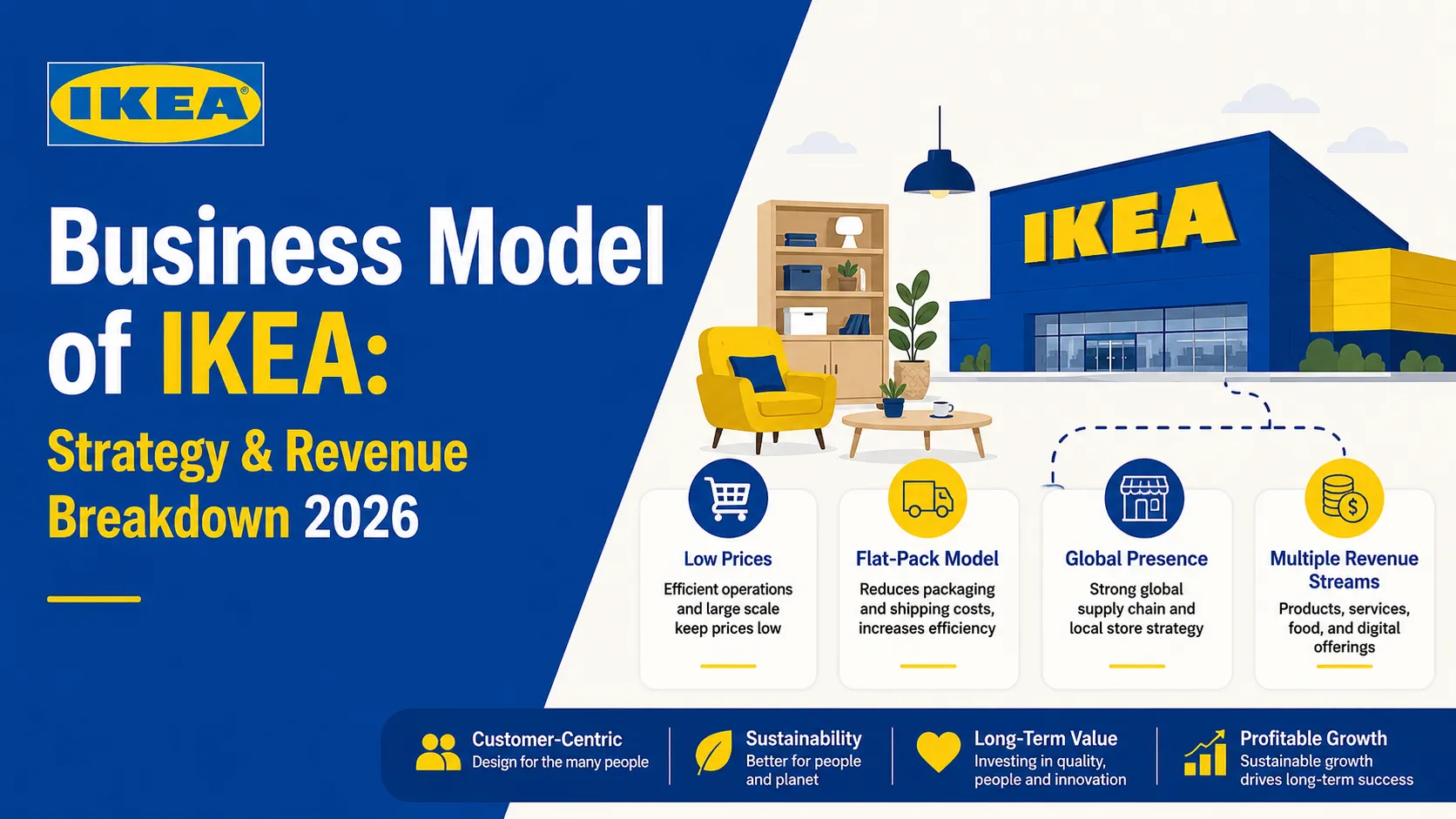
- IKEA’s business model is built around affordable furniture at global scale where product design, flat-pack logistics, store experience, and digital commerce work together.
- The company earns through multiple retail layers including furniture sales, home accessories, food courts, delivery, assembly, planning services, and online orders.
- Flat-pack design is a major business advantage because it reduces storage, transportation, and handling costs while supporting IKEA’s low-price positioning.
- The in-store experience drives higher basket value through showroom layouts, self-service warehouses, product discovery, restaurant visits, and impulse purchases.
- The biggest takeaway for founders is that IKEA succeeds by combining cost efficiency, brand trust, supply-chain control, and customer experience into one scalable retail system.
Stats That Matter
- The article positions IKEA as a global home furnishing giant built on affordable design, large-scale sourcing, standardized products, and efficient retail operations.
- Core revenue comes from furniture and home goods sales across categories like beds, sofas, tables, wardrobes, kitchens, storage, lighting, and decor.
- Additional revenue streams include food courts, delivery, furniture assembly, kitchen planning, interior design support, and online marketplace sales.
- IKEA’s warehouse-style retail model lowers operating complexity by combining showrooms, self-pickup inventory, flat-pack packaging, and centralized logistics.
- Digital transformation is becoming more important as IKEA expands eCommerce, app-based shopping, delivery coordination, AR room planning, and omnichannel customer journeys.
Real Insights
- IKEA succeeds because it sells both products and an experience where customers explore rooms, compare styles, eat, plan, and purchase in one controlled environment.
- The real strength of IKEA’s model is operational discipline because low pricing depends on design efficiency, supply-chain planning, packaging control, and inventory optimization.
- Furniture assembly shifts part of the value chain to customers allowing IKEA to reduce costs while keeping products accessible and easy to transport.
- Food and services support the core retail journey by increasing store time, improving customer comfort, and creating extra revenue beyond furniture sales.
- For entrepreneurs, the biggest lesson is to build an IKEA-style retail platform around affordability, product standardization, logistics efficiency, omnichannel shopping, and experience-led customer retention.
IKEA didn’t become a global furniture giant just by selling affordable sofas. It scaled by building a smart system that combines cost efficiency, self-service shopping, and lifestyle-driven branding. In 2026, the business model of IKEA is still one of the strongest examples of how operational design can create mass-market loyalty.
At its core, IKEA delivers value through flat-pack innovation, modular product design, and a high-volume retail engine that keeps prices accessible without compromising on style. Customers get functional, modern home solutions, while IKEA benefits from predictable demand, streamlined logistics, and strong control over product margins.
What makes IKEA’s model powerful today is how it adapts to changing consumer behavior. With more people prioritizing compact living, sustainability, and fast delivery, IKEA is evolving beyond big-box stores into omnichannel experiences—blending showrooms, ecommerce, and last-mile fulfillment to stay competitive and scalable worldwide.
How the IKEA Business Model Works
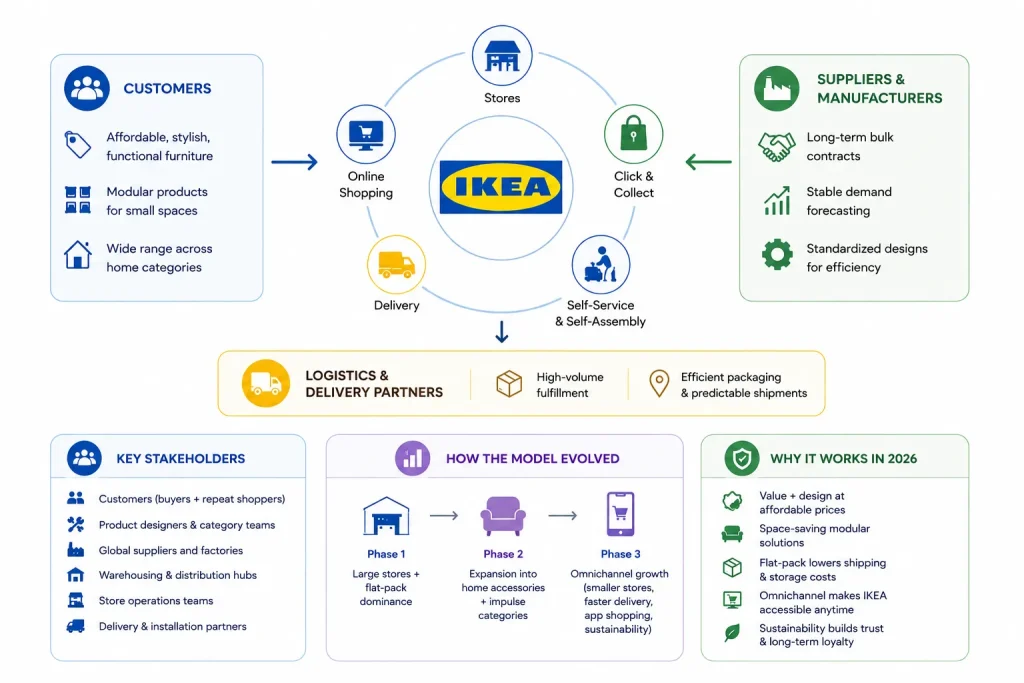
Then IKEA business model works like a highly engineered ecosystem where design, pricing, logistics, and customer behavior are connected into one repeatable system. IKEA doesn’t just sell furniture—it sells affordable lifestyle solutions at massive scale by controlling everything from product design to distribution.
Type of Business Model
IKEA runs a hybrid retail model, combining:
- Direct-to-consumer (D2C) retail (stores + online)
- Self-service + self-assembly model
- Omnichannel commerce (click & collect, delivery, city stores)
Value Proposition (Who Gets What?)
IKEA creates value for multiple segments:
1) Customers (Home buyers, renters, families)
- Affordable, stylish, functional furniture
- Modular products for small spaces
- Easy availability across categories (furniture, décor, kitchen, storage)
2) Suppliers & Manufacturers
- Long-term bulk purchase contracts
- Stable demand forecasting
- Process optimization through standard designs
3) Logistics & Delivery Partners
- High-volume fulfillment opportunities
- Efficient packaging and predictable shipments
Key Stakeholders in the IKEA Ecosystem
- Customers (buyers + repeat shoppers)
- Product designers & category teams
- Global suppliers and factories
- Warehousing and distribution hubs
- Store operations teams
- Delivery + installation service partners
How the Model Evolved Over Time
IKEA’s model evolved in major stages:
- Phase 1: Large warehouse-style stores + flat-pack dominance
- Phase 2: Expansion into home accessories + impulse categories
- Phase 3 : Omnichannel growth through:
- smaller city stores
- faster delivery models
- app-based shopping journeys
- sustainability-led product innovation
- smaller city stores
Why It Works in 2026
In 2026, IKEA wins because:
- Consumers want value + design, not luxury pricing
- Small homes need space-saving modular furniture
- Flat-pack keeps shipping and storage costs low
- Omnichannel makes IKEA reachable without needing a big store visit
- Sustainability focus strengthens brand trust and long-term retention
Target Market & Customer Segmentation Strategy
IKEA’s growth isn’t only about low pricing—it’s about understanding why people buy furniture at different life stages. The IKEA strategy is built around serving customers who want a better-looking home without paying premium designer prices. In 2026, this focus is even stronger because buyers expect affordability, fast delivery, and modern aesthetics together.
Primary Customer Segments
1) Urban renters & young professionals
- Need compact, modular, easy-to-move furniture
- Prefer minimal, modern design
- High repeat purchases (storage, décor, upgrades)
2) Middle-income families
- Buy in bulk (beds, sofas, dining, kids furniture)
- Value durability + budget control
- Strong seasonal buying behavior (festivals, home upgrades)
3) First-time home buyers
- Want complete home setup in one place
- Prefer bundles, room sets, and guided inspiration
- High order value during “new home” stage
Secondary Customer Segments
- Students and shared-living customers
- Small offices and startups
- Interior designers looking for affordable basics
Customer Journey (Discovery → Conversion → Retention)
- Discovery: Social media inspiration, search, store visits, catalogs
- Conversion: Room displays, price transparency, easy checkout
- Retention: Repeat décor buys, seasonal refresh cycles, loyalty programs
Acquisition Channels & LTV Optimization
- SEO + Google Shopping + product searches
- In-store experience + impulse add-ons
- App + email offers + personalized recommendations
- Cross-selling through “complete the room” bundles
Market Positioning & Competitive Edge
IKEA positions itself as “design for everyone”—affordable, reliable, and trend-aware. Its biggest advantage is the combination of global scale + efficient operations + brand trust, which makes it hard for local furniture brands to match both price and consistency.
Revenue Streams and Monetization Design
Once you understand who IKEA serves, the next question becomes clear: how does IKEA actually make money—and why is its revenue model so stable?
The IKEA revenue model is built on high-volume product sales, smart margin control, and repeat-purchase categories that keep customers coming back. Instead of relying on one income source, IKEA earns across furniture, home essentials, services, and add-on purchases.
Primary Revenue Stream 1: Direct Product Sales (Core Engine)
Mechanism
IKEA earns most of its revenue by selling products directly through:
- physical IKEA stores
- ecommerce website
- mobile app shopping experience
Pricing Model (2026)
- affordable-to-mid pricing for mass market
- room-based bundles (bedroom sets, kitchen sets, storage combos)
- seasonal offers without heavy discount dependency
Revenue Contribution
- largest revenue driver
- strong profit stability due to private-label and exclusive designs
Growth Trajectory
- higher focus on modular furniture for urban living
- more “complete room” bundles to increase average order value
- improved online discovery to boost conversions
Secondary Revenue Stream 2: Home Accessories & Impulse Categories
Mechanism
Customers add high-margin items like:
- décor, lighting, organizers
- kitchenware, textiles, small home upgrades
Why it matters
- increases cart value
- improves repeat purchase frequency
Secondary Revenue Stream 3: Delivery, Assembly & Installation Services
Mechanism
IKEA monetizes convenience through:
- home delivery
- assembly support
- kitchen fitting and installation services
Why it matters (2026)
As more customers shop online, service revenue grows alongside product sales.
Secondary Revenue Stream 4: B2B / Office & Bulk Orders
Mechanism
IKEA also earns from:
- small business furniture packages
- office setups and bulk buying
Overall Monetization Strategy (How It All Connects)
IKEA’s monetization works because each stream supports the other:
- furniture drives the big purchase
- accessories raise margins
- services reduce friction and increase conversions
- bundles and room sets increase customer lifetime value
This layered structure makes IKEA resilient, scalable, and profitable even during price-sensitive market cycles.
Operational Model & Key Activities
IKEA’s success isn’t only about design—it’s about running one of the most efficient retail machines in the world. The IKEA operational model is built to reduce costs at every step, from product development to delivery. In 2026, this matters even more because customers expect affordable pricing, fast fulfillment, and consistent quality across regions.
Core Operations (What IKEA Runs Daily)
IKEA’s key activities include:
- Product design & standardization (modular, flat-pack friendly)
- Supplier coordination & bulk manufacturing
- Inventory planning & warehouse management
- Store operations (self-service layout + experience zones)
- Ecommerce operations (online catalog, checkout, support)
- Quality control & returns handling
- Customer support + service scheduling (delivery/assembly)
Platform + Retail Execution
IKEA blends physical + digital operations through:
- real-time stock visibility
- click-and-collect systems
- delivery slot planning
- customer journey optimization across app and store
Resource Allocation (How IKEA Invests)
In 2026, IKEA typically prioritizes:
- Tech & digital upgrades: improving online experience and fulfillment tracking
- Logistics expansion: faster delivery hubs and regional distribution
- Store formats: large stores + smaller city outlets
- Sustainability R&D: recyclable materials and energy-efficient production
- Customer experience: room displays, guided shopping, service improvements
Why This Operational Model Wins
IKEA stays competitive because it controls:
- cost per unit through scale
- shipping efficiency through flat-pack design
- customer conversion through store experience + room inspiration
- repeat buying through high-utility categories and accessories
Strategic Partnerships & Ecosystem Development
IKEA doesn’t scale globally by working alone. Its ecosystem is built on long-term partnerships that strengthen supply stability, reduce operational risk, and improve customer experience. In 2026, the IKEA partnership strategy is focused on speed, sustainability, and omnichannel convenience—because modern customers want affordable furniture and reliable delivery.
Collaboration Philosophy
IKEA partners with organizations that help it:
- lower costs without lowering quality
- expand into new markets faster
- improve delivery and installation efficiency
- innovate in sustainable materials and production
Key Partnership Types
1) Technology & API Partners
- ecommerce infrastructure support
- inventory and warehouse automation
- customer experience tools (recommendations, personalization)
2) Payment & Financing Alliances
- card networks and payment gateways
- buy-now-pay-later and EMI providers
- in-store + online financing integrations
3) Logistics & Last-Mile Delivery Partners
- regional courier and freight partners
- installation and assembly service networks
- reverse logistics for returns and replacements
4) Manufacturing & Supplier Partnerships
- long-term contracts with global factories
- raw material suppliers (wood, textiles, packaging)
- production partners aligned with IKEA’s cost and sustainability goals
5) Regulatory & Expansion Alliances
- local compliance consultants
- real estate and retail infrastructure partners
- sustainability and certification organizations
Ecosystem Strategy (Why It Creates a Moat)
IKEA’s ecosystem builds a strong competitive edge because:
- partners help strengthen network efficiency, not just reach
- supply chain partnerships create cost advantages that are hard to copy
- logistics tie-ups improve delivery speed, increasing conversion
- sustainability alliances build long-term trust and brand preference
Growth Strategy & Scaling Mechanisms
IKEA’s growth is not powered by hype—it’s powered by repeatable systems. The IKEA growth strategy is designed to scale across countries, customer lifestyles, and housing trends without losing its core promise: good design at affordable prices. In 2026, IKEA grows by expanding its omnichannel reach, improving speed-to-home delivery, and increasing customer lifetime value through smart category expansion.
Growth Engines (What Drives Expansion)
1) Organic Brand Pull + Lifestyle Positioning
IKEA benefits from strong word-of-mouth because customers don’t just buy products—they buy an “IKEA home” identity:
- modern, minimalist aesthetics
- affordable upgrades
- functional living solutions
2) Store Experience as a Conversion Engine
Its physical stores act like a live showroom where customers:
- explore room setups
- discover bundles
- make high-ticket decisions confidently
3) Omnichannel Scaling
In 2026, IKEA is scaling faster through:
- ecommerce-first buying journeys
- click-and-collect models
- smaller city stores for accessibility
- faster last-mile delivery expansion
4) Category Expansion for Higher LTV
IKEA increases lifetime value by adding:
- home accessories and essentials
- kitchen solutions and storage systems
- work-from-home furniture
- seasonal collections that trigger repeat buys
Scaling Challenges & How IKEA Solves Them
Challenge 1: Supply chain pressure + global disruptions
Solution: diversified suppliers, better forecasting, regional distribution hubs
Challenge 2: Last-mile delivery complexity
Solution: delivery partnerships + optimized flat-pack packaging + scheduled assembly services
Challenge 3: Competing with online-first furniture brands
Solution: stronger ecommerce experience + faster delivery + improved product discovery
Challenge 4: Sustainability expectations in 2026
Solution: recyclable packaging, responsible sourcing, long-term eco design strategy
Competitive Strategy & Market Defense (2026)
The furniture and home-living market is crowded in 2026—local brands compete on price, premium brands compete on design, and online-first players compete on speed. IKEA stays ahead because it doesn’t win on just one factor. It wins through a rare combination of scale, cost control, brand trust, and repeatable execution.
Key Competitive Advantages
1) Scale + Cost Efficiency
IKEA’s biggest advantage is its global operating scale:
- bulk manufacturing lowers per-unit costs
- standardized designs reduce production complexity
- flat-pack packaging reduces storage and shipping costs
2) Strong Brand Equity + Trust
Customers trust IKEA for:
- predictable quality at a fair price
- modern design that fits most lifestyles
- a consistent experience across regions
3) Switching Barriers Through System Buying
IKEA products often connect into a larger setup:
- modular wardrobes
- kitchen systems
- storage ecosystems
This creates repeat purchases because customers prefer matching expansions.
4) Innovation in Retail Experience
IKEA uses:
- room-based storytelling
- guided customer journeys
- “complete the room” merchandising
to improve conversion and basket size.
5) Data-Driven Omnichannel Strategy
In 2026, IKEA strengthens its defense by improving:
- online product discovery
- inventory visibility
- delivery scheduling and service reliability
Market Defense Tactics (How IKEA Protects Share)
- Pricing discipline: staying affordable without damaging margins
- Fast adaptation: introducing compact living solutions and trending collections
- Store format innovation: large stores + city outlets + pickup points
- Service upgrades: delivery, assembly, and installation to reduce friction
- Supply chain resilience: multi-region sourcing and distribution planning
This is how IKEA stays strong even when competitors try to copy its product styles—because the real advantage is the system behind the products.
Read more : Best IKEA Clone Scripts 2025: Build a Scalable Furniture & Home Decor Marketplace
Lessons for Entrepreneurs & Implementation
If you study IKEA closely, you realize its success isn’t based on furniture alone—it’s based on designing a business system that scales profitably. IKEA proves that in 2026, the strongest brands don’t just sell products or services. They build repeatable ecosystems where cost control, customer experience, and operational efficiency work together.
Key Factors Behind IKEA’s Success
- Design-to-cost thinking: products are designed to be affordable from day one
- Operational simplicity: standardized parts, repeatable manufacturing, predictable supply chain
- High-volume + high-retention categories: furniture brings customers, accessories keep them returning
- Customer participation model: self-service + self-assembly lowers costs without lowering value
- Brand consistency: IKEA delivers the same lifestyle promise globally
Replicable Principles for Startups
Founders can copy IKEA’s core playbook by focusing on:
- building a clear value proposition (affordable + functional + modern)
- creating bundles and add-ons to increase average order value
- designing for logistics efficiency (delivery, packaging, cost control)
- using experience-driven conversion (UI/UX for apps, showroom effect for platforms)
Common Mistakes to Avoid
- competing only on low pricing without operational control
- ignoring retention and relying only on new customer acquisition
- scaling too fast without stable supply chain and support systems
- offering too many options without standardization
Implementation Timeline & Investment Priorities
A practical build plan in 2026 looks like:
- Phase 1: validate demand + build core catalog/service
- Phase 2: optimize operations + improve repeat purchase loops
- Phase 3: scale with partnerships + expand into new regions/categories
Ready to implement IKEA’s proven business model for your market? Miracuves builds scalable platforms with tested business models and growth mechanisms. We’ve helped entrepreneurs launch profitable apps. Get your free business model consultation today.
Conclusion
IKEA’s business model proves one powerful lesson: real scale doesn’t come from selling more products—it comes from building a system that makes growth easier every year. From flat-pack innovation to standardized design and efficient logistics, IKEA has mastered the balance between affordability and consistency, which is why it continues to win in global markets.
In 2026 and beyond, platform-style thinking is shaping every industry, including retail. The brands that succeed won’t be the ones with the most options—they’ll be the ones with the smartest execution engine, strongest customer trust, and most scalable operations. IKEA shows that when innovation meets discipline, even everyday products can become a billion-dollar ecosystem.
FAQs
What type of business model does IKEA use?
IKEA uses a hybrid retail business model combining direct-to-consumer sales, large-format stores, ecommerce, and a self-service/self-assembly approach to reduce costs and scale globally.
How does IKEA’s model create value?
IKEA creates value by offering affordable, modern, functional home solutions through smart design, flat-pack packaging, and efficient supply chains that keep pricing accessible.
What are IKEA’s key success factors?
Its biggest success factors are cost-efficient operations, standardized product design, strong brand trust, high-volume sales, and repeat-purchase categories like home accessories.
How scalable is IKEA’s business model?
Very scalable. IKEA can expand into new regions using repeatable store formats, supplier networks, and standardized product systems, supported by omnichannel fulfillment in 2026.
What are the biggest challenges in IKEA’s model?
Key challenges include supply chain disruptions, last-mile delivery complexity, inventory planning, and competition from online-first furniture brands.
How can entrepreneurs adapt IKEA’s model to their region?
Entrepreneurs can adapt it by focusing on local sourcing, compact product designs, bundles, affordable pricing, and strong delivery/installation partnerships.
What are alternatives to this model?
Alternatives include a marketplace furniture model where multiple sellers list products, a subscription/rental commerce model for flexible monthly furniture access, and a D2C single-brand model focused on one category like sofas or mattresses. Another strong option is an on-demand hyperlocal delivery model for faster same-day home essentials.
Related Article :