


Key Takeaways
What You’ll Learn
- Midjourney’s revenue model is built around subscription-first AI SaaS where users pay recurring fees for image generation speed, GPU access, quality, and commercial usage rights.
- The platform turns AI creativity into a premium digital service by offering paid plans for creators, professionals, agencies, and enterprise users.
- Community-led growth is a major advantage because user-generated artwork, shared prompts, and public discovery help reduce marketing costs while increasing adoption.
- Enterprise licensing and API access create higher-value revenue layers for brands, teams, and platforms that need custom AI image workflows.
- The key lesson for founders is that AI platforms can scale profitably when recurring subscriptions, usage control, premium rights, and community engagement work together.
Stats That Matter
- The article estimates Midjourney’s 2026 revenue at around $500–550 million, showing how fast generative AI subscription platforms can scale.
- Subscriptions contribute around 85% of total revenue through Basic, Standard, Pro, and Mega or Enterprise plans.
- Estimated paying users are around 6–7 million, with average annual revenue per user listed at approximately $85–95.
- Enterprise and API licensing contribute around 7% through custom contracts, model access, usage volume, and service-level requirements.
- Additional monetization comes from commercial usage rights, private mode, compute credits, high-volume rendering, and community programs that expand revenue beyond basic subscriptions.
Real Insights
- Midjourney proves that AI output can be monetized as professional infrastructure when quality, speed, rights, and workflow value are placed behind paid tiers.
- Its low entry pricing reduces adoption friction while premium tiers naturally capture creators, agencies, and businesses with higher usage needs.
- GPU access becomes part of the product economy because generation speed, compute credits, and high-volume rendering directly influence pricing and user upgrades.
- The strongest future opportunities are vertical AI tools for industries like real estate, fashion, healthcare, gaming, and eCommerce where image generation solves specific business problems.
- For entrepreneurs, the biggest takeaway is to build a Midjourney-style AI platform around subscriptions, compute efficiency, commercial rights, enterprise licensing, and community-powered product growth.
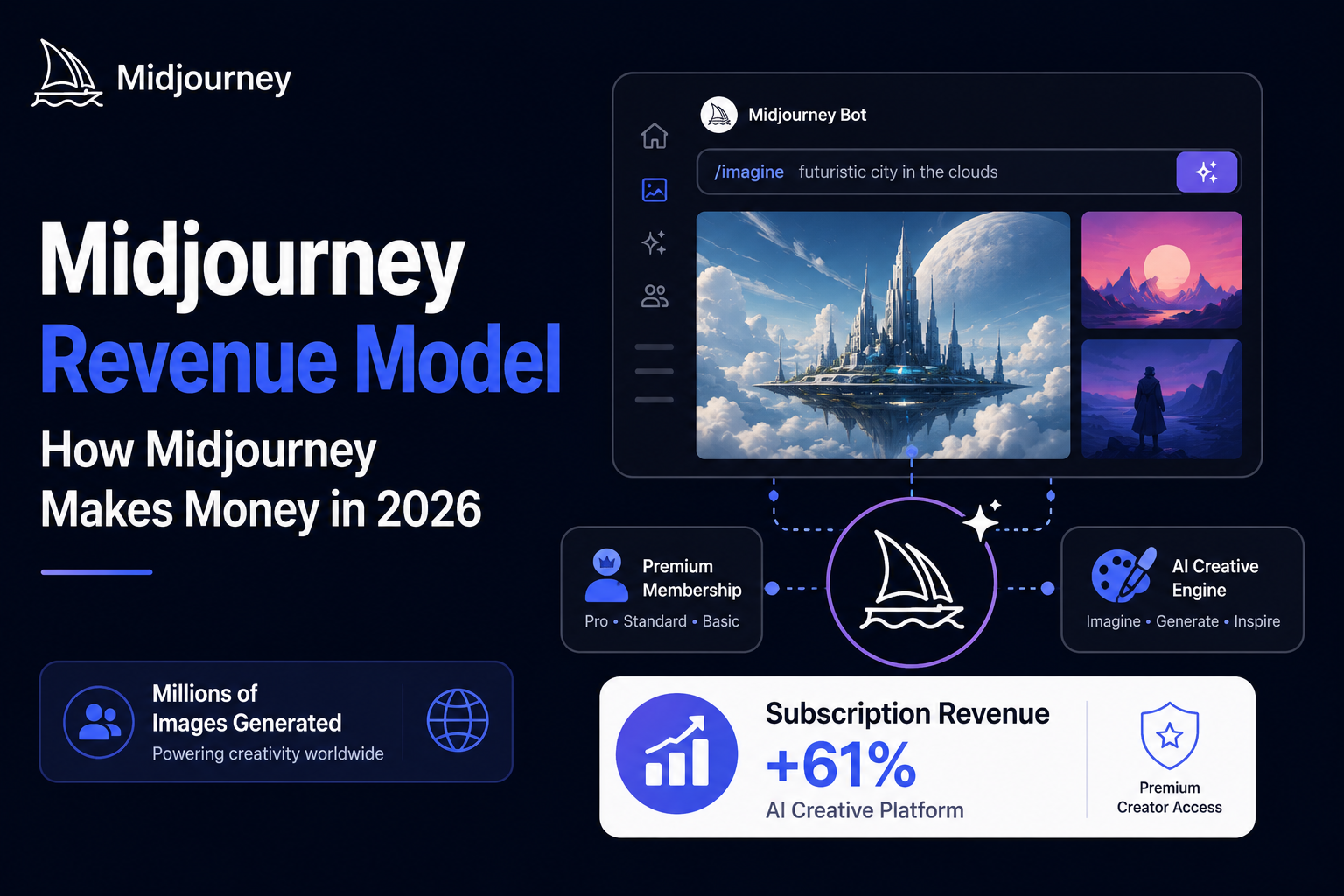
In 2026, Midjourney crossed an estimated $500+ million in annual revenue, proving that generative AI can scale into a high-margin digital business without ads or marketplaces. Its success is driven by a compute-efficient subscription model that converts GPU access and creative tooling into recurring revenue, while premium tiers capture professional and enterprise demand. This structure allows Midjourney to balance rapid user growth with margin optimization, turning infrastructure costs into a competitive advantage rather than a constraint.
What started as a Discord-based art experiment has evolved into one of the most powerful subscription-driven AI platforms in the world, serving creators, agencies, and businesses at global scale. The platform’s tight feedback loop between community, product development, and model upgrades accelerates innovation and keeps engagement high. By embedding collaboration and visibility into its workflow, Midjourney has transformed user activity into organic marketing and continuous product validation.
For founders, Midjourney offers a blueprint for building AI SaaS monetization, premium digital services, and community-powered growth loops that reduce customer acquisition costs. Its model demonstrates how low-friction entry pricing can seed mass adoption, while advanced features, privacy controls, and enterprise access create natural upsell paths. The deeper lesson lies in designing platforms where users don’t just consume value—they actively help shape and scale the product ecosystem.
Midjourney Revenue Overview – The Big Picture
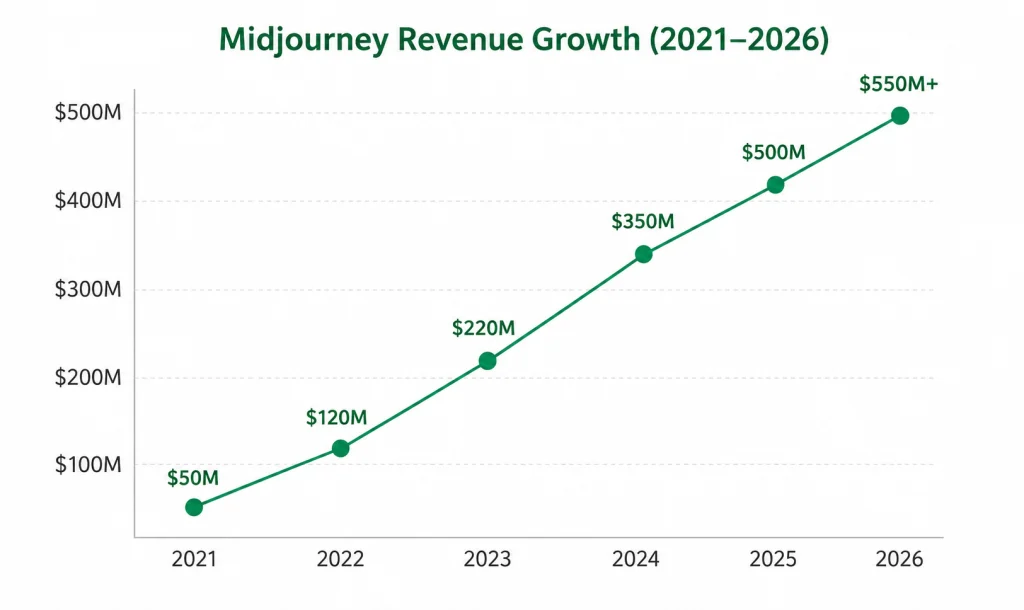
2026 Revenue: ~$500–550 million (estimated from subscriber base, pricing tiers, and usage metrics)
Valuation: ~$5–7 billion (private market estimates based on ARR multiples)
YoY Growth: ~35–45%
Revenue by Region:
- North America: ~38%
- Europe: ~27%
- Asia-Pacific: ~25%
- Rest of World: ~10%
Profit Margins:
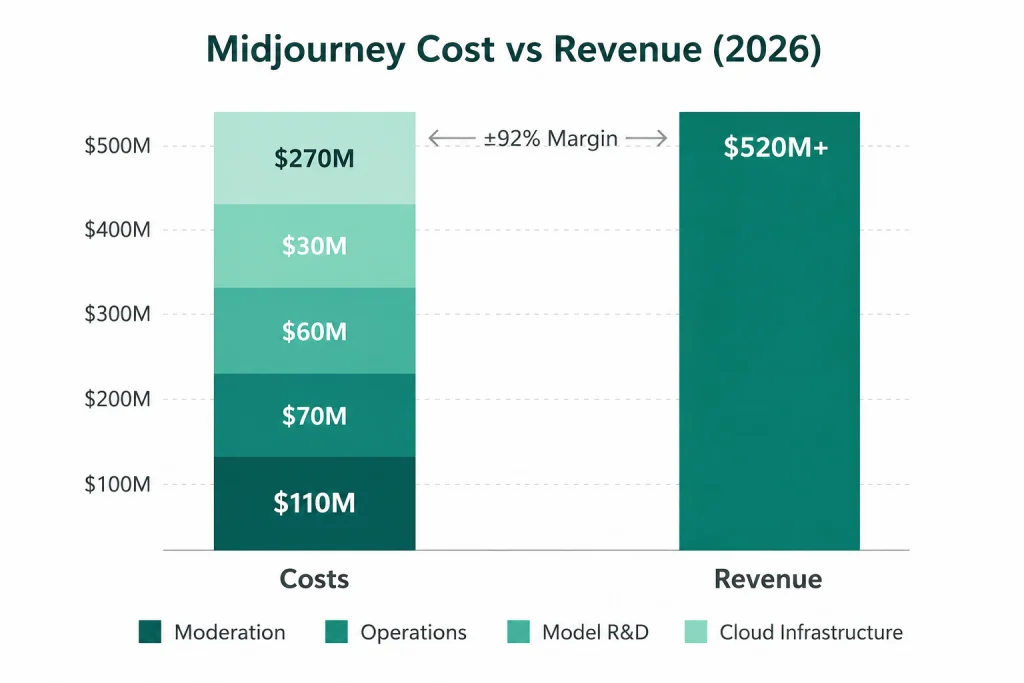
- Gross margin: ~70–80% (digital-first, subscription-led model)
- Net margin: Strong but reinvested into compute infrastructure and model R&D
Competition Benchmark:
- DALL·E (OpenAI): Bundled via API & enterprise licensing
- Stability AI: Open-source + enterprise services
- Adobe Firefly: Creative Cloud integration model
Primary Revenue Streams Deep Dive
Revenue Stream #1: Subscription Plans (Core Revenue – ~85%)
Midjourney operates on a monthly and annual subscription model that unlocks fast generation speeds, private mode, higher-quality renders, and commercial usage rights.
Pricing (2026):
- Basic: $10/month
- Standard: $30/month
- Pro: $60/month
- Mega/Enterprise: Custom pricing
How it works:
Users pay recurring fees for GPU access, generation limits, and licensing privileges.
2026 Data:
- Estimated paying users: ~6–7 million
- Average annual revenue per user (ARPU): ~$85–95
- Estimated contribution: ~$430M+
Revenue Stream #2: Enterprise & API Licensing (~7%)
Brands and platforms license Midjourney’s image generation engine for internal tools, marketing automation, and product design workflows.
How it works:
Custom contracts based on usage volume, model access, and SLA guarantees.
2026 Contribution: ~$35–40M
Revenue Stream #3: Commercial Usage Rights & Private Mode (~4%)
Professional creators and agencies pay extra for private generation and legal usage rights.
How it works:
Premium plans include IP protection and exclusive rendering environments.
2026 Contribution: ~$20M+
Revenue Stream #4: Compute Credits & High-Volume Rendering (~3%)
Heavy users buy GPU credit packs for large-scale batch generation.
2026 Contribution: ~$15M
Revenue Stream #5: Community & Creator Programs (~1%)
Revenue from branded competitions, featured artist programs, and educational partnerships.
2026 Contribution: ~$5M
Revenue Streams Percentage Breakdown
| Revenue Stream | % Share | Estimated Revenue |
|---|---|---|
| Subscriptions | 85% | $430M |
| Enterprise/API | 7% | $38M |
| Commercial Rights | 4% | $22M |
| Compute Credits | 3% | $15M |
| Community Programs | 1% | $5M |
The Fee Structure Explained
User-Side Fees
- Monthly subscriptions: $10–$60+
- GPU credit top-ups
- Private generation add-ons
Provider-Side Fees
- Enterprise licensing contracts
- API access fees
Hidden Revenue Layers
- Annual billing discounts that lock in long-term ARR
- Premium licensing for commercial usage
Regional Pricing Variation
- Lower pricing tiers in Asia and LATAM
- Enterprise pricing standardized globally
Complete Fee Structure by User Type
| User Type | Fees Paid | Revenue Source |
|---|---|---|
| Hobby Creator | $10–$30/month | Subscription |
| Professional Artist | $60/month | Subscription + Rights |
| Enterprise Team | Custom | Licensing |
| Power User | Credit Packs | Compute Sales |
| Educator/Partner | Custom | Partnerships |
How Midjourney Maximizes Revenue Per User
Segmentation:
Hobbyists → Professionals → Agencies → Enterprises.
Upselling:
Basic users are nudged toward Pro plans for speed and privacy.
Cross-Selling:
Compute credits and commercial rights.
Dynamic Pricing:
Usage-based enterprise contracts.
Retention Monetization:
Continuous model upgrades lock in creators.
LTV Optimization:
Average lifetime value estimated at $180–250 per user.
Psychological Pricing:
Low entry cost ($10/month) reduces friction, while premium tiers capture professionals.
Real Data Example:
An agency using Pro + API access can generate 10x the revenue of a casual user annually.
Cost Structure & Profit Margins
Infrastructure Costs:
GPU clusters, cloud compute, storage, inference pipelines.
CAC & Marketing:
Low paid marketing, heavy organic growth via social media and community.
Operations:
Moderation, legal compliance, customer support.
R&D:
Model training, dataset expansion, AI optimization.
Unit Economics:
- Estimated CAC: <$10 per user
- Monthly gross margin per Pro user: ~$35–40
Margin Optimization:
Annual plans, optimized GPU utilization, regional compute routing.
Profitability Path:
Scale-driven compute efficiency and enterprise licensing growth.
Future Revenue Opportunities & Innovations
New Streams:
- AI video generation subscriptions
- Brand asset automation platforms
- 3D and game asset generation tools
AI/ML-Based Monetization:
Personalized model tuning for enterprises.
Market Expansion:
Asia-Pacific creative industries and SaaS platforms.
Predicted Trends 2026–2027:
- AI-powered design workflows
- Embedded generative tools in SaaS products
- Subscription bundling with creative suites
Risks & Threats:
Compute costs, copyright regulations, open-source competition.
Opportunities for New Founders:
Vertical-specific AI tools for real estate, fashion, and eCommerce.
Lessons for Entrepreneurs & Your Opportunity
What Works:
- Subscription-first AI SaaS model
- Community-led product growth
- Premium licensing layers
What to Replicate:
- Low-friction entry pricing
- Tiered monetization paths
Market Gaps:
- Industry-specific AI image platforms
- Localized AI tools for regional markets
Improvements Founders Can Use:
- White-label AI generation systems
- Embedded AI APIs for platforms
Final Thought
Midjourney proves that AI creativity is a premium digital service, not a free commodity, by positioning advanced generation quality, speed, and commercial rights behind paid tiers. This approach reframes AI output as a business-critical tool rather than a novelty, enabling professionals and enterprises to justify recurring spend. The result is a pricing model that aligns perceived value with real productivity gains, reinforcing willingness to pay across creative and commercial use cases.
Its success lies in combining community, technology, and tiered monetization into a scalable global platform that grows through both product excellence and network effects. The community acts as a real-time innovation engine, surfacing use cases, testing new features, and driving organic adoption. At the same time, tiered plans allow the platform to monetize casual creators, professionals, and enterprises differently, maximizing revenue per user without fragmenting the experience.
For founders, the future belongs to AI ecosystems that solve specific industry problems, not just generate content. The biggest opportunities lie in verticalized platforms for sectors like real estate, fashion, healthcare, and eCommerce, where AI can automate workflows, reduce costs, and improve decision-making. Building these focused ecosystems creates defensibility, higher switching costs, and long-term revenue stability beyond generic AI tools.
FAQs
1. How much does Midjourney make per transaction?
Primarily through monthly subscriptions and enterprise licensing rather than per-image fees.
2. How does Midjourney’s pricing compare to competitors?
It’s cheaper than enterprise design tools and more premium than open-source AI platforms.
3. What percentage does Midjourney take from providers?
It doesn’t operate a marketplace, so revenue is direct from users and enterprises.
4. How has Midjourney’s revenue model evolved?
From community-based access to a structured AI SaaS subscription platform.
5. Can small platforms use similar models?
Yes, tiered AI subscriptions work well for niche markets.
6. What’s the minimum scale for profitability?
Around 50,000–100,000 paying users, depending on compute efficiency.
7. How to implement similar revenue models?
Offer freemium access, tiered subscriptions, and enterprise licensing.
8. What are alternatives to Midjourney’s model?
API-based pricing, usage-based billing, or bundled SaaS monetization.
9. How quickly can similar platforms monetize?
Many AI platforms begin generating revenue within 30–60 days of launch.