

Key Takeaways
What You’ll Learn
- White-label fintech apps help startups launch faster.
- Custom development often needs more time and budget.
- Ready features reduce early build complexity.
- Brand customization keeps the product market-ready.
- Faster launch supports quicker fintech entry.
Stats That Matter
- Core modules include wallets, KYC, cards, and transfers.
- White-label solutions reduce design and testing work.
- Custom builds can increase cost and delivery risk.
- Security layers are critical for fintech trust.
- Post-launch support helps with updates and scaling.
Real Insights
- Building from scratch can delay market entry.
- White-label still allows strong brand control.
- Fintech products need secure and reliable backend logic.
- Tested features help reduce early product risk.
- The best choice balances speed, cost, control, and trust.
Building a white-label Revolut like app is far more complex than designing a mobile app interface. A modern digital banking platform includes user onboarding, KYC and AML workflows, multi-currency wallets, card integrations, currency exchange, domestic and international transfers, admin dashboards, reporting systems, and security layers. On top of that, it requires seamless API integrations with payment providers, banking-as-a-service partners, and compliance-ready infrastructure.
For fintech founders, this means that building from scratch is not just time-consuming—it is expensive, risky, and operationally demanding. Development timelines can stretch for months or even years, while costs increase with every feature, integration, and testing cycle. Even after launch, maintaining performance, compliance, and scalability adds another layer of complexity.
This is why many startups today are choosing a white-label Revolut like app. Instead of starting from zero, they use a ready-made fintech foundation that allows faster deployment, better cost control, and a more practical path to launching a digital banking app.
What Is a White-Label Revolut like app?
A white-label Revolut like app is a ready-made digital banking platform that includes core Revolut-like features and can be customized under your own brand. It is not just a design template. It works as a fintech foundation with user onboarding, wallets, transfers, admin controls, transaction records, and integration-ready architecture.
With a white-label Revolut like , founders can:
- Launch a branded digital banking platform faster
- Customize the UI, colors, logo, and user experience
- Configure wallets, transfers, fees, currencies, and user roles
- Integrate payment gateways, banking APIs, and BaaS providers
- Add KYC and AML workflow support based on business needs
- Manage users, transactions, reports, and revenue controls from an admin dashboard
The main advantage is speed with flexibility. Instead of building every module from scratch, startups can begin with a ready-made fintech app and adapt it to their market, compliance direction, and revenue model.
For fintech startups, neobank founders, and remittance businesses, this creates a practical path to launch a Revolut like app with lower technical pressure and better cost control.
White-Label Revolut Clone vs Building from Scratch
| Factor | White-Label Revolut Clone | Build from Scratch |
|---|---|---|
| Launch Time | Fast deployment with ready modules | Long development cycle |
| Cost | Predictable and controlled | High and variable |
| Features | Pre-built fintech features included | Built individually from zero |
| Testing | Pre-tested core modules | Full testing required |
| Customization | Flexible customization on top of base | Fully custom but time-consuming |
| Risk | Lower technical and operational risk | High risk of delays and issues |
| Maintenance | Structured and manageable | Ongoing heavy maintenance |
Why Building a Revolut-Like App from Scratch Becomes Expensive
A Revolut-like platform has many moving parts. It is not only a mobile app where users send money or check balances. Behind every transaction, there are wallet rules, ledger entries, verification checks, fee calculations, API calls, admin approvals, and security controls working together.
When you build everything from scratch, the cost increases because each layer must be planned, developed, tested, and maintained separately.
Where the Cost Usually Goes
| Cost Area | Why It Increases Budget |
|---|---|
| Fintech Team | Requires backend, frontend, DevOps, QA, security, and fintech architecture experts |
| Wallet & Ledger | Needs accurate balance tracking, transaction records, reconciliation, and audit trails |
| API Integrations | Payment gateways, BaaS partners, banking APIs, card providers, and KYC vendors need custom setup |
| Compliance Workflows | KYC, AML, document checks, user verification, and approval flows must be built carefully |
| Security Layers | Encryption, secure login, 2FA, access control, API protection, and fraud monitoring add complexity |
| Admin System | Operators need dashboards for users, transactions, fees, reports, limits, and approvals |
| Testing & Maintenance | Every transaction flow, update, integration, and security layer needs continuous testing |
The real challenge is not only the first version. As your platform grows, you may need more currencies, more partners, more payment rails, more reports, and more compliance adjustments. That means the cost keeps increasing even after launch.
For early-stage fintech founders, this can slow down market entry and create unnecessary pressure before the business model is fully validated.
Faster Go-to-Market with a White-Label Digital Banking Platform
A white-label digital banking platform gives founders a faster route by starting with a ready-made fintech foundation. Instead of spending months building every module from zero, startups can focus on adapting the product to their business model and target market.
With a white-label solution, founders can:
- Add their logo, colors, and branded UI
- Configure wallets, transfers, fees, roles, and reports
- Connect payment gateways, banking partners, or BaaS providers
- Set up required modules based on launch goals
- Move faster from planning to deployment
Miracuves, as a Revolut clone development company, helps reduce launch complexity by offering a customizable fintech base with deployment support, configuration guidance, and post-launch improvement options. This allows founders to focus more on market entry, user trust, partnerships, and growth instead of getting stuck in long technical development cycles.
Read More : How to Become a White Label Reseller and Launch Your Own App Business with Miracuves
Core Features Already Included in a White-Label Revolut Clone
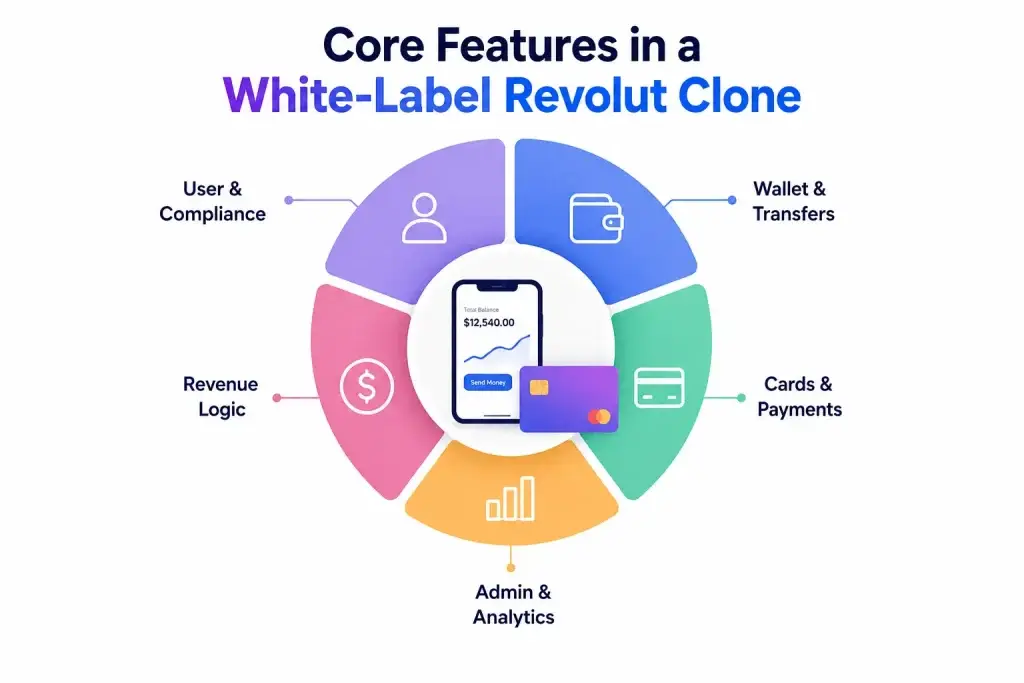
A white-label Revolut clone gives founders a ready fintech base with the core modules needed to launch, manage, and scale a digital banking platform. Instead of building every function separately, you get essential banking-style features already structured for faster setup.
Key Features Included
- User registration, login, and profile management
- KYC and AML workflow support
- Multi-currency wallet and transfer modules
- Domestic and international money transfers
- Virtual card and card management options
- Currency exchange with FX margin logic
- Business account support
- Expense tracking and transaction history
- Notifications and real-time alerts
- Admin dashboard, user roles, reports, and revenue controls
| Module | What It Helps You Manage | Business Value |
|---|---|---|
| User & Compliance | Onboarding, KYC, AML, roles, and access | Builds trust and supports compliance readiness |
| Wallet & Transfers | Multi-currency wallets, remittance, and transaction history | Creates the core digital banking experience |
| Cards & Payments | Virtual cards, payments, limits, and payment flows | Improves user convenience and platform utility |
| Admin & Analytics | Users, fees, reports, alerts, and operational controls | Helps teams manage the platform efficiently |
| Revenue Logic | Transfer fees, FX markup, subscriptions, and business charges | Supports flexible fintech monetization |
Customization Without Starting from Zero
A common misconception is that white-label means limited flexibility. In reality, a Revolut clone app can be highly customizable.
You can tailor:
- Brand identity and UI design
- Feature modules and workflows
- Payment gateways and BaaS fintech platforms
- Supported currencies and regions
- User roles and permissions
- Fee structures and revenue models
- Admin dashboards and reporting
This allows founders to build a differentiated product without the complexity of starting from scratch.
Security and Compliance-Ready Architecture
Security is a core requirement in digital banking app development.
A well-built white-label fintech platform typically includes:
- Secure login and authentication
- Two-factor authentication
- Role-based access control
- Encrypted data handling
- KYC and AML workflow support
- Transaction monitoring systems
- Audit logs for tracking activities
- API security layers
- PCI-DSS-aligned payment practices
Important Note: Final compliance depends on the target country, financial licenses, legal approvals, banking partners, and BaaS providers. Every fintech business must align its platform with local regulatory requirements.
Better Cost Control for Fintech Startups
A ready-made fintech app provides clear cost visibility from the beginning.
Instead of unpredictable development expenses, founders get:
- Defined feature sets
- Reduced development time
- Lower engineering costs
- Fewer iterations and delays
In contrast, building from scratch often leads to cost overruns due to evolving requirements, integration challenges, and compliance adjustments.
Revenue Models Supported by a Revolut like app
| Revenue Model | How It Works |
|---|---|
| Transfer Fees | Charges on domestic or international transfers |
| FX Markup | Margin on currency exchange |
| Subscription Plans | Monthly or premium account fees |
| Card Fees | Issuance or usage charges |
| Business Account Fees | Charges for business banking features |
| ATM Withdrawal Fees | Fees on withdrawals |
| Merchant Commissions | Earnings from partner merchants |
| Premium Upgrades | Advanced feature access |
| BaaS Revenue | Partner-based financial service revenue |
When Should You Choose a White-Label Revolut like app?
A white-label Revolut like app is ideal for:
- Fintech startups looking to launch quickly
- Neobank founders building digital-first banking products
- Remittance businesses expanding into digital wallets
- Financial service providers adding digital banking features
- Business banking platforms targeting SMEs
- Entrepreneurs entering digital banking with limited technical resources
- Startups validating fintech ideas before scaling
When Building from Scratch May Be Better –
In some cases, custom development is the right choice.
It may be suitable when:
- You need a proprietary core banking engine
- Your platform requires highly unique infrastructure
- You are building a large enterprise fintech product
- You have a well-funded team and long-term R&D capacity
- You want complete architectural control
However, this approach requires significantly more time, investment, and technical expertise.
Read More : Best Revolut Clone Script in 2026: Features & Pricing Compared
Why Miracuves Is a Smarter Choice for White-Label Revolut Clone Development
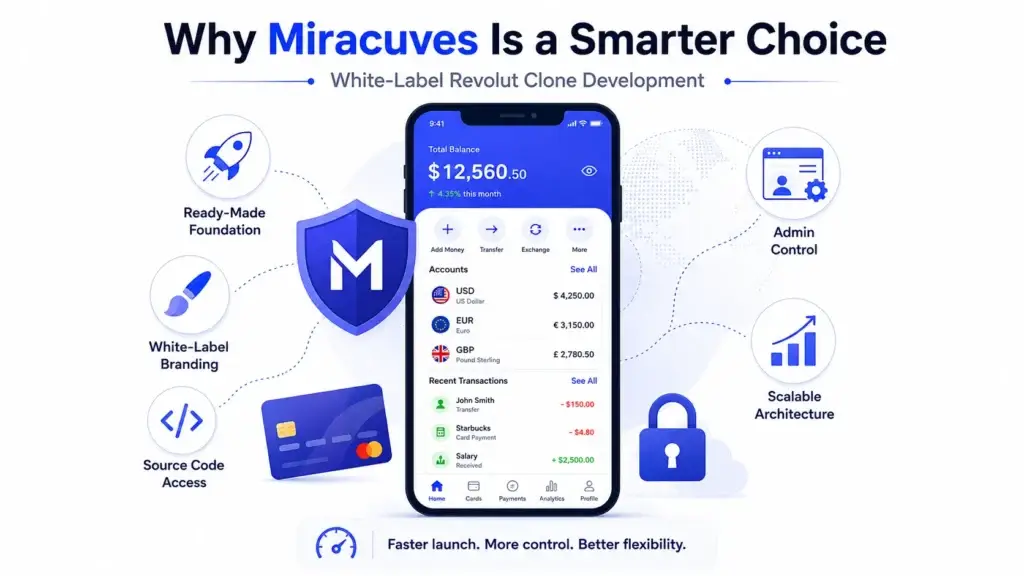
Image Source: AI-generated visual by Miracuves
Launching a Revolut-like platform needs more than good design. You need wallet logic, transfer flows, KYC support, admin control, fee management, security layers, and integration-ready architecture. Miracuves helps founders reduce this complexity with a ready-made white-label Revolut clone that can be customized for their brand, market, and fintech business model.
With Miracuves, you get:
- A ready-made fintech foundation instead of starting from zero
- White-label branding with your logo, colors, and UI style
- Source code access for better flexibility and ownership
- Customization support for wallets, transfers, fees, roles, reports, and admin controls
- Faster deployment with configuration and launch support
- Post-launch support for updates, improvements, and scaling
| Miracuves Advantage | Business Value |
|---|---|
| Ready-made fintech platform | Reduces development time and technical effort |
| White-label customization | Helps launch under your own fintech brand |
| Source code availability | Gives flexibility for future upgrades |
| Admin dashboard | Controls users, transactions, fees, and reports |
| Scalable architecture | Supports growth as users and transactions increase |
This gives fintech startups, neobank founders, and remittance businesses a faster path to market without losing control over customization. Instead of spending months building every module from scratch, founders can focus on launch strategy, partnerships, user trust, and business growth.
Final Thoughts
Building a digital banking platform from scratch gives full control, but it also demands heavy investment, long development cycles, technical planning, testing, security setup, and ongoing maintenance. For many fintech startups, neobank founders, and remittance businesses, this can delay launch and increase risk before the product even reaches the market.
A white-label Revolut likeapp gives founders a more practical path. It starts with a ready-made fintech foundation that already supports key digital banking functions and can be customized according to brand identity, user flows, payment partners, currencies, fee logic, and business goals.
With the right development partner, startups can reduce technical pressure and focus more on launch strategy, customer trust, compliance planning, partnerships, and growth. If you are planning to build a fintech app with KYC and AML, a multi-currency wallet app, or a neobank platform, a white-label approach can help you launch faster with better cost control.
Get in touch with Miracuves to explore your white-label Revolut like solution and launch your digital banking platform with confidence.
FAQs
What is a white-label Revolut like app ?
It is a ready-made digital banking platform that can be customized and launched under your own brand.
How is a Revolut like app different from building a fintech app from scratch?
A Revolut like app provides pre-built features and faster deployment, while building from scratch requires full development from zero.
Can a white-label Revolut clone be customized?
Yes, it can be customized in terms of branding, features, integrations, and business logic.
Does a Revolut like solution support KYC and AML workflows?
Yes, it typically includes KYC and AML workflow support, but final compliance depends on local regulations and partners.
Why choose Miracuves for Revolut clone app development?
Miracuves offers a ready-made fintech platform, customization support, faster deployment, and a scalable architecture for launching digital banking apps.
Related Articles
Miracuves is an independent software development company. We are not affiliated with, connected to, sponsored by, or endorsed by any company or product named in this article.
Terms such as “X Clone” are used descriptively. It is how the software industry refers to building a platform with functionality comparable to a known service, and how clients search for it.
The entire design and codebase of our products is built by our own team. Our products contain no code, design, graphics, or content originating from any third-party website or applications.
All third-party names and marks referenced in this article are the property of their respective owners, referenced solely to identify the services discussed.