



Key Takeaways
What You’ll Learn
- Perplexity AI is an AI-powered answer engine that combines conversational AI with live web search and source-backed responses.
- The platform works differently from traditional search engines because it generates summarized answers instead of only listing links and webpages.
- Source transparency is one of its biggest advantages since users can verify where information comes from while interacting with AI-generated responses.
- Perplexity AI supports multiple workflows including research, coding, content discovery, learning, summarization, and productivity tasks.
- The biggest takeaway for founders is that AI search platforms succeed when they combine conversational UX, real-time information access, source trust, and faster knowledge discovery.
Stats That Matter
- The article positions Perplexity AI as a next-generation AI search platform combining conversational AI, large language models, and real-time web information.
- Core features include AI-powered search, conversational queries, source citations, summarization, research assistance, and contextual follow-up questions.
- The platform supports different AI models and search modes allowing users to handle technical research, coding, learning, and productivity workflows more efficiently.
- Perplexity AI focuses heavily on source-backed answers helping users validate information instead of relying only on AI-generated text without references.
- The broader opportunity is AI-assisted knowledge discovery where users increasingly expect instant summarized answers instead of browsing multiple search result pages manually.
Real Insights
- Perplexity AI succeeds because it changes how users interact with information by making search feel conversational instead of keyword-driven.
- The strongest value comes from reducing research time because users can ask complex questions and receive summarized responses with supporting sources instantly.
- Trust is a major differentiator in AI search since source citations help users evaluate accuracy and reduce blind dependence on generated content.
- AI-powered search platforms may reshape traditional search behavior as users increasingly prefer direct answers, contextual follow-ups, and workflow-based assistance.
- For entrepreneurs, the biggest lesson is to build a Perplexity AI-style platform around conversational search, source transparency, AI summarization, research workflows, and real-time information retrieval.
Imagine you’re researching a new business idea, writing a blog, or comparing software tools. Instead of opening ten tabs, skimming articles, and piecing together answers, you type one question and get a clear, summarized response—with sources you can actually click and verify. That’s the everyday problem Perplexity AI is designed to solve.
Perplexity AI is an AI-powered search and research platform that blends the speed of a chatbot with the credibility of traditional search. It doesn’t just give you an answer—it shows you where the information came from, helping you explore, verify, and go deeper in one smooth flow.
What makes Perplexity AI stand out is its focus on answer-first search. Instead of ranking web pages, it tries to understand your question, pull insights from trusted sources, and present them in a clean, readable format—more like a research assistant than a search engine.
By the end of this guide, you’ll understand what Perplexity AI is, how it works step by step, how it makes money, the features that drive its growth, the technology behind AI-powered search, and why many entrepreneurs are building Perplexity-style platforms—with help from Miracuves to launch quickly and confidently.
What Is Perplexity AI? The Simple Explanation
Perplexity AI is an AI-powered answer engine and research assistant that helps users find clear, summarized answers to questions—along with the sources those answers are based on. In simple terms, it’s like having a smart researcher that reads the web for you and explains what it finds.
The Core Problem Perplexity AI Solves
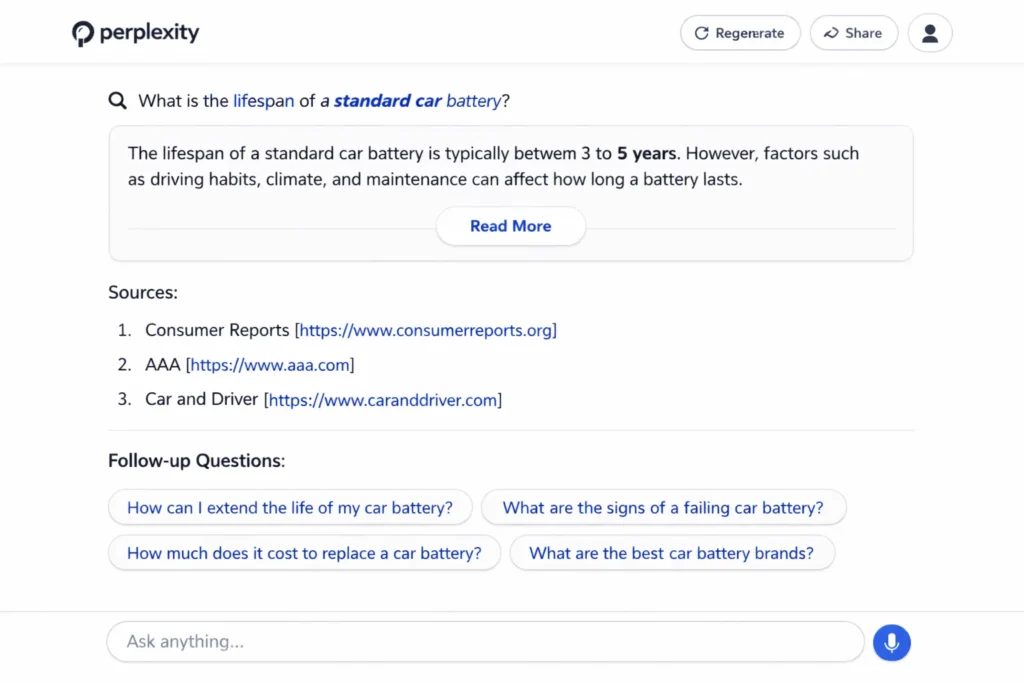
Traditional search engines give you lists of links and expect you to do the reading and comparison yourself. Perplexity AI changes that by:
- Turning questions into direct, readable answers
- Showing source citations for transparency
- Letting users ask follow-up questions naturally
- Reducing time spent jumping between tabs
It focuses on understanding, not just searching.
Target Users and Use Cases
Perplexity AI is commonly used by:
• Students and researchers
• Founders and business analysts
• Content writers and marketers
• Developers and product managers
• Curious everyday users
Typical use cases include market research, fact-checking, content creation, learning new topics, and quick business analysis.
Current Market Position
Perplexity AI is positioned as a next-generation AI search platform. It sits between traditional search engines and conversational AI tools, offering both credibility (sources) and clarity (summaries).
Why It Became Successful
Perplexity AI grew quickly because it solved a very real frustration: people don’t want ten links—they want one good answer they can trust. The combination of speed, clarity, and source transparency made it especially popular among professionals and knowledge workers.
How Perplexity AI Works — Step-by-Step Breakdown
For Users (Researchers, Founders, Creators, Students)
Asking a question
Users start by typing a question in natural language, just like talking to a person. This can be simple (“What is BNPL?”) or complex (“Compare AI image generators for marketing teams”).
Understanding the intent
Perplexity AI first tries to understand what the user actually wants, not just match keywords. It looks at:
- Topic and context
- Depth of detail requested
- Whether the user wants facts, comparisons, or explanations
This helps shape the type of answer it generates.
Searching and gathering sources
Instead of relying on a static database, Perplexity AI:
- Scans multiple online sources
- Pulls information from articles, blogs, documentation, and trusted websites
- Identifies relevant passages and data points
This step makes the answer grounded in real sources.
Generating a clear answer
The system then:
- Summarizes information into a clean, readable response
- Organizes key points into sections or bullets
- Keeps the language simple and direct
The goal is clarity, not just completeness.
Adding citations and follow-ups
Perplexity AI shows citations next to its answers, so users can click through and verify information. It also suggests follow-up questions to help users go deeper.
Typical user workflow
Question → AI understanding → source search → summarized answer → check sources → follow-up.
Technical Overview (Simple)
Perplexity AI combines:
- Large language models for understanding and explanation
- Web retrieval systems to find up-to-date information
- Ranking and relevance engines to pick the best sources
- Citation and linking systems for transparency
- Clean interface for fast reading and exploration
This lets it act as both a search engine and a research assistant.
Read More :- How to Develop an AI Chatbot Platform
Perplexity AI’s Business Model Explained
How Perplexity AI Makes Money
Perplexity AI operates on a freemium + subscription model. The platform is free for basic search and answers, while advanced features are unlocked through paid plans.
Main revenue streams include:
- Perplexity Pro subscriptions: Paid users get access to more powerful AI models, faster responses, and deeper research tools
- Enterprise and team plans: Organizations can deploy Perplexity AI internally for research and knowledge work
- Potential API and integrations: Tools for developers and businesses to embed AI search into their own products
This model balances wide adoption with premium value for power users.
Pricing Structure (Typical Model)
Perplexity AI pricing usually depends on:
- Free vs Pro access
- Monthly or annual subscription for advanced features
- Higher model access and priority processing
- Team or enterprise deployment options
Casual users can rely on the free tier, while professionals upgrade for deeper research needs.
Fee Breakdown
- Monthly subscription for Pro users
- Organization-level pricing for teams
- No ads in the core experience
- No commissions or per-click charges
Market Size and Demand
Demand for Perplexity-style platforms is driven by:
- Growth of AI-assisted research and writing
- Professionals needing faster knowledge discovery
- Students and educators using AI for learning
- Businesses seeking internal AI search tools
- Frustration with traditional link-based search
The market for answer-first search is expanding rapidly.
Profitability Insights
Perplexity improves profitability by:
- Building recurring subscription revenue
- Expanding into enterprise and internal knowledge markets
- Offering premium AI models as an upgrade path
- Retaining users through daily research workflows
Revenue Model Breakdown
| Revenue Stream | Description | Who Pays | Nature |
|---|---|---|---|
| Pro Subscriptions | Advanced AI access | Individuals | Recurring |
| Team Plans | Org research tools | Businesses | Tiered |
| Enterprise Deals | Internal AI search | Enterprises | Contract |
| API/Integrations | Embedded AI | Developers | Usage-based |
Key Features That Make Perplexity AI Successful
Answer-first search experience
Perplexity AI focuses on giving users a direct answer, not just a list of links. This saves time and makes research feel more like a conversation than a scavenger hunt.
Source citations for transparency
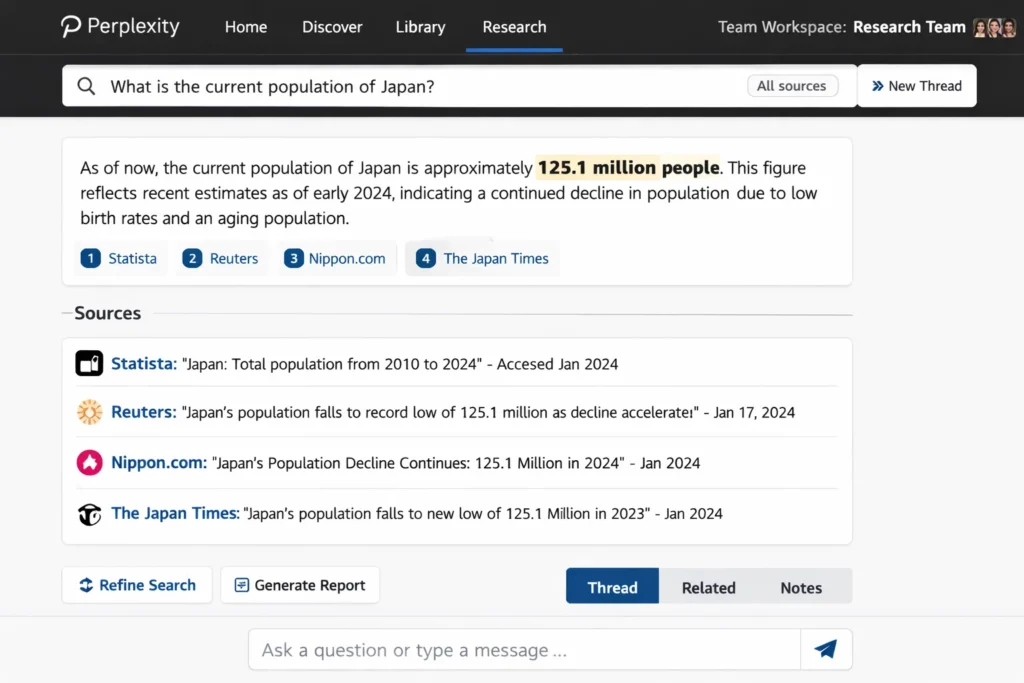
Every response includes clickable sources, which helps users verify facts, explore deeper, and trust the information provided.
Follow-up questions and conversational flow
Users can ask natural follow-up questions without retyping full queries. The system remembers context and keeps the research thread going.
Multiple AI model options (Pro users)
Paid users can access different AI models for varied reasoning styles, depth, and creativity, making the platform flexible for different tasks.
Research modes and filters
Perplexity AI offers focused modes for things like academic research, writing, or browsing, helping users tailor results to their needs.
Real-time web access
Unlike static knowledge tools, Perplexity AI pulls fresh information from the web, making it useful for current events, market trends, and up-to-date data.
Clean, distraction-free interface
The interface is designed to highlight the answer and sources, reducing clutter and helping users focus on understanding rather than navigating.
Export and sharing tools
Users can copy, share, or export answers for documents, reports, or presentations, which is helpful for professional workflows.
Team and collaboration features
Business plans support shared research spaces and collaboration for teams working on the same topics or projects.
Speed and reliability
Perplexity AI is optimized for fast responses, making it suitable for daily research and quick decision-making.
The Technology Behind Perplexity AI
Tech stack overview (simplified)
Perplexity AI works like a two-part system:
- a real-time search layer that finds fresh, relevant information
- an AI reasoning layer that reads what it found and writes a clear answer with citations
Perplexity itself explains that it searches the internet in real time, gathers insights from sources, then distills them into a conversational summary.
The “secret sauce”: RAG (Retrieval-Augmented Generation)
Perplexity is essentially a practical example of RAG, which means:
- The system retrieves information from the web (or internal files)
- Then the AI generates an answer grounded in that retrieved info
Perplexity has even published an explainer about RAG models, showing this is a core concept behind its approach.
How citations are created (why answers feel more trustworthy)
Perplexity doesn’t just “talk.” It tries to:
- Pull information from multiple relevant sources
- Use those sources while generating the answer
- Attach citations so you can verify claims quickly
That citation system is a big reason Perplexity feels like “research” instead of “chat.”
What AI models power the answers
Perplexity can use different models depending on your plan and settings. Their Help Center confirms paid subscriptions include access to “advanced AI models,” including third-party models (and you can use them similarly to their original platforms).
On top of that, Perplexity has its own search-optimized models (like the Sonar family) built specifically for grounded answers with real-time search.
The search layer (fast, ranked results)
Under the hood, Perplexity uses a ranking/search system to:
- Fetch results quickly
- Choose the most relevant passages
- Feed the best “evidence” into the answer-writing model
Perplexity’s developer docs describe building with “web-grounded chat completions” and search, which is exactly this idea of combining retrieval + generation.
Internal Knowledge Search (for teams and enterprises)
For Pro and Enterprise users, Perplexity can search internal files alongside the web—so answers can include company documents, PDFs, and knowledge bases (not just public sources).
This is a big deal for businesses because it turns Perplexity into an “internal research assistant,” not just a public search tool.
API and productization (how developers build on it)
Perplexity also offers an API platform so other products can embed this “answer engine” behavior—grounded responses powered by search.
Why this tech matters for business
Perplexity’s technology isn’t just about being smart—it’s about being usable:
- Faster decision-making (less tab-hopping)
- More trust (citations + grounded answers)
- Better team productivity (internal + web search together)
- Easier integration (API for building your own tools)
Perplexity AI’s Impact & Market Opportunity
Industry disruption Perplexity caused
Perplexity AI has pushed a major shift in how people search: from “click 10 links and figure it out yourself” to “get a clear answer first, then verify with sources.” That sounds small, but it changes behavior fast—because it turns search into a research conversation.
It’s also nudged expectations upward. Once users get used to answers with citations, they start demanding the same clarity everywhere—especially in work settings where accuracy matters.
Market statistics and growth signals
The bigger trend Perplexity is riding is the rise of AI-assisted knowledge work—students, founders, analysts, marketers, and developers all want faster research with less noise. In 2026, “AI search” is no longer a niche idea; it’s becoming a default workflow for many people who live in docs, decks, and decisions.
Perplexity’s positioning (answer-first + citations + follow-ups) fits perfectly into that shift.
User demographics and behavior patterns
Perplexity users tend to behave differently than traditional search users:
- They ask longer, more specific questions
- They do more follow-ups in a single session
- They care about sources (not just summaries)
- They use it for “thinking work” like comparisons, synthesis, and strategy—not just quick lookups
It’s often used as a daily “research buddy,” not an occasional search engine.
Geographic presence
Because it’s web-based and not tied to any specific country’s services, Perplexity has strong global appeal—especially in regions where people rely heavily on English-language web sources for business, tech, and education.
Future projections (where this is going next)
AI search platforms are trending toward:
- More personalized research workflows (saved threads, project spaces)
- Deeper enterprise adoption (internal knowledge + web together)
- Better transparency (citations, confidence, source comparisons)
- More specialized vertical search (finance, legal, medical, developer docs)
- Faster “agent-like” research (collect, compare, summarize, present)
Opportunities for entrepreneurs
There’s a big opportunity to build Perplexity-style “answer engines” for specific industries, where users need trusted, fast answers—like:
- Healthcare explainers for clinics and patients
- Legal research assistants for small firms
- E-commerce product intelligence (compare, summarize, recommend)
- Internal company knowledge search for SMBs
- Developer documentation copilots for specific tech stacks
This massive success is why many entrepreneurs want to create similar platforms—because the formula is clear: fast answers + verifiable sources + conversational follow-ups.
Building Your Own Perplexity-AI-Like Platform
Why businesses want answer-first AI search tools
Perplexity AI shows that people don’t just want information—they want understanding, speed, and trust. Businesses are interested in similar platforms because:
- Teams waste time jumping between links and documents
- Decision-makers need quick, source-backed insights
- Internal knowledge is often scattered across files and tools
- AI can turn raw information into clear, usable answers
- Subscription models create predictable revenue
This makes “answer engines” valuable across education, research, and enterprise software.
Key considerations before development
If you’re planning to build a Perplexity-style platform, focus on:
- Reliable real-time web or internal data retrieval
- Strong citation and source-tracking system
- Clean, readable answer formatting
- Follow-up and conversation memory
- Search relevance and ranking quality
- User trust, transparency, and data privacy
- Team features like shared projects and permissions
Accuracy and trust matter more than flashy features in this category.
Read Also :- How to Market an AI Chatbot Platform Successfully After Launch
Miracuves Perplexity-Like AI Search Platform Solution Cost and Tech Stack
Miracuves Pricing for a Perplexity-Like AI Search Platform developed using JavaScript architecture is available on request. Final pricing depends on AI search integration, live web query workflows, enterprise knowledge base setup, API usage, scalability requirements, security layers, and deployment scope. Estimated delivery timeline: 30 to 90 days.
Get a fully developed, custom AI platform modeled around Perplexity-style intelligent search and conversational answer capabilities. Built on a modern JavaScript foundation, this solution can be customized for AI startups, SaaS founders, enterprises, research teams, educational tools, productivity platforms, customer support systems, and industry-specific AI assistants.
- Core Workflows: AI-powered search, conversational Q&A, real-time web query handling, content summarization, citation-based responses, document intelligence, knowledge base search, user conversations, response history, and workspace-based AI interaction.
- Built-in Revenue Logic: Subscription plans, AI usage credits, API access pricing, enterprise licensing, premium AI search access, team plans, white-label AI assistant packages, and SaaS monetization models.
- Management Hub: Admin dashboard, user management, AI usage tracking, search analytics, prompt logs, workspace controls, subscription management, API monitoring, content moderation, and reporting systems.
- AI-Ready Architecture: Prepared for LLM integration, vector search, RAG workflows, live search indexing, scalable AI requests, secure data processing, AI API orchestration, and long-term AI platform scalability.
Why Does a Perplexity-Like Platform Require JavaScript Architecture?
A Perplexity-like AI platform requires more than a standard chatbot interface. It handles intelligent search requests, conversational responses, live content retrieval, AI-generated answers, citation systems, user workspaces, subscription logic, AI request processing, and enterprise-grade knowledge workflows. A modern JavaScript architecture helps manage these interactive AI operations smoothly across users, admins, teams, and AI systems.
We recommend JavaScript architecture for this type of platform because:
- Built for Interactive AI Search Workflows: JavaScript supports fast conversational search, instant AI-generated answers, live response streaming, dynamic content rendering, and real-time dashboard interactions.
- Advanced Frontend Experience: React.js or similar JavaScript frameworks can power smooth AI search interfaces, conversational layouts, workspace dashboards, research panels, knowledge hubs, API consoles, and admin systems.
- Scalable Backend Logic: JavaScript-based backend systems can efficiently manage AI APIs, search indexing, vector retrieval, user permissions, subscription limits, response history, and high-volume AI search requests.
- Flexible Integration Layer: The platform can connect with LLM APIs, vector databases, search engines, cloud infrastructure, analytics platforms, CRM systems, payment gateways, enterprise authentication tools, and third-party knowledge sources.
You get a scalable AI-powered search platform designed for intelligent knowledge discovery, conversational AI experiences, recurring revenue generation, and long-term product growth.
Note: Final pricing depends on selected AI models/APIs, live search integration, RAG implementation, vector database setup, security requirements, infrastructure scale, usage limits, and custom feature development.
Essential features to include
A strong Perplexity-style MVP should include:
- Natural language question interface
- Real-time source retrieval
- AI-generated answers with citations
- Follow-up conversation flow
- Source preview and click-through
- Saved threads or research spaces
- Subscription and usage tracking
High-impact extensions later:
- Internal document search (PDFs, docs, wikis)
- Team collaboration and shared research
- Vertical-specific modes (finance, legal, medical, dev)
- API access for embedding in other tools
- Analytics on research usage and productivity
Read More :- AI Chat Assistant Development Costs: What Startups Need to Know
Conclusion
Perplexity AI shows that the future of search isn’t about who can index the most pages—it’s about who can explain the world most clearly. By combining real-time retrieval with transparent citations, it turns searching into a thinking process instead of a guessing game.
For founders and product teams, the lesson is powerful: trust is the real competitive advantage in AI search. Platforms that make answers understandable, verifiable, and easy to explore will win long-term adoption—especially in professional and enterprise settings.
FAQs :-
What is Perplexity AI used for?
Perplexity AI is used for AI-powered search and research. People use it to get clear, summarized answers with sources for business research, learning, writing, and fact-checking.
How does Perplexity AI make money?
Perplexity AI makes money through Pro subscriptions, team plans, and enterprise licensing that unlock advanced AI models, faster responses, and collaboration features.
Is Perplexity AI free to use?
Yes. Perplexity AI offers a free tier for basic question answering, with paid plans for deeper research and premium features.
Does Perplexity AI show sources for its answers?
Yes. One of its key features is source citations, which allow users to verify information and explore original content.
Can Perplexity AI search the live web?
Yes. Perplexity AI uses real-time web retrieval to provide up-to-date answers rather than relying only on a static knowledge base.
Is Perplexity AI suitable for teams and businesses?
Yes. Perplexity AI offers team and enterprise plans for internal research, collaboration, and company knowledge search.
What makes Perplexity AI different from Google or Bing?
Perplexity AI focuses on answer-first search with explanations and citations, while traditional search engines primarily return ranked lists of links.
Can I use Perplexity AI for content creation?
Yes. Many writers and marketers use Perplexity AI for research, outlines, and source-backed drafting.
Can I build a platform like Perplexity AI?
Yes. Perplexity-style platforms can be built by combining real-time search, AI summarization, and citation systems.
How can Miracuves help build a Perplexity-AI-like platform?
Miracuves helps founders build AI-powered answer and search platforms with retrieval systems, citation tracking, team dashboards, and subscription billing—enabling fast launch and scalable growth.