Key Takeaways
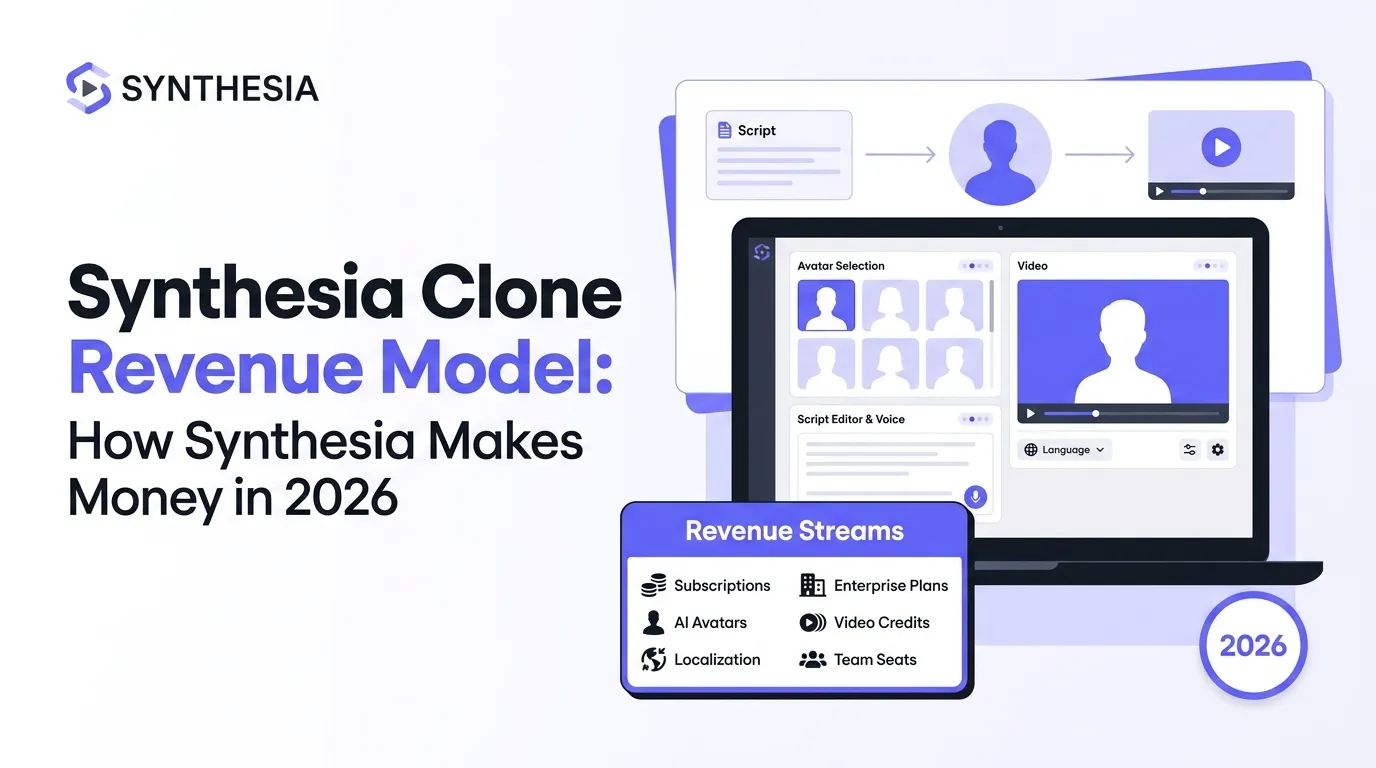
- Synthesia’s revenue model is built around AI video creation, subscription plans, enterprise licenses, and team-based usage.
- The platform connects creators, marketers, trainers, enterprises, AI avatars, and admin workflows in one video system.
- AI avatars, text-to-video generation, templates, voiceovers, collaboration, and branding tools are core revenue drivers.
- Its success depends on video quality, ease of use, localization, enterprise security, and scalable AI infrastructure.
- A Synthesia-like platform can help startups build an AI video generation business for marketing, training, and content creation.
Revenue Signals
- Users need script input, AI avatars, video templates, voice options, subtitles, exports, and project history.
- Teams need brand kits, shared workspaces, approval flows, collaboration tools, and usage controls.
- Admins need control over users, subscriptions, credits, templates, permissions, billing, and analytics.
- Subscription tiers, enterprise plans, premium avatars, and usage-based limits help increase monetization.
- Localization, custom avatars, and branded video workflows create higher-value opportunities for business customers.
Real Insights
- Synthesia shows that AI video revenue grows when content creation becomes faster, cheaper, and easier for businesses.
- Weak avatar quality or poor voice sync can reduce user trust and lower repeat usage.
- Clear pricing, export limits, video minutes, and team permissions help users choose the right plan.
- Enterprise security, content controls, and approval workflows are important for business adoption.
- Miracuves builds Synthesia-like AI video apps with text-to-video workflows, avatar tools, subscriptions, and admin control.
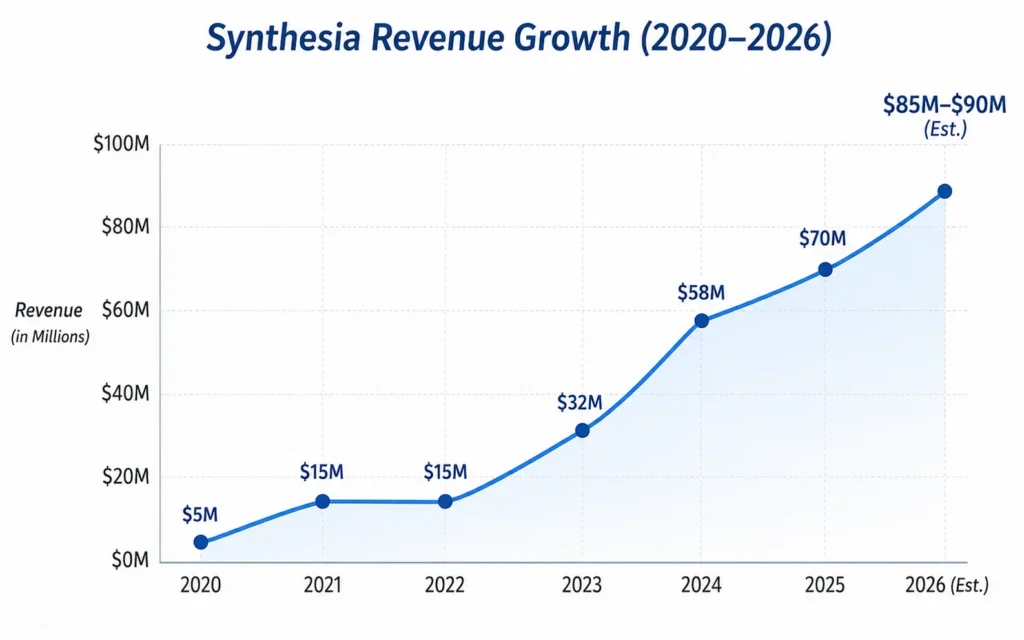
Synthesia crossed an estimated $85–90 million in annual revenue in 2026, making it one of the most commercially successful AI video platforms globally. What started as an AI experiment is now a serious SaaS business reshaping how enterprises create video content. Its growth demonstrates that AI-powered content tools are not just novel products—they can scale into multi-million-dollar businesses by solving real pain points like video production cost, time, and accessibility. The platform’s adoption across marketing, corporate training, and internal communications highlights the diverse verticals that AI video can penetrate.
For founders, Synthesia’s growth is not about hype—it’s about predictable recurring revenue, strong enterprise contracts, and exceptionally high margins driven by AI automation. The company leverages subscription-based pricing to create steady cash flow, while enterprise deals lock in long-term revenue with minimal churn. By automating video creation with AI avatars and voice synthesis, Synthesia keeps marginal costs low while scaling globally. This combination of efficiency, predictability, and scale is a strong example of how modern SaaS and AI converge to create sustainable profitability.
Studying this model helps entrepreneurs understand how AI products convert innovation into cash flow, especially in B2B SaaS markets where willingness to pay is high. Founders can learn how to segment users effectively, upsell additional features, and structure enterprise agreements to maximize lifetime value. At Miracuves, this AI video model is studied as a practical example of how automation-first platforms can scale through recurring revenue, enterprise adoption, and workflow-driven product value.
Synthesia Revenue Overview – The Big Picture
- 2026 Estimated Revenue: $85–90 million
- Valuation: ~$1.2 billion
- YoY Growth (2025–2026): ~38%
- Primary Markets: North America (45%), Europe (35%), Asia-Pacific (15%), Others (5%)
- Gross Profit Margin: ~78–82%
- Net Margin (estimated): 22–25%
- Core Competitors: HeyGen, D-ID, Colossyan, Pictory
Synthesia operates as a high-margin AI SaaS platform, benefiting from subscription predictability and enterprise-scale deployments.
Read More: What Is Synthesia? How AI Avatars Turn Text Into Studio-Style Videos
Primary Revenue Streams Deep Dive
Revenue Stream #1: Subscription Plans (Core SaaS Revenue)
This is Synthesia’s main engine. Users pay monthly or annually to create AI avatar videos.
- Share of Revenue: ~55%
- Pricing: $30–$90 per seat/month (global average)
- 2026 Contribution: ~$48 million
Revenue Stream #2: Enterprise Licensing
Large organizations license Synthesia for internal training, HR, and communications.
- Share of Revenue: ~25%
- Pricing: $10,000–$200,000+ per year
- 2026 Contribution: ~$22 million
Revenue Stream #3: Custom Avatars & Voice Models
Brands pay extra for private avatars and voices.
- Share of Revenue: ~10%
- Pricing: $1,000–$5,000 per avatar
- 2026 Contribution: ~$8.5 million
Revenue Stream #4: API & Integrations
Used by platforms embedding AI video into LMS or CRM tools.
- Share of Revenue: ~6%
- Pricing: Usage-based
- 2026 Contribution: ~$5 million
Revenue Stream #5: Add-ons & Usage Overages
Extra video minutes, languages, or storage.
- Share of Revenue: ~4%
- 2026 Contribution: ~$3.5 million
Revenue Streams Percentage Breakdown
| Revenue Stream | % Share | 2026 Revenue Est. |
|---|---|---|
| Subscriptions | 55% | $48M |
| Enterprise Licensing | 25% | $22M |
| Custom Avatars | 10% | $8.5M |
| API & Integrations | 6% | $5M |
| Add-ons & Overages | 4% | $3.5M |
The Fee Structure Explained
User-Side Fees
- Monthly/annual subscription fees
- Usage-based charges for video minutes
- Premium avatar and voice fees
Provider-Side Fees
- None (Synthesia controls the platform and IP)
Hidden Revenue Layers
- Annual contract discounts lock in long-term cash
- Seat expansion inside enterprises
- Internal department upselling
Regional Pricing Variation
- Higher pricing in US & EU
- Discounted plans in emerging markets
Complete Fee Structure by User Type
| User Type | Fees Paid | Monetization Logic |
|---|---|---|
| Individual Creator | Subscription + overages | High LTV via upgrades |
| SMB | Team plans | Seat expansion |
| Enterprise | Annual license | Long-term contracts |
| Developers | API usage fees | Volume-based growth |
How Synthesia Maximizes Revenue Per User
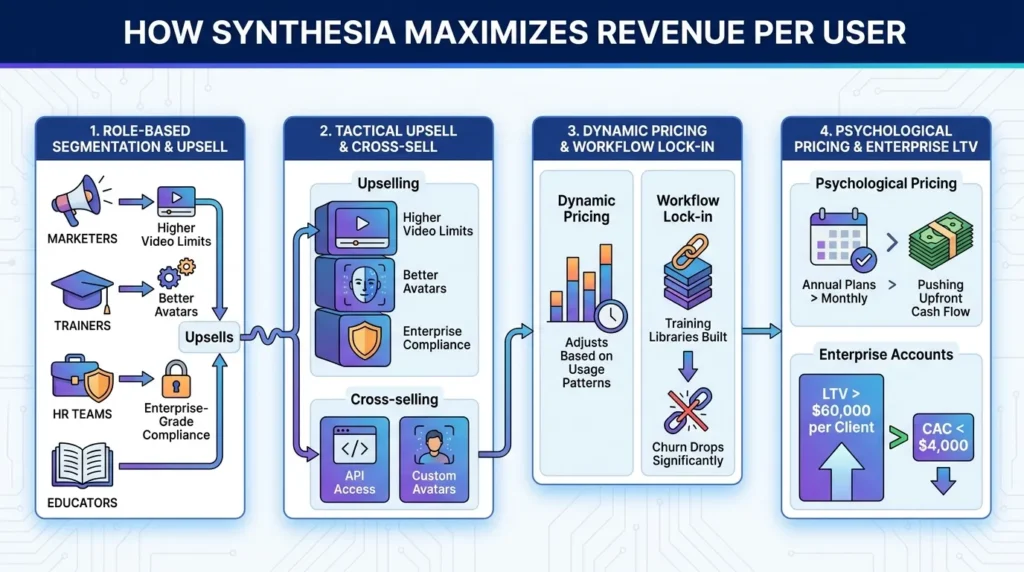
Synthesia segments users by role and intent—marketers, trainers, HR teams, and educators all see different upsells.
Upselling occurs through higher video limits, better avatars, and enterprise-grade compliance. Cross-selling includes API access and custom avatars.
Dynamic pricing adjusts based on usage patterns, while retention is driven by workflow lock-in—once companies build training libraries, churn drops significantly.
Psychological pricing plays a role: annual plans appear cheaper monthly, pushing upfront cash flow. In enterprise accounts, LTV often exceeds $60,000 per client, compared to CAC under $4,000.
Read More: Build Your Own AI Avatar Video Platform
Cost Structure & Profit Margins
Major Cost Centers
- Infrastructure & Compute: ~18%
- Sales & Marketing (CAC): ~22%
- Operations & Support: ~12%
- R&D & AI Training: ~18%
Unit Economics
- Average SMB customer LTV: ~$3,200
- Gross margin per video: ~85%
Synthesia achieves profitability by reusing AI models at scale, reducing marginal cost close to zero after deployment.
Future Revenue Opportunities & Innovations
New monetization avenues include real-time AI presenters, localized avatars for regional markets, and AI-powered personalization.
AI/ML monetization will shift toward performance-based pricing, where companies pay per engagement rather than per minute.
Between 2026–2027, expansion into Asia and Latin America is expected to accelerate growth. Risks include deepfake regulations and rising competition, but opportunities remain massive for niche-focused platforms.
Miracuves Synthesia-Like Platform Solution Cost and Tech Stack
Miracuves Pricing for a Synthesia-Like AI Video Generator Platform developed using JavaScript architecture is available on request. Final pricing depends on AI video modules, avatar generation workflows, text-to-video features, voice synthesis, subscription logic, scalability requirements, and deployment scope. Estimated delivery timeline: 30 to 90 days.
Get a fully developed, custom AI video creation platform modeled around Synthesia-style video generation. Built on a modern JavaScript foundation, this solution can be customized for AI startups, SaaS founders, video automation platforms, marketing teams, corporate training businesses, edtech platforms, and enterprise communication tools.
- Core Workflows: User onboarding, script input, AI avatar selection, text-to-video generation, voiceover creation, video templates, language selection, video preview, editing workflow, export options, and project history.
- Built-in Revenue Logic: Subscription plans, video generation credits, premium avatar access, team plans, enterprise licensing, custom avatar packages, API access, branded video exports, and white-label SaaS monetization.
- Management Hub: Centralized admin dashboard, user management, subscription control, AI usage tracking, video generation logs, avatar library management, template controls, billing records, content moderation, and analytics.
- AI Video-Ready Architecture: Prepared for AI model/API integration, video rendering queues, avatar workflows, voice synthesis tools, cloud storage, scalable media processing, team collaboration, and long-term SaaS growth.
Why Does a Synthesia-Like Platform Require JavaScript Architecture?
A Synthesia-like platform needs more than a simple video editor. It handles script processing, AI avatar rendering, voice generation, video templates, media storage, user workspaces, subscription limits, billing workflows, team access, and high-volume video generation requests. A modern JavaScript architecture helps manage these interactive AI video workflows smoothly across users, admins, teams, and connected AI systems.
We recommend JavaScript architecture for this type of platform because:
- Built for Interactive AI Video Workflows: JavaScript-based backend systems can manage script submissions, AI video requests, rendering queues, avatar selection, voice generation, export activity, and high-volume user operations.
- Advanced Frontend Experience: React.js or other JavaScript frameworks can power smooth script editors, avatar selection screens, video preview pages, template libraries, project dashboards, and admin controls.
- Scalable AI Media Logic: JavaScript architecture supports video generation limits, subscription rules, team workspaces, rendering history, storage workflows, request queues, billing systems, and enterprise-level usage management.
- Flexible Integration Layer: The platform can connect with AI video APIs, voice synthesis tools, cloud storage, payment gateways, CRM systems, analytics platforms, content moderation tools, and enterprise authentication systems.
You get a scalable Synthesia-like AI video generator platform designed for automated video creation, recurring revenue, team productivity, and long-term SaaS growth.
Note: Final pricing depends on selected AI video modules, avatar workflows, voice generation features, rendering requirements, storage setup, enterprise integrations, deployment infrastructure, and custom feature development.
Lessons for Entrepreneurs & Your Opportunity
What works is clear: subscriptions first, enterprise contracts second, and add-ons everywhere.
Founders can replicate this by focusing on one vertical—education, real estate, healthcare—and offering tailored AI avatars.
Market gaps exist in regional language content, offline deployment, and industry-specific compliance.
Final Thought
Synthesia proves that AI businesses win not by novelty, but by monetization discipline. It’s not enough to have a cutting-edge AI product—success comes from structuring revenue streams that scale predictably. Synthesia demonstrates the power of combining subscription plans, enterprise contracts, and usage-based pricing to capture value from every user segment. Its disciplined monetization strategy highlights that even highly innovative tech must be paired with strong business fundamentals to achieve sustainable growth.
Its success shows how automation, subscriptions, and enterprise trust combine into a scalable machine. By automating video creation with AI, Synthesia reduces marginal costs dramatically while maintaining high-quality output. Enterprise clients are willing to pay a premium because of reliability, compliance, and integration capabilities. Founders can take note that scaling an AI business isn’t just about technology—it’s also about building trust, simplifying adoption, and embedding your solution into workflows that clients can’t easily replace. Let’s Build Together
FAQs
1. How much does Synthesia make per transaction?
From $30 per month for individuals to over $100,000 annually for enterprises.
2. What’s Synthesia’s most profitable revenue stream?
Enterprise licensing due to long contracts and low churn.
3. How does Synthesia’s pricing compare to competitors?
It’s premium-priced but justified by quality and enterprise trust.
4. What percentage does Synthesia take from providers?
Not applicable—it owns the platform and technology.
5. How has Synthesia’s revenue model evolved?
It shifted from individual creators to enterprise-first monetization.
6. Can small platforms use similar models?
Yes, especially with niche-focused SaaS subscriptions.
7. What’s the minimum scale for profitability?
Around 1,500–2,000 paying SMB users.
8. How to implement similar revenue models?
Start with subscriptions, add usage limits, then enterprise plans.
9. What are alternatives to Synthesia’s model?
Pay-per-video, freemium, or performance-based pricing.