

Key Takeaways
- Marqeta’s revenue model is built around card issuing, payment processing, transaction fees, and embedded finance infrastructure.
- The platform connects fintech apps, banks, merchants, cardholders, payment networks, and enterprise clients.
- Interchange revenue, processing fees, API usage, card programs, and enterprise partnerships are core revenue drivers.
- Its success depends on secure payment rails, developer-friendly APIs, compliance readiness, and transaction reliability.
- A Marqeta-like platform can help startups build modern card issuing and payment infrastructure businesses.
Revenue Signals
- Businesses need card issuing APIs, transaction controls, wallet support, fraud checks, and payment reporting.
- Users need secure cards, instant payments, spending controls, transaction history, and account protection.
- Admins need control over card programs, clients, transactions, compliance, disputes, fees, and analytics.
- Enterprise integrations, usage-based fees, and transaction volume help increase platform monetization.
- Real-time authorization and payment data help fintech companies build faster financial products.
Real Insights
- Marqeta shows that fintech revenue can scale through invisible infrastructure behind cards and digital payments.
- Weak transaction reliability can affect authorization speed, user trust, and enterprise client retention.
- Clear fee structures, secure APIs, and compliance controls help businesses launch card programs confidently.
- Fraud monitoring, audit logs, and payment controls are critical for high-volume fintech infrastructure.
- Miracuves builds Marqeta-like fintech platforms with card issuing workflows, payment APIs, transaction controls, and admin management.
Marqeta crossed an estimated $520–560 million in annual revenue in 2026, positioning itself as one of the most influential card issuing and payment infrastructure platforms in the global fintech ecosystem. What began as a developer-friendly API for prepaid cards has evolved into a mission-critical financial backbone for some of the world’s largest digital banks, marketplaces, and payment apps.
For entrepreneurs, Marqeta’s success highlights how invisible infrastructure can generate massive recurring revenue. Most end users never see Marqeta’s brand, yet every transaction running through its platform contributes to predictable, high-volume cash flow. This business model demonstrates how fintech platforms can scale not through flashy features, but through deep integrations and long-term enterprise reliance.
Studying this model helps founders understand how payments, compliance, and embedded finance can be monetized at scale. In B2B fintech, trust, reliability, and regulatory readiness often matter more than marketing, making platforms like Marqeta a powerful case study in building defensible, high-retention revenue engines. At Miracuves, this kind of infrastructure-first fintech model is studied as a strong example of how scalable payment platforms can grow through reliability, integration depth, and long-term business trust.
Marqeta Revenue Overview – The Big Picture
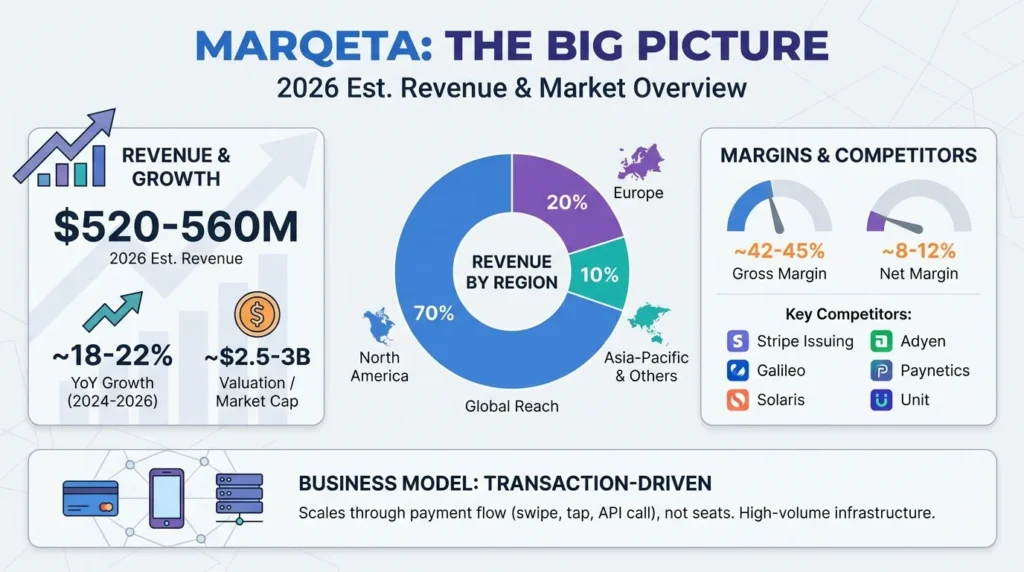
- 2026 Estimated Revenue: $520–560 million
- Valuation / Market Cap: ~$2.5–3 billion (public market range)
- YoY Growth (2024–2026): ~18–22%
- Revenue by Region:
- North America: 70%
- Europe: 20%
- Asia-Pacific & Others: 10%
- Gross Margin: ~42–45%
- Net Margin: ~8–12%
- Key Competitors: Stripe Issuing, Adyen, Galileo, Paynetics, Solaris, Unit
Marqeta operates as a high-volume, transaction-driven fintech infrastructure company. Unlike SaaS platforms that scale through seats, Marqeta scales through payment flow, where every swipe, tap, or API call increases revenue.
Read More: Marqeta Explained: Modern Card Issuing & Payments Platform
Primary Revenue Streams Deep Dive
Revenue Stream #1: Interchange Revenue (Core Driver)
Marqeta earns a share of interchange fees every time a card transaction is processed.
- Share of Revenue: ~60%
- Pricing Logic: % of transaction value
- 2026 Contribution: ~$320 million
Revenue Stream #2: Platform & API Fees
Clients pay for access to Marqeta’s card issuing, tokenization, fraud tools, and compliance stack.
- Share of Revenue: ~20%
- Pricing: Monthly platform fees + usage tiers
- 2026 Contribution: ~$105 million
Revenue Stream #3: Program Management Services
Includes KYC, KYB, regulatory reporting, and operational support.
- Share of Revenue: ~10%
- Pricing: Per-account or per-card basis
- 2026 Contribution: ~$55 million
Revenue Stream #4: Value-Added Services
Advanced fraud protection, real-time spend controls, and data analytics.
- Share of Revenue: ~7%
- Pricing: Add-on modules
- 2026 Contribution: ~$38 million
Revenue Stream #5: International Expansion Fees
Cross-border transaction enablement and regional compliance support.
- Share of Revenue: ~3%
- 2026 Contribution: ~$15 million
Revenue Streams Percentage Breakdown
| Revenue Stream | % Share | 2026 Revenue Est. |
|---|---|---|
| Interchange Fees | 60% | $320M |
| Platform & API Fees | 20% | $105M |
| Program Management | 10% | $55M |
| Value-Added Services | 7% | $38M |
| International Fees | 3% | $15M |
The Fee Structure Explained
User-Side Fees (End Customers)
- Card transaction fees (embedded in merchant pricing)
- FX and cross-border markups
- ATM withdrawal fees (client-dependent)
Provider-Side Fees (Marqeta Clients)
- Monthly platform access fees
- Per-card issuance fees
- API call volume charges
Hidden Revenue Layers
- Revenue share agreements with banks and networks
- Premium fraud modules
- Enterprise compliance upgrades
Regional Pricing Variation
- Higher compliance fees in EU and UK
- Volume-based discounts in North America
- Expansion pricing for Asia-Pacific markets
Complete Fee Structure by User Type
| User Type | Fees Paid | Monetization Logic |
|---|---|---|
| Fintech Startup | Platform + API fees | Usage-based scaling |
| Digital Bank | Interchange share | High-volume revenue |
| Marketplace | Program management | Per-account monetization |
| Enterprise | Compliance modules | Long-term contracts |
How Marqeta Maximizes Revenue Per User
Marqeta segments clients by transaction volume and regulatory complexity. High-volume fintechs unlock premium pricing through advanced fraud prevention, tokenization, and real-time data APIs.
Upselling occurs when startups grow into multi-region operations, requiring additional compliance layers. Cross-selling includes analytics dashboards, network routing optimization, and spend controls.
Dynamic pricing adjusts based on transaction thresholds, while retention is driven by deep technical integration. Once a company builds its financial stack on Marqeta, switching costs become extremely high, pushing enterprise LTV beyond $500,000 per major client.
Cost Structure & Profit Margins
Major Cost Centers
- Network & Infrastructure Costs: ~28%
- Compliance & Regulatory Operations: ~20%
- Sales & Partnerships: ~15%
- R&D & Platform Security: ~17%
Unit Economics
- Average enterprise onboarding cost: ~$40,000
- Interchange gross margin: ~45%
Marqeta improves profitability by scaling transaction volume faster than fixed compliance and infrastructure costs, allowing margins to expand as global adoption increases.
Read More: Best Marqeta Clone Scripts 2026 – Launch a Card Issuing Platform
Miracuves Marqeta-Like Platform Solution Cost and Tech Stack
Miracuves pricing for a Marqeta-like modern card issuing and payment processing platform built with JavaScript architecture is FinTech work and starts at $12,999. The final cost depends on platform modules, card infrastructure complexity, payment integrations, compliance requirements, scalability goals, and deployment scope. Estimated delivery timeline: 15-30 days, extending to 45-60 days for larger scope.
Build a scalable fintech payment infrastructure platform designed for digital banks, neobanks, fintech startups, expense management platforms, embedded finance businesses, lending companies, and payment service providers.
- Core Workflows: Virtual and physical card issuing, payment authorization, transaction processing, wallet integration, card controls, merchant payments, user onboarding, spending limits, and real-time transaction tracking.
- Payment Infrastructure Logic: Card lifecycle management, interchange fee workflows, transaction routing, fraud monitoring, spending analytics, payment authorization systems, settlement logic, and financial reporting infrastructure.
- Management Hub: Admin dashboards, card management systems, API monitoring, transaction logs, client controls, spending rule management, compliance workflows, fraud monitoring tools, and centralized platform administration.
- Enterprise Readiness: Customizable architecture for high-volume payment processing, secure fintech scaling, banking integrations, compliance operations, card program management, and long-term payment infrastructure growth.
Why a Marqeta-Like Platform Requires JavaScript Architecture
A Marqeta-like platform handles card issuing, payment authorization, transaction processing, wallet systems, merchant integrations, and real-time financial operations. It requires scalable backend infrastructure, fast API performance, secure payment handling, transaction intelligence, and responsive dashboard experiences for fintech businesses and end users.
We recommend a modern JavaScript-based architecture for this type of platform because:
- Built for Real-Time Payment Operations: JavaScript backend systems support instant transaction processing, card authorization workflows, live payment tracking, wallet updates, and high-volume financial activity handling.
- Advanced Fintech Dashboard Experience: React.js or similar JavaScript frontend frameworks can power interactive dashboards for card management, transaction analytics, payment monitoring, user controls, spending insights, and financial reporting.
- Payment Scalability: This architecture is suitable for handling growing payment volumes, multiple card programs, fintech client expansion, merchant integrations, wallet ecosystems, and large-scale transaction operations.
- Flexible Integration Layer: The platform can connect with banking APIs, payment gateways, KYC providers, fraud detection tools, accounting systems, digital wallets, card networks, and financial analytics platforms.
You get a scalable, secure, API-first payment infrastructure platform designed for long-term fintech operations, card issuing systems, and financial business growth.
Note: Final pricing depends on selected platform modules, payment gateway integrations, card issuing requirements, compliance layers, deployment infrastructure, fraud prevention systems, and custom workflow development.
Future Revenue Opportunities & Innovations
New revenue streams include embedded credit, AI-driven fraud scoring, and real-time cross-border settlement tools. As fintech platforms expand globally, Marqeta can monetize regional licensing and regulatory infrastructure.
Between 2026–2027, growth is expected in crypto-linked cards, B2B expense management platforms, and neobank expansion across Asia and Latin America. Risks include regulatory shifts and pricing pressure from vertically integrated competitors.
Lessons for Entrepreneurs & Your Opportunity
What works is clear: own the infrastructure layer, not just the app layer. Marqeta proves that backend platforms can generate more durable revenue than consumer-facing fintech products.
Founders can replicate this by building niche financial infrastructure for industries like logistics, healthcare payouts, creator economies, or cross-border payroll.
Market gaps exist in regional compliance automation, AI-driven fraud prediction, and real-time treasury management for SMBs.
Card issuing platforms are custom work at Miracuves, handled by our fintech app development team. FinTech builds start at $12,999 and typically take 15-30 days, extending to 45-60 days for larger scope. Issuing bank partnerships and card scheme membership are arranged by you.
Final Thought
Marqeta shows that fintech success isn’t driven by brand visibility, but by becoming financial infrastructure that businesses depend on daily.
Its model highlights how transaction flow, compliance readiness, and enterprise trust combine into a powerful, scalable revenue engine.
For founders, the real opportunity lies in building specialized financial rails for underserved industries, where reliability and regulation create natural competitive moats. Let’s build together
FAQs
1. How much does Marqeta make per transaction?
Typically a small percentage of interchange, depending on volume and agreements.
2. What’s Marqeta’s most profitable revenue stream?
Interchange revenue from high-volume fintech and banking clients.
3. How does Marqeta’s pricing compare to competitors?
It is premium-priced but offers deeper compliance and customization.
4. What percentage does Marqeta take from providers?
Varies by contract, usually a share of interchange plus platform fees.
5. How has Marqeta’s revenue model evolved?
It shifted from prepaid cards to full-stack embedded finance.
6. Can small platforms use similar models?
Yes, by focusing on niche payment or payout infrastructure.
7. What’s the minimum scale for profitability?
Typically above $50 million in annual transaction volume.
8. How to implement similar revenue models?
Start with API-based services, then layer compliance and interchange.
9. What are alternatives to Marqeta’s model?
SaaS-only pricing, flat per-card fees, or white-label banking platforms.
Miracuves is an independent software development company. We are not affiliated with, connected to, sponsored by, or endorsed by any company or product named in this article.
Terms such as “X Clone” are used descriptively. It is how the software industry refers to building a platform with functionality comparable to a known service, and how clients search for it.
The entire design and codebase of our products is built by our own team. Our products contain no code, design, graphics, or content originating from any third-party website or applications.
All third-party names and marks referenced in this article are the property of their respective owners, referenced solely to identify the services discussed.