


Imagine you publish great content, but now your real battle isn’t only Google rankings—it’s also whether ChatGPT, Perplexity, and AI Overviews mention your brand and cite your pages when people ask questions. You’re doing SEO… but you’re not sure how you’re showing up inside AI answers. That’s exactly the problem Writesonic has started solving.
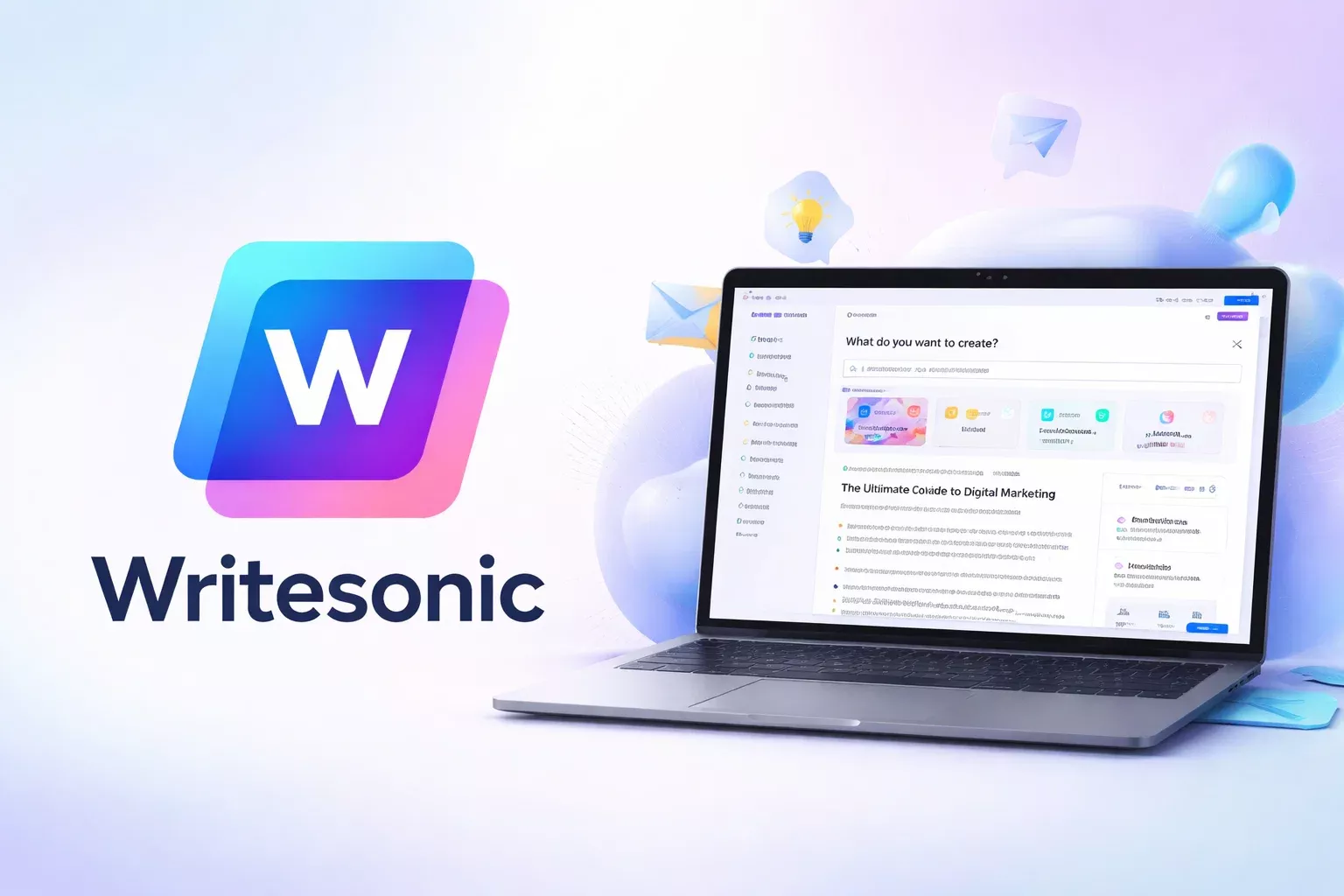
Writesonic is best known as an AI writing tool, but today it positions itself more broadly as an AI SEO + AI Search Visibility (GEO) platform. It helps teams create and refresh content, run SEO audits with AI fixes, and track how their brand appears across AI platforms like ChatGPT and others—then suggests actions to improve visibility and citations.
It also includes products under the Writesonic umbrella like Chatsonic (marketed as an AI marketing agent) and Photosonic (AI image generation), which together support content creation workflows for marketers.
By the end of this guide, you’ll understand what Writesonic is, how it works step by step, its business model and pricing structure, the features that make it valuable for marketers, and why entrepreneurs want to build similar AI SEO platforms—plus how Miracuves can help you launch one quickly.
What Is Writesonic? The Simple Explanation
Writesonic is an AI-powered marketing and SEO platform that helps businesses create content, optimize websites, and improve how their brand appears inside both traditional search engines and AI-powered search tools.
In simple terms, it’s like having an AI marketing assistant that can write, audit, and optimize your content—while also showing you how visible your brand is in tools like ChatGPT-style search and AI answer engines.
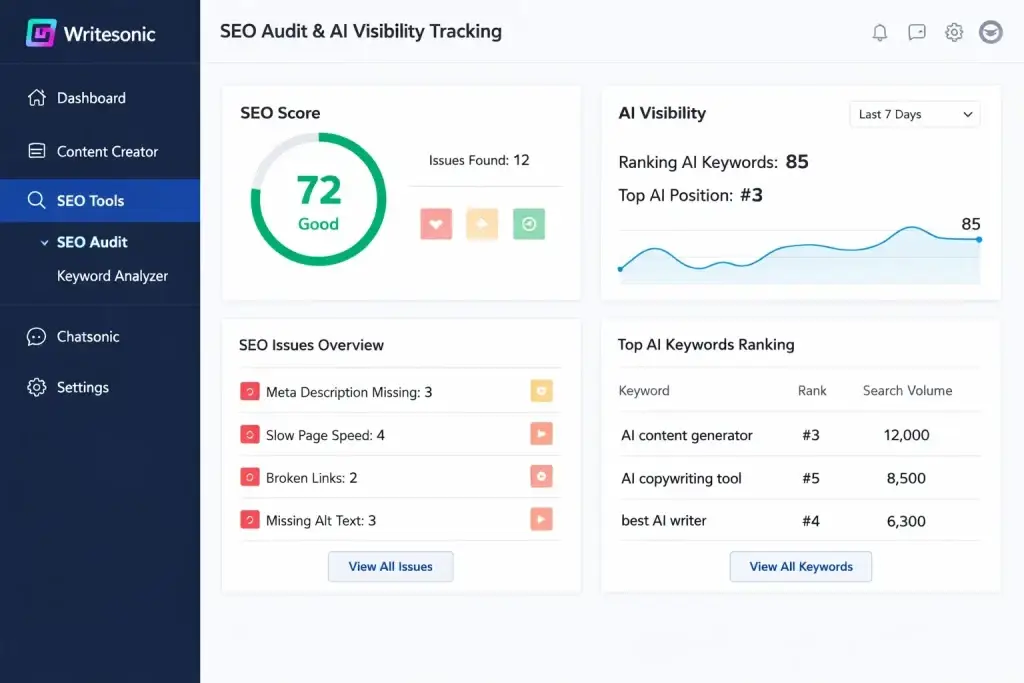
The Core Problem Writesonic Solves
Marketers today face two big challenges at once:
- Creating high-quality content fast enough to keep up with SEO demands
- Making sure their brand is actually visible inside AI-generated answers, not just Google results
Writesonic addresses this by:
- Generating SEO-optimized content (blogs, landing pages, ads)
- Auditing existing pages and suggesting AI-driven fixes
- Tracking brand and page mentions across AI search platforms
- Helping teams adapt content for both search engines and AI assistants
It turns SEO into a continuous, AI-assisted workflow instead of a one-time task.
Target Users and Use Cases
Writesonic is commonly used by:
• Digital marketers and SEO teams
• Content writers and bloggers
• E-commerce businesses
• SaaS marketing teams
• Agencies managing multiple clients
Typical use cases include blog writing, on-page SEO optimization, AI search visibility tracking, content refreshes, ad copy generation, and marketing strategy planning.
Current Market Position
Writesonic is positioned as a bridge between traditional SEO and AI-powered search visibility. While many tools focus on keywords and rankings, Writesonic emphasizes how content performs inside AI answers and conversational search tools.
Why It Became Successful
Writesonic gained traction by evolving beyond “AI writing” into AI-powered SEO operations, helping marketers adapt to a world where search is increasingly driven by AI summaries and answer engines.
How Writesonic Works — Step-by-Step Breakdown
For Marketers, SEO Teams, and Content Creators
Creating or importing content
Users can start by either writing new content with Writesonic’s AI editor or importing existing blog posts and landing pages they want to improve. This makes the platform useful for both fresh content creation and ongoing SEO optimization.
Running AI SEO analysis
Once content is inside the system, Writesonic:
- Scans the page for SEO structure (headings, keywords, links, readability)
- Identifies gaps in coverage and missing topics
- Flags technical or on-page issues
- Suggests improvements aligned with search and AI visibility goals
This turns the tool into more than a writer—it becomes an SEO assistant.
Optimizing for AI search visibility
Writesonic includes tools to help track how your brand or pages appear in AI-generated answers. Teams can:
- Monitor mentions across AI platforms
- See which pages are being cited
- Identify opportunities to improve visibility and authority
- Adjust content to increase the chances of being referenced
Using Chatsonic and workflow tools
Chatsonic acts as an AI marketing agent inside the platform. Users can ask for:
- Content ideas and outlines
- SEO strategies
- Competitor analysis
- Ad copy and campaign suggestions
This helps connect strategy and execution in one workspace.
Publishing and tracking performance
After optimizing, users can publish content to their CMS and return to Writesonic to track:
- SEO performance signals
- AI search visibility changes
- Content improvement suggestions over time
Typical workflow
Write or import content → run AI SEO audit → optimize for search + AI → publish → track visibility and refine.
Technical Overview (Simple)
Writesonic combines:
- Large language models for content generation and rewriting
- SEO analysis engines for structure and keyword alignment
- Monitoring systems for AI search and brand mentions
- Workflow tools for content planning and optimization
- Cloud infrastructure for performance and data tracking
This allows Writesonic to function as a full AI SEO operations platform, not just a writing tool.
Read More :- How to Develop an AI Chatbot Platform
Writesonic’s Business Model Explained
How Writesonic Makes Money
Writesonic makes money through a subscription-based SaaS model (monthly/annual plans). The product is packaged as an all-in-one platform that covers:
- AI content creation (article writer + marketing copy tools)
- SEO automation (audits, on-page fixes, optimization recommendations)
- AI search visibility tracking (GEO: tracking mentions/citations across AI platforms)
Pricing Structure (current plan style)
Writesonic typically offers multiple tiers (for freelancers → teams → enterprise). On its pricing page, plans are shown starting around $49/month (Lite) and scaling up through Standard/Professional/Advanced, with Enterprise as custom pricing.
What users are paying for (what changes by tier)
Pricing increases mainly with:
- Number of AI articles / generations included
- SEO audit capacity (pages/sites)
- Access to “AI optimization engine” and automated fixes
- GEO tracking depth (AI platform visibility monitoring and actions)
- Team/enterprise controls and support
Revenue streams
- Subscriptions (core revenue): recurring monthly/annual billing
- Team/Enterprise contracts: more seats, governance, and higher limits
- Add-on products: Writesonic also promotes Chatsonic as a marketing agent product line, which can be bundled into the overall ecosystem
Market size and growth drivers
Writesonic is riding two big waves at once:
- Traditional SEO demand (rank higher, publish more, fix technical issues)
- “GEO” demand (brands want visibility inside AI answers like ChatGPT and Google AI Overviews)
Profit margins insights
Like most SaaS tools, Writesonic’s margins improve when it:
- Converts free users to paid plans
- Expands from individuals to teams
- Retains customers through ongoing SEO + GEO workflows (tracking → actions → results)
Revenue model breakdown
| Revenue Stream | Description | Who Pays | Nature |
|---|---|---|---|
| Subscriptions | Access to AI writing + SEO + GEO tools | Individuals/Teams | Recurring |
| Tier upgrades | Higher limits and premium features | Growing teams | Expansion |
| Enterprise | Custom pricing, governance, support | Large orgs/agencies | Contract |
| Ecosystem tools | Chatsonic and related features | Marketers | Value-add |
Key Features That Make Writesonic Successful
AI Article Writer and Content Engine
Writesonic helps users generate SEO-friendly long-form content from briefs and keywords, turning content production into a repeatable system rather than one-off prompting.
SEO Audit and Optimization Tools
It includes SEO audit/checker workflows that scan pages, detect issues, and provide actionable recommendations—aimed at improving on-page SEO performance.
AI Search Visibility Tracking (GEO)
A major differentiator is tracking how brands appear across AI platforms (mentions/citations), then recommending actions to improve visibility—going beyond classic rank tracking.
Brand and tone controls
Users can guide style and brand consistency, which matters when creating lots of content for multiple channels and clients.
Content refresh and updating workflows
Writesonic emphasizes not only creating new content but also improving existing pages with AI, which is critical for SEO maintenance and AI answer visibility.
Multi-use marketing copy templates
Beyond blogs, it supports ads, landing pages, product descriptions, and social content—useful for performance marketing teams.
Chatsonic (AI marketing agent)
Writesonic also positions Chatsonic as a marketing agent layer that can help with research and content workflows and is part of its broader product ecosystem.
Integrations and workflow acceleration
It supports workflows that can fit into content operations, reducing the manual steps between writing, optimizing, and publishing.
Analytics-style dashboards
SEO + visibility tracking requires reporting. Writesonic’s approach relies on dashboards that show audit status, optimization suggestions, and GEO visibility trends.
Built for marketers, not just writers
The platform is structured around marketing outcomes—rankings, visibility, content velocity, and brand discoverability—rather than purely “creative writing.”

The Technology Behind Writesonic
Tech stack overview (simplified)
Writesonic is built like a connected content + SEO + AI-visibility system. Instead of only generating text, it combines:
- An AI content generation layer (“Content Engine”)
- An SEO analysis layer (site audits, SEO scoring, competitor analysis)
- An AI search visibility layer (GEO: tracking visibility/mentions across AI platforms and recommending actions)
How Writesonic creates SEO content that’s “search + AI-answer ready”
In the Writesonic approach, you start with a topic/keyword, then the platform helps you:
- Generate structured content drafts
- Optimize and refresh content to improve performance
- Align content with what AI answer engines might cite (visibility/citation gaps)
That “optimize for both” angle is a big part of their product positioning.
The SEO automation layer
Writesonic’s Site Audit is designed to surface issues and provide clear actions and automated fixes, aimed at reducing the manual work and jargon-heavy reports marketers usually deal with.
For page-level work, the SEO Checker & Optimizer flow includes things like:
- Scoring your content
- Pulling competitor insights/keywords
- Giving a structured analysis you can act on
The GEO layer: tracking AI platform visibility
This is the “new SEO” part. Writesonic promotes AI Search Tracking (GEO) to monitor how your brand shows up across AI platforms (for example, ChatGPT, Perplexity, and Google AI Overviews) and then recommends steps to improve visibility.
The workflow typically looks like:
- Track AI visibility and citations → spot gaps → create/update content → track improvement.
Chatsonic: the AI agent layer
Writesonic also offers Chatsonic, positioned as an AI marketing agent that combines multiple leading AI models with marketing-oriented tooling (they specifically mention models like ChatGPT, Claude, and Gemini, plus integrations like WordPress).
This complements the platform by helping with research, writing, and publishing tasks in a more conversational “agent” format.
Scalability and data handling (why it works for teams)
Because Writesonic supports audits, tracking, and ongoing optimization, it relies on cloud processing to:
- Run repeated site audits and analyses
- Track AI visibility across many prompts/topics
- Maintain dashboards and reporting for teams
Why this tech matters for business
Writesonic matters because it connects what marketers usually do in separate tools:
- Create content → optimize SEO → measure visibility (now including AI answer engines) → improve and repeat.
Writesonic’s Impact & Market Opportunity
Industry disruption Writesonic caused
Writesonic started as an AI writing tool, but its bigger impact has been pushing marketers toward a new reality: it’s not enough to rank on Google—you also need to be visible inside AI-generated answers. By combining AI content creation with SEO audits and AI search visibility (GEO) tracking, it helped reposition “content” as a system that must perform across both classic search and conversational AI platforms.
Market statistics and growth drivers
Writesonic is riding two strong demand waves:
- Traditional SEO demand (content + optimization + audits)
- AI search demand (brands want mentions and citations inside AI platforms and AI Overviews)
That second wave is growing fast because AI summaries are changing how users discover brands, products, and services.
User demographics and behavior
Writesonic users typically include:
- SEO teams publishing and updating large content libraries
- Content marketers producing multi-channel campaigns
- Agencies managing multiple client sites
- Founders and growth teams needing content velocity
Behavior pattern: users don’t just “generate an article.” They run a loop: create → audit → optimize → track visibility → refresh again.
Geographic presence
Because Writesonic supports global content workflows and marketing teams, it has strong international appeal—especially in markets where English SEO content is used to sell worldwide.
Future projections
Writesonic-style platforms are likely to expand into:
- Deeper AI answer engine optimization (GEO playbooks)
- More automated content refresh workflows
- Integration with analytics and conversion tracking
- Competitor visibility benchmarking across AI platforms
Opportunities for entrepreneurs
This massive success is why many entrepreneurs want to create similar platforms—especially for:
- Industry-specific SEO + GEO platforms (healthcare, fintech, legal)
- Local business visibility inside AI search
- Agency-first content operations dashboards
- Internal enterprise “content intelligence” tools
This massive success is why many entrepreneurs want to create similar platforms—because the formula is clear: create content + optimize SEO + track AI visibility + iterate continuously.
Building Your Own Writesonic-Like Platform
Why businesses want AI SEO + AI visibility platforms
Writesonic proves that modern marketing isn’t only about writing content—it’s about content performance across search and AI answer engines. Businesses want similar platforms because:
- Content production needs to be fast and scalable
- SEO requires continuous auditing and updates
- Brands now want visibility in AI answers (mentions + citations), not just rankings
- Agencies need repeatable systems across multiple clients
- A subscription workflow tool is easier to budget than manual work
Key considerations before development
If you want to build a Writesonic-style platform, focus on these foundations:
- AI content generation with structured outputs (blogs, landing pages, ads)
- Site/page audits with actionable SEO fixes
- AI visibility tracking (prompts/topics → where you show up → why/why not)
- Competitor benchmarking for SEO + AI mentions
- Workflow automation (create → optimize → track → improve)
- Team collaboration, permissions, and reporting dashboards
- Data privacy and safe content governance
Read Also :- How to Market an AI Chatbot Platform Successfully After Launch
Cost Factors & Pricing Breakdown
Writesonic–Like App Development — Market Price
| Development Level | Inclusions | Estimated Market Price (USD) |
|---|---|---|
| 1. Basic AI Writing MVP | Core web interface for AI writing tasks, user signup & login, integration with a single LLM/API, essential prompt → output flows for a few templates (e.g., ads, emails, product descriptions), basic history, simple download/copy tools, minimal brand settings, standard admin panel, basic usage analytics | $70,000 |
| 2. Mid-Level AI Content Platform | Expanded template library, brand voice presets, multi-workspace support, team collaboration (roles/comments), folders & content categorization, tone controls, SEO writing workflows (blogs/meta), optional plagiarism/similarity checks, credits/usage tracking, analytics dashboard, polished web UI and mobile-ready experience | $150,000 |
| 3. Advanced Writesonic-Level Enterprise Content Ecosystem | Large-scale multi-tenant AI content platform with enterprise organizations & RBAC/SSO, approvals & governance workflows, content scheduling & calendar tools, deep CMS/CRM integrations, API access, audit logs, detailed observability, robust safety & policy enforcement, cloud-native scalable architecture | $280,000+ |
Writesonic-Style AI Content Platform Development
The prices above reflect the global market cost of developing a Writesonic-like AI content and writing platform — typically ranging from $70,000 to over $280,000, with a delivery timeline of around 4–12 months for a complete, from-scratch build. This scope usually includes integrations with powerful LLMs, rich template and workflow systems, brand and team controls, analytics, governance, and production-grade infrastructure supporting individual creators as well as enterprise teams.
Miracuves Pricing for a Writesonic–Like Custom Platform
Miracuves Price: Starts at $15,999
This is positioned for a feature-rich, JS-based Writesonic-style AI content creation platform that can include:
- AI-powered writing for ads, emails, blogs, landing pages, scripts, and more
- Brand voice and tone controls with reusable preset libraries
- User accounts, teams, workspaces, project history, and versioning
- Usage and credit tracking with optional subscription or pay-per-use billing
- Core moderation and compliance features to ensure safe content generation
- Modern, responsive web interface plus optional companion mobile apps
From this foundation, the platform can be extended into enterprise approvals, deeper integration with CMS/CRM systems, workflow automation, advanced analytics, API access, and large-scale SaaS deployments as your content platform matures.
Note: This includes full non-encrypted source code (complete ownership), complete deployment support, backend & API setup, admin panel configuration, and assistance with publishing on the Google Play Store and Apple App Store—ensuring you receive a fully operational AI writing and content ecosystem ready for launch and future expansion.
Delivery Timeline for a Writesonic–Like Platform with Miracuves
For a Writesonic-style, JS-based custom build, the typical delivery timeline with Miracuves is 30–90 days, depending on:
- Depth of content workflows (templates, SEO features, brand voice controls, approvals)
- Number and complexity of AI model, storage, billing, and moderation integrations
- Complexity of team features (roles, workspaces) and enterprise controls (RBAC/SSO)
- Scope of web portal, mobile apps, branding, and long-term scalability plans
Tech Stack
We preferably will be using JavaScript for building the entire solution (Node.js/Nest.js/Next.js for the web backend + frontend) and Flutter / React Native for mobile apps, considering speed, scalability, and the benefit of one codebase serving multiple platforms. Other tech stacks can be discussed upon request — Contact us
Essential features to include
A strong Writesonic-style MVP should include:
- AI article/landing page generator with templates
- SEO checker for on-page improvements
- Basic site audit (technical + content issues)
- AI visibility tracking for chosen prompts/topics
- Content refresh suggestions and rewrite tools
- Projects/workspaces for multiple sites or clients
- Subscription and usage tracking
High-impact extensions later:
- Competitor AI-visibility benchmarking
- Automated internal linking suggestions
- Integration with WordPress/Webflow/CMS tools
- Conversion analytics feedback loops
- API access for agencies and automation
Read More :- AI Chat Assistant Development Costs: What Startups Need to Know
Conclusion
Writesonic shows where SEO is heading: content success is no longer measured only by rankings—it’s measured by discoverability everywhere, including AI answer engines. When a platform helps you create content, optimize it, and track visibility in AI platforms in one loop, it turns marketing into a repeatable system instead of a guessing game.
For founders and product teams, the key takeaway is simple: the most valuable marketing tools now are the ones that connect creation + optimization + visibility tracking + iteration into one workflow. That’s what keeps brands competitive as search keeps evolving.
FAQs :-
How does Writesonic make money?
Writesonic makes money through subscription plans (monthly/annual), with pricing tiers based on usage limits and access to SEO + AI visibility features.
What is Writesonic mainly used for?
Writesonic is used for AI content creation, SEO optimization, and AI search visibility tracking (GEO)—helping teams create, improve, and refresh content for better discoverability.
Does Writesonic help with SEO audits?
Yes. Writesonic includes SEO audit and optimization tools that highlight issues and provide AI-driven recommendations to improve on-page and site-level SEO.
What is GEO in Writesonic?
GEO refers to AI search visibility tracking—monitoring how your brand shows up in AI-generated answers (mentions/citations) and suggesting actions to improve that visibility.
Is Writesonic good for agencies?
Yes. Writesonic is useful for agencies because it supports repeatable content + SEO workflows that can be applied across multiple clients.
Can Writesonic replace human writers?
Writesonic can speed up drafting and optimization, but the best results come when humans review, add expertise, and ensure accuracy—especially for high-trust topics.
Can I build a platform like Writesonic?
Yes. Writesonic-style platforms can be built by combining AI writing, SEO auditing, and AI visibility tracking dashboards into one workflow system.
What makes Writesonic different from basic AI writing tools?
Writesonic goes beyond writing by adding SEO audits and AI answer visibility tracking, helping content perform across both search engines and AI platforms.
Does Writesonic support multiple languages?
Yes. Writesonic can generate content in multiple languages, which helps global marketing teams.
How can Miracuves help build a Writesonic-like platform?
Miracuves helps founders build AI-powered SEO + content + visibility platforms with content engines, audit modules, dashboards, and subscription billing—enabling fast launch and scalable growth.