



Robinhood didn’t just enter the investing world — it disrupted it. By removing trading commissions and designing a sleek mobile-first experience, the platform made stock market participation feel accessible to millions who previously saw investing as complex, expensive, or reserved for professionals.
In 2026, the Business Model of Robinhood stands as a powerful case study in how modern fintech platforms scale: not by charging users upfront, but by monetizing infrastructure, user behavior, and ecosystem partnerships. Its strategy blends brokerage services, subscriptions, interest-based revenue, and data-driven financial flows into a system that feels frictionless for users while remaining highly profitable at scale.
For entrepreneurs, the Business Model Robinhood offers lessons far beyond finance. It proves that the most successful digital platforms don’t just sell products — they build ecosystems. Understanding how Robinhood balances growth, trust, compliance, and monetization provides a blueprint for founders building scalable marketplace, subscription, and on-demand business models today.
How the Robinhood Business Model Works
Robinhood’s business model looks simple on the surface — free trading — but underneath, it’s a highly engineered fintech ecosystem optimized for scale, liquidity, and data-driven monetization.
At its core, Robinhood operates as a hybrid financial platform that blends brokerage services, financial products, and behavioral design into one seamless mobile-first experience.
Core Business Model Overview
Robinhood functions as a multi-layer fintech marketplace connecting retail investors, market makers, issuers, and financial partners.
It removes traditional friction (commissions, minimum balances, complex UX) and replaces it with:
- High user volume
- High engagement frequency
- Monetization at the infrastructure and data layer
This is a classic example of “access-first, monetize-later” platform strategy.
Type of Business Model
Robinhood operates under a Hybrid Model, combining:
- Marketplace Model
Connects retail traders with financial markets and liquidity providers. - Freemium Model
Core trading is free, while premium tools and features are paid. - Financial Services Platform
Offers brokerage, crypto trading, cash management, retirement accounts, and subscriptions.
This hybrid structure allows Robinhood to diversify revenue without charging users directly for basic actions — a key reason for rapid adoption .
Value Proposition by User Segment
Retail Investors (Primary Users)
- Zero-commission trading for stocks, ETFs, options, and crypto
- Intuitive, mobile-first interface
- Fractional shares and low entry barriers
- Fast onboarding and instant deposits
Advanced / Power Users
- Robinhood Gold subscription (margin, analytics, higher instant deposits)
- Priority access to IPOs and new financial instruments
- Enhanced research and market data
Market Makers & Financial Partners
- Massive retail order flow
- Predictable liquidity patterns
- Data-rich execution environment
Key Stakeholders & Their Roles
- Retail Users
Generate trading volume, engagement, and data. - Market Makers
Execute trades and pay Robinhood for order flow. - Regulators (SEC, FINRA, etc.)
Enforce compliance, disclosures, and consumer protection. - Technology & Banking Partners
Enable clearing, settlement, custody, and cash management.
Robinhood’s success depends on balancing trust across all four, especially under regulatory scrutiny.
Business Model Evolution
Robinhood’s model has evolved significantly since launch:
- Phase 1: Zero-commission stock trading (user acquisition)
- Phase 2: Options, crypto, and instant deposits (engagement growth)
- Phase 3: Subscriptions, retirement accounts, cash sweep programs (revenue diversification)
- Phase 4 (2025–2026):
- Deeper compliance tooling
- More conservative UX design
- Focus on long-term investors, not just traders
- Deeper compliance tooling
This evolution reflects a shift from growth-at-all-costs to sustainable, regulated scale.
Why This Model Works in 2026
Robinhood continues to work because it aligns with modern financial behavior:
- Retail investors expect mobile-first, low-cost access
- Younger demographics favor self-directed investing
- Financial literacy tools are increasingly embedded in apps
- Scale allows monetization without upfront user friction
Platform data enables precision in pricing, risk, and product design
Read more : What is Robinhood App and How Does It Work?
Target Market & Customer Segmentation Strategy
Robinhood didn’t win by targeting everyone. It won by obsessively serving underserved, overlooked investors — and then expanding outward once trust and habit were built.
Its segmentation strategy is one of the clearest examples of behavior-first market design in fintech.
Primary & Secondary Customer Segments
Primary Segment: Retail, Self-Directed Investors
These users form the backbone of Robinhood’s ecosystem.
Profile
- Age: 18–40 (Gen Z & Millennials dominate)
- First-time or early-stage investors
- Mobile-native, low patience for complex financial tools
- Price-sensitive, but engagement-rich
Why They Stay
- Zero commissions remove psychological barriers
- Simple UI reduces intimidation
- Fractional shares make investing feel accessible
- Gamified feedback loops increase habit formation
Secondary Segment: Advanced / Active Traders
Once users mature, Robinhood nudges them into higher-value tiers.
Profile
- Higher trading frequency
- Interest in options, crypto, and margin
- Willingness to pay for speed, data, and leverage
Why They Upgrade
- Robinhood Gold subscription benefits
- Larger instant deposits
- Advanced market data and analytics
- Priority access to IPOs and features
This lifecycle segmentation maximizes LTV without aggressive upselling.
Customer Journey: Discovery → Conversion → Retention
1. Discovery
- App store visibility
- Word-of-mouth and social media virality
- Cultural moments (e.g., meme stock events)
- Financial influencer and community buzz
2. Conversion
- Ultra-fast onboarding
- No minimum balance
- Instant funding
- Clean, confidence-building UI
3. Retention
- Push notifications tied to market activity
- Personalized insights and nudges
- Product expansion (crypto, retirement, cash accounts)
- Habit reinforcement through daily engagement
Robinhood turns curiosity into routine — a critical platform advantage.
Acquisition Channels & LTV Optimization
Key Acquisition Channels
- Organic referrals and social sharing
- App store optimization
- Paid digital acquisition during market booms
- Educational content and in-app learning modules
Lifetime Value Levers
- Increased trading frequency
- Subscription upgrades (Gold)
- Cross-product adoption (crypto, retirement, cash)
- Higher balances via trust and long-term positioning
The longer users stay, the more non-commission revenue layers activate.
Market Positioning & Competitive Edge
Robinhood positions itself as:
“Finance, but built for the smartphone generation.”
Differentiation Factors
- Radical simplicity compared to legacy brokers
- Strong brand recall among younger investors
- Cultural relevance during market events
- Continuous UX refinement based on behavior data
Market Share Insight (2026)
- One of the top retail brokerage apps by active users in the U.S.
- Particularly dominant among first-time investors
- Faces intense competition, but retains loyalty via habit and brand
Read more : How to Create a Robinhood like Stock Trading App in 2025
Revenue Streams & Monetization Design
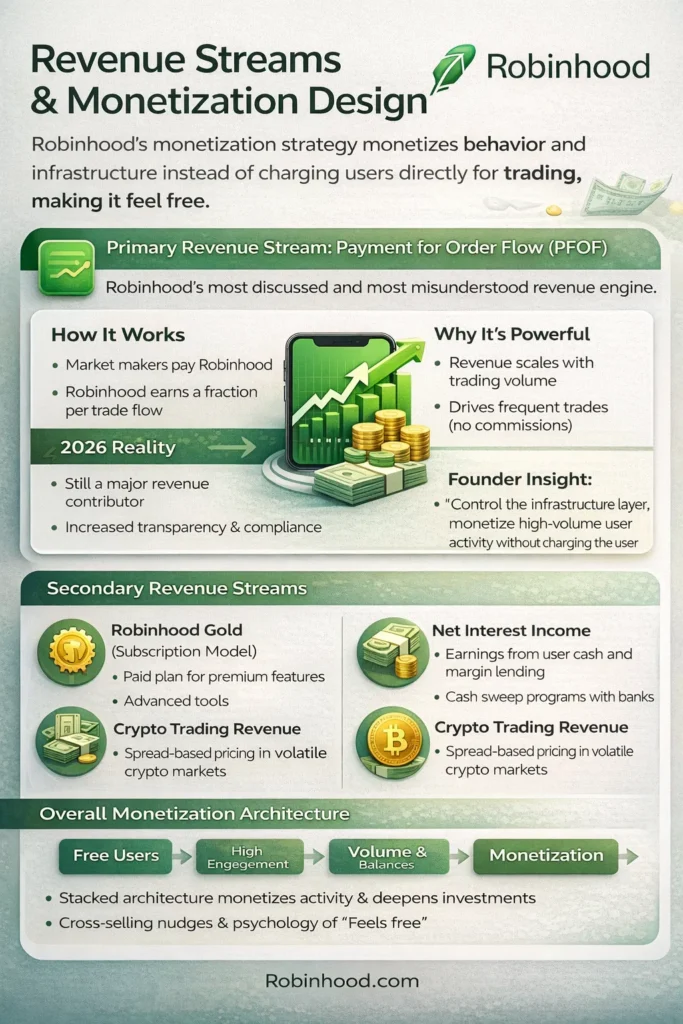
Robinhood’s monetization strategy is a textbook example of indirect revenue engineering. Instead of charging users at the point of action, it monetizes scale, behavior, and financial infrastructure.
The result? A platform that feels free while generating billions in annual revenue.
Primary Revenue Stream: Payment for Order Flow (PFOF)
This is Robinhood’s most discussed — and most misunderstood — revenue engine.
How It Works
- When users place trades, orders are routed to market makers
- Market makers pay Robinhood for this order flow
- Robinhood earns a fraction per trade, invisible to the user
Why It’s Powerful
- Revenue scales with volume, not pricing
- Users trade more because there are no commissions
- High-frequency retail activity becomes an asset
2026 Reality
- Still a major revenue contributor
- More transparent disclosures and tighter compliance
- Optimized for best execution amid regulatory oversight
Founder Insight
High-volume user behavior can be monetized without charging the user directly — if you control the infrastructure layer.
Secondary Revenue Streams
1. Robinhood Gold (Subscription Model)
- Monthly subscription fee
- Includes margin investing, advanced data, higher instant deposits
Why It Works
- Converts power users into predictable recurring revenue
- Anchors users deeper into the ecosystem
- Improves revenue stability beyond market cycles
2. Net Interest Income
Robinhood earns interest from:
- Uninvested user cash
- Margin lending
- Cash sweep programs with partner banks
As interest rates stabilized in the mid-2020s, this stream became increasingly significant.
3. Crypto Trading Revenue
- Spread-based revenue model
- No explicit commission, but margin built into pricing
- High volatility = high engagement periods
Despite regulatory uncertainty, crypto remains a behavior-driven monetization layer.
4. Other Revenue Streams
- Securities lending
- Rebate programs
- IPO access partnerships
- Retirement account services
Each stream may be smaller individually, but together they create revenue resilience.
Overall Monetization Architecture
Robinhood’s revenue model is designed as a stack, not a single pipe:
- Free access → Higher engagement
- Engagement → Volume and balances
- Volume → Infrastructure monetization
- Trust → Subscriptions and long-term assets
Cross-Selling & Upselling Tactics
- Gradual feature exposure
- Usage-based nudges (not hard sales)
- Tiered access aligned with investor maturity
Pricing Psychology
- “Free” reduces fear
- Subscriptions feel optional, not forced
Hidden complexity stays off the UI, behind the system
Read more : Robinhood Revenue Model: How Robinhood Makes Money in 2026
Operational Model & Key Activities
Robinhood’s success isn’t just about a clever business model — it’s about operational excellence at scale, especially in one of the most regulated industries in the world.
What users experience as a clean, simple app is supported by deep technical, compliance, and operational complexity.
Core Operational Pillars
1. Platform & Infrastructure Management
Robinhood operates a high-availability financial platform where downtime equals lost trust.
Key activities include:
- Real-time trade execution and routing
- Scalable cloud infrastructure for peak market events
- Latency optimization for fast order processing
- Redundancy systems to handle traffic surges
This is where fintech becomes mission-critical engineering.
2. Compliance, Risk & Trust Systems
Unlike consumer apps, Robinhood must operate under constant regulatory oversight.
Operational focus areas:
- SEC and FINRA compliance
- Trade surveillance and fraud detection
- Risk modeling for margin and options
- Customer protection and disclosures
Post-2021 scrutiny reshaped operations, pushing Robinhood toward compliance-by-design rather than compliance-as-a-layer.
3. Product Development & UX Optimization
Robinhood invests heavily in:
- Behavioral design testing
- UX simplification without sacrificing accuracy
- Educational prompts and warnings
- Feature rollouts paced with regulatory approvals
By 2026, the platform is far more educational and conservative than its early versions — a strategic evolution.
4. Customer Support & Incident Management
Support is no longer an afterthought.
Key functions:
- 24/7 in-app support
- Automated issue resolution for common problems
- Priority support for Gold users
- Crisis response protocols during market volatility
Fast, transparent communication is now a core trust metric.
5. Marketing, Education & Community
Robinhood shifted from aggressive growth marketing to:
- Financial literacy initiatives
- In-app education modules
- Long-term investing narratives
- Community engagement through content, not hype
This repositioning helps stabilize user behavior and balances regulatory expectations.
Resource Allocation Strategy (2026 Perspective)
Robinhood’s internal focus typically prioritizes:
- Technology & Infrastructure: ~35–40%
- Compliance, Risk & Legal: ~20–25%
- Product & UX: ~15–20%
- Marketing & Growth: ~10–15%
- Operations & Support: ~10%
This allocation reflects a shift from growth-first to resilience-first scaling.
Regional & Expansion Operations
- Strong U.S. operational base due to regulatory clarity
- Selective international expansion via partnerships
- Local compliance teams embedded early in new markets
- Gradual rollout of products by region
Strategic Partnerships & Ecosystem Development
Robinhood doesn’t operate as a standalone app. It’s embedded in a dense financial ecosystem where partnerships determine speed, scale, and survival.
Its partnership strategy is less about flashy alliances and more about quiet, infrastructure-level collaboration.
Partnership Philosophy
Robinhood partners to:
- Accelerate market access
- Reduce regulatory and operational burden
- Monetize ecosystem flows indirectly
- Strengthen network effects without owning every layer
This “platform-first” mindset allows Robinhood to stay lean while operating at institutional scale.
Key Partnership Categories
1. Technology & Infrastructure Partners
These partnerships keep the platform fast, reliable, and scalable.
- Cloud infrastructure providers
- Market data and analytics vendors
- Clearing and settlement partners
- Cybersecurity and fraud prevention tools
These partners enable Robinhood to handle massive trading volumes without building everything in-house.
2. Market Makers & Liquidity Providers
A critical — and often controversial — relationship.
- Execute retail trades at scale
- Provide liquidity across asset classes
- Pay for order flow under strict compliance frameworks
These partnerships directly power Robinhood’s core revenue engine while demanding transparency and execution quality.
3. Banking & Payment Alliances
Robinhood relies on regulated financial institutions for:
- Cash sweep programs
- FDIC-insured accounts
- ACH and instant deposits
- Interest-bearing balances
These alliances allow Robinhood to expand financial services without becoming a full bank.
4. Product & Issuer Partnerships
- IPO access programs
- ETF and fund collaborations
- Retirement and long-term investment products
- Crypto custody and compliance partners
These partnerships diversify offerings and attract higher-value users.
5. Regulatory & Expansion Alliances
Robinhood works closely with:
- Regulators and compliance advisors
- Legal and risk consultants
- Local partners for international entry
In fintech, regulators are ecosystem partners, not just watchdogs.
Ecosystem Strategy & Network Effects
Robinhood’s ecosystem creates value through:
- High-volume retail participation
- Data-rich trading behavior
- Liquidity aggregation
- Partner monetization opportunities
Why This Creates a Moat
- More users → more order flow
- More order flow → better partner economics
- Better economics → reinvestment in UX and trust
- Higher trust → higher balances and retention
Read more : Best Robinhood Clone Scripts 2026 — Build a Modern Trading App That Scales
Growth Strategy & Scaling Mechanisms
Robinhood’s growth story isn’t linear. It’s a mix of viral loops, cultural timing, infrastructure scaling, and strategic restraint — especially after intense scrutiny.
By 2026, Robinhood’s growth engine is far more disciplined, but still powerful.
Core Growth Engines
1. Organic Virality & Referral Loops
Robinhood’s earliest growth was fueled by:
- Invite-only waitlists
- Free stock referral programs
- Social proof among peer networks
Even today, referrals remain one of the highest-converting acquisition channels because trust travels socially in finance.
2. Behavioral Engagement Loops
Growth doesn’t stop at sign-up — it compounds through usage.
- Market movement notifications
- Personalized insights and alerts
- Streaks of engagement during earnings seasons
- Habit reinforcement through simplicity
This creates usage-driven retention, not dependency on constant paid marketing.
3. Paid Acquisition & Performance Marketing
Robinhood uses paid channels selectively:
- Scales spend during bull markets
- Pulls back during volatility or downturns
- Focuses on high-intent financial audiences
This counter-cyclical strategy protects margins and avoids waste.
4. Product Expansion as a Growth Lever
Instead of launching new apps, Robinhood:
- Expands horizontally within the same ecosystem
- Introduces new financial products to existing users
Key examples:
- Crypto trading
- Retirement accounts
- Cash management and interest programs
- Subscription-based premium tools
Each product increases account stickiness and asset retention.
5. Geographic Expansion Strategy
Robinhood’s international approach is cautious:
- Regulatory-first market selection
- Limited country rollouts
- Partnership-driven entry
- Slow, trust-building expansion
This avoids costly rollbacks common in global fintech expansion.
Scaling Challenges & How Robinhood Responded
Challenge 1: Infrastructure Stress
High-volume trading events exposed system limits.
Response
- Major infrastructure upgrades
- Cloud scaling and redundancy
- More conservative feature throttling
Challenge 2: Regulatory & Public Scrutiny
Public trust took hits during volatile market events.
Response
- Enhanced disclosures
- Stronger compliance frameworks
- UX changes to reduce impulsive trading
Challenge 3: User Maturity Shift
Early users matured beyond speculative trading.
Response
- Long-term investing tools
- Retirement-focused messaging
- Educational content
Competitive Strategy & Market Defense
Robinhood competes in one of the most brutal arenas in fintech. Legacy banks, zero-fee brokers, crypto-native platforms, and global super-apps are all fighting for the same users.
Its survival — and continued relevance — comes down to defensible advantages built over time.
Core Competitive Advantages
1. Network Effects & Switching Barriers
Robinhood benefits from behavioral network effects:
- Large user base attracts liquidity partners
- More liquidity improves execution economics
- Better economics fund product improvements
Switching costs aren’t contractual — they’re habitual:
- Established portfolios
- Familiar UI
- Embedded financial routines
2. Brand Equity & Cultural Relevance
Robinhood isn’t just a broker — it’s a cultural brand.
- Associated with retail investing empowerment
- High recall among Gen Z and Millennials
- Symbol of the “investing for everyone” movement
Even critics keep Robinhood top-of-mind — which still fuels brand dominance.
3. Product Simplicity as Strategy
While competitors add features, Robinhood:
- Removes friction
- Hides complexity
- Focuses on speed and clarity
This restraint is a competitive moat in an industry prone to overengineering.
4. Data-Driven Personalization
Robinhood leverages:
- Trading behavior data
- Portfolio patterns
- Engagement timing
This powers:
- Smarter notifications
- Personalized insights
- Risk-adjusted nudges
By 2026, personalization is compliance-aware, not just growth-driven.
Market Defense Tactics
Handling New Entrants
- Rapid feature matching when necessary
- Focus on core user base rather than edge cases
- Pricing pressure absorbed via diversified revenue streams
Managing Pricing Wars
Robinhood made pricing irrelevant by:
- Eliminating commissions entirely
- Shifting monetization behind the scenes
- Competing on experience, not fees
Once competitors matched pricing, Robinhood had already moved the battlefield.
Strategic Feature Timing
- Staggered feature releases
- Gradual rollouts with education
- Regulatory-aligned launches
This reduces backlash and increases adoption quality.
Acquisitions & Defensive Moves
Rather than aggressive M&A, Robinhood:
- Builds internally
- Partners strategically
- Acquires selectively for talent or tech
This keeps focus sharp and culture intact.
Lessons for Entrepreneurs & Implementation
Robinhood’s journey offers more than inspiration — it offers a playbook. Not everything is replicable, but the principles absolutely are.
If you’re building a platform business in 2026, this section is your blueprint.
Key Factors Behind Robinhood’s Success
- Frictionless Entry Wins Markets
Zero commissions didn’t just reduce cost — they removed fear.
The easier the first action, the faster adoption scales. - Monetize the System, Not the User Action
Robinhood makes money from infrastructure, balances, and behavior — not clicks. - Design for Habit, Not Just Usage
Daily engagement loops matter more than feature depth. - Regulation Is a Feature, Not a Constraint
Long-term trust compounds faster than short-term growth hacks. - Evolve With User Maturity
Robinhood grew with its users — from traders to long-term investors.
Replicable Principles for Startups
Founders can adapt Robinhood’s model by focusing on:
- Freemium access to eliminate adoption friction
- Lifecycle segmentation instead of one-size-fits-all monetization
- Subscription layers for advanced users
- Data-driven personalization with ethical guardrails
- Platform partnerships instead of vertical ownership
These apply far beyond fintech — to marketplaces, SaaS, healthtech, and on-demand platforms.
Common Mistakes to Avoid
- Monetizing too early and slowing growth
- Ignoring compliance until it becomes a crisis
- Over-gamifying serious user decisions
- Scaling marketing faster than infrastructure
- Chasing global expansion before local dominance
Robinhood paid the price for some of these — and corrected course.
Adapting the Model for Local or Niche Markets
You don’t need Robinhood’s scale to use its strategy.
Adaptation Examples
- Niche investing (real estate, commodities, local equities)
- Regional fintech with local compliance focus
- B2B financial platforms with freemium access
- Education-first financial apps
The key is contextual execution, not blind copying.
Implementation Timeline & Investment Priorities
Phase 1 :
- Market research & compliance mapping
- MVP with frictionless onboarding
- Core value proposition validation
Phase 2 :
- Infrastructure scaling
- Monetization layers (subscriptions, partnerships)
- Retention loops and data analytics
Phase 3 :
- Ecosystem partnerships
- Product expansion
- Brand trust and long-term positioning
Ready to implement Robinhood’s proven business model for your market?
Miracuves builds scalable platforms with tested business models and growth mechanisms.
We’ve helped entrepreneurs launch profitable apps.
Get your free business model consultation today.
Conclusion
Robinhood’s business model proves a powerful truth about modern platform companies:
Zero-commission trading was the spark, but systems, scale, and strategic evolution turned that spark into a lasting enterprise. Robinhood didn’t just democratize investing — it redefined how trust, behavior, and infrastructure interact in digital finance.
By 2026, the platform is no longer just a disruptor. It’s a case study in maturing responsibly, balancing growth with regulation, and reshaping itself as users grow older and wiser.
The future of platform economies won’t be won by the loudest innovator — but by the company that aligns technology, psychology, and execution most intelligently.
As we move deeper into 2026 and beyond, Robinhood stands as proof that sustainable digital empires are built at the intersection of simplicity and discipline.
FAQs
What type of business model does Robinhood use?
Robinhood uses a hybrid fintech model combining marketplace brokerage, freemium access, subscriptions, and financial infrastructure monetization. It removes commissions while monetizing scale and user behavior.
How does Robinhood’s business model create value?
It lowers barriers to investing through zero-commission trading and a simple mobile experience. Value is created by aggregating retail investors and monetizing order flow, balances, and premium features.
What are Robinhood’s key success factors?
Frictionless onboarding, strong brand appeal among young investors, and high engagement drive growth. Diversified revenue streams and data-driven personalization support long-term scalability.
How scalable is Robinhood’s business model?
The model is highly scalable because infrastructure and compliance costs are largely fixed. As users grow, revenue increases through volume, subscriptions, and interest income with low marginal costs.
What are the biggest challenges in this model?
Major challenges include regulatory scrutiny, maintaining platform stability during peak trading, and managing user behavior responsibly. Trust and compliance are constant operational priorities.
How can entrepreneurs adapt this model to their region?
Founders can start with a niche market, design compliance-first systems, and offer freemium access. Monetization can come from subscriptions, partnerships, or value-added financial services.
What are alternatives to Robinhood’s business model?
Alternatives include commission-based brokerages, robo-advisory subscriptions, education-first investing apps, and B2B fintech platforms. These models trade faster monetization for slower user growth.
How has Robinhood’s business model evolved over time?
Robinhood evolved from a growth-first trading app into a diversified financial services platform. The focus has shifted toward education, long-term investing, and regulatory alignment.
Related Article :