Key Takeaways
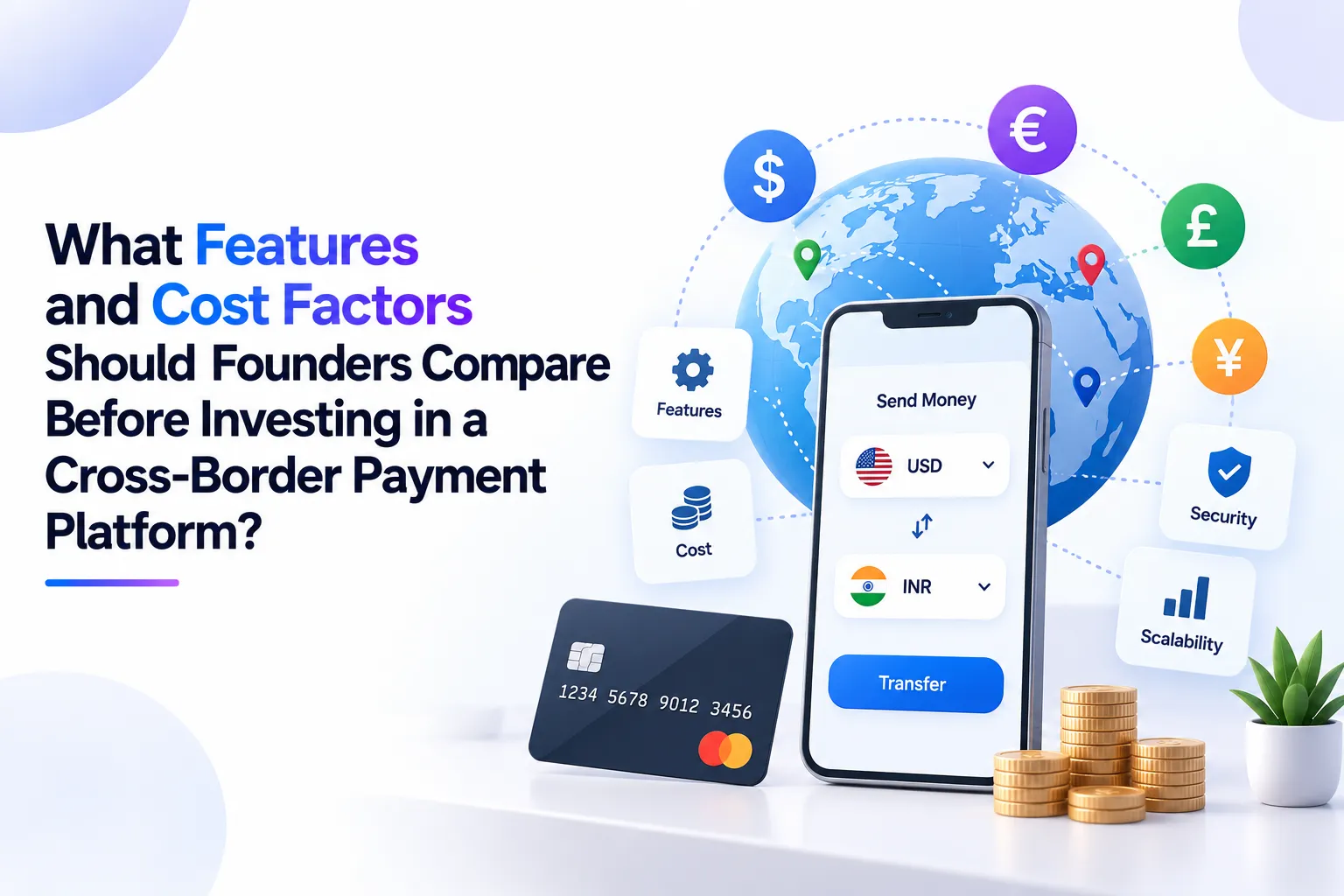
- A Cross-Border Payment Platform Features and Cost should combine multi-currency transfers, exchange-rate handling, recipient management, KYC, transaction tracking, compliance, and secure payment workflows.
- Core features may include currency conversion, international transfers, beneficiary accounts, transfer estimates, payment history, notifications, refunds, limits, and admin controls.
- Development cost depends on supported countries and currencies, banking and payment integrations, compliance requirements, FX logic, security, scalability, automation, and customization depth.
Feature & Cost Signals
- User-side features can include digital onboarding, identity verification, multi-currency balances, live exchange rates, fee estimates, beneficiary management, transfers, and transaction status tracking.
- Cost can increase with banking APIs, payment rails, FX providers, AML screening, sanctions checks, fraud monitoring, multi-region infrastructure, reconciliation, and regulatory reporting.
- Admin systems should support users, transactions, exchange rates, transfer limits, fees, compliance reviews, disputes, refunds, settlements, reports, permissions, and platform analytics.
Founder Evaluation Insights
- Founders should compare target corridors, supported currencies, settlement speed, pricing model, regulatory scope, payment partners, compliance workflows, and MVP requirements before estimating investment.
- A phased roadmap can begin with core onboarding, currency conversion, transfers, compliance, and transaction tracking before adding business accounts, cards, APIs, advanced automation, and additional corridors.
- Miracuves develops customizable cross-border payment platforms with multi-currency transfers, KYC, FX workflows, payment integrations, compliance controls, transaction tracking, analytics, security, and admin management.
Cross-border payment platforms require careful evaluation because their value depends on far more than the customer-facing interface. Founders need to assess how the system handles multi-currency balances, FX conversion, transaction states, recipient management, compliance workflows, external financial integrations, reconciliation, security, and the operational requirements of each transfer corridor.
The cost of such a platform is also influenced by the scope of those underlying workflows. Supporting additional currencies, payout methods, verification providers, banking partners, reporting requirements, or country-specific rules can increase both implementation complexity and long-term operating costs. As a result, comparing platforms only by headline pricing or the number of visible features can produce an incomplete picture.
A stronger evaluation focuses on whether the platform can support the intended business model, first launch corridor, financial partners, compliance responsibilities, and future expansion plans. This gives founders a more practical basis for comparing software quality, implementation scope, and total ownership cost before making an investment decision.
Founders who want more background before comparing platforms can first review how cross-border payment apps work, including the rela
Start With the Transfer Corridor, Not the Feature List
Cross-border payments vary significantly from one market route to another, so founders should define the initial transfer corridor before comparing platform features or development costs. The sender country, recipient country, supported currencies, funding method, payout method, settlement process, transaction limits, verification requirements, banking relationships, and liquidity structure can all influence how the platform needs to operate.
A solution that works well for one corridor may require different integrations, compliance workflows, recipient data, payout partners, or transaction rules when expanded into another market. This is why a broad feature list alone does not provide enough information to judge platform readiness. The first evaluation should focus on whether the software can support the intended money flow from the sender’s funding method through currency conversion and settlement to the recipient’s final payout method.
Defining this corridor early also makes software pricing more meaningful. Once founders understand the currencies involved, financial partners, compliance responsibilities, payout structure, and operational requirements, they can compare vendors based on a realistic implementation scope rather than a generic product demonstration.ause the underlying operating model has not yet been defined.
Compare Multi-Currency Wallet and Ledger Logic
A multi-currency wallet should be evaluated as a financial record-keeping system, not simply as a balance screen. The platform needs to distinguish between available funds, reserved amounts, pending transfers, completed transactions, refunds, reversals, fees, FX conversions, manual adjustments, and settlement records so that every movement of money can be traced clearly.
Founders should verify how those balance changes are recorded and whether every transaction creates an auditable ledger entry. It should also be clear how pending and completed balances are separated, how failed transfers release or reverse reserved funds, how refunds are reflected, and whether administrative balance changes are logged with enough detail for internal review. Reconciliation is equally important because internal wallet records need to be compared against payment, banking, or payout-provider records when discrepancies occur.
The platform should also be flexible enough to introduce additional currencies without requiring major changes to the underlying financial architecture. A polished wallet interface can improve the customer experience, but reliable ledger logic is what gives the business confidence that balances, fees, conversions, and settlement activity are being recorded correctly.
Evaluate FX Rate and Fee Transparency
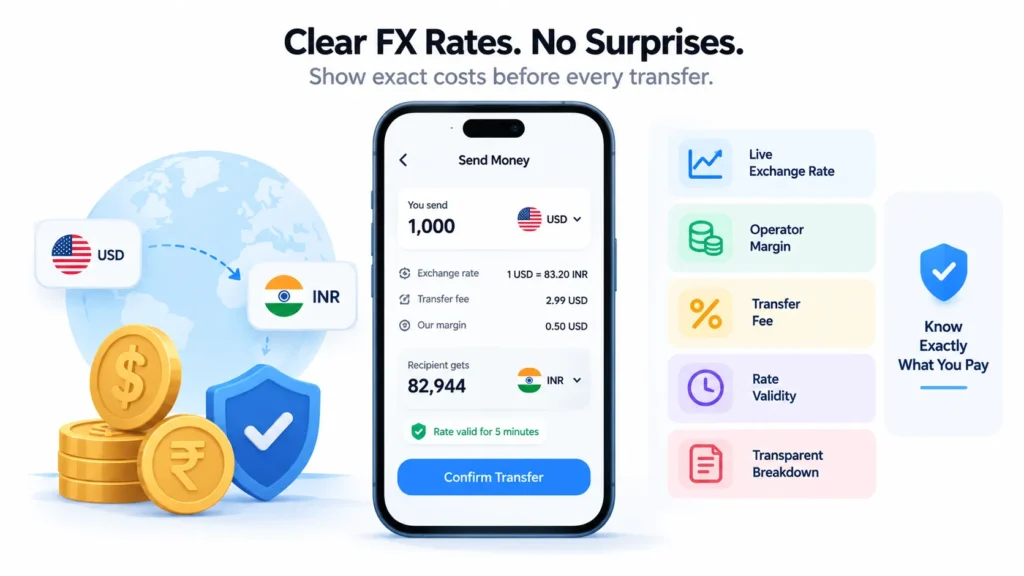
Currency conversion is another area where seemingly simple screens can hide significant complexity.
The platform needs a clear process for determining:
- source currency
- destination currency
- reference FX rate
- operator margin
- transfer fee
- recipient amount
- quote validity
- rate changes
- exceptions
The user should understand what they are paying before confirming the transaction.
The operator should understand how the amount was calculated afterward.
Founders should therefore investigate:
- Which provider supplies exchange rates?
- How often are rates refreshed?
- Can rates expire?
- Can pricing differ by corridor?
- Can the operator configure margins?
- What happens if the rate provider fails?
- Is the final recipient amount preserved in transaction records?
- Can support and compliance teams see which rate was applied?
This is not only a pricing feature.
It affects customer trust, dispute resolution, revenue logic, and financial reporting.
FX margins and transfer fees also affect how the platform generates revenue. Founders evaluating pricing structures can explore this cross-border payment business model framework for a deeper look at monetization and transaction economics.
Inspect the Complete Transfer Lifecycle
A cross-border payment platform should be evaluated across the full transaction lifecycle, not only the successful transfer path. Founders need to understand how the system handles transfers that are initiated, awaiting payment, pending verification, processing, held for review, completed, failed, cancelled, refunded, or reversed. The exact labels may differ between platforms, but every transaction should have a clearly defined state and a traceable path from initiation to final resolution.
The evaluation should also cover how state changes are controlled. Some events may happen automatically through payment or payout integrations, while others may require manual intervention from operations, compliance, or support teams. Founders should confirm what happens to wallet balances when a transaction fails, how refunds or reversals are recorded, what information the customer sees, and what level of visibility the internal team receives.
For a broader product-level comparison, this cross-border payment app feature checklist explains how customer, transfer, wallet, compliance, and administrative capabilities fit together.
A platform that demonstrates only successful transfers may appear complete during a sales demo while still creating major operational problems after launch. The stronger system is the one that gives the business clear control over exceptions, failed payments, manual reviews, reversals, and reconciliation as part of the normal transaction workflow.blems after launch.
Review Recipient and Beneficiary Management Carefully
Recipient creation is a critical part of international money movement.
Different destinations can require different information.
Depending on the corridor and payout method, recipient records may involve:
- legal name
- country
- bank information
- account identifiers
- routing data
- payment purpose
- relationship information
- address
- payout preference
- additional documentation
Founders should check whether recipient requirements can change by destination rather than being hard-coded into one universal form.
Also ask:
- Can beneficiaries be saved?
- Can users edit them safely?
- Are changes audited?
- Are recipient details validated before payment?
- Are duplicate or malformed records handled?
- Can higher-risk recipients trigger review?
Better recipient validation can prevent avoidable transfer failures before money starts moving.
Compare KYC, KYB, AML, and Risk Workflows—Not Just Verification Screens
A provider may say that the platform includes KYC.
That statement alone is not enough.
Founders should understand what happens before, during, and after verification.
The platform may need to support:
- individual identity verification
- business verification
- document review
- sanctions screening
- transaction monitoring
- risk flags
- manual review
- account restrictions
- transaction limits
- suspicious-activity escalation
- compliance notes
- audit records
A stronger evaluation question is:
Can the operating team actually review and act on financial risk inside the platform?
This matters because compliance is an ongoing operational process, not a one-time registration screen.
Software can support these workflows, but it does not automatically make the business compliant. Final regulatory requirements depend on jurisdiction, licensing, partners, funds flow, operating structure, data handling, and legal review.
Founders planning these workflows in more detail can use Miracuves’ fintech compliance planning guide to structure KYC, AML, risk, monitoring, and administrative oversight before launch.
Verify Banking, Payout, Identity, and FX Integrations
A long list of provider logos does not prove that a platform is integration-ready for your business.
For every external provider, founders should confirm:
- Is the integration already functioning?
- Is it production-ready or only possible in theory?
- Who provides the account and credentials?
- Does the provider support the intended country?
- Does separate commercial onboarding apply?
- Are there setup or transaction charges?
- Are webhooks handled?
- What happens when the provider is unavailable?
- Are retries controlled?
- Are failed requests logged?
- Can providers be replaced later?
This is especially important in fintech because many important capabilities depend on external systems.
The software provider may supply the integration layer.
Teams evaluating the technical layer can also review this cross-border payment architecture guide to understand how APIs, financial integrations, backend services, transaction data, and application layers work together.
The founder may still need separate agreements with financial institutions, identity providers, payout networks, rate providers, or other partners.
Check Reconciliation Before You Check Animation Quality
Reconciliation is one of the least visually exciting parts of a payment platform—and one of the most important operationally.
A transaction may appear completed in the application while an external payment or payout provider reports something different.
Operations teams need a way to investigate discrepancies.
A strong platform should help reconcile:
- internal transaction records
- wallet movements
- payment collections
- payout confirmations
- refunds
- provider references
- fees
- settlement data
Founders should ask whether reconciliation happens automatically, manually, or through exported reports.
They should also understand what happens when the records disagree.
Payment operations become difficult when the only answer is to inspect multiple external dashboards and spreadsheets manually.
Evaluate Admin Control as an Operating System, Not a Back Office Screen
The customer application may receive most of the design attention.
The administrative layer is where the business actually operates.
A cross-border payment operation can require separate responsibilities for:
- customer support
- finance
- compliance
- operations
- risk
- senior administration
- technical teams
These users should not necessarily have identical permissions.
Important controls can include:
- user management
- transfer review
- verification review
- account restrictions
- configurable limits
- fee controls
- FX-margin controls
- refunds
- dispute handling
- risk queues
- reconciliation
- reports
- audit history
- provider visibility
Role-based permissions matter because financial operations require accountability.
Founders who need to examine the product scope in more detail can review these cross-border payment platform features and compare them against their own corridor, compliance, customer, and operational requirements.
The person responding to a support ticket should not automatically receive the same authority as someone reviewing suspicious transfers or changing platform-wide financial rules.
Ask What the Platform Logs
In a financial system, the ability to explain what happened can be almost as important as the transaction itself.
Useful audit records may include:
- authentication events
- verification decisions
- administrative logins
- account restrictions
- fee changes
- FX-rule changes
- transfer interventions
- refunds
- permission changes
- configuration changes
- compliance notes
Founders should ask:
Who performed the action?
When did it happen?
What changed?
What was the previous state?
Can the record be altered?
Auditability supports troubleshooting, internal reviews, fraud investigations, partner discussions, and compliance operations.
Separate Software Cost From Corridor Cost
This is one of the most important comparisons founders can make.
The price of the software is not the complete cost of operating a cross-border payment business.
A corridor may introduce costs related to:
- licensing or licensed partners
- banking or correspondent relationships
- payout providers
- pre-funded liquidity
- KYC/KYB verification
- sanctions screening
- transaction monitoring
- FX-rate providers
- payment collection
- card processing
- local payout methods
- refunds
- chargebacks
- customer support
Two vendors can quote similar software prices while leaving the founder with very different operating-cost structures.
Once the required corridors, integrations, compliance workflows, and applications are defined, founders can review the factors influencing cross-border payment platform cost in more detail.
What does this quote buy—and what will still need to be purchased elsewhere?
| Cost Factor | What to Compare | Why It Matters |
|---|---|---|
| Platform Scope | Mobile, web, admin, business accounts, APIs, compliance operations | A low quote may cover fewer applications or roles |
| Transfer Corridors | Countries, currencies, payout methods, rules, limits, and partner requirements | Every corridor can introduce different operational dependencies |
| Financial Integrations | Banking, payout, payment, FX, card, and verification providers | Provider onboarding and integration work can materially affect scope |
| Compliance Workflows | KYC, KYB, AML, sanctions, monitoring, manual review, auditability | Regulated workflows require more than a basic verification screen |
| Ledger & Reconciliation | Balances, refunds, reversals, settlement records, provider matching | Weak financial records create operational and trust problems |
| Customization | New corridors, account types, approval flows, reports, integrations | Brand changes are different from deep workflow changes |
| Infrastructure | Hosting, backups, monitoring, logs, security configuration | Deployment creates ongoing operational expenses |
| Support | Bug fixes, provider maintenance, security updates, configuration, new development | “Support included” can mean very different things between providers |
Understand the Difference Between Configuration and Custom Development
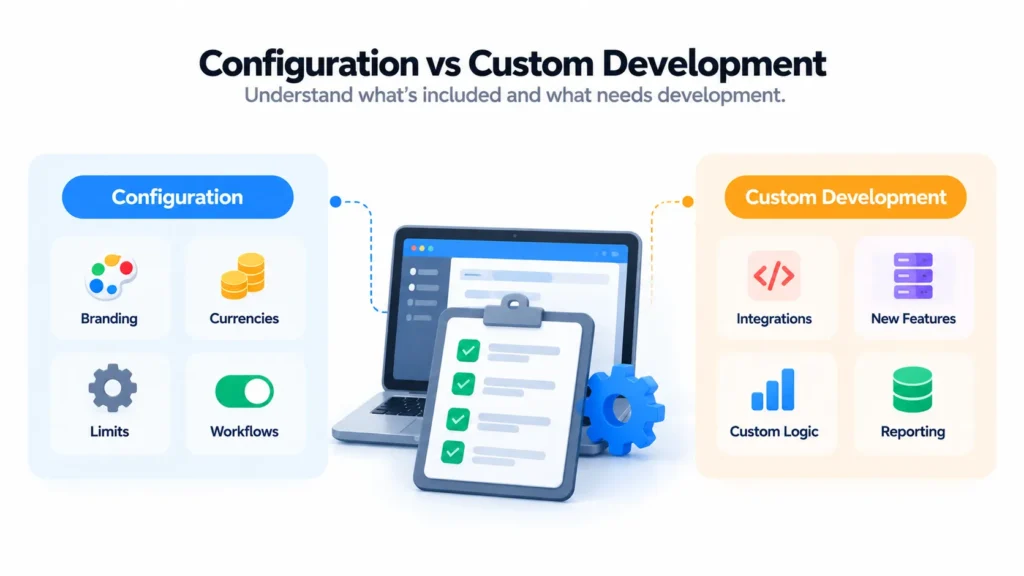
This distinction can significantly change the final cost.
Some changes may be configuration:
- brand colors
- logo
- enabled currencies
- transaction limits
- supported corridors
- operator-set fees
- selected workflows
Other requirements may involve deeper development:
- new payment providers
- unusual funds flows
- custom account types
- additional approval layers
- specialized business dashboards
- complex reconciliation rules
- country-specific data structures
- new financial products
- custom reporting systems
Before signing a proposal, founders should ask the provider to label requirements clearly as:
included
configurable
custom development
third-party responsibility
future scope
This prevents a low initial quote from turning into a succession of unexpected change requests.
Compare Source-Code and Licensing Terms
Platform price is not the same as platform ownership.
Before investing, check:
- Is the complete source code included?
- Is the code encrypted or restricted?
- Can another development team maintain it?
- Are there recurring licence charges?
- Are there per-user fees?
- Are there per-transfer vendor fees?
- Are modifications allowed?
- Are there deployment restrictions?
- Can the business self-host?
- Are repositories and documentation provided?
- What rights apply to future customization?
These questions matter because long-term fintech operations can require new partners, regulations, currencies, reports, corridors, and product modules.
A platform that is inexpensive initially but tightly restricted can become expensive later.
Include Infrastructure and Security in Total Cost of Ownership
Application development is only one layer of the investment.
Operating a financial product can also require:
- cloud infrastructure
- databases
- encrypted storage
- logging
- backups
- monitoring
- secure API handling
- credential management
- access controls
- security updates
- alerting
- incident-response processes
The goal is not simply to ask whether the platform is “secure.”
Ask how it protects and monitors:
- identities
- sessions
- API credentials
- administrative accounts
- transaction records
- financial integrations
- sensitive documents
- audit logs
Security should be treated as part of the financial architecture rather than an optional add-on.
Clarify What Support Actually Includes
“Post-launch support” can mean almost anything.
One provider may define support as bug fixing.
Another may include configuration assistance, deployment help, provider troubleshooting, updates, or infrastructure monitoring.
Before comparing proposals, ask whether support covers:
- application defects
- integration failures
- provider API changes
- security patches
- framework updates
- configuration
- deployment
- monitoring
- reporting issues
- performance problems
- new features
Also confirm the support period, response expectations, exclusions, and what happens after the included period ends.
A clear support model reduces ambiguity after the platform is already operating with real transactions.
Miracuves Wise-Like Cross-Border Payment Platform Solution Cost and Tech Stack
Miracuves Pricing for a Wise-Like Cross-Border Payment Platform developed in JavaScript For $12,999 USD (One-Time Price) in just 6 days
Get a fully developed, deployment-ready cross-border payment platform modeled around Wise-style international money transfers, multi-currency accounts, transparent fee handling, and global payout workflows. Built on a modern JavaScript foundation, this complete package includes everything you need to launch and scale:
Core Workflows: User registration, KYC verification, multi-currency account setup, international money transfers, recipient management, exchange rate display, transfer status tracking, payment history, beneficiary management, and customer notifications.
Built-in Revenue Logic: Transfer fees, foreign exchange margins, premium account plans, business account services, card-related fees, payout charges, API access fees, partner integrations, and platform service charges.
Management Hub: Centralized admin dashboard, user management, KYC review, transfer monitoring, currency controls, transaction records, beneficiary management, payment tracking, compliance logs, support handling, and financial analytics.
Launch-Ready: Fully prepared for your custom branding, configuration, payment gateway setup, KYC workflows, currency configuration, payout integrations, banking/API connections, and immediate market entry.
Why Is Wise-Like Platform Development More Affordable?
Most cross-border payment platforms become expensive when businesses choose fully custom development from scratch. Building separate workflows for users, KYC, multiple currencies, exchange rates, international transfers, beneficiaries, payouts, compliance, transaction monitoring, notifications, and admin controls can significantly increase cost, timeline, and technical complexity.
We took a smarter, more practical approach:
You Aren’t Paying for Ground-Up Development: Our cross-border payment platform engine is already developed, tested, and ready to deploy. You skip the inflated cost and long development cycles normally associated with building a complete international payments ecosystem from scratch.
The Power of JavaScript: We built this solution on a modern JavaScript architecture that supports interactive payment experiences, scalable transaction workflows, real-time status updates, API-driven financial integrations, multi-currency operations, and smooth administrative controls.
You get a launch-ready Wise-like cross-border payment platform with practical transfer, multi-currency, compliance, monetization, and management features, source code access, and faster deployment without the high custom development price tag.
Note: This cost is for the solution, re-branding, deployment, and source code only.
Model the First Corridor Before Buying More Scope
Founders can reduce both cost and execution risk by beginning with a clearly defined corridor.
Instead of trying to support dozens of countries immediately, model one route properly.
Document:
- sender country
- destination country
- currencies
- payment method
- payout method
- financial partners
- verification requirements
- transfer limits
- FX logic
- fees
- expected settlement
- liquidity requirements
- support process
- exception handling
Founders planning dedicated international-transfer products can also explore Miracuves’ remittance app solutions to understand the available product foundations for cross-border money movement.
This creates a useful baseline for evaluating software.
If the platform cannot support the first corridor clearly, a large feature list is irrelevant.
If it can, founders can then evaluate how easily the same architecture can support the next corridor.
For a deeper explanation of wallets, FX, remittance flows, and currency operations, see Miracuves’ multi-currency payment platform guide.
Founder Decision Signals
Corridor Readiness
If the provider cannot clearly explain how your first sender-to-recipient corridor will work, adding more currencies will not solve the underlying operating problem.
Ledger Reliability
If failed transfers, reversals, refunds, or pending balances are difficult to explain, review the financial-record architecture before investing.
Compliance Operations
If KYC is treated as the entire compliance layer, inspect transaction monitoring, risk review, permissions, audit logs, and escalation workflows.
Total Cost
If the quote excludes integrations, provider onboarding, infrastructure, maintenance, or corridor-specific work, compare total ownership cost rather than the initial software figure.
Mistakes Founders Should Avoid Before Investing
Choosing the Lowest Quote Without Comparing Scope
A lower software price may exclude applications, integrations, source code, deployment, compliance workflows, infrastructure, or post-launch support. Compare what is actually included before comparing totals.
Evaluating Only the Customer Interface
Attractive transfer screens reveal very little about ledger accuracy, reconciliation, failed transactions, risk review, reporting, or operational controls behind the product.
Assuming Software Automatically Provides Compliance
KYC, AML, sanctions, monitoring, and audit workflows can support a compliance program, but licensing, partner requirements, legal review, policies, and jurisdiction-specific obligations remain separate responsibilities.
Ignoring the Actual Funds Flow
Founders should understand where money enters, who holds it, where conversion occurs, which partner pays the recipient, and what happens when any stage fails.
Launching Too Many Corridors at Once
Every additional route can introduce new payout methods, data requirements, partners, fees, verification rules, liquidity needs, and customer-support complexity.
Leaving Third-Party Costs Out of the Budget
Identity verification, payment processing, screening, FX data, banking relationships, infrastructure, and other providers may charge separately from the platform vendor.
Build a Shortlist Using Evidence, Not Marketing Claims
Before choosing a platform, founders should request evidence for the workflows that matter.
Ask the provider to demonstrate:
- registration and verification
- recipient creation
- FX quote calculation
- fee calculation
- transfer initiation
- pending transfers
- failed transfers
- refunds or reversals
- compliance review
- administrative intervention
- reconciliation
- reporting
- audit logs
- role permissions
- external-provider failure handling
Then document which requirements are:
- already working
- configurable
- dependent on your credentials
- dependent on a financial partner
- custom development
- not included
This makes different proposals easier to compare fairly.
How Miracuves Helps Founders Move From Evaluation to a Working Platform
Once founders understand their target users, first transfer corridors, financial partners, risk requirements, integrations, and operational model, they can evaluate whether building every workflow from zero is necessary.
Businesses that require a broader custom implementation can explore Miracuves’ fintech app development services for payment, wallet, financial workflow, integration, and custom product requirements.
Miracuves provides a white-label cross-border payment platform designed around multi-currency wallets, international transfer workflows, administrative operations, and compliance-ready controls.
For applicable ready-made scopes, Miracuves supports a six-day standard solution deployment with source-code ownership. The actual regulated launch of a financial service can take longer because licensing, legal review, financial-partner onboarding, compliance providers, and corridor readiness sit outside software deployment.
Founders exploring products beyond remittance can also review Miracuves’ finance and investment app solutions for a wider view of ready-made financial product categories.
The practical advantage of a ready-made foundation is not simply speed.
It is the ability to begin with established payment workflows and spend more implementation effort on the parts specific to the business: corridors, financial partners, risk policies, branding, pricing logic, operational controls, and integrations.
Final Thoughts: Evaluate the Platform as a Complete Operating System
Choosing a cross-border payment platform requires more than comparing visible features or the initial software price. Founders need to understand how the platform manages financial records, FX calculations, failed and reversed transactions, compliance workflows, provider integrations, reconciliation, security, and day-to-day operational control.
The strongest option is the one that fits the planned transfer corridors, financial partners, compliance requirements, customer workflows, and expansion strategy without creating unnecessary operational complexity. A lower initial quote may not remain cost-efficient if essential integrations, infrastructure, support, or customization are excluded from the scope.
Before investing, founders should therefore compare the complete platform foundation and the total cost of operating it over time. This creates a more reliable basis for selecting technology that can support both the first launch and future cross-border payment growth.
If your team is comparing vendors rather than only product features, evaluate what a cross-border payment development partner should provide across source-code ownership, financial integrations, compliance workflows, deployment responsibilities, and post-launch support.
FAQs
What are the most important features to compare in a cross-border payment platform?
Start with wallet and ledger accuracy, FX-rate management, recipient workflows, transaction states, payment and payout integrations, KYC/KYB, AML, risk monitoring, reconciliation, administrative controls, reporting, audit logs, and role-based permissions.
What determines the cost of a cross-border payment platform?
Major cost drivers include platform coverage, currencies and corridors, wallet complexity, financial integrations, compliance workflows, customization, reporting, infrastructure, security requirements, deployment, maintenance, and third-party provider fees.
Why should founders evaluate corridors before buying software?
Each transfer corridor can involve different currencies, financial partners, recipient fields, settlement processes, fees, verification requirements, liquidity needs, and regulatory obligations. Defining the first corridor makes software evaluation much more concrete.
Does KYC functionality make a payment platform compliant?
No. Software can support KYC, KYB, AML, sanctions screening, monitoring, audit, and review workflows. Final compliance depends on jurisdiction, licensing, operating model, financial partners, legal review, policies, and implementation.
What hidden costs should founders check before investing?
Potential costs can include identity verification, sanctions screening, banking or payout partners, payment processing, FX data, liquidity, infrastructure, monitoring, maintenance, custom integrations, provider onboarding, and compliance operations.
Why is reconciliation important in a payment platform?
Reconciliation helps determine whether internal transaction records match external payment, banking, and payout records. Without it, failed or inconsistent settlements can become difficult to investigate and resolve.
Should founders choose a payment platform based on the number of supported currencies?
Not by itself. A platform may display many currencies without having complete payout, compliance, liquidity, and partner coverage for every corridor. Founders should evaluate the complete route from sender funding to recipient settlement.
What should founders ask during a platform demo?
Ask to see both successful and failed transfers, rate calculation, recipient validation, verification, refunds, manual review, transaction monitoring, administrative permissions, reconciliation, reporting, audit history, and external-provider failure handling.
Miracuves is an independent software development company. We are not affiliated with, connected to, sponsored by, or endorsed by any company or product named in this article.
Terms such as “X Clone” are used descriptively. It is how the software industry refers to building a platform with functionality comparable to a known service, and how clients search for it.
The entire design and codebase of our products is built by our own team. Our products contain no code, design, graphics, or content originating from any third-party website or applications.
All third-party names and marks referenced in this article are the property of their respective owners, referenced solely to identify the services discussed.