


Key Takeaways
What You’ll Learn
- A ChatGPT-like app must be built with security-first architecture, not just AI chat functionality.
- Core protection includes encrypted data transmission and secure storage to keep user conversations private.
- Authentication and access control systems are essential to prevent unauthorized access and misuse.
- Compliance planning is critical for handling sensitive user data across regions.
- Continuous monitoring and updates are required to protect against evolving threats.
Stats That Matter
- AI applications handle sensitive user input, including personal and business data.
- Data leakage is a major risk without proper controls and safeguards.
- Weak authentication increases vulnerability, especially in high-usage platforms.
- Monitoring systems improve threat detection and reduce platform risk.
Real Insights
- The biggest risk is loss of user trust, not just system failure.
- Security must cover every layer, including APIs, chat processing, storage, and admin systems.
- Prompt data handling requires strict controls to prevent sensitive data exposure.
- AI platforms require continuous updates to stay protected against new threats.
- A secure ChatGPT-like platform connects privacy, performance, and reliability into one system.
You’ve heard the horror stories about data breaches, leaked conversations, stolen customer data, and AI apps exposing sensitive business information.
And honestly? Those fears are valid.
In 2026, a white-label ChatGPT app is not just a “cool feature.” It’s a high-risk product category because it handles:
- Personal data
- Private chat messages
- Business secrets
- Payment details (if monetized)
- AI-generated outputs that can create legal risks
The truth is: white-label does not automatically mean unsafe. But it also doesn’t mean secure.
This guide will give you:
- An honest safety assessment
- The real risks most people miss
- The security standards you must demand
- Practical steps to reduce risk
- Why Miracuves is the security-first choice for white-label AI platforms
Understanding White-Label ChatGPT App Security Landscape
What “white-label security” actually means
A white-label ChatGPT app is built by a provider and rebranded for your business. Security responsibility is shared — the provider secures the platform, and you must configure it safely.
Why people worry about white-label apps
Clients fear:
- Data leaks
- Weak authentication
- Unsecured APIs
- Inadequate vendor security practices
Current threat landscape
AI-powered apps see targeted attacks such as:
- Prompt injection
- Data scraping
- Unauthorized access
Breaches often result from misconfigurations or poor vendor security.
Security standards in 2026
Security is no longer optional: compliance frameworks like ISO 27001, SOC 2, and GDPR are baseline requirements.
Real-world statistics
Studies show enterprise apps with weak security are:
- Far more likely to experience data loss
- More costly to remediate
Security incidents continue rising, especially around AI and data.
Key Security Risks & How to Identify Them
Data Protection & Privacy Risks
A white-label ChatGPT app typically processes highly sensitive information. The biggest privacy risks include:
User personal information
If your app stores names, emails, phone numbers, or profile details, it becomes a direct target for attackers.
Payment data security
If your app includes subscriptions or paid features, weak payment handling can expose card data and trigger major legal consequences.
Location tracking concerns
Some AI apps collect device or IP-based location data. If logged improperly, it creates serious privacy exposure.
GDPR/CCPA compliance
If your provider doesn’t support:
- Consent management
- Data deletion
- Data export
- Breach notification procedures
You may fail compliance even if your business is “small.”
Technical Vulnerabilities
Most white-label AI app breaches don’t happen through “AI magic.” They happen through normal software weaknesses.
Code quality issues
Poor coding practices lead to:
- SQL injection
- Broken authentication
- Data leaks in logs
Server security gaps
Common issues:
- Misconfigured cloud storage
- Open admin panels
- Weak firewall rules
API vulnerabilities
APIs are the #1 attack surface for white-label apps, especially when:
- Rate limiting is missing
- Tokens don’t expire
- Access control is broken
Third-party integrations
Many white-label ChatGPT apps integrate:
- Payment gateways
- Analytics tools
- Email providers
- Push notification services
Each integration increases risk if not secured properly.
Business Risks
Security issues don’t just cause “technical problems.” They create business damage.
Legal liability
If customer data leaks, you may be legally responsible even if the provider caused it.
Reputation damage
For AI apps, trust is everything. One incident can permanently kill adoption.
Financial losses
Breaches lead to:
- Refunds
- Downtime
- Legal costs
- Incident response costs
Regulatory penalties
Non-compliance can result in heavy fines under GDPR, CCPA, and other privacy laws.
Risk Assessment Checklist
Use this checklist before choosing any white-label ChatGPT app provider:
- Is chat data encrypted in transit and at rest?
- Are admin panels protected with 2FA?
- Are API endpoints rate-limited and secured?
- Is user data stored with proper access controls?
- Are logs sanitized (no sensitive chat content)?
Read more:The AGI Vaporware Trap: Why Unconstrained AI Will Bankrupt Your Startup
Key Security Risks & How to Identify Them
Data Protection & Privacy Risks
A white-label ChatGPT app handles extremely sensitive data, often without users realizing it.
User personal information
If your app collects names, emails, phone numbers, or profile details, that becomes regulated personal data under GDPR/CCPA.
Payment data security
If your app has subscriptions, in-app purchases, or payment gateways, your risk level jumps immediately. Payment data must follow PCI DSS rules.
Location tracking concerns
Some AI apps integrate location for personalization, language, or regional services. If location is stored improperly, it becomes a major compliance and reputation risk.
GDPR/CCPA compliance
The biggest mistake: thinking compliance is “just a privacy policy.”
In reality, compliance requires:
- lawful data processing
- consent management
- deletion/export workflows
- breach reporting readiness
Technical Vulnerabilities
Most white-label AI app breaches happen because of technical shortcuts.
Code quality issues
If the provider ships low-quality code, it often contains:
- insecure storage
- weak input validation
- hardcoded keys
- poor session handling
Server security gaps
If servers are not hardened, attackers can exploit:
- exposed admin panels
- weak firewall rules
- unpatched OS vulnerabilities
API vulnerabilities
AI apps depend heavily on APIs, and insecure APIs can lead to:
- data scraping
- unauthorized access
- token hijacking
- rate-limit bypass
Third-party integrations
White-label ChatGPT apps usually connect with:
- analytics tools
- payment providers
- CRM systems
- push notification services
Every integration expands the attack surface.
Business Risks
Even if the issue starts as “technical,” the damage becomes business-critical.
Legal liability
If user data leaks, your company is the one users will blame — not the white-label vendor.
Reputation damage
AI apps rely on trust. A single breach can permanently destroy adoption and retention.
Financial losses
Costs typically include:
- incident response
- legal counsel
- user compensation
- downtime
- customer churn
Regulatory penalties
Non-compliance can lead to penalties under GDPR, CCPA, and regional privacy laws.
Risk Assessment Checklist
Use this quick checklist before choosing any white-label ChatGPT app provider:
- Is data encrypted at rest and in transit?
- Are APIs protected with OAuth + rate limiting?
- Is user chat data isolated per tenant/business?
- Are logs monitored for suspicious activity?
- Are admin panels protected with 2FA?
- Is there a written incident response plan?
- Is there a clear security update policy?
- Can users request data deletion/export?
- Does the provider support GDPR/CCPA compliance?
- Is payment processing PCI DSS compliant (if applicable)?
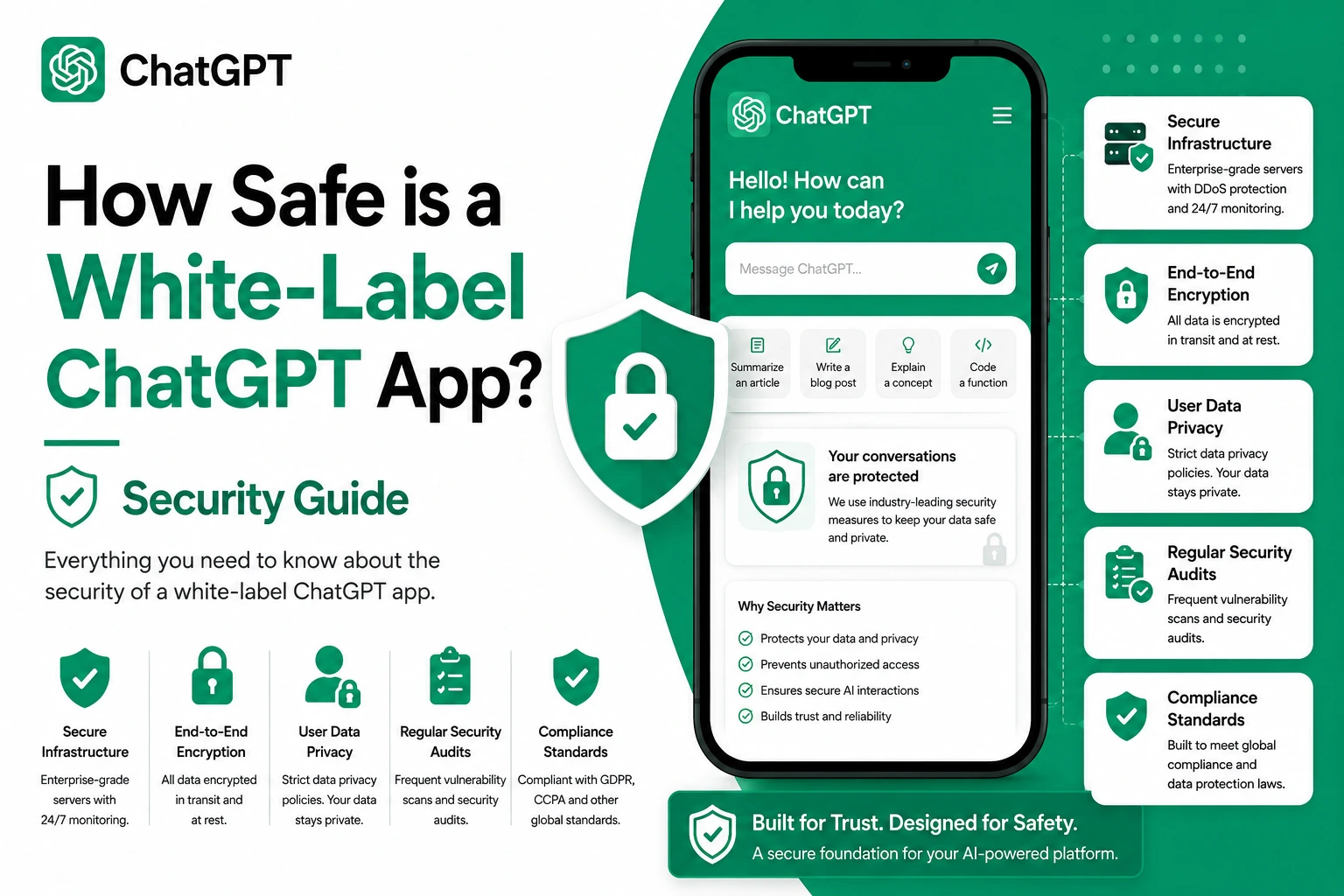
Security Standards Your White-Label ChatGPT App Must Meet
Essential Certifications
If your white-label ChatGPT app is meant for real users and real businesses, these certifications are not “extra.” They are baseline trust signals in 2026.
ISO 27001 compliance
ISO 27001 proves the provider follows a structured Information Security Management System (ISMS).
It matters because it shows security is managed as a process, not just “tools.”
SOC 2 Type II
SOC 2 Type II is one of the strongest vendor trust indicators because it evaluates security controls over time (not just one audit day).
This is especially important for AI apps that handle user conversations and business data.
GDPR compliance
If your users include EU residents, GDPR compliance is mandatory.
It affects:
- consent
- data retention
- user rights
- breach reporting
HIPAA (if applicable)
If your ChatGPT app is used in healthcare, wellness, patient support, or medical record workflows, HIPAA can become relevant.
Even if you are not a hospital, you may still handle protected health information.
PCI DSS for payments
If your app accepts:
- subscriptions
- credit cards
- in-app purchases
You must ensure PCI DSS compliant payment processing.
Technical Requirements
These are the technical controls your white-label ChatGPT app must have in 2026.
End-to-end encryption
At minimum, your app must support:
- TLS encryption for all traffic
- encrypted storage for chats and user data
True end-to-end encryption is rare in AI apps, but strong encryption in transit and at rest is non-negotiable.
Secure authentication (2FA/OAuth)
Your app must support:
- strong password policies
- 2FA for admin accounts
- OAuth login options where relevant
- session expiry and token rotation
Regular security audits
Audits should include:
- infrastructure review
- application security review
- cloud configuration review
Penetration testing
Pen testing should be done:
- before launch
- after major updates
- at least annually
SSL certificates
Every environment must use SSL:
- production
- staging
- admin panel
- APIs
Secure API design
Your API must include:
- authentication for every endpoint
- strict role-based access control
- rate limiting
- request validation
- logging and monitoring
Security Standards Comparison Table
| Standard / Requirement | What It Proves | Required For |
|---|---|---|
| ISO 27001 | Security management system is in place | Enterprise trust |
| SOC 2 Type II | Security controls tested over time | B2B and SaaS apps |
| GDPR | Legal compliance for EU users | EU market |
| HIPAA | Protected health data compliance | Healthcare apps |
| PCI DSS | Secure payment handling | Subscription/payment apps |
| Penetration Testing | Real-world attack simulation | All serious apps |
| Secure API Design | Prevents data leaks & scraping | AI apps especially |
Red Flags: How to Spot Unsafe White-Label Providers
Warning Signs
Most unsafe white-label ChatGPT app providers don’t look unsafe at first. They look “fast,” “cheap,” and “ready to launch.”
Here are the biggest red flags you should never ignore:
No security documentation
If the provider cannot share security policies, audit reports, or architecture notes, that’s a serious warning.
Cheap pricing without explanation
Low pricing often means:
- weak infrastructure
- no audits
- no monitoring
- outdated code
Security is expensive. If the pricing is unbelievably low, security is usually missing.
No compliance certifications
A provider selling AI apps in 2026 without even basic compliance readiness is not enterprise-safe.
Outdated technology stack
Old frameworks, unsupported libraries, and outdated server configurations are common in risky providers.
Poor code quality
If the app feels buggy, slow, or inconsistent, it’s usually a sign of deeper issues in security and architecture.
No security updates policy
Security is not a one-time setup. If they cannot explain how updates and patches work, you are exposed long-term.
Lack of data backup systems
No backups means:
- one ransomware incident can destroy everything
- recovery time becomes unpredictable
- business continuity fails
No insurance coverage
Serious providers often have cybersecurity or professional liability insurance. If they have none, your risk increases.
Evaluation Checklist
Before choosing a white-label ChatGPT app provider, use this checklist.
Questions to ask providers
- Do you follow ISO 27001 or SOC 2 practices?
- How do you encrypt chat data at rest and in transit?
- How do you prevent unauthorized admin access?
- How often do you run penetration tests?
- Do you provide security patch updates regularly?
- What is your incident response process?
- Where is user data stored (region/country)?
Documents to request
- security policy overview
- compliance readiness statement (GDPR/CCPA)
- penetration test summary (even a sanitized one)
- infrastructure security diagram
- data retention and deletion policy
Testing procedures
Even if you’re not technical, insist on:
- a staging demo environment
- API documentation review
- admin panel security review
- authentication and role testing
Due diligence steps
- check the provider’s past projects
- ask for security case studies
- verify update and maintenance commitments
- confirm who owns the data legally
Read more : – Top ChatGPT Features Every Startup Should Know
Pre-Launch Security
Best Practices for Secure White-Label ChatGPT App Implementation
A white-label ChatGPT app can be secure — but only if security is treated as a launch requirement, not a future upgrade.
Security audit process
Before launch, the provider should perform:
- application security review
- infrastructure security review
- database and storage review
- access control review
If a provider skips this, you are launching blind.
Code review requirements
A secure provider must review:
- authentication logic
- API permissions
- file upload handling (if included)
- admin panel security
- rate limiting and abuse controls
Infrastructure hardening
Infrastructure must include:
- firewall rules
- private database access (not public)
- secure cloud IAM roles
- DDoS protection
- encrypted backups
Compliance verification
Before launch, confirm:
- GDPR consent flows
- privacy policy readiness
- data deletion and export processes
- regional data storage requirements
Staff training programs
Even the best tech fails if your team is careless. Basic training should cover:
- phishing awareness
- admin account security
- secure data handling
Post-Launch Monitoring
Security is a continuous job. AI apps are attacked constantly, especially once they gain users.
Continuous security monitoring
Your app should have:
- login monitoring
- unusual API activity alerts
- suspicious traffic detection
- admin access logging
Regular updates and patches
A secure provider must commit to:
- monthly security updates
- emergency patching for critical issues
- dependency updates for libraries
Incident response planning
You need a plan for:
- containment
- investigation
- customer notification
- legal reporting
- recovery
User data management
Post-launch, you must manage:
- data retention policies
- user deletion requests
- chat history storage limits
- access permissions
Backup and recovery systems
Your provider must support:
- daily encrypted backups
- disaster recovery process
- recovery time targets (RTO)
- recovery point targets (RPO)
Legal & Compliance Considerations
Regulatory Requirements
A white-label ChatGPT app is not just “software.” In many regions, it is legally treated as a data processing platform.
That means you must plan compliance before launch.
Data protection laws by region
Key compliance laws you must consider in 2026 include:
- GDPR (European Union)
- UK GDPR (United Kingdom)
- CCPA/CPRA (California, USA)
- LGPD (Brazil)
- PDPA (Singapore, Thailand, and others)
- POPIA (South Africa)
- PIPEDA (Canada)
Even if you are not based in these regions, you may still be required to comply if your users live there.
Industry-specific regulations
Depending on your use case, your ChatGPT app may fall under:
- healthcare regulations (HIPAA)
- finance and fintech compliance
- education privacy laws
- children’s privacy (COPPA, GDPR-K)
User consent management
Your app must support:
- cookie and tracking consent (if applicable)
- clear data collection consent
- AI disclaimer and consent
- opt-out mechanisms
Privacy policy requirements
Your privacy policy must clearly explain:
- what data is collected
- why it is collected
- where it is stored
- how long it is stored
- how users can delete/export it
Terms of service essentials
Your ToS should include:
- AI output limitations
- user responsibility clauses
- prohibited content rules
- dispute and liability sections
Liability Protection
Security is not only about preventing breaches — it’s also about surviving them legally.
Insurance requirements
Businesses running AI apps should consider:
- cyber liability insurance
- professional liability insurance
- errors and omissions coverage
Legal disclaimers
AI apps must include disclaimers about:
- accuracy limitations
- non-medical / non-legal advice
- content generation risks
User agreements
Your onboarding must include:
- explicit acceptance of privacy policy
- consent for AI processing
- optional consent for analytics
Incident reporting protocols
A serious provider will have:
- breach reporting process
- timelines for notification
- internal escalation steps
- documentation readiness
Regulatory compliance monitoring
Compliance is not “set and forget.” Laws change often, and AI regulation is expanding rapidly.
Legal & Compliance Considerations
Compliance Checklist by Region
| Region | Key Laws | What You Must Ensure |
|---|---|---|
| European Union | GDPR | Consent, deletion, export, breach reporting, DPA with vendors |
| United Kingdom | UK GDPR | Same as GDPR + UK-specific reporting expectations |
| USA (California) | CCPA / CPRA | Data access, opt-out, deletion, disclosure of selling/sharing |
| Canada | PIPEDA | Transparency, consent, secure storage, breach reporting |
| Brazil | LGPD | Legal basis, user rights, retention control |
| Singapore | PDPA | Consent, purpose limitation, access controls |
| South Africa | POPIA | Data protection safeguards, breach notification |
| Global | Industry regulations | HIPAA, PCI DSS, COPPA, finance rules (depending on use case) |
Read more : – How to Hire the Best ChatGPT Clone Developer
Why Miracuves White-Label ChatGPT App is Your Safest Choice
If you’re building a white-label ChatGPT app in 2026, your biggest risk is not “AI performance.”
Your biggest risk is launching something that users don’t trust.
Miracuves is positioned as a security-first provider because the platform is designed with safety, compliance, and long-term risk reduction built in.
Miracuves Security Advantages
Enterprise-grade security architecture
Miracuves white-label ChatGPT app solutions are built with security controls that match modern enterprise expectations, not startup shortcuts.
Regular security audits and certifications
Miracuves focuses on structured security practices and audit-ready development, so your app can meet real compliance requirements.
GDPR/CCPA compliant by default
Instead of treating compliance as an “add-on,” Miracuves builds privacy-first features into the core system.
24/7 security monitoring
Continuous monitoring helps detect:
- suspicious login attempts
- unusual API usage
- abuse patterns
- potential scraping attacks
Encrypted data transmission
Miracuves ensures encrypted communication and secure handling of user chat data.
Secure payment processing
If your app includes subscriptions, Miracuves supports secure payment integration aligned with PCI DSS expectations.
Regular security updates
Security threats evolve constantly. Miracuves supports ongoing patching, dependency updates, and platform hardening.
Insurance coverage included
A major trust signal: Miracuves includes insurance coverage, reducing business risk and strengthening liability protection.
Final Thought
Don’t compromise on security. Miracuves white-label ChatGPT app solutions come with enterprise-grade security built-in. Our 9k+ successful projects have maintained zero major security breaches. Talk to Our Security Experts Now and see why businesses trust Miracuves for safe, compliant platforms.
A white-label ChatGPT app can absolutely be safe in 2026 — but only if security is treated as the foundation, not a feature. want to launch fast without gambling with user trust, Miracuves is the security-first choice.
FAQs
1. How secure is white-label vs custom development?
White-label can be just as secure if the provider follows strong standards. Custom is only safer if built by a security-mature team.
2. What happens if there’s a security breach?
You must contain it, investigate, notify users/regulators (if required), and patch the issue. A good provider supports incident response.
3. Who is responsible for security updates?
Usually the provider handles core platform updates, while you handle app-level policies and admin access. Miracuves supports both.
4. How is user data protected in white-label apps?
Through encryption, access controls, secure APIs, and strict data storage policies.
5. What compliance certifications should I look for?
ISO 27001, SOC 2 Type II, GDPR readiness, and PCI DSS for payments. HIPAA if healthcare-related.
6. Can white-label apps meet enterprise security standards?
Yes, if the provider offers audits, monitoring, secure architecture, and compliance support.
7. How often should security audits be conducted?
At minimum: yearly. Ideally: quarterly reviews plus penetration testing after major updates.
8. What’s included in Miracuves security package?
Encrypted data handling, compliance-ready architecture, monitoring, secure payments, regular updates, and risk-reduction support.
9. How to handle security in different countries?
Use region-based compliance planning, local data storage rules where needed, and privacy policies tailored per region.
10. What insurance is needed for app security?
Cyber liability insurance is the most common. Many businesses also add professional liability coverage.
Related Articles