

Key Takeaways
- Copy.ai’s revenue model is built around AI-powered content generation, workflow automation, paid subscriptions, and enterprise AI solutions.
- Its main revenue stream comes from recurring subscription plans for individuals, marketers, sales teams, agencies, and growing businesses.
- Enterprise plans add higher-value revenue through team seats, workflow automation, brand controls, integrations, security, and custom AI support.
- Copy.ai shows how AI SaaS companies can grow by combining self-serve tools, usage-based value, automation workflows, and business productivity outcomes.
- For founders, the biggest lesson is clear: AI tools monetize better when they solve repeat business workflows, not just one-time content generation needs.
Revenue Signals
- Subscription plans create predictable monthly and annual recurring revenue from users who need consistent AI writing and automation support.
- Team-based pricing helps increase revenue as businesses add more users, workflows, projects, and collaboration needs.
- Enterprise accounts generate stronger revenue through advanced security, onboarding, workflow customization, admin controls, and priority support.
- Workflow automation expands monetization by moving Copy.ai beyond content creation into sales, marketing, prospecting, and operational productivity.
- Integrations with CRMs, marketing platforms, and business tools increase retention because Copy.ai becomes part of daily work processes.
Real Insights
- Copy.ai is not only an AI writing tool; it is evolving into an AI workflow platform for revenue, marketing, and business teams.
- The strongest monetization happens when users depend on the platform for repeated tasks like outreach, campaign content, product messaging, and sales enablement.
- AI SaaS businesses can increase lifetime value by offering templates, brand voice controls, automation workflows, analytics, and team collaboration.
- Founders can learn from Copy.ai by building AI products around real business use cases instead of generic prompt-based features.
- The future of AI revenue models will depend on workflow depth, personalization, usage expansion, integrations, enterprise trust, and measurable productivity gains.
In 2026, Copy.ai is no longer just an AI writing tool — it’s a full-scale AI-powered revenue engine for marketing teams, startups, and global enterprises.
The platform is estimated to be generating $25–30 million annually, fueled by recurring SaaS subscriptions and fast-growing enterprise automation contracts.
For founders, Copy.ai’s business model offers a blueprint for how AI platforms can move beyond simple tools into scalable, high-margin SaaS ecosystems.
Copy.ai Revenue Overview – The Big Picture
2026 Estimated Revenue: $25–30 million
Valuation (Private Market Estimates): $300–400 million range
Year-over-Year Growth: ~40–55% (driven by enterprise AI workflow adoption)
Revenue by Region:
- North America: ~52%
- Europe: ~28%
- Asia-Pacific & Others: ~20%
Profit Margins:
Gross margins estimated between 70–80%, typical of mature AI SaaS platforms with optimized cloud infrastructure and enterprise contracts.
Competition Benchmark:
Compared to competitors like Jasper and Writesonic, Copy.ai stands out for its AI workflow automation layer, not just content generation, which increases enterprise contract sizes and long-term retention.
Read More: What Is Copy.ai? Inside the GTM AI Platform for Sales and Marketing Teams
Primary Revenue Streams Deep Dive
Revenue Stream #1: SaaS Subscriptions
How it Works: Monthly and annual plans for individuals, teams, and businesses.
Pricing Range (2026): $49–$249 per user/month
Revenue Share: ~45%
Why It Works: Recurring revenue ensures predictable cash flow and high LTV (Lifetime Value).
Revenue Stream #2: Enterprise AI Workflow Licensing
How it Works: Custom AI automations for sales, marketing, and internal content pipelines.
Contract Size: $10,000–$250,000+ annually
Revenue Share: ~30%
Why It Works: High-margin, long-term contracts with strong retention.
Revenue Stream #3: API Access & Usage-Based Billing
How it Works: Businesses integrate Copy.ai’s AI into CRMs, CMS platforms, and marketing stacks.
Pricing: Pay-per-token or usage tiers
Revenue Share: ~10%
Why It Works: Scales automatically as customers grow.
Revenue Stream #4: Team & Collaboration Plans
How it Works: Seat-based pricing for agencies and distributed marketing teams.
Revenue Share: ~8%
Why It Works: Expands revenue inside the same customer account.
Revenue Stream #5: Training, Onboarding & Custom AI Models
How it Works: Premium onboarding, private model training, and compliance customization.
Revenue Share: ~7%
Why It Works: High-margin professional services layered on SaaS.
Revenue Streams Percentage Breakdown
| Revenue Stream | % Share (2026) | Primary Customers | Monetization Style |
|---|---|---|---|
| Subscriptions | 45% | Individuals & SMBs | Monthly/Annual Plans |
| Enterprise Licensing | 30% | Enterprises | Annual Contracts |
| API & Usage Billing | 10% | Tech Companies | Pay-as-you-go |
| Team Plans | 8% | Agencies | Per-seat Pricing |
| Training & Custom AI | 7% | Regulated Firms | Project-Based |
The Fee Structure Explained
User-Side Fees:
- Monthly SaaS plans
- Per-seat team upgrades
- API usage credits
Provider-Side Fees:
- Cloud AI compute costs
- Model hosting infrastructure
- Security & compliance frameworks
Hidden Revenue Layers:
- Premium feature unlocks
- Workflow automation add-ons
- Data privacy and compliance packages
Regional Pricing Variation:
- North America: Full price
- Europe: VAT-inclusive pricing
- Asia: Discounted pricing tiers for market expansion
Complete Fee Structure by User Type
| User Type | Pricing Model | Average Annual Spend | Key Revenue Driver |
|---|---|---|---|
| Solo Creators | Subscription | $500–$1,200 | Monthly Renewals |
| SMB Teams | Per-Seat SaaS | $2,000–$6,000 | Team Expansion |
| Enterprises | Licensing | $25,000–$250,000+ | Long-Term Contracts |
| Developers | Usage-Based | Variable | API Calls |
How Copy.ai Maximizes Revenue Per User
Segmentation: Users are grouped by role — creators, agencies, sales teams, and enterprises.
Upselling: Free users are guided into paid workflows and automation features.
Cross-Selling: Teams upgrade to enterprise compliance and API integration.
Dynamic Pricing: Seat-based expansion as teams grow.
Retention Monetization: Workflow lock-in makes switching costly.
LTV Optimization: Annual contracts with discounts boost cash flow.
Psychological Pricing: “Most Popular” plan anchors conversion.
Real Example:
A 10-person sales team paying $99 per user per month generates nearly $12,000 annually — before automation or enterprise upgrades.
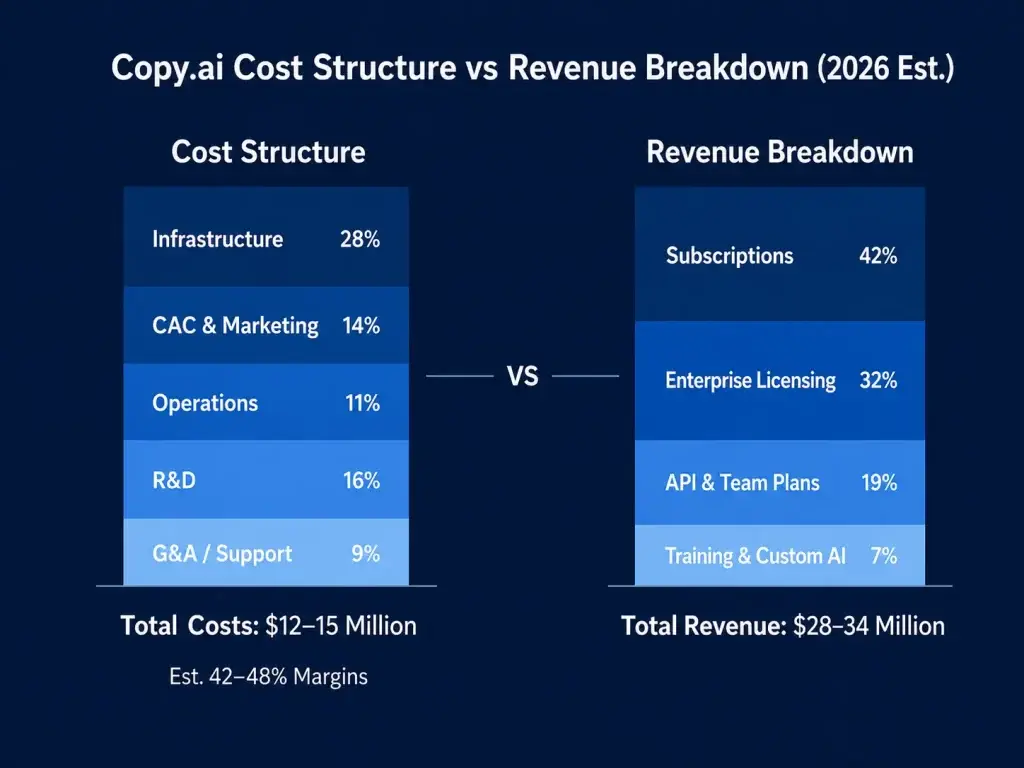
Cost Structure & Profit Margins
Infrastructure Costs:
AI compute, cloud hosting, and data storage (~25–30% of revenue).
Customer Acquisition Cost (CAC):
SEO, partnerships, and outbound sales (~15–20%).
Operations:
Support teams, compliance, and billing (~10%).
R&D:
Model fine-tuning, AI workflow tools, and platform upgrades (~15%).
Unit Economics:
High gross margins allow reinvestment into growth without external funding pressure.
Profitability Path:
Enterprise contracts push the company toward consistent operating profitability.
Future Revenue Opportunities & Innovations
New Streams:
- AI-powered CRM automation tools
- Voice-to-content AI platforms
- Internal enterprise knowledge bots
AI/ML-Based Monetization:
Private AI models trained on company data for regulated industries.
Market Expansion:
Localized AI platforms for Asia, Middle East, and LATAM.
Predicted Trends (2025–2027):
- AI agents replacing manual sales workflows
- Compliance-first AI platforms for finance and healthcare
- Vertical-specific AI SaaS products
Risks & Threats:
- Open-source AI competition
- Price wars among AI SaaS tools
- Regulatory compliance costs
Opportunities for Founders:
Niche AI platforms for legal, healthcare, real estate, and logistics.
Lessons for Entrepreneurs & Your Opportunity
What Works:
Recurring subscriptions + enterprise licensing create stable, scalable revenue.
What to Replicate:
AI workflows instead of just content generation.
Market Gaps:
Industry-specific AI platforms with built-in compliance and reporting.
Founder Advantage:
Most competitors still focus on tools — not business automation systems.
Miracuves Copy.ai-Like Platform Solution Cost and Tech Stack
Miracuves Pricing for a Copy.ai-Like AI Writing and Workflow Automation Platform developed using JavaScript architecture is available on request. Final pricing depends on AI writing modules, workflow automation features, team collaboration tools, subscription logic, AI model/API usage, scalability needs, and deployment scope. Estimated delivery timeline: 30 to 90 days.
Get a fully developed, custom AI content and productivity platform modeled after Copy.ai. Built on a modern JavaScript foundation, this solution can be customized for SaaS founders, marketing teams, agencies, startups, sales teams, content creators, and businesses planning to launch an AI writing platform.
- Core Workflows: AI content generation, blog writing, ad copy creation, email drafting, product description writing, prompt-based workflows, template libraries, document editing, and content history.
- Built-in Revenue Logic: Subscription plans, usage-based AI credits, team pricing, premium templates, workflow automation plans, enterprise packages, API access, and white-label SaaS monetization.
- Management Hub: Admin dashboard, user management, AI usage tracking, prompt logs, subscription control, template management, workspace controls, billing records, and analytics.
- AI Writing-Ready Architecture: Prepared for LLM integration, content generation workflows, prompt libraries, team workspaces, usage limits, payment gateway setup, scalable AI requests, and long-term SaaS growth.
Why Does a Copy.ai-Like Platform Require JavaScript Architecture?
A Copy.ai-like platform needs more than a basic AI writing tool. It handles prompts, AI-generated content, user workspaces, templates, subscriptions, usage limits, team collaboration, billing logic, and real-time productivity workflows. A modern JavaScript architecture helps manage these interactive AI operations smoothly across users, teams, admins, and AI systems.
We recommend JavaScript architecture for this type of platform because:
- Built for Interactive AI Workflows: JavaScript supports fast prompt submission, AI response handling, live content editing, workflow automation, document previews, and real-time dashboard updates.
- Advanced Frontend Experience: React.js or other JavaScript frameworks can power smooth writing editors, template libraries, workspace dashboards, content history, automation panels, and admin controls.
- Scalable Backend Logic: JavaScript-based backend systems can manage AI API calls, user permissions, token usage, subscription limits, team workspaces, saved outputs, and high-volume AI requests.
- Flexible Integration Layer: The platform can connect with LLM APIs, payment gateways, CRM tools, email platforms, cloud storage, analytics systems, content moderation tools, and enterprise authentication systems.
You get a scalable AI writing and workflow automation platform designed for content production, team productivity, recurring revenue, and long-term product growth.
Note: Final pricing depends on selected AI model/API, writing modules, workflow automation features, usage limits, team collaboration needs, deployment infrastructure, and custom feature development.
Final Thought
Copy.ai’s journey shows how AI tools become powerful businesses when paired with automation and enterprise value.
The real revenue isn’t in writing content — it’s in running business systems.
For founders, this model offers a roadmap to building high-margin, globally scalable AI platforms.
FAQs
1) How much does Copy.ai make per transaction?
Copy.ai primarily earns through subscriptions and contracts, not per-transaction fees.
2) What’s Copy.ai’s most profitable revenue stream?
Enterprise AI workflow licensing delivers the highest margins.
3) How does Copy.ai’s pricing compare to competitors?
It’s priced slightly higher due to automation and enterprise features.
4) What percentage does Copy.ai take from providers?
There’s no provider marketplace — revenue comes directly from users.
5) How has Copy.ai’s revenue model evolved?
It shifted from simple subscriptions to enterprise automation licensing.
6) Can small platforms use similar models?
Yes, by targeting niche industries with AI automation tools.
7) What’s the minimum scale for profitability?
Around 500–1,000 paying users or a handful of enterprise contracts.
8) How to implement similar revenue models?
Combine SaaS subscriptions with API usage and enterprise licensing.
9) What are alternatives to Copy.ai’s model?
Freemium AI platforms, ad-supported tools, or transaction-based APIs.
Miracuves is an independent software development company. We are not affiliated with, connected to, sponsored by, or endorsed by any company or product named in this article.
Terms such as “X Clone” are used descriptively. It is how the software industry refers to building a platform with functionality comparable to a known service, and how clients search for it.
The entire design and codebase of our products is built by our own team. Our products contain no code, design, graphics, or content originating from any third-party website or applications.
All third-party names and marks referenced in this article are the property of their respective owners, referenced solely to identify the services discussed.